EU and US Compliance Checklist for Teeth Whitening Kits: Navigating Regulatory Questions
There is no single certificate that clears a teeth whitening kit for both the EU and the US. Compliance is decided by classification first. The same whitening kit can be handled as a cosmetic in one market and as a medical device in another, and each route carries different paperwork, labelling duties and registration steps. This checklist walks through the questions importers actually ask — FDA approval, MDR registration, MoCRA registration, CE marking — and shows which documents belong to which route.
Problem Definition: Why Four Simple Questions Block So Many Purchase Orders
Most first-order compliance emails contain the same four lines:
- Is this whitening kit FDA approved?
- Do we need MDR registration for the EU?
- Does MoCRA apply to teeth whitening strips?
- Can you send CE certification?
They look like a checklist. In practice, each question is shorthand for a harder one: what is this product, legally, in the market where it will be sold? A whitening strip positioned as removing surface stains sits in the cosmetic lane in the United States. A whitening light marketed to treat a dental condition can fall into the medical device lane. When the classification is wrong, the documents are wrong too, and the buyer discovers it at the port, at the customs broker, or when a marketplace asks for the notification number.
Three failure patterns repeat across oral care sourcing:
- Certificate substitution. A supplier sends an ISO 22716 certificate when the buyer asked for a CPNP notification, or sends a CE document when the product is a cosmetic and is not CE marked at all.
- Scope mismatch. The certificate exists, but its certified scope line does not cover the product family being imported.
- Missing local entity. Cosmetic and device routes in both regions rely on a responsible party inside the jurisdiction. Without it, relabelling or shipment delays usually follow.
None of these problems is solved by adding the words “FDA approved” to a spec sheet. They are solved by asking for the right document for the right route, in writing, before tooling or artwork is finalised.
Industry Background: Why Regulators Are Asking More Questions
Teeth whitening has moved from a clinic procedure to a shelf product. The global teeth whitening market was valued at USD 8.93 billion in 2025 and is projected to reach USD 14.31 billion by 2034, according to Fortune Business Insights. At-home formats carry most of that value: the individual and at-home segment accounted for 68.67% of the teeth whitening market in 2024, based on Straits Research data. Regional leadership depends on how each research house defines the category — one secondary compilation places Asia Pacific at 33.80% of the 2025 market, while other research houses rank North America first when professional dental services are included in the total.
Two regulatory signals matter most for buyers sourcing whitening products from Asia:
- EU concentration rules. Teeth whitening products containing between 0.1% and 6% hydrogen peroxide in the EU require a first treatment by a dentist, under Directive 2011/84/EU. This is a formulation-driven requirement, not a marketing preference.
- US standards alignment. The US FDA recognises ISO 28399:2021 as a consensus standard for external tooth bleaching products.
Customs classification adds a third signal. A US Customs and Border Protection ruling (NY N342147) applies GRI 3(b) to teeth whitening strips imported from China and identifies the whitening strip as the essential character of the set, classifying the goods under subheading 3306.90.0000. Importers who treat the strip as a generic dental accessory risk a different duty outcome.
Formulation trends interact with all of this. Demand for PAP+ (phthalimidoperoxycaproic acid) peroxide-free whitening systems continues to grow as an alternative to traditional peroxide, mainly because of sensitivity concerns — and a peroxide-free formula does not automatically inherit the same regulatory treatment as a peroxide formula, so classification has to be re-checked whenever the formulation changes.
The Compliance Checklist: Six Documents to Request Before You Quote
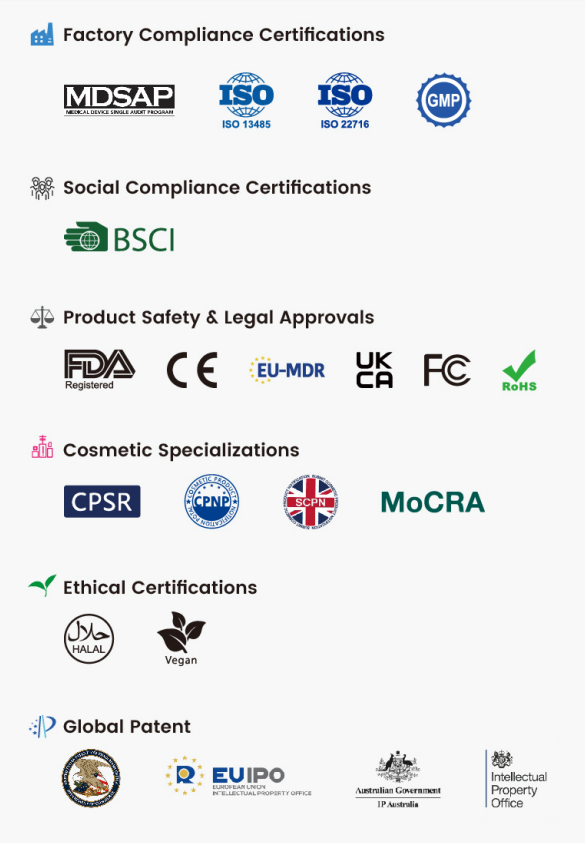
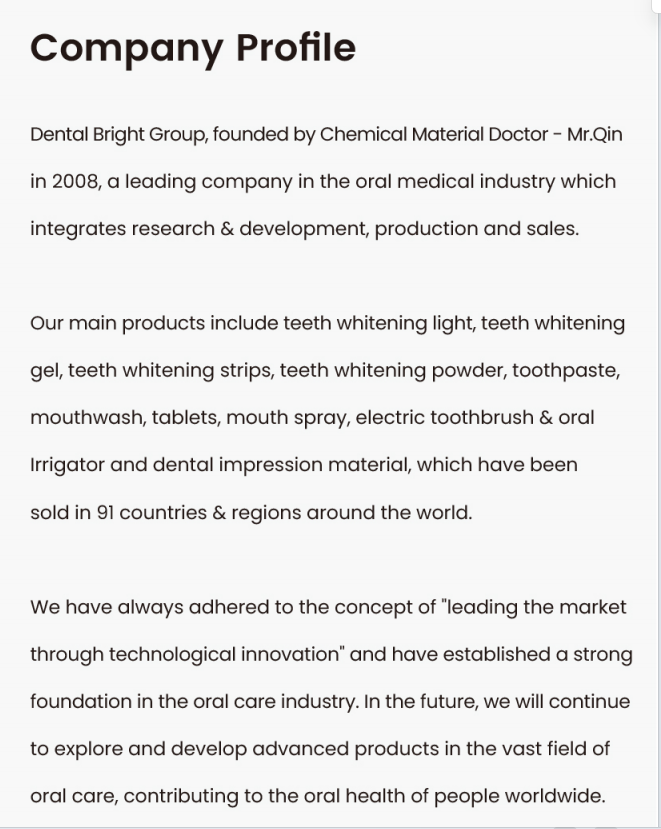
Jiangxi Dentalbright Technology Co., Ltd., which trades as GlorySmile Factory (www.glorysmile.com), is an oral care manufacturer producing teeth whitening kits, whitening strips, whitening pens, whitening gel, whitening light devices, toothpaste, mouthwash, tooth whitening powder and electric toothbrushes. Its compliance file is a useful reference structure, because it separates factory-level certification from product-level registration instead of collapsing both into one word.
1. A written classification statement: cosmetic or medical device
Ask the supplier to state, in writing, how the specific SKU is classified in each destination market and why. Intended use, claims on the artwork, formulation concentration and whether an electronic light component is marketed for a therapeutic purpose all feed into that decision. A generic catalogue line such as “FDA and CE certified” is not a classification statement.
The practical consequences differ by route. In the EU, the cosmetic route requires a Cosmetic Product Safety Report (CPSR), a Product Information File (PIF), CPNP notification and an appointed EU Responsible Person; products placed on the market as medical devices instead follow the MDR route. In the US, a cosmetic product is not “approved” by the FDA. The applicable mechanism is MoCRA-compliant cosmetic facility registration and product listing, which requires a US Agent and completion of product formulation filing on the FDA website. Products regulated as medical devices instead go through FDA medical device establishment registration and device listing.
2. The quality management certificates behind the product
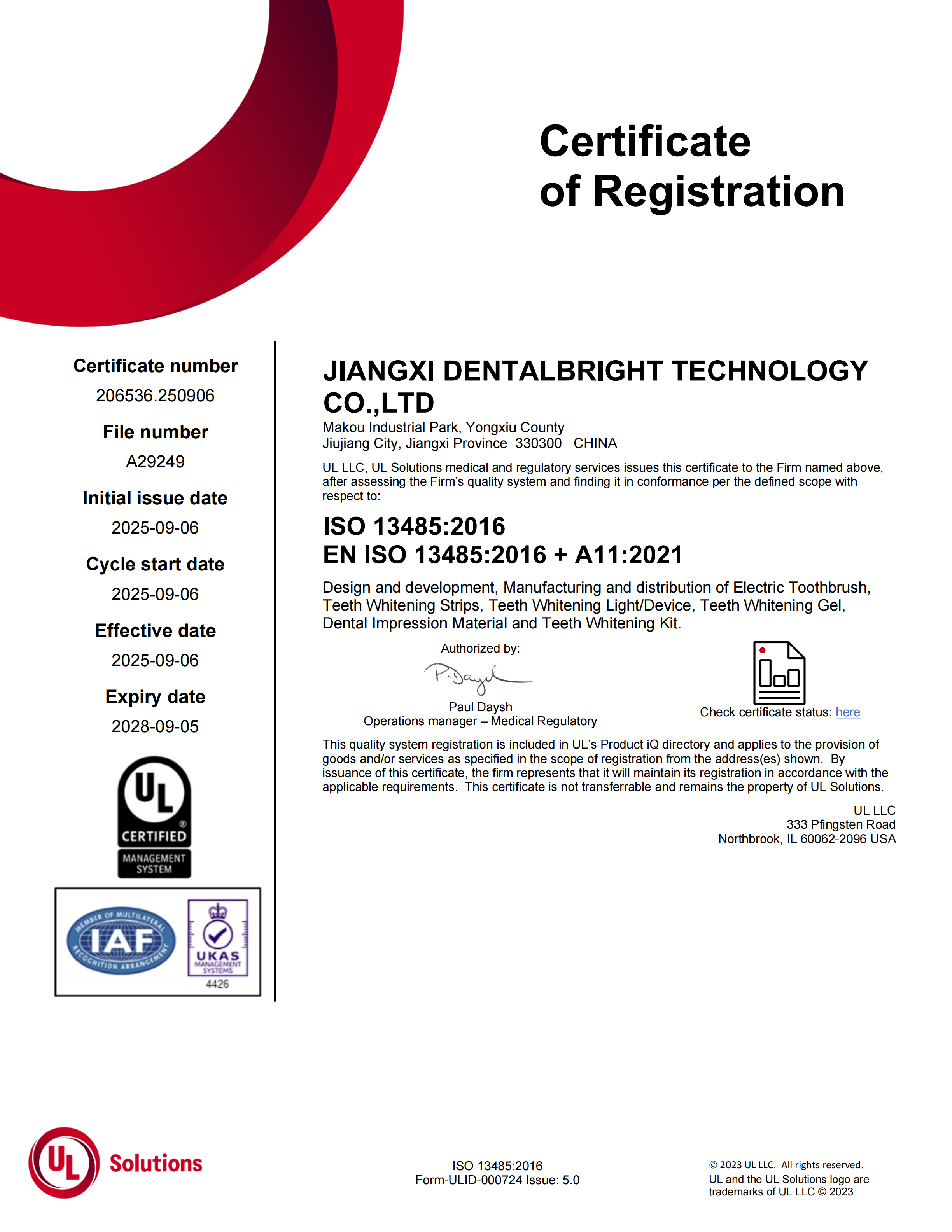
A registration is only as strong as the quality system that produced the goods. For oral care ranges that span cosmetic and device categories, buyers should expect to see both cosmetics GMP and device QMS evidence:
- ISO 22716:2007 cosmetics GMP — certificate SZ2312B8 issued by Intertek, valid 4 December 2024 to 12 December 2026. The certified scope covers manufacturing of teeth whitening pens, strips, gels, powders, foams, mouth spray, purple corrector serum and toothpaste tablets, plus packaging of teeth whitening kits.
- GMPC against the US FDA Cosmetic Good Manufacturing Practice Guidelines (2022) — certificate SZ2312B9 issued by Intertek, valid 4 December 2024 to 12 December 2026, covering the US market.
- ISO 13485:2016 / EN ISO 13485:2016 + A11:2021 — certificate 206536.250906 issued by UL Solutions, valid 6 September 2025 to 5 September 2028, covering design, development, manufacturing and distribution of electric toothbrushes, teeth whitening strips, teeth whitening light/device, teeth whitening gel, dental impression material and teeth whitening kits.
- MDSAP — certificate 206537.250906 issued by UL Solutions, valid 6 September 2025 to 5 September 2028, covering the USA, Brazil, Australia, Canada and Japan.
- amfori BSCI social audit — audited by SGS, Monitoring ID 25-0338381-1, site ID 156-030966-001, against the amfori BSCI Code of Conduct (2024 version), valid 26 June 2026 to 15 August 2027.
3. Market-specific registrations, matched to the product family
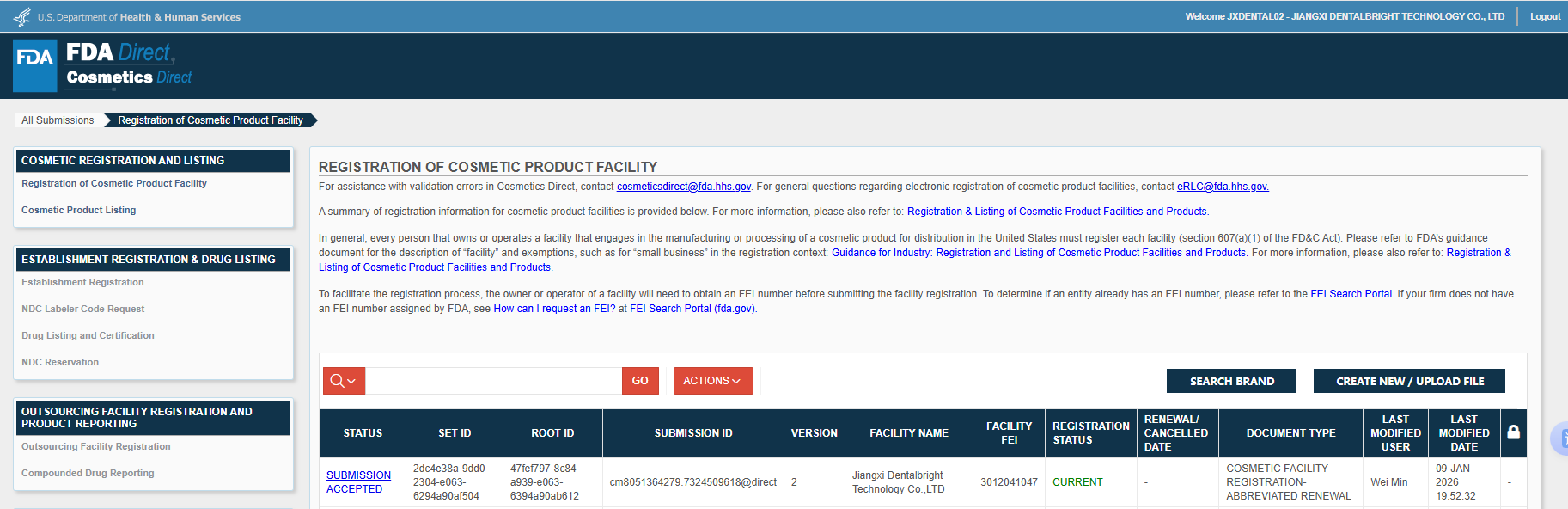
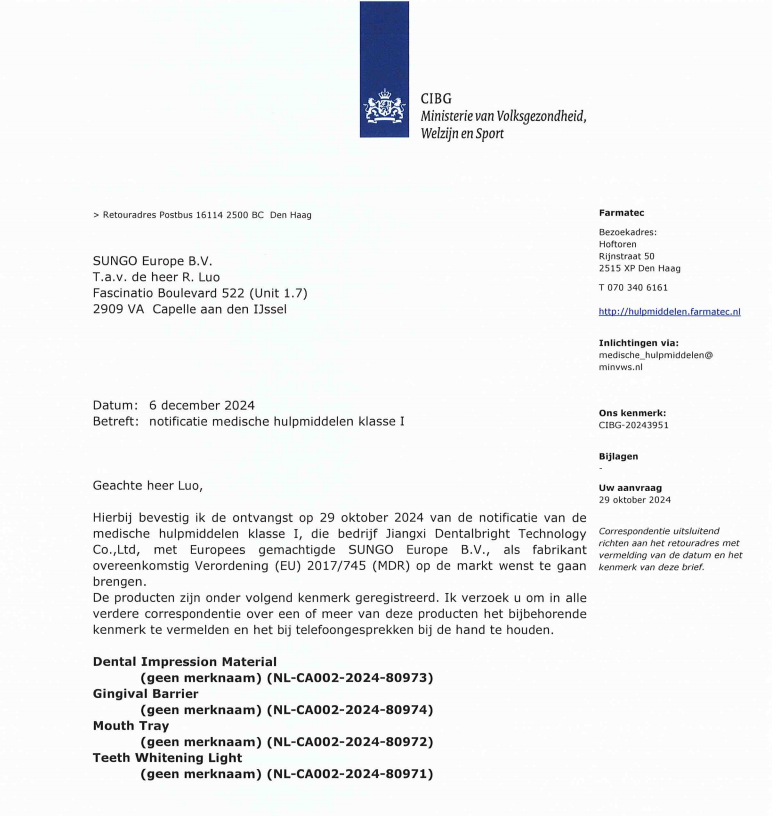
This is where most mismatches happen, because buyers often request one registration for an entire assortment. The registration follows the product family, not the supplier. GlorySmile Factory states that it has completed MoCRA-compliant cosmetic facility registration and product listing for the teeth whitening strips for the US market; that its medical device products hold MDR-CE certification with a complete Technical File and an appointed EU Responsible Person; that its teeth whitening lights, electric toothbrushes and oral irrigators have obtained FDA medical device registration; that its silicone rubber impression material has completed 510(k) registration; and that for the EU cosmetics route it has completed CPNP notification, prepared the CPSR and appointed an EU Responsible Person as required by EU cosmetic regulations.
For EU cosmetics documentation specifically, the requirement set is defined and testable. Key technical requirements include compliant concentration of the whitening active ingredient, strip substrate adhesion with no easy breakage or excessive gel overflow, and pH and odour within a safe range with no prohibited or over-limited ingredients. Test requirements cover microbiological limit testing, heavy-metal (Pb, As, Hg, Cd) testing, skin irritation testing and stability testing. Documentation requirements include CPSR, CPNP notification confirmation and EU Responsible Person information, supported by product specification, MSDS and raw material COA.
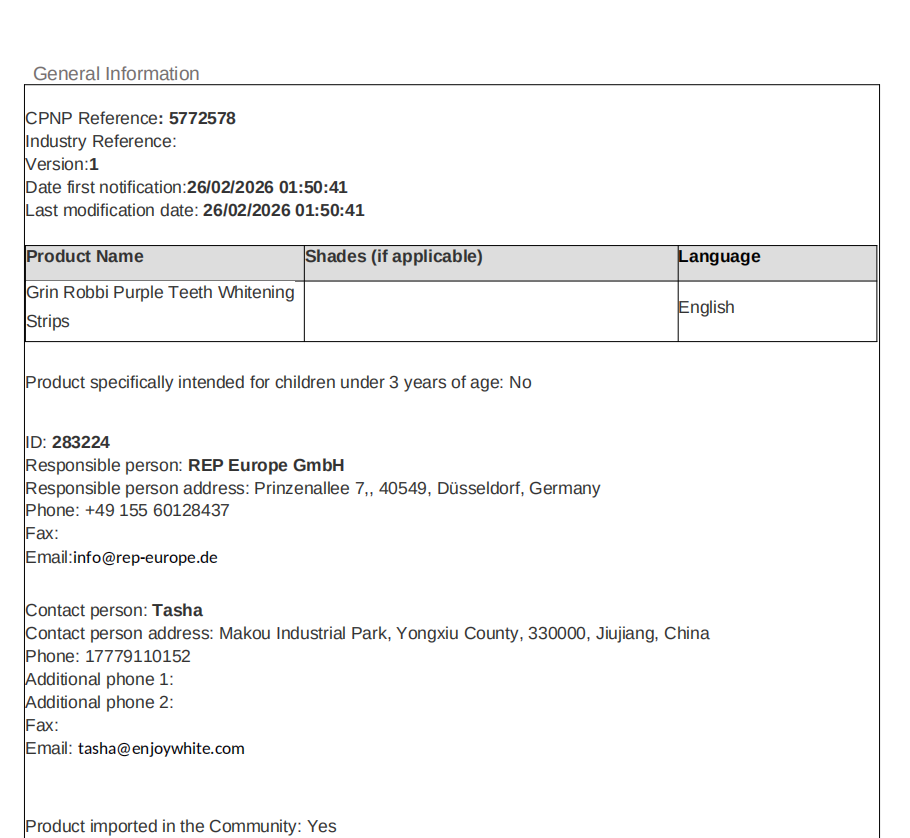
4. Responsible person, US Agent and EU representative
Both regimes rely on a local entity rather than the overseas manufacturer. EU cosmetic rules require an appointed EU Responsible Person. FDA medical device registration requires a US Agent. MoCRA-compliant cosmetic registration also requires a US Agent, together with product formulation filing on the FDA website. Buyers should verify that the named entity appears on the actual documentation, and that the entity is still active at the time of shipment.
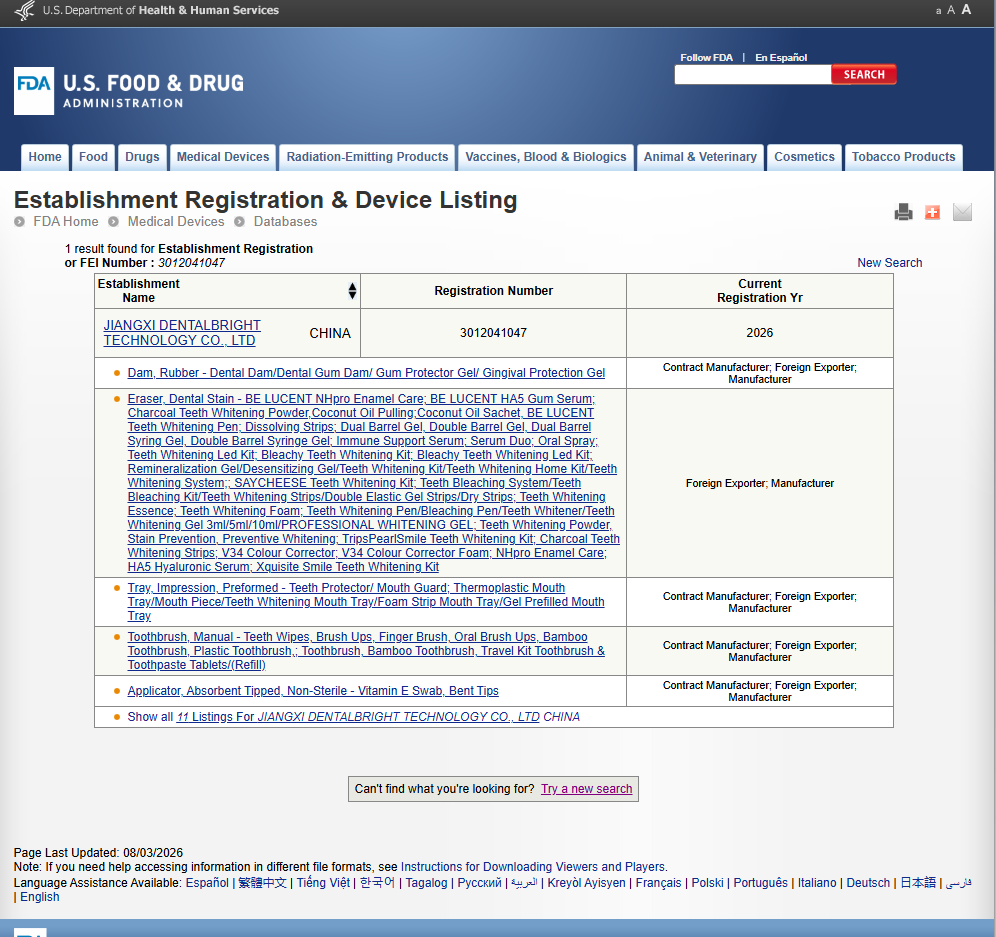
5. Test package, MSDS and safety documentation
For whitening strips and similar cosmetic formats, the documented test package is the part buyers can audit without a regulatory consultant: microbiological limits, heavy metals, skin irritation, stability, product specification, MSDS and raw-material COA. The manufacturer confirms that an MSDS is available. In-house laboratory capability supports this stage — the facility includes a 1,000 m² laboratory with a dedicated 100-class cleanroom for microbiological testing, enabling verification of raw materials, semi-finished goods and finished products. That matters because the EU test package is only credible when the underlying sampling and testing happen under a controlled environment.
6. Retail-channel certificates and IP cover
Beyond the two headline markets, channel-specific certificates unlock specific listings: a Certificate of Free Sale for Indonesia (No. 2026YB0548, issued through CCCMHPIE with CCPIT authentication, valid 1 March 2026 to 1 March 2028), a HALAL certificate covering 22 SKUs (certificate 52185957421871, valid to 21 November 2026), and a VEGAN certificate covering 23 SKUs (International Vegan Alliance certificate 22521, valid to 21 April 2027). These are retail-facing documents rather than import documents, but they are frequently requested by buyers who sell through natural, halal or vegan-positioned channels.
Design and utility patents provide a second layer of cover where buyers worry about design infringement claims in the US, EU or UK. The portfolio includes US design patent US D864,399 S for teeth-whitening equipment, EU Registered Community Design RCD No. 006537908-0001, US utility patent US 12,350,120 B1 for a gum-protecting and teeth-whitening strip and its preparation method, US design patent US D1,080,877 S for a diamond-shaped whitening device, UK Registered Design No. 6370462, and EU Registered Community Design No. 015075898-0001 covering an electric toothbrush with an integrated charger dock.
Step-by-Step Breakdown: An Eight-Step Pre-Import Workflow
- Freeze the intended use and the claims. Write down what the kit does and what the artwork says. Claims decide classification more often than ingredients do.
- Set the classification for each market separately. Cosmetic or device, EU and US, each documented with a short written rationale.
- Request the QMS certificates and read the scope line. A certificate that covers toothpaste tablets but not whitening kits does not cover your order. Check validity dates as well as scope.
- Match the registration to the product family using the documentation map further down this article.
- Confirm labelling duties. Formulation labelling positions whitening products for adults and children 16+ in several markets, and the user manual and compliance labels must match the destination country and language.
- Collect the test package, MSDS and COA, plus the CPSR and CPNP confirmation if the EU cosmetic route applies.
- Verify the responsible person or agent named on the registration, and confirm the appointment is current.
- Agree commercial and acceptance terms. For standard packaging the stated MOQ is 5 boxes; for OEM orders the customized MOQ ranges from 100 to 1,000 boxes, depending mainly on the minimum order quantity for custom packaging. Stated delivery terms are EXW / FCA / FOB / CFR. On-site inspection is supported and the Quality Department can conduct pre-shipment random inspection. Stated payment terms are 30% deposit in advance with 70% balance before shipment.
Use Cases: Four Buyer Profiles and the Documents Each One Needs
Scenario A — A private-label brand launching a peroxide-free kit in the EU
A brand owner building a PAP+ whitening kit for EU retail is normally working through the cosmetic route. The document stack is a CPSR, a PIF, CPNP notification and an appointed EU Responsible Person, supported by microbiological, heavy-metal, irritation and stability testing. Because the manufacturer holds ISO 22716 and GMPC certification with a scope that includes whitening gels, pens and strips, the cosmetics GMP evidence is already aligned to the product family. The formulation choice matters commercially as well: PAP+ systems are positioned around sensitivity, which suits brands targeting enamel-conscious buyers.
Scenario B — A US marketplace seller adding whitening strips
An e-commerce seller listing strips in the US needs MoCRA-compliant cosmetic facility registration and product listing, a US Agent, and formulation filing completed on the FDA website. Two additional details reduce friction: the manufacturer states it has already completed MoCRA-compliant facility registration and product listing for the teeth-whitening strips, and the customs classification for strips imported from China sits under subheading 3306.90.0000 per the CBP ruling referenced above. Both points should be confirmed against the exact SKU being ordered.
Scenario C — A distributor importing whitening hardware
A distributor adding LED whitening devices to an oral care portfolio is dealing with the device route, not the cosmetic route. That route requires MDR-CE certification with a complete Technical File and an appointed EU Responsible Person for Europe, and FDA medical device establishment registration and device listing for the United States. Hardware families such as the GlorySmile Teeth Whitening LED Kit are available with 16 LED, 24 LED or 32 LED configurations, with treatment timers of 10 or 16 minutes depending on model, which means the device listing has to match the exact configuration shipped — not a catalogue average.
Scenario D — A clinic or salon supply buyer
Professional buyers purchasing a clinic-format kit — for example a kit built around a 35% hydrogen peroxide dual barrier gel with gum protector, cheek retractor, saliva tow and Vitamin-E swabs — are operating outside the consumer whitening question. The EU concentration band described earlier addresses products made available to consumers; professional-use kits are positioned for dental clinic and salon whitening service, and buyers should confirm the practitioner channel rules that apply in their own jurisdiction before import.
Comparison Table: Cosmetic Route vs Medical Device Route
The table below maps the two regulatory routes to the documents that apply in each market. It is a route map, not a statement about any single SKU — the applicable route is determined per product by its intended use, claims and formulation.
| Route and typical product examples | European Union | United States |
|---|---|---|
| Cosmetic — whitening strips, whitening gel, whitening pens, whitening powder, mouthwash, toothpaste, purple corrector foam | CPSR, PIF, CPNP notification, appointed EU Responsible Person. Products containing 0.1%–6% hydrogen peroxide require a first treatment by a dentist under Directive 2011/84/EU. | MoCRA-compliant cosmetic facility registration and product listing, US Agent, product formulation filing on the FDA website. Cosmetic products are not FDA “approved”. Test package: microbiological limits, heavy metals (Pb, As, Hg, Cd), skin irritation, stability, plus MSDS and COA. |
| Medical device — whitening light/device, electric toothbrush, oral irrigator, dental impression material | MDR-CE certification, complete Technical File, appointed EU Responsible Person. QMS evidence: ISO 13485:2016 / EN ISO 13485:2016 + A11:2021 (certificate 206536.250906, valid to 5 September 2028). | FDA medical device establishment registration and device listing; 510(k) registration completed for silicone rubber impression material. MDSAP certificate 206537.250906 covers the USA, Brazil, Australia, Canada and Japan. |
| Cross-market QMS and social compliance | ISO 22716:2007 cosmetics GMP (certificate SZ2312B8, Intertek, valid to 12 December 2026); amfori BSCI social audit by SGS (valid 26 June 2026 to 15 August 2027). | GMPC against US FDA Cosmetic GMP Guidelines 2022 (certificate SZ2312B9, Intertek, valid to 12 December 2026). |
Documentation Snapshot at a Glance
| Document | Authority / Number | Validity and scope note |
|---|---|---|
| ISO 22716:2007 cosmetics GMP | Intertek / SZ2312B8 | 4 Dec 2024 – 12 Dec 2026. Manufacturing of whitening pens, strips, gels, powders, foams, mouth spray, purple corrector serum, toothpaste tablets; packaging of whitening kits. |
| GMPC (US FDA Cosmetic GMP Guidelines 2022) | Intertek / SZ2312B9 | 4 Dec 2024 – 12 Dec 2026. USA market. |
| ISO 13485:2016 / EN ISO 13485:2016 + A11:2021 | UL Solutions / 206536.250906 | 6 Sep 2025 – 5 Sep 2028. Includes teeth whitening kit, whitening light/device, strips, gel, electric toothbrush, dental impression material. |
| MDSAP | UL Solutions / 206537.250906 | 6 Sep 2025 – 5 Sep 2028. USA, Brazil, Australia, Canada, Japan. |
| amfori BSCI social audit | SGS / Monitoring ID 25-0338381-1 | 26 Jun 2026 – 15 Aug 2027. amfori BSCI Code of Conduct (2024 version). |
| HALAL certificate | Halal Foundation Center Hong Kong / 52185957421871 | Valid to 21 Nov 2026. 22 SKUs. |
| VEGAN certificate | International Vegan Alliance / 22521 | 20 Apr 2024 – 21 Apr 2027. 23 SKUs. |
| Certificate of Free Sale (Indonesia) | CCCMHPIE, authenticated by CCPIT / 2026YB0548 | 1 Mar 2026 – 1 Mar 2028. |
Certificate numbers, issuing bodies and validity dates above are stated as supplied by the manufacturer. Buyers should verify each document directly with the issuing body before relying on it for customs clearance or marketplace onboarding.
FAQ: Compliance, Capability, Budget, Sampling and Lead Time
Does a teeth whitening kit need FDA approval to be sold in the US?
Cosmetic products are not “approved” by the FDA, so the question needs to be rephrased before it can be answered. For cosmetics, the applicable mechanism is MoCRA-compliant cosmetic facility registration and product listing, which requires a US Agent and completion of product formulation filing on the FDA website. For products regulated as medical devices — for example teeth whitening lights, electric toothbrushes and oral irrigators — FDA medical device establishment registration and device listing apply, and some products also require 510(k) clearance; the silicone rubber impression material has completed 510(k) registration. Whether a specific whitening kit is treated as a cosmetic or a device depends on its intended use and claims, so the classification must be confirmed per SKU and per market.
Is MDR registration required for teeth whitening kits in the EU?
MDR registration applies when a product is placed on the EU market as a medical device. For those products, the manufacturer states that it holds MDR-CE certification with a complete Technical File and an appointed EU Responsible Person. Cosmetic products take a different path: CPNP notification, a Cosmetic Product Safety Report (CPSR), a Product Information File (PIF) and an appointed EU Responsible Person, supported by microbiological limit testing, heavy-metal testing (Pb, As, Hg, Cd), skin irritation testing, stability testing, product specification, MSDS and raw-material COA. Separately, EU rules state that teeth whitening products containing between 0.1% and 6% hydrogen peroxide require a first treatment by a dentist, so formulation concentration directly affects what can be made available and to whom.
Can an OEM teeth whitening kit manufacturer support private-label brands?
Yes. Home teeth whitening kits are produced under OEM, ODM, Private Label and Custom Design models, and the customization scope covers LED wavelength configuration, housing colour, logo printing, packaging structure, kit composition, custom user manuals and compliance labelling — the last two being directly relevant to market entry, because the manual and label text must match the destination market. Kit-level monthly capacity is stated at 105,000 sets. Customization at the label and manual level is usually the difference between a compliant launch and a relabelling cycle, so it should be specified at the sampling stage rather than after production.
What is the MOQ, and what are the payment and delivery terms?
For standard packaging the stated MOQ is 5 boxes. For OEM orders, the customized MOQ ranges from 100 to 1,000 boxes and depends mainly on the minimum order quantity for the custom packaging. Stated delivery terms are EXW / FCA / FOB / CFR, and stated payment terms are 30% deposit in advance with 70% balance before shipment. Where a project needs a lower entry quantity for market testing, the practical lever is usually packaging format and artwork rather than the kit contents.
How long does production take, and how is quality verified before shipment?
Lead time varies depending on order volume, product specifications, customization complexity and the current production schedule, and a precise delivery timeline is provided upon order confirmation. Before shipment, on-site inspection is supported and the Quality Department can conduct pre-shipment random inspection; an MSDS is available on request. For buyers who want to validate artwork, gel texture and label wording before committing to a production run, the fastest route is to request a sample set with a compliance pack for the exact SKU being evaluated — sample requests and document requests can be sent together to keep the review cycle short.
Conclusion: Classification First, Documents Second
Every regulatory question about teeth whitening kits resolves to the same starting point. Decide what the product is in each market — cosmetic or medical device — and the correct document set becomes straightforward: CPSR, PIF, CPNP notification and an EU Responsible Person for EU cosmetics; MoCRA-compliant facility registration and product listing with a US Agent for US cosmetics; MDR-CE with a Technical File for EU devices; FDA medical device establishment registration and device listing for US devices, with 510(k) where a product requires it.
Behind those product-level documents sits factory-level evidence that buyers can verify independently: ISO 22716 and GMPC for cosmetics manufacturing, ISO 13485 and MDSAP for device manufacturing, and a BSCI social audit for supply chain due diligence. The manufacturer's own production base — a 36,000 m² facility with 20,000 m² of 100,000-class cleanrooms, a 1,000 m² laboratory with a 100-class microbiological testing cleanroom, 256 employees including 17 R&D engineers and 11 QC specialists, products exported to 102 countries — is what makes the documentation stack sustainable across repeated orders rather than a one-off file assembled for a single shipment.
The most useful action a buyer can take is also the least expensive: request the compliance pack for the exact SKU, then compare the scope lines, validity dates and named responsible entities against the destination market requirements before artwork and tooling are locked.
Next step: If you are evaluating a whitening kit supplier for the EU or the US, request the compliance pack for the exact SKU you plan to import — the classification statement, QMS certificates with scope lines, product-level registration evidence, the test package and the MSDS. GlorySmile Factory supports free sampling and professional package design, so artwork and label wording can be reviewed alongside the compliance documents before production starts.
Contact: Tasha · tasha@enjoywhite.com · WhatsApp +86 177 7911 0152 · www.glorysmile.com
Download the full product catalogue (PDF): GlorySmile Factory Catalogue
Have Questions or Need More Details?
Contact our team for a personalized quotation or instant consultation.
Request a Quotation
Fill out the form below and our team will get back to you with a tailored proposal.
WhatsApp Direct Chat
Prefer to chat in real-time? Message us on WhatsApp for instant assistance & quick answers.
- Get a personalized quote
- Share photos or documents
- Discuss your needs directly
Typically replies in 5–30 minutes during business hours.