Launching a Whitening Strip Line for Your Dental Clinic: A Step-by-Step Application Guide

A take-home teeth whitening strip line extends a chairside whitening result into a managed, reorderable patient routine.
Why a dental clinic should own a take-home strip line
A whitening strip line belongs in a dental clinic for the same reason a retainer belongs in an orthodontic practice: it protects the result the clinic has already delivered. In practical terms, a clinic-ready line is built from three parts — a professional chairside kit, a take-home whitening strip chosen for the patient's sensitivity profile, and a small set of complementary products for maintenance between visits.
Glorysmile (Jiangxi DentalBright Technology Co., Ltd.), an oral care manufacturer established in 2013 and based in Makou Industrial District, Yongxiu Town, Nanchang (Jiujiang) City, Jiangxi Province, China, produces all three parts under one roof and supplies them through OEM, ODM and dealer programs. Its portfolio covers teeth whitening systems, strips, toothpaste, mouthwash, electric toothbrushes, water flossers and dental impression materials, exported to 102 countries with 90% of sales going to export markets including the EU, USA and UK.
This guide is written for dentists, clinic owners, whitening labs and dental distributors who want to add a whitening strip line to their service portfolio without improvising formulation, packaging or compliance documentation. It covers the problem the line solves, the regulatory background in the EU and US, the product building blocks available today, an eight-step launch sequence, a side-by-side format comparison, and the questions clinics ask most often before placing a first order.
Problem definition: whitening is episodic, maintenance is not
The core problem is not whitening efficacy — it is maintenance and repeatability. Five issues appear consistently when a practice tries to add a whitening line without a defined product structure:
- Result relapse. Chairside whitening removes exogenous stains, but coffee, tea and tobacco staining returns with the patient's daily habits.
- Uncontrolled at-home products. Patients who want to maintain at home often buy unbranded strips online, with no shade baseline, no written instructions from their clinician and an unknown formulation.
- Sensitive patients drop out. Patients with existing sensitivity abandon whitening when the take-home product is not matched to their sensitivity profile.
- No clinic-branded SKU. A branded take-home product requires formulation records, certificates and labelling that most practices cannot assemble alone.
- No reorder path. Without a defined strip SKU, the clinic cannot prescribe, restock or train staff consistently across appointments.
Industry background: market size, rules and trade reality
The category is large enough to justify a dedicated line. The global market for teeth whitening strips and gels was valued at USD 1.1 billion in 2025, according to Grand View Research (Teeth Whitening Strips & Gels Market Size Report 2026–2033).
Two regulatory facts shape how a clinic line is built. In the European Union, Regulation (EC) No. 1223/2009 restricts hydrogen peroxide in over-the-counter teeth whitening products to 0.1% or less. Higher-concentration products therefore sit in a professional-use context, while retail-facing SKUs for that market are usually built on peroxide-free formulas. In the United States, the MoCRA 2022 framework requires manufacturers of whitening strips (classified as cosmetics) to register facilities at USD 849 per year and list products at USD 200 each — which is why the manufacturer's registration status matters as much as the product specification when a clinic plans distribution.
On the trade side, teeth whitening strips are primarily classified under HS Code 3306.90.00 (Preparations for Oral or Dental Hygiene), per U.S. Customs ruling NY N342147. For clinics that import directly rather than buying locally, that classification defines the customs entry line and the paperwork attached to it.
Supply capacity is the other half of the background. Glorysmile's annual output includes 300,000,000 pieces of teeth whitening strips and 10,000,000 sets of whitening kits, alongside 18,000,000 boxes of whitening powder, 20,000,000 whitening pens, 30,000,000 toothpastes, 90,000,000 10 ml mouthwash units and 150,000,000 toothpaste tablets.
The solution: three building blocks of a clinic whitening line
1. The chairside professional kit
The Clinic Use Whitening Kit, model GS-001L, is the chairside starting point. It is formulated with 35% hydrogen peroxide (custom formulation supported) and supplied as a complete treatment set:
- 1 pc 5 ml dual barrier whitening gel
- 1 pc 3 ml gum protector with 2 pc curved needles
- 1 pc M size cheek retractor
- 2 pc brush ups
- 2 pc Vitamin-E swabs
- 10 pc saliva towels, 1 pc face gauze, 1 pc bib
- 1 pc aluminum bag with sticker
MOQ is 200 pcs for private label and 1 pc for regular product, with custom packaging and custom gel ingredient supported. The product sheet positions it for a 5–8 shade improvement in one treatment. Its intended industries are beauty & personal care, medical devices, dentistry and cosmetics, and the mouth tray material for Glorysmile treatment products is food-grade TPE.
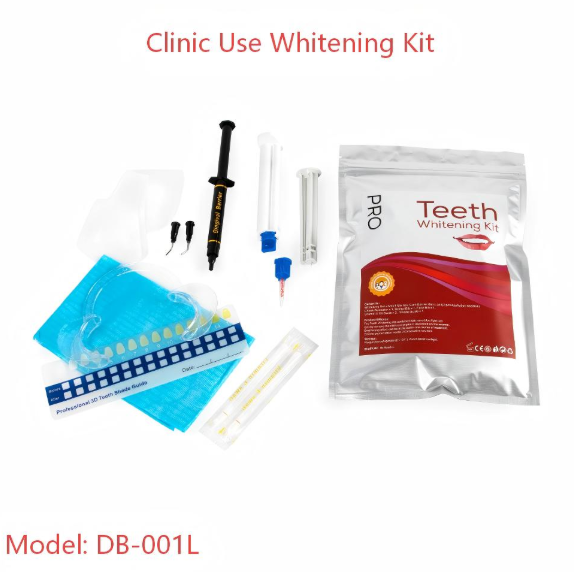
Clinic Use Whitening Kit GS-001L: dual barrier gel, gum protector with curved needles, cheek retractor and saliva control in one chairside pack.
2. The take-home strip SKU
The GlorySmile strip range gives a clinic three delivery formats and four formulation families to choose from. All strips use a three-layer construction — PET hard film, whitening gel and PE soft film — and are individually packed in aluminum bags.
- Dry strips (GS-004 series): GS-004P (PAP), GS-004C (PAP+charcoal), GS-004V (purple), GS-004H (6% HP) — described as high viscosity, residue-free, alcohol-free dry strips. This is the format most commonly used for low-sensitivity daily use at home.
- Wet strips (GS-V34-S07): a wet strip format available in a purple (V34) formulation for teeth whitening applications.
- Dissolving strips (DB-004L): a dissolving strip format for patients who prefer not to remove a strip after treatment.
Each format is supplied in 7, 14 or 21 strips per box with a user manual, shade guide and color box, and can be built on PAP, PAP+charcoal, purple, 6% HP, sodium phytate or sodium bicarbonate bases, or a custom formula. Flavour options across the range include blue raspberry, strawberry, peach, grape, watermelon, peppermint, orange, mint, pineapple, cherry blossom, coconut and mango — including fresh mint flavoured options for patients who prefer a neutral taste. OEM, ODM and dealer services are supported, and the strip range is certified under BSCI, GMP, ISO 22716, ISO 13485 and MDSAP.
3. Complementary maintenance products
Strips handle stain removal and whitening. The yellow undertone that appears between sessions is a different problem, and it is handled by a colour-correcting family that pairs naturally with a strip line:
- Purple Colour Corrector Foam, GS-006V — 30 ml, mint or custom flavour, PET inner bottle. Purple sits directly opposite yellow on the colour wheel, so a water-soluble purple dye is applied to cancel out yellow undertones.
- Purple Colour Corrector Serum, GS-006V — 30 ml, mint or custom, same colour-correcting principle for patients who prefer a serum texture.
- Purple Colour Corrector Toothpaste, DB-007P — 65 g or 120 g PE tube with PP cap, mint or custom flavour, designed to remove stains while brushing.
- Purple Colour Corrector Powder, GS-005V — 12 g (15 g, 30 g, 40 g, 100 g options) with PAP as the whitening ingredient.
- PAP+ Whitening Powder GS-005P (12 g) and Charcoal Whitening Powder GS-005C (30 g; mint, rose, strawberry, lemon or custom).
- Stain Remover Mouthwash DB-010S — 237 ml, alcohol-free, functioning as both breath freshener and stain remover; and Foam Mouthwash GS-010F in strawberry, grape bubblegum, watermelon or blue raspberry.
- Mouth Spray GS-011 — 17 ml in mint, lime, peach, chocolate, vanilla, banana, grape, peppermint, coconut or kiwifruit flavours.
- Toothpaste Tablets GS-008 (30 or 60 tabs) and the Pre-pasted Disposable Toothbrush DB-012P (14 packs per bag) for travel-size patient kits.
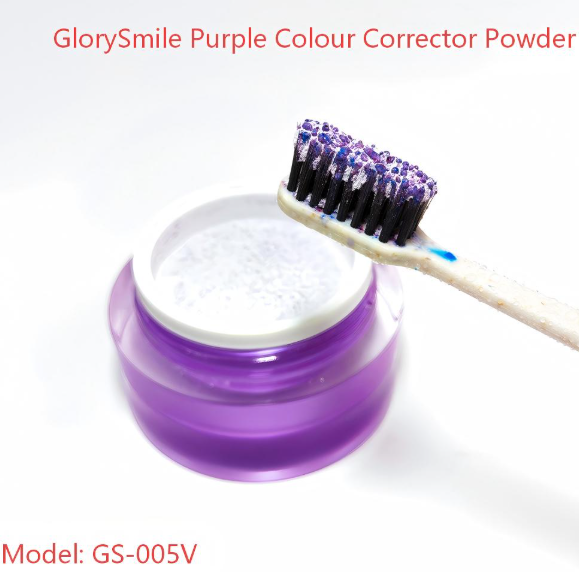
Colour-correcting products address the yellow undertone that reappears between whitening sessions, using the complementary-colour principle.
Supporting devices and gum-care adjuncts
Some clinics build the strip line around an LED device protocol. Glorysmile's LED kit range includes GS-001B (5 LED light, mouth tray, 3 pc 3 ml syringes, shade guide, gift box), GS-001J (16 LED light, 4 pc 2 ml whitening pens, dust-free cover, four adapters for iPhone/Android/Type-C/USB, USB-powered with no built-in battery), GS-001X (32 LED light, 2 pc 3 ml pens, charging and sterilisation case with a 16-minute timer and a 3-minute disinfection cycle) and the non-branded DB-001M (32 LED light, 4 pc 2 ml pens, storage case). Patent references include EU 015062946-0001 and UK 6370462 for GS-001X, and US D1,128,065 S, EU 015065790-0001 and UK 6377277 for DB-001M.
For gum care between whitening cycles, the GS-K5 electric toothbrush (5 modes: Gentle, Everyday, Intense, Whitening, Custom; 600 mAh battery; up to 60 days per charge) and the GS-K9P (IPX7 waterproof, 33,000–38,000 vibrations per minute, 4 modes, EU patent 015075898-0001) sit alongside the GS-V2 oral irrigator (4 modes, 280 ml tank, 20–120 PSI) as hygiene adjuncts.
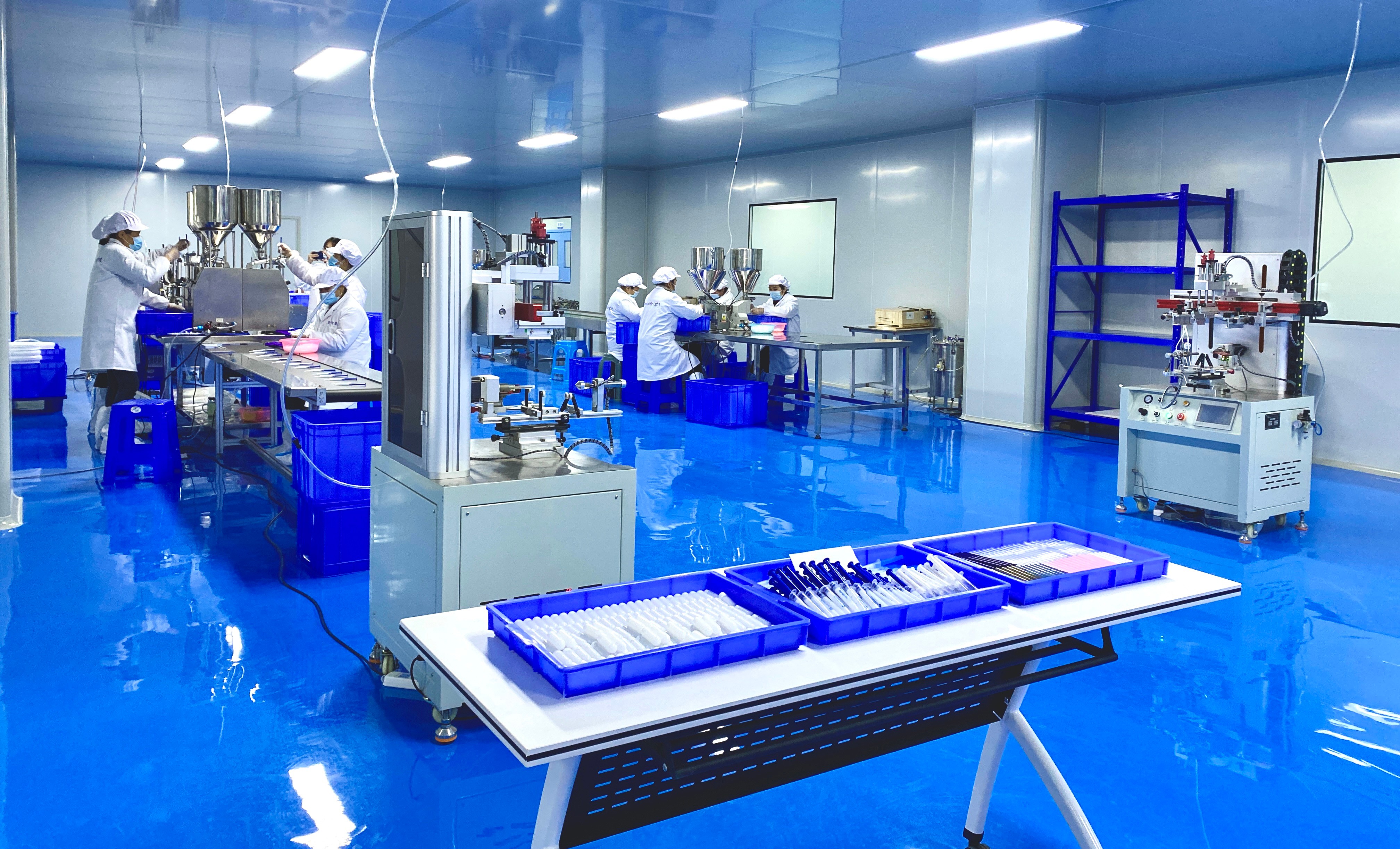
Strip production runs in a 36,000 m² facility that includes 20,000 m² of 100,000-class cleanrooms.
Step-by-step: launching the line in eight steps
Step 1 — Map the patient pathway before ordering anything
Decide what the strip line is for. The two most common pathways are (a) chairside treatment followed by take-home maintenance, and (b) a maintenance-only line for patients who were whitened elsewhere. Pathway (a) needs a professional kit and a maintenance strip; pathway (b) needs only the take-home strip plus a shade guide. Writing this down first prevents the clinic from ordering the wrong format later.
Step 2 — Choose the strip format
Dry, wet and dissolving strips behave differently in the mouth. Dry strips are the standard choice for daily-use maintenance packs; wet strips suit patients who prefer a heavier gel feel; dissolving strips suit patients who dislike handling and removing a strip, and travel use. Ordering one format per patient segment is usually simpler than ordering all three at launch.
Step 3 — Match the formulation to the patient profile and the market
Formulation is a clinical and a regulatory decision at the same time. Peroxide-free PAP formulas are the usual starting point when the patient reports sensitivity or when the product will be sold over the counter in the EU, where the hydrogen peroxide limit for such products is 0.1% or less. PAP+charcoal adds a charcoal-based polishing element for patients with visible coffee, tea or tobacco staining. The purple (V34-type) formula supports tone correction rather than stain removal alone. A 6% HP strip belongs in a professional or non-EU retail context where higher concentrations are permitted, and the clinic should confirm the intended distribution channel with the manufacturer before the artwork is finalised.
Step 4 — Run the safety checklist before the first patient
Clinic launch safety checklist
- Screen every patient for existing sensitivity, enamel condition and gum health before assigning a formulation.
- Confirm the product is labelled for adults and children aged 16 and over; this is the standard labelling position across the whitening range.
- Select an enamel-safe formula and, where indicated, a zero-peroxide option.
- Use individually wrapped strips so each application is hygienic and single-use.
- For chairside work, use the gum protector, curved needles and cheek retractor included in the professional kit rather than improvising barriers.
- Record the baseline shade with the shade guide shipped in every strip box, and re-check it at recall.
- Keep formulation records and certificates on file: MSDS, COA, and for EU cosmetics CPSR, CPNP and PIF; for medical devices, CE-MDR registration.
- Write the frequency instruction into the patient's chart — daily-use low-sensitivity products and higher-concentration products follow different intervals.
Step 5 — Build the take-home pack
Every strip order can be configured with 7, 14 or 21 strips per box alongside a user manual, shade guide and color box. For a clinic, the 14-strip configuration usually matches a two-week initial maintenance course, with the 7-strip pack used as a trial or travel size and the 21-strip pack used for longer recall intervals. Because the box, manual and shade guide are all customisable, the pack can carry the clinic's own instructions rather than a generic insert.
Step 6 — Handle sensitive patients deliberately
Sensitive patients are the group most likely to abandon whitening, and also the group most likely to stay loyal if the product fits. The manufacturer offers PAP and low-sensitivity formulas designed specifically for sensitive teeth. In practice this means assigning a peroxide-free PAP strip, starting with a lower application frequency than the standard packaging suggests, keeping the enamel-safe positioning visible on the pack, and pairing the strip with a mild daily toothpaste rather than a second whitening product.
Step 7 — Pair the strips with complementary maintenance products
Whitening strips remove stains; colour correctors manage tone. A purple colour corrector foam or serum used between whitening sessions addresses the yellow undertone that appears when the whitening effect is between applications. A stain remover mouthwash such as DB-010S supports daily stain control, and toothpaste tablets or the pre-pasted disposable toothbrush make the routine portable. For patients who only want to buy one add-on, the colour corrector is usually the strongest pairing with a strip line.
Step 8 — Brand it, sample it, then scale
The final step converts a clinical protocol into a stocked product. Glorysmile's OEM/ODM service covers product formulation, customisation, free sampling and professional package design, with a dedicated packaging design team of six and 17 R&D engineers behind formulation work. For regular orders in existing packaging the minimum order is 5 boxes; for OEM orders with customised packaging the MOQ varies by product, from 100 to 1000 boxes. Individual product sheets list 200 pcs for private label and 1 pc for regular products, so a clinic can validate with a small regular order before committing to custom packaging. Evaluate the first sample batch in the clinic — on the sensitive-patient segment specifically — before finalising artwork.
Use cases: five clinic profiles
- General practice adding an elective whitening service. Chairside kit GS-001L for the in-office appointment, 14-strip take-home pack for maintenance, colour corrector foam as the add-on.
- Whitening-focused clinic or beauty salon. A full line: chairside kit, dry and wet strip formats across PAP and purple formulas, plus LED kit support for device-based protocols.
- Smoker and heavy-coffee patients. PAP+charcoal strips (GS-004C) or charcoal powder (GS-005C) for stain removal, with the purple family for tone correction afterwards.
- Sensitive-teeth patients. Peroxide-free PAP strips (GS-004P) with a reduced application frequency and an enamel-safe positioning.
- Travel and retail bundling. 7-strip packs, toothpaste tablets (GS-008), 17 ml mouth spray (GS-011) and the pre-pasted disposable toothbrush (DB-012P) assembled as a travel size kit for the clinic's reception area or online shop.
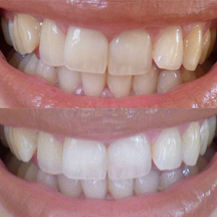
Stain removal and whitening performance is what the take-home pack must maintain after the chairside appointment.
Comparison: which strip format fits which clinic protocol
| Strip format | Models | Structure | Formula options | Pack configuration | Typical clinic role |
|---|---|---|---|---|---|
| Dry strips | GS-004P, GS-004C, GS-004V, GS-004H | Three-layer: PET hard film, whitening gel, PE soft film; individually packed in aluminum bag | PAP, PAP+charcoal, purple, 6% HP, sodium phytate, sodium bicarbonate, custom | 7 / 14 / 21 strips per box with user manual, shade guide, color box | Standard low-sensitivity daily-use maintenance after chairside treatment |
| Wet strips | GS-V34-S07 | Three-layer: PET hard film, whitening gel, PE soft film; aluminum bag | PAP, PAP+charcoal, purple, 6% HP, sodium phytate, sodium bicarbonate, custom | 7 / 14 / 21 strips per box with user manual, shade guide, color box | Patients who prefer a wet, gel-rich strip; purple tone-correcting option |
| Dissolving strips | DB-004L | Three-layer: PET hard film, whitening gel, PE soft film; aluminum bag | PAP, PAP+charcoal, purple, 6% HP, sodium phytate, sodium bicarbonate, custom | 7 / 14 / 21 strips per box with user manual, shade guide, color box | Patients who prefer not to remove a strip; travel-friendly maintenance |
All three formats share the same three-layer construction, flavour list and certification scope (BSCI, GMP, ISO 22716, ISO 13485, MDSAP).
| Building block | Model | Key specification | Role in the clinic line |
|---|---|---|---|
| Clinic Use Whitening Kit | GS-001L | 35% hydrogen peroxide, custom formulation; dual barrier gel, gum protector with curved needles, M size cheek retractor, saliva control items | Chairside professional treatment |
| GlorySmile LED Kit | GS-001B | 5 LED light, mouth tray, 3 pc 3 ml syringes, shade guide, gift box; 40 uses at 10 minutes per treatment | Device-assisted chairside or supervised home protocol |
| GlorySmile LED Kit | GS-001J | 16 LED light, 4 pc 2 ml pens, dust-free cover, 4 adapters, USB-powered; 16 minutes per day recommended | Portable device support with no built-in battery |
| GlorySmile LED Kit | GS-001X | 32 LED light, 2 pc 3 ml pens, charging and sterilisation case, 16-minute timer, 3-minute disinfection cycle; EU patent 015062946-0001, UK patent 6370462 | Higher-throughput clinic protocol with sterilisation between patients |
| Colour corrector family | GS-006V foam / GS-006V serum / DB-007P toothpaste / GS-005V powder | 30 ml, 30 ml, 65 g–120 g, 12 g; purple dye opposite yellow on the colour wheel cancels yellow undertones | Between-session tone maintenance paired with strips |
Comparison limited to published product specifications; MOQ for private label on individual items is 200 pcs, with 1 pc for regular products.
FAQ: what clinics ask before ordering
Which certifications and compliance documents support a clinic-branded whitening strip line?
Glorysmile holds MDSAP, ISO 13485, ISO 22716, US GMP, BSCI, HALAL and VEGEA, together with medical device and cosmetics production licences. Factory certificates include CE, FDA, CPSR, CPNP, PIF, SCPN, MSDS, COA, RoHS, HALAL and Vegan; product certificates include GMP, ISO 22716, ISO 13485, MDSAP and BSCI. For EU cosmetics, CPSR, CPNP and PIF can be provided, and for medical devices CE-MDR registration has been completed. MSDS is available on request. The manufacturer states that its products are FDA approved, with an FDA-certified scope covering medical devices, cosmetics and OTC drugs. One regulatory point should be planned for at the artwork stage: EU Regulation (EC) No. 1223/2009 restricts hydrogen peroxide in over-the-counter whitening products to 0.1% or less, so the formulation must match the intended sales channel.
Can the strips be customised for our clinic brand — formula, flavour and packaging?
Yes. The strip range supports OEM, ODM and dealer programs with custom formulation (PAP, PAP+charcoal, purple, 6% HP, sodium phytate, sodium bicarbonate or a fully custom base), custom flavour across twelve published options, custom strip type across dry, wet and dissolving formats, and custom packaging and printing. Each box can be built with 7, 14 or 21 strips plus a user manual, shade guide and color box. Custom formula, packaging, printing, label and bottle colour services are also available across the complementary colour corrector, powder, mouthwash and tablet products, so the whole clinic line can share one visual identity. Formulation work is supported by 17 R&D engineers and a six-person packaging design team.
What is the minimum order quantity for a clinic or distributor?
For regular orders in the manufacturer's existing packaging, the MOQ is 5 boxes. For OEM orders with customised packaging, the MOQ varies by product and ranges from 100 to 1000 boxes. Individual product specification sheets list 200 pcs for private label and 1 pc for regular products — for example, the Clinic Use Whitening Kit GS-001L and the LED kits follow that structure. This gives a clinic two entry points: validate with a small regular order, then move to custom packaging once the protocol and formulation are confirmed.
Can we evaluate the strips and the kit before placing a production order?
Glorysmile's OEM/ODM service includes free sampling and professional package design, so a clinic can evaluate the strip format, the flavour and the sensitivity profile before committing to artwork or volume. The company also supports custom gel ingredients and custom packaging during the sampling stage. A practical evaluation sequence is to order samples of the paper-based PAP strip, the strip format you intend to stock, and the colour corrector you plan to pair with it, then run them on a small group of patients and compare baseline and follow-up shades using the shade guide shipped with each box.
How is production capacity and lead time handled for a clinic line?
Production is in-house rather than outsourced. The 36,000 m² facility in Jiangxi includes 20,000 m² of 100,000-class cleanrooms and a 1,000 m² laboratory with a 100-class cleanroom for microbiological testing, run by approximately 256 staff including 17 R&D engineers and 11 QC specialists. Annual output includes 300,000,000 pieces of whitening strips and 10,000,000 whitening kits. The company describes itself as a source factory offering short lead times and flexible customisation; the exact schedule for a specific order — including artwork approval, sampling and packaging — is confirmed directly with the sales team at the time of quotation.
Next step for your clinic line. Request samples of the strip format you plan to stock, or a quotation for a private-label run, and the team will confirm formulation, packaging and documentation for your market.
Contact Tasha — Email: tasha@enjoywhite.com · WhatsApp / Tel: +86 177 7911 0152
Download the full product catalogue (including strips, clinic kits, colour correctors and devices): Glorysmile Catalog PDF
Manufacturer: glorysmile.com — Makou Industrial District, Yongxiu Town, Nanchang (Jiujiang) City, Jiangxi Province, China. The facility is a 15-minute drive from Nanchang Changbei International Airport.
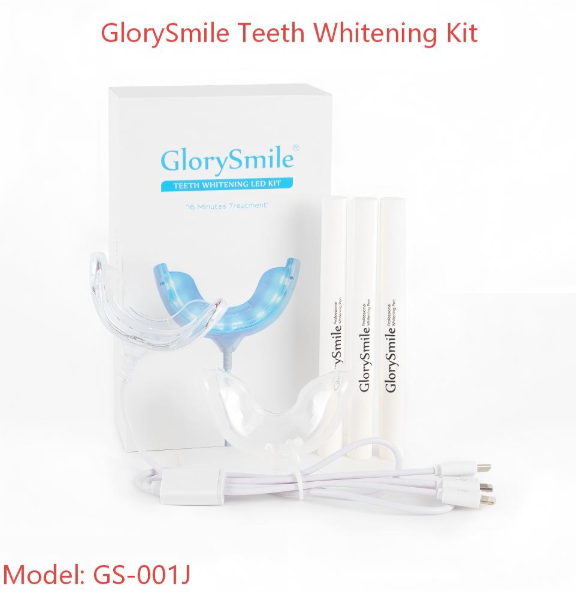
Device-supported kits can be bundled with strip packs so the clinic owns both the chairside and the take-home stage.
Conclusion
A whitening strip line succeeds in a dental clinic when it is treated as a clinical pathway rather than a retail add-on. The pathway has three parts: a chairside professional kit such as the 35% hydrogen peroxide GS-001L for the in-office result, a take-home whitening strip selected by format and formulation — dry, wet or dissolving, in PAP, PAP+charcoal, purple or 6% HP — and a colour-correcting maintenance product such as the purple foam, serum, toothpaste or powder for the weeks between appointments.
Launching the line follows eight steps: map the patient pathway, choose the format, match the formulation to the patient profile and to EU or US requirements, run the safety checklist, build the take-home pack, handle sensitive patients with low-sensitivity PAP formulas, pair the strips with colour-correcting maintenance, and finally brand, sample and scale. The supply side supports all eight steps from a single source: 36,000 m² of manufacturing space, 20,000 m² of 100,000-class cleanrooms, a 1,000 m² microbiological laboratory, certifications covering MDSAP, ISO 13485, ISO 22716, US GMP, BSCI, HALAL and VEGEA, and OEM/ODM services that include free sampling and package design.
For a clinic, the practical measure of success is simple: the patient leaves with a shade record, a written maintenance interval and a product they can actually reorder.
Have Questions or Need More Details?
Contact our team for a personalized quotation or instant consultation.
Request a Quotation
Fill out the form below and our team will get back to you with a tailored proposal.
WhatsApp Direct Chat
Prefer to chat in real-time? Message us on WhatsApp for instant assistance & quick answers.
- Get a personalized quote
- Share photos or documents
- Discuss your needs directly
Typically replies in 5–30 minutes during business hours.