
Sachet, Bottle, or Strip: Comparing Teeth Whitening Kit Production Formats
The short answer: sachet-based gel, bottled liquid or serum, and strip-based formats are not interchangeable packaging choices. Each runs on a different line, and the line — not the artwork — sets your minimum order quantity, your delivery date, and how fast you can scale a repeat order. Format selection is a manufacturing decision that happens before brand and design decisions, not after them.
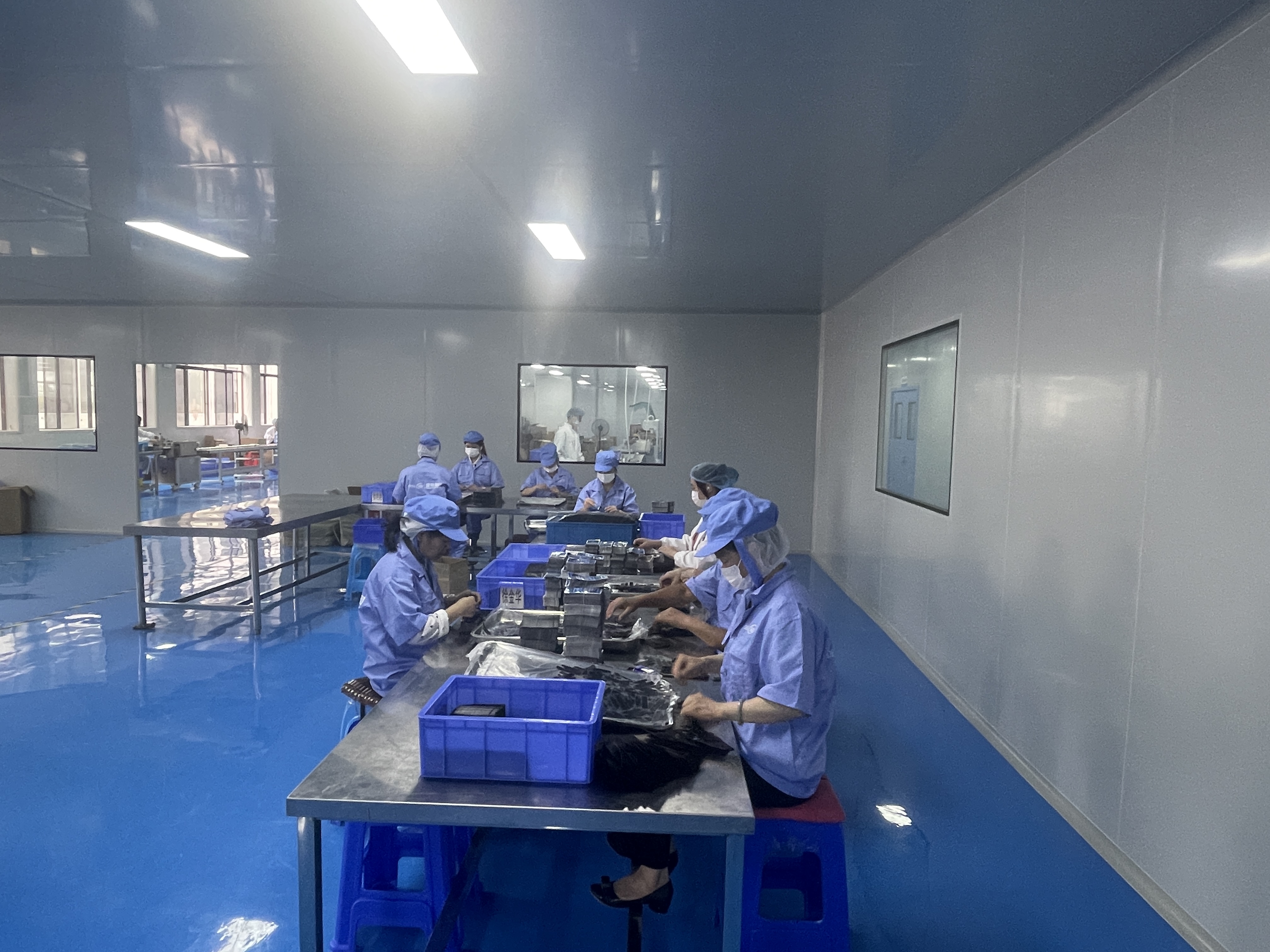
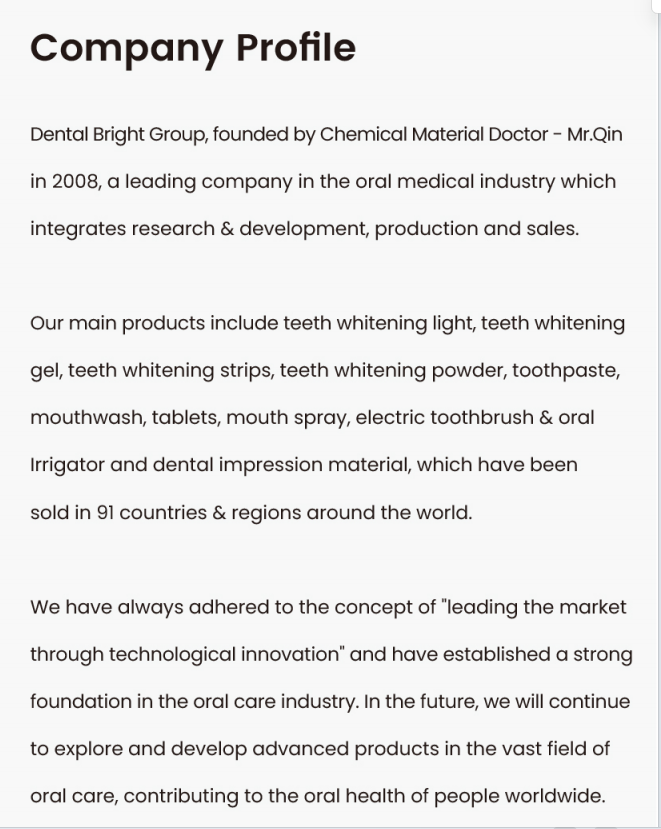
This is a buyer's decision matrix, not a ranking. It compares the three formats using the production data of GlorySmile Factory — Jiangxi Dentalbright Technology Co., Ltd., an oral care contract manufacturer based in Makou Industrial District, Yongxiu Town, Jiujiang City, Jiangxi Province, China, producing teeth whitening kits, whitening strips, whitening pens, powder, toothpaste, mouthwash and electric toothbrushes for OEM, ODM, private-label and distributor partners. The company operates a 36,000 m² facility, has been in the oral care industry for 18 years, and exports 90% of its output to the EU, USA and UK.
One principle applies to every format below: MOQ is determined by product category, customization requirements and production line configuration, and the exact quantity is confirmed during quotation and sampling. Treat any figure in this article as the starting point of that conversation, not as a substitute for it.
Why the Format Decision Comes Before the Brand Decision
Most buyers evaluate formats by how the unit looks on a shelf. That is the wrong first question, because packaging suppliers quote on packs while factories quote on lines — and the line determines what you can actually order.
Three failure modes appear when format is chosen for shelf appeal first:
- MOQ surprise. A format that looks premium may require tooling and a custom packaging minimum that does not match a test-market budget. Standard-packaging orders and OEM custom-packaging orders do not sit in the same MOQ bracket.
- Lead-time surprise. Filling a sachet, filling a bottle and laminating a strip are three different processes with three different throughput rates and changeover times.
- Compliance surprise. The regulatory route follows the product classification and the actives used — not only the pack format — so a format switch late in development can reopen documentation work.
The practical rule is simple: pick the format that matches your dose, your channel and your launch volume, then let design work inside those constraints.
Industry Background: What Is Driving Format Demand
The global teeth whitening market was valued at USD 8.93 billion in 2025 and is projected to reach USD 14.31 billion by 2034, according to Fortune Business Insights. Within that market, the individual or at-home segment accounted for 68.67% of the total in 2024, per Straits Research — which is why contract-manufacturing decisions in this category are increasingly made at the format level rather than at the brand level.
On regional demand, Facts & Stats reported that Asia Pacific led the teeth whitening market with a 33.80% share in 2025. Buyers should note that research houses disagree on regional leadership depending on whether professional dental services are included in the definition, so regional share figures should be read as directional rather than definitive.
Two product-level trends directly affect format choice:
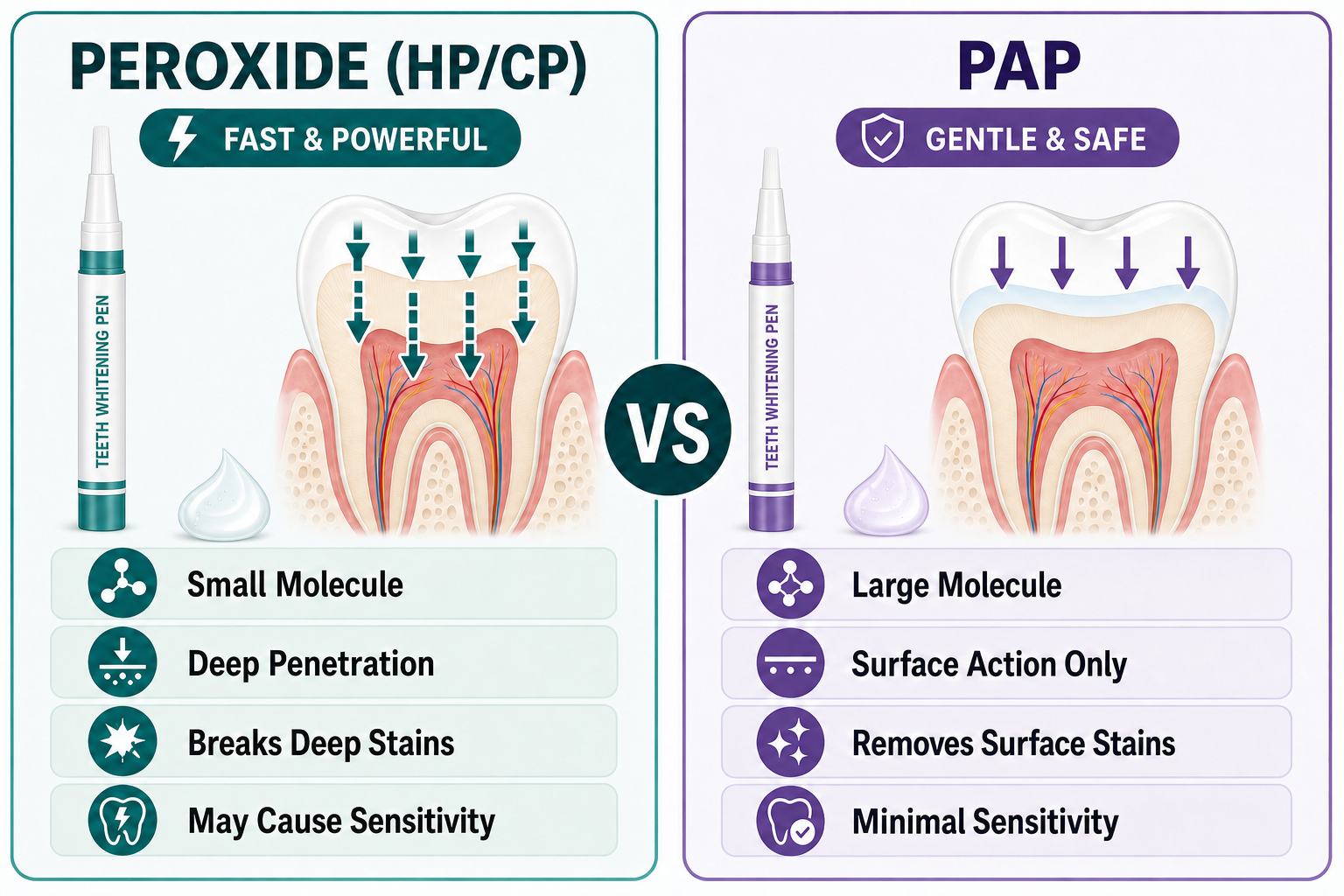
- Peroxide-free demand. The Insight Partners reports that global demand for PAP+ (phthalimidoperoxycaproic acid) based, peroxide-free whitening kits is rising as an alternative to traditional peroxide, driven by sensitivity concerns.
- Regulatory thresholds. In the European Union, teeth whitening products containing between 0.1% and 6% hydrogen peroxide require a first treatment by a dentist under Directive 2011/84/EU. In the United States, the FDA recognizes ISO 28399:2021 as a consensus standard for external tooth bleaching products, and US Customs has classified Chinese-origin whitening strips under HS subheading 3306.90.0000.
None of these rules are format-specific in themselves — but they shape which actives you can put in which pack, which is the real constraint a format comparison has to solve.
The Three Formats, Side by Side
Format 1 — Sachet-Based Gel
A sachet format doses a fixed amount of gel or liquid into a single-use aluminum pouch. It is a confirmed capability of this factory: the DB-010P coconut mouthwash ships as a 20-pack of 12 ml sachets with an aluminum bag material, and the listed support service for that SKU includes custom formula, custom packaging and custom sachet. The factory's stated monthly capacity for the sachet line is 2,500,000 units.
What sachet filling is good at:
- Dose accuracy and hygiene. One pouch, one treatment — no open-jar handling and no cross-contamination between uses.
- Sample and trial economics. Low unit weight reduces freight cost on sample kits, travel retail packs and subscription boxes.
- Merchandising range. Because the pouch is small, multi-flavour or multi-SKU trial packs are practical to assemble.
The trade-off: sachets are a single-use format, so repeat-purchase frequency drives total volume, and the pouch itself carries less perceived premium value than a glass or rigid bottle.
Format 2 — Bottled Liquid or Serum
Bottled formats cover two distinct sub-types: a low-viscosity serum or colour corrector in a small dropper-style bottle, and a larger liquid or foam in a pump or screw-cap bottle.
Confirmed GlorySmile SKUs in this format include:
- GS-006V Purple Colour Corrector Serum — 30 ml net volume, PET inner bottle, mint or custom flavour, MOQ 200 pcs for private label and 1 pc for regular product. Supports custom formula, packaging, printing, label and bottle colour.
- GS-006V Purple Colour Corrector Foam — 30 ml net volume, PET inner bottle, same customization scope. Purple works by being directly opposite yellow on the colour wheel; a water-soluble purple dye is applied to cancel yellow undertones on teeth.
- DB-010S Liquid Mouthwash — 237 ml net volume in a PP bottle, alcohol-free, positioned as a breath freshener and stain remover.
- GS-010F Foam Mouthwash — PP bottle, strawberry / grape bubblegum / watermelon / blue raspberry flavours, with custom formula, packaging, label and bottle colour support.
The factory's stated monthly capacity for the bottled line is 416,000 units, and its annual output figure for 10 ml mouthwash formats is 90,000,000 pcs — useful context when you need to judge whether a bottle-based launch plan fits an existing filling schedule.
Bottles are strongest where the product is used over weeks rather than in a single sitting, where the brand needs visible volume on shelf, and where a colour-correcting or daily-maintenance positioning is the core claim. The trade-off is unit weight, glass or bottle cost, and a higher per-unit freight load than sachets.
Format 3 — Strip-Based
Strip-based kits remain the highest-volume format in this factory's portfolio, with annual output of 300,000,000 pcs of teeth whitening strips. Three strip types are listed:
- GS-004H/V/C/P — dry strips. Content options of 7 / 14 / 21 bag strips plus user manual, shade guide and colour box, packed in an aluminum bag. The strip itself is a three-layer build: PET hard film, whitening gel, and PE soft film.
- GS-V34-S07 — wet strips. Same content structure, wet-strip construction.
- DB-004L — dissolving strips. Same content structure, dissolving strip construction.
Formula options across the strip range include PAP, PAP + charcoal, purple, 6% HP, sodium phytate, sodium bicarbonate, or a custom blend. Flavour options cover blue raspberry, strawberry, peach, grape, watermelon, peppermint, orange, mint, pineapple, cherry blossom, coconut and mango. The listed service scope is OEM, ODM and dealer supply.
The internal trade-off between strip types matters more than most buyers expect. Dry strips offer good adhesiveness, are not easy to slip off, and leave minimal residue, but they come at a higher cost. Wet strips have weaker adhesion than dry strips, so they tend to shift during application and leave relatively more residue, but their advantage is lower cost — and the higher residue actually helps purple pigments adhere better to the teeth for a physical whitening effect. Glossy "better" is not the question; the question is which trade-off your price point and claim can support.
Buyer takeaway: format decides the dose and the process; the active decides the claim and the compliance route. Decide them in that order and most late-stage rework disappears.
Step-by-Step Breakdown: How to Evaluate a Format
- Start from the dose and the claim. Define what one treatment is — 10 minutes per day for 40 uses in the case of a 3 ml syringe kit, or a single-use pouch. The dose determines whether sachet, bottle or strip is even viable.
- Match the active to the format and the market. GlorySmile offers PAP (peroxide-free), carbamide peroxide and hydrogen peroxide formulas across its ranges. If your target market is the EU, remember that 0.1%–6% hydrogen peroxide products require a first treatment by a dentist under Directive 2011/84/EU, while peroxide-free PAP avoids that specific threshold.
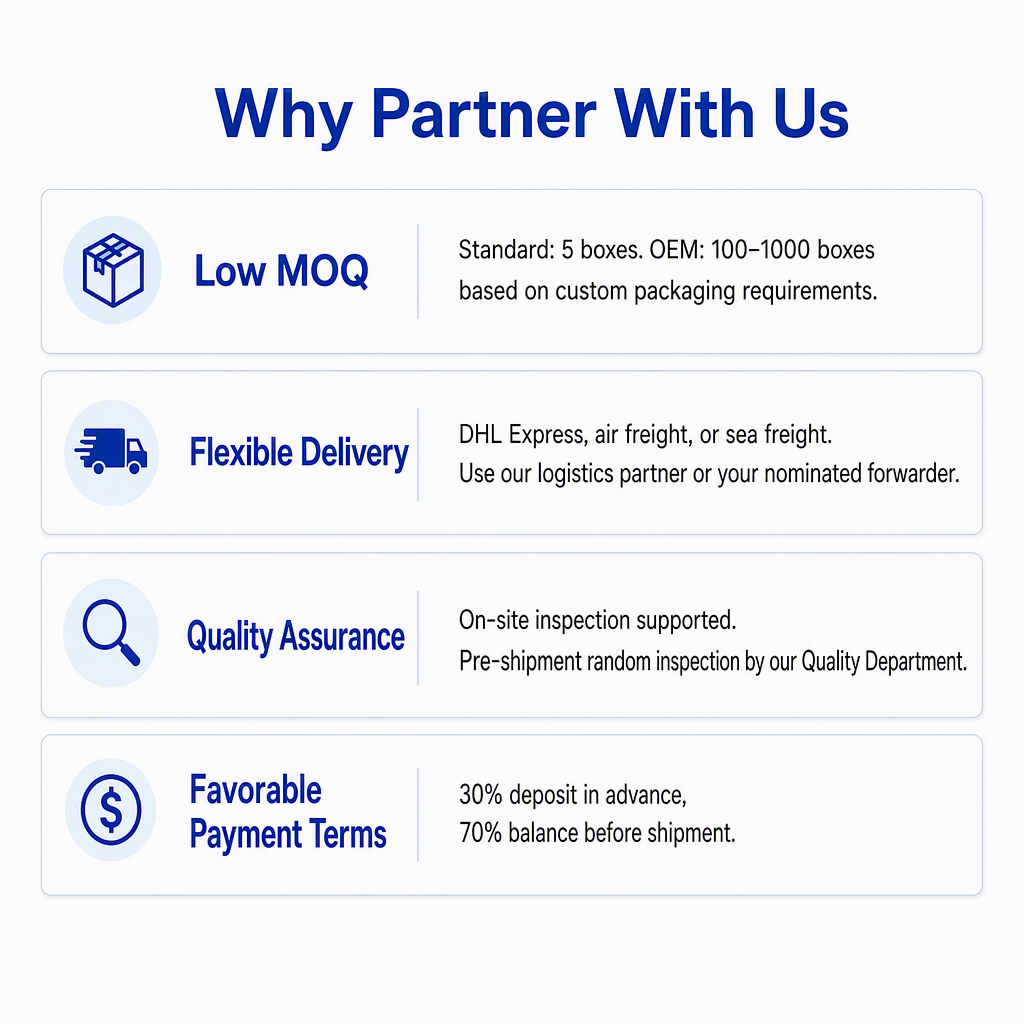
- Set a realistic MOQ expectation. For standard packaging, the MOQ is 5 boxes. For OEM orders with customized packaging, the MOQ ranges from 100 to 1,000 boxes and depends mainly on the minimum the custom packaging supplier will run. Most individually listed SKUs — from purple colour corrector serum to whitening strips — state MOQ of 200 pcs for private label and 1 pc for regular product.
- Test capacity against your launch plan. Compare your monthly forecast with the line you intend to use: 2,500,000 sachets per month, 416,000 bottled units per month, or 300,000,000 strips per year.
- Confirm the lead-time drivers, not a lead-time number. Lead time varies with order volume, product specifications, customization complexity and the current production schedule. Comparison data on file records a 5–7 day lead time for GlorySmile gel programs, but that is a reference point, not a guarantee for your specification.
- Lock the compliance documentation before tooling. The documentation you need is set by the classification of the finished product, not by the pack: cosmetic, OTC drug or medical device.
- Validate with a sample. Free sampling and professional package design are part of the OEM/ODM service scope. Confirm adhesion, flavour, fill weight and pouch seal on a physical sample before committing to a production run.
Comparison Table: Sachet vs Bottle vs Strip
| Decision dimension | Sachet-based gel | Bottled liquid / serum | Strip-based |
|---|---|---|---|
| Referenced product evidence | DB-010P coconut mouthwash: 20 × 12 ml sachets, aluminum bag | GS-006V purple colour corrector serum (30 ml); DB-010S liquid mouthwash (237 ml); GS-010F foam mouthwash | GS-004H/V/C/P dry strips; GS-V34-S07 wet strips; DB-004L dissolving strips |
| Primary pack material | Aluminum sachet bag | PET inner bottle (serum); PP bottle (mouthwash) | Aluminum strip bag; three-layer strip of PET hard film, whitening gel, PE soft film |
| Stated line capacity | 2,500,000 units / month | 416,000 units / month | 300,000,000 pcs / year |
| MOQ logic | MOQ is set by product category, customization requirements and production line configuration; the exact quantity is confirmed at quotation and sampling. Standard packaging starts at 5 boxes, OEM custom packaging at 100–1,000 boxes, and most listed SKUs at 200 pcs for private label. | ||
| Customization scope | Custom formula, custom packaging, custom sachet | Custom formula, packaging, printing, label, bottle colour | OEM, ODM and dealer service; custom formula, flavour and packaging |
| Actives available at factory level | PAP (peroxide-free), carbamide peroxide and hydrogen peroxide, plus sodium phytate, sodium bicarbonate and charcoal options; concentration range quoted at HP 0.1–35% and CP 0.1–44% across kit programs. | ||
| Compliance notes | Cosmetic route: CPSR, CPNP notification and PIF for the EU; MoCRA-compliant cosmetic registration for the US. Device route: CE-MDR for the EU, FDA medical device registration for the US. | US Customs has classified Chinese-origin whitening strips under HS 3306.90.0000. | |
| Lead-time drivers | Order volume, product specification, customization complexity and current production schedule. A 5–7 day reference lead time is recorded for GlorySmile gel programs. | ||
Use Cases: Which Format Fits Which Buyer
Choose sachet-based gel when
- You are launching trial kits, travel retail packs or subscription boxes where weight and dose control drive margin.
- You need single-use hygiene as part of the consumer proposition.
- Your forecast sits comfortably inside a 2,500,000-unit monthly sachet line.
Choose bottled liquid or serum when
- Your claim is built on daily maintenance, colour correction or a serum-style ritual rather than a single whitening session.
- You want visible bottle volume on shelf in pharmacy, beauty or e-commerce listings.
- You want to extend a range with adjacent bottled SKUs — foam mouthwash, liquid mouthwash, colour corrector foam — from the same supplier.
Choose strip-based when
- You are supplying mass retail, FMCG or promotional programs at volume. A high-volume promotional project run by this factory delivered 7 million units with zero return rate.
- You need a 7 / 14 / 21-count pack architecture that maps cleanly to price tiers.
- You need flavour differentiation — twelve flavour options are listed across the strip range.
The Tie-Breakers: OEM, ODM, Custom Formulation, Private Label and Lifecycle QA
Once two formats are technically viable, the decision usually turns on supplier capability rather than format mechanics. Five factors separate suppliers at this stage.
1. OEM and ODM depth. Full OEM/ODM service here covers formulation, customization, free sampling and professional package design — from concept to shelf. That matters when your format choice requires a packaging structure that does not yet exist off the shelf.
2. Custom formulation. The listed formulation range covers HP 0.1–35%, CP 0.1–44%, peroxide-free PAP and coconut-oil formulas — a spread that spans cosmetic-grade through OTC-grade positioning. If your format decision is driven by a sensitive-teeth or peroxide-free claim, PAP and low-sensitivity formulas are the relevant starting point.
3. Private label economics. Most listed SKUs carry an MOQ of 200 pcs for private label and 1 pc for regular product, which supports staged launches: test a private-label run, verify sell-through, then scale into a full OEM program.
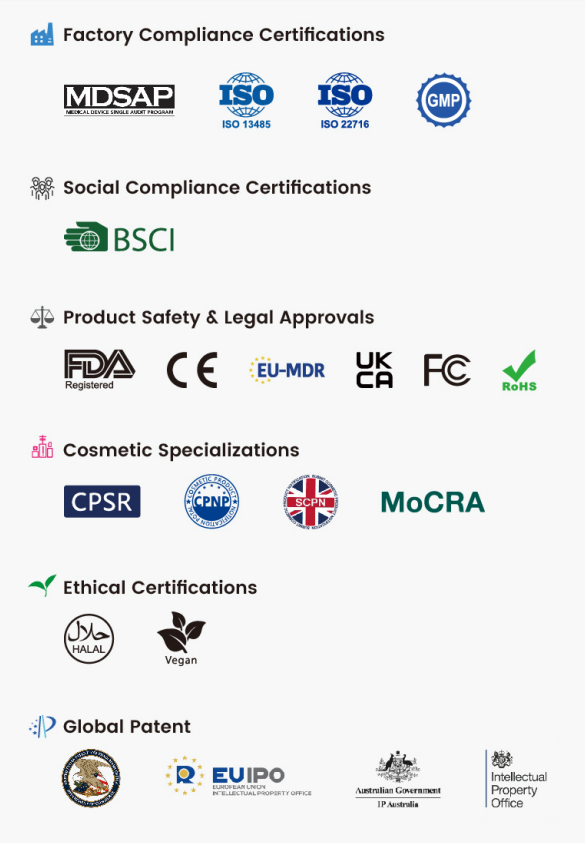
4. Compliance ownership. The manufacturer holds factory certificates CE, FDA, CPSR, CPNP, PIF, SCPN, MSDS, COA, RoHS, HALAL and Vegan, plus product certificates GMP, ISO 22716, ISO 13485, MDSAP and BSCI. For the EU, CPSR, CPNP notification and PIF are provided for cosmetic products, and CE-MDR registration is complete for medical devices. For the US, teeth whitening lights, electric toothbrushes and oral irrigators hold FDA medical device registration, whitening strips have MoCRA-compliant cosmetic facility registration and product listing, and the silicone rubber impression material has completed 510(k) registration. Choosing a supplier with an established compliance route is cheaper than building one after your format is locked.
5. Full-lifecycle quality assurance. The 36,000 m² facility includes 20,000 m² of 100,000-class cleanrooms, and a 1,000 m² laboratory with a 100-class cleanroom dedicated to microbiological testing. That in-house setup allows verification of raw materials, semi-finished goods and finished products, backed by 11 QC specialists and 17 R&D engineers. Order flow runs in three stages — small trial order, medium-batch verification, mass production — with on-site inspection supported and pre-shipment random inspection available from the Quality Department. Payment terms are 30% deposit in advance with 70% balance before shipment, and delivery terms are EXW / FCA / FOB / CFR.
Frequently Asked Questions
Do sachet, bottle and strip formats follow the same compliance path?
No. The compliance path follows the product classification and the actives used, not the pack format alone. GlorySmile holds factory certificates CE, FDA, CPSR, CPNP, PIF, SCPN, MSDS, COA, RoHS, HALAL and Vegan, and product certificates GMP, ISO 22716, ISO 13485, MDSAP and BSCI. For EU cosmetic products, CPSR, CPNP notification and PIF are provided; for medical devices, CE-MDR registration is complete. In the EU, products containing 0.1%–6% hydrogen peroxide require a first treatment by a dentist under Directive 2011/84/EU, and in the US the FDA recognizes ISO 28399:2021 for external tooth bleaching products.
Can one factory run sachet, bottle and strip lines for the same brand launch?
Yes. GlorySmile operates a 36,000 m² facility with 20,000 m² of 100,000-class cleanrooms, 256 employees, 17 R&D engineers and 11 QC specialists. Annual output includes 10,000,000 sets of teeth whitening kits, 300,000,000 pcs of teeth whitening strips, 20,000,000 pcs of teeth whitening pens and 30,000,000 pcs of toothpaste. Stated monthly line capacity is 2,500,000 sachets and 416,000 bottled units, so a brand can run a strip-led hero SKU and a bottle-based serum extension from the same quality system.
How is the MOQ for a teeth whitening kit actually determined?
MOQ is determined by product category, customization requirements and production line configuration, and the exact quantity is confirmed during quotation and sampling. For standard packaging, the MOQ is 5 boxes. For OEM orders with customized packaging, the MOQ ranges from 100 to 1,000 boxes and depends mainly on the minimum order quantity the custom packaging requires. Individually listed SKUs, including whitening strips, purple colour corrector serum and whitening kits, state an MOQ of 200 pcs for private label and 1 pc for regular product.
Can we validate a format before committing to a production run?
Yes. Free sampling and professional package design are part of the OEM/ODM service scope, and cooperation runs in three stages: small trial order, medium-batch verification, then mass production. Buyers can also inspect on site, and the Quality Department can perform a pre-shipment random inspection. Payment terms are 30% deposit in advance with 70% balance before shipment, under EXW / FCA / FOB / CFR delivery terms.
What drives lead time on repeat orders, and can a distributor rely on long-term supply?
Lead time varies with order volume, product specification, customization complexity and the current production schedule; a 5–7 day lead time is recorded for GlorySmile gel programs as a reference point. For long-term wholesale programs, the relevant durability signals are the certification set rather than a single delivery date: exports to 102 countries, a 90% export ratio, and customer feedback indicating a 99.8% positive feedback rate with no safety or compliance incidents. Distributors evaluating a multi-year supply relationship should request the current product catalog and confirm format availability against their own forecast before signing.
Conclusion
Sachet, bottle and strip are three different manufacturing commitments, and the comparison is decided by four numbers: your dose, your MOQ bracket, your monthly volume against the relevant line capacity, and your compliance route. Sachet filling favors single-dose accuracy, low freight weight and sample-friendly economics. Bottled serum and liquid formats favor daily-use claims, shelf presence and colour-corrector positioning. Strip formats favor high-volume retail, flavour differentiation and pack-tier pricing — supported here by 300,000,000 pcs of annual strip output.
Where formats tie, the tie-breakers are OEM and ODM depth, custom formulation range, private-label MOQ flexibility, compliance ownership, and lifecycle quality assurance. Those are the factors that decide whether a format choice still works in year three of a distributor relationship, not just in the first order.
Next step: confirm your format against real capacity
GlorySmile Factory (Jiangxi Dentalbright Technology Co., Ltd.) provides free sampling and package design for OEM, ODM and private-label teeth whitening kit projects. Send your target format, market and forecast to receive a quotation and confirmed MOQ.
Email: tasha@enjoywhite.com | WhatsApp / Tel: +86 177 7911 0152 | Web: www.glorysmile.com
Factory address: Makou Industrial District, Yongxiu Town, Nanchang (Jiujiang) City, Jiangxi Province, China — a 15-minute drive from Nanchang Changbei International Airport.
Have Questions or Need More Details?
Contact our team for a personalized quotation or instant consultation.
Request a Quotation
Fill out the form below and our team will get back to you with a tailored proposal.
WhatsApp Direct Chat
Prefer to chat in real-time? Message us on WhatsApp for instant assistance & quick answers.
- Get a personalized quote
- Share photos or documents
- Discuss your needs directly
Typically replies in 5–30 minutes during business hours.