Teeth Whitening Kit vs. Purple Colour Corrector Foam: A Private-Label Portfolio Decision
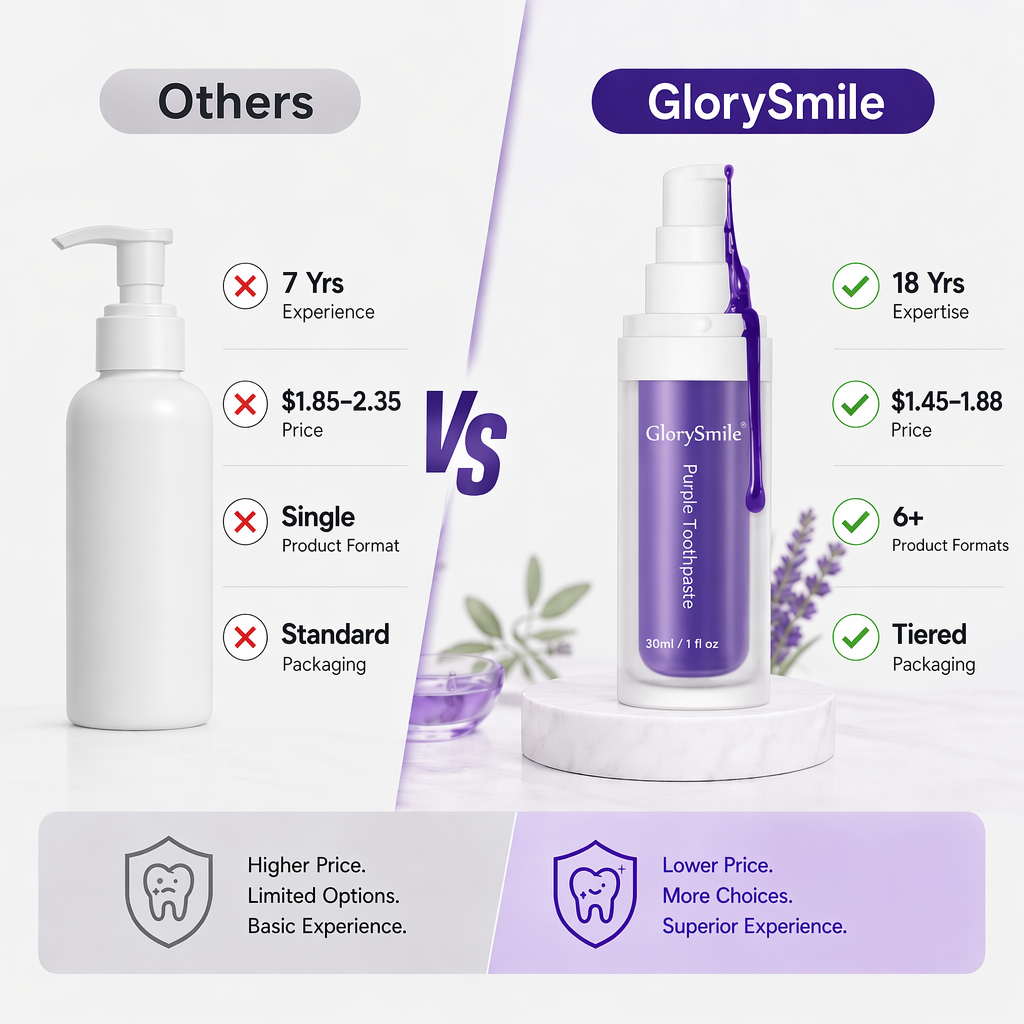
Private-label buyers often frame the choice as a straight contest: teeth whitening kit or purple colour corrector foam. In practice, the decision is a portfolio question. A whitening kit is a treatment-led system; a purple colour corrector foam is a cosmetic daily-care format. The right first move depends on the claim the brand can support, the routine it wants to own, and the compliance file it can assemble for the EU and US. For some brands the kit should anchor the line; for others the foam is the lower-commitment entry SKU; for many, the stronger plan is a sequenced portfolio rather than a simultaneous launch.
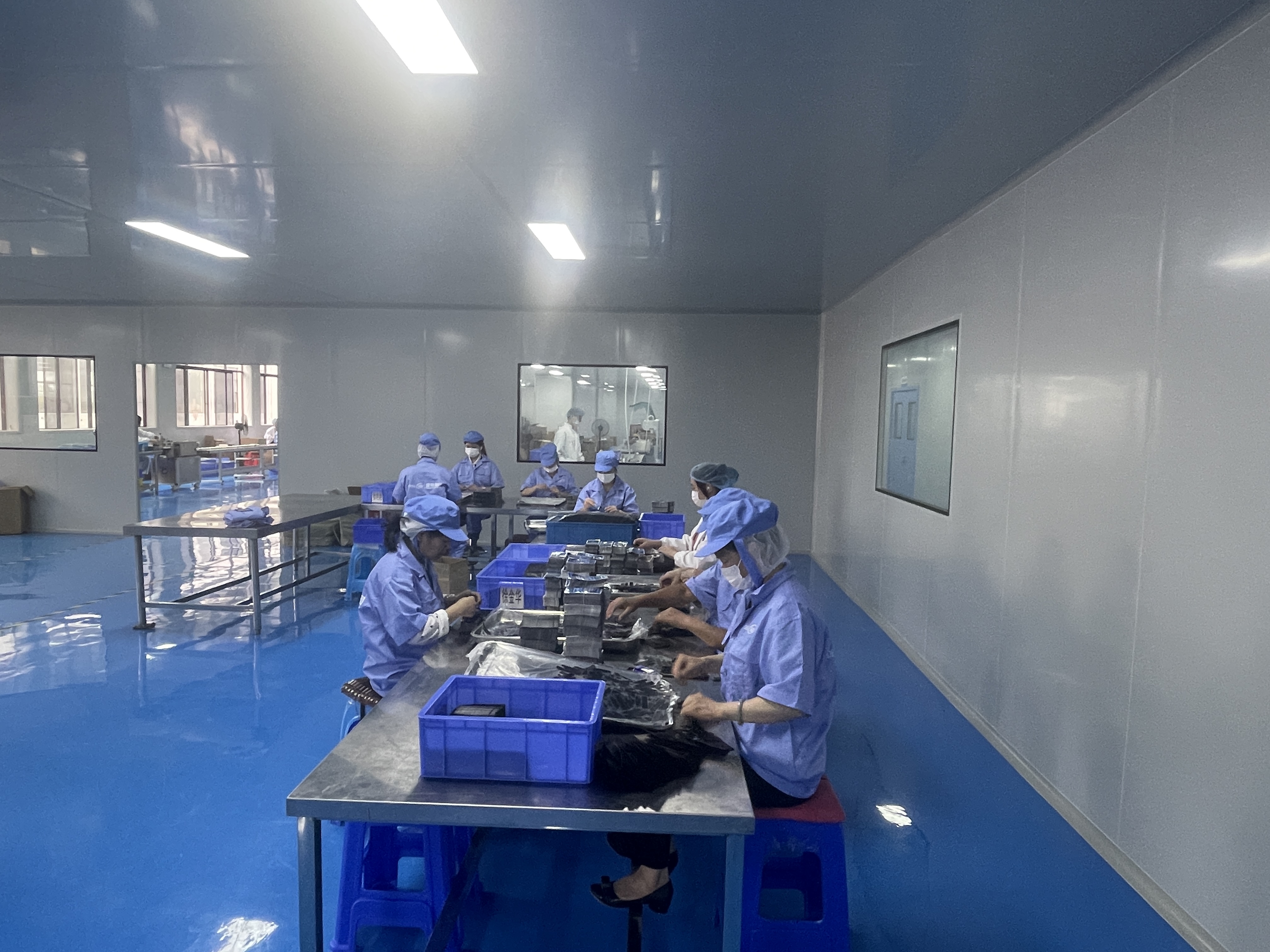
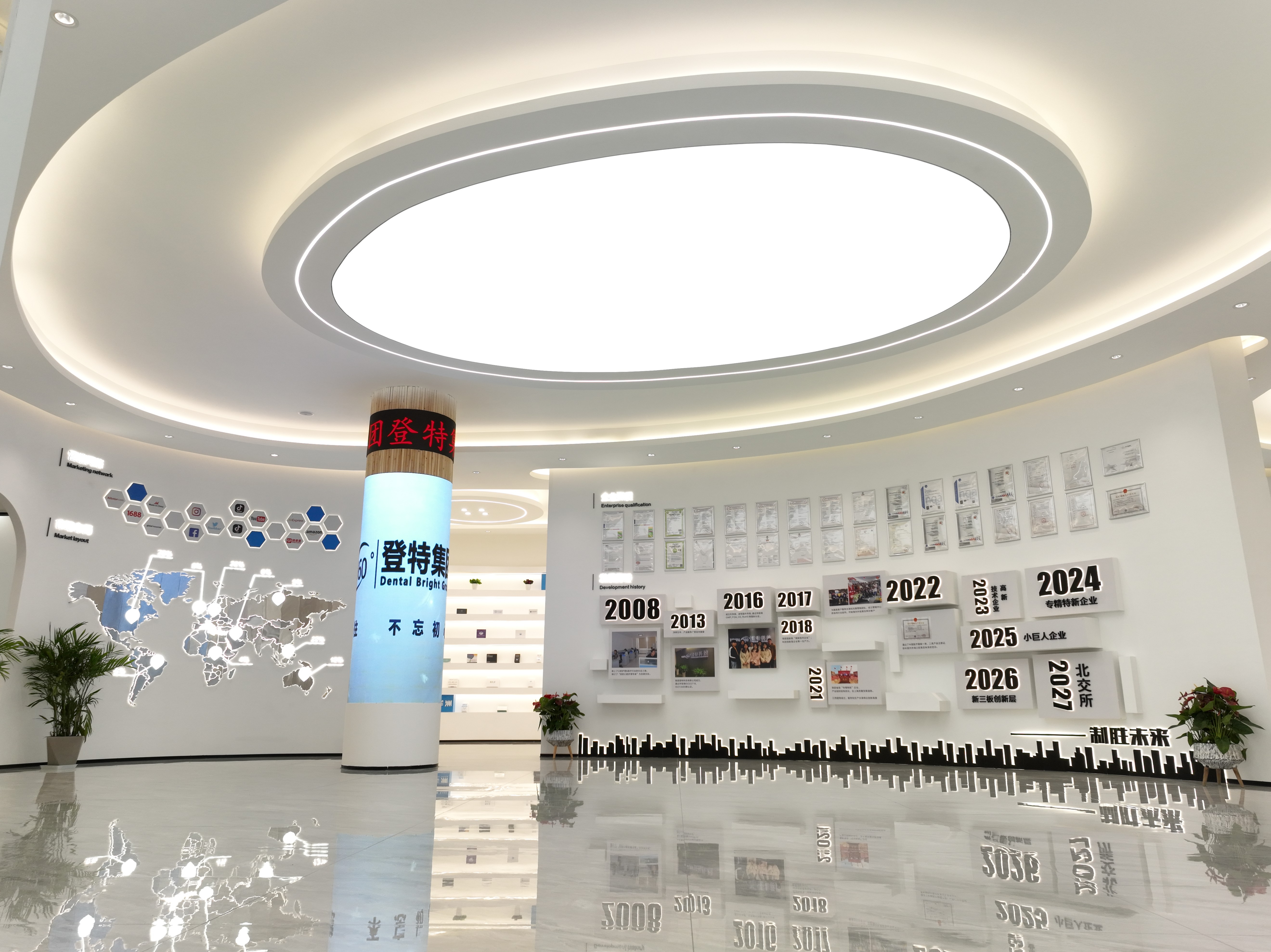
GlorySmile (Jiangxi DentalBright Technology Co.,Ltd.) is an oral-care OEM/ODM manufacturer with a 36,000 m² facility in Jiangxi, China. Its product range includes teeth whitening kits, whitening strips, whitening gel, whitening light, toothpaste, mouthwash and electric toothbrushes, and it offers OEM/ODM, custom formulation, free sampling, package design and private-label production services. That manufacturing base is useful for this comparison because both the kit and the foam need formula control, packaging choice and market-specific documentation.
The portfolio problem: two oral-care SKUs with different jobs
Both products sit in oral care, but they solve different buyer problems. A teeth whitening kit is a system: a light, a mouth tray, gel syringes, a shade guide, instructions and usually a gift box. A purple colour corrector foam is a cosmetic format: the supplied specification lists a 30 ml net volume, mint flavour as standard, custom flavour as an option and an inner bottle made of PET.
The buyer's real question is not which product is more popular in general. It is which product fits the brand's routine, claims, sales channel and compliance workload. A kit asks the buyer to manage a multi-component bill of materials and a whitening regimen. A foam asks the buyer to manage a cosmetic formula, flavour and packaging story, and to keep colour-correction claims within the documentation the supplier can provide.
That distinction matters at the decision stage because the two formats can require different evidence. A whitening kit may need bleaching-related standards, concentration labelling and sensitivity positioning. A colour-correction foam may need cosmetic product documentation, ingredient review and claim support. Treating one as a direct substitute for the other can create a portfolio gap or an unsupported claim.
Industry background: why both formats are on the buyer's desk
Demand signals support both formats, but for different reasons. Fortune Business Insights valued the global teeth whitening market at USD 8.93 billion in 2025 and projected it to reach USD 14.31 billion by 2034. Straits Research reported that the individual or at-home segment accounted for 68.67% of the teeth whitening market in 2024. Those figures describe a broad market, not a guarantee for any single SKU, but they explain why private-label buyers continue to look for at-home whitening formats.
Formulation interest is also shifting. The Insight Partners reports rising demand for PAP+ (phthalimidoperoxycaproic acid) based peroxide-free whitening kits as an alternative to traditional peroxide, driven by sensitivity concerns. That is commercial research, not a product-specific test result, but it is a useful signal for portfolio planning: buyers are asking more questions about sensitive-teeth suitability and peroxide-free positioning.
Regulation adds another layer. For the EU market, Directive 2011/84/EU states that teeth whitening products containing between 0.1% and 6% hydrogen peroxide require a first treatment by a dentist. For the US market, the FDA recognises ISO 28399:2021 as a consensus standard for external tooth bleaching products. A whitening kit and a colour-correction foam may not sit in the same regulatory category, so the compliance file should be built product by product rather than borrowed from one SKU to the other.
Decision rule: when to lead with the kit, the foam, or both
Use a portfolio rule rather than a popularity rule:
- Lead with the teeth whitening kit when the brand wants a treatment-led routine with a visible device, tray, gel and shade guide, and when the buyer can support the relevant bleaching or cosmetic claims for the target market.
- Lead with the purple colour corrector foam when the brand wants a cosmetic daily-care SKU for yellow-tone neutralisation, a simpler format for first-time buyers, or a colour-correction story that complements an existing oral-care range.
- Sequence both when the brand wants a fuller portfolio. Prove the formula, packaging and compliance file for the first SKU, then add the second with its own documentation and sampling. Do not assume the foam shares the kit's bleaching mechanism, or that the kit's documents cover the foam.
The supplied application data for whitening kits describes once-daily use with 10–30 minutes per treatment, supported by a whitening light, whitening gel, shade guide and manual. The supplied foam specification covers 30 ml, mint flavour and flavour customisation; it does not state a peroxide concentration. That is exactly why the two SKUs should be evaluated separately.
Comparison table: private-label decision factors
| Decision factor | Teeth whitening kit | Purple colour corrector foam |
|---|---|---|
| Primary portfolio role | Treatment-led whitening system with LED light, mouth tray, whitening gel, shade guide, manual and gift box. | Cosmetic colour-correction foam for daily oral care. The supplied application data lists yellow-tone neutralisation (V34) as a function in oral hygiene and FMCG scenarios. |
| Typical supplied configuration | For example, GS-001B and GS-001Y include 1 pc 5 LED teeth whitening light, 1 pc mouth tray, 3 pcs 3 ml whitening syringes, 1 pc shade guide, 1 pc user manual and 1 pc gift box. | 30 ml net volume, mint flavour as standard, custom flavour available, inner bottle made of PET. |
| Routine fit | Once-daily treatment routine of 10–30 minutes per treatment, based on the supplied application data. The buyer must confirm the final instructions for use and any device features in the quotation. | Daily oral-care routine with a cosmetic tone-correction step. The exact application method should be taken from the final product instructions, not from the category name. |
| Formulation questions | GlorySmile offers PAP (peroxide-free), carbamide peroxide and hydrogen peroxide formulas. A supplied comparison lists HP 0.1%–35%, CP 0.1%–44% and peroxide-free PAP within its formula range. Sensitive-teeth options include PAP and low-sensitivity formulas. | Mint flavour is standard and flavour can be customised. The supplied specification does not state a peroxide concentration; request the exact formula sheet, ingredient list and claim support before using peroxide-free or sensitive-teeth language. |
| EU compliance file | For cosmetic products, GlorySmile can offer CPSR, CPNP and PIF. For medical devices, CE-MDR registration has been completed. If the kit contains 0.1%–6% hydrogen peroxide, Directive 2011/84/EU requires a first treatment by a dentist. | If positioned as a cosmetic, the file should be checked for CPSR, CPNP and PIF where applicable. If the formula or claims move it into another category, the classification should be rechecked before labelling. |
| US compliance file | The supplied FAQ states that products are FDA approved and that the FDA-certified scope covers medical devices, cosmetics and OTC drugs. The FDA also recognises ISO 28399:2021 for external tooth bleaching products. | Confirm the product-specific FDA status, labelling and cosmetic or drug classification for the foam. Do not rely on the kit's file as evidence for the foam. |
| MOQ guidance | For regular orders in existing packaging, the supplied FAQ states an MOQ of 5 boxes. For OEM orders with customised packaging, the MOQ varies by product from 100 to 1,000 boxes. Confirm the exact MOQ for the chosen kit model and packaging. | The same general MOQ guidance applies, but the exact figure depends on the foam formula, filling volume, flavour and packaging. Confirm it in the quotation rather than applying a kit MOQ to the foam. |
| Lead time | Lead time is quoted per product, packaging and customisation. Confirm it during quotation and sampling. | Lead time is quoted per product, packaging and customisation. Confirm it during quotation and sampling. |
| Customisation scope | OEM/ODM, custom formulation, private-label production, package design and free sampling are available. Kit components and gift-box packaging can be specified within the approved project scope. | Flavour customisation and packaging choice are supported. Formula, filling and artwork should be confirmed against the approved sample before mass production. |
| Typical buyer fit | Brands building a whitening treatment SKU, a gift-box kit or a device-plus-consumable routine. | Brands testing a cosmetic colour-correction add-on, a daily-care SKU or a complementary oral-care item. |
Step-by-step portfolio evaluation
1. Define the claim before the product
Start with the claim the brand intends to make. A whitening kit may be sold around a whitening routine, shade guide and gel delivery. A purple colour corrector foam may be sold around cosmetic yellow-tone neutralisation and daily freshness. The claim determines the formula questions, the label language and the documents the buyer must request.
This step prevents a common private-label error: choosing a format first and then looking for evidence to support the marketing story. At the decision stage, the evidence should lead the format choice.
2. Lock the formulation and sensitivity position
For the kit, ask which whitening chemistry is being offered. GlorySmile offers PAP (peroxide-free), carbamide peroxide and hydrogen peroxide formulas. The supplied comparison also lists HP 0.1%–35% and CP 0.1%–44% within the formula range. For a teeth whitening kit for sensitive teeth, the relevant option is the PAP or low-sensitivity formula designed for sensitive teeth. Confirm the final concentration, usage instructions and market labelling before making a sensitivity claim.
For the foam, ask for the exact formula sheet. The supplied specification gives 30 ml, mint flavour, custom flavour and a PET inner bottle, but it does not state a peroxide concentration. If the brand wants a peroxide-free teeth whitening kit message, that claim belongs to the kit formula only if the kit documentation supports it. The foam needs its own formula confirmation before the same language is used.
3. Map compliance documents by market and classification
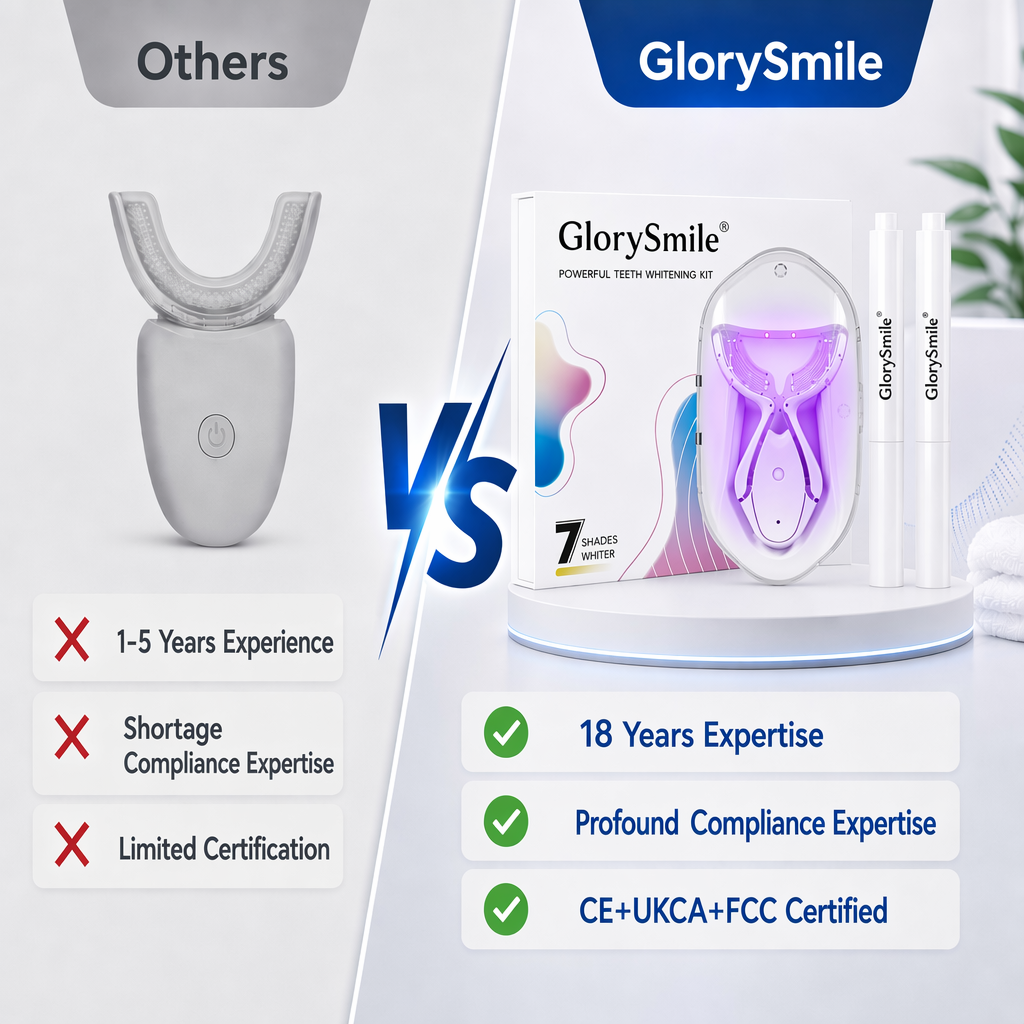
Build the compliance file separately for each SKU and each market. For EU cosmetic products, GlorySmile can offer CPSR, CPNP and PIF. For medical devices, CE-MDR registration has been completed. For the US market, the supplied FAQ states that products are FDA approved and that the FDA-certified scope covers medical devices, cosmetics and OTC drugs. Also request MSDS and COA where applicable.
Factory certificates listed in the supplied FAQ include CE, FDA, CPSR, CPNP, PIF, SCPN, MSDS, COA, RoHS, HALAL and Vegan. Product certificates include GMP, ISO 22716, ISO 13485, MDSAP and BSCI. For example, the GS-001X teeth whitening kit is certified with MDSAP, ISO 13485, ISO 22716, GMP and BSCI, and holds EU patent 015062946-0001 and UK patent 6370462. These are useful proof points, but they should be matched to the exact product, model and market before they are used in a buyer pack.

4. Confirm MOQ and lead time per product, not per portfolio
MOQ and lead time should be confirmed per product and customisation need. The supplied FAQ gives a useful starting point: regular orders in existing packaging have an MOQ of 5 boxes, while OEM orders with customised packaging vary by product from 100 to 1,000 boxes. That does not mean every kit and every foam shares the same MOQ. A gift-box kit with a light, tray, syringes and shade guide has a different component set from a 30 ml foam with custom flavour.
Lead time should be treated the same way. The exact lead time is determined by the product, packaging, formula and customisation, and should be confirmed during quotation and sampling. Buyers should not publish a launch date based on a category-level assumption.
5. Sample both formats against the same buyer scenario
GlorySmile offers free sampling and professional package design. Use the sample to check the full kit experience: light, tray, gel syringes, shade guide, manual and gift box. For the foam, check the 30 ml fill, mint or custom flavour, bottle, cap and label. If the brand is considering both, sample them together so the team can compare the unboxing, instructions and price architecture side by side.
During sampling, confirm the exact claims that will appear on pack. For the kit, that includes the whitening formula, concentration and sensitive-teeth wording. For the foam, it includes the colour-correction wording, flavour and any peroxide-free statement. A sample approval should cover both the physical product and the claim file.
6. Validate packaging, artwork and instructions
The kit's supplied configuration includes a gift box, and the foam's supplied configuration includes a 30 ml bottle with a PET inner bottle. Packaging is not just a visual choice; it affects the bill of materials, the instructions for use and the market label. Check that the artwork carries the correct product name, model, formula version, net content and required warnings.
For the kit, the instruction manual is part of the product experience. For the foam, the label must explain the cosmetic role clearly and avoid implying a whitening treatment outcome that the documentation does not support. Both SKUs should be checked against the final approved sample before mass production.
7. Plan the launch sequence
If both products are approved, launch in a sequence that matches the brand's evidence. A whitening-led brand can start with the kit and add the foam as a cosmetic companion SKU. A colour-correction-led brand can start with the foam and add the kit only when the bleaching or treatment claims, compliance file and sampling feedback are ready. A distributor can carry both, but should keep separate product dossiers and separate claim sets.
Use cases: which portfolio shape fits which buyer
Whitening-led brand
A brand that wants to own a whitening routine should start with the kit. The 5 LED light, mouth tray, 3 ml syringes, shade guide, manual and gift box create a complete treatment presentation. The buyer should confirm the formula, sensitive-teeth option and EU or US documentation before setting the retail claim. The foam can be added later as a separate cosmetic SKU, but it should not be described as the same treatment.
Colour-correction-led brand
A brand entering with a cosmetic colour-correction story can start with the purple colour corrector foam. The 30 ml format, mint flavour and custom flavour option give the buyer a compact SKU to test. The buyer should request the formula sheet, ingredient list and cosmetic compliance file before using yellow-tone neutralisation claims. If the test succeeds, the kit can become the next treatment-led addition.
Sensitive-teeth line
For a sensitive-teeth line, the kit has a clearer starting point because GlorySmile offers PAP and low-sensitivity formulas designed for sensitive teeth. The buyer should confirm the final formula and concentration, then match the label to the market. The foam should enter only when its own formula and sensitivity support are documented; the kit's sensitive-teeth file should not be transferred automatically.
Retail gift and seasonal sets
The kit's supplied configuration already includes a gift box, which makes it easier to plan a boxed retail set. The foam's 30 ml bottle and flavour options can support a companion SKU, but the buyer should confirm whether it is sold as a separate item or included in a set. Any set configuration should be quoted with its own MOQ, packaging and lead time.
Distributor portfolio
A distributor serving both treatment and daily-care buyers may need both formats. The kit covers buyers looking for a device-plus-gel routine; the foam covers buyers looking for a cosmetic colour-correction item. The distributor should keep separate compliance files, separate product descriptions and separate training materials so the sales team does not blend the two claims.
Compliance documentation buyers should request
For the EU market, request the cosmetic file first when the product is positioned as a cosmetic: CPSR, CPNP and PIF. For a whitening kit positioned as a medical device, ask for CE-MDR registration evidence. If the kit contains hydrogen peroxide between 0.1% and 6%, the EU rule requires a first treatment by a dentist, so the label and instructions must reflect that condition.
For the US market, request product-specific FDA status and labelling evidence. The supplied FAQ states that the FDA-certified scope covers medical devices, cosmetics and OTC drugs, but the buyer should still match the document to the exact SKU. For external tooth bleaching products, the FDA recognises ISO 28399:2021 as a consensus standard, which is a useful reference when reviewing the technical file.
Also request MSDS and COA where applicable. The factory certificate list includes CE, FDA, CPSR, CPNP, PIF, SCPN, MSDS, COA, RoHS, HALAL and Vegan, while the product certificate list includes GMP, ISO 22716, ISO 13485, MDSAP and BSCI. Check the document scope: a factory certificate does not automatically prove a product-specific claim, and a kit certificate does not automatically cover the foam.
FAQ
What compliance documents should EU and US buyers request for these two SKUs?
For EU cosmetic products, request CPSR, CPNP and PIF; for medical devices, request CE-MDR evidence. For the US, request product-specific FDA status and labelling evidence, and use ISO 28399:2021 as a reference for external tooth bleaching products. Also request MSDS and COA where applicable, plus the factory and product certificates that match the exact SKU. If a whitening kit contains 0.1%–6% hydrogen peroxide for the EU market, confirm that the first treatment by a dentist requirement is reflected in the label and instructions.
Is the teeth whitening kit suitable for sensitive teeth?
GlorySmile offers PAP and low-sensitivity formulas designed for sensitive teeth. The buyer should confirm the final formula, concentration and market-specific labelling before using a sensitive-teeth claim. The kit's sensitivity position should be documented separately from the foam's formula file.
Is the purple colour corrector foam peroxide-free?
The supplied foam specification states a 30 ml net volume, mint flavour as standard, custom flavour as an option and a PET inner bottle. It does not state a peroxide concentration. Buyers should request the exact formula sheet and ingredient list, then confirm whether a peroxide-free or sensitive-teeth claim is supported before publishing it.
What is the MOQ and lead time for a private-label order?
The supplied FAQ states that regular orders in existing packaging have an MOQ of 5 boxes, while OEM orders with customised packaging vary by product from 100 to 1,000 boxes. Lead time is determined per product and customisation need. Confirm both the MOQ and the lead time during quotation and sampling rather than applying one number to both the kit and the foam.
Can the kit and foam use the same packaging or claim file?
They should not automatically share either. The kit includes multiple components such as a 5 LED light, mouth tray, 3 ml syringes, shade guide, manual and gift box. The foam is a 30 ml cosmetic format with flavour options and a PET inner bottle. Each needs its own packaging specification, formula file and market documentation. Shared brand artwork is possible, but the product-specific content should remain separate.
Which OEM teeth whitening kit manufacturer is better for private label projects?
There is no universal best manufacturer. Compare documented capabilities against the portfolio: formula range, sensitive-teeth options, EU and US compliance documents, MOQ per product and customisation, sampling process, packaging support and after-sales follow-up. GlorySmile is an oral-care OEM/ODM manufacturer with a 36,000 m² facility, OEM/ODM and private-label production services, free sampling and product formats that include whitening kits and purple colour corrector foam. For a private-label project, request a sample and quotation for both SKUs so that MOQ and lead time can be confirmed per product and customisation.
Conclusion: choose the portfolio role, then confirm the file
The teeth whitening kit and the purple colour corrector foam do not need to compete for the same slot in a private-label line. The kit is the stronger anchor when the brand wants a treatment-led routine, a device-plus-gel presentation and a shade guide. The foam is the stronger entry point when the brand wants a cosmetic colour-correction SKU with flavour customisation and a compact 30 ml format.
For a two-SKU portfolio, sequence the launch around the evidence. Confirm the formula, sensitive-teeth position, EU and US documents, packaging, MOQ and lead time for each product separately. Then sample both formats against the intended retail story. That approach keeps the portfolio flexible without turning either SKU into an unsupported claim.
To review the wider oral-care range, download the GlorySmile catalog or contact the team through glorysmile.com to request samples and a quotation for the teeth whitening kit and purple colour corrector foam.
Have Questions or Need More Details?
Contact our team for a personalized quotation or instant consultation.
Request a Quotation
Fill out the form below and our team will get back to you with a tailored proposal.
WhatsApp Direct Chat
Prefer to chat in real-time? Message us on WhatsApp for instant assistance & quick answers.
- Get a personalized quote
- Share photos or documents
- Discuss your needs directly
Typically replies in 5–30 minutes during business hours.