
Teeth Whitening Strips vs. Purple Colour Corrector Foam: Which Brightening SKU Wins?
For most oral care brands building a routine brightening range, teeth whitening strips are the stronger anchor SKU. Purple colour corrector foam is the better support SKU when a brand already has a routine whitening product and needs a fast, appearance-led tone correction step. The decision is not about which format is more effective; it is about what the brand promises, how the product is regulated in each target market, and how much supplier auditing the launch can carry.
This guide compares the two formats as private-label products, not as clinical treatments. It anchors supplier due diligence in verifiable MDSAP, ISO 13485, ISO 22716, GMP and BSCI certifications, and it avoids claims that are not supported by the supplied manufacturing data.
Problem Definition: Why Brighter Products Get Misclassified
Brightening is a retail shelf label, not a product specification. Teeth whitening strips and purple colour corrector foam often sit in the same retail section, but they address different consumer tasks.
Whitening strips serve a routine-care task. The product format is built around a gel-bearing strip that is applied to the teeth, normally once per day, using no-slip dry adhesive technology in the dry-strip format. Suppliers list routine-care attributes such as stain removal, anti-sensitivity protection and a whitening procedure that runs for a defined number of days. The purchase is driven by ingredient format, adherence, residue and pack count.
Purple colour corrector foam serves a visual tone-correction task. The product is positioned around yellow tone neutralisation, using the purple colour correction concept often described as V34. The consumer is not buying a whitening treatment in the clinical sense; they are buying a cosmetic step that changes the immediate visual impression of tooth colour. The purchase is driven by colour, texture, packaging and the claim language permitted in the target market.
The common mistake is to treat both products as interchangeable because both are marketed as brightening. A brand that places a colour corrector foam under a routine-whitening promise will struggle with repeat purchase and legal review. A brand that places whitening strips under a quick-fix beauty promise will struggle with consumer education and might attract regulatory scrutiny for unsupported claims.
The correct decision framework is narrower. First, define the consumer promise in one sentence. Second, map the regulatory path. Third, confirm that the supplier's audited systems cover the exact SKU. Then compare MOQ, customization depth and lead time.
Industry Background: Two Purchase Intents Inside One Category
The oral care brightening category has split into two purchase intents. One intent is routine whitening. Consumers look for a repeatable at-home procedure and compare products by formula, strip type and comfort. The other intent is visual tone correction. Consumers look for an immediate cosmetic effect and compare products by colour, presentation and convenience.
This split matters for private-label brands because the two intents produce different product lifecycles. Routine whitening supports subscription models and repeat purchase. Visual tone correction supports impulse purchase, bundling and seasonal sets. A brand with only one format can still sell well, but it occupies only one purchase occasion.
The split also changes what buyers should ask suppliers. For whitening strips, the critical questions are about formulation, strip adhesion, residue, packaging and the quality system that supports the product. For purple colour corrector foam, the critical questions are about cosmetic manufacturing practice, colour consistency, packaging format and the claim language that the brand intends to use.
In both cases, the supplier's certification scope is more important than the certificate logo. A manufacturer may hold a certificate that covers some products but not others. Buyers should read the scope text and confirm that the exact product name or model appears in the current certificate.
Detailed Solution: What a Verified Supplier Can Supply Across Both Formats
Jiangxi Dentalbright Technology Co., Ltd. (Glorysmile Factory) is an oral care manufacturer based in Jiangxi Province, China. The company was founded in 2008 and completed its current factory in 2013. The 36,000 m² facility includes 20,000 m² of 100,000-class cleanrooms and a 1,000 m² laboratory with a 100-class cleanroom for microbiological testing. It employs 256 people, including 17 R&D engineers and 11 QC specialists, and exports about 90% of its output to markets including the EU, USA and UK. The company reports exports to 102 countries.
For teeth whitening strips, the supplier lists three product families: GS-004H/V/C/P, GS-V34-S07 and DB-004L. Production modes include OEM, ODM, custom formulation and private label. Customization covers strip type, active ingredient, residue-free or standard formulation, colour, flavour, packaging and labelling. The supplier offers PAP (peroxide-free), carbamide peroxide (CP) and hydrogen peroxide (HP) formulations. Monthly capacity is 29.2 million pieces, and annual capacity is 300 million pieces of teeth whitening strips.
The supplier also holds US Utility Patent 12,350,120 B1, issued on 2025-07-08, for a gum-protecting and teeth-whitening strip and its preparation method. The patent describes a residue-free strip using an acrylic copolymer gelling agent with a marginal sealing effect. This patent applies to the strip format, not to a colour corrector foam.
For the purple colour corrector foam, the supplier lists product model GS-006V. The provided certificate text places foam and purple colour corrector serum within the ISO 22716 and GMPC cosmetic manufacturing scope. The BSCI audit scope lists manufacturing of teeth whitening gel, whitening light/device, whitening strips, toothpaste, electric toothbrush and mouthwash, but does not explicitly name the purple colour corrector foam in the supplied text. Buyers should confirm SKU-level listing before ordering. This is a normal verification step and not necessarily a negative signal.
The supplier's certification position is as follows:
- MDSAP certificate 206537.250906, issued by UL LLC, covering the USA, Brazil, Australia, Canada and Japan, valid to 2028-09-05. The scope includes teeth whitening strips.
- ISO 13485:2016 / EN ISO 13485:2016 + A11:2021 certificate 206536.250906, issued by UL LLC, valid to 2028-09-05. The scope includes teeth whitening strips.
- ISO 22716:2007 certificate SZ2312B8, issued by Intertek Testing Services, valid to 2026-12-12. The scope includes teeth whitening strips and cosmetic foams.
- GMPC under the U.S. FDA Cosmetic Good Manufacturing Practice Guidelines 2022, certificate SZ2312B9, issued by Intertek Testing Services, valid to 2026-12-12. The scope includes teeth whitening strips and cosmetic foams.
- amfori BSCI social audit, Monitoring ID 25-0338381-1 and amfori Site ID 156-030966-001, audited by SGS, valid to 2027-08-15. The scope includes teeth whitening strips and several other product categories.
Two timing notes matter for buyers working in late 2026. The ISO 22716 and GMPC certificates expire on 2026-12-12, so a buyer placing an order now should request the renewal status or the updated certificate before shipment. The BSCI audit remains valid to 2027-08-15, and the MDSAP and ISO 13485 certificates remain valid to 2028-09-05.
Production evidence supports the supplier's ability to handle large programmes. In one supplier case record, a two-year promotional gift programme for pharmacy and supermarket retail involved 7 million units, passed third-party factory audits (BSCI/ISO), and reported zero returns in large-batch inspection. That is a supplier-reported result, useful as a reference point rather than a guarantee for a new brand.
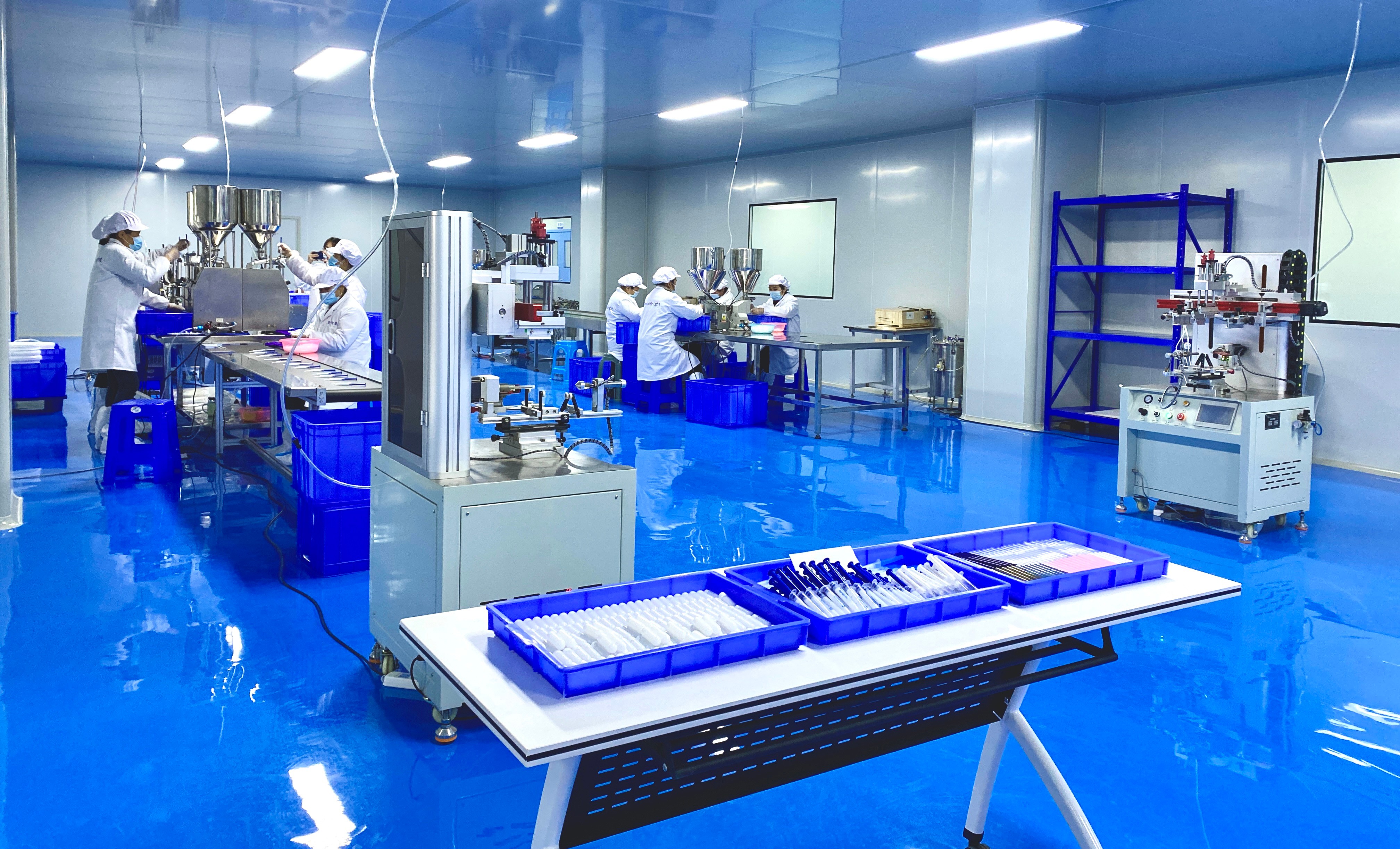
Production workshop at the Jiangxi facility. Cleanroom capacity and QC staffing are part of the supplier due diligence for both product formats.
Step-by-Step Breakdown: Choosing Between the Two SKUs
The following sequence keeps the decision grounded in facts rather than category enthusiasm.
Step 1: Write the consumer promise in one sentence
If the sentence contains routine care, stain removal or daily use, the brand is buying a whitening strip. If it contains visual tone correction, yellow tone neutralisation or photo-ready appearance, the brand is buying a colour corrector foam. If both ideas appear, plan two separate SKUs rather than one blended claim.
Step 2: Map the regulatory path for each target market
In the EU, cosmetic products require a Cosmetic Product Safety Report, CPNP notification and an EU Responsible Person. Medical-device products require CE-MDR registration. In the USA, cosmetic products require MoCRA-compliant facility registration and product listing with a US Agent; medical devices require FDA establishment registration and device listing. Whitening strips can fall on either side depending on formulation and claims, while purple colour corrector foam is normally handled as a cosmetic product. The supplier states that it can provide CPSR, CPNP and PIF for cosmetic products, and that medical-device products have MDR-CE certification with a technical file and an EU Responsible Person.
Step 3: Audit the supplier's certification scope at SKU level
Do not accept a certificate package without matching it to the product. For whitening strips, confirm MDSAP, ISO 13485, ISO 22716, GMPC and BSCI. For purple colour corrector foam, confirm ISO 22716 and GMPC first, then ask whether BSCI covers the specific foam line. Certificate numbers and expiry dates should match the quotation and the shipment documents.
Step 4: Confirm customization depth before design work
For strips, ask about strip type, active ingredient, residue level, colour, flavour, packaging and labelling. For foam, ask about formula, texture, colour, packaging format, labelling and any flavour options. If the supplier cannot provide these details, the foam should be treated as a standard product, not a custom development.
Step 5: Compare commercial terms across both formats
The supplier's terms are: MOQ of 5 boxes for standard packaging; OEM MOQ from 100 to 1,000 boxes depending mainly on custom packaging minimums; delivery terms of EXW, FCA, FOB or CFR; and payment of 30% deposit with 70% balance before shipment. Brands should calculate the cash cycle for both SKUs before committing to a dual launch.
Step 6: Request samples and lock the launch timeline
The supplier offers free sampling and professional packaging design as part of its OEM/ODM service. Lead time varies depending on order volume, product specifications, customization complexity and current production schedule. A precise delivery timeline is provided upon order confirmation. For a dual-SKU launch, request separate samples for strips and foam, and confirm that user instructions and legal statements match the actual format.
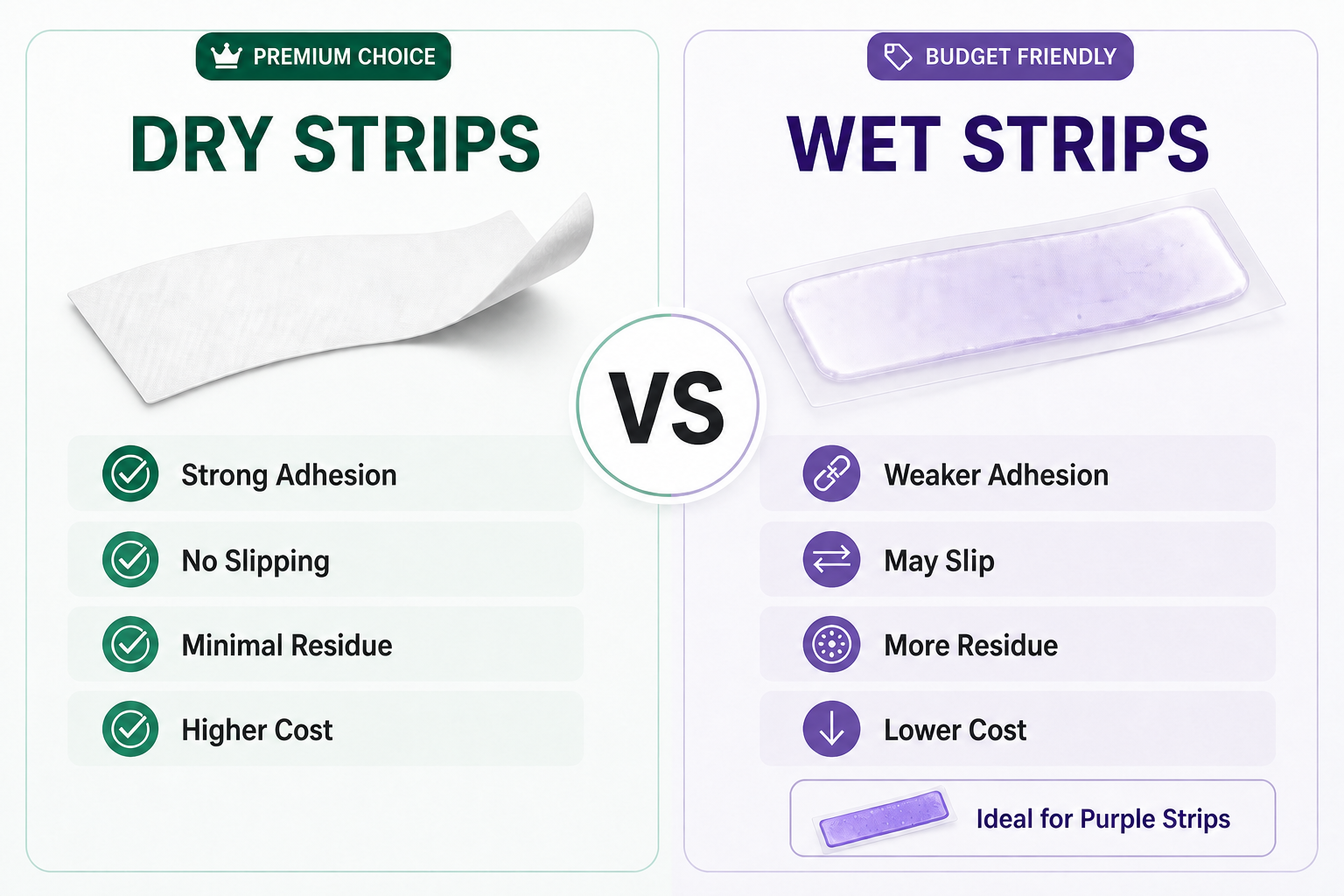
Strip type affects adhesion, residue and cost. The supplier offers residue-free and standard formulation options within the whitening strip range.
Use Cases: When Each Format Fits the Portfolio
Use cases should be matched to the brand's channel and repeat-purchase model.
- E-commerce and DTC brand: Use teeth whitening strips as the core subscription SKU and purple colour corrector foam as a content-led add-on or bundle item. The two formats cover routine care and visual correction without forcing one product to do both jobs.
- Pharmacy and chain retail: Whitening strips provide a clearer functional shelf position. Purple colour corrector foam suits impulse-purchase placement, seasonal displays or pairing with whitening toothpaste. Retail buyers often prefer the strip because its audit scope is broader.
- Dental clinic private label: Whitening strips fit the clinic's routine-care programme. Purple foam can be a retail add-on in the clinic shop, but it is not a clinical treatment step.
- Gift and travel sets: Purple foam can support small-format, multi-item kits because the format relies on visual presentation and category freshness. Whitening strips remain the anchor item in the same kit.
- Distributors managing multiple regions: The supplier's MDSAP, ISO 13485, ISO 22716, GMPC and BSCI certificates simplify audit conversations for the USA, EU, UK and other markets. The distributor should still verify SKU-level listing on each certificate.
Comparison Table: Verified Product and Audit Facts
| Decision factor | Teeth whitening strips | Purple colour corrector foam |
|---|---|---|
| Product format | Whitening strip with gel-bearing adhesive layer | Colour corrector foam |
| Product models listed by the supplier | GS-004H/V/C/P, GS-V34-S07, DB-004L | GS-006V |
| Production mode | OEM, ODM, custom formulation, private label | Listed within cosmetic manufacturing scope; specific production mode not stated in the supplied capacity data |
| Customization dimensions | Strip type, active ingredient, residue-free or standard formulation, colour, flavour, packaging, labelling | Specific customization dimensions not stated in the supplied product data |
| Formulation options | PAP (peroxide-free), carbamide peroxide (CP), hydrogen peroxide (HP) | Specific formulation not stated in the supplied product data |
| Monthly capacity | 29.2 million pieces | Not stated in the supplied capacity data |
| Annual capacity | 300 million pieces | Not stated in the supplied capacity data |
| Audited system coverage | MDSAP, ISO 13485, ISO 22716, GMPC and BSCI explicitly list teeth whitening strips | ISO 22716 and GMPC list foam and purple colour corrector serum; BSCI does not explicitly list foam in the supplied certificate text |
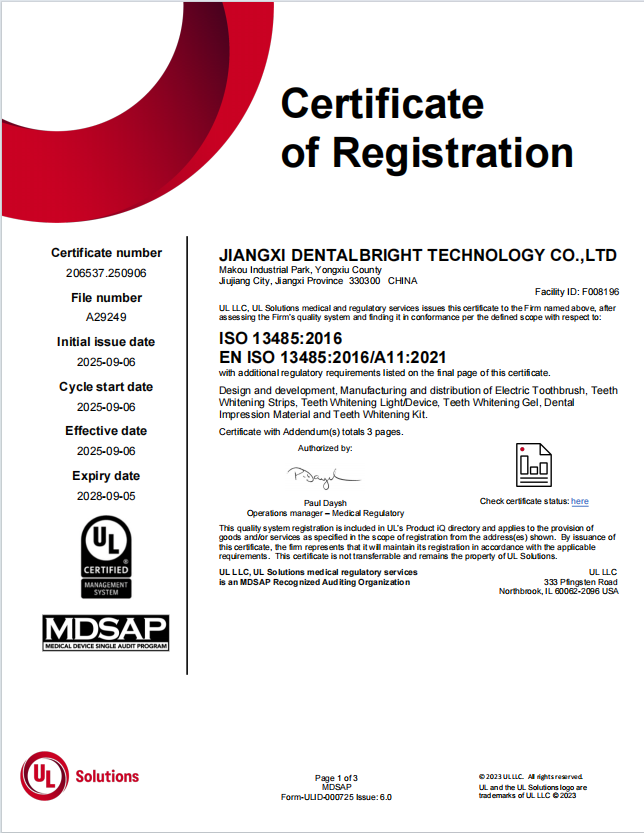
MDSAP certificate 206537.250906, issued by UL LLC, covers teeth whitening strips and is valid to 2028-09-05.
The table shows a clear pattern. Whitening strips have a wider audit footprint in the supplied documents and a deeper set of listed customization and formulation facts. Purple foam has a narrower documented footprint in the supplied materials, which means the buyer should ask more questions before committing. That is not a reason to avoid the foam; it is a reason to verify the exact SKU.
Practical rule for buyers: If the brand needs a routine-care anchor SKU with a deeper technical story, start with whitening strips. If the brand already has a routine-care SKU and needs a visually driven, cosmetic-positioned addition, add the purple foam. If the brand wants both, confirm that the supplier can document each product against the correct certificate scope before the order is placed.
FAQ
Are both whitening strips and purple colour corrector foam covered by MDSAP, ISO 13485, ISO 22716, GMP and BSCI?
Teeth whitening strips are explicitly listed in the MDSAP certificate 206537.250906 and the ISO 13485 certificate 206536.250906, both issued by UL LLC and valid to 2028-09-05. They are also listed in ISO 22716 certificate SZ2312B8 and GMPC certificate SZ2312B9, both issued by Intertek Testing Services and valid to 2026-12-12. The BSCI audit, Monitoring ID 25-0338381-1, audited by SGS and valid to 2027-08-15, covers manufacturing of teeth whitening strips and other listed products. Purple colour corrector foam model GS-006V appears in the ISO 22716 and GMPC cosmetic scope, but the supplied BSCI text does not explicitly name the foam. Buyers should confirm SKU-level coverage before ordering.
Can Glorysmile produce both teeth whitening strips and purple colour corrector foam for private label?
Yes. The supplier offers OEM, ODM, custom formulation and private label for teeth whitening strips, with monthly capacity of 29.2 million pieces and annual capacity of 300 million pieces. The listed strip models are GS-004H/V/C/P, GS-V34-S07 and DB-004L. Strip customization covers strip type, active ingredient, residue-free or standard formulation, colour, flavour, packaging and labelling. The supplier also lists purple colour corrector foam model GS-006V within its cosmetic manufacturing scope. Brands should request written confirmation of the foam customization options, because the supplied product data does not list them in the same detail as the strip range.
What are the MOQ and payment terms for private label orders?
For standard packaging, the MOQ is 5 boxes. For OEM orders with customized packaging, the MOQ ranges from 100 to 1,000 boxes, mainly depending on the custom packaging minimum. Delivery terms are EXW, FCA, FOB or CFR. Payment terms are 30% deposit in advance and 70% balance before shipment. Brands comparing the two formats should calculate packaging-driven MOQ differences as well as unit costs, because strip packs and foam packs do not necessarily share the same packaging minimums.
Can a brand request samples before committing to production?
Yes. Free sampling and professional packaging design are part of the supplier's OEM/ODM service. A practical sample pack for either format should include the product sample, the relevant certificate extracts, the COA and the MSDS. Brands should test the sample for the format-specific attributes that matter: adhesion and residue for strips, and texture, colour and packaging compatibility for foam.
What is the lead time for OEM teeth whitening strips and foam?
Lead time varies depending on order volume, product specifications, customization complexity and current production schedule. The supplier provides a precise delivery timeline upon order confirmation. For a cross-SKU launch, it is advisable to keep the delivery schedule in the written order confirmation and to include a 24-hour after-sales response channel in the supplier agreement. This helps keep both SKUs aligned without assuming that their production schedules are identical.
Conclusion
Teeth whitening strips win as the anchor brightening SKU for most oral care brands because they carry a broader audited footprint in the supplied documents, a deeper set of formulation and customization facts, and a clearer routine-care purchase intent. Purple colour corrector foam wins as a support SKU when the brand needs a cosmetic visual-correction product and can verify the exact SKU against the supplier's ISO 22716 and GMPC scope.
The decision rule is straightforward: choose the SKU that matches the consumer promise, the regulatory path and the repeat-purchase model, then verify the supplier's certificate scope for that exact product. A supplier that can cover both formats is useful, but the brand still owns the SKU-level verification.
For buyers preparing a dual-format review, the Glorysmile product catalogue is available here: Download the oral care product catalogue.
Contact: Tasha | Email: tasha@enjoywhite.com | Tel/WhatsApp: +86 177 7911 0152 | Website: www.glorysmile.com
Factory address: Makou Industrial District, Yongxiu Town, Nanchang (Jiujiang) City, Jiangxi Province, China. The facility is a 15-minute drive from Nanchang Changbei International Airport.
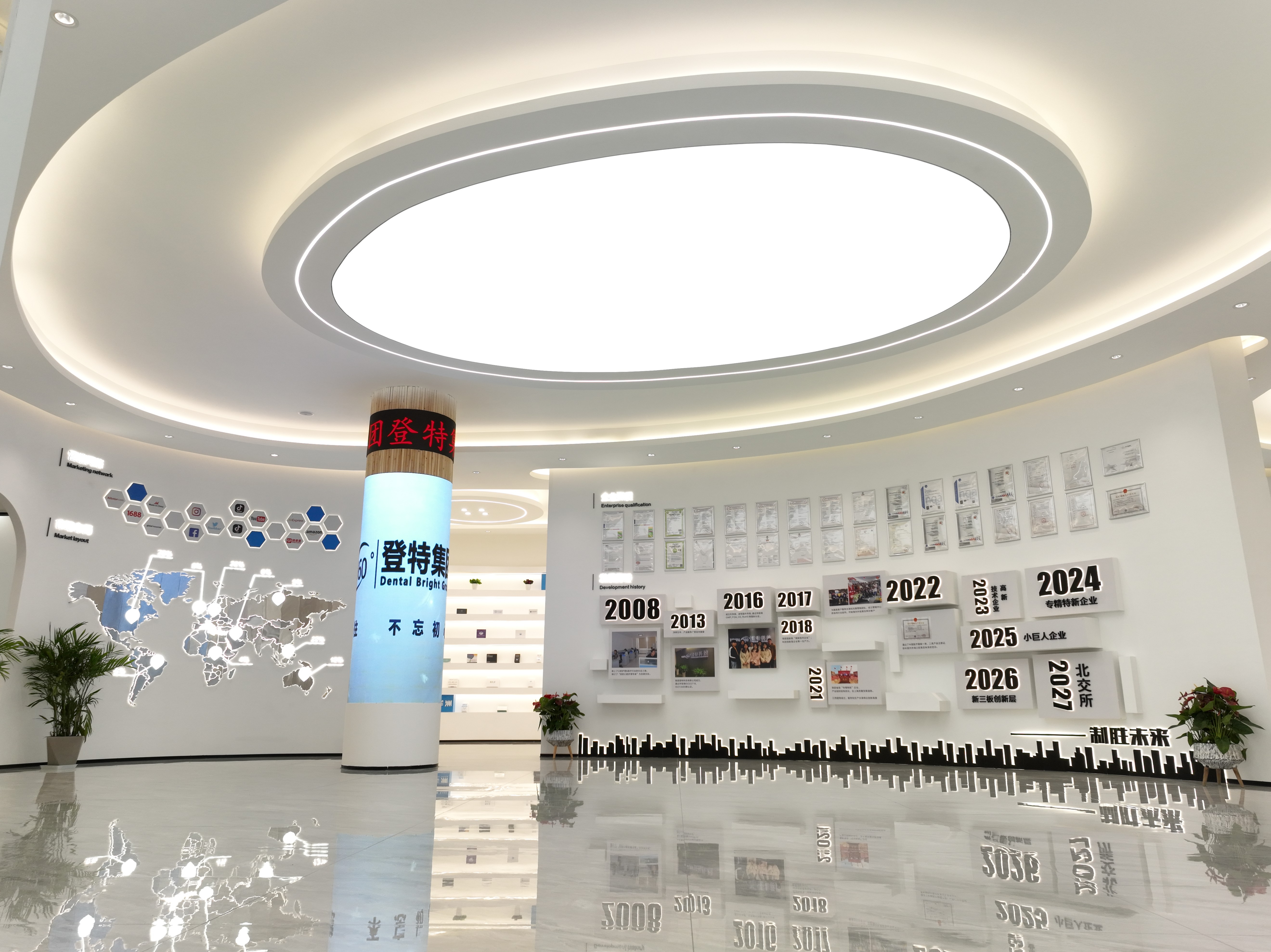
Showroom review can help buyers compare strip and foam formats before requesting samples.
Have Questions or Need More Details?
Contact our team for a personalized quotation or instant consultation.
Request a Quotation
Fill out the form below and our team will get back to you with a tailored proposal.
WhatsApp Direct Chat
Prefer to chat in real-time? Message us on WhatsApp for instant assistance & quick answers.
- Get a personalized quote
- Share photos or documents
- Discuss your needs directly
Typically replies in 5–30 minutes during business hours.