Teeth Whitening Strips vs. Purple Colour Correctors: A Buyer's Comparison Guide
Teeth whitening strips and purple colour correctors are usually merchandised as neighbours and are frequently described with the same word: whitening. For importers and brand owners building an oral care line, that overlap is misleading. The two formats are built on different mechanisms, occupy different steps in the customer’s routine, and carry different compliance and sourcing profiles.
The practical answer is that these formats are complements rather than substitutes. A strip is a timed, chemistry-led stain-removal step in which whitening actives are carried on a film that stays on the teeth. A purple colour corrector — supplied as foam, serum, powder or toothpaste — is a routine format that works through the complementary relationship between purple and yellow on the colour wheel.
This guide compares the two on the variables that decide whether a line actually sells: intended role in the routine, what the customer can realistically expect to see, and how each format fits with companion products such as toothpaste, mouthwash and oral irrigators. It also works through the buyer questions that come up most often — wet versus dry strips, peroxide versus PAP gel — and the MOQ, compliance and lead-time factors that determine launch timing. All product and capability details below come from GlorySmile’s own product data at glorysmile.com.
The problem with comparing “whitening” to “whitening”
Most portfolio mistakes in this category start with a single wrong assumption: that both formats answer the same customer question. They do not. A strip answers “how do I remove the coffee, tea or tobacco staining that has built up on my teeth?” A purple colour corrector answers a different one: “how do I reduce the yellow undertone I see in the mirror today?”
When a brand treats them as interchangeable, two things usually go wrong. Internally, the two SKUs compete for the same listing space and the same marketing claim, which dilutes both. Externally, the claim behind the purple format gets stretched until it sounds like a whitening course, which creates regulatory exposure in markets where cosmetic and drug claims are separated.
Three questions resolve the decision before any artwork is designed:
- Job to be done: is this SKU a stain-removal course or a daily tone-correction step?
- Claim support: which market are we selling into, and which claim is permitted there?
- Supply support: what MOQ, lead time and documentation can the manufacturer commit to for both formats?
What is pushing the two formats onto the same shelf
Two forces explain why purple colour correctors appeared beside whitening strips rather than replacing them. The first is category growth. Grand View Research values the global teeth whitening strips and gels market at USD 1.1 billion in 2025, which is large enough to support multiple formats inside a single retail set.
The second force is regulatory. EU Regulation (EC) No. 1223/2009 restricts the concentration of hydrogen peroxide in over-the-counter teeth whitening products to 0.1% or less. In the United States, MoCRA 2022 requires manufacturers of whitening strips, classified as cosmetics, to register facilities and list products. For cross-border sellers, both rules push brands toward formats and formulations that are easier to launch as cosmetics, and toward suppliers who already hold the paperwork.
Trade classification follows the same logic. Teeth whitening strips are primarily classified under HS Code 3306.90.00 (preparations for oral or dental hygiene) according to US Customs ruling NY N342147, which places them in the same customs family as the companion toothpaste and mouthwash formats that sit around them on the shelf.
What each format actually does
Teeth whitening strips: a chemistry-led stain-removal step
GlorySmile whitening strips are built as a three-layer construction: a PET hard film, a whitening gel layer, and a PE soft film. They ship in an aluminium bag, typically with 7, 14 or 21 strip bags per unit, plus a user manual, a shade guide and a colour box.
The format itself comes in three delivery types, which matter for both the customer experience and the unit cost:
- Dry strips — available as standard dry, alcohol-free dry, residue-free dry and high-viscosity dry versions.
- Wet strips — a lower-cost format with different adhesion and residue behaviour.
- Dissolving strips — positioned for oral cleansing scenarios.
Available formulations across the strip range include PAP, PAP with charcoal, purple, 6% hydrogen peroxide, sodium phytate and sodium bicarbonate, with fully custom options. Flavour is a real differentiation lever here: blue raspberry, strawberry, peach, grape, watermelon, peppermint, orange, mint, pineapple, cherry blossom, coconut and mango are all available.
In the reference whitening scenario for this product family, the format is designed around a once-daily application of roughly 10 to 30 minutes per treatment, with the function described as removing exogenous stains (coffee, tea, tobacco), a 5–8 shade whitening range, and anti-sensitivity protection. Enamel-safe formulations and a zero-peroxide option are part of the strip specification, and the formulation is labelled for adults and children aged 16 and over.
Purple colour correctors: optics rather than oxidation
Purple works because purple sits directly opposite yellow on the colour wheel and is therefore its complementary colour. In practice, a water-soluble purple dye is applied to the teeth to cancel out yellow undertones. This is an optical mechanism, not the oxidative stain-removal chemistry that drives a whitening strip.
That distinction should shape how the format is positioned. A brand should treat a purple colour corrector as a tone-correction layer in the daily routine rather than as a replacement for a whitening course, and it should not present the strip as an instant tone neutraliser either. The two mechanisms simply do different work.
GlorySmile supplies the purple format in four product forms, which allows a brand to enter the category at different price points and routine positions:
- Purple Colour Corrector Foam (GS-006V) — 30 ml, mint or custom flavour.
- Purple Colour Corrector Serum (GS-006V) — 30 ml, mint or custom flavour.
- Purple Colour Corrector Powder (GS-005V) — 12 g net weight, with 15 g, 30 g, 40 g and 100 g options, PAP as the whitening ingredient.
- Purple Colour Corrector Toothpaste (DB-007P) — 65 g or 120 g, mint or custom flavour.
The reference scenario for this product family describes the function as yellow tone neutralisation (V34), stain removal and breath freshening, supplied in safety-sealed bottles, with a formula strictly compliant for adults and children aged 16 and over, and alcohol-free.
Side-by-side: the variables that decide which format you buy
| Decision variable | Teeth whitening strips | Purple colour correctors |
|---|---|---|
| Primary job in the routine | Remove exogenous stains (coffee, tea, tobacco) and whiten through applied whitening actives | Neutralise yellow undertones through the complementary purple–yellow colour relationship, within a stain-removal and breath-freshening routine |
| Formats available | Dry (including alcohol-free dry, residue-free dry, high-viscosity dry), wet, dissolving | Foam, serum, powder, toothpaste |
| Typical pack | 7 / 14 / 21 strip bags per unit with user manual, shade guide and colour box; aluminium bag | 30 ml foam; 30 ml serum; 12 g powder (15/30/40/100 g options); 65 g / 120 g toothpaste |
| Formula options | PAP, PAP + charcoal, purple, 6% HP, sodium phytate, sodium bicarbonate, custom | Purple dye base with custom formula; PAP in the powder format |
| Application pattern | Once-daily timed application; 10–30 minutes per treatment in the reference whitening scenario | Built into the daily routine as a standalone step or a brushing-adjacent step |
| Sensitive-teeth and labelling | PAP and low-sensitivity formulas available; enamel-safe and zero-peroxide options; labelled for adults and 16+ | Labelled for adults and 16+; alcohol-free in the reference V34 scenario |
| Visible expectation | Stain removal built over a course of use; the reference scenario lists stain removal and a 5–8 shade whitening range | Yellow tone neutralisation (V34) — a tone-correction effect, not a whitening course |
| Private-label MOQ | 200 pcs for private label, 1 pc for regular product on listed strip SKUs | 200 pcs for private label, 1 pc for regular product on listed purple SKUs |
Read the table as a division of labour, not a ranking. A brand that launches only the strip format leaves the “yellow tone” search and shelf conversation to someone else; a brand that launches only the purple format has no stain-removal course to support repeat purchase.
Decision variables inside each format
Wet versus dry strips: adhesion, residue and cost
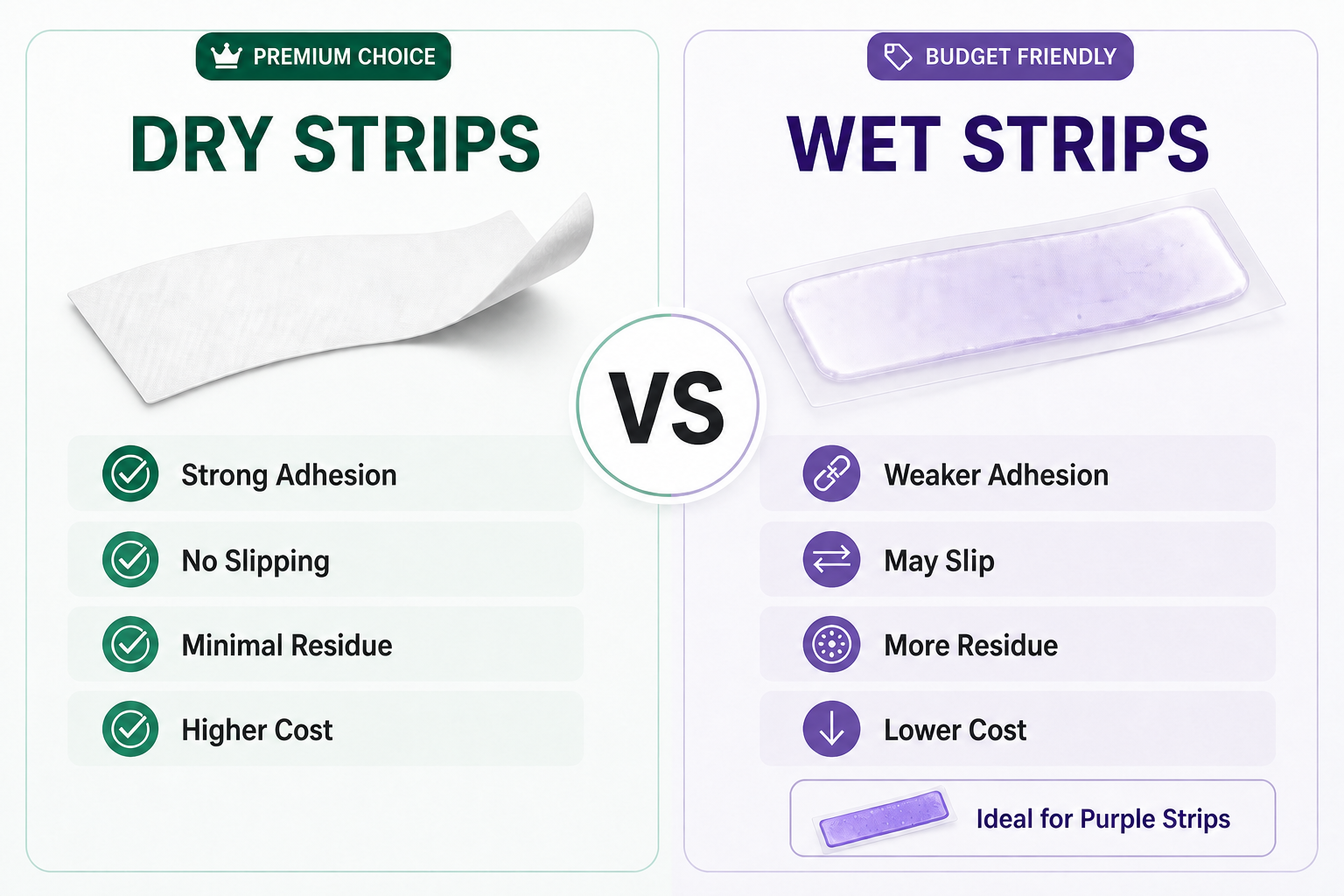
Dry strips offer good adhesiveness, are not easy to slip off during wear, and leave minimal residue. The trade-off is a higher unit cost, which makes them the better fit for buyers who need strong adhesion and low-residue performance and have the budget for it.
Wet strips are less adhesive than dry strips, so they tend to shift during application and leave relatively more residue. Their advantage is a lower cost, which suits budget-conscious programmes. There is one additional rule worth knowing before specification: wet strips are also the recommended base for purple whitening strips, because the higher residue helps purple pigments adhere better to the teeth and supports the physical whitening effect.
Peroxide versus PAP gel: speed, sensitivity and the regulatory route
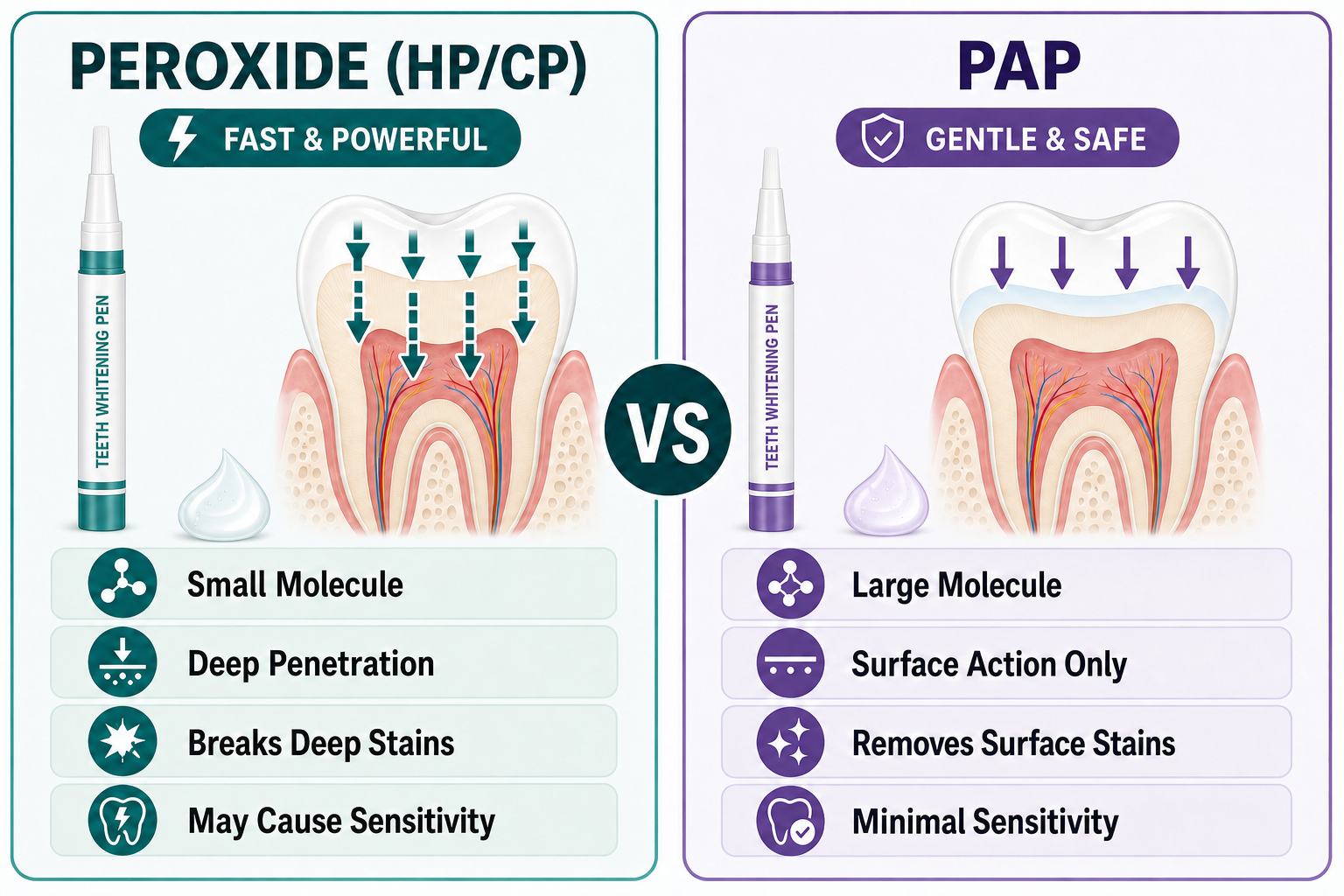
Hydrogen peroxide and carbamide peroxide are small-molecule penetrating actives. They move through the enamel into the dentin and break down deep-seated pigments through free-radical oxidation, which makes them fast and powerful — and more likely to cause tooth sensitivity. In most markets they are also strictly regulated as drugs, which is exactly where the EU limit of 0.1% or less for over-the-counter products becomes a design constraint.
PAP (phthalimidoperoxycaproic acid) is a large-molecule, surface-acting active. Its molecular size prevents it from penetrating the tooth structure, so it oxidises surface stains only. The result is a gentler profile with minimal sensitivity and a slower route to visible results, but it is chemically stable and easier to launch as a cosmetic in most countries — which makes it the natural choice for daily, long-term maintenance whitening and for sensitive-teeth positioning.
The decision rule that follows from this is straightforward: prioritise effectiveness and accept temporary sensitivity, or prioritise a gentler daily-use profile. GlorySmile offers PAP (peroxide-free), carbamide peroxide and hydrogen peroxide formulations, plus PAP and low-sensitivity formulas designed for sensitive teeth, so both routes can be produced from one supply base.
Foam versus serum versus powder versus toothpaste
Within the purple family, the four formats differ mainly in how they enter the routine. Foam and serum are standalone steps supplied in 30 ml bottles; powder and toothpaste fold tone correction into a brushing-adjacent habit, with the powder also carrying PAP as its whitening ingredient. For a brand testing the category, the practical approach is to start with the format that matches the routine the target customer already performs, then extend into the others once reorder data confirms which one holds.
Companion products: what has to sit next to the format
Compatibility is where most two-format lines are won or lost, because neither the strip nor the colour corrector is a complete oral care routine on its own. GlorySmile manufactures the surrounding formats in the same facility, which keeps formulation, artwork and compliance work in one place:
- Toothpaste — GlorySmile Fruity Toothpaste (GS-007F), 60 g, in flavours including smooth mint, strawberry, red velvet, mango sorbet, peach iced tea, grape bubblegum, watermelon, vanilla, banana, coconut whip and candy cane; and GlorySmile Double Tube Toothpaste (GS-007D), 100 g, formulated with PAP and hydrogen peroxide.
- Mouthwash — Liquid Mouthwash (DB-010S), 237 ml in a PP bottle, alcohol-free, functioning as a breath freshener and stain remover; Coconut Mouthwash (DB-010P), 20 × 12 ml sachets; and Foam Mouthwash (GS-010F) in strawberry, grape bubblegum, watermelon and blue raspberry, applied as 2 pumps swished for 30 to 60 seconds.
- Oral irrigator — Oral Irrigator (GS-V2) with four modes (Soft, Gum Care, Pulse, Standard), rated water pressure of 20–120 PSI, a 280 ml tank, USB-C charging of 3–4 hours and up to 65 days of use per full charge.
The compatibility logic is simple. Strips are a timed, applied step that the customer performs deliberately. Purple formats are daily adjuncts that run alongside brushing or rinsing. Toothpaste and mouthwash provide the base and refresh layers that make the routine feel complete, and the irrigator sits in the hygiene layer beneath both. Sourcing these from separate suppliers multiplies artwork versions, compliance files and lead-time risk; sourcing them together shortens the path from concept to shelf.
A step-by-step workflow for building the two-format line
- Map the job per SKU. Assign the stain-removal course to the strip and the daily tone-correction step to the purple format. Write the claim for each one separately before touching packaging.
- Select the strip delivery type. Choose dry strips when adhesion and low residue are the priority; choose wet strips when cost is the priority, or when the strip itself is a purple whitening strip.
- Select the whitening chemistry. Decide between peroxide (fast, high efficacy, sensitivity risk, drug-regulated in most markets) and PAP (gentle, slower, easier to launch as a cosmetic, suitable for sensitive-teeth positioning).
- Select the purple format. Foam or serum for a standalone step; powder or toothpaste for a brushing-adjacent habit. All four are available at 200 pcs private-label MOQ on listed SKUs.
- Lock the companion set. Decide which toothpaste, mouthwash and irrigator SKUs complete the routine, and confirm that flavour and packaging direction are coherent across the set.
- Confirm the compliance route per market before artwork. For EU cosmetics: CPSR, CPNP notification and an EU Responsible Person. For US cosmetics: MoCRA-compliant facility registration and product listing. For medical-device items: MDR-CE registration with Technical File and EU Responsible Person.
- Validate with a sample. Run the formulation and packaging through a sample round before committing to a production run, and use a small trial order to test claim wording and shelf presentation.
- Plan replenishment, not just launch. Agree account management, inspection and after-sales terms up front so the second and third orders run on the same specifications as the first.
Use cases: which buyer profile buys which format
- Stain-removal-led brand. Targets coffee, tea and tobacco staining with a PAP or PAP + charcoal strip, supported by a whitening toothpaste. The strip carries the efficacy story; the purple format is optional.
- Travel and convenience brand. Combines dissolving strips with coconut mouthwash sachets and mouth spray. Portability, not whitening depth, is the purchase driver.
- Aesthetic-first brand. Leads with the purple colour corrector foam or serum as an everyday visual step, then adds a strip as the deeper treatment option. This profile needs the two claims kept clearly separate.
- Full-portfolio retailer or distributor. Builds a bundled set: strips, purple foam, purple toothpaste, whitening powder and an oral irrigator, all under one brand, all documented from one supplier.
Sourcing due diligence before you commit

Format fit is only half the decision. The other half is whether the supplier can hold both formats to the same standard across repeat orders.
On capacity, Jiangxi DentalBright Technology Co., Ltd. (Glorysmile Factory) operates a 36,000 m² facility that includes 20,000 m² of 100,000-class cleanrooms and a 1,000 m² laboratory with a 100-class cleanroom for microbiological testing. Annual capacity includes approximately 300,000,000 pieces of teeth whitening strips and 10,000,000 sets of teeth whitening kits. The team comprises 256 people, including 17 R&D engineers and 11 QC specialists.
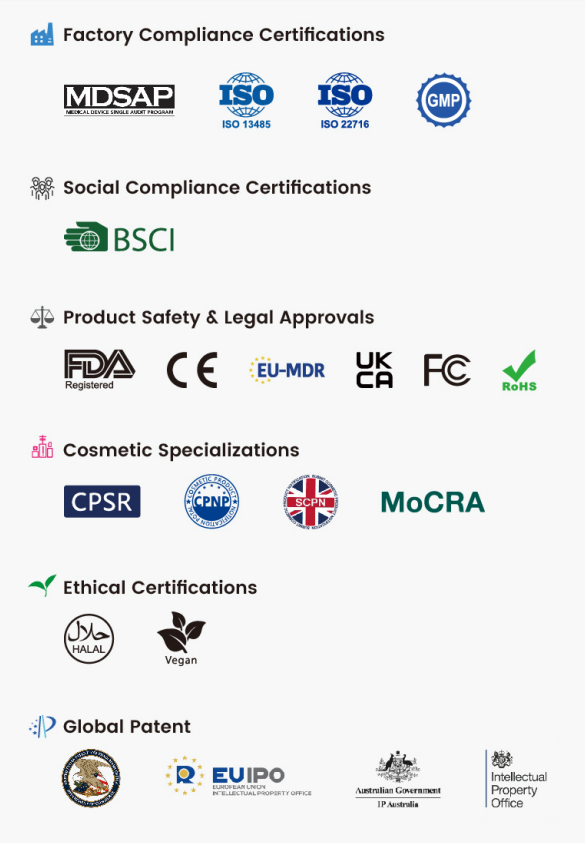
On certifications, the manufacturer is certified to MDSAP, ISO 13485, ISO 22716, US GMP and BSCI, and holds both medical device and cosmetics production licences. Factory certificates include CE, FDA, CPSR, CPNP, PIF, SCPN, MSDS, COA, RoHS, HALAL and Vegan; product certificates include GMP, ISO 22716, ISO 13485, MDSAP and BSCI. For the EU, CPSR, CPNP and PIF are available for cosmetic products, and CE-MDR registration is in place for medical devices. For the US, MoCRA-compliant cosmetic facility registration and product listing have been completed for the teeth whitening strips, and the FDA-certified scope covers medical devices, cosmetics and OTC drugs.
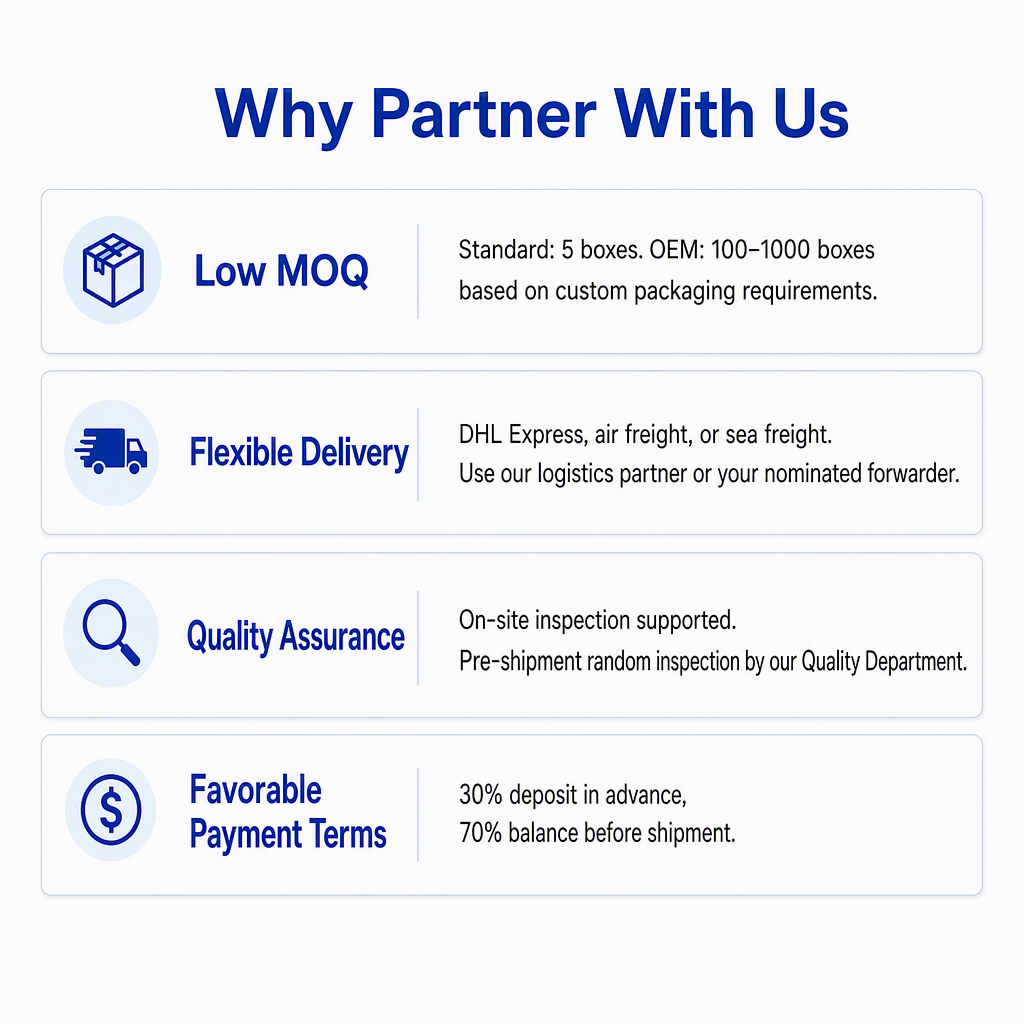
On order terms, the framework is the same for both formats: MOQ of 5 boxes for standard packaging, with OEM custom packaging MOQ varying by product from 100 to 1,000 boxes. Delivery terms are EXW, FCA, FOB or CFR, and payment terms are 30% deposit in advance with 70% balance before shipment. Both on-site inspection and pre-shipment random inspection by the quality department are supported.
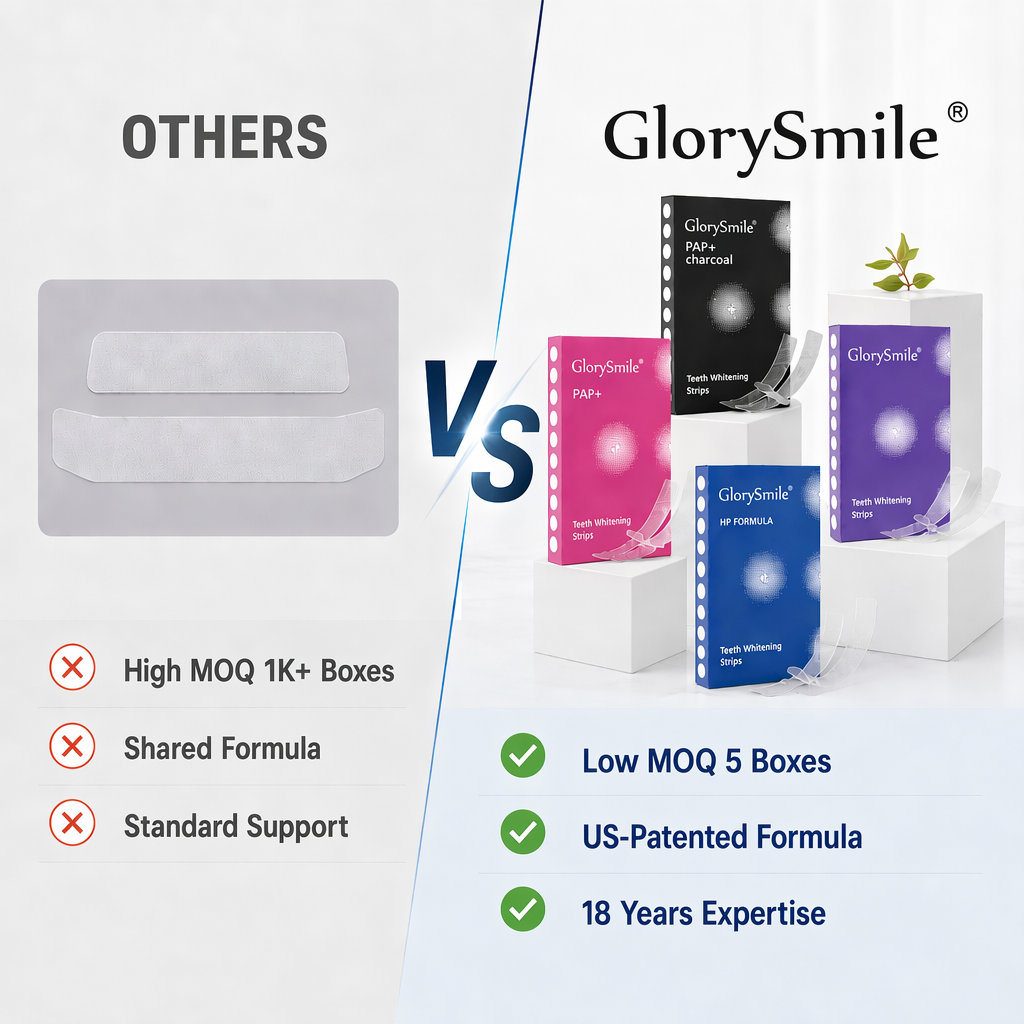
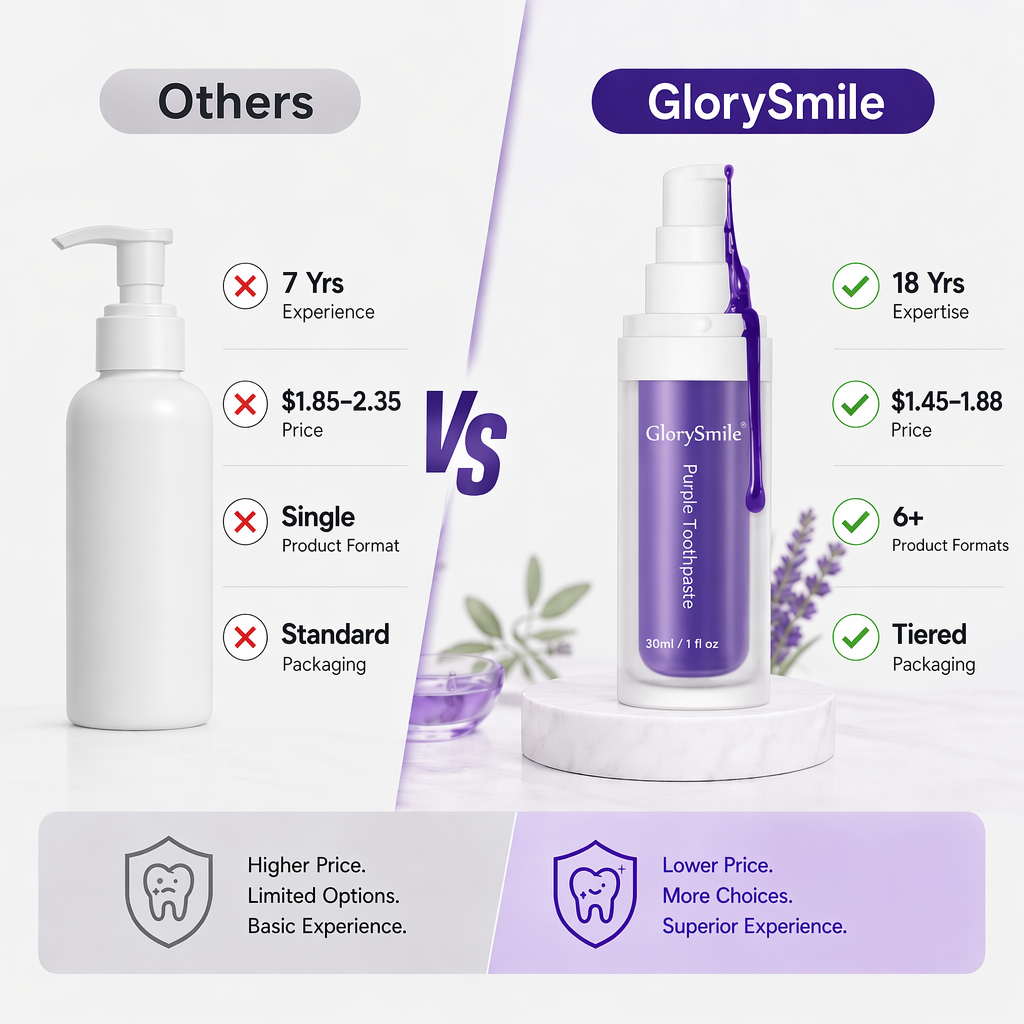
On commercial benchmarks, GlorySmile’s V34 colour corrector is priced at $1.45–$1.88 per unit against $1.85–$2.35 for a reference competitor, with an MOQ of 5 boxes against 50 boxes. On strips, GlorySmile is benchmarked at $1.85–$2.00 per box against $1.92–$2.65, with customisation turnaround of 7–15 days against 10–25 days. Lead time runs 5–7 days against a minimum of 10 days for the reference suppliers. Pricing always depends on final specification, so compare unit price together with MOQ, lead time and included compliance support rather than in isolation.
For long-term programmes, the operating model matters as much as the price. Each client is assigned a dedicated account manager, after-sales feedback on quality complaints is handled directly rather than through a standardised ticket queue, and cooperation is structured in three stages: small trial orders, medium-batch verification, and mass production. That structure is what makes a two-format line practical to sustain, because the strip and the purple corrector will rarely reorder at the same time or in the same volume.
FAQ
Can both formats be supplied with compliant documentation for the EU and the US?
Yes. For cosmetic products, CPSR, CPNP and PIF can be supplied for the EU market, and CE-MDR registration has been completed for medical-device products. For the US market, MoCRA-compliant cosmetic facility registration and product listing have been completed for the teeth whitening strips, with a US Agent requirement handled under the same framework. Products are FDA approved, and the FDA-certified scope covers medical devices, cosmetics and OTC drugs. Buyers should also factor in EU Regulation (EC) No. 1223/2009, which restricts hydrogen peroxide in over-the-counter whitening products to 0.1% or less — a key reason peroxide-free PAP options matter for EU listings.
Can strips and purple colour correctors be produced by the same supplier, and what options are available?
Yes, and producing both from one facility removes a significant amount of duplicated compliance and artwork work. Strips are available as dry strips (including alcohol-free dry, residue-free dry and high-viscosity dry), wet strips and dissolving strips, in 7/14/21 strip bags with a user manual, shade guide and colour box. Formulations include PAP, PAP + charcoal, purple, 6% HP, sodium phytate and sodium bicarbonate, with custom options, and flavour ranges cover blue raspberry, strawberry, peach, grape, watermelon, peppermint, orange, mint, pineapple, cherry blossom, coconut and mango. Purple colour correctors are available as foam (30 ml), serum (30 ml), powder (12 g with 15/30/40/100 g options) and toothpaste (65 g / 120 g). Both product families are offered at 200 pcs for private label and 1 pc for regular product on listed SKUs, under full OEM/ODM services covering formulation, customisation, free sampling and packaging design.
How do MOQ and order cost work when buying both formats together?
For standard packaging, MOQ is 5 boxes. For OEM orders with customised packaging, MOQ varies by product and ranges from 100 to 1,000 boxes, driven mainly by the minimum order quantity for custom packaging. Payment terms are 30% deposit in advance with 70% balance before shipment, and delivery terms are EXW, FCA, FOB or CFR. As a commercial reference point, the V34 colour corrector is benchmarked at $1.45–$1.88 per unit against $1.85–$2.35 for a reference competitor, and strips at $1.85–$2.00 per box against $1.92–$2.65, with MOQ of 5 boxes against 10,000–70,000 pairs on the strip side. The practical approach for a two-format launch is to combine SKUs into one trial order so that packaging and freight minimums are shared.
How does sampling work before a two-format launch?
Free sampling is part of the OEM/ODM service, alongside product formulation, customisation and packaging design. Because MOQ for regular products is 1 pc, a brand can validate both formats in the same trial — for example a dry strip against a wet strip, or a PAP formulation against a peroxide formulation — before committing to a full run. The same framework supports a small trial order, a medium-batch verification stage and then mass production, which keeps inventory risk low while the market response is still unknown. Verification support includes on-site inspection and pre-shipment random inspection by the quality department, and whitening kits carry a 12-month warranty from the date of purchase.
What lead time and after-sales support should buyers plan for?
Lead time runs 5–7 days, compared with a minimum of 10 days for the reference competitors, and customisation turnaround is 7–15 days against 10–25 days. Each client is assigned a dedicated account manager, quality complaints receive direct after-sales feedback rather than a standardised process queue, and customised-project adjustments are followed up flexibly. To move forward on a two-format line, request the product catalogue and current specification sheets, then send your target market and claim direction to tasha@enjoywhite.com or WhatsApp +86 177 7911 0152 so that the strip format, the purple format and the compliance route can be scoped together.
Conclusion: decide by routine role, then by supply
Teeth whitening strips and purple colour correctors are not competing answers to the same question. The strip is a timed, chemistry-led stain-removal step whose performance depends on the delivery type (dry, wet or dissolving) and the active (peroxide or PAP). The purple colour corrector is a daily tone-correction format built on the complementary relationship between purple and yellow, available as foam, serum, powder or toothpaste. Neither replaces the other, and a brand that positions them against each other will usually lose the shelf space to one that positions them as a sequence.
What separates a line that ships from one that stalls is the supply side: whether both formats can be documented for the target market, produced at a MOQ that suits a launch, and replenished on a lead time that keeps the reorder cycle intact. That is also why the comparison should end with documentation and lead time rather than with a claim about which format whitens more.
Next step: review the full product range
Download the GlorySmile catalogue for strip and purple colour corrector specifications, packaging options and MOQ details: GlorySmile Product Catalogue (PDF).
Contact: Tasha · tasha@enjoywhite.com · Tel / WhatsApp +86 177 7911 0152. Jiangxi DentalBright Technology Co., Ltd. (Glorysmile Factory), Makou Industrial District, Yongxiu Town, Nanchang (Jiujiang) City, Jiangxi Province, China — a 15-minute drive from Nanchang Changbei International Airport. Factory visits are welcome.
Have Questions or Need More Details?
Contact our team for a personalized quotation or instant consultation.
Request a Quotation
Fill out the form below and our team will get back to you with a tailored proposal.
WhatsApp Direct Chat
Prefer to chat in real-time? Message us on WhatsApp for instant assistance & quick answers.
- Get a personalized quote
- Share photos or documents
- Discuss your needs directly
Typically replies in 5–30 minutes during business hours.