
Teeth Whitening Strips vs. Whitening Kits: Which Format Matches Your Brand?
Teeth Whitening Strips vs. Whitening Kits: Which Format Matches Your Brand?
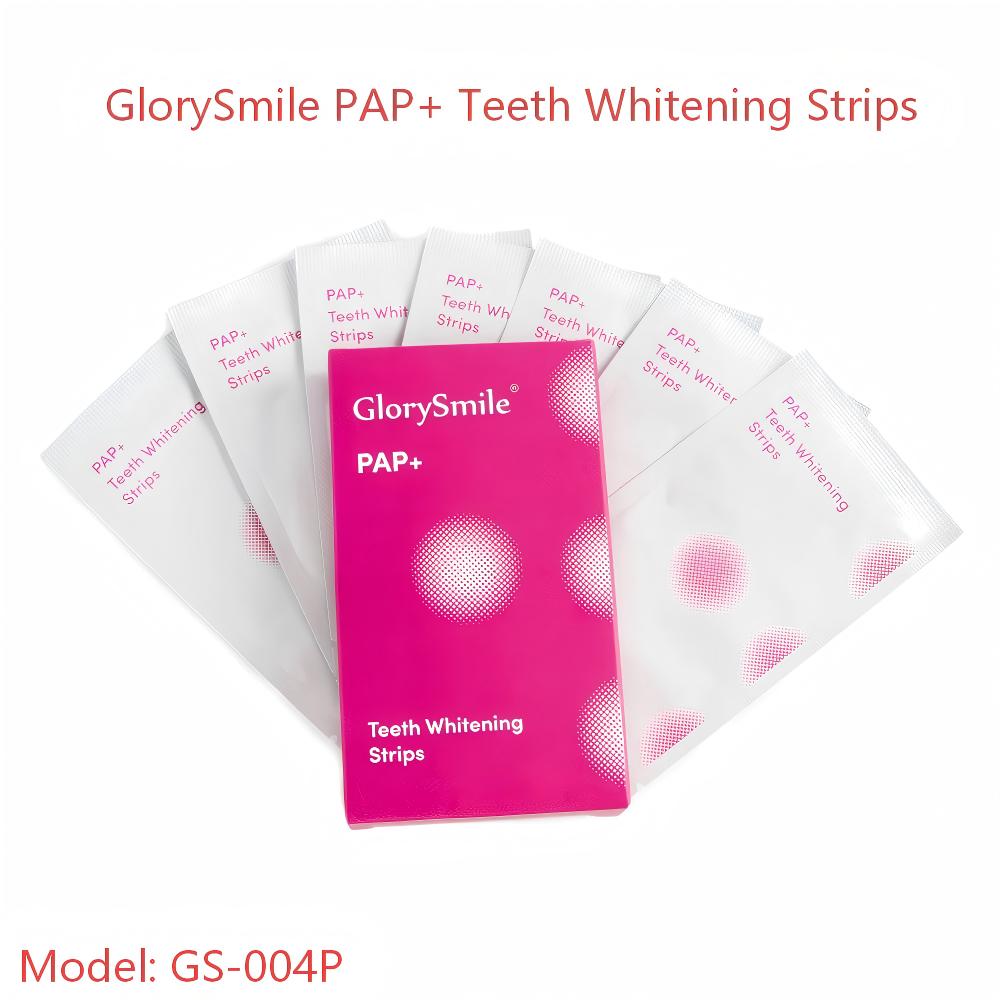
Short answer: choose teeth whitening strips if your business model depends on repeat purchase, low unit price and travel-friendly single-use products; choose an LED whitening kit if your brand is built around a durable device, a higher order value and premium or gifting positioning. Glorysmile manufactures both formats at its Jiangxi factory — strips at a monthly capacity of 29.2 million pieces and LED kits at 105,000 sets — so the comparison below is made on identical certification, MOQ and customization terms.
Whitening strips and LED whitening kits are often treated as two sizes of the same product. They are not. A strip is a consumable that a shopper replaces every few weeks; an LED kit is a device purchase that is later topped up with gel pens or syringes. That structural difference drives purchase frequency, packaging weight, formula compliance, marketing angle and after-sales load — which is why the format decision should be settled before artwork, formula selection or market-entry planning begins.
This guide compares the two formats on the criteria that actually influence a private-label launch: how the product is used, how long a treatment takes, what the user experiences, which distribution channel each format fits, and which certifications, MOQs and patents apply. Every specification below comes from Glorysmile's own OEM/ODM catalog, and every market figure is attributed to its published source.
Why the Strips-vs-Kit Decision Is Harder Than It Looks
Most buyers start from a price list, which is the wrong starting point. The two formats differ on six structural variables, and each one changes the unit economics of a project:
- Purchase cycle. Strips are consumed in 7, 14 or 21-strip packs and reordered; a kit is bought once, then replenished through 2 ml or 3 ml gel pens and syringes.
- Order value and shipping profile. Strips ship as flat aluminium strip bags inside a colour box. Kits add an LED light, a mouth tray, batteries or a charging case and a rigid gift box.
- Compliance scope. A cosmetic strip and a powered whitening light can sit in different regulatory categories in the same market, so the paperwork differs even when the brand owner is the same.
- Formula risk. Peroxide-based formulas produce faster visible results but a higher chance of temporary sensitivity; PAP (peroxide-free) formulas trade speed for gentleness and are easier to launch as a cosmetic in most markets.
- Marketing message. Strips sell convenience, price-per-use and travel; kits sell a device experience, accessories and gifting.
- After-sales load. A powered kit needs warranty handling and electronic quality control; a strip does not.
Choosing a format from a price list alone usually produces a product that is priced for one channel and designed for another.
Industry Background: A Large Category With Tightening Rules
The global market for teeth whitening strips and gels was valued at USD 1.1 billion in 2025, according to Grand View Research (report published June 2026). A separate estimate from Mordor Intelligence places the wider teeth whitening market at USD 7.72 billion in the same year, which shows how much of the category sits outside strips and gels alone.
Two regulatory facts shape how each format can be sold. In the European Union, Regulation (EC) No. 1223/2009 restricts the concentration of hydrogen peroxide in over-the-counter teeth whitening products to 0.1% or less, which pushes mainstream EU-facing SKUs toward peroxide-free PAP formulas and cosmetic positioning rather than a clinical one. In the United States, MoCRA 2022 requires manufacturers of whitening strips to register facilities (USD 849 per year) and list products (USD 200 per product), turning compliance into a per-SKU cost decision rather than a fixed overhead.
Customs classification matters for landed-cost modelling as well: teeth whitening strips are primarily classified under HS Code 3306.90.00 (preparations for oral or dental hygiene), per a U.S. Customs and Border Protection ruling.
The practical consequence for a brand owner is straightforward: format and formula should be selected market by market, not once for the whole catalogue.
The Two Formats in a Real OEM Catalog
Format A — Teeth Whitening Strips: Three Constructions, One Consumable Logic
Glorysmile produces strips in three constructions that behave differently in the hand and on the shelf:
- Dry strips (models GS-004H, GS-004V, GS-004C and GS-004P), including alcohol-free dry, residue-free dry and high-viscosity dry variants.
- Wet strips (model GS-V34-S07).
- Dissolving strips (model DB-004L).
All three are supplied in 7, 14 or 21-strip packs with a user manual, shade guide and colour box. The strip bag is aluminium; the strip itself is a three-layer build of PET hard film, whitening gel and PE soft film. Formula options across the range include PAP, PAP with charcoal, Purple, 6% HP, sodium phytate and sodium bicarbonate, with custom formulations available. Flavours cover Blue Raspberry, Strawberry, Peach, Grape, Watermelon, Peppermint, Orange, Mint, Pineapple, Cherry Blossom, Coconut and Mango.
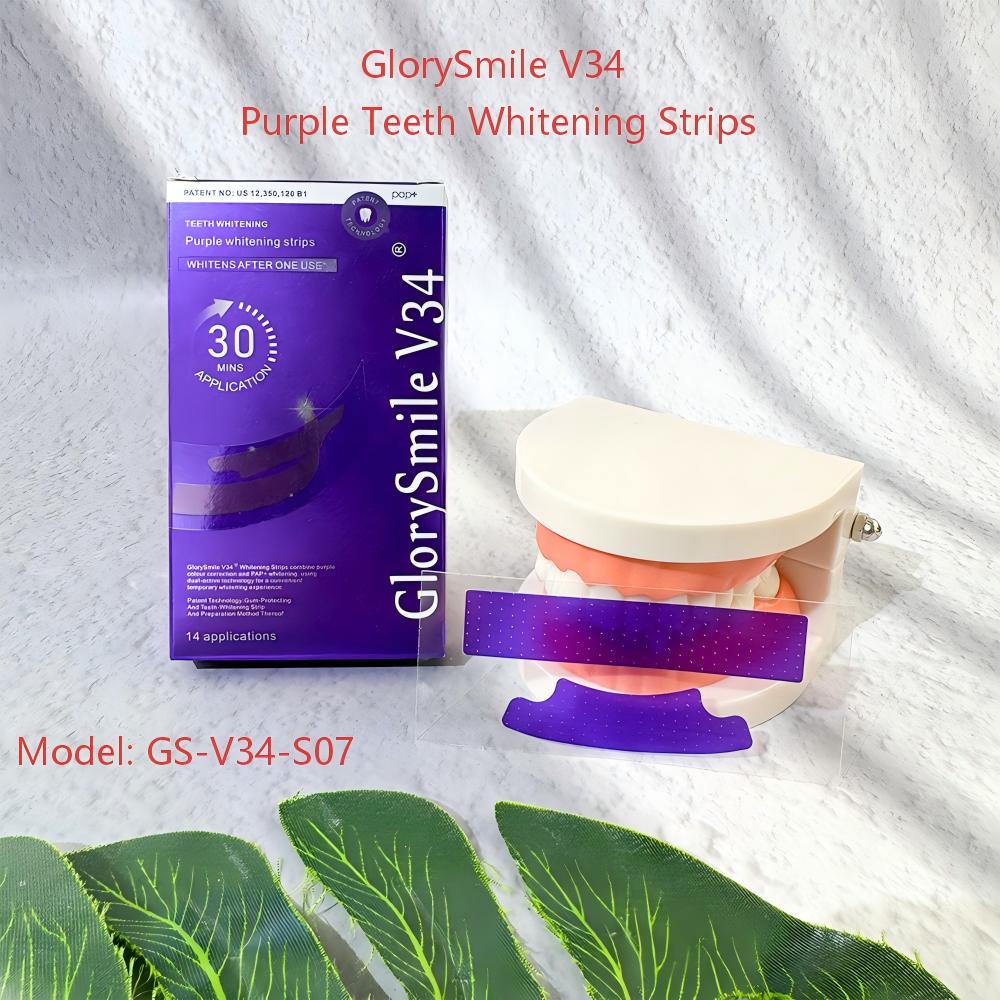
The dry-versus-wet choice has a commercial consequence beyond texture. Dry strips offer good adhesion, are less likely to slip during wear and leave minimal residue, at a higher unit cost. Wet strips adhere less firmly, tend to shift during application and leave relatively more residue, which lowers cost — and the extra residue helps purple pigment stay in contact with the teeth for the physical colour-correcting effect, which is why wet strips are the recommended construction for purple whitening strips.
Strip capacity at the factory runs at 29.2 million pieces per month, and the strips range is offered as OEM, ODM and dealer business with customization across strip type, active ingredient, residue-free or standard formulation, colour, flavour, packaging and labelling. The manufacturer also holds United States Utility Patent US 12,350,120 B1 for a gum-protecting and teeth-whitening strip and its preparation method.

Format B — LED Whitening Kits: A Device, a Tray and a Gel Consumable
The kit range pairs an LED whitening light with a food-grade TPE mouth tray and a gel delivery system. Contents and electronics vary by model:
- GS-001J: 16 LEDs, four 2 ml whitening pens, a dust-free cover and four adapters (iPhone, Android, Type-C, USB). The light is plug-and-play, powered from a phone, laptop or power bank with no built-in battery, and the recommended treatment time is 16 minutes per day.
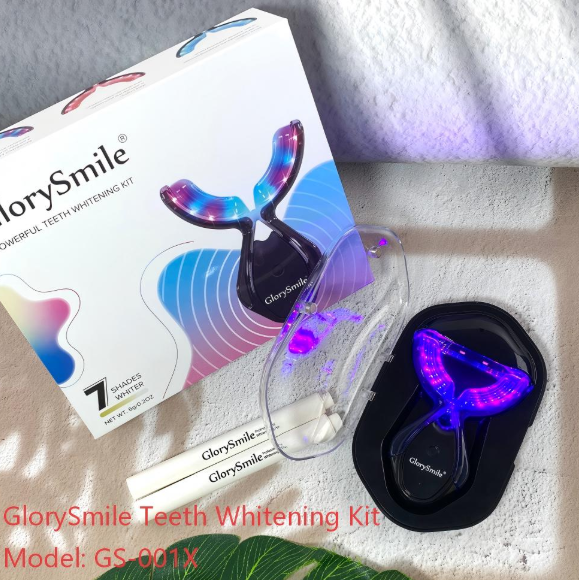
- GS-001X: 32 LEDs, two 3 ml whitening pens and a charging-and-sterilisation case with cable. The light timer runs 16 minutes; battery life is up to five uses per charge on a 150 mAh lithium-ion cell with a four-hour charge time; the case runs a three-minute sterilisation cycle that starts automatically when closed, using two UV lights and a stated 99.99% sterilisation rate.
- GS-001Y: 5 LEDs with a 10-minute timer, one mouth tray and three 3 ml whitening syringes; the stated life is 30 uses on two CR2450 lithium metal batteries.
- GS-001B: 5 LEDs, a 10-minute treatment time and 40 uses on two CR2032 batteries.
- DB-001M: 32 LEDs, four 2 ml whitening pens, a storage case with charging cable and a 16-minute timer; a 450 mAh lithium-ion battery charges in two to three hours and covers up to eight uses.
- GS-001L: a clinic-use kit built around 35% hydrogen peroxide gel for professional channels.
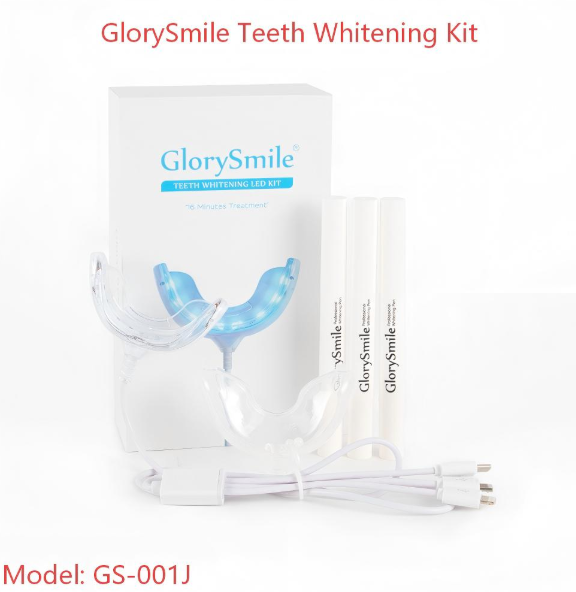
Gel formulas for the kit range include hydrogen peroxide, carbamide peroxide, PAP, sodium phytate, sodium bicarbonate and charcoal, with custom blends available. Kit packaging is a hard cardboard box, and monthly kit capacity is 105,000 sets. Design protection on the kit line includes US D1,128,065 S, EU registration 015065790-0001 and UK registration 6377277 for the DB-001M, plus EU registration 015062946-0001 and UK registration 6370462 for the GS-001X.
Application Time and User Experience, Step by Step
How a strip treatment works
The strip routine is short and low-equipment: a single individually wrapped set is opened, applied to the upper and lower front teeth, worn once per day, then removed. The dry-strip construction is engineered around no-slip adhesion so the film stays in place with minimal residue; the wet construction shifts more easily and leaves more residue. Because strips are single-use, the experience is designed to fit a daily routine away from home as easily as at the bathroom mirror — the catalog lists home and travel use at normal room temperature as the operating condition, with individually wrapped units, an enamel-safe formula and a zero-peroxide option among the stated requirements.
How a kit treatment works
A kit treatment follows a device logic. The user applies gel from a pen or syringe to the mouth tray or to the teeth, depending on the model, inserts the food-grade TPE tray and switches on the LED light. Timers are set to 10 minutes on the GS-001Y and GS-001B and 16 minutes on the GS-001J, GS-001X and DB-001M, while the broader product data describes one treatment per day lasting 10 to 30 minutes. Power is either plug-and-play through a phone, laptop or power bank, or a rechargeable lithium-ion cell, and the GS-001X adds a sterilisation cycle each time the case is closed.
Sensitivity: the formula choice behind the experience
Peroxide and PAP gels behave differently in use, and that difference decides which end user each format suits. Hydrogen peroxide and carbamide peroxide are small-molecule penetrating actives: they move through the enamel into the dentin and break down deep-seated pigment through free-radical oxidation, which makes results faster and more dramatic but also more likely to cause temporary sensitivity. PAP (phthalimidoperoxycaproic acid) is a large-molecule, surface-acting active: its molecular size keeps it out of the tooth structure so it oxidises surface stains only, which makes it gentle with minimal sensitivity but slower to show visible change.
For a brand, that translates into a decision rule: position peroxide-based strips and kits where effectiveness is the priority and the audience accepts possible transient sensitivity, and position PAP options for sensitive-teeth users, daily maintenance routines and cosmetic-compliant launches.
Use Cases: Which Format Fits Which Channel
Glorysmile's project history shows both formats succeeding in more than one channel type, which is why the format decision should follow the channel rather than the other way around.
| Project type | Quantity | Application | Stated result |
|---|---|---|---|
| Supermarket chains and corporate gift buyers | 7 million units | Promotional gift sets for pharmacy chain and supermarket retail | Passed third-party factory audits (BSCI/ISO); zero return rate in large batch inspection |
| Cross-border e-commerce platform (platform-owned brand OEM) | 1 million units | OEM partnership for a platform-owned brand | Top 3 sales rank in the Oral Care category; 99.8% positive feedback; zero safety or compliance incidents |
| E-commerce seller, private-label launch | 5 million units | Private-label brand launch | Top 10 bestseller status in category; 4.8-star user rating |
| Dental clinics and beauty salons | 500 thousand units | Professional clinic supply and salon whitening service | Stated whitening of 5–8 shades in one treatment; zero sensitivity reports from 5,000+ patients |
Read across those projects and a channel pattern appears:
- Strips fit mass retail and pharmacy promotional sets, travel retail, low-price entry SKUs, and e-commerce subscription or repeat-purchase models.
- Kits fit premium e-commerce listings, gifting programmes built around the hard cardboard gift box, home-beauty and device aisles, clinic-adjacent retail, and brand bundles where a device anchors the range.
Whitening Strips vs. LED Whitening Kits: Side-by-Side Comparison
| Dimension | Whitening strips (dry / wet / dissolving) | LED whitening kit |
|---|---|---|
| Product form | Single-use adhesive film strips | Reusable LED light plus mouth tray and gel pen or syringe |
| Catalog models | GS-004H/V/C/P (dry), GS-V34-S07 (wet), DB-004L (dissolving) | GS-001J, GS-001X, GS-001Y, GS-001B, DB-001M, GS-001L (clinic use) |
| Pack contents | 7/14/21 strips, user manual, shade guide, colour box | LED light (5/16/32 LEDs), 2 ml or 3 ml gel pens or syringes, mouth tray, adapters or charging case, shade guide, manual, gift box |
| Stated use rhythm | Once per day; no-slip dry adhesive technology | Once per day; 10–30 minutes per treatment; model timers of 10 or 16 minutes |
| Materials | Three-layer strip: PET hard film, whitening gel, PE soft film; aluminium strip bag | Food-grade TPE mouth tray; hard cardboard box |
| Formula options | PAP, PAP + charcoal, Purple, 6% HP, sodium phytate, sodium bicarbonate, custom | Hydrogen peroxide, carbamide peroxide, PAP, sodium phytate, sodium bicarbonate, charcoal, custom |
| Flavour options | 12 options including mint, peppermint, strawberry, mango, coconut, cherry blossom | Custom gel ingredient; flavour set per project |
| Monthly capacity | 29.2 million pieces | 105,000 sets |
| MOQ | 200 pcs private label / 1 pc regular product | 200 pcs private label / 1 pc regular product |
| IP held by manufacturer | US 12,350,120 B1 (gum-protecting whitening strip) | US D1,128,065 S, EU 015065790-0001, UK 6377277 (DB-001M); EU 015062946-0001, UK 6370462 (GS-001X) |
| Best-fit channel | Mass retail, pharmacy promotions, travel retail, e-commerce subscriptions | Premium e-commerce, gifting, home-beauty retail, clinic-adjacent lines |
Compliance and Sourcing Constraints Buyers Should Verify Before They Commit
Format decisions are only defensible if the paperwork behind them holds. The following constraints are the ones most likely to delay a launch:
- Factory certification. The manufacturer holds MDSAP, ISO 13485, ISO 22716, US GMPC (certificate SZ2312B9, issued by Intertek under the U.S. FDA Cosmetic Good Manufacturing Practice Guidelines 2022) and BSCI social audit certification (SGS-audited under the amfori BSCI Code of Conduct 2024), alongside both medical device and cosmetics production licences.
- Per-SKU certification. Certificates are issued to specific models, not to an entire range. HALAL certificate 52185957421871 covers 22 SKUs and names the wet strip GS-V34-S07; VEGAN certificate 22521 covers 23 SKUs and includes the whitening strips range; the Certificate of Free Sale for Indonesia (CFS No. 2026YB0548; CCPIT Doc No. 263302A0/H02065) lists teeth strips, whitening devices, mouthwash, whitening kits and gels.
- Market documents. For the EU, cosmetic documentation typically requires CPSR, CPNP notification, PIF and an appointed EU Responsible Person, all of which the manufacturer states it can supply. For the US, MoCRA facility registration and product listing apply to strip products.
- Labelling and concentration. Kit formulations are labelled for adults and children aged 16 and over, and the tray is BPA-free. In the EU, the 0.1% over-the-counter limit on hydrogen peroxide under Regulation (EC) No. 1223/2009 means the formula decision belongs in the compliance plan, not in a late-stage substitution.
- Intellectual property. Establish who owns the design rights on the housing you intend to sell. Registrations held by the manufacturer include the US utility patent 12,350,120 B1 for a gum-protecting whitening strip, US D1,128,065 S, EU 015065790-0001 and UK 6377277 for the DB-001M kit, and EU 015062946-0001 with UK 6370462 for the GS-001X.
- MOQ and lead time. MOQ is 200 pcs for private-label products and 1 pc for regular products across the strip and kit lines. Lead time depends on order volume, product specification, customization complexity and the current production schedule; a precise delivery timeline is provided at order confirmation.
- Quality control. Strip production is supported by pre-shipment testing, third-party laboratory testing (SGS/UL) and microbial, pH and efficacy evaluation. Kit production adds incoming inspection of LED modules, batteries and electronic components with COA verification, plus in-process checks on appearance, silicone hardness, noise level, leakage current and dielectric strength.

Frequently Asked Questions
What certifications support whitening strips and whitening kits for export markets?
The manufacturer holds MDSAP, ISO 13485, ISO 22716, US GMPC (certificate SZ2312B9, Intertek, under the U.S. FDA Cosmetic Good Manufacturing Practice Guidelines 2022), BSCI and both medical device and cosmetics production licences, and states that products comply with FDA, CE, CPSR, PIF and CPNP requirements. SKU-level certificates include HALAL certificate 52185957421871 (22 SKUs, including the wet strip GS-V34-S07), VEGAN certificate 22521 (23 SKUs, including whitening strips) and GMPC coverage for the GS-V34-S07. Note that EU Regulation (EC) No. 1223/2009 limits hydrogen peroxide to 0.1% in over-the-counter whitening products, so peroxide-free PAP formulas are the practical route for EU cosmetic positioning.
Can Glorysmile supply peroxide-free teeth whitening strips as an OEM manufacturer?
Yes. The strips range includes PAP (peroxide-free) formulas alongside PAP with charcoal, Purple and 6% HP options, produced as dry, wet or dissolving strips in 7, 14 or 21-strip packs with a user manual, shade guide and colour box, and with 12 flavour options and customization of strip type, active ingredient, residue-free or standard formulation, colour, packaging and labelling. OEM, ODM and dealer services are available, with an MOQ of 200 pcs for private-label products and 1 pc for regular products.
What is the minimum order quantity for private-label strips or kits?
Across both formats, the MOQ is 200 pcs for private-label orders and 1 pc for regular products. Exact MOQ is confirmed during quotation and sampling, because it depends on product category, customization requirements and production line configuration.
Can I evaluate both formats before placing a production order?
Yes. The manufacturer offers free sampling together with professional package design as part of its OEM/ODM service, and strip production is supported by pre-shipment testing and third-party laboratory testing (SGS/UL), with microbial, pH and efficacy evaluation available for verification.
How long is the lead time, and what is the next step?
Lead time varies with order volume, product specifications, customization complexity and the current production schedule; a precise delivery timeline is provided upon order confirmation, and long-term partners receive market intelligence briefings and regulatory compliance guidance. The fastest way to decide between strips and kits is to hold both: request a sample set and compare the strip pack against an LED kit in your own packaging plan. Full specifications are in the Glorysmile catalog (PDF).
Conclusion: Match the Format to the Business Model, Not the Trend
If your channel is built on repeat purchase, price-driven conversion and light logistics, strips are the more natural first product: they are consumed quickly, reordered predictably, and available in dry, wet and dissolving constructions with peroxide-free PAP formulas that fit cosmetic positioning in the EU and individually wrapped, travel-friendly packs for retail and e-commerce. If your channel is built on higher order value, device storytelling and gifting, an LED kit gives you a hero product with a consumable tail — gel pens, syringes and trays that keep the customer inside your brand after the first purchase.
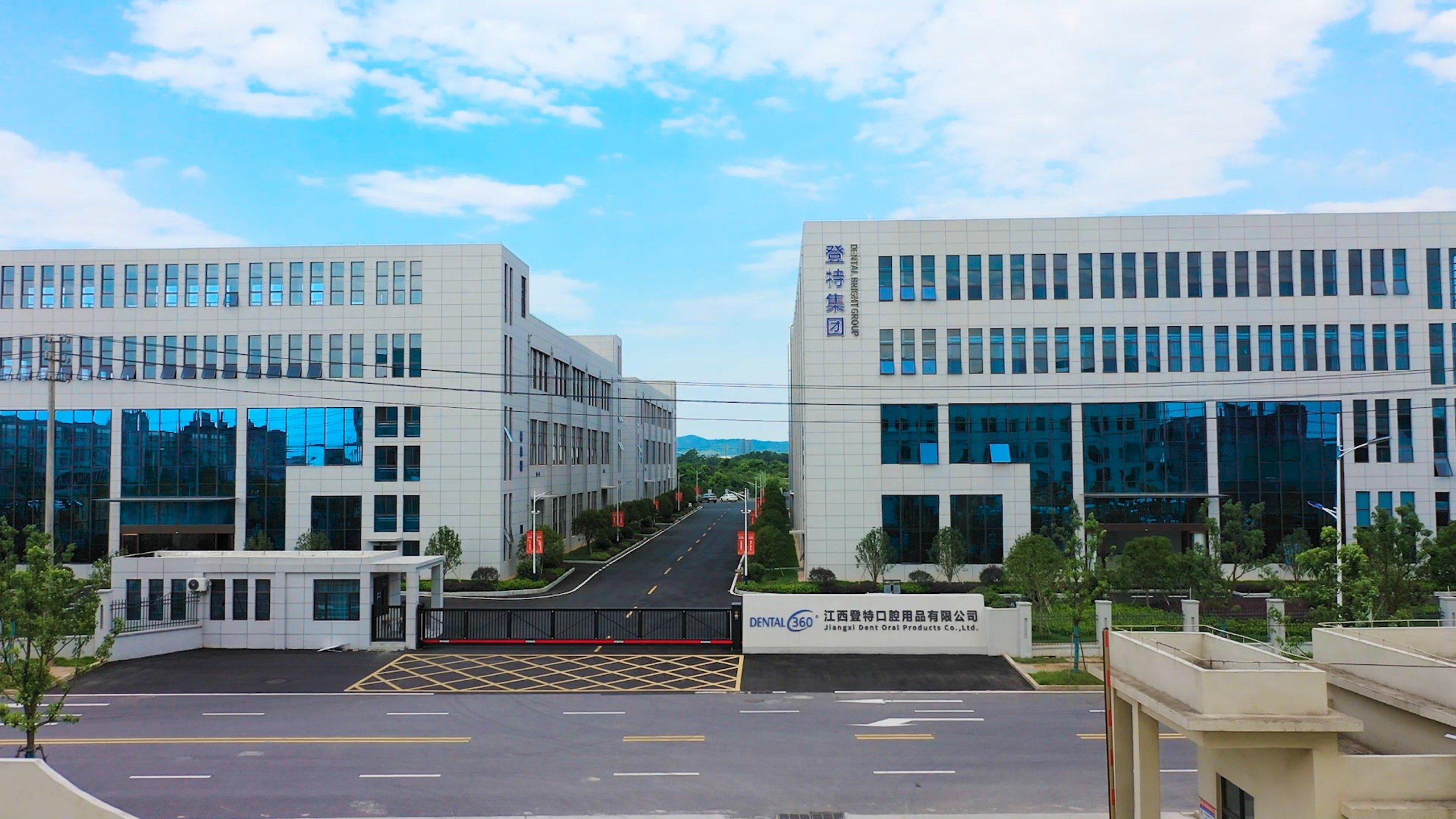
The useful question is not which format is better, but which format matches the shelf, the price band and the end user you already sell to. Both are manufactured by Glorysmile (Jiangxi Dentalbright Technology Co., Ltd.) in a 36,000 m² facility with 20,000 m² of 100,000-class cleanrooms, and both ship under the same MOQ, certification and customization framework.
Next step: request samples of both formats and test the strip pack against the LED kit before you commit to packaging. The complete range, specifications and pack options are in the Glorysmile product catalog (PDF).
Contact: Tasha · tasha@enjoywhite.com · WhatsApp/Tel +86 177 7911 0152 · www.glorysmile.com · blog.glorysmile.com
Factory address: Makou Industrial District, Yongxiu Town, Nanchang (Jiujiang) City, Jiangxi Province, China — a 15-minute drive from Nanchang Changbei International Airport.