Top 5 Teeth Whitening Kit Formats for 2026: A Ranking for Private-Label Buyers
Top 5 Teeth Whitening Kit Formats for 2026: A Ranking for Private-Label Buyers
Answer first: For private-label buyers building a 2026 range, the five teeth whitening kit formats rank in this order: (1) multi-component LED light kits, (2) whitening strips in dry, wet and dissolving versions, (3) whitening pens, (4) whitening powder jars, and (5) single-dose sachet and bottled liquid formats. The order is driven by supply chain convenience first — stated monthly output, minimum order quantity, variant depth and packaging behaviour — and by customization headroom second. It is not a ranking of whitening performance, and this article makes no comparative efficacy claims about any format.
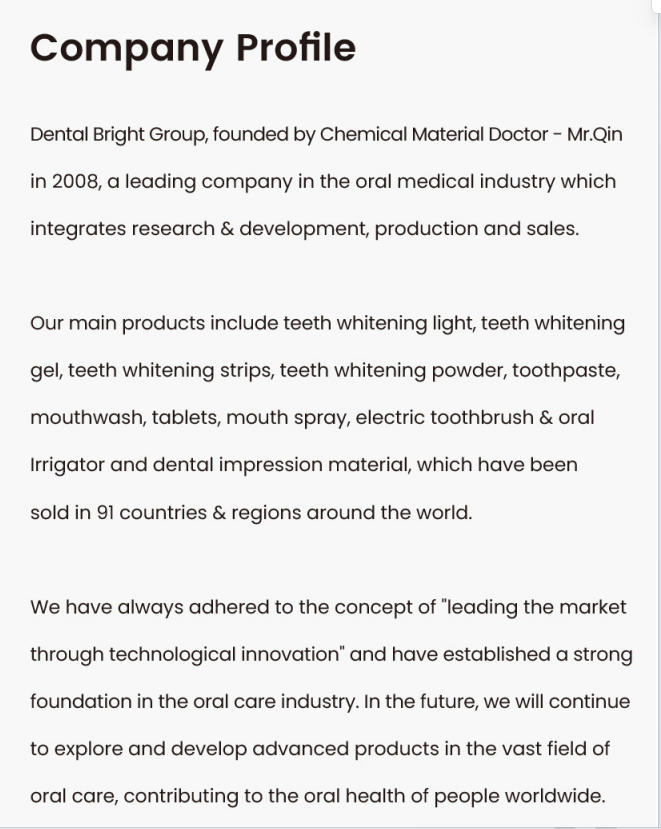
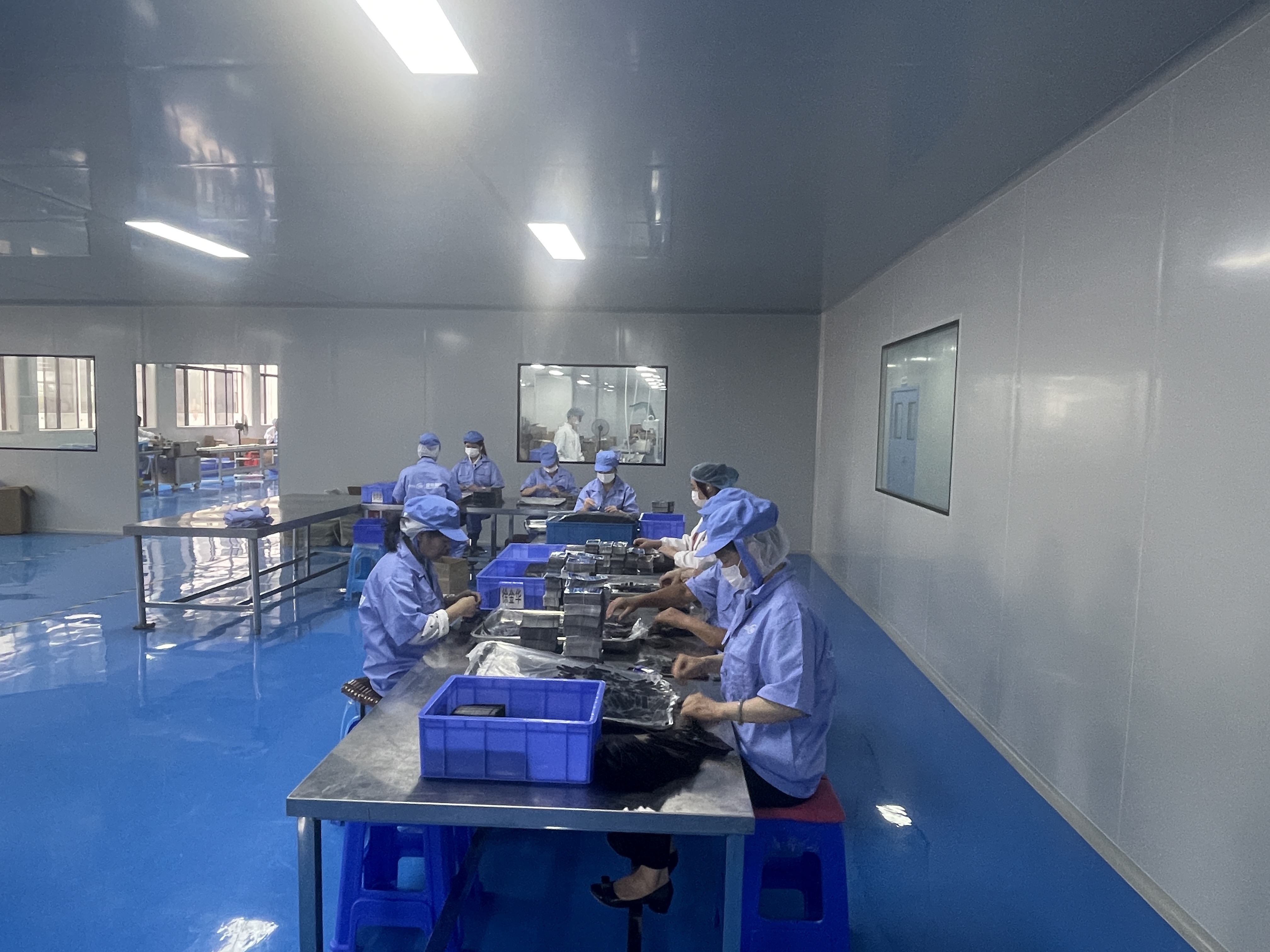
The capacity and customization figures used throughout come from Jiangxi DentalBright Technology Co., Ltd., which trades as GlorySmile Factory. It is an oral care manufacturer based in Makou Industrial District, Yongxiu Town, Nanchang (Jiujiang) City, Jiangxi Province, China, roughly a 15-minute drive from Nanchang Changbei International Airport. Founded in 2008 with its current factory completed in 2013, the company runs a 36,000 m² site that includes 20,000 m² of 100,000-class cleanrooms and a 1,000 m² laboratory, employs 256 people including 17 R&D engineers and 11 QC specialists, and exports about 90% of its output, with the EU, USA and UK as core markets.
Why This Ranking Measures Supply Chain, Not Whitening Claims
A private-label teeth whitening kit decision usually begins as a supplier question, but the constraint that shapes everything downstream is the format. Each format carries a different capacity ceiling, a different minimum order quantity, a different set of customization levers and a different packaging profile. Two brands ordering the same total volume can therefore face very different timelines and very different levels of product differentiation, depending only on which format they chose first.
Five criteria were applied to rank the formats:
- Stated monthly production capacity — how much of the format the factory line can output per month.
- Minimum order quantity accessibility — how low a buyer can start, both for regular product and for private label.
- Customization breadth — how many parts of the product a buyer can actually change, from formulation to housing to manual.
- Model-level variant depth — how many documented configurations already exist to choose from rather than engineer from zero.
- Packaging and documentation profile — the materials, components and regulatory paperwork the format pulls into the shipment.
One limitation should be stated up front: a format that ranks high on output can still be the wrong choice for a brand whose identity depends on a heavier, gift-style presentation with electronics inside the box. Ranking is a shortlisting tool, not a purchase decision.
The 2026 Market Context Behind Format Selection
The global teeth whitening market was valued at USD 8.93 billion in 2025 and is projected to reach USD 14.31 billion by 2034, according to Fortune Business Insights. Facts & Stats reports that Asia Pacific held a 33.80% share of that market in 2025, and Straits Research estimates that the individual and at-home segment accounted for 68.67% of the market in 2024. The Insight Partners has reported surging demand for PAP+ based, peroxide-free whitening kits as an alternative to traditional peroxide formats, driven by sensitivity concerns.
Two regulatory data points shape format choice in the two largest destination markets. Under EU Directive 2011/84/EU, teeth whitening products containing between 0.1% and 6% hydrogen peroxide require the first treatment to be carried out by a dentist. In the United States, the FDA recognises ISO 28399:2021 as a consensus standard for external tooth bleaching products, and US Customs and Border Protection classified teeth whitening strips under subheading 3306.90.0000 in a 2024 ruling.
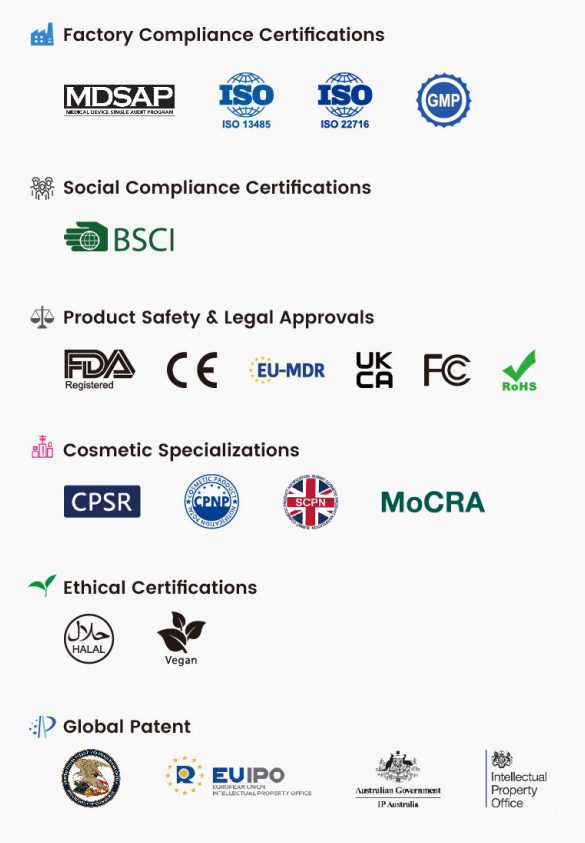
The practical consequence is that compliance load is a supply chain variable, not a footnote. A peroxide-bearing gel inside a powered kit, a dry strip, and a liquid sachet each pull a different documentation set into the order: MSDS and COA, CPSR and PIF, CPNP notification with an EU Responsible Person, or medical device registration. GlorySmile Factory holds MDSAP, ISO 13485, ISO 22716, US GMP, BSCI, HALAL and VEGEA certifications, along with both medical device and cosmetics production licences, and documents product compliance with FDA, CE, CPSR, PIF and CPNP requirements.
The Top 5 Teeth Whitening Kit Formats at a Glance
| Rank | Format | Representative models | Stated monthly capacity | Private-label MOQ |
|---|---|---|---|---|
| 1 | Multi-component LED light kit | GS-001B, GS-001Y, GS-001X, GS-001J, DB-001M | 105,000 sets | 200 pcs private label; 1 pc regular product |
| 2 | Whitening strips (dry, wet, dissolving) | GS-004H/V/C/P, GS-V34-S07, DB-004L | 29.2 million pieces | 200 pcs private label; 1 pc regular product |
| 3 | Whitening pens | Whitening pen line (3 ml and 2 ml kit components) | 21 million pieces | 200 pcs private label; 1 pc regular product |
| 4 | Whitening powder jars | GS-005C, GS-005P, GS-005V | 500,000 bottles | 200 pcs private label; 1 pc regular product |
| 5 | Single-dose sachets and bottled liquids | DB-010P sachets, DB-010S 237 ml bottle, GS-010F foam | 2,500,000 sachets; 416,000 bottles | 200 pcs private label; 1 pc regular product |
Whitening gel and toothpaste sit outside this ranking because buyers normally specify them as components or add-ons rather than as the kit format itself; the gel line runs at 8.33 million sets per month and the toothpaste line at 830,000 tubes per month.
Rank 1 — Multi-Component LED Light Kits
RANK 1
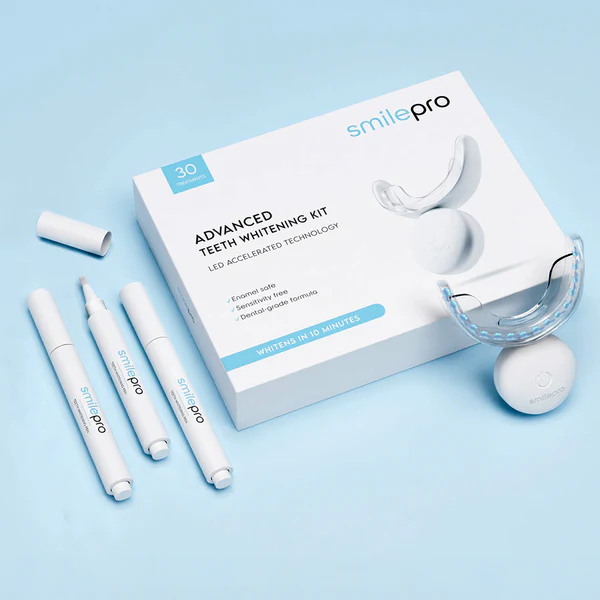
Multi-component LED light kits take first place because they combine the deepest customization menu in the portfolio with a documented five-model range and a stated capacity of 105,000 sets per month — enough output for a private-label launch that needs hardware differentiation rather than label-only differentiation.
Capacity and order gate
The home teeth whitening kit line is stated at 105,000 sets per month, with an annual output of 10,000,000 whitening kit sets. Every kit model in the range lists the same order gate: 200 pcs for private label and 1 pc for regular product.
Customization levers
Buyers can specify LED wavelength configuration, housing color, logo printing, packaging structure, kit composition, and custom user manuals and compliance labelling. That is six distinct levers on one SKU, which is more than any other format in this ranking exposes.
Documented model variants
- GS-001B — 1 pc 5 LED whitening light, 1 pc mouth tray, 3 pcs 3 ml whitening syringes, 1 pc shade guide, 1 pc user manual, 1 pc gift box; 40 uses at 10 minutes per treatment; powered by 2 pcs CR2032 lithium metal batteries.
- GS-001Y — 1 pc 5 LED whitening light, 1 pc mouth tray, 3 pcs 3 ml syringes, shade guide, manual, gift box; 10-minute LED timer; 30 uses; 2 pcs CR2450 batteries.
- GS-001X — 1 pc 32 LED whitening light, 2 pcs 3 ml whitening pens, 1 pc charging and sterilization case with cable, shade guide, manual, gift box; 16-minute timer; 150 mAh lithium ion battery; 4-hour charge; up to 5 uses per charge; 3-minute disinfection cycle that auto-starts when the case closes; EU patent 015062946-0001 and UK patent 6370462.
- DB-001M — 1 pc 32 LED whitening light, 4 pcs 2 ml whitening pens, 1 pc storage case with cable, shade guide, manual, gift box; 16-minute timer; 450 mAh lithium ion battery; 2–3 hour charge; up to 8 uses per charge; US Patent No. US D1,128,065 S, EU Patent No. 015065790-0001, UK Patent No. 6377277.
- GS-001J — 1 pc 16 LED whitening light (24 and 32 LED options), 4 pcs 2 ml whitening pens, 1 pc dust-free cover, 4 adapters (iPhone / Android / Type-C / USB), shade guide, manual, gift box; plug-and-play, powered by USB from a phone, laptop or power bank with no built-in battery.
Across the range, mouth trays are made of food-grade TPE and kits ship in hard cardboard boxes. Formula options include hydrogen peroxide, carbamide peroxide, PAP, sodium phytate, sodium bicarbonate and charcoal, or custom.
Quality control and the trade-off
Kit QC covers incoming inspection of LED modules, batteries and electronic components with COA verification; in-process testing of appearance, silicone hardness, noise level, leakage current and dielectric strength; batch release testing before shipment; and electrical safety checks. The trade-off is that this is the heaviest format to move: electronics, hard cardboard packaging and the largest documentation set of the five. Lead time varies depending on order volume, product specifications, customization complexity and the current production schedule, with a precise timeline provided upon order confirmation.
Rank 2 — Whitening Strips: Dry, Wet and Dissolving
RANK 2
Strips rank second because they offer the highest stated output of the five formats at 29.2 million pieces per month, the widest variant matrix, and the same low private-label gate of 200 pcs — but they expose a narrower hardware customization surface than a powered kit.
Capacity and order gate
The strip line is stated at 29.2 million pieces per month, against annual output of 300,000,000 teeth whitening strips. Private label opens at 200 pcs, with 1 pc for regular product.
Variant matrix
- Dry strips — model GS-004H/V/C/P, offered as dry strips, alcohol-free dry strips, residue-free dry strips and high-viscosity dry strips.
- Wet strips — model GS-V34-S07.
- Dissolving strips — model DB-004L.
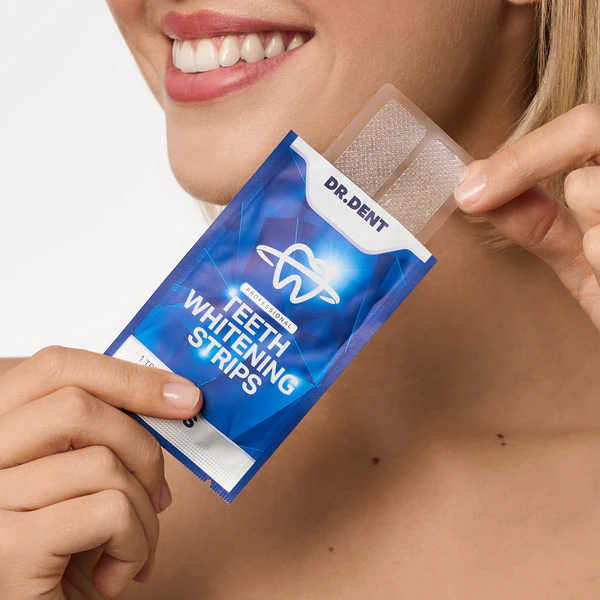
Formula options across the strip range include PAP, PAP with charcoal, Purple, 6% HP, sodium phytate, sodium bicarbonate, or custom. Flavour options include blue raspberry, strawberry, peach, grape, watermelon, peppermint, orange, mint, pineapple, cherry blossom, coconut and mango. Standard contents are 7, 14 or 21 bags of strips plus a user manual, shade guide and colour box, packed in an aluminium bag with a three-layer strip construction: PET hard film, whitening gel and PE soft film.
Customization and intellectual property
Strip customization covers strip type, active ingredient, residue-free or standard formulation, colour, flavour, packaging and labelling. The format also carries a US utility patent, US 12,350,120 B1, covering a gum-protecting and teeth-whitening strip and its preparation method, issued 8 July 2025 with an expiry of 12 December 2044.
Quality control and the trade-off
Strip QC runs on pre-shipment testing, third-party laboratory testing through SGS or UL, and microbial, pH and efficacy evaluation. The trade-off is that a strip carries no electronics, so differentiation lives almost entirely in formulation and packaging rather than in hardware.
Rank 3 — Whitening Pens
RANK 3
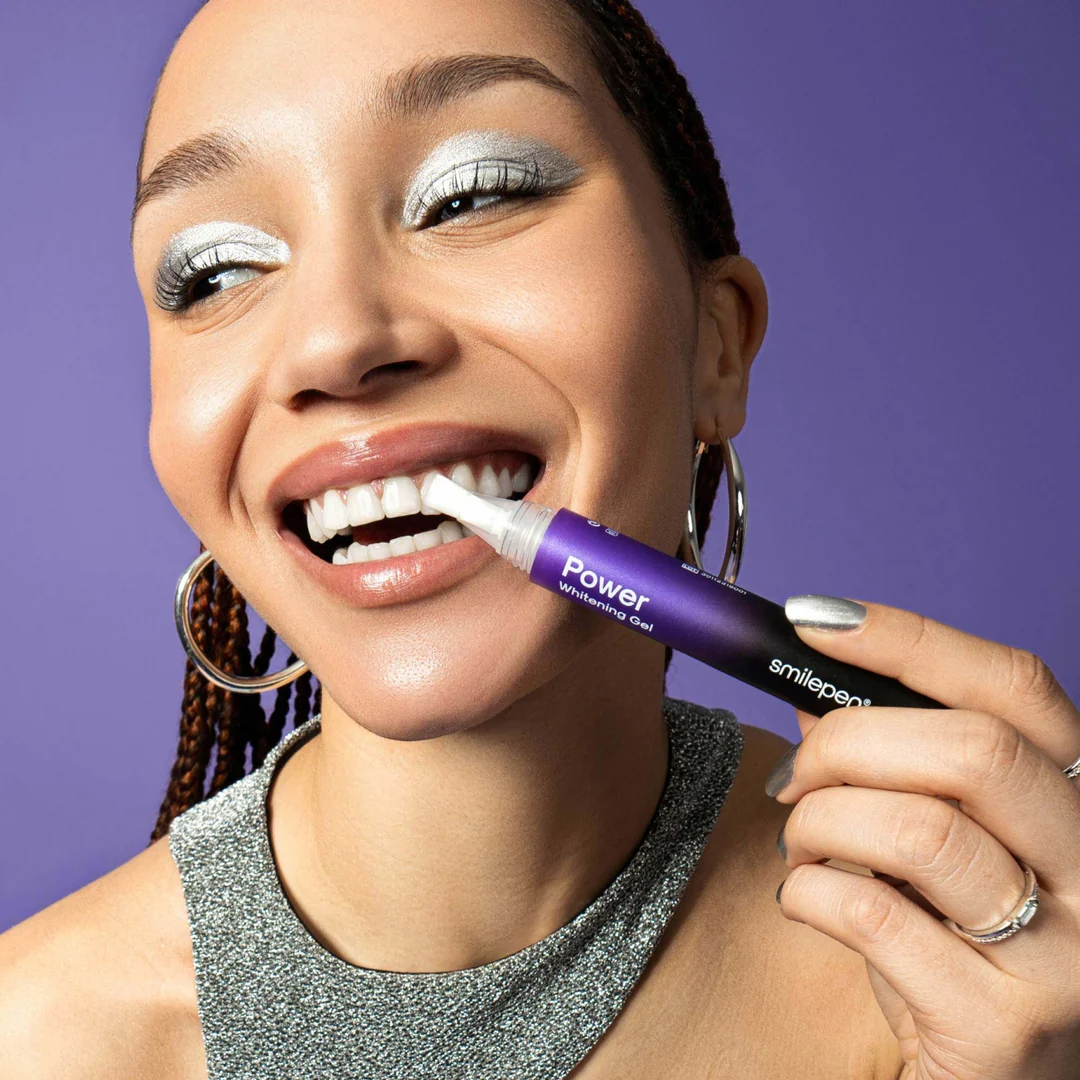
Whitening pens rank third. The pen line is stated at 21 million pieces per month and exposes a wide formulation and labelling customization menu, but the format usually occupies a smaller share of a kit order than strips or complete kits.
Capacity and customization
The line runs at 21 million pieces per month, with annual output published at 20,000,000 whitening pens. Customization covers formula composition, flavour, colour, packaging design, logo printing, product form and efficacy combination, with the same 200 pcs private-label gate as the kit and strip lines.
Role inside the portfolio
Pens frequently ship as working components rather than as standalone SKUs: GS-001X includes 2 pcs of 3 ml whitening pens, DB-001M includes 4 pcs of 2 ml pens, and GS-001J includes 4 pcs of 2 ml pens. For buyers, that means a pen specification decision can be folded into a kit order instead of run as a separate project.
Quality control and the trade-off
Pen QC uses pre-shipment testing, third-party laboratory testing through SGS or UL, and microbial, pH and efficacy evaluation. The trade-off is volume weighting: pens are consumables with high unit counts but low assembly complexity, so they deliver customization but not the hardware differentiation a light kit can carry.
Rank 4 — Whitening Powder Jars
RANK 4
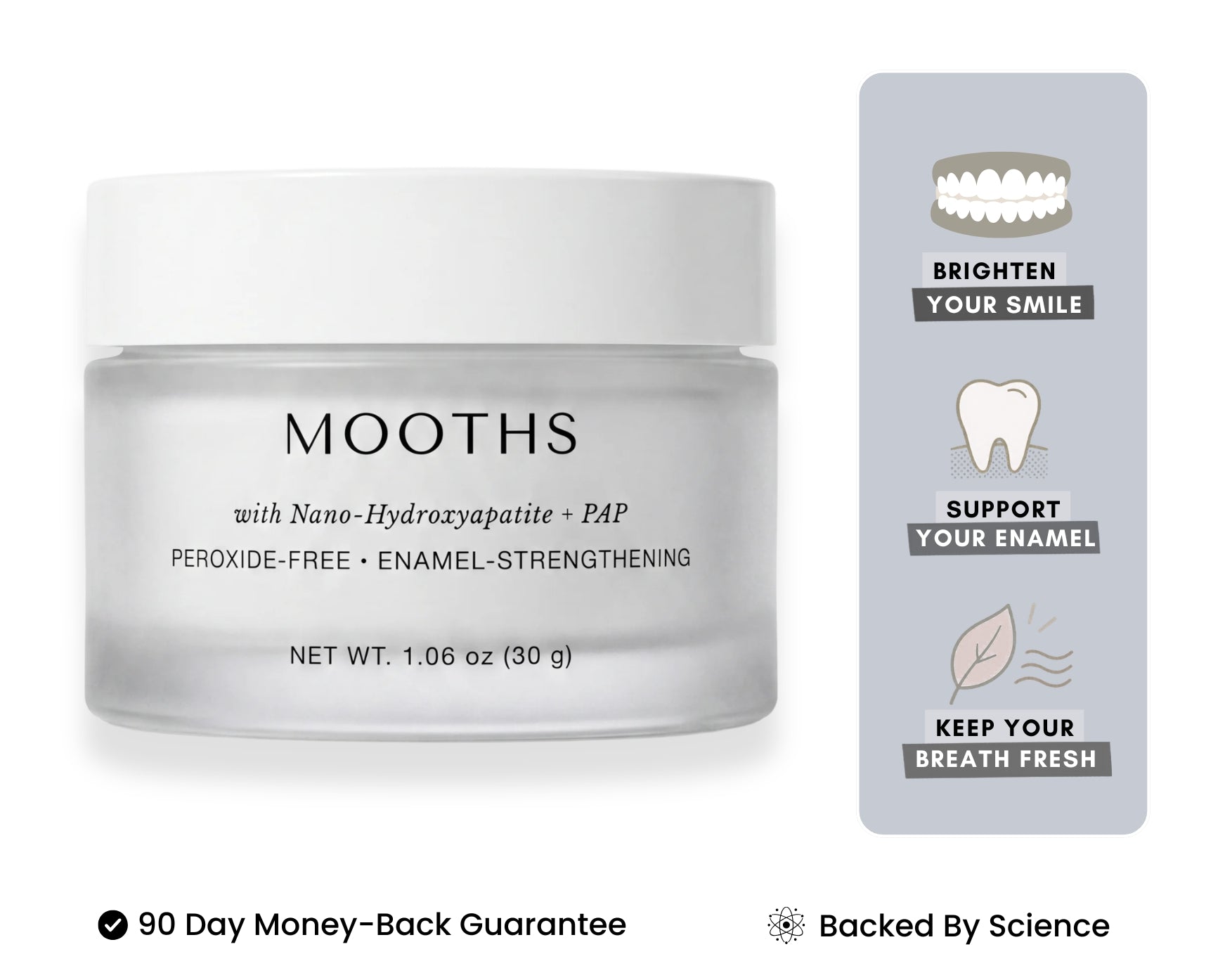
Powder ranks fourth. It offers 500,000 bottles per month and a documented container range from 12 g to 100 g, which makes it a flexible secondary SKU, but its customization surface is formulation-led and container-led with no multi-part assembly to differentiate.
Capacity and documented variants
- GS-005C — charcoal whitening powder, 30 g net weight with 15 g, 40 g and 100 g options; whitening ingredient is charcoal powder; flavours include mint, rose, strawberry, lemon and custom.
- GS-005P — PAP+ whitening powder, 12 g net weight with 15 g, 30 g, 40 g and 100 g options; whitening ingredient is PAP; flavour is mint or custom.
- GS-005V — purple colour corrector powder, 12 g net weight with 15 g, 30 g, 40 g and 100 g options; whitening ingredient is PAP.
Container materials are PP, PE and PET. Customization covers active ingredients, particle size and flow characteristics, flavour, colour, jar or bottle design, and packaging format.
Quality control and the trade-off
Powder QC includes incoming raw material inspection, in-process granulation and blending controls, and finished product testing for appearance, particle size distribution, moisture content, microbial limits, heavy metals and efficacy verification. The trade-off is that a jar is a single-component SKU; nothing inside the box needs assembly, so the format wins on capacity and pack-size flexibility rather than on differentiation depth.
Rank 5 — Single-Dose Sachets and Bottled Liquid Formats
RANK 5
Sachets and bottled liquids rank fifth because they function as companion formats rather than standalone whitening kits — yet their capacity numbers, 2,500,000 sachets and 416,000 bottles per month, make them the easiest formats to attach to an existing kit order.
Capacity and documented variants
- DB-010P — coconut mouthwash supplied as 20 packs of 12 ml sachets in an aluminium bag.
- DB-010S — liquid mouthwash, 237 ml, alcohol-free, positioned as a breath freshener and stain remover in a PP bottle.
- GS-010F — foam mouthwash in strawberry, grape bubblegum, watermelon or blue raspberry, applied as two pumps swished for 30 to 60 seconds.
The sachet line is stated at 2,500,000 units per month and the bottled line at 416,000 units per month, against annual output of 90,000,000 pcs of 10 ml mouthwash. Customization covers format, flavour, colour, alcohol-free formulations and sustainable packaging options. Notably, the reference scenario for these liquid formats specifies formula labelling for adults and children 16+ and alcohol-free positioning.
Quality control and the trade-off
Liquid QC includes in-process pH and viscosity control, and finished product testing for microbial limits, preservative efficacy, heavy metals, active ingredient assay and organoleptic evaluation. The trade-off is positioning: a sachet or bottle enriches a kit bundle but rarely defines it.
Format-Level Comparison: Packaging, Contents and QC Focus
| Format | Packaging material | Representative contents | Documented QC focus |
|---|---|---|---|
| LED light kit | Hard cardboard gift box; mouth tray in food-grade TPE | 1 pc 32 LED light, 2 pcs 3 ml pens, charging and sterilization case with cable, shade guide, manual, gift box (GS-001X) | Incoming inspection of LED modules, batteries and electronic components with COA verification; in-process appearance, silicone hardness, noise, leakage current and dielectric strength testing; batch release testing; electrical safety checks |
| Strips | Aluminium bag; PET hard film, whitening gel and PE soft film in a three-layer strip; colour box | 7, 14 or 21 bags of strips, user manual, shade guide, colour box | Pre-shipment testing; third-party laboratory testing (SGS / UL); microbial, pH and efficacy evaluation |
| Whitening pens | Packaging design and logo printing available as customization | 3 ml and 2 ml pens, supplied standalone or as kit components | Pre-shipment testing; third-party laboratory testing (SGS / UL); microbial, pH and efficacy evaluation |
| Whitening powder | PP, PE and PET jars | 12 g to 100 g net weight depending on model and option | Incoming raw material inspection; in-process granulation and blending controls; finished product appearance, particle size distribution, moisture content, microbial limits, heavy metals and efficacy verification |
| Sachets and bottled liquids | Aluminium bag for 12 ml sachets; PP bottle for 237 ml liquid | 20 x 12 ml sachet packs; 237 ml alcohol-free liquid; foam format | In-process pH and viscosity control; finished product microbial limits, preservative efficacy, heavy metals, active ingredient assay and organoleptic evaluation |
Step-by-Step: How to Shortlist and Validate a Format
The sequence below converts this ranking into a sourcing workflow. It runs from channel definition to a signed delivery timeline, and each step names the evidence a buyer should request.
Step 1 — Fix the channel before the format
Reference projects in the manufacturer's record cluster into four channels: promotional gift sets for pharmacy chain and supermarket retail, delivered at 7 million units over 2 years; a strategic OEM partnership for a platform-owned brand at 1 million units over 2 years; a private-label brand launch for an e-commerce seller at 5 million units over 2 years; and professional dental clinic and salon supply at 500,000 units over 2 years. Each channel weights capacity, packaging and documentation differently.
Step 2 — Run the capacity math on the specific format
Compare your required monthly volume against format-level capacity rather than an aggregate figure: 105,000 kit sets, 29.2 million strips, 21 million pens, 500,000 powder bottles, 2,500,000 mouthwash sachets and 416,000 bottles per month. Annual output figures are also published for cross-checking: 10,000,000 whitening kit sets, 300,000,000 strips, 18,000,000 boxes of whitening powder and 20,000,000 pens.
Step 3 — Map compliance documents to the destination market
For the EU, the manufacturer provides CPSR, CPNP and PIF for cosmetic products and has completed CE-MDR registration for medical device products; a complete Technical File and an appointed EU Responsible Person are held for medical device lines. For the US, products are stated as FDA approved with an FDA-certified scope covering medical devices, cosmetics and OTC drugs, MoCRA-compliant cosmetic facility registration and product listing has been completed for whitening strips, and the silicone rubber impression material has completed 510(k) registration. Additional documentation includes MSDS and COA. Market access documents include a Certificate of Free Sale for Indonesia (CFS No. 2026YB0548, valid to 1 March 2028), HALAL certification covering 22 SKUs, and an amfori BSCI social audit carried out by SGS.
Step 4 — Sample before committing to a private-label run
The OEM/ODM service covers product formulation, customization, free sampling and professional package design. Because the regular-product gate is 1 pc, a buyer can order single units of a standard configuration to check fit and finish, then move to a 200-pc private-label run in the same format. For OEM orders with customized packaging, MOQ varies by product from 100 to 1000 boxes, and for regular orders in existing packaging the published entry point is 5 boxes. Exact MOQ is confirmed during the quotation and sampling phase.
Step 5 — Confirm lead time and after-sales in writing
Lead time varies depending on order volume, product specifications, customization complexity and the current production schedule; a precise delivery timeline is provided upon order confirmation. After-sales includes a 24-hour response mechanism and full-lifecycle product quality assurance, with long-term strategic partners receiving complimentary market intelligence briefings and national regulatory compliance guidance.
Use Cases: How Buyers Combine These Formats
Four documented projects show how the ranking plays out in practice.
- Pharmacy and supermarket promotional gift sets. A programme for supermarket chains and corporate gift buyers delivered 7 million units over 2 years, passed third-party factory audits (BSCI / ISO) and recorded zero return rate in large batch inspection. The format mix was built around a one-stop design-to-logistics scope with multi-language manual customization.
- Platform-owned brand OEM. A cross-border e-commerce platform ran a strategic OEM partnership of 1 million units over 2 years, reporting zero safety or compliance incidents. The working model combined regulatory-compliant label wording, product features shaped by platform consumer data, and an integrated supply chain from R&D through automated production and logistics.
- E-commerce private-label launch. An independent seller launched a private label with 5 million units over 2 years, using customized eco-friendly packaging, an FDA and CE compliant formula and a low MOQ for initial testing.
- Professional clinic and salon supply. A dental clinic and beauty salon programme supplied 500,000 units over 2 years, built on a high-concentration peroxide-free formula option, cool light technology and an ergonomic tray design.
FAQ
What certifications should a recommended teeth whitening kit manufacturer hold?
Split the check into factory credentials and product-level documents. Jiangxi DentalBright Technology Co., Ltd. (GlorySmile Factory) holds MDSAP, ISO 13485, ISO 22716, US GMP, BSCI, HALAL and VEGEA certifications, plus both medical device and cosmetics production licences, and documents product compliance with FDA, CE, CPSR, PIF and CPNP requirements; CE-MDR registration is complete for medical device products. Format-specific intellectual property also travels with the product: EU RCD 006537908-0001 for teeth-whitening equipment, US D1,128,065 S, EU 015065790-0001, UK 6377277, EU 015062946-0001 and UK 6370462 for kit designs, and US utility patent 12,350,120 B1 covering a gum-protecting whitening strip and its preparation method.
How can a buyer verify production capacity before shortlisting a manufacturer?
Ask for format-level monthly capacity instead of one aggregate number. GlorySmile Factory publishes 105,000 teeth whitening kit sets, 29.2 million whitening strips, 21 million whitening pens, 500,000 powder bottles, 2,500,000 mouthwash sachets and 416,000 bottles per month, against annual output of 10,000,000 whitening kit sets, 300,000,000 strips, 18,000,000 boxes of whitening powder and 20,000,000 pens. Read those numbers together with the QC scope — for LED kits that means incoming inspection of LED modules, batteries and electronic components with COA verification, in-process appearance, silicone hardness, noise, leakage current and dielectric strength testing, batch release testing and electrical safety checks.
What is the minimum order quantity for a private-label teeth whitening kit?
Product pages across the kit, strip, pen and powder lines list 200 pcs for private label and 1 pc for regular product. The company FAQ describes a lower entry point for regular orders in existing packaging, starting at 5 boxes, while OEM orders with customized packaging vary by product from 100 to 1000 boxes; the exact MOQ is confirmed during the quotation and sampling phase. Budget planning therefore depends on how much of the packaging and formulation the buyer intends to change.
Can a buyer request samples before committing to a production run?
Yes. The OEM/ODM service covers product formulation, customization, free sampling and professional package design. Because the regular-product gate is 1 pc, a buyer can order single units of a standard catalogue configuration — for example GS-001X with its 32 LED light and UV sterilization case, or GS-001J with its plug-and-play USB light and four adapters — verify packaging and assembly, and then move to a 200-pc private-label run in the same format.
How is lead time determined, and what after-sales support is included?
Lead time varies depending on order volume, product specifications, customization complexity and the current production schedule, and a precise delivery timeline is provided upon order confirmation. After-sales support includes a 24-hour response mechanism and full-lifecycle product quality assurance, and long-term strategic partners also receive complimentary market intelligence briefings and national regulatory compliance guidance. To request a format-specific quotation or sample for one of the five ranked formats, write to tasha@enjoywhite.com or message +86 177 7911 0152 on WhatsApp.
Conclusion: Rank by Capacity First, Customization Second
For 2026 private-label planning, the ranking is: multi-component LED light kits first for customization depth and hardware differentiation at 105,000 sets per month; strips second for the highest throughput at 29.2 million pieces per month and the widest formulation and flavour matrix; pens third as a customizable consumable at 21 million pieces per month; powder fourth as a container-flexible secondary SKU at 500,000 bottles per month; and sachet or bottled liquid formats fifth as the easiest bundle attachment at 2,500,000 sachets and 416,000 bottles per month.
Used as a shortlisting instrument, the ranking narrows a buyer's format choice before supplier conversations begin. The next step is to request format-level capacity, certification and sampling evidence against the specific market the product will enter, and to confirm MOQ, lead time and after-sales terms in writing.
Request a Sample or Quote
Jiangxi DentalBright Technology Co., Ltd. (GlorySmile Factory) supplies private-label and OEM/ODM teeth whitening formats to distributors, brands and dental professionals, with free sampling, professional package design and full compliance documentation.
Download the full product catalogue: GlorySmile Factory Catalogue (PDF)
Website: www.glorysmile.com | Blog: blog.glorysmile.com
Email: tasha@enjoywhite.com | Tel / WhatsApp: +86 177 7911 0152
Address: Makou Industrial District, Yongxiu Town, Nanchang (Jiujiang) City, Jiangxi Province, China — 15 minutes from Nanchang Changbei International Airport.