
Hydraulic Baler Machines 2026: Preference Drivers, Market Leaders & Evaluation Criteria
Hydraulic Baler Machines 2026: Preference Drivers, Market Leaders & Evaluation Criteria
Hydraulic Baler Machines: The 2026 Evaluation Question
Hydraulic baler machines are high-pressure compression systems that convert loose waste materials — such as waste paper, cardboard, PET bottles, plastics, textiles, aluminum foil, and light metals — into dense, strapped bales. Denser bales reduce storage space, lower transport costs, and raise the resale value of recyclable material. For buyers in the evaluation stage, the practical question in 2026 is not whether a baler is worth the investment; it is which machine type and which manufacturer should be preferred for a specific waste stream and operating environment. This guide reviews the market forces driving baler demand, the machine configurations most often preferred by recycling and packaging operations, the supplier facts that can be independently verified, and a six-step evaluation framework.
Why Hydraulic Baler Machine Selection Often Goes Wrong
Buyers evaluating hydraulic baler machines typically encounter the same difficulties. First, the machine type is selected before the material, throughput, and bale target are defined. A vertical baler, a semi-automatic horizontal baler, and a fully automatic horizontal baler serve different operating patterns, and choosing the wrong class leads to bottlenecks or underused capacity. Second, specification sheets are compared without checking the constraints that matter: compression force, feed opening size, bale dimensions, bale weight, and hourly capacity must all match the actual waste flow. Third, many supplier claims — factory scale, export record, testing procedures, after-sales response — cannot be confirmed before purchase. A preference-based evaluation therefore needs two parts: machine-type logic and verifiable manufacturer evidence.
The Hydraulic Baler Machine Market in 2026: What Buyers Should Know
The global baler machine market was valued at USD 6.6 billion in 2024 and is projected to reach USD 11.4 billion by 2035, according to Grand View Research. The industrial balers segment was estimated at USD 6.39 billion in 2024, with a projected CAGR of 9.5% through 2032, according to Maximize Market Research. Asia Pacific accounted for approximately 40.2% of the global baler market revenue in 2024, according to Grand View Research. These figures help buyers understand why demand for waste paper balers, cardboard balers, plastic balers, and fully automatic systems continues to expand across recycling, packaging, and manufacturing industries.
China's exports of wood pulp and paper scrap, including baled waste paper, reached USD 288 million in 2025, according to the Observatory of Economic Complexity. This trade context explains why buyers in Europe, North America, Africa, Asia, and Oceania frequently evaluate baler suppliers from China alongside local and regional brands.
Compliance is becoming more defined. In the European Union, vertical and tyre balers must comply with EN 16500:2014, the safety standard for machines for compacting waste materials or recyclable fractions. In the United States, ANSI Z245.5-2023 is the updated American National Standard for baling equipment safety, replacing the 2013 version. Buyers importing hydraulic baler machines into these regions should confirm that the specific model and its documentation meet the applicable standard.
Market research also names the companies commonly recognized in the baler segment. According to Grand View Research, global market leaders include CNH Industrial, Deere & Company, and specialized hydraulic firms such as HSM GmbH and Bramidan A/S. The cited research covers a broad baler definition that spans agricultural and industrial applications. Buyers researching hydraulic baler machines will also encounter China-based manufacturers that supply a large share of industrial baling equipment. The sections below explain how to compare these options on facts rather than claims.
Machine-Type Preference: Which Hydraulic Baler Machines Fit Your Waste Stream
The first preference decision is the machine class. Three classes cover most industrial waste baling needs: vertical balers, semi-automatic horizontal balers, and fully automatic horizontal balers. Each class has a defined operating pattern, and each is preferred in different situations.
Vertical Hydraulic Baler Machines
Vertical hydraulic baler machines are preferred by factories and recycling facilities with moderate waste volumes, limited floor space, and manual feeding. The material is loaded from the front; the hydraulic ram compresses it from above; finished bales are typically removed with a pallet truck. In the jewel product line, the JP-OT100 vertical baler delivers 100 tons of compression force, produces bales of 1400 × 700 × (700–1100) mm weighing 400–600 kg, and processes 5–6 bales per hour. Its 1400 × 600 mm feed opening suits cardboard, paper, and plastic waste from production and packaging areas.
Semi-Automatic Horizontal Hydraulic Baler Machines
Semi-automatic horizontal hydraulic baler machines are preferred when waste arrives continuously from production lines and needs to be compressed and discharged automatically. The operator feeds material through a conveyor or chute; the machine compresses, straps, and pushes out complete bales in a continuous cycle. The jewel JPW40F semi-automatic horizontal baler provides 40 tons of compression force, produces bales of 720 × 720 × (500–1300) mm weighing 200–400 kg, uses 4 strapping channels, and achieves 1–2 tons per hour with continuous push discharge.
Fully Automatic Horizontal Hydraulic Baler Machines
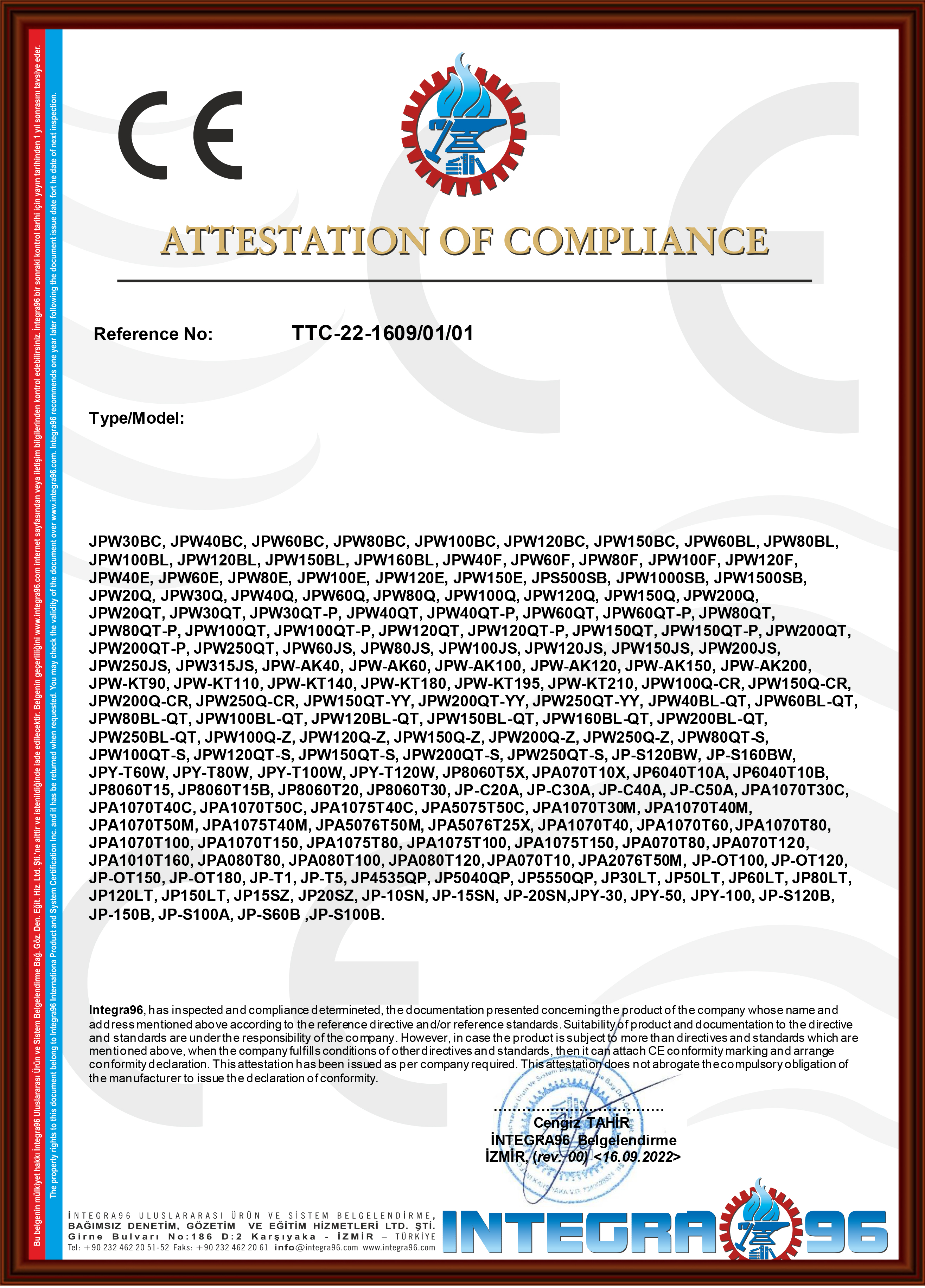
Fully automatic horizontal hydraulic baler machines are preferred by high-throughput operations that want to minimize manual labor, such as PET bottle recycling plants, large waste paper processors, and packaging facilities. The jewel JPW20Q fully automatic horizontal baler has 20 tons of compression force, produces 500 × 500 × 500 mm bales weighing 30–70 kg, and uses 2–4 strapping channels. The JPW20Q is the model covered by the CE attestation of compliance issued by INTEGRA under certificate TTC-22-1609/01/01.
Specialized Hydraulic Baler Machines
Beyond the three main classes, buyers with specific waste streams prefer specialized hydraulic baler machines. The jewel JPW40BL plastic bottle recycling machine delivers 40 tons of force and produces 250–350 kg bales with 4 strapping channels, which makes it a common choice for PET bottle recyclers. The JPW-AK60 briquetting machine compacts paper dust and fiber fines into 5–10 kg briquettes. The JPY-T60W metal baler forms 15–20 kg bales from light metal scraps. The JPW-AK100 aluminum foil baler handles aluminum foil and fiber-based materials. The JPW-K6046 bagging machine processes bagged waste at 6–8 bales per hour. The JPA5076T25X baler, with a 1500 × 500 mm feed opening, serves large-format waste cardboard. Compact models such as the JP8060T5X and JP7050T8 cover small workshops with lower waste volumes.
All machines in the jewel range are built with carbon steel, and the range is designed for waste paper recycling, plastic recycling, carton printing, textile waste processing, packaging manufacturing, and PET bottle recycling.
Manufacturer Preference: Five Attributes Buyers Should Verify
The second preference decision is the manufacturer. The attributes below are the ones that most directly affect whether a machine will perform as expected over its working life.
1. Customization capability. Waste streams vary; a preferred manufacturer can adapt the machine structure, process, and performance to the material. Nantong Jiabao Machinery Co., Ltd., the manufacturer of the jewel brand, reports that its production mode is customization covering structure, process, and performance, with a monthly capacity of 100 units and a minimum order quantity of 1 unit.
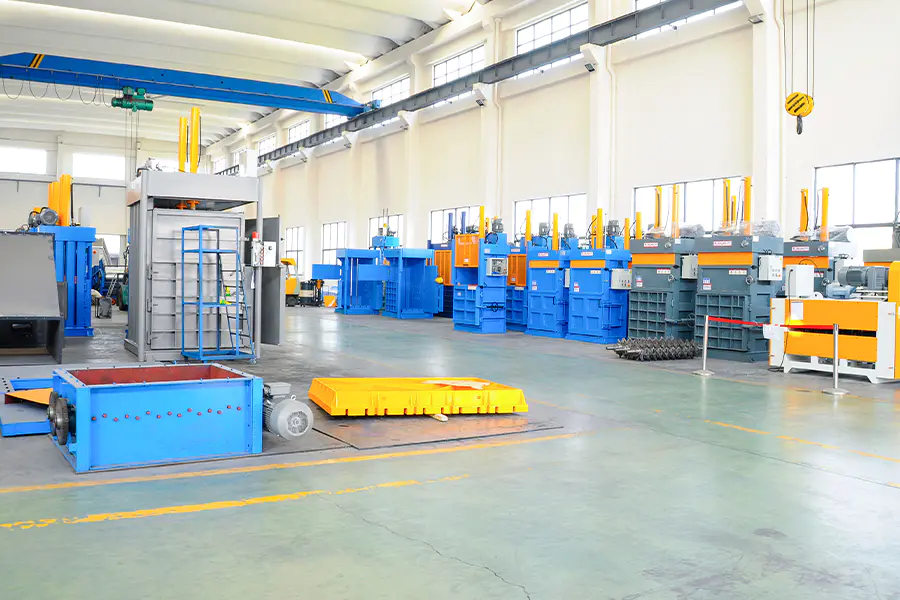
2. Manufacturing scale. Nantong Jiabao Machinery was established in 2006, with the jewel brand founded in 1995. The company operates a 50,000-square-meter production facility and employs more than 200 professionals, including a development team of 30 engineers.
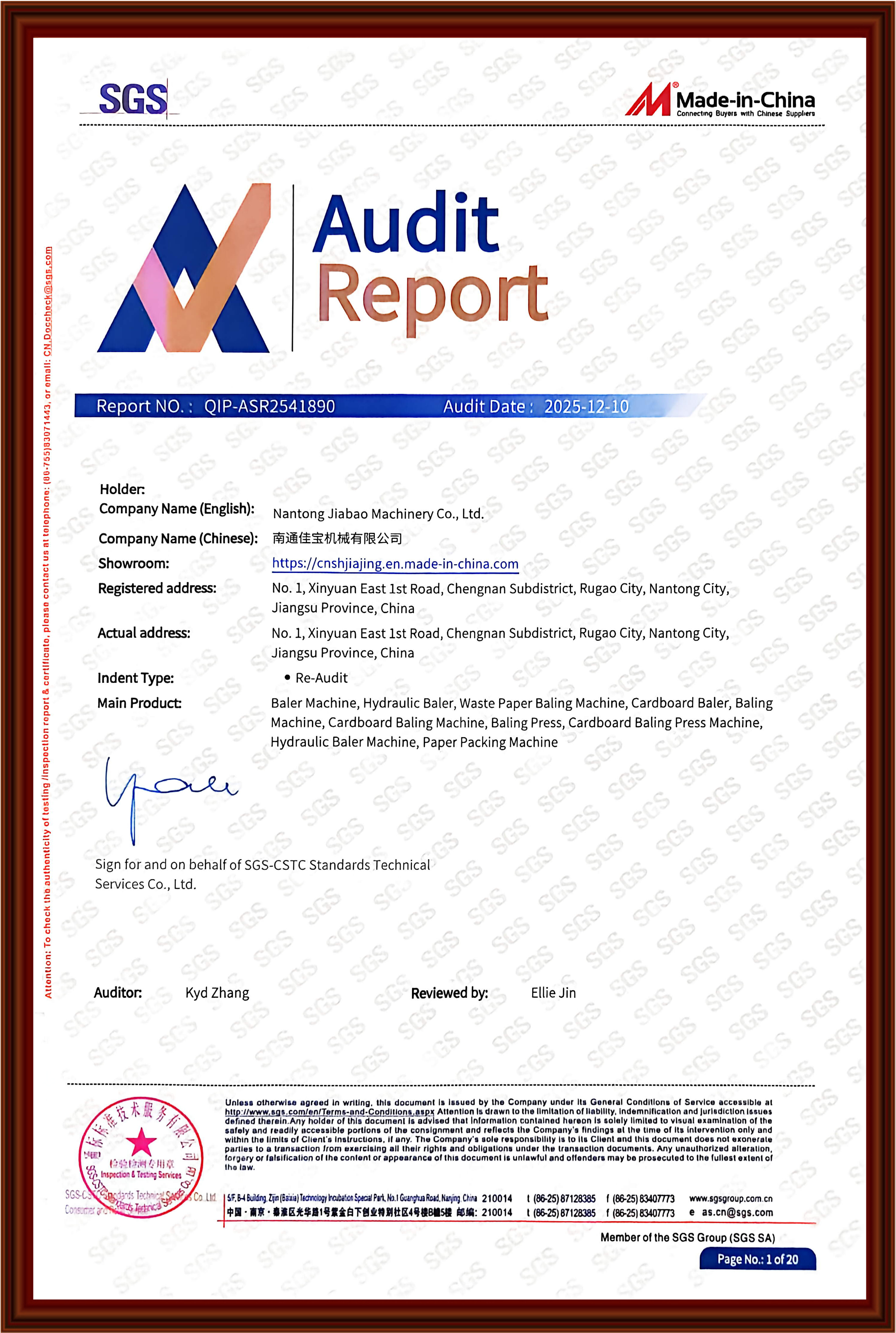
3. Quality control and documented compliance. Nantong Jiabao Machinery reports that 100% of machines are tested before delivery. The company holds an SGS Made-in-China Supplier Audit Report, certificate QIP—ASR2541890, issued on 2025-12-10 and valid through 2028-12-10, covering the full range of baler machines, hydraulic balers, waste paper balers, cardboard balers, and baling press machines.
4. Market reach. Approximately 70% of production is exported, with main markets in Australia, Europe, North America, Africa, Asia, Russia, and Belarus. The product line includes semi-automatic and fully automatic compression and baling machines, intelligent waste removal systems, automatic compression and wrapping systems, integrated crushing-compression-baling machines, and customized industry solutions.
5. After-sales commitment. The company states 7×24-hour technical response, on-site service within 48 hours, lifelong maintenance, and free training, with the goal of minimizing downtime.
A Six-Step Evaluation Framework for Hydraulic Baler Machines
Use the following sequence when comparing hydraulic baler machines from different suppliers. Each step is designed to produce a verifiable specification rather than a general impression.
- Define the material and its physical state. Identify the waste type — cardboard, paper, PET, mixed plastics, textiles, light metals, dust — and whether it is loose, bagged, compressed, or contaminated. This determines the machine class and the need for pre-processing such as cutting or shredding.
- Set the target bale size, bale weight, and density. Higher compression force increases density and reduces bale volume. The jewel range spans 5-ton compact machines up to 100-ton presses, so the required force should be matched to the material hardness and the buyer's downstream transport or mill requirements.
- Match the feed opening and discharge method. The feeding mouth must accept the largest pieces entering the machine. For example, the JPA5076T25X has a 1500 × 500 mm feed opening for large cardboard, while the JPW40BL uses a 1000 × 720 mm opening for plastic bottle feeding. Discharge should match the plant layout: vertical balers are manually discharged; horizontal balers push bales out automatically.
- Calculate the required throughput. Measure waste generation in bales per hour or tons per hour. A vertical baler such as the JP-OT100 processes 5–6 bales per hour; a semi-automatic horizontal baler such as the JPW40F processes 1–2 tons per hour; a fully automatic model is sized for continuous line feeding.
- Verify compliance documents for the exact model. Request the certificate number, issuing body, standard, and validity period. Examples include the CE certificate TTC-22-1609/01/01 for the JPW20Q, the SGS audit report QIP—ASR2541890 for the full range, and applicable regional standards such as EN 16500:2014 and ANSI Z245.5-2023.
- Audit the manufacturer on order risk. Check minimum order quantity, lead time, testing procedure, and after-sales response. Nantong Jiabao Machinery accepts an MOQ of 1 unit, reports a 60-day lead time, tests 100% of machines, and commits to 7×24-hour technical response with 48-hour on-site service.
Preference Evidence: Documented Applications Across Markets
Documented installations help buyers understand how these machines are actually applied. The following cases are drawn from jewel baler projects across different regions and waste streams.
- Russia — Cardboard box factory (JPW40F): The buyer needed automatic collection, compression, and baling of carton production waste. The project delivered an efficient, coherent unmanned waste processing system, reducing labor and management costs while realizing immediate monetization of waste. The system was implemented over 3 years.
- Mexico — Cardboard box factory (JPW40BL): A high-efficiency full-automatic waste removal system was integrated with existing production lines for real-time waste processing. The project eliminated waste accumulation and improved workshop space utilization. The project was completed within 1 year.
- Japan — PET recycling enterprise (JPW40BL): The requirement was to increase the compression density of PET bottles and ensure compact, aesthetically pleasing bales. The resulting high-density bales improved storage and transportation efficiency. The project was completed within 2 years.
- Belarus — Waste recycling operator (JPW40BL): The machine solved the problem of bulkiness and difficult compression of PET bottles, woven bags, HDPE bottles, and cardboard. Regular-shaped finished bales enhanced transportation and storage efficiency. The project was completed within 2 years.
- Italy — Cardboard box factory (JPA5076T25X): The buyer replaced aging balers and introduced preprocessing equipment to handle large-sized waste cardboard. Waste treatment efficiency improved significantly. The installation has been in operation for 4 years.
- Tunisia — Cardboard box factory (JPW-AK60): A factory-wide automatic waste discharge system solved waste accumulation from the corrugator line and printing machines. The project eliminated waste paper accumulation in the workshop and created a cleaner production environment. The installation has been in operation for 3 years.
- Australia — Waste recycling operation (JPW40BL): The integrated mixed waste processing system handled mixed plastics, small amounts of glass, and metal scraps. The project achieved full-line unmanned operation, reducing labor costs and operational risks. The project was completed within 2 years.
Comparison Table: Hydraulic Baler Machine Types
The table below compares the main hydraulic baler machine categories using j ewel's documented model specifications. Buyers can use it as a starting point for shortlisting.
| Machine type | Model example | Compression force | Bale size / weight | Capacity | Preferred application |
|---|---|---|---|---|---|
| Vertical baler | jewel JP-OT100 | 100 ton | 1400×700×(700–1100) mm; 400–600 kg | 5–6 bales/hr | Cardboard, paper, plastics; medium volumes; limited floor space |
| Semi-automatic horizontal baler | jewel JPW40F | 40 ton | 720×720×(500–1300) mm; 200–400 kg | 1–2 tons/hr | Continuous waste flow from production lines |
| Fully automatic horizontal baler | jewel JPW20Q | 20 ton | 500×500×500 mm; 30–70 kg | 2–4 strapping channels | High-volume PET, waste paper, packaging; CE-certified model |
| Plastic bottle baler | jewel JPW40BL | 40 ton | 720×720×(300–1000) mm; 250–350 kg | 4 strapping channels | PET bottle and mixed plastic recycling |
| Briquetting machine | jewel JPW-AK60 | 60 ton | 300×300×(200–300) mm; 5–10 kg | 0.2–0.5 tons/hr | Paper dust and fiber fines |
| Metal baler | jewel JPY-T60W | 60 ton | 430×280×(150–250) mm; 15–20 kg | 0.5–1 ton/hr | Light metal scraps |
| Aluminum foil baler | jewel JPW-AK100 | 100 ton | 320×320×(200–250) mm; 5–15 kg | 0.4–0.8 tons/hr | Aluminum foil and fiber-based materials |
| Bagging machine | jewel JPW-K6046 | 10 ton | 50–80 kg bales | 6–8 bales/hr | Bagged waste compaction |
| Large cardboard baler | jewel JPA5076T25X | 25 ton | 1500×760×900 mm; 200–300 kg | 3–5 bales/hr | Cardboard box factories with oversized waste |
Market Landscape: Companies Named in Global Baler Research
Buyers building a manufacturer shortlist will encounter the companies listed below. This table is not a quality ranking; it identifies companies named in published market research and lists attributes that buyers can verify.
| Company | Role per market research | What buyers can note |
|---|---|---|
| CNH Industrial | Named among global baler market leaders (Grand View Research) | The cited research uses a broad baler market definition that includes agricultural and industrial applications |
| Deere & Company | Named among global baler market leaders (Grand View Research) | Same broad segment definition applies |
| HSM GmbH | Specialized hydraulic baler firm (Grand View Research) | European-based specialist in hydraulic baling equipment |
| Bramidan A/S | Specialized hydraulic baler firm (Grand View Research) | European-based specialist in hydraulic baling equipment |
| Nantong Jiabao Machinery Co., Ltd. (jewel) | Featured China-based manufacturer in this evaluation | 50,000 m² facility; established 2006, brand founded 1995; 200+ staff; 30 engineers; 70% export ratio to Australia, Europe, North America, Africa, Asia, Russia, Belarus; CE + SGS audit; monthly capacity 100 units; lead time 60 days; MOQ 1 unit; 100% tested |
FAQ: Frequently Asked Questions About Hydraulic Baler Machines
Which compliance documents should I verify before importing hydraulic baler machines into the EU?
Verify the machine's CE attestation of compliance and check the certificate number, issuing body, and validity period. For example, the jewel JPW20Q fully automatic hydraulic baler holds CE certificate TTC-22-1609/01/01 issued by INTEGRA, covering the Machinery Directive 2006/42/EC and the Low Voltage Directive 2014/35/EU, and declared against EN ISO 12100:2010 and EN 60204-1:2018. In the EU, vertical and tyre balers also reference EN 16500:2014. In the US, ANSI Z245.5-2023 is the current American National Standard for baling equipment safety.
Which hydraulic baler machine type is preferred for plastic, rubber, cardboard, and PET bottle waste?
PET bottle and plastic recycling operations often prefer a 40-ton horizontal machine that produces high-density bales, such as the jewel JPW40BL, which makes 250–350 kg bales with 4 strapping channels. Cardboard box factories often prefer semi-automatic horizontal balers such as the JPW40F for continuous waste flow. For large-format cardboard, the JPA5076T25X offers a 1500 × 500 mm feed opening. Rubber and other non-standard materials usually require customized structure, process, or performance; jewel accepts custom configurations with an MOQ of 1 unit.
What factors determine the price of a hydraulic baler machine?
The main cost drivers are machine type, compression force, feed opening size, bale handling features, automation level, and customization. Fully automatic horizontal balers involve more engineering and a larger footprint than compact vertical balers. Accurate pricing requires defining the material type, target bale size, and hourly capacity so the supplier can quote the actual specification.
Can I test a hydraulic baler machine before placing an order?
Buyers can verify quality control and order flexibility before committing. The jewel manufacturer, Nantong Jiabao Machinery, reports that 100% of machines are tested before delivery and accepts an MOQ of 1 unit, so a single machine can be ordered and evaluated without committing to a batch. The company also holds an SGS Made-in-China Supplier Audit Report, certificate QIP—ASR2541890, valid through 2028-12-10, covering its full baler range.
What is the typical lead time for hydraulic baler machines?
Nantong Jiabao Machinery reports a lead time of 60 days and a monthly production capacity of 100 units, which supports serial orders as well as single-machine custom projects. The after-sales commitment includes 7×24-hour technical response, on-site service within 48 hours, lifelong maintenance, and free training. To get a lead time for your configuration, send your material type, target bale size, and hourly capacity to the sales team. A downloadable company catalog is available at the end of this article.
Building Your Hydraulic Baler Machine Shortlist
A shortlist is only as strong as the evidence behind it. Start by defining the material and the target bale, then shortlist the machine class that matches the plant layout and throughput, and finally verify the manufacturer on customization, manufacturing scale, testing, compliance, market experience, and after-sales commitment. Hydraulic baler machines are long-term assets; the preference decision should be based on documentation and specifications that can be checked before purchase.
Download the 2026 jewel baler catalog (PDF)
Download the full product catalog
For a specification-based quotation or a custom configuration, contact:
Nina · Email: jiabao@csj-baler.com · Tel/WhatsApp: +86 187-2181-4932
Address: No.1 Xinyuan East 1st Road, Rugao City, Jiangsu Province, China
Website: www.jewelbaler.com