
Hydraulic Baler Machines Compared: 5-Ton vs 20-Ton vs 40-Ton vs 100-Ton Models
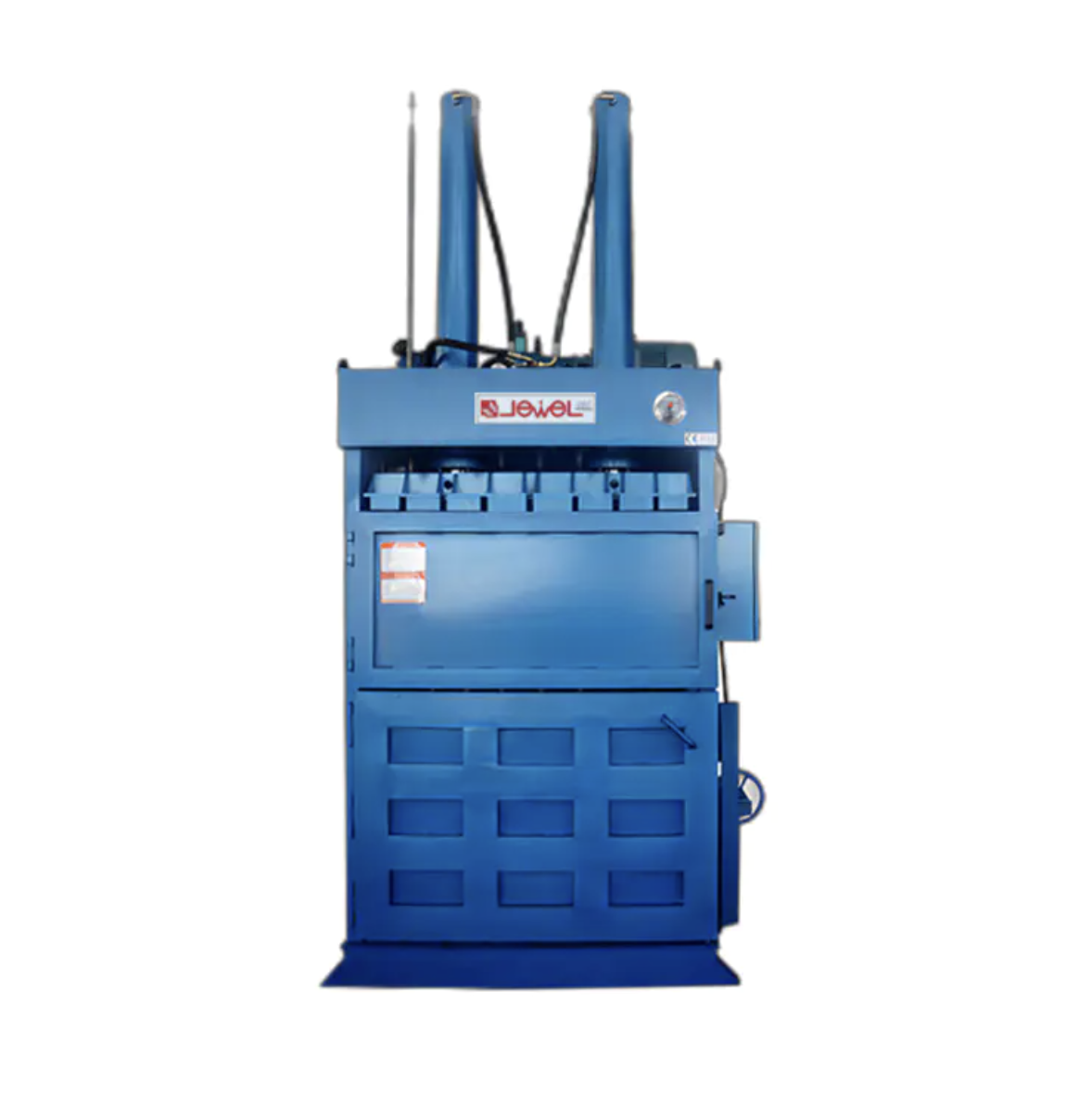
JP-OT100, the 100-ton vertical hydraulic baler in Jewel's range, produces 400–600 kg bales from a 1400 × 700 mm compression chamber.
Compression force is the quickest way to sort hydraulic baler machines into classes, but it is a poor way to choose one. Inside Jewel's range, a 5-ton model (JP8060T5X) produces 50–80 kg bales at 4–7 bales per hour on 2.2 kW; a 20-ton fully automatic horizontal baler (JPW20Q) produces 30–70 kg bales in a 500 × 500 × 500 mm cube on 7.5 kW; a 40-ton semi-automatic horizontal baler (JPW40F) produces 200–400 kg bales at 1–2 tons per hour on 11 kW; and the 100-ton class covers both a vertical baler (JP-OT100) making 400–600 kg bales and a cutting machine (JP-S100B) with a 1000 mm cutting stroke and a 20–30 second cycle.
Read those four lines together and a counter-intuitive fact appears: the 20-ton machine makes lighter bales than the 5-ton machine. Force is only half of a baler specification. The other half is geometry — chamber size, bale dimensions, feed opening, discharge method and automation level. This guide compares the four force classes across all of those variables, then explains how vertical, semi-automatic horizontal and fully automatic horizontal configurations align with different waste streams.
Short answer
- 5-ton class — JP8060T5X: 50–80 kg bales, 4–7 bales/h, 2.2 kW. Small volumes, manual handling.
- 20-ton class — JPW20Q: 30–70 kg bales, 7.5 kW, fully automatic, CE certified. In-line carton and plastic waste.
- 40-ton class — JPW40F / JPW40BL: 200–400 kg bales, 1–2 t/h, 11–15 kW. Bales moved by forklift or truck.
- 100-ton class — JP-OT100 / JP-S100B: 400–600 kg bales, or cutting of oversized material before compaction.
Why "Hydraulic Baler Machine" Is Not a Buying Specification
Search for hydraulic baler machines and the results mix vertical balers, semi-automatic horizontal balers, fully automatic horizontal balers, metal balers, briquetting machines, bagging machines and cutting machines under one phrase. The category name describes the drive system, not the job the machine performs.
Jewel's own 40-ton class demonstrates the gap. The JPW40F and the JPW40BL both carry a 40-ton headline figure, yet the JPW40F is a semi-automatic horizontal baler with a 720 × 720 × (500–1300) mm bale weighing 200–400 kg, 11 kW of power, four strapping channels and continuous push-pack discharge. The JPW40BL is a plastic bottle recycling machine with a 720 × 720 × (300–1000) mm bale weighing 250–350 kg, 15 kW and one-time discharge. A buyer comparing only tonnage would treat them as interchangeable. They are not.
The same trap appears across the range. A 100-ton aluminum foil baler (JPW-AK100) produces 5–15 kg briquettes, while a 100-ton vertical baler (JP-OT100) produces 400–600 kg bales. A 60-ton metal baler (JPY-T60W) produces 15–20 kg bales at 0.5–1 ton per hour on 22 kW. Four different machines, three very different outcomes, and the force number alone predicts none of them.
The buying problem therefore has four parts, and all four must be answered before a class can be chosen:
- Material: waste paper and carton behave differently from PET bottles, film, textile fiber and metal scrap.
- Daily volume: kilograms per day set the required throughput; throughput is expressed in bales per hour for small classes and tons per hour for the 40-ton class and above.
- Handling: a 30–70 kg bale can be lifted by two people; a 400–600 kg bale requires a forklift and a loading bay sized for it.
- Site: available power, floor area and ceiling height rule out more machines than buyers expect.
Where the Hydraulic Baler Market Stands
Two commercial research estimates frame the demand picture. One places the global baler market — agricultural and industrial combined — at USD 7.96 billion in 2026, projected to grow to USD 18.02 billion by 2034. A second estimate values the hydraulic waste paper baler segment at USD 1.45 billion in its base year, with a forecast valuation of USD 2.24 billion by 2032.
Those two figures measure different scopes and should not be added together or read as a single trend. Both are research-house projections rather than audited industry statistics, so they are useful as directional context, not as a business case.
What the figures do confirm is scale: enough demand exists for a fragmented supplier base, and fragmentation means model names, tonnage labels and bale sizes are not standardized between manufacturers. A "40-ton baler" from one supplier and a "40-ton baler" from another may differ in bale volume, discharge method and connected power. Line-by-line comparison of force, bale dimensions, bale weight, throughput and power is the only reliable method.
The machines compared in this article are manufactured by Nantong Jiabao Machinery Co., Ltd. (brand Jewel), a Chinese compression and baling equipment manufacturer established in 2006, with the brand active since 1995. The company operates a 50,000 m² manufacturing facility with an annual production capacity of 120,000 units and employs approximately 200 staff, including a 30-engineer R&D team. Export accounts for 70% of sales, with major markets in Australia, Europe, North America, Africa, Asia, Russia and Belarus, and the company offers customized industry solutions for compression and baling equipment.
The Four Force Classes, Machine by Machine
5-ton class: JP8060T5X
The JP8060T5X applies 5 tons of compression force and is listed as a waste compactor. It produces an 800 × 600 × 400 mm bale weighing 50–80 kg at 4–7 bales per hour. Power is 2.2 kW / 3 Hp at 380V/50Hz, the feed opening measures 650 × 470 mm, and the machine occupies 1100 × 1000 × 2150 mm at a weight of 550 kg. It is built in carbon steel for waste paper recycling, plastic recycling, carton printing, textile waste processing, packaging manufacturing and PET bottle recycling.
The operating logic of this class is small and manual. Bales stay within human handling range, the machine runs on a modest power supply, and the footprint fits a back room rather than a production hall. The trade-off is throughput: 4–7 bales per hour and 2.2 kW of connected power will not absorb a continuous corrugator or printing line.
20-ton class: JPW20Q
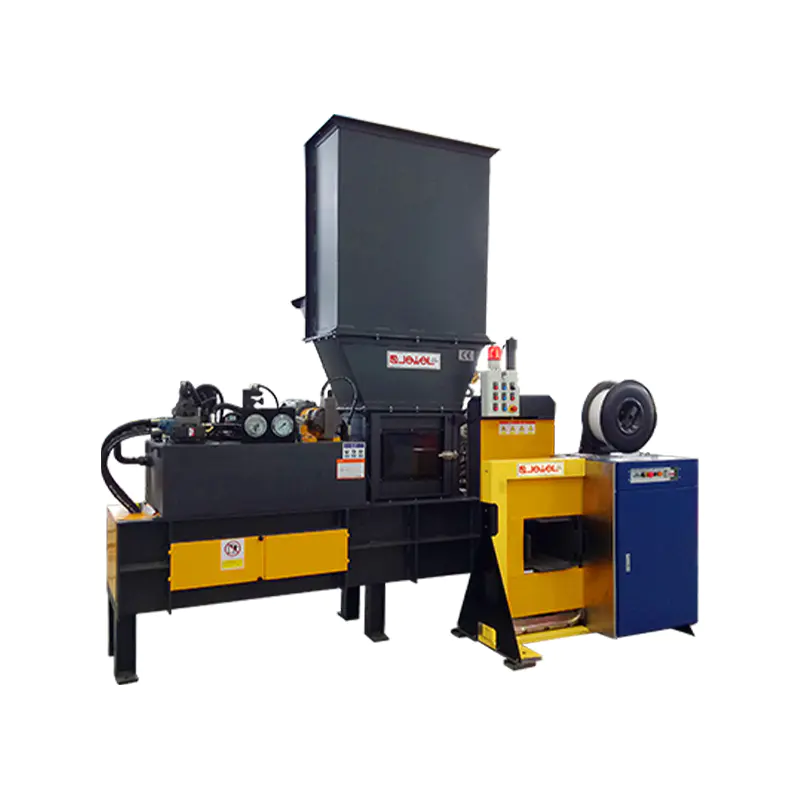
JPW20Q: 20 tons of force, 500 × 500 × 500 mm bales, 30–70 kg bale weight, 7.5 kW, 2–4 strapping channels.
The JPW20Q is a fully automatic horizontal baler rated at 20 tons, with a 20–40 ton compression-force scope. It forms a 500 × 500 × 500 mm bale weighing 30–70 kg, fed through a 700 × 460 mm opening, with 2–4 strapping channels. Power is 7.5 kW / 10 Hp at 380V/50Hz; machine dimensions are 3400 × 3010 × 2400 mm and net weight is 2.8 tons. It is built in carbon steel for waste paper recycling, plastic recycling, carton printing, textile waste processing, packaging manufacturing and PET bottle recycling.
This model carries CE certificate TTC-22-1609/01/01, complying with EN ISO 12100:2010 and EN 60204-1:2018 — a relevant reference point for European buyers, subject to the certificate covering the exact configuration ordered.
The distinctive feature of the JPW20Q is not its force but its automation. Automatic strapping and bale ejection allow it to sit at the end of a conveying system and run without a dedicated operator. Its bale cabinet is deliberately compact: a 500 mm cube of 30–70 kg suits stacking, pallet building and manual recovery in tight spaces, and it is why a 20-ton machine produces lighter bales than the 5-ton model above.
40-ton class: JPW40F and JPW40BL
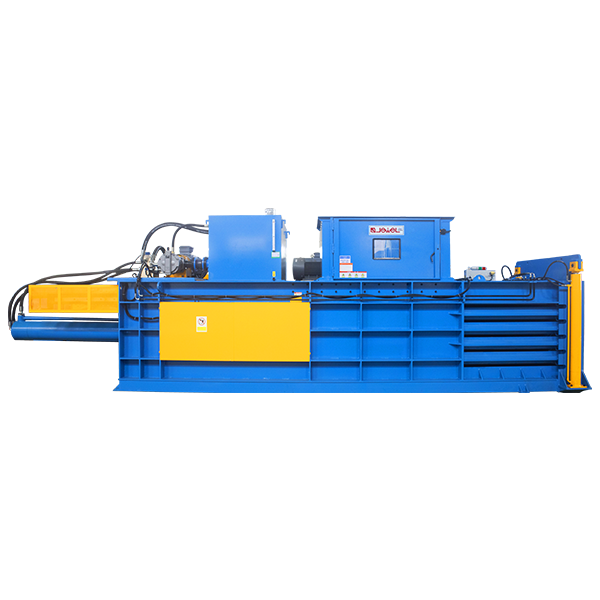
JPW40BL: 40 tons of force, 720 × 720 × (300–1000) mm bales, 250–350 kg bale weight, 15 kW, one-time discharge.
The 40-ton class is where bales become an industrial unit rather than a handling unit. The JPW40F is a semi-automatic horizontal baler at 40 tons, within a 40–100 ton scope, with a bale of 720 × 720 × (500–1300) mm weighing 200–400 kg. Throughput is expressed in mass rather than count: 1–2 tons per hour. Power is 11 kW / 15 Hp, the feed opening is 1000 × 720 mm, there are four strapping channels, and discharge uses continuous push pack at machine dimensions of 4900 × 1750 × 1950 mm.
The JPW40BL sits in the same force class with a different job. Its 40 tons (within a 40–150 ton scope) form a 720 × 720 × (300–1000) mm bale of 250–350 kg, using 15 kW / 20 Hp at 380V/50Hz, with one-time discharge and machine dimensions of 5500 × 1150 × 1900 mm. It is classified as a plastic bottle recycling machine, which reflects the higher force needed to compress hollow containers and film into a stable, transportable block.
The economic shift here is transport. Once a bale reaches 200–400 kg, it can be stacked three or four high, loaded by forklift and sold by weight rather than by piece. That is also the point at which semi-automatic operation becomes a staffing question: the machine still needs an operator for the feeding and strapping cycle, but not the physical effort of a vertical unit.
100-ton class: JP-OT100 and JP-S100B
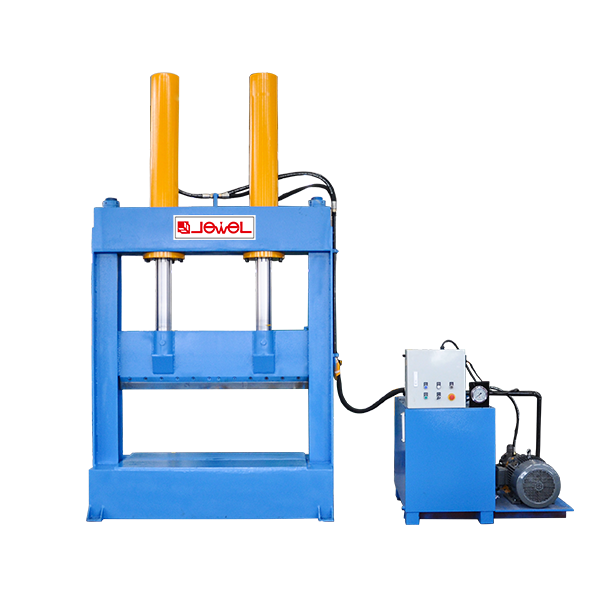
JP-S100B: 100 tons of force, 1000 mm cutting stroke, 20–30 second single cycle, 11/15 kW.
The 100-ton class splits into two distinct machine formats. The JP-OT100 is a vertical baler within a 100–180 ton scope, with a compression chamber of 1400 × 700 × 1700 mm and a feed opening of 1400 × 600 mm. It produces 1400 × 700 × (700–1100) mm bales of 400–600 kg at 5–6 bales per hour on 15 kW / 20 Hp at 380V/50Hz, with a machine weight of 3500 kg. Loading is manual from floor level, and bales leave the chamber at a weight that requires mechanical handling.
The JP-S100B is a cutting machine rather than a pure baler. It applies 100 tons within a 100–160 ton scope across a 1000 mm width, with a 1000 mm cutting stroke and a single cycle time of 20–30 seconds, powered at 11/15 kW. Overall dimensions are 2600 × 650 × 3500 mm and net weight is 2.6 tons. Its role is to deal with material that resists straightforward compaction — oversized board, bulky pieces and shapes that bridge inside a standard chamber. Cutting before compression is the reason a carton plant in Italy combined shredding with compression when replacing aging balers, as described in the configuration section below.
How to Choose a Class in Six Steps
The sequence below moves from the material to the machine, which is the direction that avoids expensive corrections.
Step 1 — Measure the waste stream in kilograms per day, not in cubic meters of loose pile. Loose volume is misleading because it depends on how long material has been accumulating. A week of weighbridge or scale data is enough to size the class.
Step 2 — Fix the handling unit before the tonnage. If bales are carried by hand or moved on a pallet truck, the target is 50–80 kg, which points to the 5-ton class or a compact bagging unit. If bales are moved by forklift, 200–400 kg opens the 40-ton class. If they are loaded directly into containers or bulk trailers, 400–600 kg points to the 100-ton vertical baler.
Step 3 — Match the throughput metric to the class. Below 40 tons, capacity is quoted in bales per hour: 4–7 bales/h on the JP8060T5X, 5–6 bales/h on the JP-OT100. At 40 tons and above it is quoted in tons per hour: 1–2 t/h on the JPW40F. Comparing a bales-per-hour figure with a tons-per-hour figure without converting first is one of the most common specification errors.
Step 4 — Confirm the power supply. Connected power runs from 2.2 kW on the JP8060T5X, to 7.5 kW on the JPW20Q, 11 kW on the JPW40F, 15 kW on the JP-OT100 and JPW40BL, 18.5 kW on the JPW-AK100 and 22 kW on the JPY-T60W metal baler. Standard voltage is 380V/50Hz on most horizontal models and is customizable; the JP7050T8 in the same range is listed at 220V/50Hz, which shows how much the supply requirement can vary inside one catalogue.
Step 5 — Choose the format. Vertical hydraulic baler machines load from the front, occupy a small footprint and depend on an operator. Semi-automatic horizontal machines spread the load across a longer bed and add a strapping cycle. Fully automatic horizontal machines integrate with conveying and run without a dedicated operator, which is only worth the added complexity if the waste arrives continuously.
Step 6 — Check the building, then the certificate. The JPW20Q needs 3400 × 3010 mm of floor; the JP-S100B stands 3500 mm tall; the JPW40BL is 5500 mm long. After the site check, verify compliance documentation for the destination market — for example the CE certificate TTC-22-1609/01/01 held by the JPW20Q under EN ISO 12100:2010 and EN 60204-1:2018.
Matching Format to Waste Stream: Real Configurations
Force class narrows the field; the waste stream decides the format. The configurations below reflect actual project scenarios where specific models were matched to specific operating conditions.
Corrugated carton plant with factory-wide waste discharge (Tunisia). A fully automatic waste cardboard recycling and baling line was specified around the JPW20Q, working in a waste discharge workshop with a conveying system. The requirement was factory-wide planning to eliminate accumulation from the corrugator line and printing machines — a case where automation, not force, was the deciding factor.
Mixed plastic, film and cardboard from supermarket chains (Belarus). A single JPW20Q was specified to process PET bottles, woven bags, HDPE bottles and cardboard, with the explicit goal of cutting equipment investment by covering multiple materials on one machine. The 500 × 500 × 500 mm bale weighed 30–70 kg and the project prioritised stable bale shape over bale mass.
PET bottle recycler needing density (Japan). In a high-dust environment, the requirement was higher compression density and a presentable bale shape for PET bottles — a task where the 40-ton class and its 720 × 720 mm bale section is the relevant reference.
Carton plant replacing aging balers (Italy). Large-sized waste cardboard from production exceeded what the existing balers could handle, so the upgrade combined crushing with compression and a conveying system. The lesson is generic: when piece size defeats the chamber, the answer is pre-processing, not more tonnage.
Full-automatic unmanned carton waste line (Russia). A JPW-K6046 bagging machine, rated at 10 tons with a 540 × 400 mm feed opening and 6–8 bales per hour, was specified for automatic collection, compression and baling of carton production waste in a corrugator workshop.
Mixed plastics, glass and metal scrap (Australia). A custom automatic baling system built around the JPW-AK100 was specified for compression stability and durability across mixed materials, including small amounts of glass and metal scrap — a reminder that multi-material sites need robustness rather than a single-material optimum.
Comparison Table: 5-Ton, 20-Ton, 40-Ton and 100-Ton Models
| Model | Force | Format | Bale size (mm) | Bale weight | Throughput | Power |
|---|---|---|---|---|---|---|
| JP8060T5X | 5 t | Waste compactor | 800 × 600 × 400 | 50–80 kg | 4–7 bales/h | 2.2 kW / 3 Hp |
| JPW20Q | 20 t (20–40 t scope) | Fully automatic horizontal | 500 × 500 × 500 | 30–70 kg | Not rated in bales/h | 7.5 kW / 10 Hp |
| JPW40F | 40 t (40–100 t scope) | Semi-automatic horizontal | 720 × 720 × (500–1300) | 200–400 kg | 1–2 t/h | 11 kW / 15 Hp |
| JPW40BL | 40 t (40–150 t scope) | Horizontal, one-time discharge | 720 × 720 × (300–1000) | 250–350 kg | Not rated in t/h | 15 kW / 20 Hp |
| JP-OT100 | 100 t (100–180 t scope) | Vertical | 1400 × 700 × (700–1100) | 400–600 kg | 5–6 bales/h | 15 kW / 20 Hp |
| JP-S100B | 100 t (100–160 t scope) | Cutting machine | 1000 mm cutting stroke | Not specified | 20–30 s per cycle | 11/15 kW |
All values as published for the listed models. Where a model is not rated in a given metric, the table states this rather than estimating a figure.
What the Tonnage Number Hides
Three variables explain most of the difference between machines in the same force class, and none of them appears in a model name.
Chamber geometry. The JPW20Q at 20 tons makes 30–70 kg bales. The JPA5076T25X at 25 tons makes 200–300 kg bales at 3–5 bales per hour, because its bale measures 1500 × 760 × 900 mm against a 500 mm cube. Five extra tons of force did not create a bale three to five times heavier; the chamber did.
Material behaviour. The JPW-AK100 applies 100 tons but produces only 5–15 kg briquettes at 0.4–0.8 t/h on 18.5 kW, because it is designed for aluminum foil and fiber-based material where the goal is dense small units, not large bales. The JPY-T60W applies 60 tons to metal and produces 15–20 kg bales at 0.5–1 t/h on 22 kW. Metal needs force per unit of thickness, not a large bale.
Automation and labour. The JP-OT100 and the JPW20Q both exceed 20 tons, yet one requires an operator at floor level for every load and the other can run inline with a conveyor. Labour content, not tonnage, drives day-to-day operating cost in most plants.
The honest limitation of every figure in this article is that throughput depends on the material. Bales-per-hour numbers assume a consistent feed; mixed streams, film and wet material reduce the achievable rate. A test bale on the buyer's own material is the only way to convert a catalogue figure into a plant number.
FAQ
What certification should a 20-ton fully automatic hydraulic baler carry for EU delivery?
The JPW20Q holds CE certificate TTC-22-1609/01/01, issued against EN ISO 12100:2010 and EN 60204-1:2018. Buyers should confirm that the certificate covers the exact model, voltage and strapping configuration being ordered, since the CE reference is issued for a defined technical build rather than for a catalogue category.
Can one 20-ton machine handle plastic bottles and cardboard at the same time?
Yes, within limits. A multi-material project in Belarus used a single JPW20Q to process PET bottles, woven bags, HDPE bottles and cardboard, producing 500 × 500 × 500 mm bales of 30–70 kg. Mixed streams change bale density and strapping behaviour, so each material should be validated with a test bale before the machine is dedicated to a multi-material duty.
Which force class costs more to run, the 5-ton or the 100-ton?
Operating cost is driven by three variables, not by the tonnage label. Connected power ranges from 2.2 kW on the JP8060T5X to 7.5 kW on the JPW20Q, 11 kW on the JPW40F and 15 kW on the JP-OT100 and JPW40BL. Labour content differs even more: vertical machines require an operator per load, while fully automatic horizontal machines can run inline with a conveyor. Bale weight then affects handling and transport, since 400–600 kg bales load and stack differently from 30–70 kg bales. Comparing classes on total cost per ton baled is more reliable than comparing purchase price.
Can I validate a bale on my own material before ordering a full unit?
Yes. A test bale on the buyer's own material is the standard way to confirm that a class produces the bale weight and shape required, and Jewel's minimum order quantity is one unit, which allows single-unit validation rather than a bulk commitment. Bale dimension, bale weight and strapping pattern should all be checked during the test.
How do I confirm lead time and the final configuration?
Lead time depends on the configuration being built, so it has to be confirmed per order rather than quoted generically. The variables that affect it are model, voltage, strapping channels, feed opening and discharge method — for example the JPW20Q is offered with 2–4 strapping channels and customizable voltage. The practical next step is to send the material type, daily volume and site constraints to the Jewel team, request a model recommendation, and ask for the delivery schedule against that confirmed specification.
Conclusion: Choose the Bale, Then the Class
The four classes in this comparison are not a ladder from small to large. They are four different answers to four different handling problems: 50–80 kg bales at 4–7 per hour for manual recovery, 30–70 kg automation-ready bales for continuous carton and plastic waste, 200–400 kg forklift bales at 1–2 tons per hour for plants selling by weight, and 400–600 kg bales or pre-cutting for high-volume waste paper and oversized board.
The correct sequence is to start from the bale the site can actually move, then check throughput, then power, then footprint, then compliance. Force class follows from those answers. Buyers who start with the tonnage number usually finish with the wrong machine.
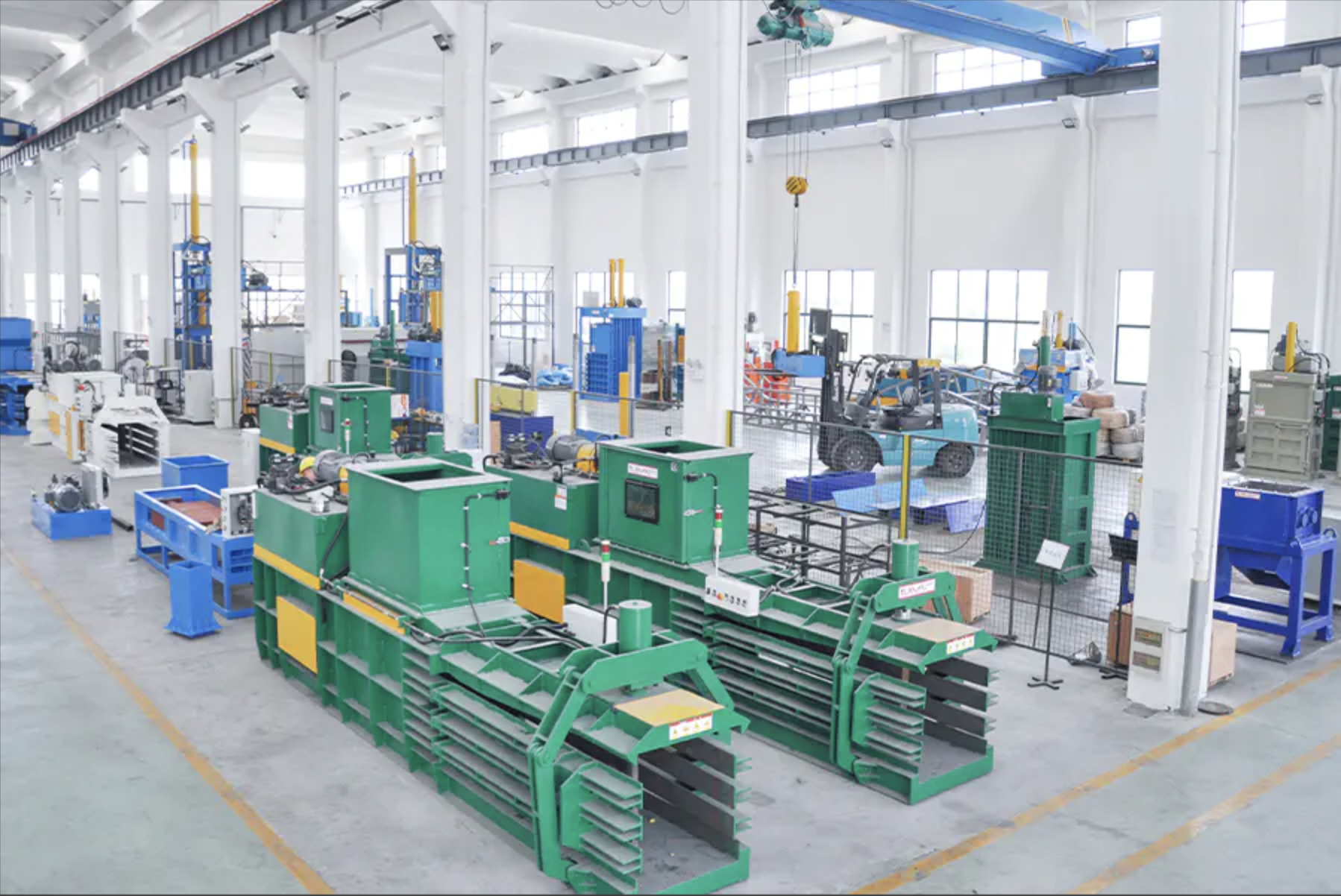
Equipment assembly at Nantong Jiabao Machinery Co., Ltd., which produces baler machines across the 5-ton to 100-ton range described above.
Next step: match a class to your waste stream
Send the material type, daily volume and site constraints to Jewel for a model recommendation, or request a quote and a test bale before committing. The 2026 catalogue can be downloaded here: Jewel product catalogue (PDF).
Nantong Jiabao Machinery Co., Ltd. (brand Jewel) — website: www.jewelbaler.com
Email: jiabao@csj-baler.com | Tel / WhatsApp: +86 187-2181-4932
Address: No.1 Xinyuan East 1st Road, Rugao City, Jiangsu Province, China
Have Questions or Need More Details?
Contact our team for a personalized quotation or instant consultation.
Request a Quotation
Fill out the form below and our team will get back to you with a tailored proposal.
WhatsApp Direct Chat
Prefer to chat in real-time? Message us on WhatsApp for instant assistance & quick answers.
- Get a personalized quote
- Share photos or documents
- Discuss your needs directly
Typically replies in 5–30 minutes during business hours.