Hydraulic Baler Machines Compared by Application
Hydraulic Baler Machines Compared: Choosing the Right Press for Your Waste Stream
Choosing among hydraulic baler machines is not simply a question of picking the brand with the highest tonnage or the lowest price. A hydraulic baler machine uses hydraulic force to compress loose waste and recyclable material into a dense bale or briquette, but the machine that works well for one facility can be the wrong fit for another. Buyers moving from product awareness to supplier evaluation need a comparison method that starts from material type, target bale size, throughput, available labor, plant layout, and verification documents. This guide compares the published specification set of Jewel hydraulic baler machines as a concrete reference, explains what each specification means for a purchasing decision, and adds certified and project-based facts that can be checked before an order is placed.
Jewel is the baler export brand used by Nantong Jiabao Machinery Co., Ltd., a manufacturer based in Rugao City, Jiangsu Province, China. The brand traces its history to 1995, while the company was established in 2006. Jewel operates a 50,000-square-meter modern production facility with over 200 employees and exports roughly 70 percent of its output to markets that include Europe, North America, Africa, Asia, Australia, Russia, and Belarus. The company’s main product line is compression and baling equipment, including semi-automatic and fully automatic machines, intelligent waste removal systems, automatic compression and wrapping systems, integrated crushing-compression-baling systems, and customized industry solutions.
The comparison below is written for procurement managers, waste recyclers, cardboard box factories, plastic processors, and packaging plants that need a practical decision basis rather than a generic brochure.
Why Hydraulic Baler Machine Comparisons Fail Without a Decision Basis
Most specification mistakes happen when a buyer evaluates one machine attribute in isolation. Compression force alone does not explain the complete behavior of a baler. Feed opening size determines the largest piece of waste that can enter the chamber. Bale dimensions and bale weight determine how many bales will be handled, stored, and transported. Discharge method affects whether the bale can be pushed into a conveyor line or must be removed by forklift. Automation level affects the number of operators needed around the machine. Certification scope affects whether the machine can be legally sold into the target market. A proper machine comparison must include all of these variables.
Jewel’s published specification sheet provides a useful example of why tonnage is not enough. The JPW40F and the JPW40BL are both 40-ton hydraulic balers from the same manufacturer. They share the same nominal compression force and similar bale cross-sections of 720 by 720 millimeters. However, their bale lengths and weights differ. The JPW40F produces bales of 720 by 720 by 500 to 1,300 millimeters, with bale weights from 200 to 400 kilograms. The JPW40BL produces bales of 720 by 720 by 300 to 1,000 millimeters, with bale weights from 250 to 350 kilograms. The rated electric power also differs: the JPW40F uses 11 kilowatts while the JPW40BL uses 15 kilowatts. Their bale discharge methods are different as well. The JPW40F uses continuous push pack discharge, while the JPW40BL uses one-time blunder discharge. A buyer who compares only tonnage would not see these operational differences.
Similar sensitivity is needed when comparing machines by material type. Jewel lists the same broad applicable industries for most models: waste paper recycling, plastic recycling, carton printing, textile waste processing, packaging manufacturing, and PET bottle recycling. The real distinction comes from the machine configuration. For example, the JPA5076T25X has a wide feed opening of 1,500 by 500 millimeters, which is relevant for large cardboard waste. The compact JP8060T5X has a much smaller feed opening of 650 by 470 millimeters. The metal baler JPY-T60W is specified with a feed opening of 900 by 430 millimeters and a bale cross-section of 430 by 280 by 150 to 250 millimeters. These are not interchangeable configurations even when the material is described broadly as recyclable waste.
Hydraulic Baler Market Context and Standards That Affect Comparison
Market data helps explain why so many machine options exist. Grand View Research estimated the global baler machine market at USD 6.6 billion in 2024 and projected growth to USD 11.4 billion by 2035. A separate estimate from Maximize Market Research valued the industrial balers market at USD 6.39 billion in 2024, with a projected compound annual growth rate of 9.5 percent through 2032. The two figures are not contradictory: definitions and market boundaries differ across research firms, especially when agricultural balers are included or excluded. What matters for an equipment buyer is that the baler category is broad, and hydraulic models compete alongside manual, vertical, horizontal, and fully automatic designs.
Standards are just as important as market size. In the European Union, safety regulations require vertical balers and tyre balers to comply with EN 16500:2014, the standard for machines for compacting waste materials or recyclable fractions. In the United States, ANSI Z245.5-2023 is the updated American National Standard for baling equipment safety, replacing the 2013 version. A comparison list should therefore include not only machine specifications but also the standard that applies to the installation country. For machines being imported into the EU, a CE declaration and supporting technical documentation should be checked model by model rather than accepted as a generic company certificate.
Hydraulic Baler Machine Comparison Table Based on Published Jewel Specifications
The following table compares representative hydraulic baler and related densifying equipment models using data from Jewel’s published product specification list. The table deliberately avoids prices and performance values that are not documented in that specification set.
| Reference designation in specification list | Model | Compression force | Bale output or cross-section | Bale weight | Throughput | Rated power | Feed opening |
|---|---|---|---|---|---|---|---|
| Waste compactor | JP8060T5X | 5 tons | 800 x 600 x 400 mm | 50 - 80 kg | 4 - 7 bales/h | 2.2 kW | 650 x 470 mm |
| Bagging machine | JPW-K6046 | 10 tons | No fixed bale footprint stated | 50 - 80 kg | 6 - 8 bales/h | 2.2 kW | 540 x 400 mm |
| Hydraulic baler | JPA5076T25X | 25 tons | 1,500 x 760 x 900 mm | 200 - 300 kg | 3 - 5 bales/h | 7.5 kW | 1,500 x 500 mm |
| Vertical baler | JP-OT100 | 100 tons | 1,400 x 700 x 700 - 1,100 mm | 400 - 600 kg | 5 - 6 bales/h | 15 kW | 1,400 x 600 mm |
| Semi-automatic horizontal baler | JPW40F | 40 tons | 720 x 720 x 500 - 1,300 mm | 200 - 400 kg | 1 - 2 tons/h | 11 kW | 1,000 x 720 mm |
| Plastic bottle recycling machine / horizontal baler | JPW40BL | 40 tons | 720 x 720 x 300 - 1,000 mm | 250 - 350 kg | No fixed bales/h value stated | 15 kW | 1,000 x 720 mm |
| Fully automatic horizontal baler | JPW20Q | 20 tons | 500 x 500 x 500 mm | 30 - 70 kg | No fixed tons/h value stated | 7.5 kW | 700 x 460 mm |
| Metal baler | JPY-T60W | 60 tons | 430 x 280 x 150 - 250 mm cross-section | 15 - 20 kg | 0.5 - 1 tons/h | 22 kW | 900 x 430 mm |
| Briquetting machine | JPW-AK60 | 60 tons | 300 x 300 x 200 - 300 mm | 5 - 10 kg | 0.2 - 0.5 tons/h | 15 kW | 500 x 300 mm |
| Aluminum foil / fiber-type baler | JPW-AK100 | 100 tons | 320 x 320 x 200 - 250 mm | 5 - 15 kg | 0.4 - 0.8 tons/h | 18.5 kW | 500 x 320 mm |
The table also shows machine dimensions that affect plant layout. The compact JP8060T5X measures 1,100 by 1,000 by 2,150 millimeters and weighs 550 kilograms. The bagging machine JPW-K6046 measures 950 by 780 by 2,150 millimeters and weighs 600 kilograms. The JPA5076T25X hydraulic baler measures 2,150 by 1,200 by 2,500 millimeters and weighs 2,100 kilograms. The JPW40F semi-automatic horizontal baler measures 4,900 by 1,750 by 1,950 millimeters. The JPW40BL horizontal machine measures 5,500 by 1,150 by 1,900 millimeters. The JPW20Q fully automatic horizontal unit measures 3,400 by 3,010 by 2,400 millimeters and weighs 2.8 tons. These dimensions should be checked against the planned installation area, forklift access, and future expansion space.
What to Compare First in Hydraulic Baler Machines
Buyers at the Evaluation stage should make decisions in a logical order. The first comparison point is the waste form. Cardboard sheet, PET bottle, HDPE bottle, woven bag, mixed plastic, paper dust, aluminum foil, and metal scrap each generate different handling problems. In Beltway’s project record, for example, a waste recycler in Belarus needed to solve the bulkiness and difficult compression of PET bottles, woven bags, HDPE bottles, and cardboard. In that situation the relevant comparison was not only force but the ability to form regular-shaped bales from different material shapes.
The second comparison point is the required bale output. Some recyclers want large bales that can be loaded directly into trucks. In Jewel’s range, the JP-OT100 vertical baler produces one of the larger output ranges: 400 to 600 kilograms per bale. Other operations might prefer smaller, standardized bales for automated handling. The JPW20Q fully automatic horizontal baler produces bales of 500 by 500 by 500 millimeters, weighing 30 to 70 kilograms. A machine comparison should therefore start by defining the customer’s target bale weight and bale size before looking at brand preferences.
The third comparison point is feed opening and intake method. A wide feed opening is not a luxury when production scrap is large. The JPA5076T25X has a feed opening of 1,500 by 500 millimeters and was connected in a real Italian cardboard box factory project to solve difficult handling of large-sized waste cardboard. The project included preprocessing equipment and replacement of aging balers. In small-volume workshops, by contrast, a compact unit such as the JP8060T5X with its 650 by 470 millimeter feed opening may be enough.
The fourth comparison point is discharge and integration. Bales can be discharged continuously or in full batches. The JPW40F specification mentions continuous push pack discharge, while the JPW40BL specification mentions one-time blunder discharge. These details change conveyor design and downstream bale handling. In production lines where waste must be removed from a corrugator or printing machine continuously, the buyer should ask how the baler receives material, whether conveying and collection equipment is included, and how the machine communicates with the rest of the line.
The fifth comparison point is power and utility limits. In the Jewel specification list, the connected power of hydraulic balers ranges from 2.2 kilowatts on small compactors up to 22 kilowatts on the metal baler model JPY-T60W. Many models list voltage as customizable, for example 380V/50Hz or 220V/50Hz. A candidate machine must be checked against the site voltage, available power, and electrical drawing requirements before purchase.
Step-by-Step Hydraulic Baler Comparison Process
Use the following sequence when evaluating two or more hydraulic baler machines, including models from different suppliers.
- Document the waste stream by type, shape, moisture, contamination, and daily volume. If the waste arrives in mixed form, list every category that must be compressed.
- Set the output requirement in kilograms per day or tons per hour. From the table above, machines such as JPW-AK60 are rated at 0.2 to 0.5 tons per hour, while JPW40F is rated at 1 to 2 tons per hour. The performance interval must be matched to the actual daily accumulation volume.
- Define acceptable bale size and bale weight for transport and storage. Bales that are too light may increase handling cost, while bales that are too heavy for the loading equipment create operational risk.
- Compare chamber or feed opening dimensions. Material that cannot enter the chamber cannot be baled without preprocessing.
- Compare discharge method and strapping channels. The JPW20Q, for example, has 2 to 4 strapping channels. The JPW40F and JPW40BL have 4 strapping channels. These details affect whether the bale keeps its shape and whether the line can keep up with production.
- Compare floor space and machine weight against the building layout. Workshop dimensions and floor strength should be checked before the machine arrives.
- Compare power consumption, voltage, and auxiliary equipment requirements.
- Check certification model scope and audit scope, not just brand-level claims.
- Compare customization capability and commercial terms. Jewel’s production records state that customization services cover structure, process, and performance, with a minimum order quantity of one unit and typical production lead time of 60 days.
Use Cases That Show How Comparisons Turn Into Decisions
Jewel’s published project cases provide verifiable examples of machines selected for different waste problems.
For piled waste paper in a cardboard box factory, a project in Tunisia addressed waste accumulation from the corrugator line and printing machines. The installation included one hydraulic baler unit and achieved the elimination of waste paper accumulation, creating a clean and efficient production environment. According to the project record, the reference machine was the JPW-AK60 briquetting unit. This case shows that when the waste is generated across a whole factory and needs to be collected automatically, the selected machine must work as part of a factory-wide waste discharge system.
For large waste cardboard in Italy, a cardboard box factory replaced aging balers and introduced preprocessing equipment. The project was connected to the JPA5076T25X hydraulic baler. The result was greatly improved waste treatment efficiency, solving the handling problem of large-sized cardboard. This case supports the comparison principle that feed opening and preprocessing are part of the calculation.
For carton production waste in Russia, a cardboard box factory used a JPW40F semi-automatic horizontal baler line to automate waste collecting, compressing, and baling. The project was implemented over three years and ended with an efficient and coherent unmanned waste processing system. The client reduced labor and management costs while turning waste into an immediate source of income. This result depended not on a single machine acting alone but on the integration of collection, compression, baling, and discharge.
For PET bottles and other bulky plastics, a PET recycling enterprise in Japan tested hydraulic balers with the aim of increasing compression density. The result was compact and aesthetically pleasing bales that improved storage and transportation efficiency. Another project in Belarus solved the problem of bulky PET bottles, woven bags, HDPE bottles, and cardboard using one hydraulic baler unit. In both cases, regular bale shape and higher density were explicit purchasing criteria.
For mixed waste processing in Australia, one hydraulic baler machine, model JPW40BL, was part of an integrated system using multi-material separation technology to handle plastics, glass, and metal scraps. The completed project achieved full-line unmanned operation and reduced labor costs and operational risks. The machine choice there had to support continuous mixed processing, not just compression of a single clean stream.
Certifications, Factory Audit, and Commercial Verification
Specification sheets are not enough. Buyers should verify the manufacturer’s competence and the machine’s compliance documentation before moving to Execution.
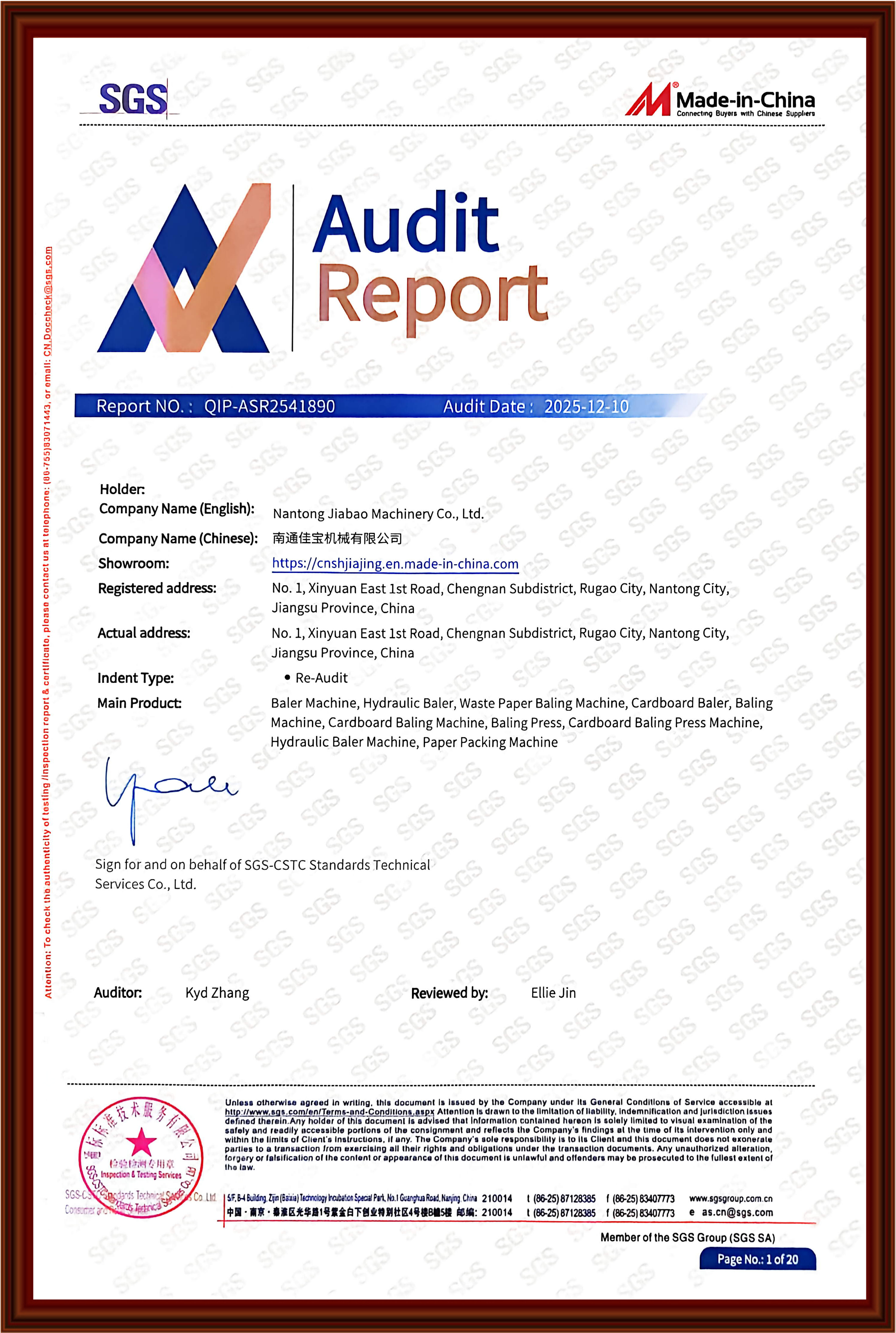
Jewel holds a SGS Made-in-China Supplier Audit Report with certificate number QIP-ASR2541890, issued by SGS and dated December 10, 2025, with validity until December 10, 2028. The audit scope covers the full range of baler machines, hydraulic balers, waste paper balers, cardboard balers, and baling press machines. This audit report is useful as a supplier-level reference because it was issued by a third-party inspection body.
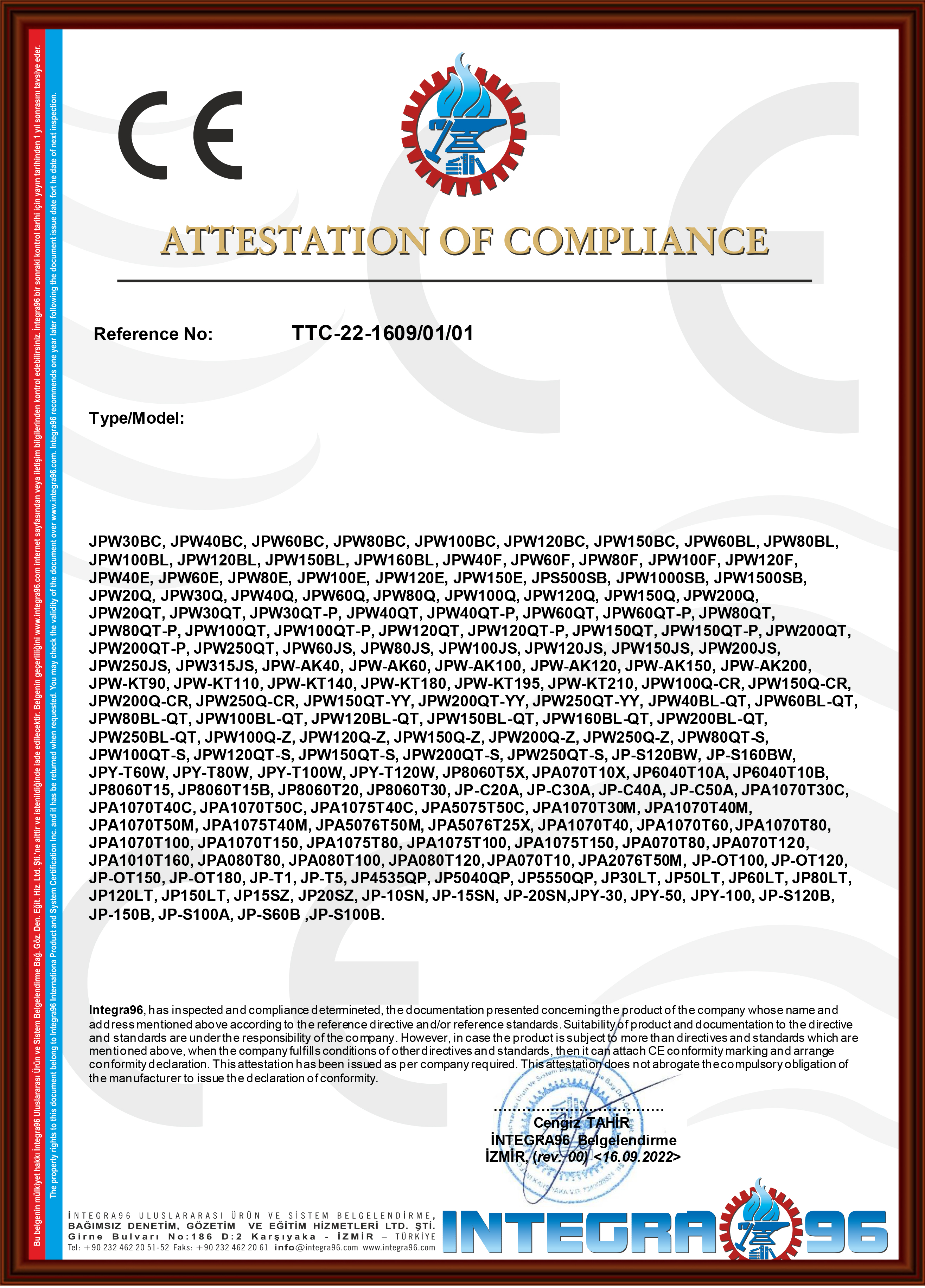
For a specific machine model, the CE documentation should be inspected. Jewel’s JPW20Q fully automatic horizontal baler is associated with CE certificate number TTC-22-1609/01/01 issued by INTEGRA. The certificate references Machinery Directive 2006/42/EC, Low Voltage Directive 2014/35/EU, and technical standards EN ISO 12100:2010 and EN 60204-1:2018, with validity from September 16, 2022 to September 16, 2027. For an EU installation, buyers should ask whether the exact model offered in the quotation is covered by the CE certificate or whether other model-specific declarations apply.
Commercial terms also affect the comparison. Jewel’s procurement support unit lists a minimum order quantity of one unit, delivery method FOB Shanghai, acceptance based on pre-shipment test, and payment terms of 50% deposit and 50% balance. Monthly production capacity is listed as 100 units, and typical production lead time is 60 days. Quality control is described as 100% test. After-sales support includes 7x24-hour technical response, 48-hour on-site service where needed, lifelong maintenance, and free training. These terms allow a buyer to plan the full purchase cycle rather than treating the machine as a one-time commodity purchase.
Frequently Asked Questions About Hydraulic Baler Machine Comparison
Which certificates should I check when comparing hydraulic baler machines for the EU?
For EU installations, check whether the specific model has a CE declaration that covers the Machinery Directive and relevant harmonized standards. In Jewel’s published certificates, the JPW20Q fully automatic horizontal baler is listed under CE certificate number TTC-22-1609/01/01 issued by INTEGRA, referencing 2006/42/EC, 2014/35/EU, EN ISO 12100:2010, and EN 60204-1:2018. At supplier level, Jewel also holds an SGS Made-in-China Supplier Audit Report, number QIP-ASR2541890. European safety regulations require vertical balers and tyre balers to comply with EN 16500:2014, so confirm with the supplier whether the offered vertical model carries the relevant compliance documentation.
How do bale size and bale weight affect the choice between vertical and horizontal hydraulic balers?
Bale size and weight determine how many bales a facility will handle per day, how many workers are needed, and how the bales fit into trucks or containers. In Jewel’s product set, the JP-OT100 vertical baler is specified with a compression force of 100 tons, bales of 1,400 by 700 by 700 to 1,100 millimeters, and bale weights of 400 to 600 kilograms. The JPW40F semi-automatic horizontal baler produces bales of 720 by 720 by 500 to 1,300 millimeters, with weights of 200 to 400 kilograms. The JPW20Q fully automatic horizontal baler produces smaller bales of 500 by 500 by 500 millimeters, weighing 30 to 70 kilograms. These published figures give a starting point for matching output bale logistics to the machine. If transport or handling is designed around a certain bale size, the machine specification sheet should show a bale size range that covers that target.
How much automation difference is there between semi-automatic and fully automatic hydraulic baler machines?
Automation level should be compared by the number of operations the machine performs by itself. In Jewel’s published line, the JPW40F is described as a semi-automatic horizontal baler, while the JPW20Q is described as a fully automatic horizontal baler. The JPW20Q has 2 to 4 strapping channels and is also the model in Jewel’s range with CE documentation. The JPW40F uses a continuous push pack discharge method and is rated at 1 to 2 tons per hour. A buyer should ask the supplier which steps are automatic: feeding, pre-pressing, main pressing, strapping, and bale discharge. This is more useful than relying only on the model names.
Can I order a customized hydraulic baler machine without buying a large quantity?
Customization does not always require a large volume order. Jewel provides customization production services that cover structure, process, and performance, with a minimum order quantity of one unit. Typical production lead time is 60 days, and monthly production capacity is 100 units. Buyers with unusual feed openings, voltage requirements, bale sizes, or automation needs can request a configuration review before placing a full order.
What is the typical lead time and ordering process for hydraulic baler machines?
Jewel’s published procurement conditions list a minimum order quantity of one unit, delivery method FOB Shanghai, acceptance through pre-shipment test, and 50/50 payment terms. Typical production lead time is 60 days, and the production system has a monthly capacity of 100 units. After-sales support is described as 7x24-hour technical response, 48-hour on-site availability if needed, lifelong maintenance, and free training. For a new specification conversation, contact Jewel directly with the material type, daily volume, and target bale size so that the quotation can be checked against the published specification set.
Final Comparison Framework for Hydraulic Baler Machines
The most reliable way to compare hydraulic baler machines is to replace vague statements with verifiable numbers. Define the waste stream. Define the target bale weight and dimensions. Check feed opening, power, floor space, discharge method, strapping channels, and automation level. Verify the model-specific certification and factory audit. Then compare commercial terms such as lead time, minimum order quantity, and pre-shipment testing. This article used Jewel hydraulic baler specifications and project records because their numbers are publicly traceable and can be checked by a buyer. The same method should be applied to quotations from any supplier before a final purchase decision.
For a machine comparison related to your actual materials, contact Nina by email at jiabao@csj-baler.com or by WhatsApp at +86 187-2181-4932. You can also download the 2026 baler brochure here: Jewel baler brochure PDF. A complete RFQ should include material type, daily waste volume, available floor space, and target bale size.