
Hydraulic Baler Machines: Compression Force and Bale Chamber Geometry
A technical selection guide to how compression force, bale chamber dimensions, feeding mouth size, bale weight and throughput constrain one another — with published specification data from the Jewel hydraulic baler range.
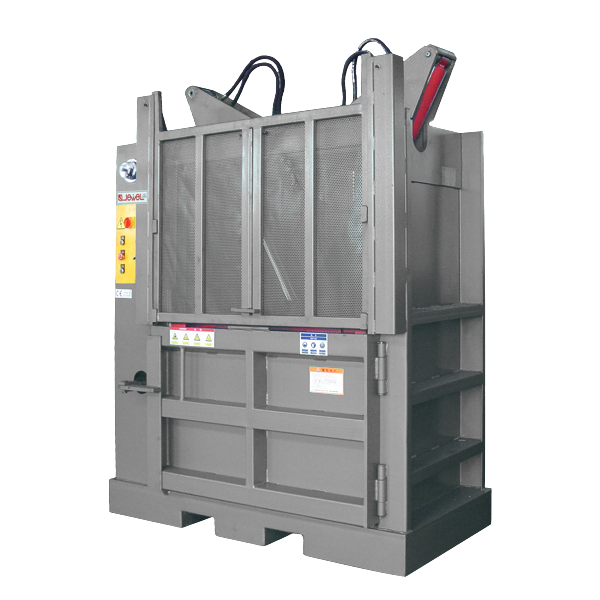
A hydraulic baler machine is a system of linked constraints: pressing capacity, chamber geometry and feed opening are specified together, not separately.
Buyers usually shortlist hydraulic baler machines on compression force and then specify everything else. That order is backwards. Compression force sets how hard the press can push, but bale chamber geometry determines what the finished bale becomes, the feeding mouth determines whether a material can enter the chamber at all, and bale weight and throughput are outcomes of those three constraints working together.
This guide is written for procurement teams and plant engineers at the research and evaluation stage. It reads a baler datasheet as a system of constraints rather than a list of highlighted numbers, using published model data from the Jewel range — including JPW20Q, JPW40BL and JPW-AK60 — to show how the numbers interact in practice.
Problem Definition: Why One Number Cannot Describe a Baler
A baler specification is a coupled system. Five parameters are typically quoted separately on a datasheet, yet none of them can be changed without moving the others:
- Compression force (ton) — the pressing capacity of the hydraulic cylinder. Across the Jewel range, published scope values run from 2 ton to 180 ton.
- Bale chamber and bale dimensions (mm) — the internal volume that fixes the finished bale format. JPW20Q produces a 500×500×500 mm bale; JPW40BL produces a 720×720×(300–1000) mm bale; JPW-AK60 produces a 300×300×(200–300) mm bale.
- Feeding mouth size (mm) — the opening through which material is loaded. JPW20Q is listed at 700–460 mm, JPW40BL at 1000×720 mm, and JPW-AK60 at 500×300 mm.
- Bale weight (kg) — a result, not a setting. It follows from force applied inside a given chamber volume: 30–70 kg on JPW20Q, 250–350 kg on JPW40BL, 5–10 kg on JPW-AK60.
- Baling capacity — expressed as bales per hour or tons per hour. JPW-AK60 is listed at 0.2–0.5 ton/hr; JPW40F is listed at 1–2 ton/hr; JPY-T60W at 0.5–1 ton/hr.
The most common mismatch is assuming that more force automatically produces a heavier bale. It does not. JPW20Q applies 20 ton of compression force into a 500×500×500 mm chamber and produces bales of 30–70 kg. JPW-AK60 applies 60 ton — three times the force — into a 300×300×(200–300) mm chamber and produces bales of 5–10 kg at 0.2–0.5 ton/hr. Higher force inside smaller geometry produces a smaller, denser unit; the bale weight falls because the chamber volume falls faster than the force rises.
Three practical failure patterns follow from this:
- Force-heavy, geometry-light. A plant buys a high-tonnage press but keeps a small chamber, and the resulting bale is still too light for efficient transport.
- Oversized feed opening, undersized press. Bulky material enters the chamber easily, but the press cannot reach the density that makes the bale worth shipping.
- Bale weight targets set by logistics alone. A transport or storage target is stated first, and the machine is then selected without checking whether force, chamber and feed opening can physically deliver it.
Industry Background: Where the Specification Pressure Comes From
Equipment specification decisions are being made inside a market that is growing and, at the same time, becoming less uniform. The global baler machine market was valued at USD 6.6 billion in 2024 and is projected to reach USD 11.4 billion by 2035 (Grand View Research). Within that, the industrial balers segment was valued at USD 6.39 billion in 2024, with a projected CAGR of 9.5% through 2032 (Maximize Market Research). Asia Pacific accounted for approximately 40.2% of total baler market revenue in 2024 (Grand View Research).
Published estimates are not consistent with each other, and buyers should treat any single growth figure as directional. Depending on whether agricultural balers are included, 2024 valuations for the baler market are reported in a range around USD 6.4 billion to USD 6.6 billion, and forecast growth rates range widely, from roughly 4.8% to 10.6%, depending on the study period and the target segment.
Compliance frameworks add a second layer of constraint. European safety requirements for waste processing equipment reference standards such as EN 16500:2014 for vertical baling presses, and in the United States baling equipment safety requirements are published under ANSI Z245.5-2023, which replaced the 2013 version of that standard. The practical implication for a specification document is that force and geometry must be validated against the destination market's requirements before the purchase order, not after delivery.
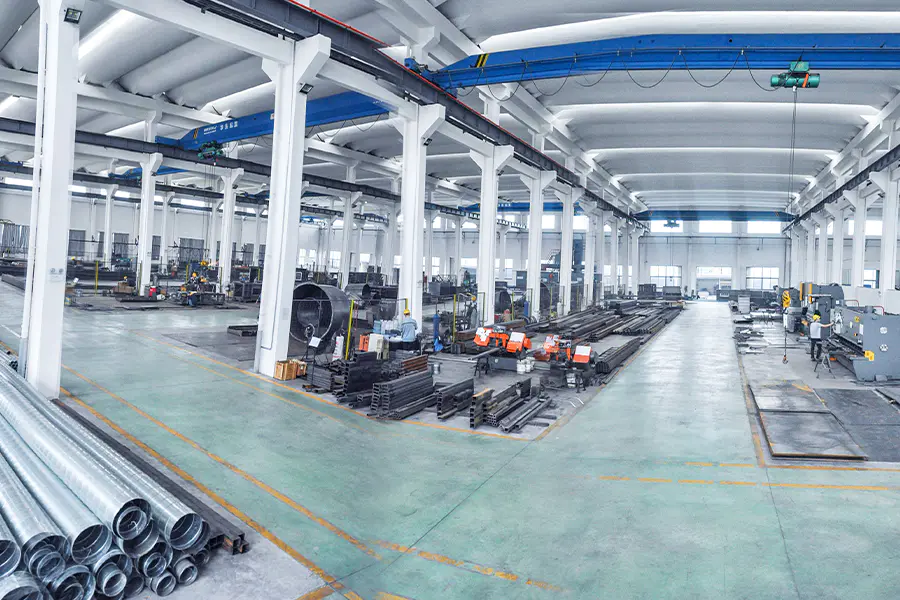
The machines described in this guide are manufactured by Nantong Jiabao Machinery Co., Ltd., established in 2006, with the jewel brand founded in 1995. The company operates a 50,000 m² production facility with more than 200 staff, including a 30-engineer R&D team, and exports approximately 70% of its output to markets including Australia, Europe, North America, Africa, Asia, Russia and Belarus.
Detailed Solution: How Force, Chamber and Feed Opening Are Configured Together
Jewel builds hydraulic baler machines on a configurable platform rather than fixed catalogue variants. Carbon steel is the primary material of construction, and voltage is customizable to the destination supply — 380V/50Hz appears across most listed models, while JP7050T8 is listed at 220V/50Hz. Customization covers structure, process and performance, with a minimum order quantity of one unit and a monthly production capacity of 100 units. Every machine is subject to 100% testing.
JPW20Q — 20 Ton Into a 500×500×500 mm Chamber
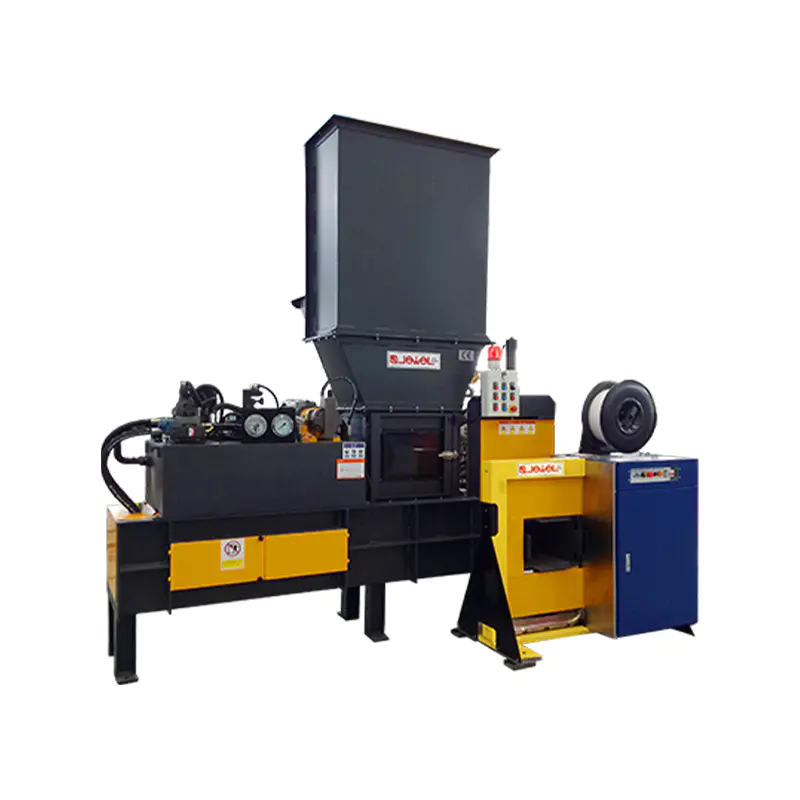
JPW20Q: fully automatic horizontal baler, 20 ton compression force, 500×500×500 mm bale, 30–70 kg bale weight.
JPW20Q is a fully automatic horizontal baler listed at 20 ton compression force, a 500×500×500 mm bale dimension, a 700–460 mm feeding mouth, 2–4 strapping channels and a bale weight of 30–70 kg. Power is 7.5 kW / 10 Hp at 380V/50Hz (customizable), and the machine measures 3400×3010×2400 mm at 2.8 ton. It is a geometry-first machine: a modest force paired with a compact, cube-shaped chamber that suits automated waste removal from carton lines and printing machines, and material streams that include waste paper, plastic, carton, textile, packaging and PET bottles.
JPW40BL — 40 Ton Into a 720×720 mm Chamber With Variable Bale Length
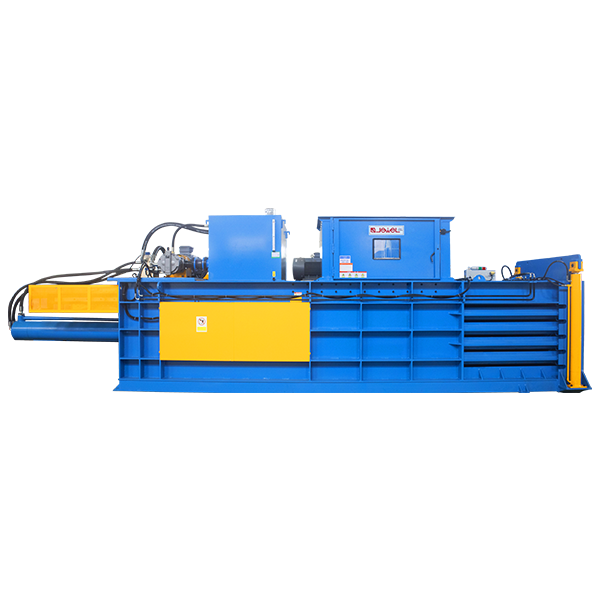
JPW40BL: 40 ton compression force, 720×720×(300–1000) mm bale, 1000×720 mm feeding mouth, 250–350 kg bale weight.
JPW40BL is listed as a plastic bottle recycling machine at 40 ton compression force, with a 720×720×(300–1000) mm bale dimension — a fixed 720×720 mm cross-section with an adjustable bale length from 300 to 1000 mm. The feeding mouth is 1000×720 mm with four strapping channels, and bale weight is 250–350 kg. Power is 15 kW / 20 Hp at 380V/50Hz (customizable); the machine measures 5500×1150×1900 mm. The adjustable length is the key specification point: it allows the same cross-section to be delivered in different bale weights without changing the press or the chamber cross-section.
JPW-AK60 — 60 Ton Into a 300×300 mm Briquetting Chamber
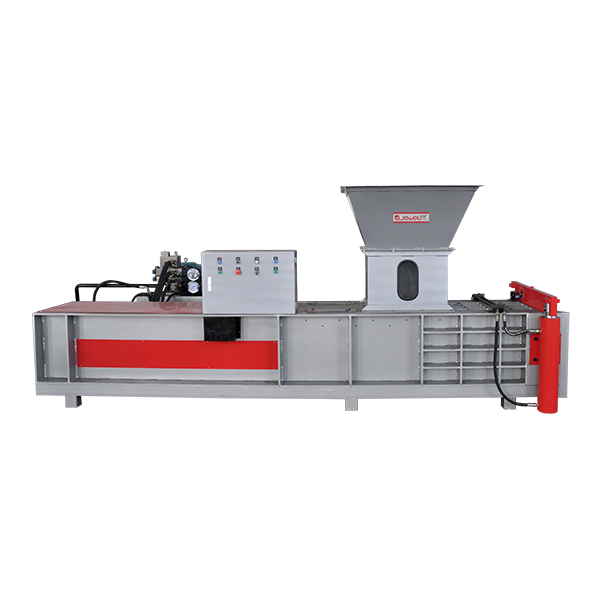
JPW-AK60: 60 ton compression force, 300×300×(200–300) mm bale, 500×300 mm feeding mouth, 0.2–0.5 ton/hr.
JPW-AK60 is a briquetting machine at 60 ton compression force with a 300×300×(200–300) mm bale dimension and a 500×300 mm feeding mouth. Bale weight is 5–10 kg at a baling capacity of 0.2–0.5 ton/hr, with 15 kW / 20 Hp at 380V/50Hz (customizable). The machine measures 3900×900×1350 mm at 2100 kg, and is listed for a similar material profile of paper dust. Its high force is applied inside a small chamber to produce a dense, low-volume briquette rather than a shipping bale.
| Parameter | JPW20Q | JPW40BL | JPW-AK60 |
|---|---|---|---|
| Type (as listed) | Fully automatic horizontal baler | Plastic bottle recycling machine | Briquetting machine |
| Compression force | 20 ton | 40 ton | 60 ton |
| Bale dimension (mm) | 500×500×500 | 720×720×(300–1000) | 300×300×(200–300) |
| Feeding mouth size (mm) | 700–460 | 1000×720 | 500×300 |
| Bale weight (kg) | 30–70 | 250–350 | 5–10 |
| Baling capacity | — | — | 0.2–0.5 ton/hr |
| Strapping channels | 2–4 | 4 | — |
| Power | 7.5 kW / 10 Hp | 15 kW / 20 Hp | 15 kW / 20 Hp |
| Voltage (customizable) | 380V/50Hz | 380V/50Hz | 380V/50Hz |
| Machine dimension (mm) | 3400×3010×2400 | 5500×1150×1900 | 3900×900×1350 |
| Machine weight | 2.8 ton | — | 2100 kg |
| Primary material | Carbon steel | Carbon steel | Carbon steel |
A dash indicates the parameter is not listed for that model in the current specification data. All values are taken from published model specifications.
Material, Voltage and Compliance Constraints
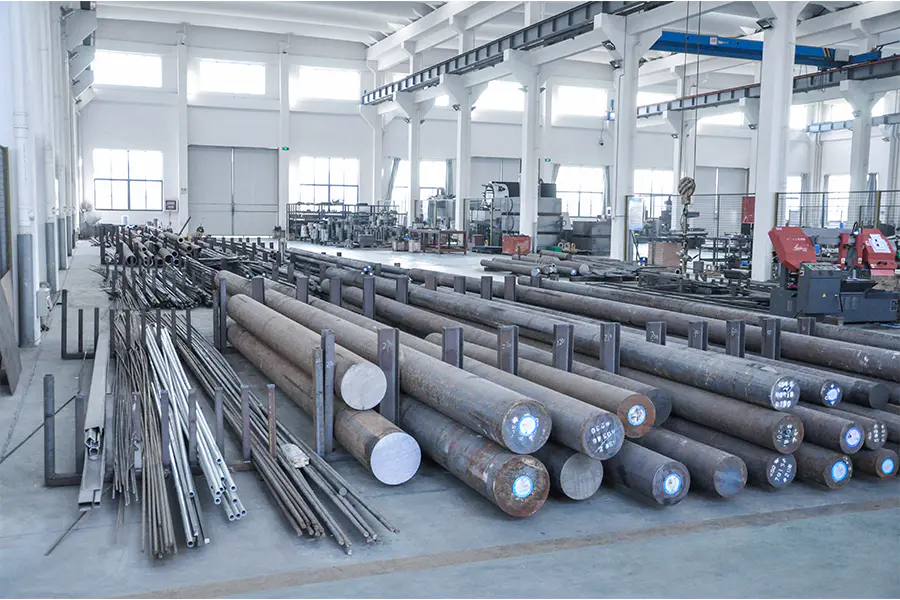
Carbon steel is the primary material of construction across the hydraulic baler machine range.
Three constraints sit outside the mechanical parameters and are frequently checked late in the process, which is the wrong time.
Material of construction. Carbon steel is the primary material used across the range. This matters for abrasive or contaminated streams, because structural material is what carries the reaction forces generated by the compression cylinder.
Voltage. The voltage of the hydraulic baler machine is customizable to meet specific requirements. The listed models illustrate the span: 380V/50Hz on JPW20Q, JPW40BL, JPW-AK60, JP-OT100, JPA5076T25X and JPW-AK100, and 220V/50Hz on JP7050T8.
Certification evidence. The JPW20Q fully automatic horizontal baler holds CE certification for the EU market, certificate number TTC-22-1609/01/01, issued by INTEGRA. The certification covers Directive 2006/42/EC (Machinery Directive) and Directive 2014/35/EU (Low Voltage Directive), with applicable standards EN ISO 12100:2010 and EN 60204-1:2018. The certificate was issued on 2022-09-16 and expires on 2027-09-16.
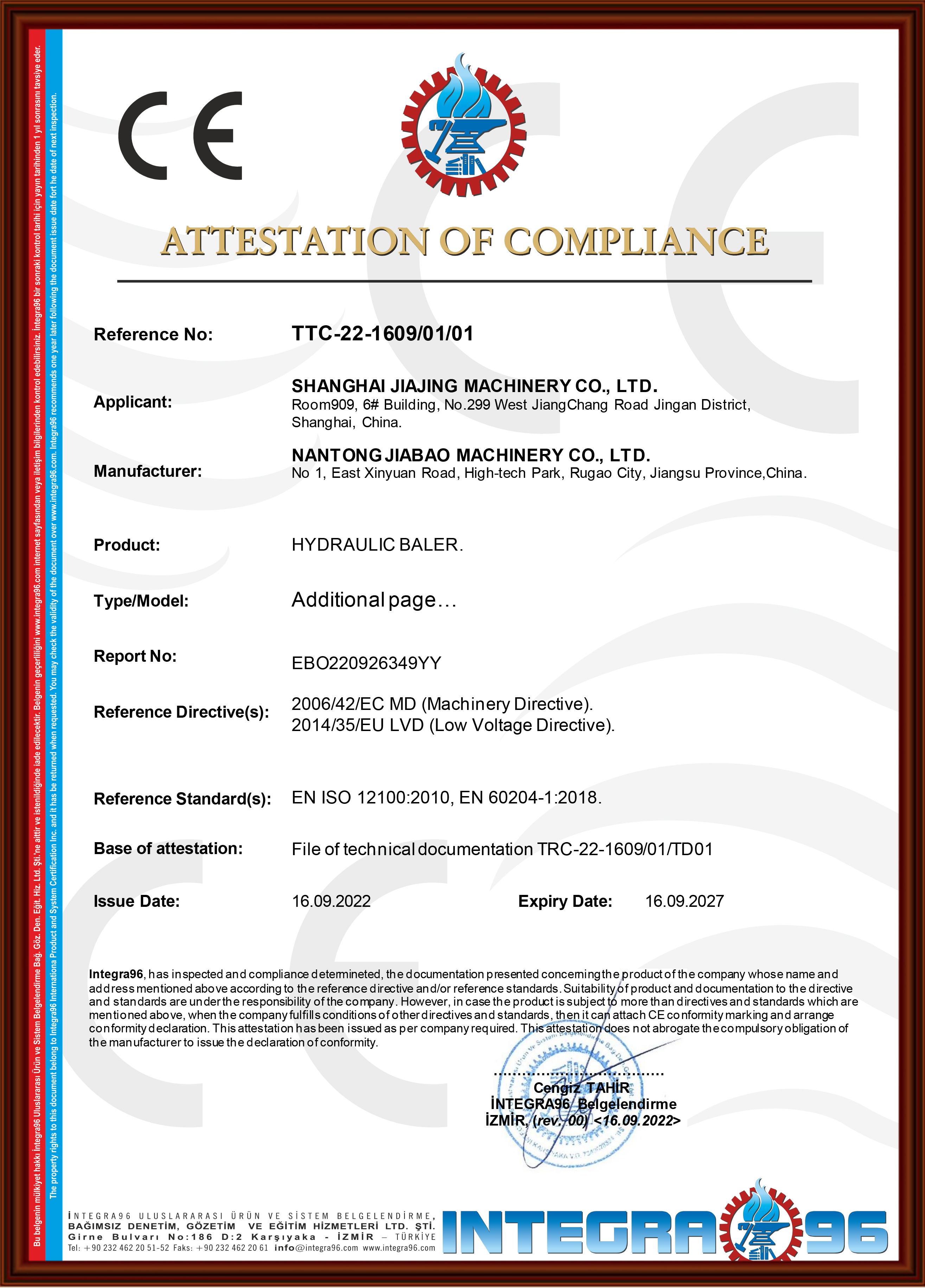
CE attestation of compliance covering Directive 2006/42/EC and Directive 2014/35/EU for the JPW20Q.
In addition, the hydraulic baler machine line holds an SGS Made-in-China Supplier Audit Report for the EU market, certificate number QIP—ASR2541890, issued by SGS against the Made-in-China Supplier Audit Specification. The audit report was issued on 2025-12-10 and expires on 2028-12-10, and its scope covers the full range of baler machine, hydraulic baler, waste paper baler, cardboard baler and baling press machine.
Step-by-Step Breakdown: A Six-Step Specification Sequence
Working through the following sequence prevents the coupling problem described earlier from being resolved by accident rather than by design.
- Classify the material stream. Separate the stream into what will actually enter the feeding mouth: waste paper, cardboard and carton scrap, PET bottles, HDPE, plastic film, woven bags, textile waste, packaging waste, paper dust or fiber-based material such as aluminum foil waste. Material behavior — bulky versus free-flowing — determines the minimum feeding mouth size before any other parameter is chosen.
- Set the target bale format. Decide the bale cross-section and target bale weight required by handling, storage and transport. The published range shows the available span: 5–10 kg on JPW-AK60, 15–20 kg on JPY-T60W, 30–70 kg on JPW20Q, 50–80 kg on JP7050T8 and JPW-K6046, 200–300 kg on JPA5076T25X, 200–400 kg on JPW40F, 250–350 kg on JPW40BL, and 400–600 kg on JP-OT100.
- Match the feeding mouth to the largest piece. The feeding opening must accept the material before pre-processing. The listed range runs from 500×300 mm on JPW-AK60 and 500×320 mm on JPW-AK100 up to 1400×600 mm on JP-OT100 and 1500×500 mm on JPA5076T25X.
- Set compression force against the required bale density. Force should be chosen for the density the material can realistically hold, not maximized. Sixty tons in a 300×300 mm briquetting chamber is a different objective from forty tons in a 720×720 mm baling chamber, even though both are described as compression force.
- Confirm the power supply and voltage configuration. Power across the listed models ranges from 2.2 kW / 3 Hp on JP7050T8, JPW-K6046 and JP8060T5X, through 7.5 kW / 10 Hp on JPW20Q and JPA5076T25X and 11 kW / 15 Hp on JPW40F, up to 15 kW / 20 Hp on JPW40BL, JPW-AK60 and JP-OT100, 18.5 kW / 25 Hp on JPW-AK100 and 22 kW / 30 Hp on JPY-T60W. Voltage is customizable, so availability of the plant supply should be stated at specification time.
- Verify compliance documentation and quality control. Request the certificate numbers and their validity dates for the destination market, and confirm the testing regime — 100% test on every machine — plus the after-sales terms before the order is placed.
Use Cases: Geometry Decisions in Real Installations
The following field applications show how the same three parameters were resolved in different directions depending on the material and the plant.
- Cardboard box factory, Tunisia — JPW-AK60. A factory-wide automatic waste discharge system was configured to clear piled waste paper from the corrugator line and printing machines. The installation eliminated waste paper accumulation in the workshop after three years of operation, and reduced cleanup and space costs by converting the waste into a standardized on-site material flow.
- Cardboard box factory, Mexico — JPW40BL. The requirement was a full-automatic waste removal system that integrated with existing production lines for real-time waste processing. The result, reported after one year, was that waste accumulation was resolved and workshop space utilization and overall site image improved.
- PET recycling enterprise, Japan — JPW20Q and related models. The plant needed higher compression density on PET bottles with compact, aesthetically consistent bales. After two years, the denser bales were reported to improve storage and transport efficiency and the added value of the recycled product.
- Carton manufacturer, Italy — JPA5076T25X. Aging balers were replaced and preprocessing equipment introduced to handle large-sized waste cardboard. Four years on, waste treatment efficiency was improved and the handling problem for oversized cardboard was resolved.
- Mixed recycling operation, Belarus — JPW20Q. One machine was configured to process bulkier and harder-to-compress PET bottles, woven bags, HDPE bottles and cardboard together. The reported result after two years was that regularly shaped bales improved transport and storage efficiency.
- Carton plant, Russia — JPW-K6046 and JPW40F. Automatic collection, compression and baling were integrated with carton production waste streams. The three-year outcome was a coherent unmanned waste processing system with reduced labour and management cost and immediate monetization of waste.
- Mixed solid waste recycler, Australia — JPW-AK100. The stream combined mixed plastics with small amounts of glass and metal scrap, placing the emphasis on compression stability and durability. After two years, the line operated unmanned, reducing labour cost and operational risk.
Comparison Table: Reading the Range by Geometry
The wider range shows how chamber geometry and force are traded against each other. Force alone does not predict bale weight — geometry does, and the feeding mouth sets the material envelope.
| Model | Type (as listed) | Compression force (ton) | Bale dimension (mm) | Feeding mouth (mm) | Bale weight (kg) | Power |
|---|---|---|---|---|---|---|
| JP8060T5X | Waste compactor | 5 | 800×600×400 | 650×470 | 50–80 | 2.2 kW / 3 Hp |
| JPW-K6046 | Bagging machine | 10 | — | 540×400 | 50–80 | 2.2 kW / 3 Hp |
| JP7050T8 | Baling machine | — | — | 670×400 | 50–80 | 2.2 kW / 3 Hp |
| JPW20Q | Fully automatic horizontal baler | 20 | 500×500×500 | 700–460 | 30–70 | 7.5 kW / 10 Hp |
| JPA5076T25X | Hydraulic baler | 25 | 1500×760×900 | 1500×500 | 200–300 | 7.5 kW / 10 Hp |
| JPW40F | Semi-automatic horizontal baler | 40 | 720×720×(500–1300) | 1000×720 | 200–400 | 11 kW / 15 Hp |
| JPW40BL | Plastic bottle recycling machine | 40 | 720×720×(300–1000) | 1000×720 | 250–350 | 15 kW / 20 Hp |
| JPY-T60W | Metal baler | 60 | Cross-section 430×280×(150–250) | 900×430 | 15–20 | 22 kW / 30 Hp |
| JPW-AK60 | Briquetting machine | 60 | 300×300×(200–300) | 500×300 | 5–10 | 15 kW / 20 Hp |
| JP-OT100 | Vertical baler | 100 | 1400×700×(700–1100) | 1400×600 | 400–600 | 15 kW / 20 Hp |
| JPW-AK100 | Aluminum foil baler | 100 | 320×320×(200–250) | 500×320 | 5–15 | 18.5 kW / 25 Hp |
A dash indicates the parameter is not listed for that model in the current specification data. All values are published model specifications; scope values for the range are shown as 2–180 ton.
Two comparisons in Table 2 make the coupling visible. JP-OT100 and JPW-AK100 both apply 100 ton of compression force, yet JP-OT100 produces bales of 400–600 kg while JPW-AK100 produces bales of 5–15 kg — the difference is entirely chamber geometry. Separately, JPW40F at 40 ton / 11 kW and JPW40BL at 40 ton / 15 kW share the same force and the same 1000×720 mm feeding mouth, but differ in bale length range (500–1300 mm versus 300–1000 mm) and bale weight (200–400 kg versus 250–350 kg).
Frequently Asked Questions
Which certifications apply to these hydraulic baler machines in the EU market?
Two documents apply. The JPW20Q fully automatic horizontal baler holds CE certification, certificate number TTC-22-1609/01/01, issued by INTEGRA for the EU market, covering Directive 2006/42/EC (Machinery Directive) and Directive 2014/35/EU (Low Voltage Directive), with applicable standards EN ISO 12100:2010 and EN 60204-1:2018. The certificate was issued on 2022-09-16 and expires on 2027-09-16. In addition, the hydraulic baler machine line holds an SGS Made-in-China Supplier Audit Report, certificate number QIP—ASR2541890, issued by SGS against the Made-in-China Supplier Audit Specification, applicable to the EU market, with issue date 2025-12-10 and expiry date 2028-12-10. Its scope covers the full range of baler machine, hydraulic baler, waste paper baler, cardboard baler and baling press machine. EU buyers should also note that waste processing equipment safety requirements reference standards such as EN 16500:2014 for vertical baling presses, while US buyers commonly work against ANSI Z245.5-2023.
Can compression force and bale chamber geometry be customized?
Yes. Customization covers structure, process and performance, and the published compression force scope runs from 2 ton to 180 ton. The reference models show how geometry shifts with the application: JPW20Q at 20 ton into a 500×500×500 mm bale, JPW40BL at 40 ton into a 720×720×(300–1000) mm bale, and JPW-AK60 at 60 ton into a 300×300×(200–300) mm briquetting bale. Voltage is customizable as well — 380V/50Hz is listed on most models and 220V/50Hz on JP7050T8 — and carbon steel is the primary material of construction.
What drives the cost of a hydraulic baler machine?
Cost follows configuration, and the configuration is defined by the parameters in this guide: compression force within the 2–180 ton scope, bale chamber and bale dimensions, feeding mouth size, bale weight target, power rating (from 2.2 kW / 3 Hp on JP7050T8 up to 22 kW / 30 Hp on JPY-T60W), automation level (bagging machine, waste compactor, semi-automatic horizontal or fully automatic horizontal), carbon steel construction, and the depth of customization in structure, process or performance. Because the minimum order quantity is one unit and every machine is 100% tested, a buyer can size the configuration to the actual material stream rather than purchasing surplus force that the stream cannot use.
Can I validate the bale format before committing to a full order?
The minimum order quantity is one unit and quality control is 100% test on each machine, so a single machine can be used to validate how a chosen geometry behaves on a specific material. The comparison that matters most at this stage is between bale weight tiers: 30–70 kg on JPW20Q, 50–80 kg on JP7050T8 and JPW-K6046, 200–300 kg on JPA5076T25X, 250–350 kg on JPW40BL, and 400–600 kg on JP-OT100. Confirming which of these actually fits the plant's handling, storage and transport setup is the purpose of sample validation. Sample and specification requests can be sent through the contact details below.
What is the production lead time, and what support follows delivery?
Lead time is 60 days, against a monthly production capacity of 100 units. After delivery, support includes a 7×24h technical response, on-site attendance within 48 hours, lifelong maintenance and free training, with the stated objective of minimizing downtime. Buyers evaluating a supplier at this stage should confirm these terms together with the certification validity dates and the 100% test regime before placing the order. To review the full model range and parameter tables in one document, the 2026 Jewel product brochure is available at the Jewel brochure download link.
Conclusion: Specify the Geometry, Then the Force
Compression force is the most visible number on a hydraulic baler machine datasheet and the least useful one in isolation. The reference models in this guide show why: 20 ton into a 500×500×500 mm chamber produces 30–70 kg bales, 40 ton into a 720×720 mm chamber produces 250–350 kg bales, and 60 ton into a 300×300 mm chamber produces 5–10 kg briquettes. Force, bale chamber geometry, feeding mouth size, bale weight and throughput are one decision expressed five ways.
The sequence that works is consistent across material streams: classify the material, set the bale format, match the feeding mouth to the largest piece, size the force to the density the material can hold, confirm power and voltage for the plant supply, and verify certification scope and validity for the destination market. The wider range supports that sequence with a 2–180 ton compression force scope, carbon steel construction, customizable voltage, and a minimum order quantity of one unit with 100% testing.
Next Step: Brochure, Sample and Specification Support
If you are comparing configurations against a specific material stream, the fastest route is a specification review rather than a catalogue comparison. Send the material type, target bale weight, feeding mouth requirement and plant voltage, and the configuration can be matched against the published model data.
Contact: Nina | Email: jiabao@csj-baler.com | Tel / WhatsApp: +86 187-2181-4932
Company: Nantong Jiabao Machinery Co., Ltd. (jewel) — www.jewelbaler.com
Address: No.1 Xinyuan East 1st Road, Rugao City, Jiangsu Province, China
Catalog: Download the 2026 Jewel product brochure