
Hydraulic Baler Machines Explained: A First Look for Buyers
Loose recyclable material creates a simple problem: it fills floor space before it creates value. Hydraulic baler machines solve that problem by compressing waste into dense bales, making the material easier to store, transport and sell. This article explains hydraulic baler machines in plain language for buyers who are still mapping out equipment options.
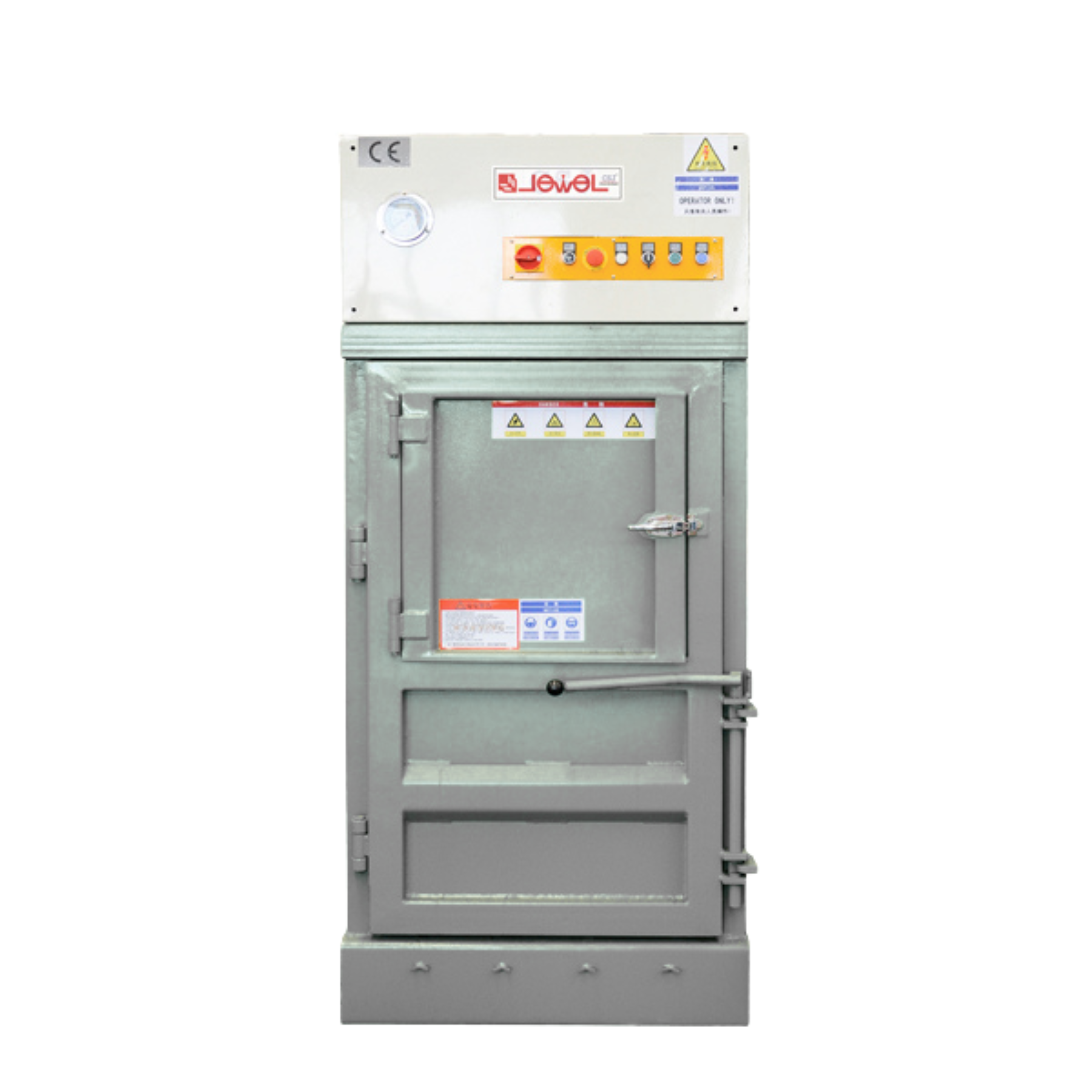
JP8060T5X is one example of a compact hydraulic baler in the Jewel range.
What Is a Hydraulic Baler Machine?
A hydraulic baler machine uses a hydraulic cylinder to compress recyclable or waste material into a dense, manageable bale. The term covers many configurations: vertical balers, horizontal balers, semi-automatic and fully automatic units, compact waste compactors, briquetting presses and material-specific machines.
In the product descriptions used by Nantong Jiabao Machinery Co., Ltd., hydraulic baler models are designed for waste paper recycling, plastic recycling, carton printing, textile waste processing, packaging manufacturing and PET bottle recycling. The listed models are made of carbon steel. Several machine examples in this article come from this manufacturer, which operates under the Jewel brand and is based in Rugao, Jiangsu Province, China. The company was established in 2006 and works under a brand founded in 1995.
The Waste Problem That Hydraulic Balers Solve
Many waste streams are bulky before they are baled. Carton printing plants generate scrap from corrugators and printing presses, while recycling operations receive PET bottles, woven bags, HDPE containers, cardboard and mixed plastics. If those materials sit loose in a factory, they take up loading bays, slow down material flow and increase the number of truck movements.
Hydraulic balers address that problem by converting loose material into a bale with a predictable size. The bale can be handled with a forklift, stacked in a warehouse and loaded for recycling. In factory settings, conveying systems can move waste directly from production equipment to the baler, reducing the amount of manual handling.
Industry Background: Baling Is a Growing Equipment Category
Baling equipment sits inside a wider market that is attracting attention from recyclers, packaging plants and investors. Grand View Research estimated the global baler machine market at USD 6.6 billion in 2024 and projected it to reach USD 11.4 billion by 2035. A separate study by Maximize Market Research valued industrial balers at USD 6.39 billion in 2024 and projected a 9.5% compound annual growth rate through 2032. Grand View Research also reported that Asia Pacific accounted for about 40.2% of the global baler market in 2024.
For first-time buyers, this market context matters because hydraulic baler machines are not a single commodity product. The equipment family ranges from simple vertical presses to automatic horizontal lines connected to conveyors. Understanding the basic machine types is therefore the first practical step in any purchase process.
How a Hydraulic Baler Machine Works
Although hydraulic baler designs differ by type and manufacturer, the basic sequence is similar. Material is introduced through a feeding mouth into a compression chamber. A hydraulic ram then pushes against the material and compresses it into a block. Once the bale reaches the desired size or pressure, it is tied or wrapped, and the machine releases the finished bale.
Three operating levels are common in industrial baling: manual feeding with a vertical press, semi-automatic horizontal baling, and fully automatic horizontal baling with conveying support. The right level depends on how much material the operation generates each day and how much automation is practical for the facility.
Main Types of Hydraulic Baler Machines and Their Workflows
Vertical Hydraulic Balers
Vertical balers are commonly used when floor space is limited or throughput is moderate. Material is loaded into a vertical chamber, and the baler compresses it from above. The JP-OT100 from Jewel is a useful example. It is a vertical baler with a 100-ton compression force, a 1400 mm x 600 mm feeding mouth and a 1400 mm x 700 mm x 1700 mm compression chamber. It produces bales of 1400 mm x 700 mm x (700-1100) mm, each weighing between 400 kg and 600 kg. The catalog rating is 5-6 bales per hour, and the machine weight is 3500 kg.
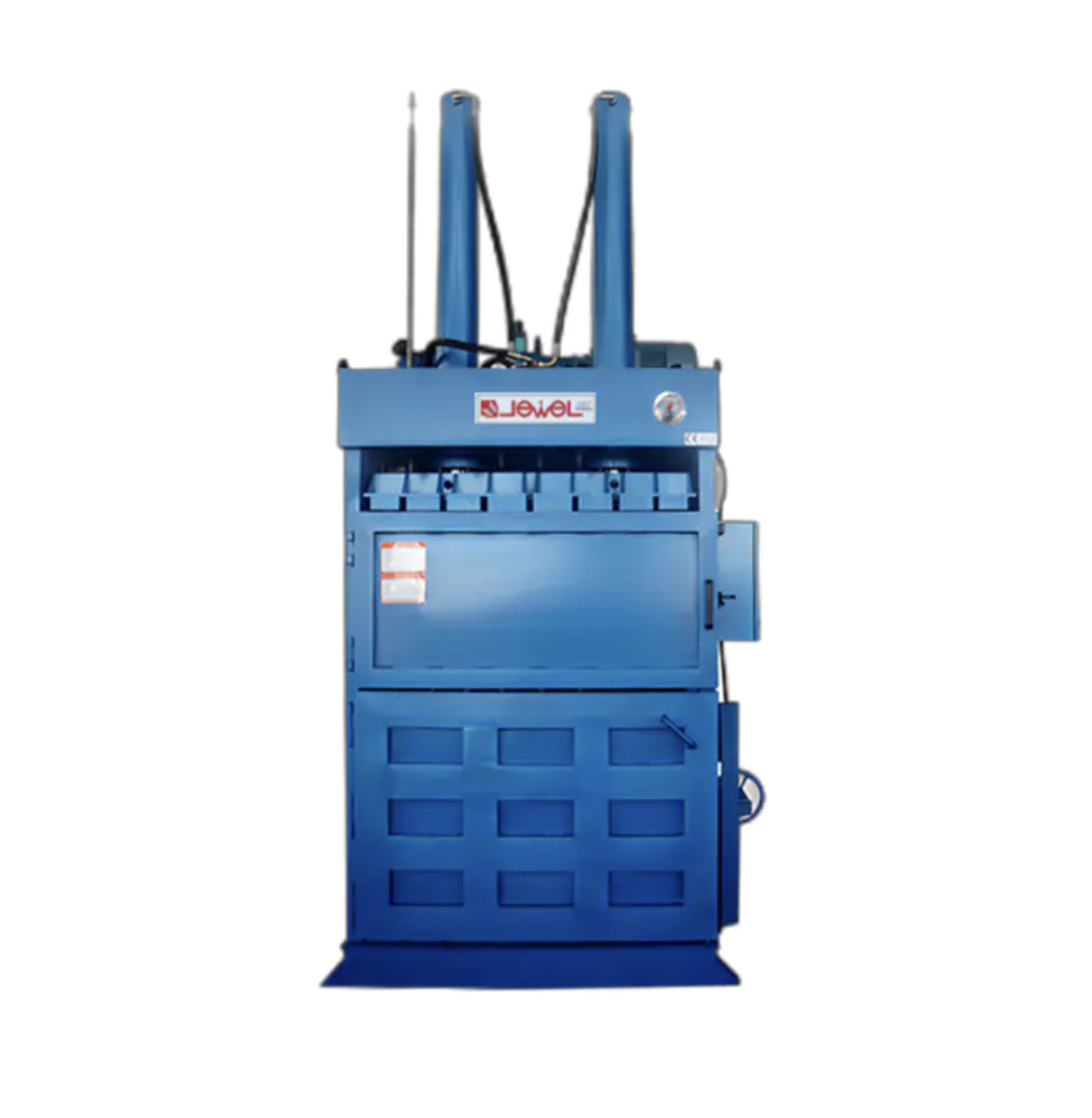
Vertical hydraulic balers such as the JP-OT100 produce heavy bales with a smaller equipment footprint.
Semi-Automatic Horizontal Hydraulic Balers
Horizontal balers accept material through a side or top feed opening and eject the finished bale along a horizontal plane. A semi-automatic horizontal baler is often the next step for factories that need higher throughput without installing a full automated line.
The JPW40F is a representative model. It is made of carbon steel, uses 40 tons of compression force and operates within a 40-100 ton range. Its feeding mouth measures 1000 mm x 720 mm, and its bale dimension is 720 mm x 720 mm x (500-1300) mm. Finished bales weigh between 200 kg and 400 kg. The JPW40F is rated at 1-2 tons per hour and uses a continuous push pack discharge method. The machine has four strapping channels and a 11 kW/15 HP motor.
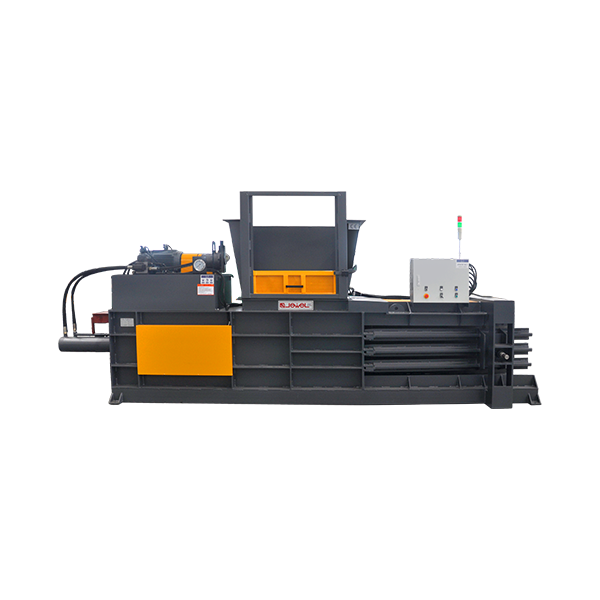
The JPW40F semi-automatic horizontal baler is suited to more continuous factory waste output.
Fully Automatic Horizontal Hydraulic Balers
A fully automatic hydraulic baler machine is designed for plants where waste arrives continuously from production lines. The JPW20Q is a fully automatic horizontal baler with a 20-ton compression force. It produces bales of 500 mm x 500 mm x 500 mm weighing 30-70 kg. The feeding mouth size is 700 mm x 460 mm, and the machine can use 2-4 strapping channels. It operates at 380V/50Hz with 7.5 kW/10 Hp. The complete machine measures 3400 mm x 3010 mm x 2400 mm and weighs 2.8 tons.
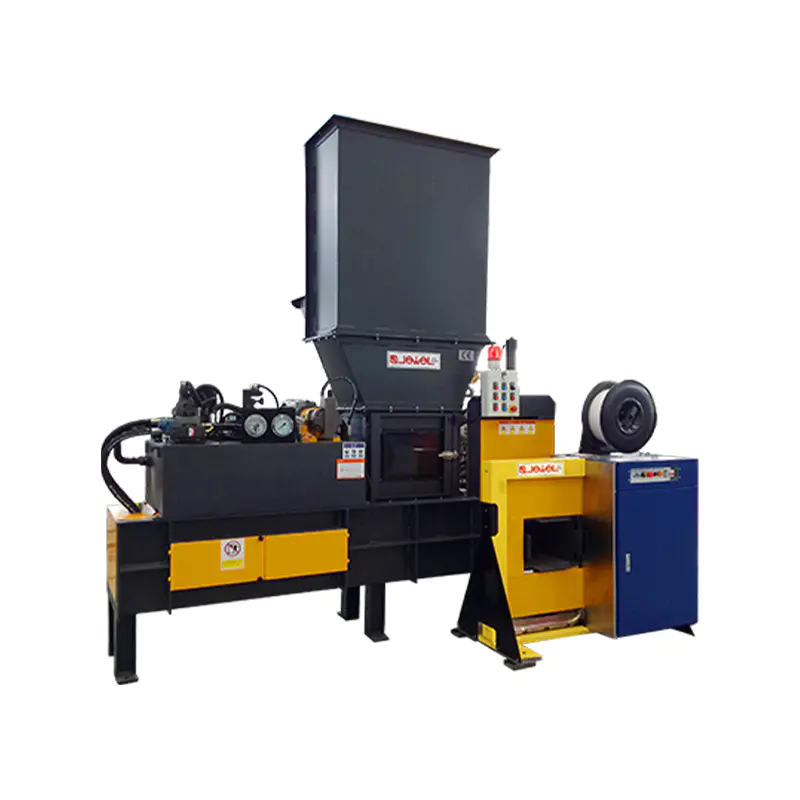
Fully automatic baling equipment is often paired with a conveying system for continuous waste removal.
Material-Specific Hydraulic Baler Machines
Material-specific hydraulic balers are often the fastest way to match bale output to the downstream recycler or mill. In the Jewel catalog, these machines include plastic bottle balers, metal balers, aluminum foil balers, briquetting machines and bagging machines.
The JPW40BL is built for plastic bottle recycling. It has a 40-ton compression force, a 1000 mm x 720 mm feeding mouth and produces bales weighing 250-350 kg. It uses 15 kW/20 Hp and operates at 380V/50Hz.
The JPY-T60W is classified as a metal baler. It has a 60-ton compression force and a 900 mm x 430 mm feeding mouth. Bale cross-section is 430 mm x 280 mm, with length variable between 150 mm and 250 mm. Each bale weighs 15-20 kg, and the machine capacity is 0.5-1 ton per hour.
The JPW-AK100 belongs to the aluminum foil baler category. It is a carbon steel machine for aluminum foil and fiber-based material, while the JPW-AK60 is a briquetting machine that can handle paper dust-like material and produces small bales of 5-10 kg. For plants that need smaller bales with low power consumption, the JP7050T8 is a compact hydraulic baler rated at 6-8 bales per hour, producing bales of 50-80 kg at 2.2 kW/3 Hp.
Hydraulic Baler Machines Compared: Key Decision Facts
| Machine Type | Example Model | Compression Force | Bale Weight | Output | Typical Workflow |
|---|---|---|---|---|---|
| Vertical baler | JP-OT100 | 100 tons | 400-600 kg | 5-6 bales/hour | Manual or assisted loading; dense bales in a smaller footprint |
| Semi-automatic horizontal baler | JPW40F | 40 tons (range 40-100 tons) | 200-400 kg | 1-2 tons/hour | Continuous push pack discharge; operator describes feeding |
| Fully automatic horizontal baler | JPW20Q | 20 tons | 30-70 kg | 2-4 strapping channels | Designed for continuous lines and automatic bale handling |
| Plastic bottle recycling baler | JPW40BL | 40 tons | 250-350 kg | Not specified as bales/hour | Dedicated to PET bottle and plastic recycling streams |
| Compact hydraulic baler | JP7050T8 | 2-180 ton working range | 50-80 kg | 6-8 bales/hour | Low-power vertical baling for smaller operations |
Comparison based on product specifications in the Jewel baler catalog.
Where Hydraulic Balers Show Up in Practice
Application records in the Jewel catalog describe how hydraulic baler machines are used across several waste and recycling environments.
- For PET plastic processors in Japan, balers operate in high-dust environments and are expected to produce dense, well-formed bales while working with conveying systems.
- For renewable-resource recyclers handling mixed supermarket waste in Belarus, the equipment is used to compress PET bottles, woven bags, HDPE bottles and cardboard with one automatic baling line.
- For packaging and carton plants in Russia, waste from carton production can be collected, compressed and baled through an unmanned system integrated with the production line.
- For comprehensive solid waste recyclers in Australia, custom automatic baling systems handle mixed plastics, small amounts of glass and metal scraps while maintaining compression stability and durability.
These examples show why the first equipment question is not always about tonnage. The more useful question is how the baler fits the material path: where waste enters, how staff or conveyors feed it, and how the bale exits.
Step-by-Step: A First Selection Framework for Hydraulic Balers
Step 1: Identify the Material Stream
Describe the waste realistically. Paper, cardboard, plastic bottles, plastic film, aluminum foil and metal scraps behave differently inside a baler. Dust, contamination and material springback also affect chamber size and compression force.
Step 2: Estimate Output and Bale Size
Choose a target output and bale size before comparing models. A compact unit such as the JP7050T8 produces 50-80 kg bales at 6-8 bales per hour. A larger semi-automatic machine such as the JPW40F produces 200-400 kg bales at 1-2 tons per hour.
Step 3: Decide the Automation Level
Manual vertical balers make sense for lower volume. Semi-automatic horizontal balers increase throughput but still need operators. Fully automatic horizontal balers are intended for continuous operation with conveying systems and automatic strapping.
Step 4: Match the Bale to the Buyer
Recycling markets usually value bales with consistent density, size and weight. If a mill or scrap buyer expects a certain bale size, the baler must produce that size without causing handling problems.
Step 5: Check Facility and Utility Constraints
Review door heights, forklift access, floor strength and voltage. Machine dimensions and net weight matter. For example, the JP-OT100 weighs 3500 kg, and the JPW20Q measures 3400 mm x 3010 mm x 2400 mm. Confirm the space before finalizing the machine type.
Specification Checklist for Hydraulic Baler Machines
When you compare hydraulic balers, look for these fields in the specification sheet:
- Compression force in tons
- Feeding mouth size
- Compression chamber size
- Finished bale dimensions
- Bale weight range
- Baling capacity in bales per hour or tons per hour
- Number of strapping channels
- Discharge method
- Power and voltage
- Machine dimensions and net weight
- Construction material
Frequently Asked Questions About Hydraulic Baler Machines
What safety standards apply to hydraulic balers?
For waste compacting equipment used in Europe, EN 16500:2014 is a relevant standard for vertical baling presses. In the United States, ANSI Z245.5-2023 is the updated national standard for baling equipment safety. Buyers should ask the manufacturer to confirm which standard applies to the model and destination.
What types of material can hydraulic baler machines process?
Hydraulic baler machine descriptions cover waste paper recycling, plastic recycling, carton printing, textile waste processing, packaging manufacturing and PET bottle recycling. Application notes also mention PET bottles, woven bags, HDPE bottles, cardboard, mixed plastics and small amounts of glass and metal scrap.
Which factors most influence the budget of a hydraulic baler project?
Do not compare only by compression tonnage. The main budget variables are machine type, feeding method, automation level, bale handling path, conveying systems and any cutting or briquetting pre-step. In the Jewel range, the compact JP7050T8 uses 2.2 kW/3 Hp and weighs 590 kg, while the vertical JP-OT100 weighs 3500 kg and uses 15 kW/20 Hp. Define your material and output target before asking for project pricing.
Which hydraulic baler specifications should I compare first?
Compare compression force, feeding mouth size, bale dimensions, bale weight, baling capacity, strapping channels, power and voltage, discharge method, machine dimensions and construction material. These values tell you whether the baler fits the facility, operates on the available power supply and meets downstream bale-size needs.
How can I turn this overview into a technical next step?
Ask for documented machine specifications and describe your material, volume and desired bale output. Nantong Jiabao Machinery Co., Ltd., operating under the Jewel brand, offers customized industry solutions for compression and baling equipment and has application background in baler machines. You can request more details by emailing jiabao@csj-baler.com, calling +86 187-2181-4932, or downloading the 2026 Jewel catalog through the link below.
Turning First-Look Knowledge Into a Shortlist
Hydraulic baler machines serve one clear purpose: they turn loose waste into dense, consistent bales that are easier to store, move and sell. The choice between vertical, semi-automatic horizontal and fully automatic horizontal equipment depends on the material stream, the hourly output and the level of automation the plant can support.
For a practical next step, use the Jewel 2026 catalog to compare baler models, dimensions and configurations. If you need help identifying a starting point for your waste stream, contact Jewel by email or WhatsApp and describe your material and target bale size.
Email: jiabao@csj-baler.com
Tel/WhatsApp: +86 187-2181-4932
Website: www.jewelbaler.com
Address: No.1 Xinyuan East 1st Road, Rugao City, Jiangsu Province, China
Have Questions or Need More Details?
Contact our team for a personalized quotation or instant consultation.
Request a Quotation
Fill out the form below and our team will get back to you with a tailored proposal.
WhatsApp Direct Chat
Prefer to chat in real-time? Message us on WhatsApp for instant assistance & quick answers.
- Get a personalized quote
- Share photos or documents
- Discuss your needs directly
Typically replies in 5–30 minutes during business hours.