
Hydraulic Baler Machines: Industry-Specific Application Guide for Textile, Carton, PET & Foil
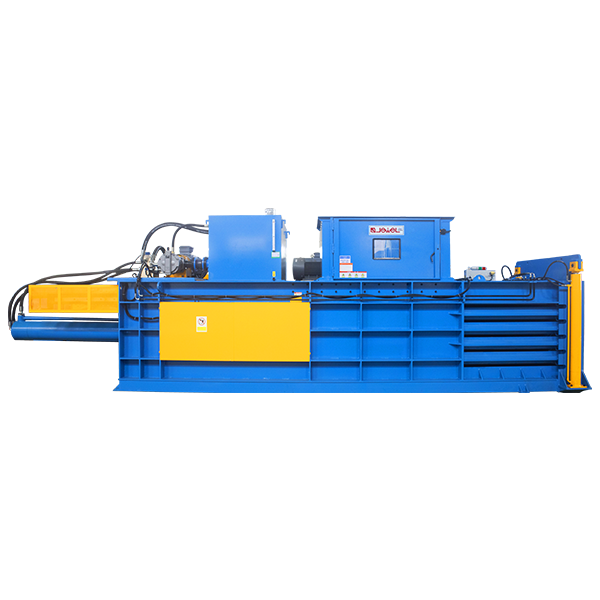
Cover image: JPW40BL horizontal hydraulic baler configuration used in waste recycling applications. Image source: Jewel product image library.
Hydraulic baler machines are not one product category with one specification. A vertical baler, a semi-automatic horizontal baler, a fully automatic horizontal baler, and an aluminum foil baler solve different material, space, labor, and bale-handling problems. The practical question is not “which hydraulic baler machine is best?” but “which compression, feed opening, bale size, automation level, and voltage fit this waste stream and this plant?”
This guide is a cluster-level application companion to the broader hydraulic baler machines topic. It maps common recycling and processing scenarios — textile waste, carton printing waste, PET bottles, aluminum foil, and metal recovery — to verified Jewel configurations, including the JP-OT100 vertical baler, the JPW40F semi-automatic horizontal model, the JPW20Q fully automatic horizontal model, and the JPW-AK100 aluminum foil baler. Jewel is the brand of Nantong Jiabao Machinery Co., Ltd., a China-based manufacturer of compression and baling equipment established in 2006; the brand was founded in 1995.
Problem Definition: Why Generic Baler Recommendations Fail
Waste streams behave differently under compression. Textile waste can spring back and bridge in the feed opening. Carton and waste paper can form dense bales only when the chamber and tying system match the paper grade. PET bottles trap air and require sufficient compression density to make transport economically useful. Aluminum foil is light and can fold, tear, or rebound if the baler is set up like a general carton press. Metal scrap needs a different force and wear profile from paper or plastic.
A buyer who compares only tonnage misses the constraints that decide daily output: feed opening size, bale chamber dimensions, bale weight, cycle time, tying method, voltage, floor space, and how the machine is fed. A 5-ton baler and a 150-ton baler can both be “hydraulic baler machines,” but they do not serve the same project. The result of a poorly matched unit is predictable: manual re-feeding, inconsistent bale density, higher wire consumption, blocked chutes, excess floor space, and transport loads that are lighter than planned.
Industry Background: Demand Is Broad, but Application Fit Is Local
The baler category is commercially active across recycling, packaging, printing, and metal recovery. Verified market research cited in the data package estimates the global baler market at USD 7.96 billion in 2026, with the hydraulic waste paper baler segment estimated at USD 1.45 billion in its base year. The hydraulic metal recycling baler segment was valued at USD 913 million in 2023. These figures describe category scale, not a reason to choose one machine type. The buying decision remains local to the plant: material mix, labor model, storage space, and downstream transport.
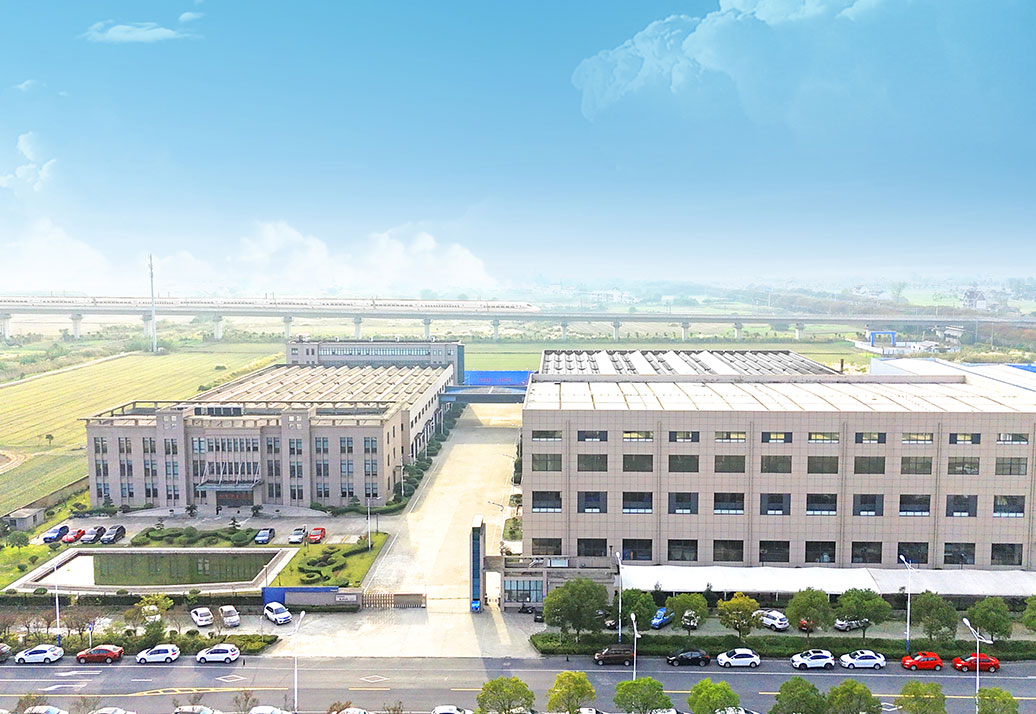
For evaluation-stage buyers, the useful industry signal is segmentation. Suppliers list vertical, horizontal, semi-automatic, fully automatic, scrap, waste paper, carton, plastic bottle, fiber, and foil variants because the underlying jobs differ. Jewel’s own production data supports a broad configuration range: the company reports a 50,000 m² production facility, more than 200 professionals, a monthly capacity of 100 units, a minimum order quantity of 1 unit, and a 60-day lead time. Those facts matter when a project needs a customized hydraulic baler machine rather than a catalog unit.
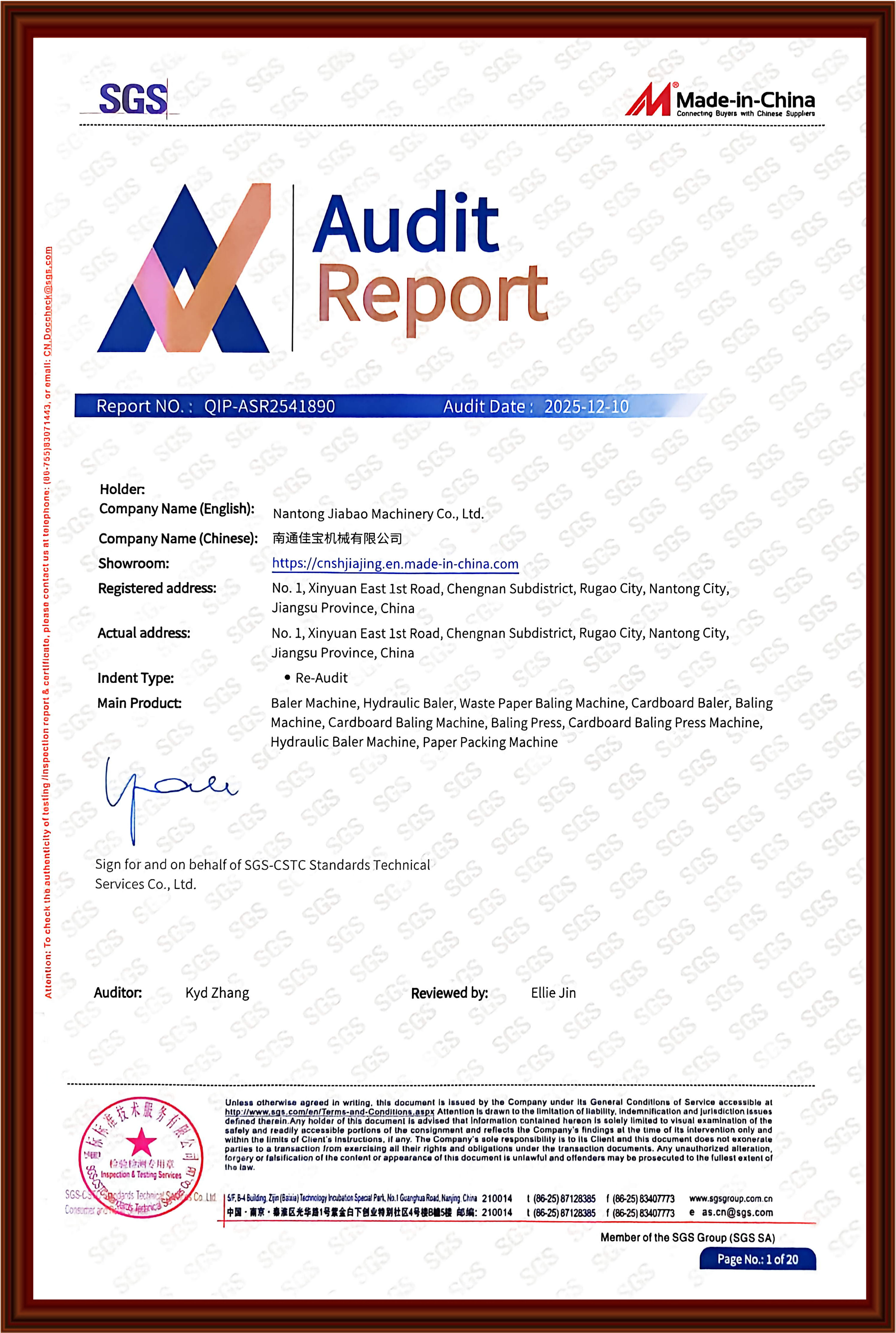
Proof image: SGS Made-in-China Supplier Audit Report QIP—ASR2541890, issued 2025-12-10 and valid to 2028-12-10. The audit scope covers the full range of baler machines, hydraulic balers, waste paper balers, cardboard balers, and baling press machines.
Detailed Solution: Map the Material Stream to the Machine Type
Textile and fiber waste: control bulk and rebound
Textile waste, fiber, and loose packaging film are bulky and elastic. They usually reward a vertical hydraulic baler or a semi-automatic horizontal hydraulic baler when the plant needs regular bale shape without a fully automated line. The buyer should confirm the feed opening, chamber size, and tying pattern with the actual material, because fiber bulk density varies by source. For a fiber hydraulic baler machine project, the practical test is whether the finished bale holds its shape during stacking and transport. If the material is very light and the plant has limited floor space, a vertical hydraulic baler such as the JP-OT100 is the more natural starting point. If the material is fed from a conveyor or baled continuously, a horizontal model is easier to integrate.
Carton, cardboard, and printing waste: match chamber and tying to paper grade
Carton hydraulic baler machines and waste paper hydraulic baler machines are often evaluated on force alone, but paper grade and feeding method matter more. A cardboard factory waste hydraulic baler machine must handle trim from corrugator lines, printing machines, and die-cutters. In Tunisia, a cardboard box factory used product 4301 for clearing piled waste paper and improving workshop efficiency; the project included a factory-wide automatic waste discharge system to solve waste accumulation from the corrugator line and printing machines. In Mexico, a cardboard box factory used a high-efficiency full-automatic waste removal system integrated with existing production lines to eliminate waste accumulation and improve workshop space utilization. In Russia, a cardboard box factory used product 4312 for automatic collection, compression, and baling during carton production, achieving an unmanned waste processing system over a three-year project.
For semi-automatic horizontal hydraulic baler machines, the JPW40F is the relevant model in the Jewel range. It appears in the verified SGS audit scope and in the Russia carton project. For fully automatic waste paper hydraulic baler machines, the JPW20Q is the CE-certified horizontal model in the verified data. The choice between them should be based on labor availability, conveyor integration, and whether the plant can feed a horizontal chamber continuously.
PET bottles and plastic waste: density is the economic variable
Plastic bottle hydraulic baler machines and hydraulic baler machines for rubber and plastic waste are judged by compression density and bale stability. PET bottles trap air; loose bottles occupy transport volume and raise storage and freight cost. In Japan, a PET recycling enterprise required a solution that could increase the compression density of PET bottles and produce compact bales; the project improved handling efficiency and reduced transport and storage costs. In Belarus, a waste recycling client used product 4310 to handle PET bottles, woven bags, HDPE bottles, and cardboard; the result was regular-shaped bales that improved transportation and storage efficiency. In Australia, product 4310 was used in integrated mixed waste processing for plastics, glass, and metal scraps, achieving full-line unmanned operation.
For fully automatic horizontal hydraulic baler machines in PET and mixed plastic lines, the JPW20Q is supported by CE certificate TTC-22-1609/01/01, issued by INTEGRA and valid to 2027-09-16. The certificate covers 2006/42/EC MD and 2014/35/EU LVD, with standards EN ISO 12100:2010 and EN 60204-1:2018. For buyers in the EU, that is a model-specific compliance check, not a generic supplier claim. For mixed plastic and rubber waste, the feed opening and chamber must be sized for the largest piece; otherwise the press hydraulic baler machine becomes a manual sorting station.
Aluminum foil and light metal: use a foil-specific configuration
Aluminum foil hydraulic baler machines are not simply scaled-down carton balers. Foil is light, folds easily, and can slip or rebound during compression. The JPW-AK100 Aluminum Foil Baler is a concrete example of industry-specific configuration: carbon steel construction, 5-ton compression force, 2600 kg machine weight, 4000 × 920 × 1350 mm dimensions, 4–7 bales per hour capacity, and 50–80 kg bale weight. Those figures give a buyer a practical starting point for space planning, floor loading, and bale handling. The 50–80 kg bale range is light enough for manual or small-vehicle handling, while the 4–7 bales/hour range sets a realistic throughput expectation for a dedicated foil stream.
For metal recovery beyond foil, the requirements change. The verified data includes a JPW150BL-QT fully automatic horizontal closed-end baler with 150-ton compression force and a bale size of 1100 × 1250 × 1500 mm. That is a different class of metal hydraulic baler machine from a foil baler. Scrap hydraulic baler machines and metal hydraulic baler machines should be specified with the heaviest scrap, the cutting or shear requirement, and the loading method in view. Do not use a foil baler’s force or bale weight as a proxy for mixed metal scrap.
Adjacent configurations: bagging and briquetting are not the same purchase
Bagging hydraulic baler machines and briquetting hydraulic baler machines serve downstream or different material-reduction steps. A standard baler produces a tied bale; a bagging system adds containment, and a briquetting press changes the output form. If the project needs one of those outputs, specify it as a separate requirement rather than assuming a standard waste hydraulic baler machine will cover it. The same discipline applies to customized hydraulic baler machines: customization should be defined by structure, process, or performance need, not by a general request for “something special.”
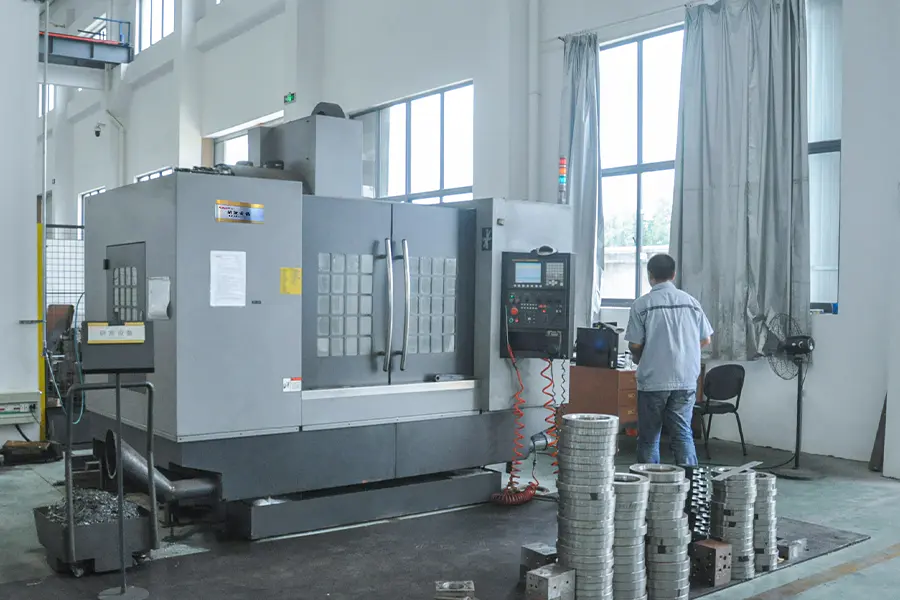
Supporting image: production workshop at Nantong Jiabao Machinery Co., Ltd. The company reports a 50,000 m² facility and a monthly capacity of 100 units.
Step-by-Step Breakdown: Build a Scenario Checklist Before You Compare Models
Step 1 — Classify the material by behavior, not by name. Ask whether the stream is paper, carton, PET, mixed plastic, rubber, textile fiber, foil, or metal scrap. Note whether it is clean, wet, bulky, elastic, or abrasive. A waste paper hydraulic baler machine and a metal hydraulic baler machine may share a hydraulic principle but not a wear profile.
Step 2 — Measure the feed opening and floor space. The largest regular piece must enter without forced folding. For vertical hydraulic baler machines, confirm door opening, chamber access, and overhead clearance. For horizontal models, confirm conveyor or chute height, approach space, and bale ejection clearance. A machine that fits the waste but not the building is still the wrong machine.
Step 3 — Set the bale target. Define bale weight, bale dimensions, and tying method. The JPW-AK100 example shows why this matters: a 50–80 kg bale and 4–7 bales per hour capacity suit a dedicated foil stream with light handling. A carton or PET project may need a different bale size to match truck loading, warehouse racking, or buyer acceptance.
Step 4 — Match automation to the real labor model. Vertical hydraulic baler machines are often manually fed and suited to lower-volume or space-constrained areas. Semi-automatic horizontal hydraulic baler machines reduce handling but still require an operator. Fully automatic horizontal hydraulic baler machines are specified when the baler must integrate with a conveyor, automatic waste discharge, or unmanned waste processing. The Russia carton project and Australia mixed-waste project both show automation as a system decision, not a standalone machine feature.
Step 5 — Confirm voltage, certification, and market access. For EU delivery, check the model-specific CE certificate. The JPW20Q certificate TTC-22-1609/01/01 covers 2006/42/EC MD and 2014/35/EU LVD, with EN ISO 12100:2010 and EN 60204-1:2018. The SGS audit QIP—ASR2541890 covers the full range of baler machines and is valid to 2028-12-10. Voltage is a project variable; it should be confirmed in the quotation rather than assumed from a catalog.
Step 6 — Validate with a sample and a factory test. Jewel reports 100% test before shipment, a minimum order quantity of 1 unit, and a 60-day lead time. For a new material stream, use those facts to structure a pilot: send a representative sample, agree on bale density and bale shape, and confirm the test criteria before the production order. A sample review is more useful than a generic model comparison when the material is variable.
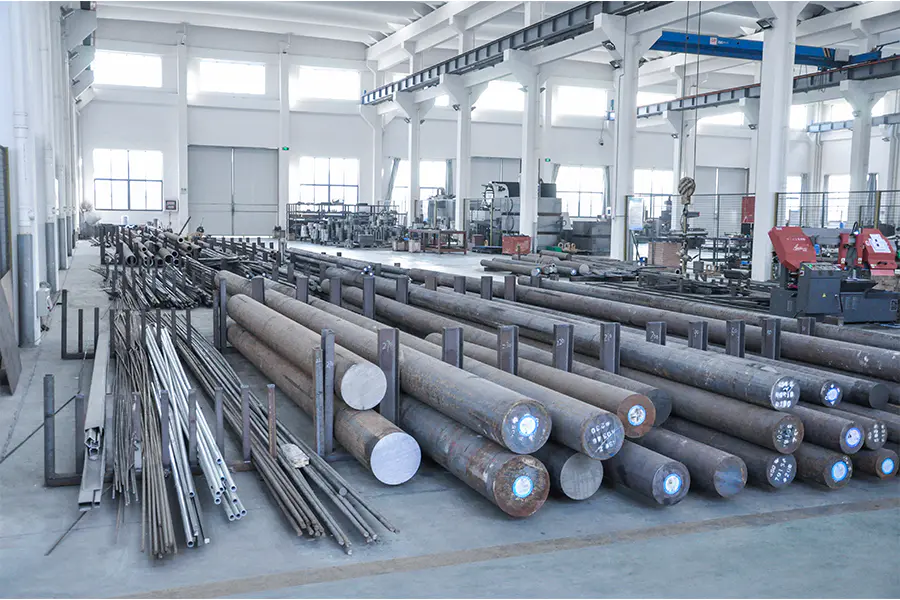
Supporting image: steel warehouse supporting baler production. Material readiness is part of the 60-day lead-time and customization review.
Use Cases: What the Application Map Looks Like in Practice
Carton and printing waste
Cardboard box factories generate trim continuously, and the waste volume is predictable. The Tunisia, Mexico, and Russia cases all point to the same decision pattern: collect waste at the source, compress it close to the line, and remove manual clearing from the workflow. A semi-automatic horizontal model such as the JPW40F fits a plant that can feed a horizontal chamber; a fully automatic model such as the JPW20Q fits a line-integrated or higher-throughput project. The Mexico case specifically describes a full-automatic waste removal system integrated with existing production lines, eliminating waste accumulation and improving workshop space utilization.
PET bottle and mixed plastic recycling
PET recycling projects usually justify the baler by transport density. The Japan case required higher compression density and compact bales. The Belarus case handled PET bottles, woven bags, HDPE bottles, and cardboard in one project. The Australia case handled mixed plastics, small amounts of glass, and metal scraps with a multi-material separation approach. These are different material mixes, and they should not be forced into one model without checking the feed opening and bale chamber. For a plastic bottle hydraulic baler machine, the key questions are bottle size, whether caps and labels are removed, and whether the bale will be sold or internally transported.
Textile and fiber waste
Textile waste is often lower-density than carton and more elastic than PET. A fiber hydraulic baler machine should be sized for the loose bulk volume, not just the weight. Vertical hydraulic baler machines are common where floor space is limited and manual feeding is acceptable. Semi-automatic horizontal models are relevant when the material is fed from a sorting line or when bale uniformity is needed for resale. Because the provided case data does not include a textile-specific installation, the correct evaluation step is a sample test with the actual fiber mix.
Aluminum foil and light metal
Foil converters, packaging plants, and light-metal processors need a compact bale that can be handled without specialized lifting equipment. The JPW-AK100’s 5-ton force, 50–80 kg bale weight, and 4–7 bales/hour capacity are a practical fit for a dedicated foil stream. For heavier metal recovery, the 150-ton JPW150BL-QT is a different configuration with a 1100 × 1250 × 1500 mm bale size. Buyers should not compare those two machines as if they were substitutes; they belong to different application classes.
Comparison Table: Configuration Facts Buyers Can Verify
The table below uses only facts from the provided content units and verified data. It is a starting point for quotation discussions, not a substitute for a sample test.
| Configuration | Typical application | Verified facts available | Buyer check before order |
|---|---|---|---|
| Vertical hydraulic baler — JP-OT100 | Space-constrained sorting, textile, carton, PET, foil, retail or warehouse waste | Listed among related products in the SGS audit scope QIP—ASR2541890, which covers the full range of baler machines, hydraulic balers, waste paper balers, cardboard balers, and baling press machines. | Confirm feed opening, bale size, floor space, manual feeding height, and whether the material springs back. |
| Semi-automatic horizontal hydraulic baler — JPW40F | Carton printing waste, mixed paper and plastic, PET, plant-level waste collection | Used by a cardboard box factory in Russia for automatic collection, compression, and baling during carton production; included in the SGS audit scope. | Confirm throughput, chamber size, tying system, conveyor or chute interface, voltage, and operator load. |
| Fully automatic horizontal hydraulic baler — JPW20Q | PET recycling, mixed waste, carton, line-integrated waste processing | CE certificate TTC-22-1609/01/01, issued by INTEGRA, valid to 2027-09-16; covers 2006/42/EC MD and 2014/35/EU LVD, with EN ISO 12100:2010 and EN 60204-1:2018; included in the SGS audit scope. | Confirm PLC and feeding integration, bale ejection, maintenance access, voltage, and EU market documentation. |
| Aluminum foil hydraulic baler — JPW-AK100 | Aluminum foil, light foil scrap, packaging foil recovery | Carbon steel construction; 5-ton compression force; 2600 kg machine weight; 4000 × 920 × 1350 mm dimensions; 4–7 bales/hour capacity; 50–80 kg bale weight. | Confirm foil thickness, bale handling method, floor loading, footprint, and whether the bale weight suits the downstream buyer. |
| Heavy-duty metal baler — JPW150BL-QT | Metal recovery and higher-force scrap baling | Fully automatic horizontal closed-end baler with 150-ton compression force and 1100 × 1250 × 1500 mm bale size. | Confirm scrap type, loading method, shear or cutting need, wear parts, and transport dimensions. |
FAQ: Compliance, Capability, Budget, Sample, and Lead Time
What compliance documents should I check on a hydraulic baler machine for EU delivery?
For the JPW20Q fully automatic horizontal baler, the verified CE certificate is TTC-22-1609/01/01, issued by INTEGRA and valid to 2027-09-16. It covers 2006/42/EC MD and 2014/35/EU LVD, with standards EN ISO 12100:2010 and EN 60204-1:2018. The SGS Made-in-China Supplier Audit Report QIP—ASR2541890 covers the full range of baler machines and is valid to 2028-12-10. Buyers should match the certificate to the exact model and voltage, not only to the supplier name.
Can Jewel customize hydraulic baler machines for textile, carton, PET, or foil waste?
Yes. The verified capability data lists customization for structure, process, and performance. Jewel reports a monthly capacity of 100 units, 100% test before shipment, a minimum order quantity of 1 unit, and a 60-day lead time. Customization should be specified against a material sample and a bale target so that the chamber, feed opening, force, and automation level are defined before production.
What drives the budget for a hydraulic baler machine project?
The provided data does not include price figures, so a responsible budget comparison should be built from configuration drivers: compression force, bale chamber size, automation level, feed opening, voltage and certification requirements, material wear, and after-sales scope. A foil baler with 5-ton force and 50–80 kg bales is a different cost class from a 150-ton metal baler. Ask for a quotation that separates machine configuration, optional feeding or ejection equipment, documentation, and service.
Can I validate a sample before placing an order?
A one-unit minimum order quantity supports a pilot or sample-validation approach. The practical step is to send a representative material sample and agree on the test criteria: bale weight, bale shape, cycle time, and whether the bale remains stable during handling. Jewel’s 100% test process should be documented in the order. For a sample review, contact the Jewel team through www.jewelbaler.com or the contact details below.
What lead time and after-sales support should I expect?
The verified lead time is 60 days. After-sales support is listed as 7×24h technical response, with 48 hours on site, lifelong maintenance, and free training. For project planning, confirm the lead time against the final configuration, voltage, and documentation package. A soft next step is to request a quotation or a sample review using the contact details in the CTA below.
CTA image: factory-based quotation and sample review for hydraulic baler machine projects.
Conclusion: Choose the Application, Then the Machine
The useful comparison for hydraulic baler machines is not a single ranking. It is a material-to-machine map. Textile and fiber waste put a premium on feed opening and bale stability. Carton and waste paper put a premium on continuous feeding, chamber size, and tying. PET and plastic put a premium on compression density and transport economics. Aluminum foil needs a foil-specific configuration such as the JPW-AK100, with its 5-ton force, 2600 kg weight, 4000 × 920 × 1350 mm dimensions, 4–7 bales/hour capacity, and 50–80 kg bale weight. Metal recovery moves into a different force class, illustrated by the 150-ton JPW150BL-QT in the verified data.
Before you compare quotations, write the scenario checklist: material behavior, largest piece, required bale weight and size, feed method, floor space, voltage, certification market, labor model, and sample acceptance criteria. That checklist will separate a vertical hydraulic baler from a semi-automatic horizontal model, and a standard waste baler from a customized hydraulic baler machine. It will also keep the evaluation honest when a supplier offers a model that looks similar on paper but does not fit the stream.
Request a Sample Review or Quotation
Jewel — Nantong Jiabao Machinery Co., Ltd. — manufactures hydraulic baler machines for carton, waste paper, PET, plastic, textile, foil, and metal recovery applications. Share your material, bale target, voltage, and destination market to receive a configuration-based quotation.
Contact: Nina | Email: jiabao@csj-baler.com | Tel / WhatsApp: +86 187-2181-4932 | Address: No.1 Xinyuan East 1st Road, Rugao City, Jiangsu Province, China
Website: www.jewelbaler.com | WhatsApp: Start a WhatsApp inquiry
Download the product brochure: 2026 Aluminum Foil Baler Brochure (PDF)
Next step: send a material sample description and your target bale size. The team can confirm whether a vertical, semi-automatic horizontal, fully automatic horizontal, or foil-specific configuration is the right starting point.
Have Questions or Need More Details?
Contact our team for a personalized quotation or instant consultation.
Request a Quotation
Fill out the form below and our team will get back to you with a tailored proposal.
WhatsApp Direct Chat
Prefer to chat in real-time? Message us on WhatsApp for instant assistance & quick answers.
- Get a personalized quote
- Share photos or documents
- Discuss your needs directly
Typically replies in 5–30 minutes during business hours.