
Hydraulic Baler Machines: Matching Models to Waste Paper, Carton, Plastic, Textile, and PET Streams
Direct answer: Matching hydraulic baler machines to a material stream is a four-variable decision — feed opening, bale dimension and bale weight, throughput, and power supply. In the Jewel range, that decision runs from a 5-ton waste compactor with a 650 × 470 mm feed opening (JP8060T5X) up to a 100-ton vertical baler with a 1400 × 600 mm feed opening and a 1400 × 700 × 1700 mm compression chamber (JP-OT100). A model that fits a waste paper yard rarely fits a textile plant, and a model that fits a corrugator line rarely fits a PET washing line.
This guide maps five real streams — waste paper, carton and box plant waste, plastic, textile, and PET bottles — to specific models using published specifications. Each section states the feed opening, bale size, bale weight, throughput and power figure that decides the match, and the article closes with an eight-step checklist you can run against your own site data.
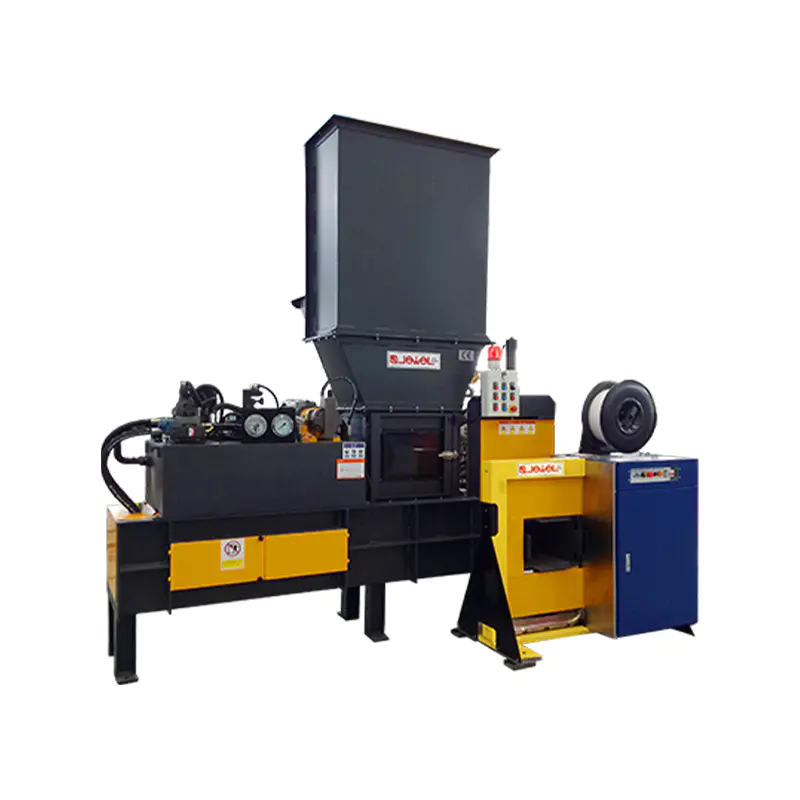
Problem Definition: Why Tonnage-First Selection Fails
Buying a baling press by compression force alone produces three predictable failures: material bridges in the feed opening, finished bales miss the downstream buyer's specification, and manual labour never actually disappears from the yard. All three are geometry and throughput problems, not force problems.
Feed opening is the first hard constraint. A JP-OT100 vertical baler accepts material through a 1400 × 600 mm mouth, while a JPW20Q fully automatic horizontal baler feeds through 700 × 460 mm and a JPW-AK60 briquetting machine through 500 × 300 mm. Large-size waste cardboard and unsorted box plant trim simply will not travel through a small mouth without pre-cutting, which is exactly why an Italian box plant had to replace aging balers and add preprocessing equipment to handle large-sized waste cardboard.
Bale specification is the second constraint. The Jewel range produces bales from 5–15 kg (JPW-AK100) and 5–10 kg (JPW-AK60) up to 400–600 kg (JP-OT100). Bale weight and bale dimension decide how the bale is handled afterwards: manual stacking, forklift movement, or automatic loading into a baled-material container. Strapping configuration matters here too — the JPW20Q is built with 2–4 strapping channels, while the JPW40F and JPW40BL each use 4 strapping channels.
Throughput is the third constraint. Capacity in this range is expressed two ways. Tonne-based models are quoted in tons per hour — JPW40F at 1–2 t/hr, JPY-T60W at 0.5–1 t/hr, JPW-AK100 at 0.4–0.8 t/hr, JPW-AK60 at 0.2–0.5 t/hr. Bale-count models are quoted in bales per hour — JP-OT100 at 5–6, JP8060T5X at 4–7, JP7050T8 and JPW-K6046 at 6–8, JPA5076T25X at 3–5.
Power is the fourth constraint. Installed power in the range runs from 2.2 kW / 3 Hp (JP8060T5X, JPW-K6046, JP7050T8) to 22 kW / 30 Hp (JPY-T60W), with 15 kW / 20 Hp on the JP-OT100 and JPW40BL, 18.5 kW / 25 Hp on the JPW-AK100, and 7.5 kW / 10 Hp on the JPW20Q and JPA5076T25X. Most models are listed at 380V/50Hz with customizable voltage; the JP7050T8 is listed at 220V/50Hz.
Industry Background: Volume, Regulation, and Sourcing Context
The global baler machine market was valued at USD 6.6 billion in 2024 and is projected to reach USD 11.4 billion by 2035 according to Grand View Research; the industrial balers segment specifically was valued at USD 6.39 billion in 2024 with a projected CAGR of 9.5% through 2032 according to Maximize Market Research. Asia Pacific accounted for approximately 40.2% of total baler market revenue in 2024. Published estimates differ by scope — agricultural versus industrial balers, and different forecast windows — so buyers should treat any single figure as an order-of-magnitude indicator rather than a precise forecast.
Trade data supports the same direction of travel: China's exports of wood pulp and paper scrap, including baled waste paper, reached USD 288 million in 2025 according to the Observatory of Economic Complexity.
Regulation shapes model choice more than market size does. European safety regulations require vertical and tyre balers to comply with EN 16500:2014, the standard for vertical baling presses used in waste processing. In the United States, ANSI Z245.5-2023 is the updated American National Standard for baling equipment safety requirements, replacing the 2013 version. For a buyer specifying a vertical baler such as the JP-OT100 for an EU site, or a horizontal machine for a US site, the applicable safety standard belongs in the specification from day one rather than in a post-delivery retrofit.
Entity reference: Jewel is the baler brand of Nantong Jiabao Machinery Co., Ltd., a compression and baling equipment manufacturer established in 2006 (the brand was founded in 1995), operating a 50,000 m² facility in Rugao City, Jiangsu Province, China, with more than 200 employees, a 30-engineer R&D team, annual output of 120,000 units, and an export ratio of 70% across Australia, Europe, North America, Africa, Asia, Russia and Belarus. The product portfolio covers semi-automatic and fully automatic compression and baling machines, intelligent waste removal systems, automatic compression and wrapping systems, and integrated crushing, compression and baling machines. Specifications and the current range are published at www.jewelbaler.com.
Detailed Solution: Model-to-Material Mapping
1. Waste paper recycling
For loose OCC, mixed paper and sorted paper grades, the semi-automatic horizontal baler is the workhorse. The JPW40F semi-automatic horizontal baler applies 40 tons of compression force through a 1000 × 720 mm feed opening, produces 720 × 720 × (500–1300) mm bales at 200–400 kg, and runs at 1–2 t/hr on 11 kW / 15 Hp. Bales are discharged by continuous push pack, which suits a yard that stages bales continuously for transport.
Where the constraint is large-size or mixed cardboard rather than throughput, the JPA5076T25X hydraulic baler is the better fit: 25 tons of force, a 1500 × 500 mm feed opening, 1500 × 760 × 900 mm bales weighing 200–300 kg, 3–5 bales per hour, and 7.5 kW / 10 Hp. The wide feed opening is the decisive specification here, not the tonnage.
2. Carton and box plant waste
Box plants generate two different wastes that need two different answers. Corrugator and printing machine trim is voluminous and continuous, which calls for automation; paper dust and small trim fines behave like a powder and cannot be baled effectively in a standard chamber.
For automated trim handling, the JPW20Q fully automatic horizontal baler is specified at 20 tons of force, a 700 × 460 mm feed opening, 500 × 500 × 500 mm bales at 30–70 kg, 2–4 strapping channels, 7.5 kW / 10 Hp, and a 3400 × 3010 × 2400 mm footprint. Its role is inline: waste goes from the production line into the baler without a manual loading step. This is the configuration pattern behind documented box plant projects in Tunisia, Mexico and Russia.
For paper dust, the JPW-AK60 briquetting machine is the matching model: 60 tons of force, a 500 × 300 mm feed opening, 300 × 300 × (200–300) mm briquettes at 5–10 kg, 0.2–0.5 t/hr, and 15 kW / 20 Hp. The datasheet lists paper dust as the similar material for this model, which is why it appears in carton plant installations rather than in general waste paper yards.
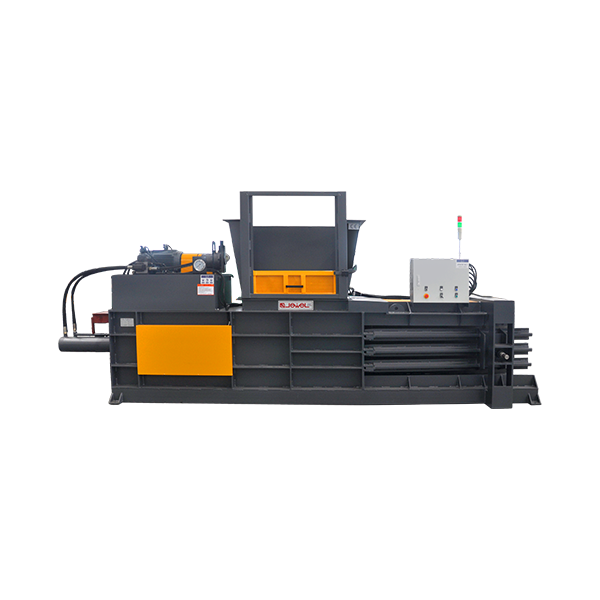
3. Plastic: film, HDPE and woven bags
Plastic is where compression density decides whether the operation is economic. A JPW40BL plastic bottle recycling machine applies 40 tons of force, feeds through 1000 × 720 mm, produces 720 × 720 × (300–1000) mm bales at 250–350 kg with 4 strapping channels, and runs on 15 kW / 20 Hp with one-time blunder discharge.
That combination — high bale weight plus a single discharge action — is what allows a mixed plastics line to move bales without repacking. It is the same specification pattern used in an Australian mixed waste facility handling plastics, glass and metal scraps in one line, and in a Belarusian waste recycling operation compressing PET bottles, woven bags, HDPE bottles and cardboard together.
4. Textile waste
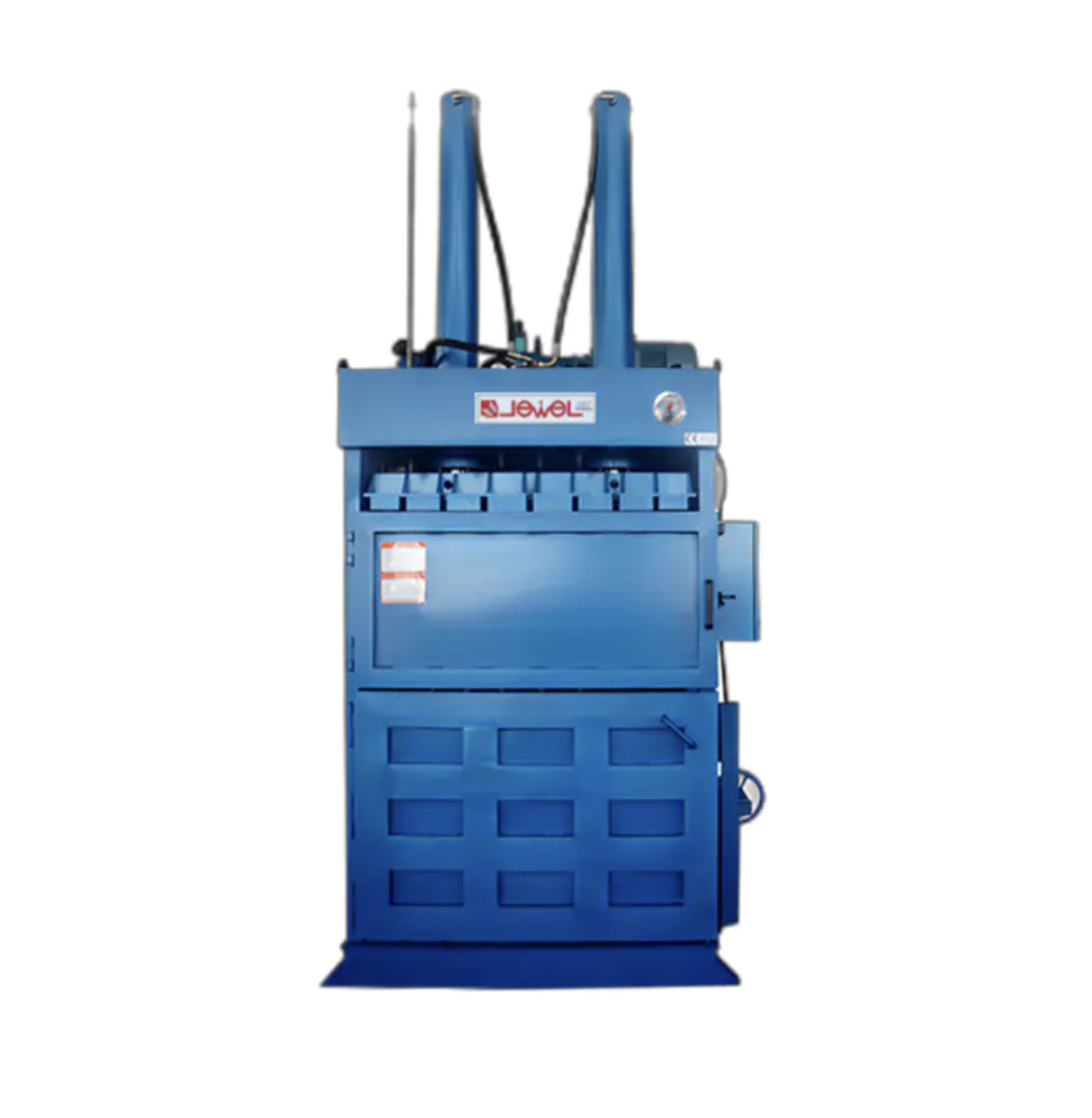
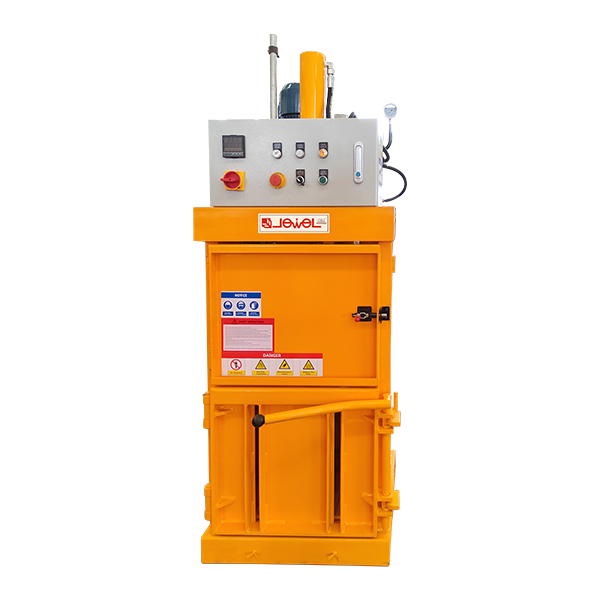
Textile waste is bulky, springy and slow to compress, so vertical chamber geometry and dwell time matter more than raw tonnage. The JP-OT100 vertical baler applies 100 tons of force through a 1400 × 600 mm feed opening into a 1400 × 700 × 1700 mm compression chamber, producing 1400 × 700 × (700–1100) mm bales at 400–600 kg, 5–6 bales per hour, on 15 kW / 20 Hp. The 3500 kg machine weight reflects the frame required to hold that chamber under load.
Where textile arrives as rolls or oversized pieces that will not enter the chamber, the JP-S100B cutting machine is used as a preprocessing stage: 100 tons of force, 1000 mm cutting width, 1000 mm cutting stroke, and a 20–30 second single cycle time on 11 kW / 15 Hp. The pattern is the same one used on large-size cardboard — reduce the size, then bale.
5. PET bottle recycling
PET baling has one dominant objective: raise compression density so that transport and storage cost per tonne falls. Three models fit that objective at different scales.
The JPW20Q fully automatic horizontal baler produces small, dense, uniform 500 × 500 × 500 mm bales weighing 30–70 kg with 2–4 strapping channels — useful where bales are handled manually or moved in mixed loads. The JPW40BL produces 250–350 kg bales for higher-volume PET recovery. For lower-volume or decentralised collection points, the JP8060T5X waste compactor produces 800 × 600 × 400 mm bales at 50–80 kg, 4–7 bales per hour, on 2.2 kW / 3 Hp.
The underlying requirement is documented in a Japanese PET recycling project that needed a solution able to effectively increase the compression density of PET bottles and produce compact, aesthetically pleasing bales — the gain being higher storage and transport efficiency and higher added value for the recycled product.
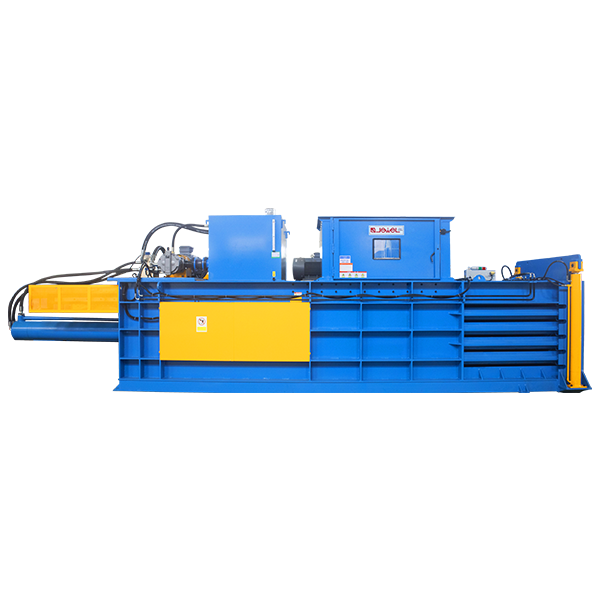
6. Light, intermittent and speciality flows
Not every site justifies a horizontal baler. For packaging manufacturers and small carton converters, the JP7050T8 baling machine handles a 670 × 400 mm feed opening at 6–8 bales per hour, 50–80 kg per bale, on 2.2 kW / 3 Hp and a listed 220V/50Hz supply — the smallest power footprint in the range. The JPW-K6046 bagging machine works a 540 × 400 mm feed opening at 6–8 bales per hour and 50–80 kg per bale on the same 2.2 kW / 3 Hp drive.
Two speciality models complete the picture. The JPW-AK100 aluminium foil baler applies 100 tons through a 500 × 320 mm feed opening, producing 320 × 320 × (200–250) mm bales at 5–15 kg and 0.4–0.8 t/hr on 18.5 kW / 25 Hp, with fibre-based materials listed as the similar material. Where a stream also carries metal scrap, the JPY-T60W metal baler handles a 900 × 430 mm feed opening, 430 × 280 × (150–250) mm bale cross-sections at 15–20 kg, and 0.5–1 t/hr on 22 kW / 30 Hp.
Step-by-Step Breakdown: Eight-Step Scenario-to-Model Checklist
- Classify the material. Fibre (paper, carton), film and rigid plastic, textile, PET bottles, or mixed. Fibre and textile reward high force and a large chamber; PET rewards compression density; large-size cardboard and rolled textile require pre-cutting.
- Convert volume into a comparable unit. Measure tons per hour, then compare against published capacity: JPW40F 1–2 t/hr, JPY-T60W 0.5–1 t/hr, JPW-AK100 0.4–0.8 t/hr, JPW-AK60 0.2–0.5 t/hr, or bales per hour: JPW-K6046 and JP7050T8 6–8, JP-OT100 5–6, JP8060T5X 4–7, JPA5076T25X 3–5.
- Fix the bale specification with the downstream buyer. Confirm bale dimension and bale weight, then check strapping channels — 2–4 on the JPW20Q, 4 on the JPW40F and JPW40BL.
- Match feed opening to the largest item and the feeding method. 1500 × 500 mm (JPA5076T25X) for large-size board; 1400 × 600 mm (JP-OT100) for bulky textile; 1000 × 720 mm (JPW40F, JPW40BL) for general fibre and plastic; 900 × 430 mm (JPY-T60W) for metal; 700 × 460 mm (JPW20Q); 670 × 400 mm (JP7050T8); 650 × 470 mm (JP8060T5X); 540 × 400 mm (JPW-K6046); 500 × 320 mm (JPW-AK100); 500 × 300 mm (JPW-AK60).
- Choose the automation level. Vertical (JP-OT100) for lower or intermittent volume; semi-automatic horizontal (JPW40F) for continuous 1–2 t/hr with operator-controlled feeding; fully automatic horizontal (JPW20Q) where waste is conveyor-fed and the target is an unmanned or minimally manned line.
- Confirm the discharge method. Continuous push pack on the JPW40F supports steady staging; one-time blunder discharge on the JPW40BL suits a single large discharge action per cycle. Discharge method determines how bales are staged and loaded.
- Verify power supply and footprint. Most models are listed at 380V/50Hz with customizable voltage; the JP7050T8 is listed at 220V/50Hz. Check machine dimensions against available floor space — from 880 × 820 × 2150 mm (JP7050T8) and 950 × 780 × 2150 mm (JPW-K6046) up to 5500 × 1150 × 1900 mm (JPW40BL) and 4900 × 1750 × 1950 mm (JPW40F).
- Lock commercial terms and plan validation. Minimum order quantity is 1 unit, delivery terms are FOB Shanghai, payment terms are 50/50, and acceptance criteria are pre-shipment test. Customization production services cover structure, process and performance, with a typical production lead time of 60 days and monthly production capacity of 100 units.
Use Cases: Documented Installations
The mapping above is not theoretical. Seven documented projects show how model choice tracks material stream and site constraint.
- Tunisia — cardboard box factory, 1 unit, 3 years. The installation clears piled waste paper and boosts workshop efficiency. A factory-wide automatic waste discharge system solved waste accumulation from the corrugator line and printing machines, eliminating waste paper accumulation and creating a clean, efficient production environment. The documented model reference is the JPW-AK60 briquetting machine.
- Mexico — cardboard box factory, 1 unit, 1 year. Automated waste disposal raised line efficiency and cut manual clearing costs. A high-efficiency, reliable full-automatic waste removal system integrated seamlessly with existing production lines, eliminating waste accumulation and improving workshop space utilisation and overall image.
- Russia — cardboard box factory, 1 unit, 3 years. Automated collection, compression and baling of carton production waste produced an efficient, coherent unmanned waste processing system that reduced labour and management costs and enabled immediate monetisation of waste. Documented model reference: JPW40F semi-automatic horizontal baler.
- Italy — cardboard box factory, 1 unit, 4 years. Aging balers were replaced and preprocessing equipment introduced to handle large-sized waste cardboard, greatly improving waste treatment efficiency. Documented model reference: JPA5076T25X.
- Japan — PET recycling enterprise, 1 unit, 2 years. The requirement was higher PET compression density for faster handling and lower transport and storage costs. The result was compact, aesthetically pleasing bales that improved storage and transportation efficiency and raised the added value of recycled products.
- Belarus — waste recycling, 1 unit, 2 years. The project solved the bulkiness and compression difficulty of PET bottles, woven bags, HDPE bottles and cardboard, accelerating waste treatment and reducing storage and delivery expenses.
- Australia — waste recycling, 1 unit, 2 years. Integrated mixed waste processing with multi-material separation handles plastics, glass and metal scraps, achieving full-line unmanned operation that reduced labour costs and operational risks. Documented model reference: JPW40BL.
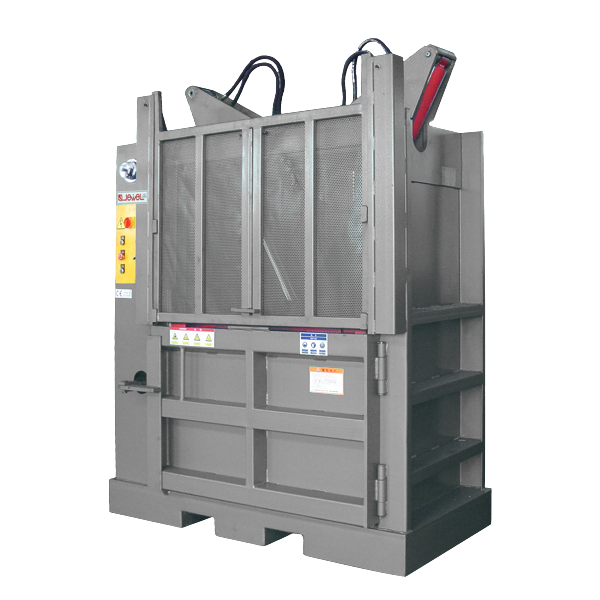
Comparison Table: Feed Opening, Bale Size, Throughput and Power by Model
| Model | Machine type | Force (t) | Feed opening (mm) | Bale size (mm) | Bale weight (kg) | Throughput | Power | Best-fit stream |
|---|---|---|---|---|---|---|---|---|
| JP8060T5X | Waste compactor | 5 | 650 × 470 | 800 × 600 × 400 | 50–80 | 4–7 bales/hr | 2.2 kW / 3 Hp | Low-volume PET, light mixed waste |
| JPW-K6046 | Bagging machine | 10 | 540 × 400 | Not listed | 50–80 | 6–8 bales/hr | 2.2 kW / 3 Hp | Packaging waste, light film |
| JP7050T8 | Baling machine | Not listed | 670 × 400 | Not listed | 50–80 | 6–8 bales/hr | 2.2 kW / 3 Hp (220V/50Hz) | Carton offcuts, small converters |
| JPW20Q | Fully automatic horizontal baler | 20 | 700 × 460 | 500 × 500 × 500 | 30–70 | Not listed (2–4 strapping channels) | 7.5 kW / 10 Hp | Inline carton waste, PET |
| JPA5076T25X | Hydraulic baler | 25 | 1500 × 500 | 1500 × 760 × 900 | 200–300 | 3–5 bales/hr | 7.5 kW / 10 Hp | Large-size cardboard, mixed paper |
| JPW40F | Semi-automatic horizontal baler | 40 | 1000 × 720 | 720 × 720 × (500–1300) | 200–400 | 1–2 t/hr | 11 kW / 15 Hp | Waste paper, OCC, carton |
| JPW40BL | Plastic bottle recycling machine | 40 | 1000 × 720 | 720 × 720 × (300–1000) | 250–350 | Not listed (4 strapping channels) | 15 kW / 20 Hp | PET, HDPE, woven bags, mixed plastic |
| JPW-AK60 | Briquetting machine | 60 | 500 × 300 | 300 × 300 × (200–300) | 5–10 | 0.2–0.5 t/hr | 15 kW / 20 Hp | Paper dust, carton plant fines |
| JPY-T60W | Metal baler | 60 | 900 × 430 | 430 × 280 × (150–250) cross-section | 15–20 | 0.5–1 t/hr | 22 kW / 30 Hp | Metal scrap within mixed streams |
| JPW-AK100 | Aluminium foil baler | 100 | 500 × 320 | 320 × 320 × (200–250) | 5–15 | 0.4–0.8 t/hr | 18.5 kW / 25 Hp | Aluminium foil, fibre-based material |
| JP-OT100 | Vertical baler | 100 | 1400 × 600 | 1400 × 700 × (700–1100) | 400–600 | 5–6 bales/hr | 15 kW / 20 Hp | Textile, bulky fibre, carton |
| JP-S100B | Cutting machine | 100 | 1000 mm cutting width | Not listed | Not listed | 20–30 s per cycle | 11 kW / 15 Hp | Pre-cutting bulky textile and board |
All figures above are manufacturer-published specifications for the listed Jewel models. Entries marked not listed are not stated in the current specification set.
FAQ
Which certifications and safety standards apply to Jewel hydraulic baler machines?
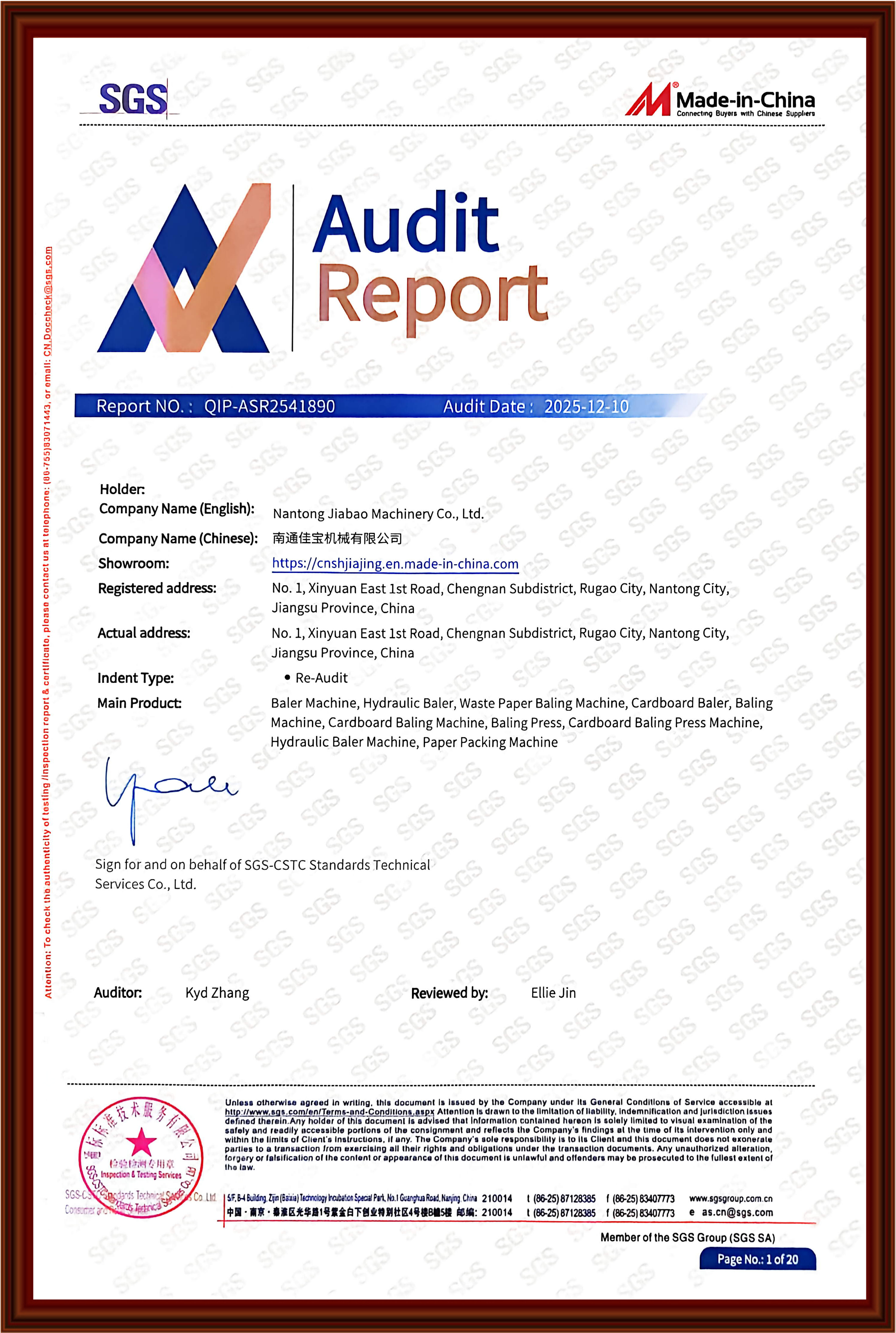
Jewel hydraulic baler machines are covered by an SGS Made-in-China Supplier Audit Report, certificate number QIP—ASR2541890, issued by SGS on 10 December 2025 and valid to 10 December 2028. The audit scope covers the full range of baler machine, hydraulic baler, waste paper baler, cardboard baler and baling press machine, and is assessed against the Made-in-China Supplier Audit Specification for the EU market. Model JPW20Q additionally holds a CE Attestation of Compliance, certificate number TTC-22-1609/01/01, issued by INTEGRA on 16 September 2022 and valid to 16 September 2027, assessed against 2006/42/EC (Machinery Directive) and 2014/35/EU (Low Voltage Directive) using the harmonised standards EN ISO 12100:2010 and EN 60204-1:2018. Buyers specifying for Europe should also reference EN 16500:2014, the European safety standard for vertical baling presses, which is directly relevant to vertical models such as the JP-OT100; for the United States, ANSI Z245.5-2023 is the current baling equipment safety standard, replacing the 2013 edition.
Can a hydraulic baler machine be customized for a specific material or plant layout?
Yes. Nantong Jiabao Machinery Co., Ltd. provides customization production services covering structure, process and performance, with a minimum order quantity of 1 unit and monthly production capacity of 100 units, supported by a 30-engineer R&D team. In practice, material-specific customization shows up as different machine architectures: the JPW-AK60 briquetting machine for paper dust, the JPW40BL plastic bottle recycling machine for PET, HDPE and woven bags, the JP-OT100 vertical baler with a 1400 × 700 × 1700 mm compression chamber for bulky textile, and the JP-S100B cutting machine as a pre-cutting stage where oversized material cannot enter a chamber directly. Voltage is customizable across the range, with most models listed at 380V/50Hz and the JP7050T8 listed at 220V/50Hz. Every unit is 100% tested before shipment.
What drives the cost of a hydraulic baler machine project?
Configuration, not catalogue position, drives commercial terms. The four cost-relevant variables are compression force class (from 5 tons on the JP8060T5X to 100 tons on the JP-OT100, JPW-AK100 and JP-S100B), automation level (vertical, semi-automatic horizontal, or fully automatic horizontal), bale specification including bale dimension, bale weight and number of strapping channels, and discharge method such as continuous push pack or one-time blunder discharge. Because these variables are project-specific, a machine is quoted against a defined material stream and target bale specification rather than from a fixed list. The standard commercial framework is a minimum order quantity of 1 unit, FOB Shanghai delivery terms, 50/50 payment terms, and acceptance criteria defined as pre-shipment test.
How is the material validated before shipment?
Acceptance criteria are defined as pre-shipment test, which means the configuration is verified against the agreed specification before the machine leaves the factory. To set that test up, provide the material type, the daily or hourly volume, the target bale weight and bale dimension required by your downstream buyer, the feeding method (manual, conveyor or inline with production equipment), and the available power supply and floor footprint. These five data points are enough to map a stream to a model and define the test criteria — for example, a PET recovery operation targeting denser bales would be assessed against the compression-density outcome, while a carton plant targeting an unmanned line would be assessed against continuous feed and automatic discharge behaviour.
What is the lead time and minimum order quantity?
The typical production lead time is 60 days and the minimum order quantity is 1 unit, with monthly production capacity of 100 units, FOB Shanghai delivery, 50/50 payment terms and pre-shipment test acceptance. After-sales support runs on a 7×24h technical response model with 48-hour on-site response, lifelong maintenance and free training, aimed at keeping downtime as close to zero as possible. If you are ready to move from evaluation to execution, share your material stream and bale specification with the Jewel team to receive a configuration proposal, or download the current product catalogue here: Jewel product catalogue (PDF).
Conclusion: Match the Model to the Stream, Then Verify It
Hydraulic baler machines are not interchangeable across material streams. The eight-step checklist comes down to a simple sequence: classify the material, convert volume into tons per hour or bales per hour, fix the bale specification with the downstream buyer, then match feed opening, automation level, discharge method, power and footprint to that requirement. Waste paper leans towards the JPW40F or JPA5076T25X, carton plant trim towards the JPW20Q or JPW-AK60, plastic towards the JPW40BL, textile towards the JP-OT100 with optional JP-S100B pre-cutting, and PET towards the JPW20Q, JPW40BL or JP8060T5X depending on volume.
Documented projects in Tunisia, Mexico, Russia, Italy, Japan, Belarus and Australia all follow the same logic — the machine was chosen because of what the material does and how the plant runs, not because of a headline tonnage figure.
Next step: send your stream, get a model match
Tell us your material type, daily volume, target bale size and available power supply, and the Jewel team will return a model recommendation with a configuration proposal for sample and specification validation.
Contact: Nina — jiabao@csj-baler.com | Tel / WhatsApp: +86 187-2181-4932 | Chat on WhatsApp
Website: www.jewelbaler.com | Knowledge base: blog.jewelbaler.com | Download the catalogue (PDF)
Nantong Jiabao Machinery Co., Ltd. — No.1 Xinyuan East 1st Road, Rugao City, Jiangsu Province, China. Established 2006; Jewel brand founded 1995; 50,000 m² production facility; 200+ employees; 30 R&D engineers; export ratio 70%.