
Hydraulic Baler Machines Ranked: Top Picks by Bale Weight, Force, and Feed Opening
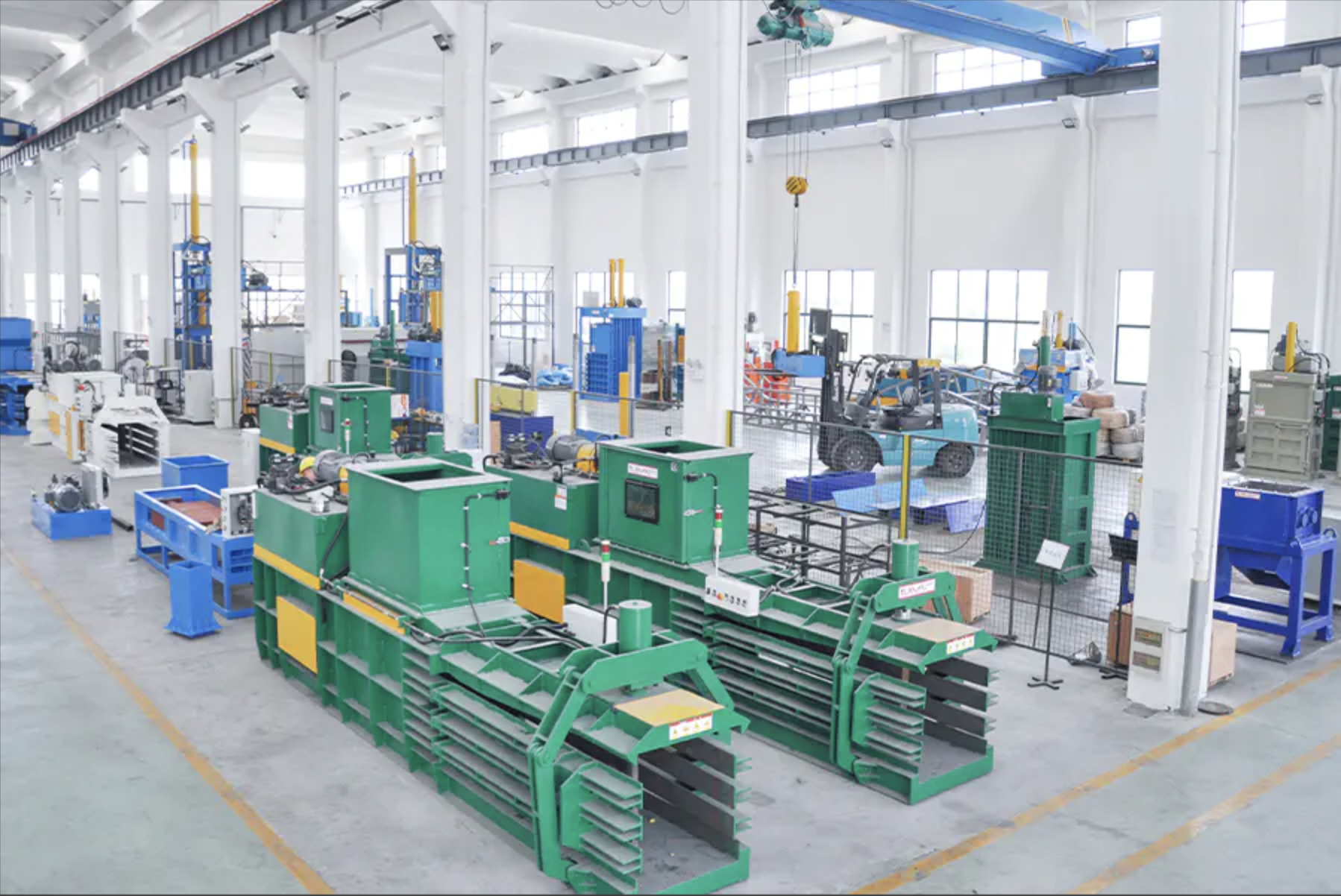
Hydraulic baler machines are assembled and tested before shipment. Model-level specifications, not brand claims, are what a buyer can actually compare.
Short answer: ranked by bale weight, compression force and feed opening, the heaviest single bale in this set comes from JP-OT100 at 400–600 kg per bale, followed by JPW40BL at 250–350 kg. JP7050T8 and JP8060T5X sit in the 50–80 kg band with 6–8 and 4–7 bales per hour respectively. JPW20Q produces 30–70 kg bales with 2–4 strapping channels, and JPW-AK100 concentrates 100 tons of force into 5–15 kg aluminium foil blocks.
Most rankings of hydraulic baler machines are written as brand preferences and stop there. This one is ordered by published machine specifications, so the sequence can be checked against a datasheet line by line. The three ranking keys are bale weight, compression force and feed opening size, because those three numbers determine transport cost, material density and what the machine can physically be fed.
All six machines in this ranking come from one manufacturer, Jewel, the brand of Nantong Jiabao Machinery Co., Ltd. That is a deliberate choice: comparing figures from a single specification set avoids the common problem of lining up numbers that were measured under different definitions. Jewel is a manufacturer of hydraulic compression and baling equipment established in 2006, with the brand founded in 1995, operating a 50,000 m² production facility in Rugao, Jiangsu Province, China, with more than 200 staff and a 30-engineer R&D team.
Problem definition: why tonnage is the wrong first filter
Compression force is a hydraulic circuit value. Bale weight is an output value. Buyers routinely treat them as the same thing and end up with a machine that presses hard but ships light.
The gap is visible inside this single ranking. JP8060T5X is listed at 5 tons of compression force yet produces 50–80 kg bales. JPW20Q is listed at 20 tons of force and produces 30–70 kg bales. A buyer who filtered on tonnage alone would rank those two in one order; a buyer who filtered on freight economics would rank them in the opposite order.
Feed opening creates the second mismatch. A wide opening accepts loose, unshredded material straight from a corrugator or a sorting line. A narrow opening requires pre-baling, pre-crushing or manual loading. Neither is better in isolation, but a 500×320 mm opening and a 1400×600 mm opening do not belong in the same material flow.
The practical consequence is that hydraulic baler machines should be specified backwards: start from the bale you need to ship and the material form you actually generate, then read force and opening as constraints rather than as headline features.
Industry background: what buyers are stepping into in 2026
Published market research puts the global baler market at USD 7.96 billion in 2026, a figure that includes agricultural as well as industrial balers, so it should not be read as the size of the hydraulic waste-baling segment alone. Within the narrower hydraulic waste paper baler segment, one commercial research estimate places the base-year valuation at USD 1.45 billion. A separate estimate covers hydraulic metal recycling balers at USD 913 million in 2023.
Those figures matter less as forecasts than as a signal about supply. A category of this size supports many suppliers, and marketplace listings for hydraulic baler machines do show multiple manufacturers and multiple variants marketed side by side. The practical problem for a buyer is therefore not availability. It is comparability: listings rarely share metrics, test conditions or model definitions, so a shortlist built from listing pages alone tends to compare unlike machines.
The response that works is to rank on a fixed set of published parameters and to state the ranking logic openly. That is what the list below does.
Detailed solution: six hydraulic baler machines ranked by published specification
The ranking key is bale weight, because bale weight is what the buyer pays to move, store and sell. Compression force and feed opening are used as tie-breakers and as fit constraints. Where a model's published data does not include a specific figure, that figure is not supplied here.
#1 JP-OT100 — 400–600 kg bales from a vertical chamber
JP-OT100 is a vertical hydraulic baler rated at 100 tons of compression force, with a compression chamber of 1400×700×1700 mm. Finished bales measure 1400×700 mm with a height between 700 and 1100 mm, and weigh 400–600 kg. Baling capacity is listed at 5–6 bales per hour, power at 15 kW / 20 Hp, voltage at 380V/50Hz, and machine weight at 3500 kg.
It takes first place because no other machine in this set produces a bale in that weight class. For an operation paying freight by weight and volume, bale weight is the single specification that most directly changes cost per tonne moved.
The reason it can reach that bale weight is the chamber height. A 1700 mm compression chamber builds density through a vertical stroke rather than a long horizontal one, and the 1400×600 mm feed opening accepts flattened cartons and full sheets without a pre-shredding step. The trade-off is footprint geometry: a vertical machine needs headroom and a loading pattern that suits top-down feeding, so it fits a dedicated baling bay better than an inline position on a production floor.
JP-OT100 published specification
- Type: vertical baler
- Compression force: 100 tons
- Bale dimension: 1400×700×(700–1100) mm
- Compression chamber: 1400×700×1700 mm
- Feed opening: 1400×600 mm
- Bale weight: 400–600 kg
- Baling capacity: 5–6 bales/hour
- Power: 15 kW / 20 Hp · Voltage: 380V/50Hz (customizable)
- Machine weight: 3500 kg
#2 JPW40BL — 250–350 kg bales with a 1000×720 mm feed opening
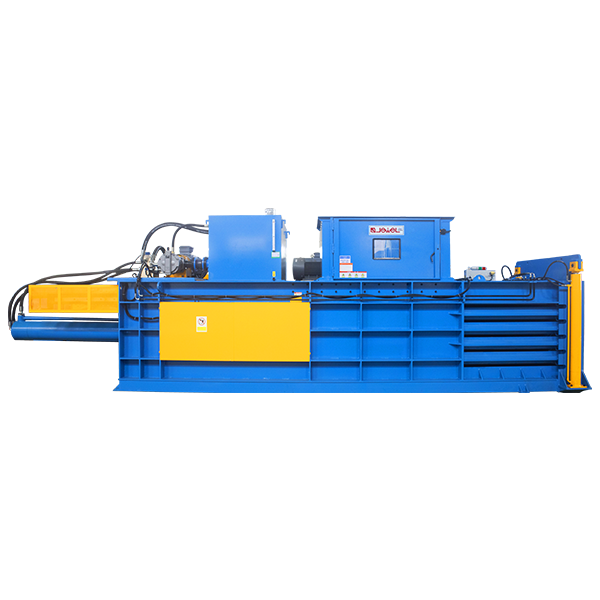
JPW40BL: 40 tons of force, four strapping channels, and a bale length adjustable from 300 to 1000 mm.
JPW40BL runs at 40 tons of compression force through a 1000×720 mm feed opening, into a bale cross-section of 720×720 mm with a length adjustable between 300 and 1000 mm. Bale weight is 250–350 kg. The machine carries four strapping channels, uses 15 kW / 20 Hp at 380V/50Hz, measures 5500×1150×1900 mm, and discharges bales by a one-time blunder method.
It ranks second on bale weight, at roughly half the JP-OT100 figure, and it is the more flexible of the two. The 300–1000 mm bale length range lets a buyer tune the finished bale to a pallet footprint or a container loading plan without changing the machine. Four strapping channels matter for dense plastic: more wires across the bale means less spring-back when bales are stacked three or four high in a yard.
In the published product data this model is classified as a plastic bottle recycling machine, which is consistent with the combination of a moderate 40-ton force and a wide feed opening. The long, low chassis means it suits an inline position where material arrives on a conveyor rather than being loaded by hand from above.
#3 JP7050T8 — 50–80 kg bales at 6–8 bales per hour on 220V
JP7050T8 produces 50–80 kg bales at a listed rate of 6–8 bales per hour, through a 670×400 mm feed opening. Power is 2.2 kW / 3 Hp with a 220V/50Hz supply, machine dimensions are 880×820×2150 mm, and machine weight is 590 kg.
It ranks third on bale weight and first on throughput in the 50–80 kg band. The reason it sits above JP8060T5X is the hourly rate: 6–8 bales against 4–7 bales at the same bale weight range.
The specification that decides real-world fit is the voltage. A 2.2 kW machine running on single-phase 220V can be installed in a warehouse or a retail back-of-house position where a 380V three-phase supply is not available. That is a hard constraint, not a preference, and it eliminates most of the other machines in this list before any other comparison begins.
Reading the data correctly: the published specification for JP7050T8 does not list a single-machine compression force figure, and none is stated here. Buyers comparing it against higher-force models should request the force and bale-density data directly rather than infer it from the model number.
#4 JP8060T5X — fixed 800×600×400 mm bales for standardised stacking
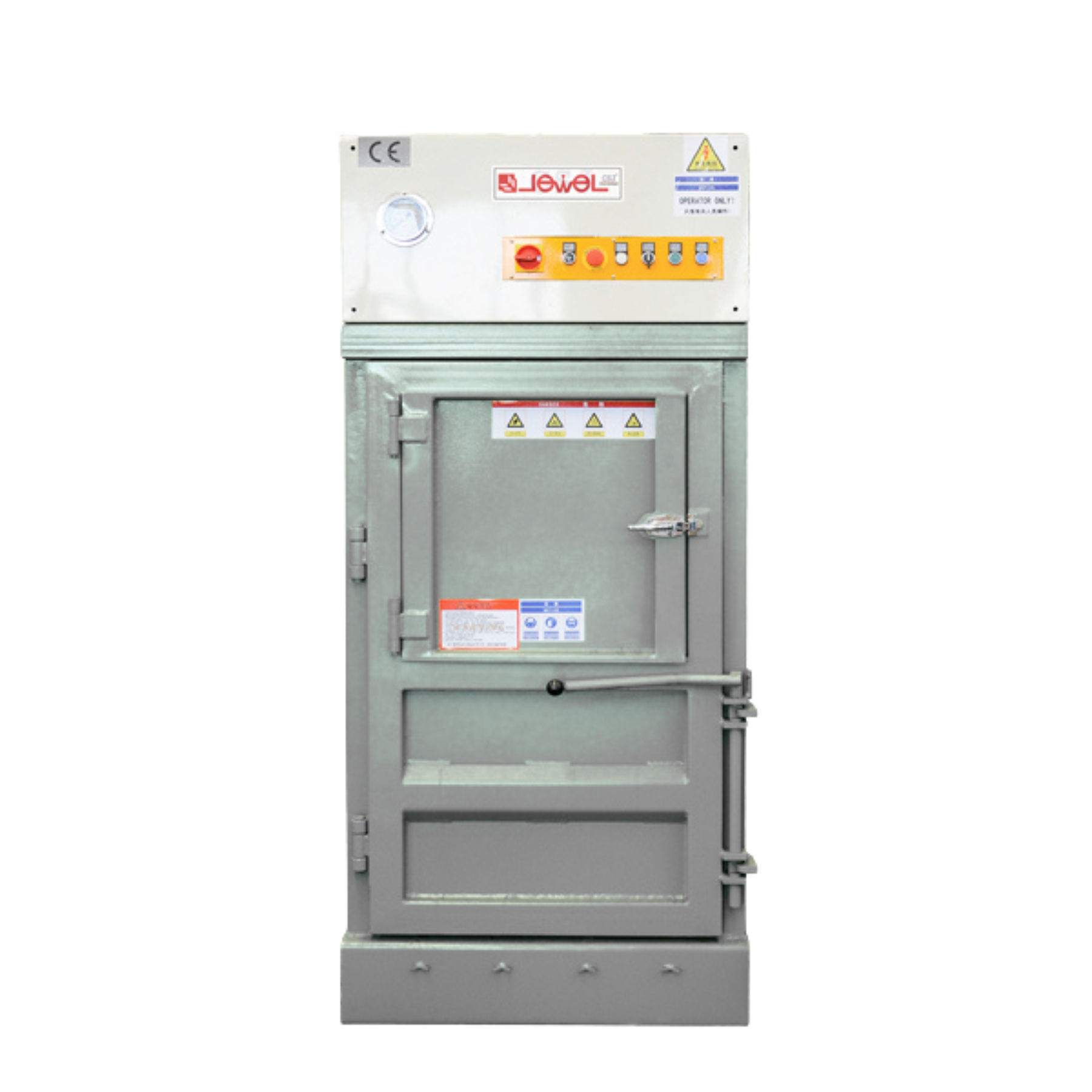
JP8060T5X produces a fixed bale size, which standardises pallet counts and outbound documentation.
JP8060T5X is listed at 5 tons of compression force with a fixed bale dimension of 800×600×400 mm, a 650×470 mm feed opening, 50–80 kg bale weight, and a baling capacity of 4–7 bales per hour. Power is 2.2 kW / 3 Hp at 380V/50Hz, dimensions are 1100×1000×2150 mm, and machine weight is 550 kg.
It ranks below JP7050T8 only because of throughput. Its advantage is dimensional consistency: a fixed bale size means every unit leaving the machine occupies the same space, which simplifies pallet planning, container loading and stock counting. Operations that sell baled material by the unit rather than by weight often value that predictability above a marginal difference in hourly output.
The 5-ton force figure sitting next to a 50–80 kg bale is a useful reminder of why force cannot be read alone. Bale weight here comes from a fixed chamber geometry and a defined compression stroke, not from a large hydraulic rating.
#5 JPW20Q — fully automatic horizontal operation from 30–70 kg bales
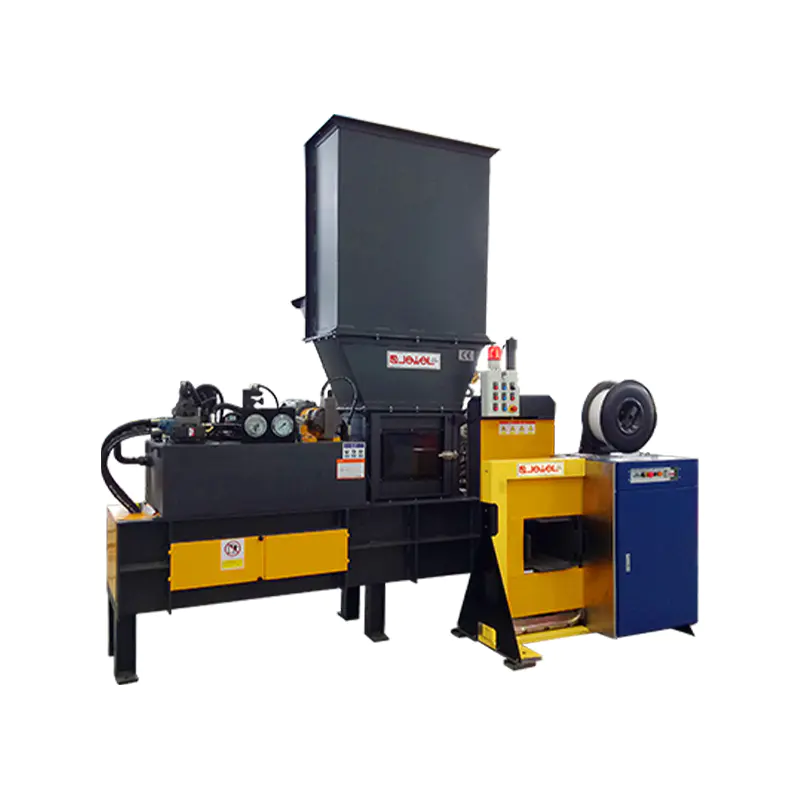
JPW20Q is the fully automatic horizontal machine in this set, and the only model here with its CE certificate number published.
JPW20Q is a fully automatic horizontal baler rated at 20 tons of compression force, producing 500×500×500 mm bales of 30–70 kg. The feed opening is 700×460 mm, strapping channels run from 2 to 4, power is 7.5 kW / 10 Hp at 380V/50Hz, machine dimensions are 3400×3010×2400 mm, and machine weight is 2.8 tons.
It ranks fifth on bale weight, the lowest figure among the horizontal machines listed here. That placement needs context, because bale weight is not what this model is specified to optimise. JPW20Q is the fully automatic horizontal machine in this set, meaning the compression and tying cycle runs without an operator at the feed end. And it is the only machine here whose EU certification is published down to certificate number: CE certificate TTC-22-1609/01/01, issued by INTEGRA, covering Directives 2006/42/EC (Machinery Directive) and 2014/35/EU (Low Voltage Directive), with applicable standards EN ISO 12100:2010 and EN 60204-1:2018.
For an operation whose real constraint is labour rather than bale weight, or whose destination market is the EU, those two facts outrank the ranking position. For an operation selling into a freight market where every kilogram in a bale reduces cost per tonne, they do not.
#6 JPW-AK100 — 100 tons of force concentrated into 5–15 kg aluminium foil blocks
JPW-AK100 is an aluminium foil baler rated at 100 tons of compression force, producing 320×320 mm bales with a length of 200–250 mm and a weight of 5–15 kg. Feed opening is 500×320 mm, baling capacity is 0.4–0.8 tons per hour, power is 18.5 kW / 25 Hp at 380V/50Hz, dimensions are 4000×920×1350 mm, and machine weight is 2600 kg. The published product data lists fibre-based materials as a similar application.
It ranks last on bale weight and that is precisely the point. Aluminium foil and light fibre waste do not need a large bale; they need high density in a small cross-section. Concentrating 100 tons of force into a 320×320 mm chamber is what produces a compact 5–15 kg block that stacks and ships without deforming. Running foil through a 400–600 kg bale machine produces a large, loose bale rather than a dense one.
This is the clearest example in the list of why a specification ranking has to be read together with material type. Last place on bale weight is first place on density for a narrow material stream.
Step-by-step: how to filter a hydraulic baler machine with three numbers
The sequence below uses the same three parameters in the same order, so the result stays comparable across suppliers.
Step 1 — Fix the bale weight band from your outbound logistics. Work backwards from how the baled material leaves the site. If bales are sold by weight to a mill or a recycler, heavier bales reduce freight cost per tonne. If bales are stacked in a constrained warehouse or loaded by hand, a 400–600 kg bale is a handling problem rather than an advantage.
Step 2 — Match compression force to material density, not to ambition. Force has to overcome the spring-back of the specific material. Loose cartons, PET bottles, HDPE and woven bags behave differently under load, which is why mixed-material operations often need more force than a single-stream operation producing the same bale weight.
Step 3 — Check the feed opening against the material's actual form. Measure the material as it arrives, before anyone touches it. A 1400×600 mm opening accepts full carton sheets; a 500×320 mm opening does not. If the feed opening is too small, the hidden cost is a pre-crushing or manual-cutting step that never appears on the machine quotation.
Step 4 — Decide automation before calculating labour. A fully automatic horizontal machine removes the operator from the cycle. A semi-automatic or vertical machine keeps a person at the loading point. The decision should be made on shift structure and labour availability, not on machine price alone.
Step 5 — Confirm voltage and site supply. Voltage on these hydraulic baler machines is customizable to meet specific requirements, and the standard listings in this set range from 220V/50Hz on JP7050T8 to 380V/50Hz on the larger models. Confirming the site supply before ordering avoids a transformer or rework cost after delivery.
Step 6 — Verify compliance documents for the destination market. Compliance is a delivery condition, not a formality. This is covered in its own section below.
Use cases: which material streams and industries each model fits
The six machines are all listed for the same broad industry set: waste paper recycling, plastic recycling, carton printing, textile waste processing, packaging manufacturing and PET bottle recycling. The differentiation comes from how each model's bale weight, force and feed opening interact with a specific stream.
Corrugated carton printing and packaging. High-volume carton waste arrives as large, flat sheets from corrugator and printing lines. JP-OT100's 1400×600 mm opening and 400–600 kg bale weight suit a central baling bay handling the whole plant's output. JPW20Q is the alternative when the priority is an automatic cycle tied into a waste extraction system rather than maximum bale weight. A carton plant in Mexico, for example, specified a full-automatic waste removal setup that had to integrate with existing production lines for real-time waste processing, and JP-OT100 is the model listed against that project.
Waste paper and scrap handling. Where baled paper is sold by weight, bale weight drives revenue per truckload. JP-OT100 and JPW40BL cover that requirement at 400–600 kg and 250–350 kg respectively, with JPW40BL's adjustable 300–1000 mm bale length giving control over the loading plan.
Plastic bottle and PET recycling. PET is the material most sensitive to density, because loose bottles occupy enormous volume per kilogram. A PET recycler in Japan specified a solution specifically to increase compression density and produce compact, aesthetically consistent bales, and JPW40BL is the model in this set with the strapping capacity — four channels — and bale weight to support that. Operations running mixed plastics, films and waste paper from supermarket chains in one machine have also been configured on the horizontal models in this range.
Packaging manufacturing and light-duty workshops. Where floor space is tight and the power supply is single-phase, JP7050T8 covers 50–80 kg bales at 6–8 bales per hour on 220V, and JP8060T5X delivers a fixed 800×600×400 mm bale at 4–7 bales per hour. Both are compact machines under 600 kg.
Aluminium foil and fibre-based waste. JPW-AK100 is specified for foil and similar fibre-based material, producing 5–15 kg blocks at 0.4–0.8 tons per hour. A mixed solid waste recycler in Australia handling mixed plastics with small amounts of glass and metal scrap is the kind of multi-material environment where a dedicated high-density machine sits alongside a general baler rather than replacing it.
Comparison table: six hydraulic baler machines side by side
| Rank | Model | Type | Compression force | Bale weight | Feed opening | Bale output | Power / Voltage |
|---|---|---|---|---|---|---|---|
| 1 | JP-OT100 | Vertical | 100 tons | 400–600 kg | 1400×600 mm | 5–6 bales/h | 15 kW / 380V 50Hz |
| 2 | JPW40BL | Horizontal | 40 tons | 250–350 kg | 1000×720 mm | Not listed | 15 kW / 380V 50Hz |
| 3 | JP7050T8 | Baling machine | Not listed | 50–80 kg | 670×400 mm | 6–8 bales/h | 2.2 kW / 220V 50Hz |
| 4 | JP8060T5X | Waste compactor | 5 tons | 50–80 kg | 650×470 mm | 4–7 bales/h | 2.2 kW / 380V 50Hz |
| 5 | JPW20Q | Fully automatic horizontal | 20 tons | 30–70 kg | 700×460 mm | Not listed | 7.5 kW / 380V 50Hz |
| 6 | JPW-AK100 | Aluminium foil baler | 100 tons | 5–15 kg | 500×320 mm | 0.4–0.8 t/h | 18.5 kW / 380V 50Hz |
All figures as published in the manufacturer's product specification data. Voltage is customizable on these models; the values shown are the standard listings.
Two structural facts sit behind the table. All models use carbon steel as the primary construction material, which sets the durability baseline rather than differentiating between them. And bale output is not a like-for-like row: JP-OT100, JP7050T8 and JP8060T5X are rated in bales per hour, while JPW-AK100 is rated in tons per hour, so those figures should not be compared directly without converting.
Compliance: what to verify before a machine ships
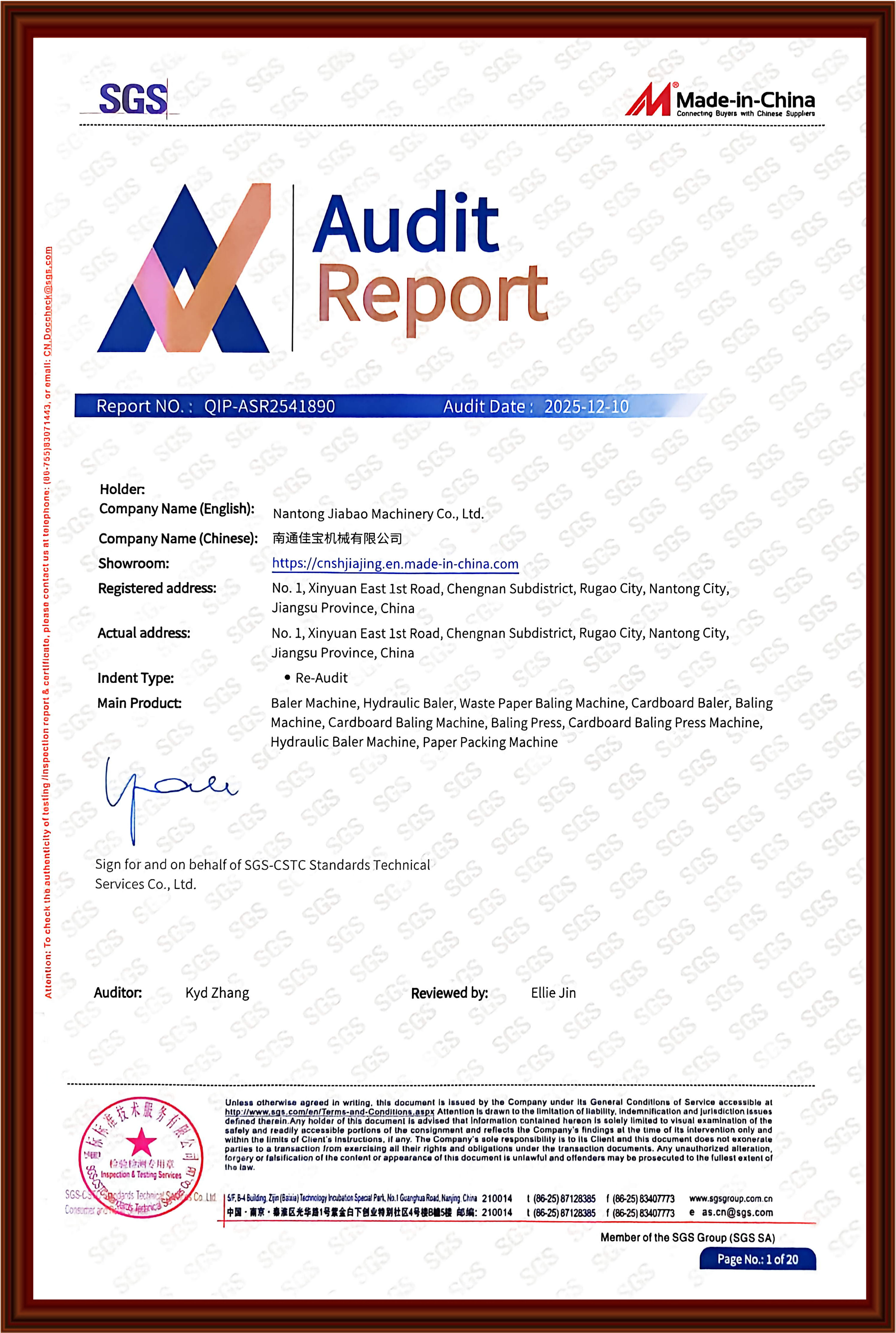
The SGS Made-in-China Supplier Audit Report covers the baler machine range, certificate number QIP—ASR2541890.
For EU destinations, two documents carry the weight. The first is the CE certification on JPW20Q: certificate number TTC-22-1609/01/01, issued by INTEGRA, covering Directives 2006/42/EC and 2014/35/EU, with standards EN ISO 12100:2010 and EN 60204-1:2018 applying. The certificate is listed with an issue date of 2022-09-16 and an expiry date of 2027-09-16.
The second is the SGS Made-in-China Supplier Audit Report, certificate number QIP—ASR2541890, issued by SGS on 2025-12-10 and valid to 2028-12-10, assessed against the Made-in-China Supplier Audit Specification for the EU market. Its declared scope covers the full range of baler machine, hydraulic baler, waste paper baler, cardboard baler and baling press machine products, and the related product list includes JPW20Q, JP7050T8, JPW40F, JPW40BL, JP-OT100, JP8060T5X and JPW-AK100.
Those two documents answer different questions. The CE certificate is a machine-level conformity statement tied to a specific model and a specific set of standards. The SGS audit report is a supplier-level verification. A buyer who needs EU market access should confirm that the certificate references the exact model being ordered, not only the product family, because a certificate issued against one model does not automatically extend to another.
FAQ
Which of these hydraulic baler machines carry EU market certification, and what exactly does it cover?
JPW20Q holds CE certification number TTC-22-1609/01/01, issued by INTEGRA, covering Directives 2006/42/EC (Machinery Directive) and 2014/35/EU (Low Voltage Directive), with standards EN ISO 12100:2010 and EN 60204-1:2018 applying. The certificate is listed as issued on 2022-09-16 and expiring on 2027-09-16. Separately, the SGS Made-in-China Supplier Audit Report, certificate number QIP—ASR2541890, was issued by SGS on 2025-12-10 and is valid until 2028-12-10, assessed against the Made-in-China Supplier Audit Specification for the EU market. The CE certificate is model-specific; the SGS report is supplier-level. Buyers should check that the certificate names the model being ordered.
Can one hydraulic baler machine handle several material streams, or does each material need a dedicated model?
Multi-material operation is possible within limits set by force and feed opening. The horizontal models in this set are listed for waste paper recycling, plastic recycling, carton printing, textile waste processing, packaging manufacturing and PET bottle recycling, and mixed-material projects covering PET bottles, woven bags, HDPE bottles and cardboard have been configured on horizontal machines in this range. The limits appear when material forms diverge sharply: JPW-AK100 is specified for aluminium foil and fibre-based material because 100 tons of force in a 320×320 mm chamber produces a 5–15 kg dense block, which is a different objective from producing a 400–600 kg bale. A single machine can cover a mixed stream; it cannot optimise for both extremes at once.
What drives the price difference between these hydraulic baler machine models?
Price is not published for these models, and no figure is stated here. What can be compared is the specification profile that drives cost. Compression force ranges from 5 tons on JP8060T5X to 100 tons on JP-OT100 and JPW-AK100. Installed power ranges from 2.2 kW on JP7050T8 and JP8060T5X to 18.5 kW on JPW-AK100. Automation level separates JPW20Q, a fully automatic horizontal machine, from the semi-automatic and vertical configurations. Machine weight ranges from 550 kg on JP8060T5X to 3500 kg on JP-OT100, which affects freight and foundation requirements. Customization of structure, process and performance is available, and that scope also changes cost. Each of these variables should be priced against the required bale output rather than compared as an isolated number.
How can a buyer validate a machine before placing a full order?
Validation starts with the published specification and then moves to production evidence. The minimum order quantity for these hydraulic baler machines is 1 unit, which allows a single-machine trial rather than a volume commitment. Quality control is listed as 100% test, meaning each unit is tested rather than sampled from a batch. Monthly production capacity is 100 units, and customization covers structure, process and performance. A buyer should request the specification sheet for the exact model, the compliance documents that name that model, and confirmation of the voltage configuration against the site supply, since voltage is customizable.
What is the lead time, and what after-sales support is included?
Lead time is listed at 60 days. After-sales support is a 7×24 hour technical response with on-site attendance within 48 hours, plus lifelong maintenance and free training. For buyers comparing suppliers, the practical check is whether those commitments are written into the order rather than stated informally. Buyers who want to move from specification comparison to a concrete proposal can request the current product catalogue and a model-specific quotation, including confirmation of the voltage configuration and the compliance documents for the destination market.
Conclusion: rank on numbers, then confirm on documents
The six machines in this ranking separate cleanly once bale weight is treated as the primary key. JP-OT100 leads at 400–600 kg per bale for high-volume carton and waste paper streams. JPW40BL delivers 250–350 kg bales with four strapping channels and an adjustable bale length for plastic and PET. JP7050T8 and JP8060T5X cover the 50–80 kg band at 6–8 and 4–7 bales per hour, with JP7050T8 running on 220V single-phase. JPW20Q trades bale weight for a fully automatic horizontal cycle and published CE certification. JPW-AK100 concentrates 100 tons of force into 5–15 kg foil blocks where density, not weight, is the objective.
Two cautions follow from the data itself. First, compression force and bale weight are different measurements, and the list shows machines where a lower force figure produces a heavier bale. Second, not every model has every figure published, and where a figure is missing it should be requested rather than assumed. A ranking built on published specifications is only as useful as the buyer's willingness to check the gaps.
Next step
Review the full hydraulic baler machine range, compare model specifications against your material stream, and request a model-specific quotation with the compliance documents for your destination market.
Jewel — Nantong Jiabao Machinery Co., Ltd. · No.1 Xinyuan East 1st Road, Rugao City, Jiangsu Province, China · www.jewelbaler.com · Email: jiabao@csj-baler.com · Tel / WhatsApp: +86 187-2181-4932
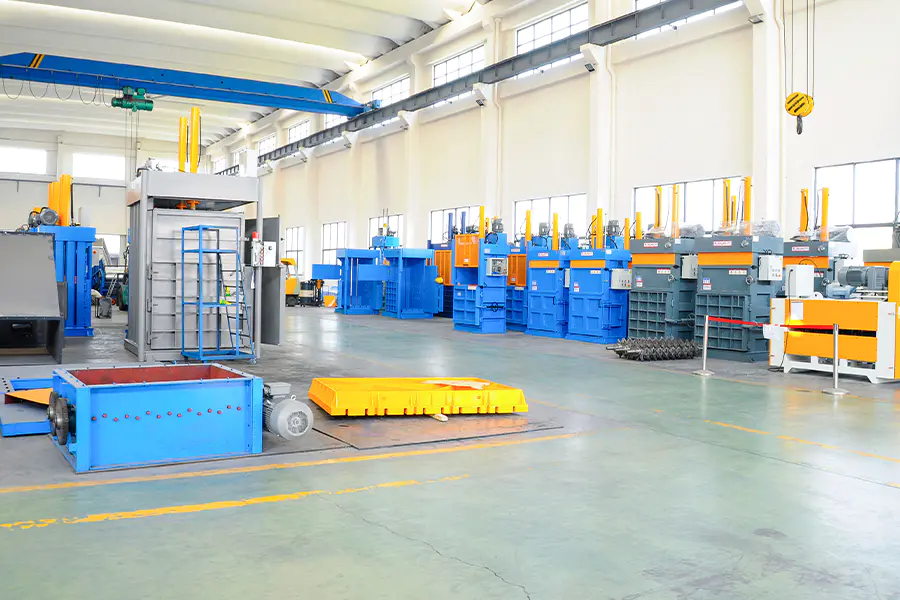
Hydraulic baler machines are assembled, tested at 100%, and prepared for shipment from the Rugao production facility.
Have Questions or Need More Details?
Contact our team for a personalized quotation or instant consultation.
Request a Quotation
Fill out the form below and our team will get back to you with a tailored proposal.
WhatsApp Direct Chat
Prefer to chat in real-time? Message us on WhatsApp for instant assistance & quick answers.
- Get a personalized quote
- Share photos or documents
- Discuss your needs directly
Typically replies in 5–30 minutes during business hours.