
Hydraulic Baler Machines: Certifications, Specs and the Constraints That Determine Fit
At the Research and Evaluation stage, buyers of hydraulic baler machines should be comparing proof, parameters and practical limits, not just machine names. A hydraulic baler machine may be certified for one regional market but not another. Its voltage may be standard at 380V/50Hz or intentionally customizable. Its feed opening decides whether whole plastic bottles or large cardboard pieces enter without a preprocessing step. Its bale dimensions and bale weight decide how much transport value is recovered from each load. This article explains which certification and specification constraints should act as decision gates before a buyer moves from evaluation to purchase.
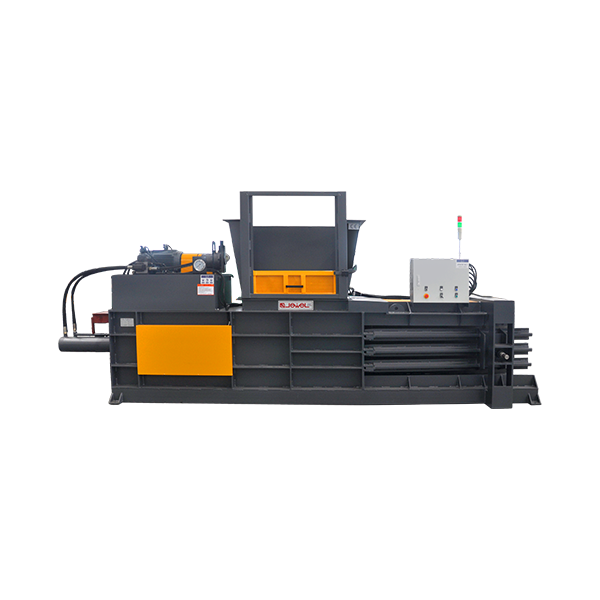
Why Certification and Specification Checks Are the Real Shortlisting Step
Search queries such as waste hydraulic baler machines, waste paper hydraulic baler machines, carton hydraulic baler machines, plastic bottle hydraulic baler machines, metal hydraulic baler machines and scrap hydraulic baler machines all point to one underlying need: the buyer wants a machine that can process a specific waste stream under specific site constraints. Certification documents establish whether the machine may legally or commercially operate in a market. Specifications establish whether it will physically do the job.
There is a common mismatch in purchasing conversations. Buyers spend time on automation levels, but skip the certificate scope behind a CE marking. They compare compression force, but forget to compare the feed opening with the actual piece size of their material. They ask for a bale dimension, but do not confirm the machine footprint and door height at the installation point. For a company at the Research to Evaluation stage, the shortlist should be built from verifiable constraints rather than from product names.
Balers in a Growing Market With Harder Compliance Questions
The investment context is strong, and that makes disciplined evaluation more important. Grand View Research estimated the global baler market at USD 6.6 billion in 2024, with a projection of USD 11.4 billion by 2035. A separate industrial balers market estimate from Maximize Market Research put the 2024 market at USD 6.39 billion. Asia Pacific represented an estimated 40.2% of the global baler market revenue share in 2024. In the same supply chain environment, China reported wood pulp and paper scrap exports of USD 288 million in 2025 according to the Observatory of Economic Complexity, which shows that baled paper waste circulates across borders and therefore needs consistent, verifiable processing specifications.
Regulatory expectations are also rising. European safety requirements for compacting equipment frequently reference machine safety and electrical safety standards such as EN ISO 12100 and EN 60204-1. Vertical and tyre balers in Europe are addressed by EN 16500:2014 for compacting waste materials or recyclable fractions. In the United States, baler equipment safety is commonly referenced through ANSI Z245.5-2023. A responsible buyer should ask which of these documents actually apply to the machine model under consideration and which documents are already held by the supplier.
Use Compliance Evidence as a Gate, Not as Decoration
Compliance paperwork is meaningful only when it can be traced to an exact product model, a standard, a certificate number and an issuing body. Two general types of evidence matter in an Evaluation stage review: product-level certification and supplier-level audit certification.
CE Certification for the EU: Read the Model, the Directives and the Standards
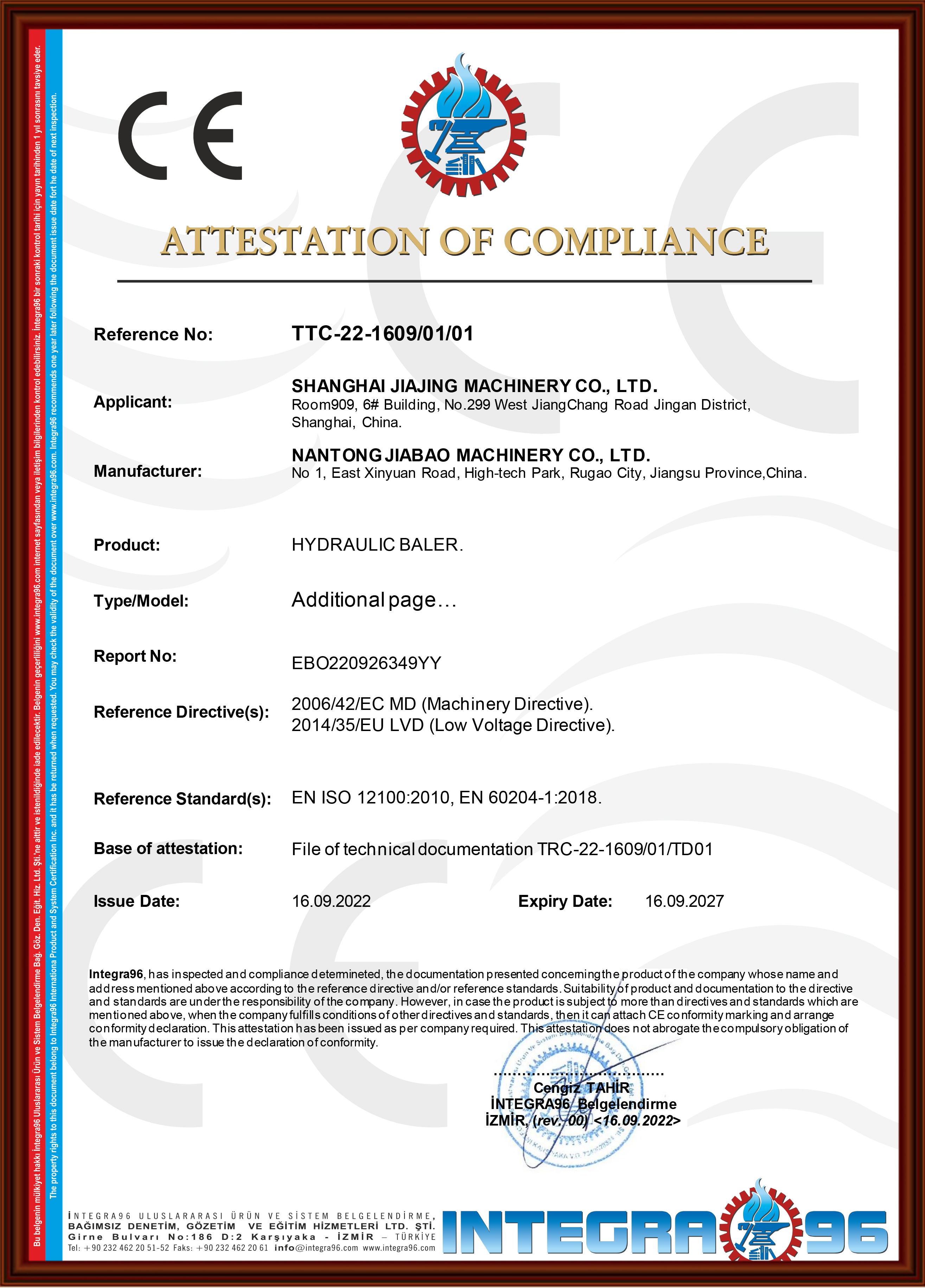
The fully automatic horizontal baler model JPW20Q, part of the hydraulic baler machines product line, holds CE certification for the EU market. The certification scope includes Directive 2006/42/EC on machinery and Directive 2014/35/EU on low voltage equipment. The applicable standards are EN ISO 12100:2010 and EN 60204-1:2018. The certificate number is TTC-22-1609/01/01 and it was issued by INTEGRA.
This level of detail is useful because CE is not a generic quality stamp. A CE certificate should state what has been assessed. If a supplier says the machine is CE certified but cannot provide the issuing body, certificate number, directives, standards or specific model, the evidence is incomplete.
SGS Supplier Audit: A Factory-Level Constraint Check
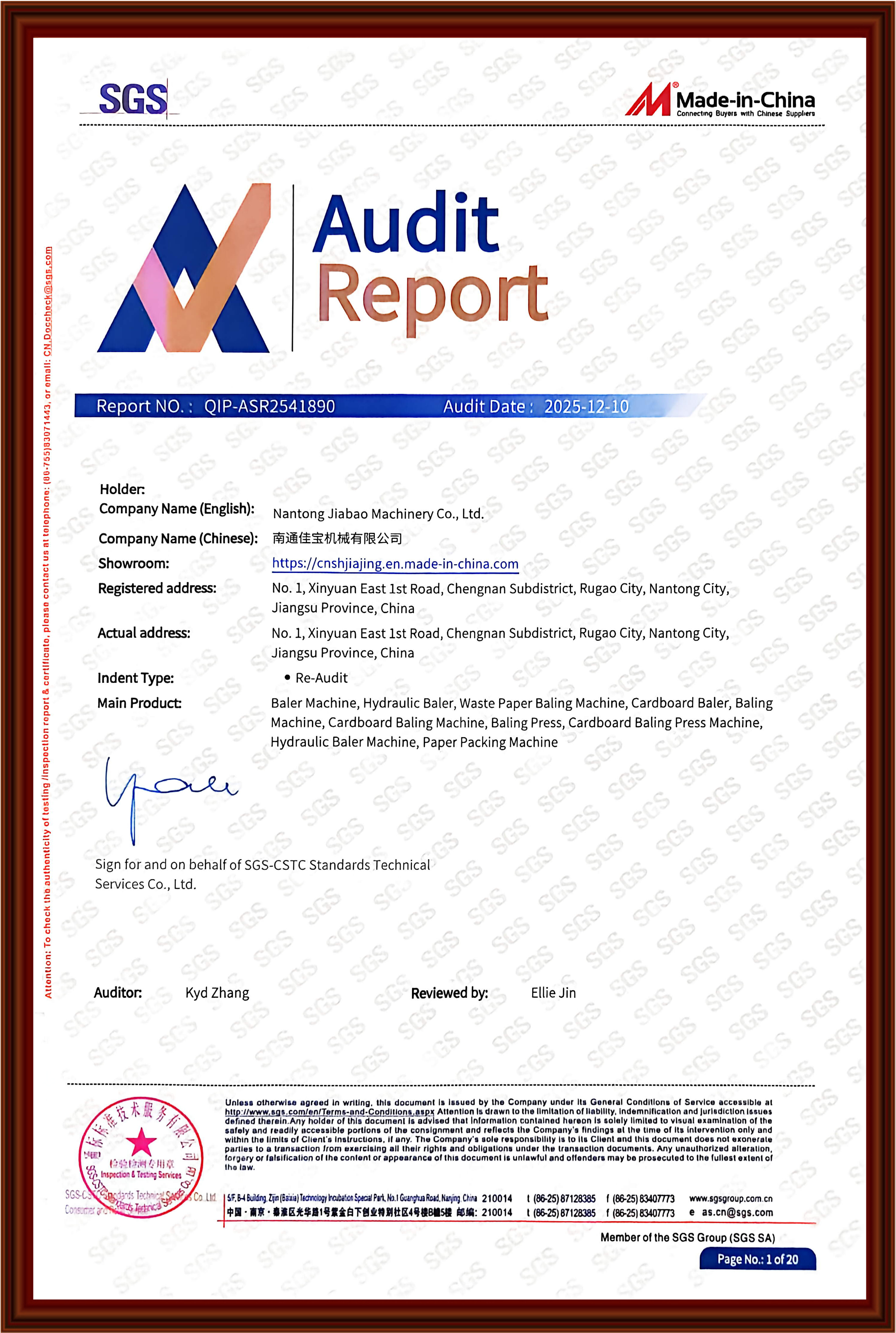
At the supplier level, the hydraulic baler machines range from Nantong Jiabao Machinery Co., Ltd. is covered by an SGS Made-in-China Supplier Audit Report. The certificate number is QIP-ASR2541890, the issuing body is SGS, and the applicable standard is the Made-in-China Supplier Audit Specification. The certification is listed for the EU market and is valid from 2025-12-10 to 2028-12-10. According to the certification scope, it covers a full range of baler machines, hydraulic balers, waste paper balers, cardboard balers and baling press machines.
This kind of audit evidence does not replace product-level CE certification, but it supports the evaluation of the manufacturer as a supplier. It gives the buyer a reason to request more detailed factory and process information before negotiation.
Material and Electrical Constraints Are Part of the Specification
Two specification facts are easy to overlook during the Research stage. First, the voltage of the hydraulic baler machine is customizable to meet specific site requirements. That matters because a buyer in one country may expect 220V/50Hz, while another may require 380V/50Hz or a different supply. Second, this hydraulic baler machine range is made with carbon steel as the primary construction material. Material choice affects rigidity, welding structure, service life and suitability for repeated compression cycles.
Step-by-Step Breakdown: Turn Specs Into a Decision Framework
Use the following sequence to move from a general intention to a concrete machine specification.
Step 1. Define the Material Stream and the Required Function
Start with the incoming material. The same core machine logic applies to hydraulic baler machines for rubber and plastic waste, cardboard factory waste hydraulic baler machines, Fiber hydraulic baler machines, metal hydraulic baler machines and Aluminum Foil hydraulic baler machines: the machine must accept the material shape, size, moisture condition and contamination level. A fully automatic waste paper baler is selected for high-volume corrugated paper, while a plastic bottle baler may need a different feed opening and bale density strategy.
Step 2. Match the Feed Opening to the Actual Undisturbed Piece Size
The feed opening is a mechanical limit. For example, the JPW20Q fully automatic horizontal baler has a feed mouth size of 700 by 460 mm. The JPW40F semi-automatic horizontal baler has a feed mouth size of 1000 by 720 mm. The JP-OT100 vertical baler has a feed mouth size of 1400 by 600 mm. If the production line generates large cardboard sheets or long plastic film rolls, the feed opening must be matched with a shredder, cutter or conveyor strategy.
When preprocessing is required, the specification changes from a single baler project to an integrated line. One example in the jewel product range is the JP-S100B cutting machine, designed with a 1000 mm cutting width, a 1000 mm cutting stroke, an 11 kW motor and a single-cycle time of 20 to 30 seconds. This is the type of equipment that can help an older baler line handle oversized cardboard waste.
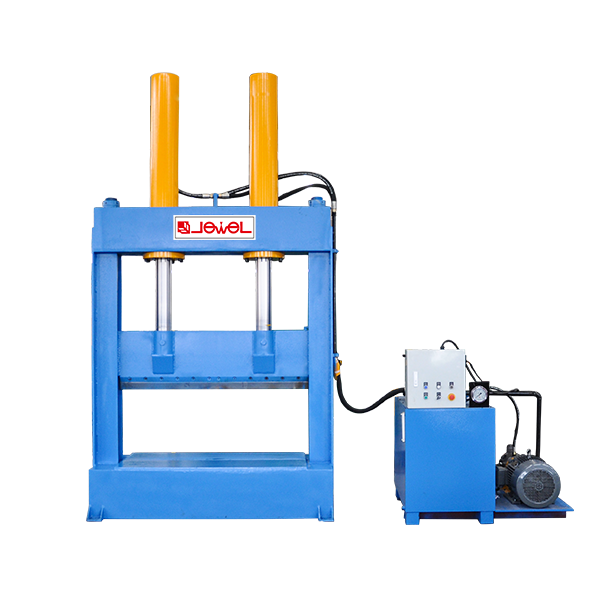
Step 3. Set the Bale Dimension, Bale Weight and Strapping Requirement
Bale size and bale weight determine how many bales fit into a truck or container. The JPW20Q produces bales of 500 by 500 by 500 mm with a bale weight range of 30 to 70 kg and two to four strapping channels. The JPW40F semi-automatic horizontal baler produces 720 by 720 mm bales with adjustable length from 500 to 1300 mm, a bale weight of 200 to 400 kg and four strapping channels. The JP-OT100 vertical baler produces 1400 by 700 mm bales with a height range of 700 to 1100 mm and bale weight of 400 to 600 kg.
These numbers are not merely marketing details. They define storage rack width, container usage, forklift handling convenience and downstream mill or recycler acceptance limits.
Step 4. Verify Throughput and Discharge Logic
Capacity numbers must be read in the context of the machine cycle and discharge method. The JPW40F semi-automatic horizontal baler has a rated baling capacity of one to two tons per hour and uses a continuous push pack discharging method. The JPW40BL plastic bottle recycling machine has a bale dimension of 720 by 720 mm with lengths from 300 to 1000 mm, a bale weight of 250 to 350 kg and one-time bale discharge. The JP-OT100 vertical baler is rated at five to six bales per hour.
A buyer evaluating an automated plant should also ask whether the baler can be connected to a conveying system. Several jewel baler projects have been configured with conveying systems for automatic waste collection from corrugator lines, printing machines and packaging lines.
Step 5. Check Power, Voltage, Floor Space and Installation Access
The electrical load and physical dimensions of the machine are constraints that appear after order confirmation if they are ignored too early. The JPW20Q uses 7.5 kW and has a machine dimension of 3400 by 3010 by 2400 mm and a machine weight of 2.8 tons. The JPW40F uses 11 kW and has a machine dimension of 4900 by 1750 by 1950 mm. The JP-OT100 uses 15 kW and weighs 3500 kg.
Because voltage is customizable, the buyer should state the available site voltage before requesting a final technical drawing. The machine must also fit through the existing door, warehouse aisle and installation bay.
Step 6. Ask for the Certificate Copy and Verify Scope and Validity
Request a copy of the actual certificate, not just a screenshot of a logo. For European evaluation, ask whether the exact model is covered by a CE attestation and which directives are listed. If the certificate is model-specific, determine which other models are not yet covered. For the current jewel product line, CE certification is documented for the JPW20Q fully automatic horizontal baler. The SGS Made-in-China Supplier Audit Report provides a wider range-level audit statement.
Step 7. Confirm Customization, Testing and After-Sales Limits
For custom hydraulic baler machines, the buyer should ask about lead time, MOQ, testing procedure and after-sales response. In the jewel capability statement, customization can cover structure, process and performance; monthly production capacity is stated as 100 units, lead time as 60 days and MOQ as one unit. The quality control statement includes 100% testing. After-sales support is described as 7 by 24 hour technical response, lifelong maintenance and free training.
Use Cases: How Constraint Patterns Shape Machine Selection
Project examples from the jewel corpus show why constraints, rather than generic assumptions, should shape a specification.
A cardboard box factory in Italy needed to replace aging balers and introduce preprocessing equipment to handle large-sized waste cardboard. The result was improved waste treatment efficiency and a practical solution for difficult, oversized material. This type of project is a reminder that the baler alone is not always the complete answer.
A cardboard production plant in Russia used automatic collection, compression and baling to manage waste from carton production. The project goal was to reduce manual labor and build a coherent unmanned waste processing system. The reported result included lower labor and management costs, a cleaner production environment and faster monetisation of waste.
A PET recycling enterprise in Japan needed higher compression density and regular, compact bales for PET bottles. The project focus was not simply on pressing force; it was on compression behaviour, bale aesthetics, storage efficiency and transportability. After the solution was in operation, the compact bales improved storage and transportation efficiency and raised the perceived value of the recycled product.
An Australian mixed-waste recycler processing plastics with small amounts of glass and metal scraps needed a line that could handle multiple material types. The project outcome pointed to full-line operation with lower labour cost and lower operational risk, which is the logic behind asking about multi-material capability before choosing a model.
Comparison Table: Hydraulic Baler Machine Types and Key Specification Constraints
The table below compares representative models within the jewel hydraulic baler machines range. Specifications are based on published model data from the manufacturer.
| Machine Type | Representative Model | Compression Force | Feed Opening | Bale Size or Bale Weight | Power |
|---|---|---|---|---|---|
| Fully Automatic Horizontal Baler | JPW20Q | 20 ton | 700 x 460 mm | 500 x 500 x 500 mm; 30-70 kg per bale | 7.5 kW / 10 Hp |
| Semi-Automatic Horizontal Baler | JPW40F | 40 ton | 1000 x 720 mm | 720 x 720 x 500-1300 mm; 200-400 kg per bale | 11 kW / 15 Hp |
| Vertical Baler | JP-OT100 | 100 ton | 1400 x 600 mm | 1400 x 700 x 700-1100 mm; 400-600 kg per bale | 15 kW / 20 Hp |
| Plastic Bottle Recycling Machine | JPW40BL | 40 ton | 1000 x 720 mm | 720 x 720 x 300-1000 mm; 250-350 kg per bale | 15 kW / 20 Hp |
| Metal Baler | JPY-T60W | 60 ton | 900 x 430 mm | 430 x 280 x 150-250 mm cross-section; 15-20 kg per bale | 22 kW / 30 Hp |
| Aluminum Foil Baler | JPW-AK100 | 100 ton | 500 x 320 mm | 320 x 320 x 200-250 mm; 5-15 kg per bale | 18.5 kW / 25 Hp |
| Briquetting Machine | JPW-AK60 | 60 ton | 500 x 300 mm | 300 x 300 x 200-300 mm; 5-10 kg per briquette | 15 kW / 20 Hp |
| Bagging Machine | JPW-K6046 | 10 ton | 540 x 400 mm | 50-80 kg per bag; 6-8 bags per hour | 2.2 kW / 3 Hp |
Note: the JPW-AK60 briquetting machine lists similar materials such as paper dust. Application confirmation should always be part of the RFQ process.
Specification and Compliance Checklist Before You Finalise a Supplier
- Certificate number and issuing body: verify the number, issue date, expiry date and issuing organisation for every claimed certificate.
- Certificate scope: confirm whether the certificate covers the exact hydraulic baler machine model or only a related product.
- Applicable directives and standards: for EU-bound equipment, check directives such as 2006/42/EC and 2014/35/EU and standards such as EN ISO 12100:2010 and EN 60204-1:2018.
- Electrical supply: state your site voltage clearly. The voltage of jewel hydraulic baler machines is customizable to meet specific requirements.
- Machine material: confirm whether the machine uses carbon steel or other materials.
- Feed opening: compare the opening with the largest expected material size, including uncompressed rolls, sheets and containers.
- Bale dimension and weight: confirm whether the bales meet your storage, trucking and end-market requirements.
- Throughput and discharge method: check whether the baler discharges continuously, one-time, or via a manual unloading bay.
- Machine dimension, machine weight and power: verify access, floor loading, ventilation and electrical capacity at the installation site.
- Customization requirement: if the application requires changes to structure, process or performance, confirm that the supplier offers custom hydraulic baler machines and can state MOQ and lead time.
- Testing and after-sales: ask whether each machine is tested before shipment and what after-sales response structure is offered.
FAQ
Which compliance evidence should be reviewed before buying hydraulic baler machines?
Buyers should verify the certificate number, issuing body, applicable standard, certification scope, validity and the covered product model. For example, the JPW20Q fully automatic horizontal baler is CE certified under directives 2006/42/EC and 2014/35/EU, with certificate number TTC-22-1609/01/01 issued by INTEGRA. The full baler range also holds an SGS Made-in-China Supplier Audit Report with certificate number QIP-ASR2541890, valid until 2028-12-10.
Are compression force, bale dimension and voltage customizable on hydraulic baler machines?
Yes. Within the jewel product range, the voltage of the hydraulic baler machine is customizable to meet site requirements. Machinery is generally built with carbon steel as the primary material. Customization can cover structure, process and performance. The correct evaluation starts with material type, feed size, target bale weight, daily output and available factory floor area.
What determines the budget when choosing a hydraulic baler machine?
No generic price list is published because the specification depends on material characteristics, automation level, bale dimension, voltage, certification scope and optional pre-processing equipment. Budget estimates should be requested after the machine type and scope are defined. This prevents comparing quotes that are not built to the same constraints.
What are the MOQ and lead time for customized hydraulic baler machines?
For customized hydraulic baler machines, jewel states an MOQ of one unit, a monthly production capacity of about 100 units and a lead time of 60 days. Every unit is described as 100% tested before delivery. A project-specific lead time should be confirmed with the supplier after the material and site constraints are known. To start that discussion, send your material type, daily waste volume, target bale size, voltage and floor layout to jiabao@csj-baler.com.
Next Step: Turn Your Constraints Into a Specification
Download the 2026 catalog to compare machine models, or contact the jewel engineering sales team with your material and site data. A clearer specification produces a more reliable quotation.
Chat on WhatsAppDownload the 2026 Baler Catalogue PDFEmail: jiabao@csj-baler.com | Tel/WhatsApp: +86 187-2181-4932 | Website: www.jewelbaler.com
Conclusion
Certifications and specifications are not two separate checklists. Certification is the compliance gate, while specifications are the physical fit. A CE certificate with a clear model number, directive list and issuing body removes market risk. A carefully matched feed opening, compression force, bale size, voltage and discharge method removes operational risk.
Nantong Jiabao Machinery Co., Ltd. is a baler equipment manufacturer established in 2006, with a brand history beginning in 1995. The company operates a 50,000-square-meter production facility in Rugao City, Jiangsu Province, China, with a team of more than 200 professionals and an in-house engineering department. Its export markets include Australia, Europe, North America, Africa, Asia, Russia and Belarus. For a buyer in the Evaluation stage, the practical next step is to turn this article into an RFQ: define the material, set the bale target, state the voltage and site limits, request the relevant certificate copy, and let those constraints determine the hydraulic baler machine that fits.