
Inside an Aluminum Composite Panel: Sheets, Core, Coating, Thickness
Inside an Aluminum Composite Panel: Sheets, Core, Coating, and Thickness
An aluminum composite panel is two thin aluminum sheets bonded to a lightweight core, with a factory-applied coating on the visible face and a removable protective film over it. That is the entire construction. Everything else on a quotation — the alloy designation AA1100, AA3003 or AA5005, the aluminum thickness, the core type, the coating chemistry, the finish name and the total panel thickness — is a decision about one of those layers.
Because “aluminum composite panel” names a construction and not a fixed recipe, two panels sold under the same product name can differ in every layer while measuring the same overall thickness. A buyer who checks only the total thickness is reading one number out of five. This article opens the panel up layer by layer: what each layer is, what it contributes to the finished sheet, and which line of a specification it belongs on.
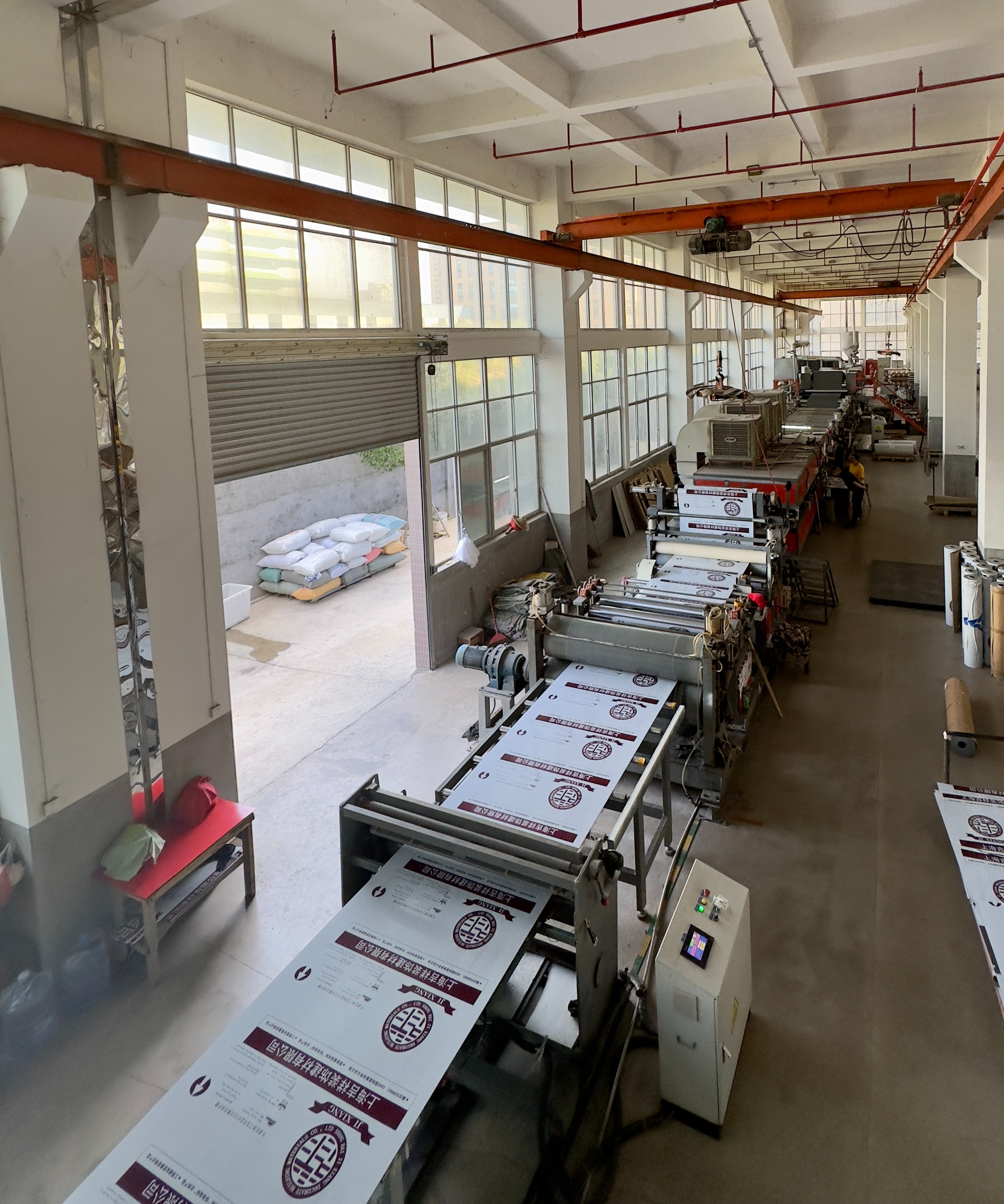
A fully automatic ACP production line: the stage where the layers described in this guide are combined into one panel.
The layer stack, in order
Read from the visible face inward, a coated aluminum composite panel is a stack of six components:
- Protective film — applied to the surface to prevent scratches during transportation and installation.
- Coating — the factory-applied PVDF or polyester layer that forms the finished surface.
- Outer aluminum sheet — one of the two aluminum skins.
- Adhesive film — the high-performance bonding layer between aluminum and core.
- Core — the lightweight middle: PE core or fireproof core.
- Inner aluminum sheet — the second skin, which closes the sandwich.
Two measurements run through this stack, and they are not interchangeable. Panel thickness is measured across the whole build, skins plus core. Aluminum thickness is measured on one skin only. Most specification confusion about aluminum composite panels starts when those two values are treated as one number.
Why the layer stack, not the product name, decides what arrives
The category name tells a buyer very little about the build. Two panels that both carry the words “aluminum composite panel” may hold a PE core or a fireproof core, a 0.05 mm skin or a 0.50 mm skin, a PVDF coating or a polyester one, and still sit at the same total thickness. The differences live inside the panel, which is why the useful comparison document is a layer-level specification rather than a product label.
Market data shows how heavily the category leans on one coating choice: in Market Research Future’s 2026 aluminum composite panel report, PVDF-coated panels accounted for 36.5% of global revenue in 2025. That is a category-level estimate from a commercial research publisher; it describes the market as a whole, not the product mix of any individual supplier.
Fire performance is the clearest example of why the layer, not the label, matters. Mitsubishi Chemical’s ALPOLIC/fr technical page describes mineral-core fire-resistant panels reaching Euroclass A2-s1, d0 under EN 13501-1. That classification belongs to a tested product build assessed against a specific standard; it does not follow automatically from the words “fireproof core” on a data sheet. For an actual order, the fire performance rating the project requires has to be agreed in the contract and confirmed against the panel supplied — JIERSUN’s application data states explicitly that fire performance rating, weather and UV resistance, nano self-cleaning coating and colour/texture options are technical requirements to be defined in the contract.
That is also why the layer list is worth comparing supplier to supplier. Jiersun (Fujian) Decorative Building Materials Co., Ltd. has manufactured aluminum composite panels since 2006 at a 20,000 m² facility in Fujian, 70 km from the port, and supplies export markets in Southeast Asia, Africa and the Middle East.
Layer 1 — Aluminum sheets: alloy grade and aluminum thickness
The two aluminum sheets are specified by two separate values: alloy grade and aluminum thickness. JIERSUN supplies AA1100, AA3003 and AA5005, with other grades available on demand, and aluminum thickness from 0.05 mm to 0.50 mm.
The three designations are different aluminum alloy grades, and this guide does not rank them against each other: which grade suits a project depends on forming, fixing and exposure conditions that have to be confirmed against the application rather than assumed from the number. What matters at specification stage is that the grade is written down and stays attached to the order.
Aluminum thickness is the value buyers most often leave out. The supplied range runs from 0.05 mm to 0.50 mm — a tenfold span — and it is a per-skin gauge, not a panel gauge. Take two panels both described as 4 mm: one specified at 0.50 mm aluminum and one specified lower inside the same range are both “4 mm ACP”, yet only one of them states how much aluminum the sandwich actually contains. (That pairing illustrates the range; it is not a fixed product configuration.)
A quotation line is only complete when it carries both values, for example 4 mm panel, AA3003, aluminum thickness 0.xx mm. Where either value is missing, the specification is still open.
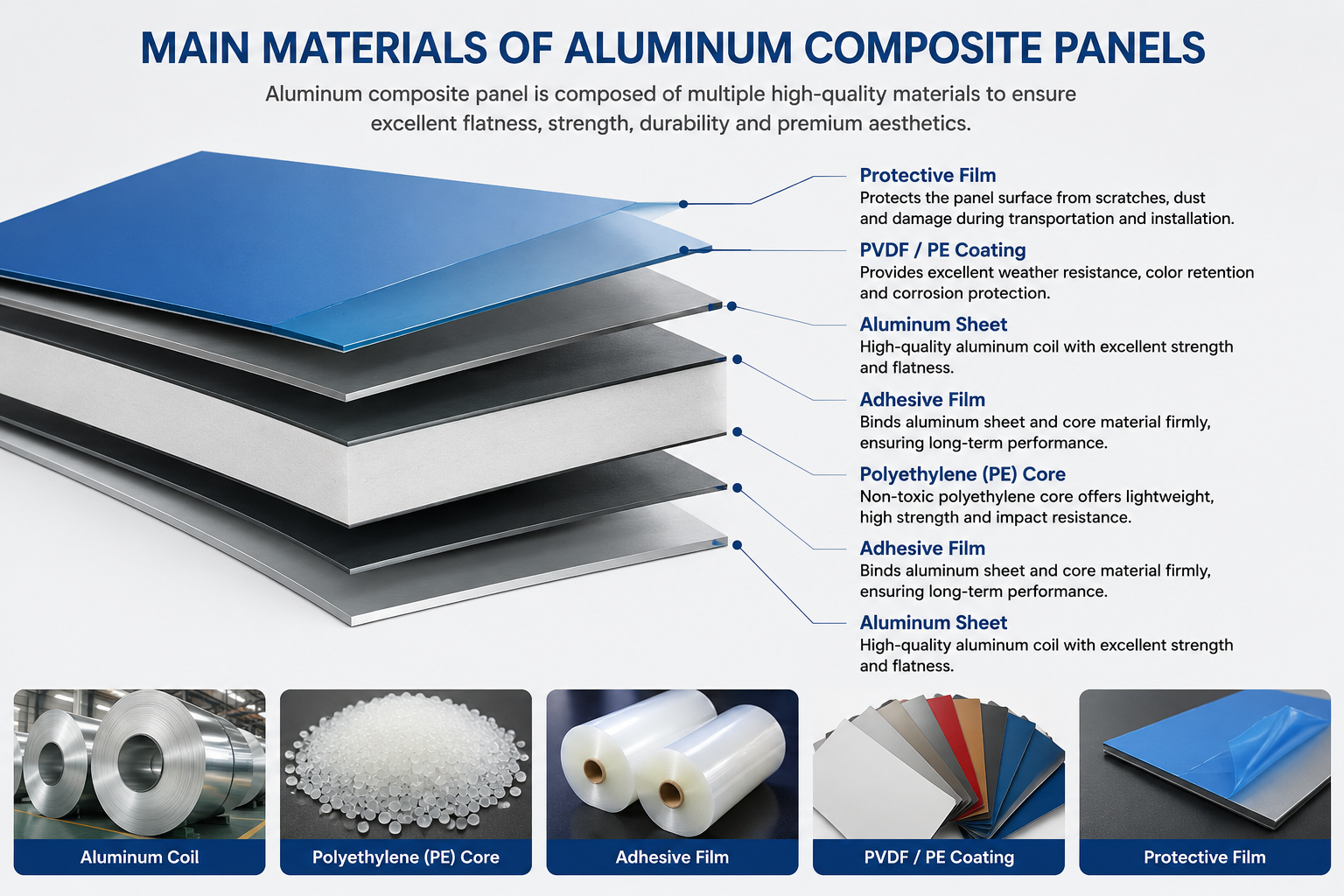
The material set behind the panel: aluminum coils, PE or fireproof mineral core, adhesive films and PVDF or polyester coatings.
Layer 2 — The core: PE core and fireproof core
JIERSUN supplies two core options — a PE core and a fireproof core — and the core is the layer that decides how much of the panel’s thickness is aluminum and how much is lightweight material. It is also the reason a composite panel is far lighter than a solid aluminum sheet of the same overall thickness.
Core selection is, in practice, a fire-performance decision. The PE core is the standard polymer build; the fireproof core exists so that a panel can be specified where the project sets a fire requirement. The point that trips buyers up is the word “fireproof”: it is a core type, not a classification. The classification is granted to a tested build under a named standard, so two questions have to be kept separate — which core? and which rating, evidenced how?
Three checks keep that separation practical:
- Write the required fire performance rating into the contract, next to the weather and UV resistance and any coating requirement.
- Ask for the rating to be tied to the exact build being quoted — core plus skins plus coating — not to a core material in general.
- Compare a sample against the written build before the order, and keep that agreed specification as the acceptance reference.
Layer 3 — The coating: PVDF, polyester, and the finish names buyers see
JIERSUN applies PVDF or polyester coatings in the factory, and the finish a buyer sees — PVDF coated, mirror, wood grain, marble grain, brushed, nano self-cleaning or fireproof — is named separately from the coating chemistry. Those two facts answer different questions, and both belong on the order.
The distinction matters because the finish names are visual and textural categories, while PVDF and polyester describe the coating system. A line that reads “wood grain ACP” does not say which coating system sits on the panel; a line that reads only “PVDF coated” does not say what colour or texture the face will be. Colour is supplied to order, so it becomes a third item to state.
Two further points keep a coating specification honest:
- Finish options are not interchangeable claims. A nano self-cleaning option, for instance, is a coating type in the range; how it behaves on a given project should be confirmed against the product specification rather than inferred from the name.
- “PE” appears twice in aluminum composite panel specifications and means two different things. A PE core is polyethylene — the middle layer. A polyester coating is also written as PE in some supplier documents — the surface layer. When a data sheet says “PE”, check which layer it is describing before comparing two panels.
Layer 4 — The protective film: transport protection, not a finish
The protective film is applied to the surface to prevent scratches during transportation and installation, and it is not part of the finished surface. It sits above the coating, leaves the factory with the panel, and is a handling aid rather than a performance layer.
For buyers that has two consequences. First, a panel that looks scratched in a photograph may have a film problem rather than a coating problem — check the film before judging the finish. Second, the film should never be read as an extra weather layer or as a substitute for the coating on an exterior application. On an installed panel, the coating is what stays exposed, so the coating system is the durable decision.
Protective film lamination: the last layer added to the build, and the first one removed after installation.
Panel thickness and aluminum thickness: two numbers, one specification line
JIERSUN supplies panel thicknesses of 3 mm, 4 mm, 5 mm, 6 mm and 8 mm at normal widths of 1220 mm, 1250 mm and 1500 mm, with aluminum thickness from 0.05 mm to 0.50 mm. The panel figure covers the whole stack; the aluminum figure covers one skin. Both are needed to describe a panel.
The arithmetic is simple, and it is the reason the distinction matters: panel thickness is made up of the two skins, the two adhesive films and the core between them. Fix the total thickness and raise the aluminum gauge, and the core becomes thinner. Fix the total thickness and lower the gauge, and more of the panel is core. Neither version is automatically right — but a buyer who orders only “4 mm” has left that choice to the supplier.
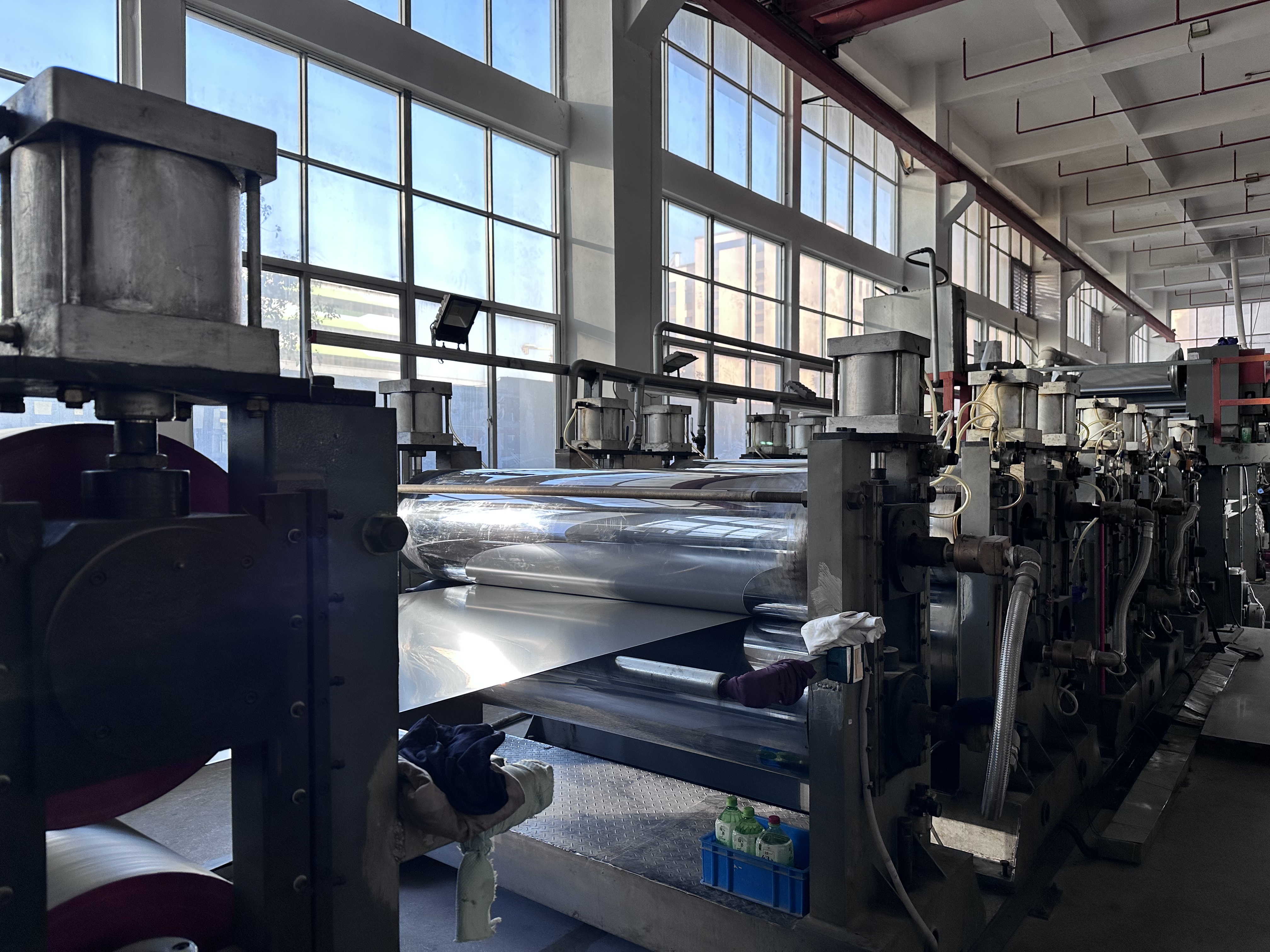
Calibration equipment controls the dimensional build of the panel — the stage where panel thickness is held to specification.
| Layer | What JIERSUN supplies | Its role in the finished panel | What the order should state |
|---|---|---|---|
| Aluminum sheets (two skins) | AA1100, AA3003, AA5005 (other grades on demand); aluminum thickness 0.05 mm–0.50 mm | The two faces of the sandwich and the layer that carries the visible surface | Alloy grade and aluminum thickness in millimetres |
| Adhesive film | High-performance adhesive films | Bonds each aluminum sheet to the core | Bonding detail as confirmed by the supplier |
| Core | PE core or fireproof core | The lightweight middle that separates the two skins | Core type plus the fire performance rating the project requires |
| Coating | PVDF or polyester (PE), factory applied | The finished surface layer of the panel | Coating system: PVDF or polyester |
| Surface finish | PVDF coated, mirror, wood grain, marble grain, brushed, nano self-cleaning, fireproof | The visual and textural effect the buyer sees | Finish name, colour, and colour customization |
| Protective film | Applied to the surface | Prevents scratches during transportation and installation | Film confirmed as transport protection, with handling advice from the supplier |
The first two content columns come from JIERSUN’s supplied panel data; the final column is a buyer’s checklist, not a product claim.
From order to packed panel: where each layer’s specification locks
Each layer is fixed at a different point between enquiry and shipment, which is why a late change to one layer is not a cosmetic change. The sequence below tracks those stages, and the point at which a decision becomes part of the order.
- Build specification. Alloy grade, aluminum thickness, panel thickness, width, core type, coating system, finish and colour are agreed. Everything downstream depends on this list, and it doubles as the acceptance reference.
- Aluminum coil. The skins come from high-quality aluminum coils in the agreed grade.
- Coating. PVDF or polyester coating is applied in the factory, which is why coating and colour are order-time decisions rather than site decisions.
- Bonding. Aluminum sheets, high-performance adhesive film and core are combined into the sandwich on the production line.
- Calibration. Panels pass through calibration equipment — the stage at which the dimensional build is controlled.
- Protective film. Film is laminated onto the finished surface for transport and installation.
- Packing and shipment. The packed panel should match the specification list from step one, which is exactly what an incoming inspection compares against.
JIERSUN documents this line through its fully automatic ACP production line, panel calibration machine, panel turning machine and protective film laminating machine. Individual line parameters and any project-specific requirement are confirmed per order; a general process description does not replace the agreed specification.
Which layer comes up first in each application
Every application uses the same six-layer build, but the first specification question changes with the job. JIERSUN’s application data lists six industry settings, and the layer that drives the conversation differs in each.
- Building curtain wall and exterior wall decoration. Coating system and core fire performance come first, because the panel is exposed and the project usually sets a fire requirement. Weather and UV resistance requirements belong in the contract from the start.
- Commercial and retail storefronts. Finish and colour lead, with the build confirmed behind them — the visible face is the design decision, but the coating system still has to be written down.
- Signage and advertising billboards. Surface finish and panel thickness are usually the first two questions, since the panel is handled and viewed as a flat sign face; outdoor signage adds the same weather and UV consideration as an exterior wall.
- Interior decoration and furniture manufacturing. Thickness and finish normally decide the choice, with the fire requirement following the building rather than the panel.
- Engineering project decoration. The project specification, not the catalogue, sets the order of questions — which is why the layer list is the more useful checklist.
JIERSUN’s own product positioning reflects that split: the 3 mm panel is positioned for building curtain wall and exterior wall decoration, the 4 mm panel for interior decoration, and the 5 mm panel for the furniture factory industry, with 6 mm and 8 mm completing the range.
Frequently asked questions about aluminum composite panel construction
What are the layers inside an aluminum composite panel?
A coated aluminum composite panel has six components: a removable protective film; a factory-applied PVDF or polyester coating; an outer aluminum sheet; high-performance adhesive film; a PE or fireproof core; and an inner aluminum sheet. JIERSUN supplies the skins in AA1100, AA3003 or AA5005 with aluminum thickness from 0.05 mm to 0.50 mm, in panel thicknesses of 3 mm, 4 mm, 5 mm, 6 mm and 8 mm.
Does a 4 mm panel always contain the same amount of aluminum?
No. The 4 mm figure is the total across both skins, the adhesive films and the core, while aluminum thickness is a separate value supplied from 0.05 mm to 0.50 mm per skin. Two 4 mm panels can therefore differ in how much aluminum they contain and in how much of the thickness is core. Ask for the alloy grade and the aluminum thickness in millimetres on the quotation, not only the total panel thickness.
PE core or fireproof core — how should a buyer decide?
Start from the project’s fire requirement, not from the core name. JIERSUN supplies both a PE core and a fireproof core; where the project sets a fire performance rating, the fireproof core is the option to evaluate, and the required rating has to be written into the contract and confirmed against the product actually supplied. A “fireproof core” label is a core type, not a classification — ask which build was tested and against which standard.
What is the difference between PVDF coating and a wood grain or marble grain finish?
They answer different questions. PVDF and polyester are coating systems applied in the factory; mirror, wood grain, marble grain, brushed, nano self-cleaning and PVDF coated are the finish names a buyer sees. A quotation that says “wood grain” does not state the coating system, and one that says only “PVDF coated” does not state colour or texture. Specify both, plus the colour, which JIERSUN supplies to order.
Aluminum Composite Panel suppliers: what should a buyer check first?
Check the layer specification before the price: alloy grade, aluminum thickness in millimetres, panel thickness and width, core type, coating system, finish, colour, and the fire rating the project requires. Then confirm that a sample matches that written specification and that the protective film is intact on delivery. For JIERSUN, samples, specification confirmation and current pricing can be requested directly from the sales team.
Next step. JIERSUN’s 2026 aluminum composite panel range — 3 mm to 8 mm panel thickness, AA1100/AA3003/AA5005 skins, PE or fireproof cores, PVDF or polyester coatings and custom colours — is documented in the JIERSUN ACP catalogue (2026). For a sample or a specification check, contact sales3@jiersun.com or +86 17750700228.
Conclusion: read the panel as five specifications, not one
An aluminum composite panel is best read as five specifications: the alloy and aluminum thickness of the skins, the core type, the coating system, the finish and colour, and the total panel thickness. The protective film sits on top of all five as transport protection. Two panels with the same product name and the same total thickness can differ across every one of them.
For buyers at the research stage, the practical move is to turn a catalogue page into a layer list and confirm that every line is answered in writing before any price comparison means anything. A quotation that states alloy, gauge, core, coating, finish and total thickness is comparable; a quotation that states one number is not.
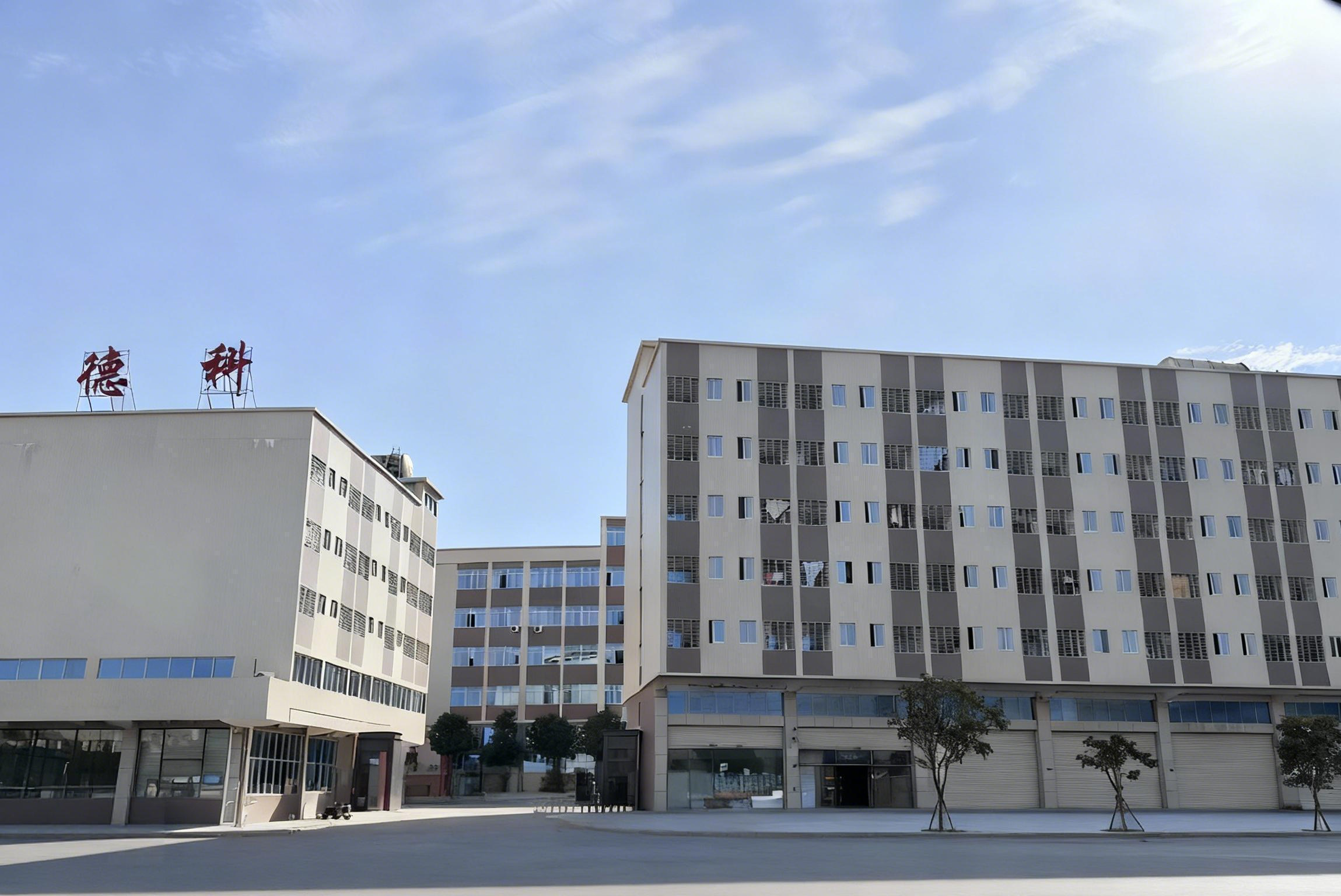
JIERSUN’s Fujian facility: panels produced from aluminum coils, PE or fireproof core, adhesive film and PVDF or polyester coating.
Have Questions or Need More Details?
Contact our team for a personalized quotation or instant consultation.
Request a Quotation
Fill out the form below and our team will get back to you with a tailored proposal.
WhatsApp Direct Chat
Prefer to chat in real-time? Message us on WhatsApp for instant assistance & quick answers.
- Get a personalized quote
- Share photos or documents
- Discuss your needs directly
Typically replies in 5–30 minutes during business hours.