
Cooler Bag, Lunch Bag, or Insulated Box: Matching Gel Ice Packs to Your Scenario
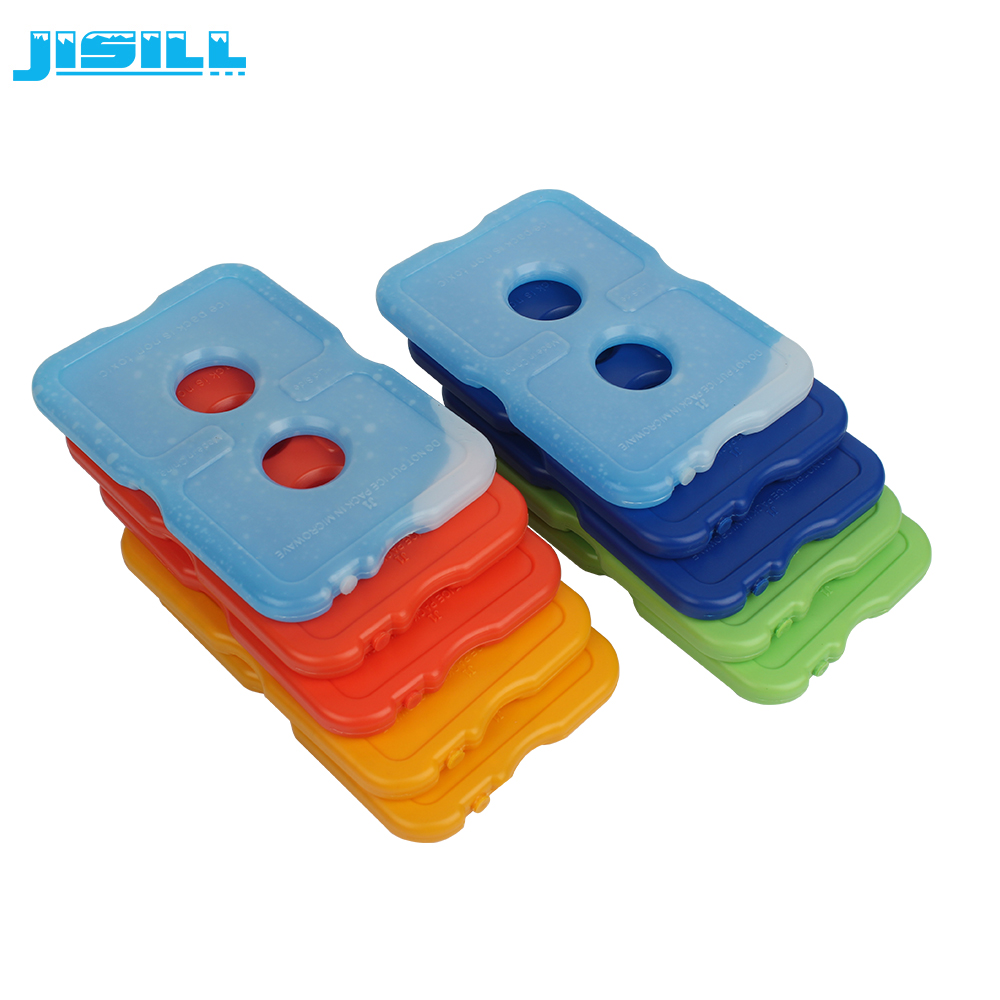
A gel ice pack is not a standalone product. It is one component of a thermal system, and the system decides the result. Two buyers can order packs from the same production line, place them in different carriers, and record completely different temperature outcomes. The variable that determines success is rarely the gel itself — it is whether the pack format, the charge temperature, and the pack mass were matched to the carrier, the payload, and the number of hours the shipment spends in transit.
Jisi Cold Chain (Changzhou Jisi Cold Chain Technology Co., Ltd.) is a Chinese manufacturer founded in 2013 that specialises in PCM ice packs, cooler boxes, and VIP vacuum insulated panels, operating from a 40,000 m² facility in Changzhou, Jiangsu Province. This guide works through three of the manufacturer's model families — BH011, BH162, and BH004 — and explains which cold chain scenario each one is positioned for, so that decision-stage buyers can specify the right pack before committing to a production run.
Problem Definition: Why the Same Gel Ice Pack Performs Differently in a Cooler Bag and an Insulated Box
Most portable cold chain failures are scenario mismatches rather than material failures. Four variables sit between a pack leaving the freezer and the payload arriving within specification:
- Carrier air volume. A lunch bag with a small internal cavity is dominated by pack surface area, while an insulated box with a larger cavity is dominated by the ratio of pack mass to payload mass.
- Insulation quality. Boxes built around PU or VPU panels retain cold differently from a soft-sided cooler bag, and a vacuum insulated panel lining behaves differently again.
- Mission duration. A 12-hour hold and a 120-hour hold are different engineering problems. Selecting a pack for the shorter mission and then shipping on the longer one is the most common specification error in portable cold chain.
- Charge logistics. A PCM pack must be conditioned at a defined temperature. If it is frozen when the protocol expects conditioning, the band it delivers will be wrong even though the pack is technically cold.
The practical consequence is that "buy a gel ice pack" is not a specification. The specification is: deliver this payload, in this carrier, at this temperature band, for this many hours. The pack is selected after that sentence is written.
Industry Background: A Growing but Loosely Categorised Market
Published market estimates for the category differ widely, and the difference is instructive. Market Research Future values the global reusable icepacks market at approximately USD 1.962 billion in 2024, with a projected USD 2.862 billion by 2035. The Business Research Company sizes the global gel ice pack market at USD 14.56 billion in 2025, driven substantially by chronic pain management and pharmaceutical cold chain demand. The gap between those two figures is largely a categorisation effect: consumer reusable packs, retail wellness products, and medical cold chain infrastructure are counted differently by different research houses. Buyers should read them as directional indicators of demand rather than as a like-for-like comparison.
Two segments are defined more consistently. MarketsandMarkets projects the vaccine storage equipment market — cold boxes and carriers — growing from USD 0.86 billion in 2024 to USD 1.21 billion by 2029. Intel Market Research values the Phase Change Material (PCM) pack market at USD 476 million in 2025, growing at a CAGR of 4.5% on demand for precise thermal management in biologics. Both point the same direction: growth is concentrated in temperature-defined applications, where a pack is specified against a band rather than against a general instruction to keep things cool.
On the supply side, Dataintelo records that China accounts for over 11.2% of global gel ice pack revenues as of 2025, functioning as a primary manufacturing hub for export to North America and Europe. Jisi Cold Chain is part of that base. The company reports a 70% export ratio across North America, South America, Western Europe, Eastern Europe, Eastern Asia, and Southeast Asia, supported by a monthly production capacity of 10,000 units and a quality control process based on 100% testing.
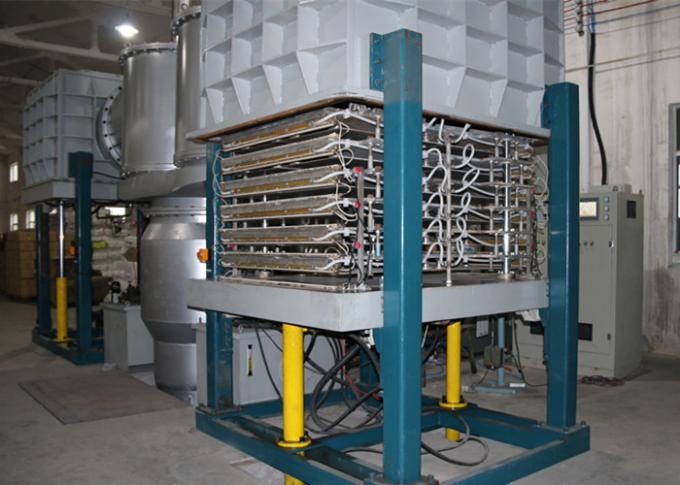
The manufacturer's manufacturing base also explains its format range. Jisi Cold Chain traces its origins to a food plastic packaging business, and its own blow moulding and injection moulding equipment produces plastic shells, lids, and plastic packaging tubes in house. That in-house tooling is why the range can cover rigid shells, flexible nylon packs, and consumer-format mini packs from the same facility.
In regulated medical and vaccine logistics, the reference framework is the WHO PQS performance specification E004/VC01.2, which defines standards for vaccine carriers and cold boxes and requires verified cold life durations. Any buyer specifying for a public health or pharmaceutical program should design against that specification rather than against a generic hold-time claim.
Detailed Solution: Matching Pack Format to Carrier
Jisi Cold Chain's approach is to hold the chemistry constant and vary the format, the temperature band, and the conditioning profile. The available bands run across -30 °C, -25 °C, -15 °C, -10 °C, -5 °C, 0 °C, 2–8 °C, 18 °C, and 23 °C, and the company states that these bands meet the refrigerated transportation needs of ice cream, food, vaccines, and drugs. Demonstrated hold durations run at 12, 24, 48, 72, and 96 hours, and up to 120 hours depending on the box and panel configuration.
Cooler Bags and Cool Bag Ice Packs: BH011 for Portable Use
Cooler bags are short-mission, low-insulation carriers. The pack does not need an extended hold; it needs to fit the base of the bag, freeze quickly between trips, and stay in contact with the payload. Jisi positions BH011 for portable use, which is the profile that suits soft-sided cool bags, delivery bags, and day-trip carriers.
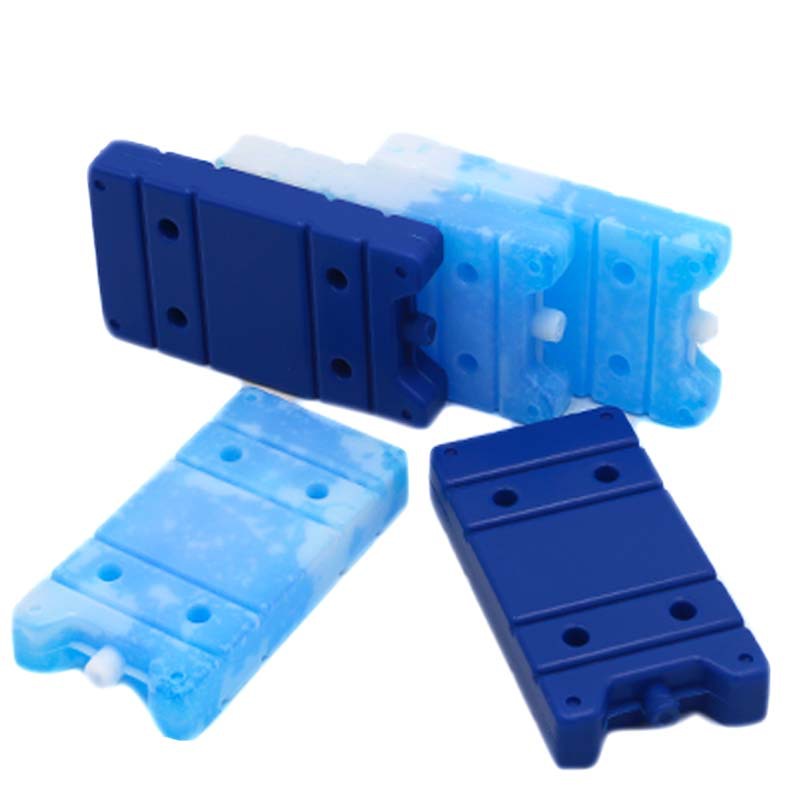
For larger cooler bags, the practical choice shifts towards large cooler ice packs and ice cooler brick formats, where pack mass carries a greater share of the thermal load. A flat, wide pack that sits under the payload transfers cold more evenly than a tall pack pushed against one wall, because contact area — not pack volume — drives performance in the first hours of a trip. The same logic applies to beer holder cooler inserts and other rigid consumer carriers, where the pack must be shaped to the cavity rather than simply be cold.
Lunch Bags, Mini Ice Packs, and Food-Contact Safety
Lunch bags are the tightest scenario: minimal air volume, no active insulation, and a payload that may sit directly against the pack. Here the specification is dominated by food-contact compliance rather than hold time. Jisi packs use an HDPE outer shell with an inner liquid of SAP or CMC, and the company states that all materials are non-toxic and food-grade, supported by SGS and MSDS reports. Internal risk review lists no identified risks requiring additional control measures beyond standard quality control procedures.
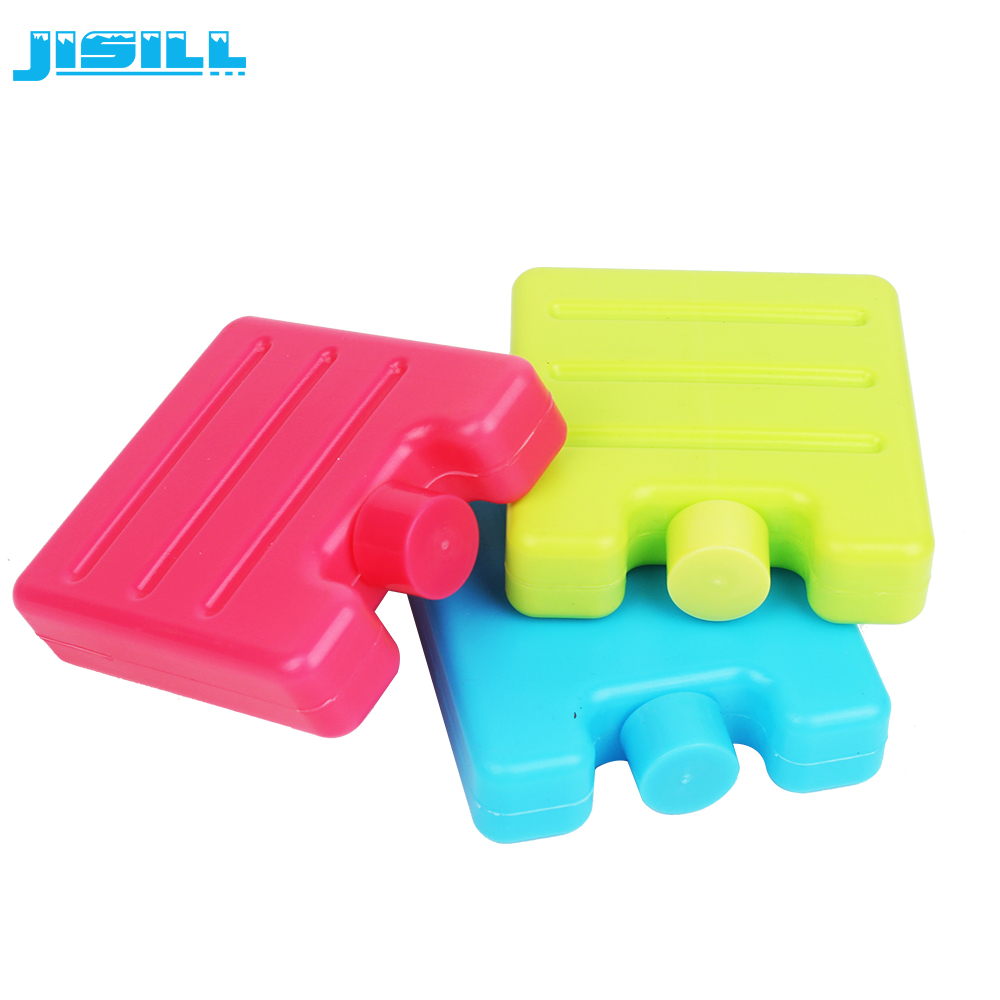
Lunch ice packs and mini ice packs in this family are also used in adjacent applications where the same leak-proof requirement applies, including breast milk transport bags and small medical cool boxes. If a pack will sit against unwrapped food or against a feeding bottle, confirm the food-contact documentation for the exact model before ordering rather than assuming that any blue ice pack qualifies.
Insulated Boxes, Medical Cool Boxes, and Vaccine Cooler Boxes: BH162 and PCM
Insulated boxes are where phase change material earns its place. A PCM ice pack — also described as a phase change material ice plate — is formulated to hold a defined temperature band as it changes phase, rather than drifting upward as melting ice does. That behaviour is what temperature-sensitive biologics, reagents, and 2–8 °C vaccine shipments require, and it is the reason the PCM pack segment is expanding faster than the category as a whole.
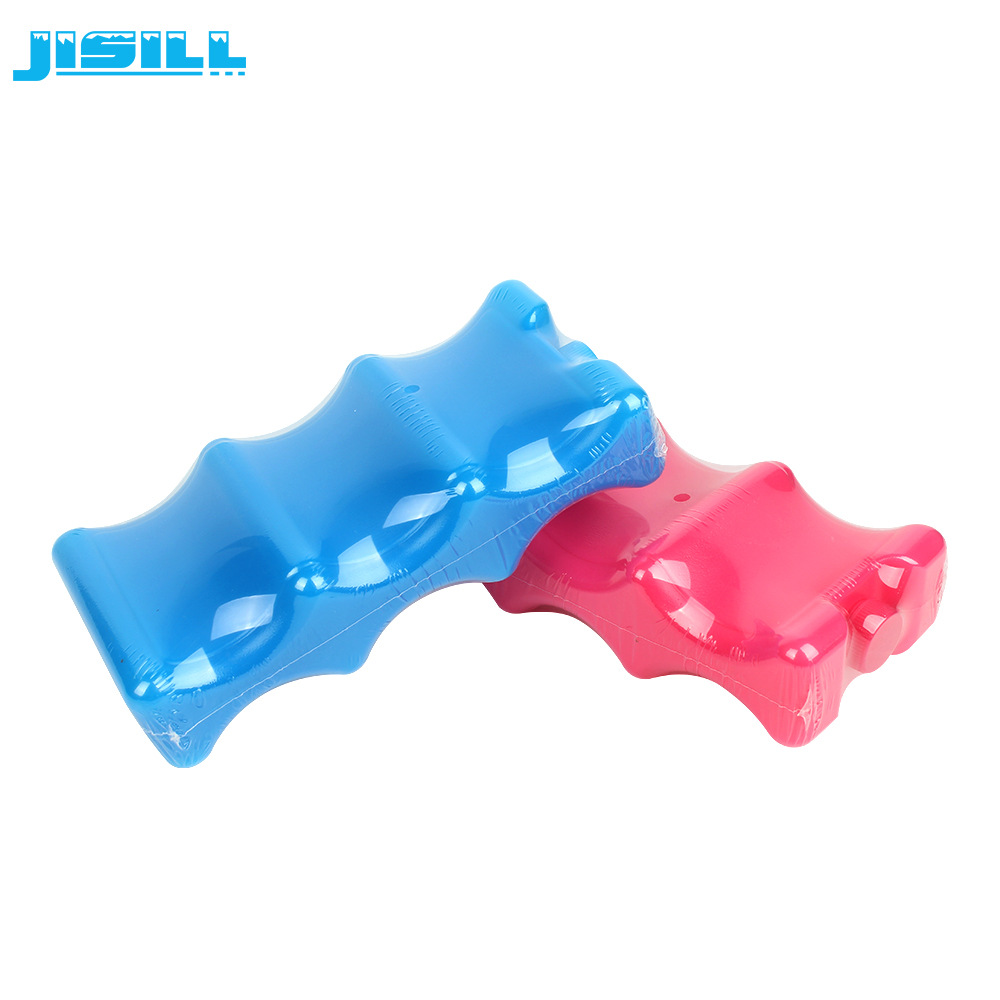
Jisi positions BH162 as a PCM-based nylon pack. The nylon format resists abrasion inside rigid boxes, where packs slide against racks and panel walls during handling, and the PCM formulation is matched to one of the bands listed above. Pairing a BH162 with a box built on PU or VPU panels and a vacuum insulated panel lining is the configuration the manufacturer supplies for extended-hold medical transport, including eutectic cold plate arrangements where a flat plate format fits the internal geometry better than a block.
For any program that must demonstrate compliance, WHO PQS E004/VC01.2 is the performance specification to design against, and the verified cold life duration should be established for the exact box and pack combination rather than assumed from a catalogue figure. A medical cool box or vaccine cooler box validated with one pack format cannot be assumed to perform identically with another.
Model-Specific Food Fresh-Keeping: BH004
Prepared food, chilled delivery, and fresh-keeping carriers are built around a specific box model, and the pack has to match that model's internal geometry. Jisi positions BH004 for model-specific food fresh-keeping, meaning the pack is selected against the carrier it will travel in rather than as a general-purpose block. Flat eutectic cold plates are the usual pairing in this scenario because they stack under a tray or a divider without displacing the payload or changing the load plan.
Dimensions, Weight, and Multi-Purpose Design
Dimension and weight data are model-specific, and the two values that matter most to a buyer are the pack footprint against the carrier base and the pack weight against the payload weight. Request the specification sheet for the exact part number and check the footprint against the internal base area before ordering. A pack that is even slightly too wide will sit on top of the payload instead of beneath it and will change the temperature profile of the entire trip.
Multi-purpose design is the operational benefit that offsets that effort. Because the packs are reusable and require no maintenance, a single pack family can move between a lunch bag on a weekday, a cooler bag at the weekend, and a small medical cool box when the need arises. The company's supplied comparison data also notes a lower replacement cost and higher efficiency relative to the baseline it was measured against, together with a cost position approximately 10% lower. That data is manufacturer-supplied and should be validated against your own route testing before it is written into a purchase agreement.
Decision rule: choose the model family from the carrier and the mission duration first, then confirm the temperature band. BH011 for portable cooler bag and lunch bag duty, BH162 where a PCM band must hold inside a rigid insulated or medical box, BH004 where a specific food fresh-keeping carrier dictates the pack geometry.
Step-by-Step Breakdown: Six Steps from Scenario to Order
- Define the mission. Record the payload, the required temperature band (for example 2–8 °C for vaccines and drugs, or a frozen band for ice cream), and the maximum number of hours in transit.
- Characterise the carrier. Note the internal base dimensions, the insulation type, and whether the carrier is a soft cooler bag, a lunch bag, or a rigid insulated box with VIP panels.
- Select the model family. BH011 for portable cooler bag and lunch bag use, BH162 for PCM-controlled bands in insulated and medical boxes, BH004 for model-specific food fresh-keeping carriers.
- Verify compliance requirements. Confirm food-contact documentation (food-grade materials, SGS, MSDS) for food applications, and align medical or public health programs with WHO PQS E004/VC01.2.
- Validate with a route test. Run the pack, carrier, and payload through a realistic trip with a data logger before scaling. Confirm the conditioning instruction for the specific model with the manufacturer, because a correctly frozen pack is not necessarily a correctly conditioned one.
- Lock the supply terms. Agree the MOQ, delivery terms, acceptance criteria, and payment terms, then confirm repeat-order capacity against your annual volume.
Use Cases: Four Scenarios in Practice
1. The daily lunch bag
A mini ice pack or lunch ice pack in a soft bag, sized to the bag base, with food-contact documentation on file. The requirement is a few hours in mild ambient conditions. Over-specifying a PCM pack for this scenario adds weight and cost without adding performance.
2. Food delivery and fresh-keeping carriers
A model-specific BH004 pack matched to the delivery box, normally in a flat eutectic cold plate format so that the payload footprint does not change. Multi-stop routes benefit most from reusability and from the absence of maintenance between runs.
3. Reagent and sample transport in a medical cool box
BH162 PCM packs conditioned to the required band, inside a box with PU or VPU panel construction. Programs that must document performance should design against WHO PQS E004/VC01.2 and verify cold life on the exact configuration rather than on a comparable one.
4. Breast milk and small-volume cold carry
Insulated bags with leak-proof blue ice packs sized so they do not crush the container. Food-grade materials and a reliable leak-proof seal are the deciding criteria here, ahead of hold duration.
Comparison: Model-to-Scenario Mapping and Supplied Data
The table below summarises the model positioning described above. Dimension and weight values are model-specific and should be confirmed on the specification sheet for the exact part number.
| Carrier scenario | Model family | Positioning | Confirm before ordering |
|---|---|---|---|
| Cooler bag / cool bag | BH011 | Portable use | Pack footprint against the bag base; freeze cycle between trips |
| Lunch bag / mini pack | BH011 | Portable use | Food-contact documentation; leak-proof seal |
| Insulated box with a defined temperature band | BH162 | PCM-based nylon pack | Required band; conditioning instruction; panel type |
| Medical cool box / vaccine cooler box | BH162 | PCM-based nylon pack | WHO PQS E004/VC01.2 alignment if required by the program |
| Model-specific food fresh-keeping carrier | BH004 | Food fresh-keeping | Carrier model match; payload weight versus pack weight |
Manufacturer-supplied performance data for the range is summarised below. Items marked as manufacturer data were provided by Jisi Cold Chain and are best validated through route testing on your own lanes.
| Parameter | Supplied data |
|---|---|
| Temperature bands | -30, -25, -15, -10, -5, 0, 2–8, 18, 23 °C |
| Hold duration | 12, 24, 48, 72, 96 hours, and up to 120 hours depending on configuration |
| Cargo types supported | Ice cream, food, vaccines, and drugs |
| Maintenance | No maintenance required; reusable; lower replacement cost (manufacturer data) |
| Cost position | Approximately 10% lower against the supplied comparison baseline (manufacturer data) |
| Quality control | 100% testing |
| Monthly production capacity | 10,000 units |
Frequently Asked Questions
Are Jisi gel ice packs safe for direct contact with food?
Jisi states that its packs use an outer HDPE shell with an inner liquid of SAP or CMC, that all materials are non-toxic and food-grade, and that the company holds SGS and MSDS reports covering them. Internal risk review lists no identified risks and requires no additional control measures beyond standard quality control procedures. Buyers in regulated medical or public health programs should separately confirm alignment with WHO PQS E004/VC01.2.
Can Jisi supply packs for a specific temperature band and carrier rather than a general-purpose pack?
Yes. The available bands span -30 °C to 23 °C, including the 2–8 °C band used for vaccines and drugs, and hold durations of 12 to 120 hours are quoted depending on the box and panel configuration. The range positions BH011 for portable use, BH162 as a PCM-based nylon pack, and BH004 for model-specific food fresh-keeping, with a four-person R&D team supporting custom development, PANTONE colour matching, and custom printing.
What is the MOQ and what purchasing terms apply?
MOQ starts at 1,000 pieces. Delivery terms are FOB or CIF, the acceptance criterion is a pre-shipment test, and payment can be made by T/T, PayPal, or Western Union; the company also states that D/P, D/A, and L/C terms can be accepted. Carton packaging is standard, and silk screen printing, offset printing, or an applied sticker can be adapted to your design.
Can I get samples before committing to a scenario?
Yes. For existing models without custom printing, Jisi supplies free samples, with the freight paid by the buyer. Samples deliver the most value when they are tested against the actual carrier and payload: run the pack through a realistic cycle and check the footprint, the leak-proof seal, and the temperature at the end of the trip before scaling to a production order.
How do production capacity and repeat supply work?
The facility operates at a monthly production capacity of 10,000 units with a quality control process based on 100% testing, and exports account for 70% of output across North America, South America, Western Europe, Eastern Europe, Eastern Asia, and Southeast Asia. For repeat programs, send your carrier type, payload, required temperature band, and maximum transit hours to the sales contact so that capacity and delivery terms can be confirmed against your schedule — email ying@czjmjs.com or message +86 138 6123 0192 on WhatsApp for a quotation and a sample plan matched to your scenario.
Conclusion
Scenario matching is what separates a working cold chain from a hopeful one. BH011 covers portable cooler bag and lunch bag duty, BH162 brings a PCM-based nylon format to insulated boxes and medical cool boxes where a defined band must hold for hours, and BH004 is specified against model-specific food fresh-keeping carriers. Dimensions, weight, temperature band, and duration are the four values that decide whether a pack fits, and all four are model-specific — so the specification sheet, not the catalogue photo, is the document to work from.
Next Step: Match a Pack to Your Carrier
Send your carrier type, payload, required temperature band, and maximum transit hours. Jisi Cold Chain will confirm the closest model family, provide a specification sheet with dimensions and weights, and arrange samples for route testing.
Email: ying@czjmjs.com | WhatsApp: +86 138 6123 0192 | Website: cooler-icepacks.com
Download the full catalogue: Jisi Cold Chain Product Brochure (PDF)
Have Questions or Need More Details?
Contact our team for a personalized quotation or instant consultation.
Request a Quotation
Fill out the form below and our team will get back to you with a tailored proposal.
WhatsApp Direct Chat
Prefer to chat in real-time? Message us on WhatsApp for instant assistance & quick answers.
- Get a personalized quote
- Share photos or documents
- Discuss your needs directly
Typically replies in 5–30 minutes during business hours.