
Gel Ice Pack Dossier for Medical Buyers: FDA, MSDS, CPSIA, EU 10/2011
A compliance dossier for gel ice packs in Health & Medicine is a four-part document set — FDA-related documentation, an MSDS/SDS, CPSIA evidence, and Regulation (EU) No 10/2011 documentation — that must be matched to one model, one material construction and one destination market. Buyers who treat the dossier as a folder of certificates rather than a model-level mapping usually end up re-requesting documents during evaluation, or accepting evidence that never actually covered the item being purchased.
This guide maps those four document types to the checks a cold-chain buyer runs between research and evaluation: what each document addresses, what it does not establish, how a food grade HDPE outer shell and a cooling gel fill change the material-safety review, and where the JISILL and JISI model records genuinely differ — including the models that add SGS, CE or LFGB. It closes with a request sequence and written acceptance criteria you can paste directly into an RFQ.

Model BH047: food grade HDPE outer material, cooling gel fill, listed with FDA, MSDS, CPSIA and Regulation (EU) No 10/2011 documentation.
Why Gel Ice Pack Dossiers Fail Medical Cold-Chain Review
Most dossier rejections come from a mismatch between the certificate and the product, not from a missing certificate. A supplier can hold a genuine test report and still fail your review, because the report describes a different model, a different fill, or a different regulatory question than the one your application raises.
The first failure mode is the model-generic package. One FDA document and one MSDS arrive covering “gel ice packs” in general, while the RFQ lists several models whose construction differs: cooling gel, cooling liquid, SAP or CMC, PCM, or cooling powder. None of the documents names the model or the fill, so nothing in the file confirms that the pack you will receive is the pack that was tested.
The second failure mode is the label without a scope. Supplier records commonly carry short tokens such as FDA, SGS, CE, LFGB or EU, and each means something different. SGS is a testing organisation, not a regulation. CE is a marking whose meaning depends on the directive or regulation it is applied under. LFGB refers to German food and feed law. “EU” on a product line may mean the EU food-contact framework, or nothing more specific than “intended for European customers”. A label is a pointer to a document; it is not the document.
The third failure mode is the market mismatch. A US hospital group and an EU pharmacy distributor do not need the same package: CPSIA is a United States children's-product statute, while Regulation (EU) No 10/2011 is the EU framework for plastic food-contact materials. Many buyers still request both as a screening line, which is reasonable, provided the file states which document answers which question rather than presenting a flat list of logos.
The Four Documents, Mapped to Buyer Checks
Each of the four documents answers a different question, and none of them answers the question “will this pack hold temperature for my shipment”. Keeping those roles separate is the fastest way to run a dossier review that survives audit.
| Document | Buyer check it supports | What it does not establish |
|---|---|---|
| FDA-related documentation | The US record the supplier actually holds for a named model and material | That the pack is “FDA approved”, or that it is a regulated medical device in your use case |
| MSDS / SDS | Chemical identity, handling, storage, transport and workplace-safety review for the fill | Food-contact suitability, hold time, or leak and compression resistance |
| CPSIA evidence | Whether a children's-product scope has been assessed, with testing behind it | Adult medical cold-chain conformity, or any thermal performance claim |
| Regulation (EU) No 10/2011 | Food-contact conformity of the plastic parts for the EU market: composition, migration and declaration of compliance | Components outside the plastic food-contact scope, or system-level cooling performance |
FDA documentation: define what “FDA” means before you file it
No single FDA approval covers gel ice packs as a category, so the useful question is not “are you FDA approved” but “which FDA-related document do you hold, for which model, and what does it say”. Jisi Cold Chain states that it holds FDA, SGS and MSDS reports for its products; that statement is a starting point for due diligence, not the end of it.
The regulatory route depends on intended use. FDA's product classification database lists cold packs within regulation number 890, the physical medicine device framework at 21 CFR Part 890. That entry addresses cold packs used as medical devices; it does not convert a gel pack whose job is to keep product cold inside an insulated box into a regulated device. Where a pack is applied to a patient, device questions become relevant. Where it only cools goods in transit, the more likely questions are food-contact or general product-safety ones. Document your intended use in the file, then ask for the document that corresponds to it: a test report, a statement of compliance, or a registration — dated, and carrying the model number.
MSDS / SDS: a handling document, not a food-contact approval
An MSDS (now commonly an SDS under GHS-style formats) describes what is inside the pack, how it should be stored, what happens if it leaks, and how it should be handled or transported. It is the document warehouse teams, couriers and safety officers need. It is not evidence of food-contact suitability, and it says nothing about whether the pack will still be intact after fifty freeze-thaw cycles.
This is where model coverage matters most. The fill is not uniform across the range: BH047, BH125 and BH050 use cooling gel; BH084 uses cooling liquid; BH055 and BH066 use SAP or CMC; BH162 and BH130 use PCM; BH065 uses cooling powder. A single SDS issued for “gel ice packs” is unlikely to describe all of those compositions accurately. Request the SDS per filling, and check that the revision date is current and the composition matches the model you are buying.
CPSIA: in scope only where a children's product is involved
CPSIA is the United States consumer-product safety statute covering children's products, including limits on lead and phthalates and the testing and certification that supports them. It becomes a live requirement when a pack is designed or marketed for children, or is likely to be used by them — mini ice packs, lunch ice packs, and novelty or promotional formats are the obvious cases.
For a hospital or pharmacy cold-chain pack the legal scope is narrower, but CPSIA evidence is still frequently requested by US distributors as a general screening line. Read a CPSIA statement for what it is: a supplier assurance about a defined scope. Ask which models and which components it covers before you treat it as a compliance milestone.
Regulation (EU) No 10/2011: material-specific and condition-specific
Regulation (EU) No 10/2011 governs plastic materials and articles intended to come into contact with food in the EU. It works through composition requirements, migration limits, a declaration of compliance, and migration testing under conditions that reflect the food type, contact time and temperature. A valid document therefore has to name the plastic components and state the conditions assumed.
The model records show why this is a per-model question rather than a per-supplier one. BH047, BH065 and BH050 list Regulation (EU) No 10/2011 (recorded as “Regulation(EU)no.102011”). BH084 lists “EU” without naming the regulation. BH125, BH055 and BH130 list FDA, SGS, MSDS and CPSIA but not the regulation. BH162 and BH066 list LFGB instead. None of these differences is automatically a defect — they usually reflect which market a model was documented for — but the buyer has to know which document exists for the specific SKU before promising EU food-contact conformity internally.
Practical rule: if the pack contacts food or drink directly, treat the EU 10/2011 declaration as a primary document and ask for the migration test behind it. If the pack sits outside the food container as secondary packaging, state that in the file so the declaration is not over-read as covering a contact scenario it was never assessed for.
Material-Safety Review: HDPE Shell and Cooling Gel Fill
The material claim that survives review is not the phrase “food grade”; it is which material, at which grade, supported by which document. Jisi Cold Chain describes its construction as an HDPE outer material with an inner liquid of SAP or CMC, and describes those materials as non-toxic and food grade. Product records add further variants: cooling gel, cooling liquid, cooling powder and PCM.
The shell deserves its own review line. HDPE is the moulded outer body on most models in the range, and the questions that matter are the resin grade and its food-contact declaration, the colourant or masterbatch used, whether regrind is permitted, and how the cap, plug or weld is sealed. None of the four dossier documents answers those questions on its own; they are confirmed by the material declaration plus the supplier's process control. On that process side, Changzhou Jisi Cold Chain Technology Co., Ltd. reports a 40,000 m² factory, 60 employees, 620,000 units of annual output and 100% testing.
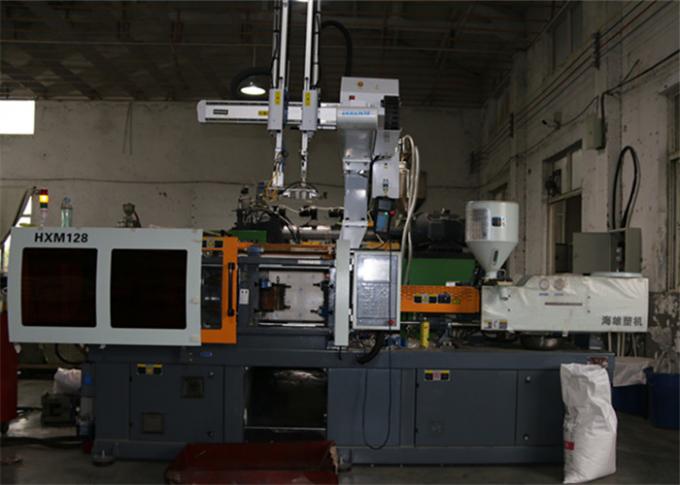
Injection moulding of HDPE shells, lids and tube components — the production stage where shell material and seal integrity are determined.
The fill then has to be matched to the document set. A SAP or CMC fill, a PCM fill and a cooling-gel fill are different chemical systems with different handling notes, different disposal routes and, in the EU food-contact framework, potentially different assessment needs. This is why a dossier assembled at brand level rather than model level tends to collapse at the evaluation stage: the reviewer cannot tell which document belongs to which fill.
It is equally important to state what the four documents do not cover. They do not report leak or drop performance after repeated freeze-thaw, they do not report compression strength under a loaded cooler, and they do not report hold time. Those sit in a separate performance layer. WHO PQS documentation for vaccine cold boxes (specification reference E004/CB01.3, as cited in the evidence set behind this guide) frames verification around maintaining 2–8 °C with a 48-hour cold life at 43 °C ambient — a system-level requirement that no certificate satisfies on its own and that no gel pack meets in isolation from its box, payload and ambient profile.
Model-by-Model Document Differences in the JISILL and JISI Range
The records below show the pattern a buyer should expect: the core four documents recur, while SGS, CE, LFGB and the EU regulation appear only on specific models. Read the table as a document map, not as a ranking — a model without a CE line is not thereby non-conforming; it simply has a different documented scope.
| Model (type) | Size / capacity | Outer / inner material | Documents listed in the product record |
|---|---|---|---|
| BH047 — Ice Cooler Brick | 23.5 × 19.5 × 3 cm; 1,000 g | Food Grade HDPE / Cooling Gel | FDA, MSDS, CPSIA, Regulation (EU) No 10/2011 |
| BH084 — Large Cooler Ice Packs | 33 × 22.5 × 2 cm; 1,000 g | Plastic HDPE / Cooling Liquid | FDA, SGS, MSDS, CPSIA, EU |
| BH125 — Breast Milk Ice Pack | 21 × 12 × 4.5 cm; 505 ml | Food Grade HDPE / Cooling Gel | FDA, SGS, MSDS, CPSIA |
| BH055 — Plastic Ice Packs | 16.5 × 9 × 1.8 cm; 200 g | Environment HDPE / SAP or CMC | FDA, SGS, MSDS, CPSIA, CE |
| BH162 — Cool Bag Ice Packs | 250 ml / 500 ml | Nylon PE / PCM | SGS, FDA, MSDS, CPSIA, LFGB |
| BH065 — Fan Ice Pack | 18.5 × 11.7 × 3.3 cm; 600 ml | HDPE / Cooling Powder | FDA, MSDS, CPSIA, Regulation (EU) No 10/2011 |
| BH066 — Ultra Thin Ice Pack | 19 × 12.5 × 1 cm | HDPE / SAP or CMC | FDA, SGS, MSDS, CPSIA, LFGB |
| BH130 — PCM Ice Pack | 46 × 32.5 × 2.5 cm; 2,600 ml | HDPE / PCM | FDA, SGS, MSDS, CPSIA |
| BH050 — Fan Ice Pack | 16.5 × 10.2 × 3 cm; 350 g | Food Grade HDPE / Cooling Gel | FDA, MSDS, CPSIA, Regulation (EU) No 10/2011 |
Three details in that table are easy to miss in a spreadsheet review. First, brand spelling varies between records: several models carry JISILL and others carry JISI, so the name printed on a certificate should be checked against the name on the purchase order before documents are filed. Second, an SGS line appears on five models in this set and not on others, which reflects where third-party testing was commissioned rather than a product hierarchy. Third, the CE line appears on BH055's certification record while its certificate field lists only FDA, SGS, MSDS and CPSIA — exactly the kind of internal inconsistency a buyer should resolve in writing rather than infer.
When the pack is one component of a larger cold-chain system, the container documents enter the same review. The JS-42L medical cool box, for example, is recorded as a 42 L, 2–8 °C unit with PU and vacuum insulated panel construction, a stated thermal conductivity below 0.0025 W/m·K, and FDA, MSDS and CPSIA documentation. The BWX42L vacuum insulated panel is recorded with SGS documentation for a −20 °C, 42 L configuration. Neither record turns a gel pack dossier into a system qualification, but a buyer assembling a vaccine or reagent transfer kit needs both layers visible in the same file.
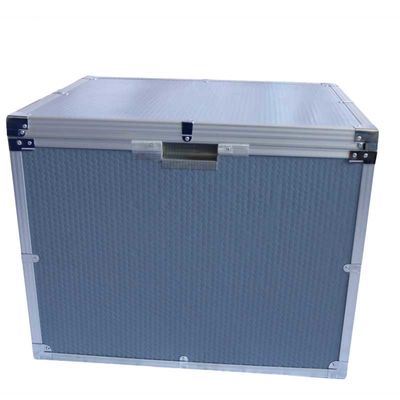
JS-42L medical cool box: when packs ship inside a temperature-controlled box, the container documentation joins the dossier review.
A Step-by-Step Dossier Request Process
Run the request in this order and most of the rework disappears. Each step produces something the next step depends on, so skipping ahead usually means restarting.
- Lock the model and the fill. Write the model number and the fill into the RFQ — for example BH047 with cooling gel, or BH066 with SAP or CMC. A dossier request without a model number invites a brand-level answer.
- State the intended use and the destination markets. “Cools product inside an insulated box, shipped to Germany and the United States” produces a different, and more accurate, document list than “medical use”.
- Ask for a document index before the documents. One table listing model, document type, issuing body, report or certificate number, issue date and covered market.
- Check document-to-model match. Reject any item that does not name the model and the fill, even if the certificate itself is genuine.
- Check scope and assumptions. For EU 10/2011, confirm the food-contact conditions assumed. For CPSIA, confirm whether a children's-product scope was assessed. For FDA, confirm which document type is being supplied.
- Ask for the underlying report, not the summary line. A one-line “passed” entry cannot be audited; the report number, test method and result can.
- Cross-check names. Confirm that the entity and brand on each document match the entity and brand on the purchase order, including the JISILL and JISI spellings used across the range.
- Record the acceptance decision and re-verify on change. Any new tooling, resin source, fill formulation or colourant is a trigger to re-confirm, not to assume continuity.
Acceptance Criteria: What a Passing Dossier Looks Like
A dossier is acceptable when every item can be traced to the purchased item and to a defined regulatory question. The criteria below are the ones worth writing into the evaluation record.
- The document names the exact model (for example BH047, BH125 or BH130) and the fill actually supplied.
- The issuing laboratory or body is identifiable, with an issue date and a report or certificate number.
- The scope statement matches your use: in-box cooling, direct food contact, children's-product scope, or device application.
- EU 10/2011 documentation states the food-contact conditions assumed and references the migration testing performed.
- The SDS revision date is current and its composition section matches the model's fill.
- The supplier confirms in writing which models are covered by which certificate — no brand-level blanket statements.
- Receipt samples match the documented construction: shell material, fill, colourant, cap or weld.
- Documents are re-issued or re-confirmed when tooling, resin or fill changes, and the re-confirmation is filed with the original.
Two criteria are commonly dropped and are worth restoring. The first is the intended-use statement: without it, a reviewer cannot tell whether a food-contact document, a children's-product document or a device document is the relevant one. The second is the change trigger, because most compliance failures in repeat orders happen after a silent material or tooling substitution, not on the first shipment.
Where This Matters: Health & Medicine Cold-Chain Scenarios
Documentation priorities shift with the scenario, even when the same pack family is used. The three patterns below cover most evaluations.
Vaccine and reagent transfers at 2–8 °C. Here the pack sits inside a validated box and the dossier is a screening layer, not the qualification. The packs matter for temperature band and repeatability; the documented 2–8 °C PCM grade in the range is relevant at the selection stage, while hold-time evidence belongs to the box-and-payload test. Buyers should keep the two files separate so a conformity document is never mistaken for a performance result.
Breast milk and maternal health shipping. BH125, a 21 × 12 × 4.5 cm, 505 ml breast milk ice pack with food grade HDPE and cooling gel, sits in a use case where food-contact and material-safety questions arrive early, often from the recipient side as well as the procurement side. A model-specific FDA, MSDS and CPSIA file, plus a clear statement on the fill, answers most of those questions before they escalate.
Pharmacy last-mile and diagnostic sample courier. Smaller formats dominate: BH066 at 19 × 12.5 × 1 cm, or the JS BH014 mini ice pack at 12 × 7.8 × 2 cm and 150 g. These are the models most likely to trigger a CPSIA question, because thin, small and colourful packs migrate into lunch and consumer contexts. Confirm the scope deliberately rather than by default.
FAQ
Is a gel ice pack FDA approved for medical cold chain use?
No single FDA approval covers gel ice packs, and buyers should not accept that wording. FDA does not pre-approve a reusable gel pack as a product category. FDA's product classification database does list cold packs within regulation number 890, the physical medicine device framework at 21 CFR Part 890, but that entry addresses cold packs used as medical devices; it does not convert a gel pack that cools product inside an insulated box into a regulated device. Depending on intended use, the relevant route may be food-contact rules, general consumer-product rules or device rules. Ask the supplier for the actual document it holds — report, statement or registration — with the model number, material and date on it, and record your intended use in the file.
Which documents should a Health & Medicine buyer request per gel ice pack model?
Request four items for the exact model: the FDA-related document the supplier actually holds, the MSDS or SDS for that model's fill, CPSIA evidence if the pack is or could be a children's product, and Regulation (EU) No 10/2011 documentation if the pack or its plastic parts contact food in the EU. Add the model-specific extras shown in the record — SGS reports, LFGB or CE where listed. Every item should name the model (for example BH047 or BH125), the fill (cooling gel, SAP or CMC, PCM, cooling powder), the issuing body and the issue date.
Can Jisi Cold Chain supply model-specific documents and customized packs?
Changzhou Jisi Cold Chain Technology Co., Ltd. states that it holds FDA, SGS and MSDS reports for its products and describes its outer material as HDPE with SAP or CMC inside, non-toxic. Its capability record lists OEM/ODM production, customization of shape, temperature, colour, size and logo, and 100% testing, in a 40,000 m² factory with 60 employees and 620,000 units of annual output. Because documentation differs by model, confirm the exact model in the RFQ: BH047 and BH050 list Regulation (EU) No 10/2011, BH055 additionally lists CE, and BH162 and BH066 list LFGB.
Does the dossier include price, and what MOQ applies?
The dossier contains conformity documents, not commercial terms, so price is quoted per project and is not part of the compliance package. MOQ figures also need written confirmation, because the supplied records differ: the capability record lists a 1,000-piece MOQ, while the corporate FAQ describes about 3,000 pieces for existing models and more than 5,000 pieces when a new model is created. Treat the quotation as the controlling document, and keep both figures visible in the evaluation notes instead of assuming one applies.
Can I test samples before committing, and what is the lead time?
Yes. For existing models without printing, Jisi Cold Chain offers free samples with freight paid by the buyer, and model records list sample turnaround of about two days. Bulk delivery varies by model — roughly 7 to 10 days for BH047, 5 to 7 days for BH065 and 10 to 15 days for the JS-42L medical cool box — with supply ability recorded at about 10,000 pieces per week for BH047 and BH065. A practical next step is to request a sample together with the document index for that same model and check that the two match before ordering; the Jisi Cold Chain company and product brochure (PDF) summarises the range for that request.
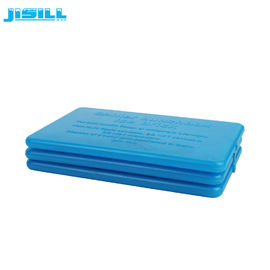
Model BH066 ultra thin ice pack: a model whose record lists FDA, SGS, MSDS, CPSIA and LFGB documentation.
Conclusion
A gel ice pack dossier is only as strong as its mapping. The four documents — FDA-related documentation, MSDS/SDS, CPSIA evidence and Regulation (EU) No 10/2011 — answer four different questions, and none of them answers the performance question a medical cold-chain team eventually asks. What the dossier does is establish, model by model, that the shell material and the fill have been assessed for the market and contact scenario you are buying for.
The work of evaluation therefore sits in three places: confirming which document exists for the specific model, confirming what scope that document actually covers, and confirming that the physical sample matches the file. Across the JISILL and JISI range those documents vary — SGS on some models, CE on one, LFGB on two, Regulation (EU) No 10/2011 on three — and that variation is normal. What is not acceptable is a brand-level certificate package presented as model-level evidence. Request the index first, match it to the purchase order, and keep the acceptance criteria in the file so the next repeat order is checked against the same standard.
Have Questions or Need More Details?
Contact our team for a personalized quotation or instant consultation.
Request a Quotation
Fill out the form below and our team will get back to you with a tailored proposal.
WhatsApp Direct Chat
Prefer to chat in real-time? Message us on WhatsApp for instant assistance & quick answers.
- Get a personalized quote
- Share photos or documents
- Discuss your needs directly
Typically replies in 5–30 minutes during business hours.