How Self-Adhesive PVC Film Solves Interior Decoration Problems
Short answer: most interior decoration problems that end in a full replacement are surface problems, not structural ones. Self-adhesive PVC decorative film answers them by changing the visible face of a sound substrate instead of the substrate itself. A 0.16 mm PVC film with a water-based acrylic pressure-sensitive adhesive is applied peel-and-stick to cabinet doors, wardrobe fronts, vanity panels, furniture tops and wall surfaces, so the room can be re-finished without dismantling it.
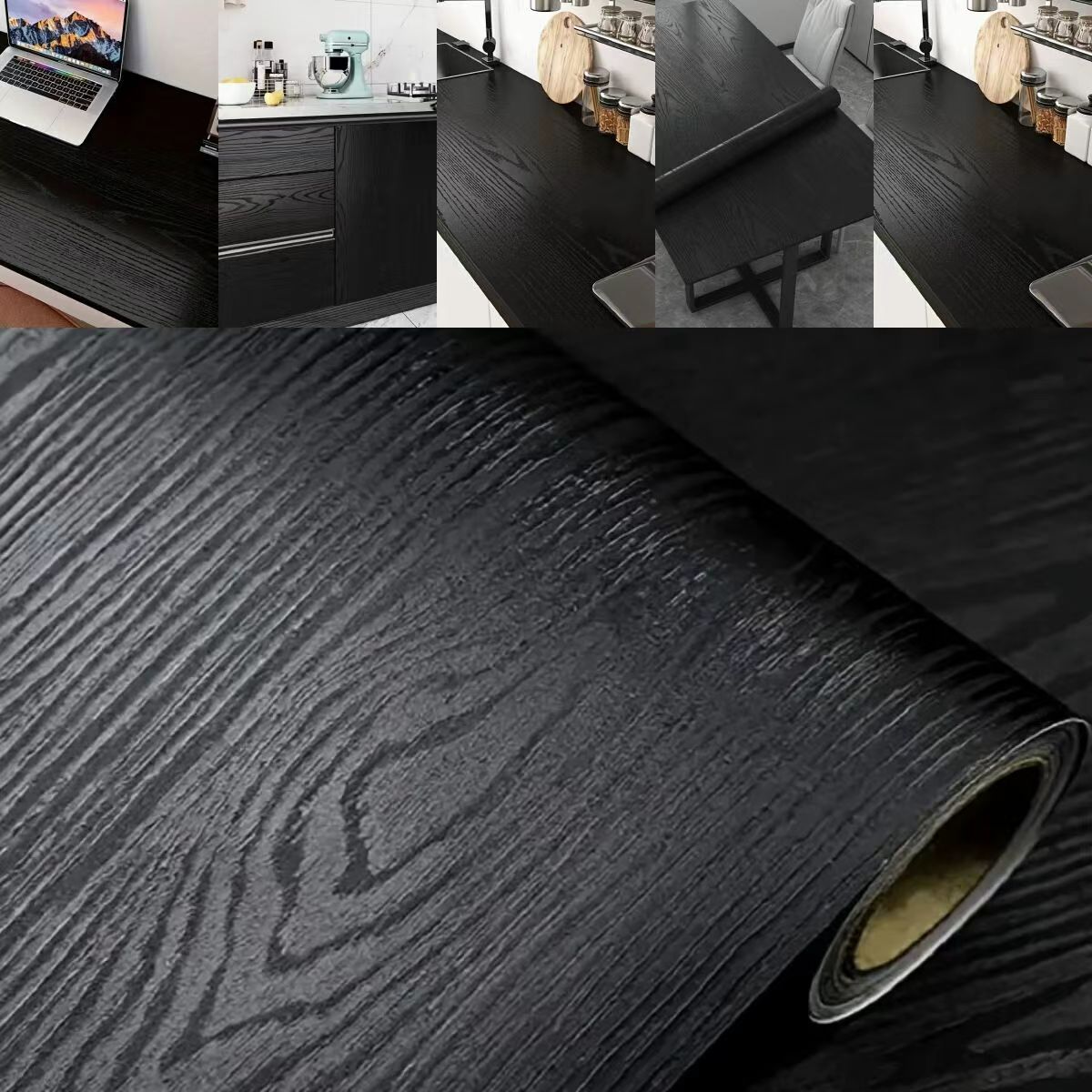
Re-facing instead of replacing: the existing board stays, the visible surface changes. Image: Foshan Nanhai Jiadamei Decoration Material Co., Ltd.
The material also has clear limits, and they matter more than the marketing version of the story. Film does not restore a failing substrate, it does not replace waterproofing at joints, and it is not a structural repair. The sections below set out what the film is designed to fix, what it will not fix, and which production capabilities determine whether a project comes out consistent across dozens of doors or only looks acceptable on the first panel.
Problem Definition: Five Surface Problems That Trigger a Renovation
Interior decoration decisions are rarely triggered by a board that has stopped working. In most renovation projects the trigger is appearance, hygiene or downtime: a kitchen that looks a decade older than the building, a vanity with water staining below the counter, a wardrobe run where three doors were replaced and no longer match, or a hotel floor that cannot be closed for three weeks. Those five situations are the ones self-adhesive PVC decorative film is built to answer.
1. Ageing surfaces on boards that are still structurally sound
Cabinets, wardrobes and doors from an earlier renovation cycle are frequently square, solid and correctly hung, but their surface has yellowed, dulled or gone out of fashion. Replacing them creates a second problem: matching discontinued door profiles, hinges and handles. Film keeps the carcass and the hardware and changes only the face, which is why cabinet wrap PVC film is one of the most common renovation uses of this material.
2. Moisture staining in bathrooms and wash areas
The PVC surface of the film is water-resistant and easy to clean, which makes it suitable for normal bathroom and wash-area use. The limitation is specific: edges, joints and the underlying substrate should not be continuously exposed to water or excessive moisture. A bathroom waterproof PVC film application is therefore a surface solution on a stable, sealed panel — not a substitute for sealing the room itself.
3. Scratches, fading and replacement parts that no longer match
Once one panel in a visible run has been replaced, the whole run tends to look mismatched. Solid colour PVC decorative film is the simplest way to bring a set of doors back to one colour, and wood grain or marble grain patterns can be used where the surrounding joinery has a grain or stone effect. For furniture in daily use, buyers often raise surface durability such as anti-scratch performance; the appropriate approach is to state the requirement up front and verify it against an approved sample rather than assume it.
4. Downtime in hotels, offices and retail spaces
Commercial interiors have the same surface problems as homes, with an additional cost: every closed room or aisle is lost revenue. Because the film is applied to existing surfaces, hotel rooms, office fronts and retail fixtures can be re-faced without removing them from the building, which shortens the period in which a space is unusable.
5. A design that the current stock cannot match
The fifth problem is commercial rather than physical. A designer specifies a warm grey or a particular stone effect, and the stock range does not carry it. This is where OEM and ODM capability decides whether the project moves forward, and where a supplier with in-house coating and printing can offer custom colours, custom patterns and sample-based matching instead of a near-miss from the catalogue.
Industry Background: Why Film Is Now a Standard Renovation Answer
Decorative film is no longer a niche substitute material. Dataintelo's PVC Decorative Film Market Research Report 2034 values the global PVC decorative film market at USD 4.8 billion in 2025 and projects USD 8.6 billion by 2034. The same report places Asia Pacific at a 42.3% revenue share in 2025, the furniture sector at approximately 44.6% of global consumption, and wood grain as the largest product segment at 38.4% in 2025.
Supply has followed demand. International Trader Publications reported that China became the world's largest PVC exporter in 2025, accounting for 24% of total global trade volume, and General Administration of Customs China data shows exports under HS Code 3919 (self-adhesive plates, sheets, film, foil, tape and strip of plastics) reaching an all-time high of RMB 246.296 million in January 2026.
For a buyer or specifier, the practical consequence is that the question has shifted. It is no longer whether film is an acceptable renovation material, but which format, which finish and which production capability will hold a large surface area consistent. That is a capability question, and it is answered by looking at coating lines, inspection routines, colour matching and customisation scope rather than by the pattern catalogue alone.
Detailed Solution: What the Film Is and Which Capabilities Decide the Outcome
Leiyegaoke (Foshan Nanhai Jiadamei Decoration Material Co., Ltd.) is a manufacturer of self-adhesive PVC decorative film based in Foshan, Guangdong, China, founded in 2001. Its product range and production data make a useful reference for the capability points that decide whether a problem-solution project succeeds.
Material and roll format
The standard construction is a PVC film with a water-based acrylic pressure-sensitive adhesive and a paper release liner, supplied in a peel-and-stick format. The standard specification across the range is 0.16 mm thickness, 1,240 mm width and 50 m per roll, packed one roll per carton and declared under HS code 39199090. Those fixed dimensions matter in practice: a 1,240 mm width allows cabinet doors and furniture panels to be covered without a longitudinal join in most cases.
Finish and pattern range
Surface finishes include matte, glossy, embossed and super matte. Pattern categories include wood grain, marble, stone, solid colour, metallic, textile and concrete. Super matte PVC decorative film is typically chosen where a low-sheen appearance is wanted and where reflections on large dark surfaces would otherwise dominate the room, while glossier finishes are used where light reflection is part of the design.
Named series and how they map to a project
- LY1804–LY1869 — self-adhesive PVC decorative film offered across wood grain, marble, solid colour, stone, metallic, textile and concrete patterns, with matte, glossy, embossed or super matte finishing, applied by peel and stick to furniture, cabinets, doors, walls and interior renovation surfaces.
- LG7801–LG7836 — Japanese-style wood grain PVC decorative film in 0.16 mm thickness, 1,240 mm × 50 m per roll, with matte or super matte finish, water-based acrylic adhesive and paper release liner.
- LF6801–LF6830 — marble grain PVC decorative film in 0.16 mm thickness, 1,240 mm width and 50 m per roll, with matte, glossy or textured finish options, customizable colour, pattern and adhesive strength, intended for indoor decorative surface renovation.
Customisation: the OEM/ODM layer
The manufacturer provides OEM and ODM production services. Documented customisation scope covers custom colours, custom patterns, sample-based customisation, custom sizes, custom thickness, surface finish customisation, custom logo, custom labels, custom packaging and custom cartons. That scope is what makes problem five solvable: a project that needs a specific colour or a pattern matched to existing joinery can be produced to sample rather than forced into the nearest stock option.
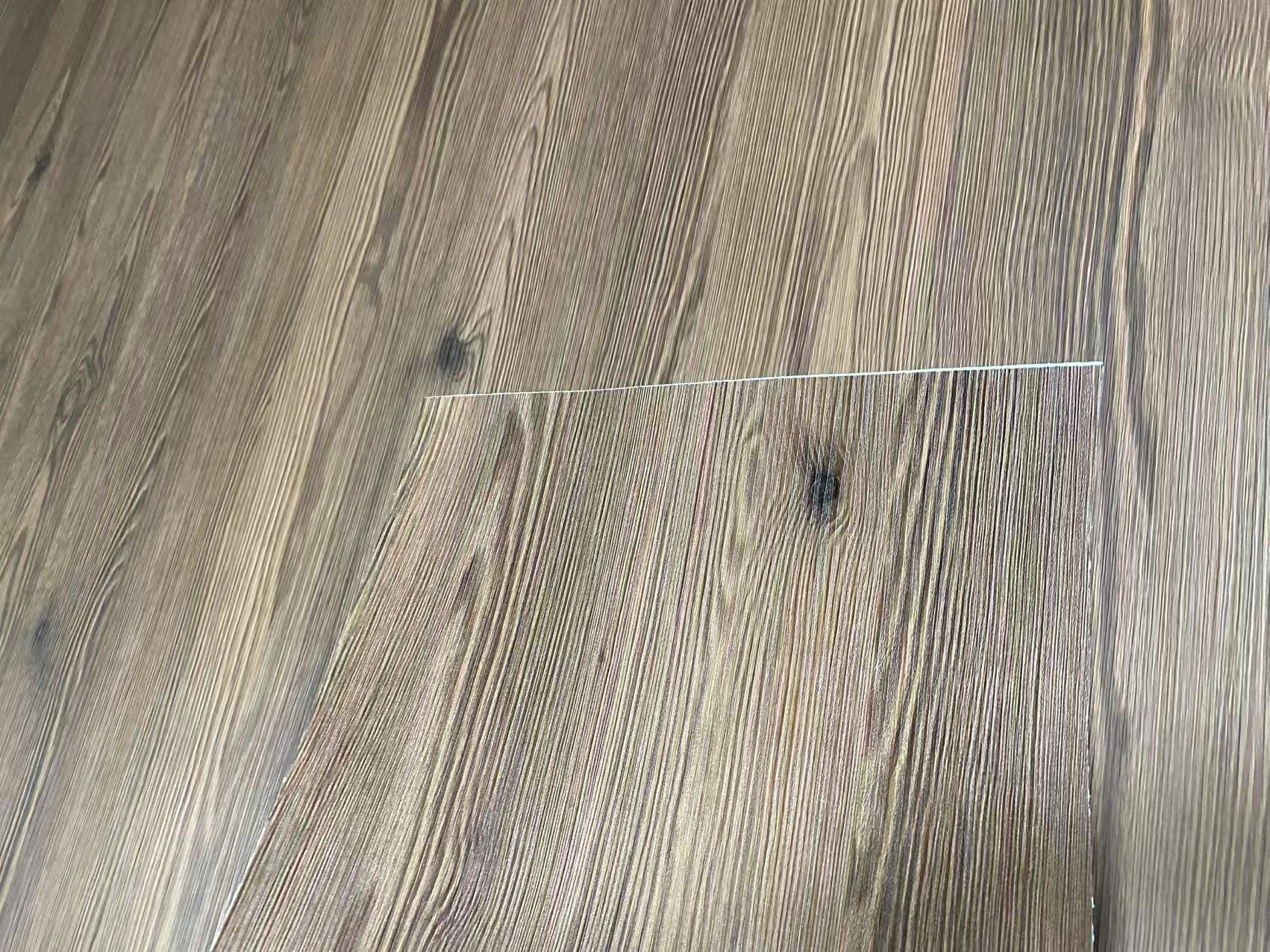
OEM/ODM scope covers custom colours, patterns, thickness, roll sizes, adhesives, labels and packaging.
Production control, capacity and lead time
The factory covers 12,000 m² with 50 employees, including 5 R&D engineers, and runs two adhesive coating lines inside an integrated system that covers PVC film production, printing, laminating, adhesive coating, slitting, inspection and packaging. Annual output is 15,000,000 meters, monthly capacity is 120,000 meters, quality control is documented as 100% test, and the stated lead time is 20–25 days. Roughly 80% of output is exported, with customers in Europe, South America, the Middle East and CIS countries, as well as Southeast Asia, Africa and North America.
For a renovation contractor or distributor, the integrated line matters for three reasons. Colour matching, thickness and adhesive performance are controlled inside one process rather than assembled from several suppliers; roll-to-roll consistency is what keeps a 40-door run visually uniform; and the lead time is a planning input for projects with fixed handover dates.
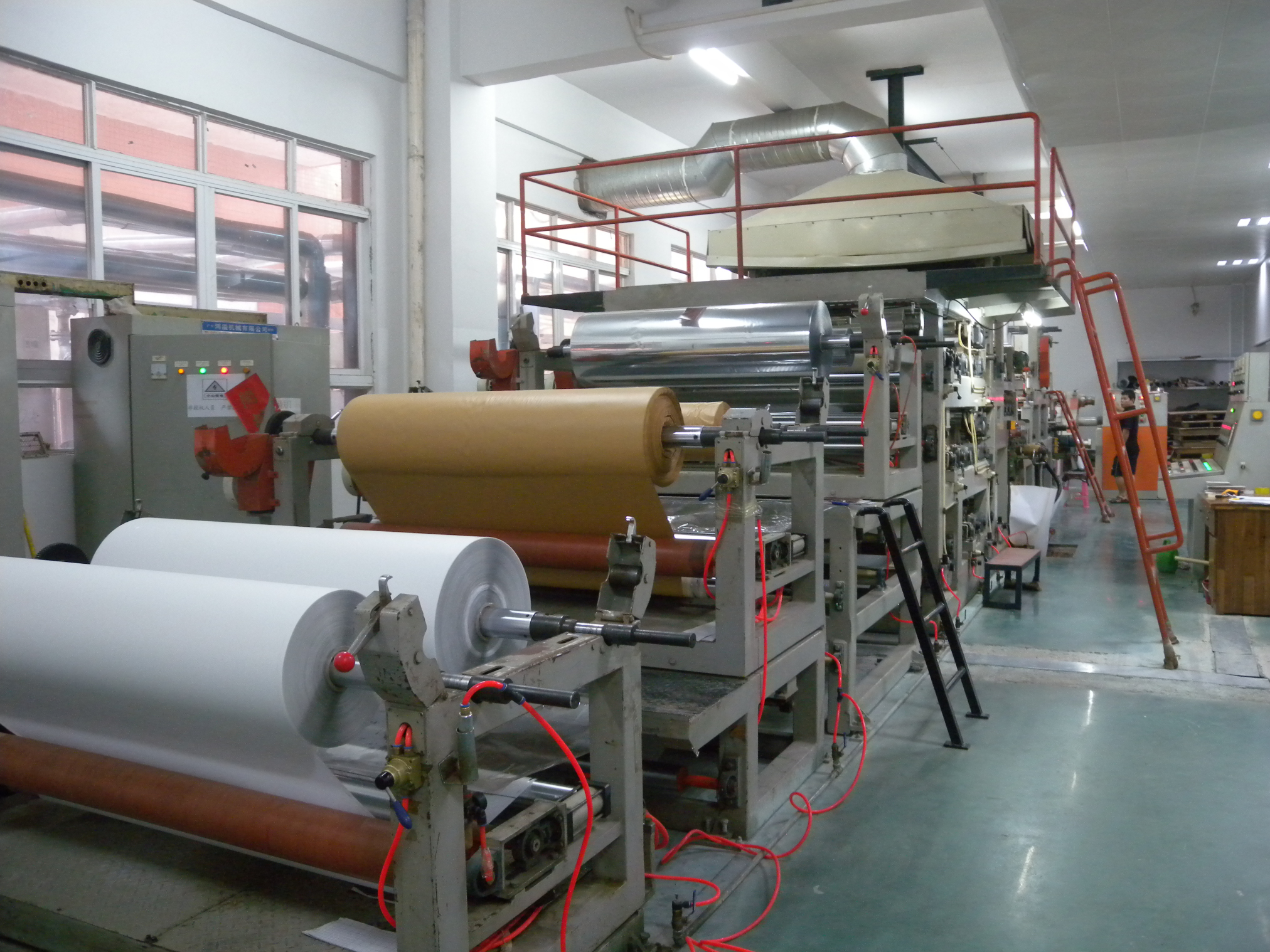
Two adhesive coating lines and an integrated printing, laminating, slitting and inspection process support roll-to-roll consistency.
Compliance documentation
The manufacturer states that its products comply with REACH and RoHS. A RoHS test report, certificate number CANEC26009798401, was issued on 24 April 2026 by SGS-CSTC Standards Technical Services Co., Ltd. Guangzhou Branch under the EU RoHS Directive (EU) 2015/863 amending Annex II to Directive 2011/65/EU, with a scope covering self adhesive PVC decorative film, PVC decorative film and vinyl film.
Chemical compliance is not the same as fire performance. Flame-retardant grades such as B1 (GB 8624) exist in the decorative film market and are specified in some commercial projects, and buyers who use tensile strength and elongation as acceptance criteria may reference ASTM D1593, the standard specification for nonrigid vinyl chloride plastic film and sheeting. Where a project requires either, the requirement should be confirmed in writing against the specific product rather than assumed from a general compliance statement.
Step-by-Step Breakdown: Six Steps From Diagnosis to Finished Surface
The difference between a renovation that looks factory-finished and one that fails at the edges is almost always preparation and application discipline, not the film itself. The following sequence reflects the documented application requirements and risk notes for self-adhesive PVC decorative film.
Step 1 — Diagnose the substrate before ordering anything
Film is recommended for smooth, clean, dry and stable surfaces, including furniture panels, cabinets, doors, metal, glass and other properly prepared interior surfaces. Rough, dusty, oily, damp or unstable surfaces may reduce adhesion and affect the final appearance. This step is a go or no-go check: if the panel is delaminating, swollen from long-term water ingress or physically broken, the film is the wrong answer.
Step 2 — Choose finish and pattern from the problem, not from the swatch book
A bathroom panel and a kitchen door have different exposure profiles; a dark wardrobe front and a light door have different glare behaviour. Selecting the finish against the actual condition prevents a technically correct installation from looking wrong in place.
Step 3 — Prepare the surface completely
Remove dust, oil, moisture and loose material before installation, and dry the surface thoroughly. Where the substrate is uncertain, test a small area before full installation. Rough or porous surfaces may require surface treatment or a primer; that requirement should be established before the order is placed, not on the day of installation.
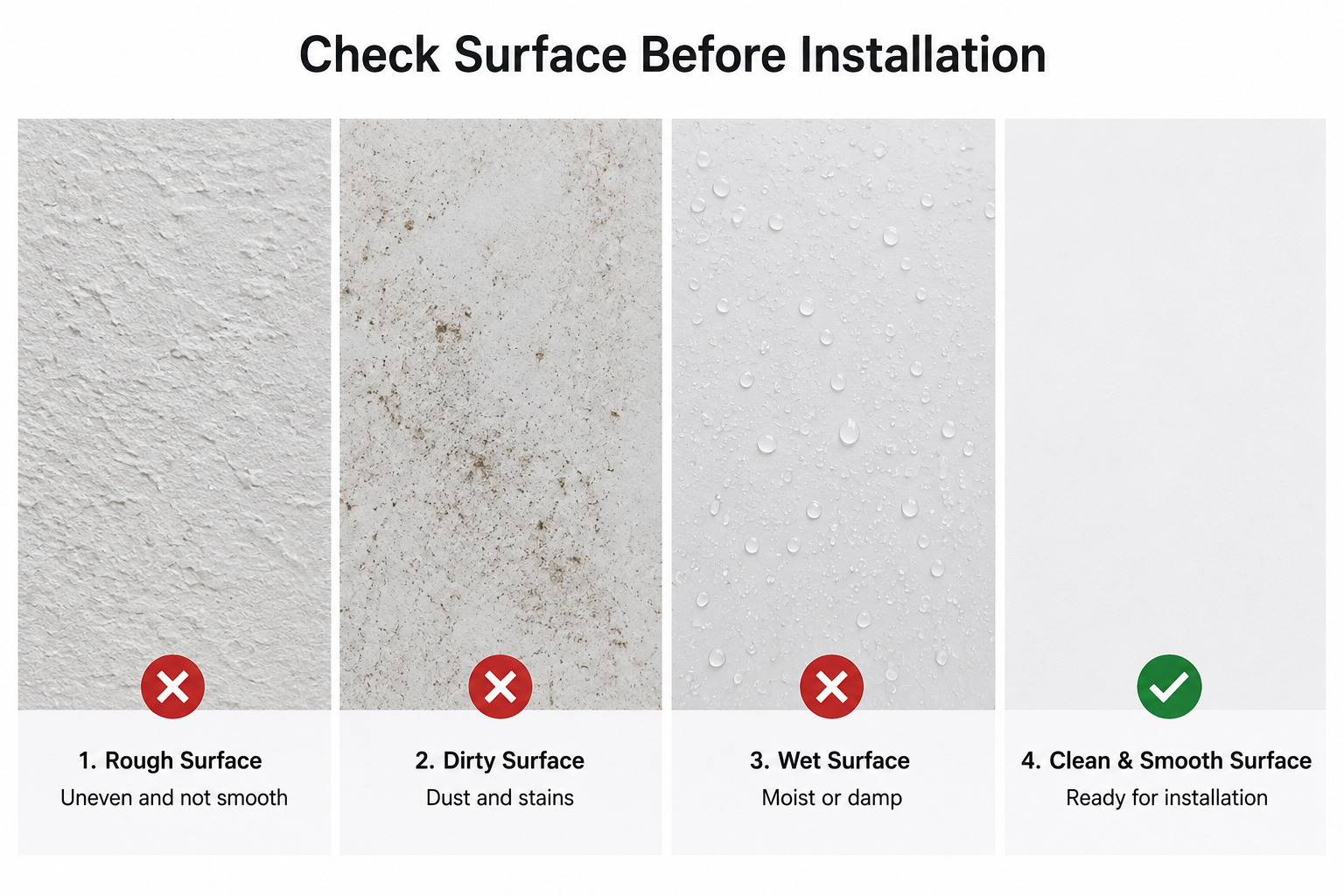
Preparation check: smooth, clean, dry and stable substrates are the documented requirement for reliable adhesion.
Step 4 — Plan the cut and set out the tools
Standard application equipment includes a utility knife, squeegee, heat gun, measuring tape, ruler, surface cleaning tools, edge trimming tools and an application roller. Working from a roll plan that follows the panel sequence reduces waste and keeps the pattern direction consistent across adjacent doors.
Step 5 — Apply gradually and push the air out
Peel the release liner back step by step and use the squeegee to push trapped air out as the film goes down. For bubble-free application, air-release self-adhesive PVC film helps: it uses a specially designed release liner and adhesive structure that creates micro air channels allowing trapped air to escape more easily during installation. Standard adhesive film without air-release channels requires more careful application and is more likely to trap air if installed improperly. Where large areas or cabinet wrapping are involved, it is worth confirming with the supplier which adhesive structure the order will carry.
Step 6 — Trim, inspect and maintain
Trim edges cleanly, use heat on curves and returns where the material needs to follow a shape, then inspect for lifting at corners. Routine maintenance is simple: remove loose dust with a soft dry cloth, wipe normal stains with a soft damp cloth, use a mild neutral detergent diluted with water for grease or stubborn dirt, wipe again with a clean damp cloth to remove residue, and dry with a soft clean cloth. Test any unfamiliar cleaning product on a small hidden area first.
Use Cases: Scenario Mapping
Kitchen and cabinetry renovation
Self-adhesive PVC decorative film is suitable for renovating kitchen cabinet doors and other smooth indoor furniture surfaces, and provides a decorative, water-resistant and easy-to-clean surface. It works best on painted wood, sealed MDF, metal and other properly finished panels; rough, dusty, oily or untreated porous surfaces need preparation first. A furniture manufacturer in Algeria has laminated the film onto MDF board for more than six years at 100,000 meters per month, producing finished cabinet doors, with stated requirements covering design, colour, waterproofing, oil-proofing and anti-scratch performance.
Bathroom and wash-area panels
The PVC surface is water-resistant and easy to clean for normal use, and marble grain film is often the natural choice where a stone effect is wanted. The condition to respect is at the joints: edges and the underlying substrate should not be continuously exposed to water or excessive moisture, so sealing and detailing remain part of the job.
Furniture renovation
Tables, sideboards, wardrobe doors and shelving can be re-faced in place. Solid colour film is used where uniformity is the goal, wood grain where the existing interior has timber and super matte where a quiet, low-reflection finish suits the room.
Hotels, offices and retail interiors
When a floor or an office front is re-faced rather than rebuilt, the space returns to service sooner. The roll format supports multi-panel runs, and the pattern range covers the hotel, office and retail palettes described for this material.
Distributor and renovation-supplier programmes
For importers, distributors and renovation material suppliers, private-label packing is part of the OEM/ODM scope: custom logo, labels, cartons and packaging can be produced alongside the film itself. Stock colours are available from one roll per colour, which allows a distributor to test a market before committing to volume.
Comparison Table: Repair Options and Film Format Selection
When a surface looks tired, three routes are usually on the table. The comparison below uses only documented product facts and neutral practical considerations; it does not assume a cost difference that has not been quoted.
| Option | What actually changes | Where it fits | Constraints to confirm |
|---|---|---|---|
| Replace doors or panels | The board and the finish | Damaged or delaminating substrate; a change of door style or size | New panel lead time, re-fitting of hinges and handles, and matching discontinued profiles |
| Repaint or re-spray | Only the coating | Flat, smooth, well-prepared surfaces with a suitable base coat | Surface preparation, curing time, and masking of adjacent surfaces in an occupied room |
| Self-adhesive PVC decorative film | Only the visible face | Sound, smooth, clean, dry and stable substrates: furniture panels, cabinets, doors, metal, glass | Surface preparation, edge detailing, and avoiding continuous water exposure at edges and joints |
The second table maps the on-site problem to the format that answers it, using the documented series and finish options.
| Problem on site | Format to evaluate | Basis in the documented product range |
|---|---|---|
| Mismatched or uneven colour across a run of doors | Solid colour film, LY1804–LY1869 | Solid colour is a listed pattern; custom colours are available from 3,000 meters per colour |
| Grease and daily wiping on kitchen fronts | Matte or super matte, LG7801–LG7836 or LY1804–LY1869 | Water-resistant, easy-to-clean surface; matte and super matte are listed finishes |
| Bathroom and wash-area panels | Marble grain, LF6801–LF6830 | Marble grain series with customizable colour, pattern and adhesive strength |
| Glare and reflections on large dark surfaces | Super matte finish | Super matte is listed for LG7801–LG7836 and LY1804–LY1869 |
| A pattern that must match existing joinery | Custom pattern, sample-based customisation | OEM/ODM scope includes custom colours, custom patterns and sample-based customisation |
FAQ
Does self-adhesive PVC film for interior decoration meet EU compliance requirements?
For this manufacturer, the stated compliance position is REACH and RoHS. A RoHS test report, certificate number CANEC26009798401, was issued on 24 April 2026 by SGS-CSTC Standards Technical Services Co., Ltd. Guangzhou Branch under the EU RoHS Directive (EU) 2015/863 amending Annex II to Directive 2011/65/EU, with the scope covering self adhesive PVC decorative film, PVC decorative film and vinyl film. The products are declared under HS code 39199090. Compliance is product- and project-specific: fire performance, such as B1 (GB 8624) flame-retardant grades, and physical tests such as ASTM D1593 are separate requirements and should be confirmed in writing for the project before ordering.
Can an OEM cabinet wrap PVC film manufacturer match a specific colour or pattern?
Yes, where the supplier runs OEM/ODM production. Leiyegaoke provides OEM and ODM production services and documents custom colours, custom patterns, sample-based customisation, custom sizes, custom thickness, surface finish customisation, custom logo, custom labels, custom packaging and custom cartons. Custom colour orders start at 3,000 meters per colour, while stock colours are available from one roll per colour. Colour matching and finished-product inspection sit inside the documented quality control process, and five R&D engineers work on product development and customisation.
What are the minimum order and delivery terms for an interior decoration project?
The documented purchasing terms are as follows. MOQ: stock colours one roll per colour; custom colours 3,000 meters per colour. Delivery terms: EXW, FOB, CIF, express and air shipment. Payment terms: T/T. Acceptance criteria: customer or third-party inspection, acceptance based on an approved sample, and inspection of appearance, colour, pattern and dimensions. Because the minimum order is defined per colour, a multi-colour project should be planned around the number of colours as well as the total meterage.
How should a sample be validated before a full order?
Request the sample in the actual colour, pattern, thickness and finish, then apply it to a representative piece of the real substrate rather than to a smooth offcut. Check adhesion, colour match, thickness and surface appearance after curing, and keep the approved sample as the acceptance reference, since acceptance can be based on the approved sample. Note that rough, dusty, oily, damp or unstable surfaces may reduce adhesion and cause bubbling, edge lifting or peeling. If the project covers large areas where trapped air is a risk, confirm with the supplier whether the order will use an air-release adhesive structure or standard adhesive.
What lead time applies to an OEM order?
The stated production lead time is 20–25 days, supported by a monthly capacity of 120,000 meters, an annual output of 15,000,000 meters and two adhesive coating lines within an integrated production system. For projects with a fixed handover date, it is advisable to confirm the schedule before the specification is locked. Samples, quotations and roll specifications can be requested directly from the manufacturer: Angel, office@jiadamei.com, +86 13420779866 (also WhatsApp), or through www.leiyegaoke.com.
Conclusion: A Decision Rule, Not a Universal Answer
Self-adhesive PVC film is the right answer when the substrate is sound, the surface can be made smooth, clean, dry and stable, and the problem is the visible face. It is the wrong answer when the panel is structurally failing, when an edge or joint will sit continuously in water, or when the project requires a fire or physical performance that has not been confirmed for the specific product.
Within those boundaries, the material closes the gap between a room that looks finished and a room that looks dated, without replacing the joinery behind it. The capability facts that decide the result are unglamorous: 0.16 mm thickness and 1,240 mm width held consistently, water-based acrylic adhesive applied on controlled coating lines, colour matching before production, 100% inspection, and the OEM/ODM flexibility to produce a colour or pattern that the project actually needs.
Next Step: Test the Film on Your Own Substrate
Send the panel type, the colour or pattern reference and the panel count, and request a sample in the matching series — LY1804–LY1869, LG7801–LG7836 or LF6801–LF6830 — together with a quotation and roll specification.
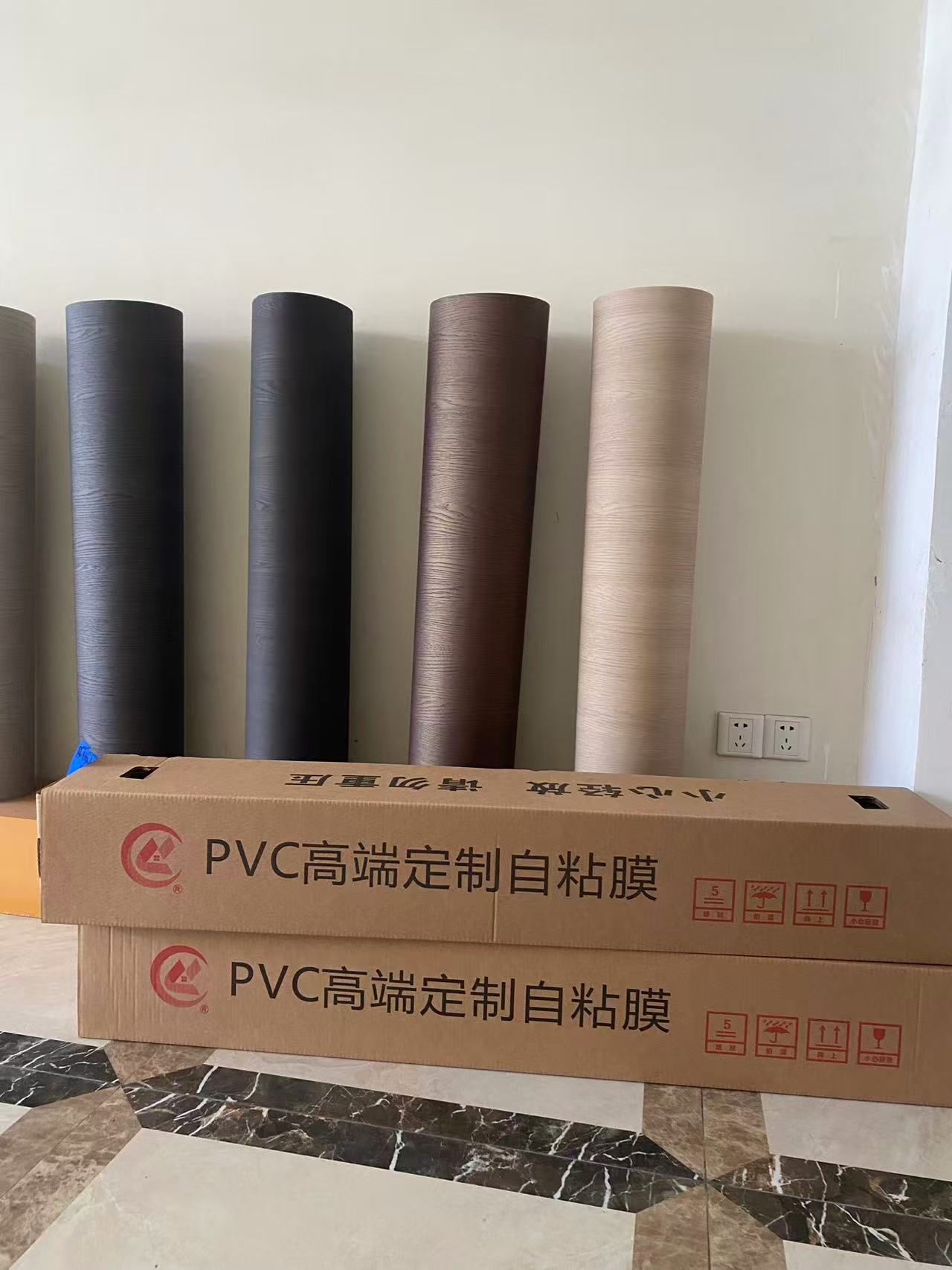
Foshan Nanhai Jiadamei Decoration Material Co., Ltd. (Leiyegaoke) · Jinguang Industrial Zone, Tangtou Village, Shishan Town, Nanhai District, Foshan, Guangdong, China · office@jiadamei.com · +86 13420779866
Have Questions or Need More Details?
Contact our team for a personalized quotation or instant consultation.
Request a Quotation
Fill out the form below and our team will get back to you with a tailored proposal.
WhatsApp Direct Chat
Prefer to chat in real-time? Message us on WhatsApp for instant assistance & quick answers.
- Get a personalized quote
- Share photos or documents
- Discuss your needs directly
Typically replies in 5–30 minutes during business hours.