
Marble Grain LF6801–LF6830 vs. Japanese-Style Wood Grain LG7801–LG7836
Marble grain and Japanese-style wood grain are usually shortlisted for the same interior project, and the decision rarely comes down to which one looks better on its own. In the Leiyegaoke range, marble grain LF6801–LF6801 to LF6830 and Japanese-style wood grain LG7801–LG7836 are built on the same film construction: PVC, 0.16 mm thick, 1,240 mm wide, 50 m per roll, with a paper release liner and a water-based acrylic pressure-sensitive adhesive. The real difference sits in what each grain family is asked to do on a surface.
Because the build is shared, this comparison is not about which film is technically superior. It is about matching a grain family to a project intent — a stone reference on cabinets and large panels, or a matte, smooth wood reference on doors, wardrobes and hotel joinery. The sections below compare the two ranges on the criteria that actually change a purchase order: finish, substrate, cutting behaviour, roll planning, cost logic and OEM scope.
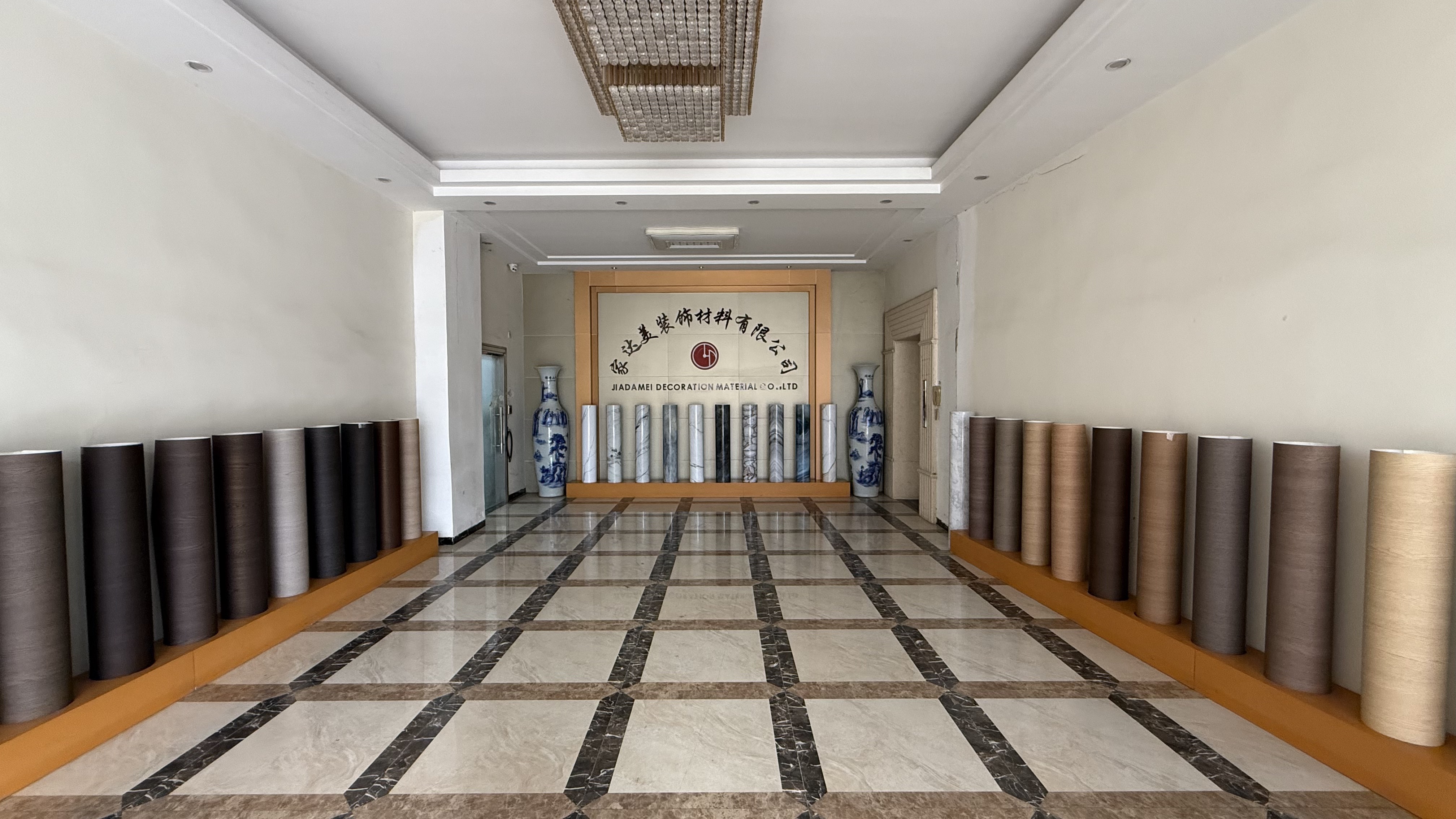
Film samples on display in the Leiyegaoke showroom, Foshan, Guangdong.
The short answer: pick by surface, not by preference
Choose marble grain LF6801–LF6830 when the target surface is large, flat and meant to read as stone — cabinet doors and panels, furniture faces, wall panels and other broad areas where a marble reference is replacing a slab. Choose Japanese-style wood grain LG7801–LG7836 when the surface is a door, a wardrobe front or hotel joinery where a matte or smooth wood finish is the design intent and the grain must repeat consistently across many panels.
Two project conditions settle most cases. The first is panel geometry: a stone pattern needs enough uninterrupted flat area for the veining to read as stone rather than as a repeated print, so narrow stiles, deep profiles and heavily divided doors rarely carry a marble look well. The second is repetition: when a hotel floor repeats the same door or wardrobe front dozens of times, grain direction and batch colour consistency matter more than the pattern itself, which is where a wood grain range with matte and smooth finish options tends to simplify specification.
| Attribute | Marble grain LF6801–LF6830 | Japanese-style wood grain LG7801–LG7836 |
|---|---|---|
| Film type | PVC self-adhesive decorative film | PVC self-adhesive decorative film |
| Nominal thickness | 0.16 mm | 0.16 mm |
| Roll width | 1,240 mm | 1,240 mm |
| Roll length | 50 m | 50 m |
| Roll area (calculated: 1.24 m × 50 m) | 62 m² | 62 m² |
| Release liner | Paper | Paper |
| Adhesive | Water-based acrylic, pressure-sensitive | Water-based acrylic, pressure-sensitive |
| Finish character | Realistic stone look; sheen level to be confirmed on the physical swatch | Matte or smooth finishes, as specified per reference |
| Surfaces it is usually specified for | Cabinets, furniture faces, large flat panels and wall areas | Doors, wardrobes, hotel joinery and repeated interior elements |
| Decision driver | Stone appearance without a slab | Calm wood appearance with controlled sheen |
What both ranges share before the grain decision
Because LF6801–LF6830 and LG7801–LG7836 come off the same production platform, a buyer comparing them is comparing pattern and finish, not base performance. The shared specification is worth stating explicitly, because it determines how both films behave on site.
- 0.16 mm PVC film. A thin, flexible decorative layer that conforms to flat and gently curved surfaces and can be trimmed at edges with hand tools.
- Thickness tolerance ±0.01 mm. Consistent gauge across a roll matters during installation: an uneven film is harder to squeegee evenly and shows more edge variation on butt joints.
- Colour deviation ΔE ≤ 2.0. This is the batch-to-batch colour control the manufacturer publishes for the product line, and it is the figure to quote when several rolls must match on one project.
- 1,240 mm × 50 m rolls. A working width that suits cabinet and panel work, supplied in a roll length that reduces the number of roll changes on a large job.
- Paper release liner. A flat, cuttable backing that holds its shape when film is measured and cut on a bench before peeling.
- Water-based acrylic pressure-sensitive adhesive. The carrier is water rather than an organic solvent, and the adhesive bonds under hand or squeegee pressure without a separate glue stage.
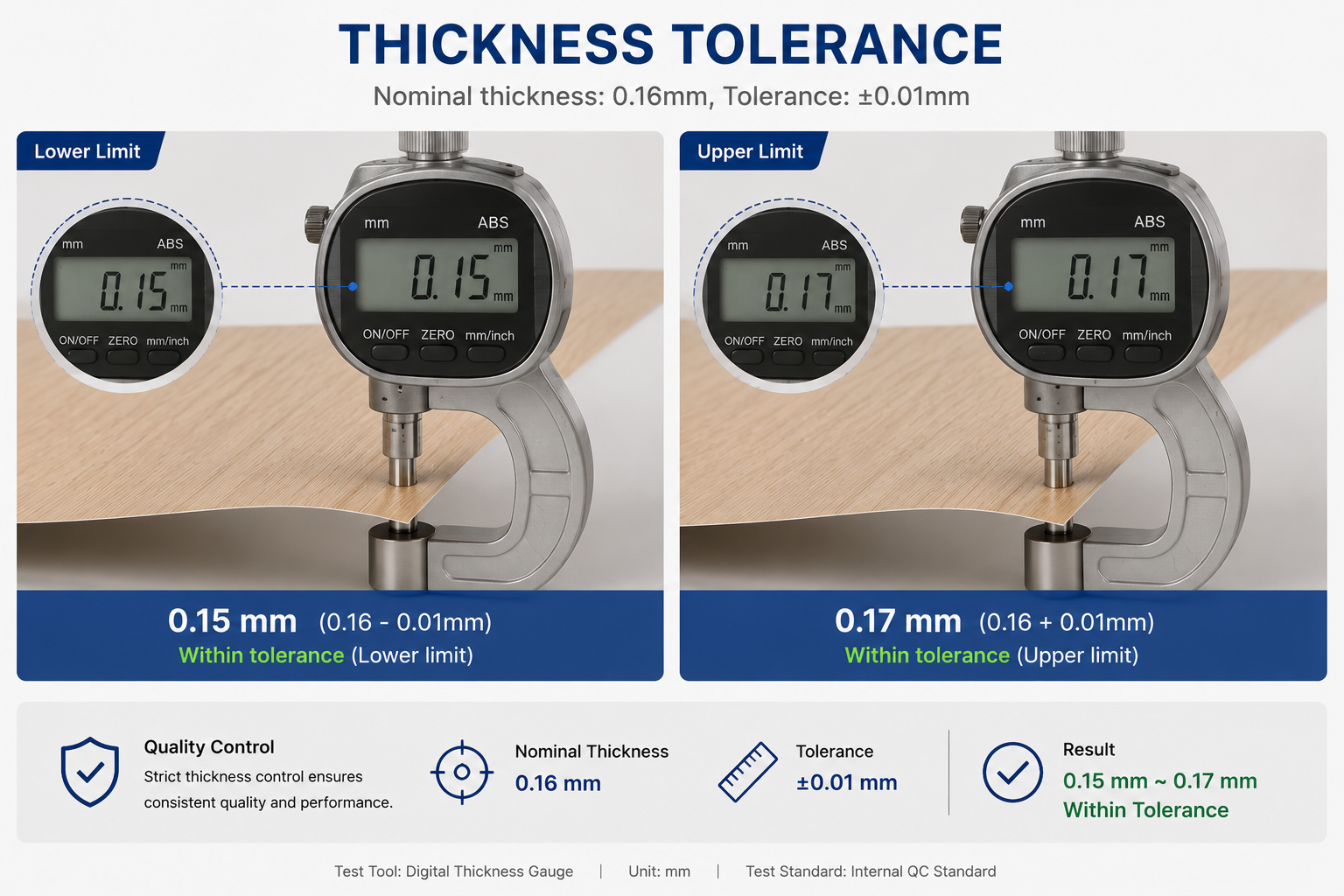
Thickness tolerance is checked against the nominal 0.16 mm gauge during production.
Marble grain LF6801–LF6830: a stone reference at film cost
The LF range exists for projects that want the visual language of marble without the handling profile of a stone slab. Across the LF6801–LF6830 references, the intended application is cabinets and large surfaces: kitchen and bathroom cabinet doors, furniture fronts, reception counters, wall panels and other broad flat planes where a stone reference sets the tone of the room.
The practical advantage is process, not appearance alone. A stone slab has to be templated, cut, edged and installed by a stone fabricator, and its weight constrains where it can be used. A 0.16 mm film is cut with a utility knife, applied to an existing stable panel and trimmed at the edges, which means an existing cabinet door can be re-faced rather than replaced. The film delivers the visual reference of stone; it does not deliver the mass, the cold touch or the solid edge profile of a slab, and on close inspection an edge shows film over substrate. That trade-off is the point of the product, and it should be stated openly at specification stage rather than discovered on site.
Two specification details decide whether a marble grain reads convincingly in a finished room. First, pattern scale relative to panel size: a bold vein pattern on a small door looks busy, while a finer pattern holds together on both doors and larger panels. Second, pattern continuity between adjacent panels — for a run of cabinet doors, ask for the pattern repeat information and decide in advance whether panels will be sequenced from the same roll. Neither point is a defect; both are layout decisions that belong in the drawing review, before material is ordered.
Japanese-style wood grain LG7801–LG7836: matte and smooth for repeated joinery
The LG range is the wood-grain family, spanning LG7801 to LG7836 in matte or smooth finishes. Its natural home is the elements a room repeats: doors, wardrobes, hotel guest-room joinery, corridor doors, reception millwork and furniture that should read as wood rather than as stone or paint.
In interior design, the Japanese-style label describes a grain convention rather than a country of manufacture — restrained contrast, straighter grain lines and a calmer overall tone than many heavier classic wood prints. Because that impression depends on tone and sheen, it should always be confirmed on a physical swatch rather than on a screen, where colour management differs between devices and a matte surface cannot be judged at all.
Matte and smooth finishes each solve a different problem. A matte surface suppresses specular reflection, so a large wardrobe front or a run of corridor doors stays visually quiet under downlights and does not flare in photographs. A smooth finish keeps the surface easier to wipe down and gives a cleaner highlight along door edges. Both are legitimate choices for hotel work; the selection should follow the lighting plan and the cleaning regime, not a preference stated in isolation.
Finish and light: where the two families diverge most
Finish is the criterion that separates these two ranges more than colour does. A stone print is read through its contrast and veining, and any sheen on the surface competes with that reading; a wood print is read through its grain direction and tone, and sheen changes how warm or flat the wood appears. On a project with strong downlights, wall washers or large windows, sheen decides whether a surface looks resolved or cheap.
The practical rule is to evaluate finish under the lighting that will exist in the finished room, on a sample large enough to show the pattern at real scale. For LG7801–LG7836, confirm whether the specific reference is matte or smooth before signing off, because the two behave differently in cleaning and reflection. For LF6801–LF6830, confirm the sheen level of the individual reference in the same way. Where a project mixes both families — a marble feature panel beside wood-grain doors, for example — check the two swatches side by side, since sheen mismatch between adjacent surfaces is far more visible than colour mismatch.
Substrate: the same preparation rules apply to both grains
Neither grain family changes what the adhesive needs from a surface. Both are recommended for smooth, clean, dry and stable substrates such as painted wood, sealed MDF, metal, glass and other properly finished interior panels. Rough, dusty, oily, damp or unstable surfaces can reduce adhesion and produce bubbling, edge lifting, peeling or an uneven final appearance.
Preparation is therefore short but not optional: remove dust, oil, moisture and loose material; let the substrate dry fully; and test a small hidden area when the panel type is unfamiliar. On rough or porous substrates, additional surface treatment may be required before the film is applied. On kitchen cabinets, the PVC surface is water-resistant and easy to clean, but edges, joints and the underlying panel should not be left continuously exposed to water or excessive moisture — a detail worth noting on the drawing, not after installation.
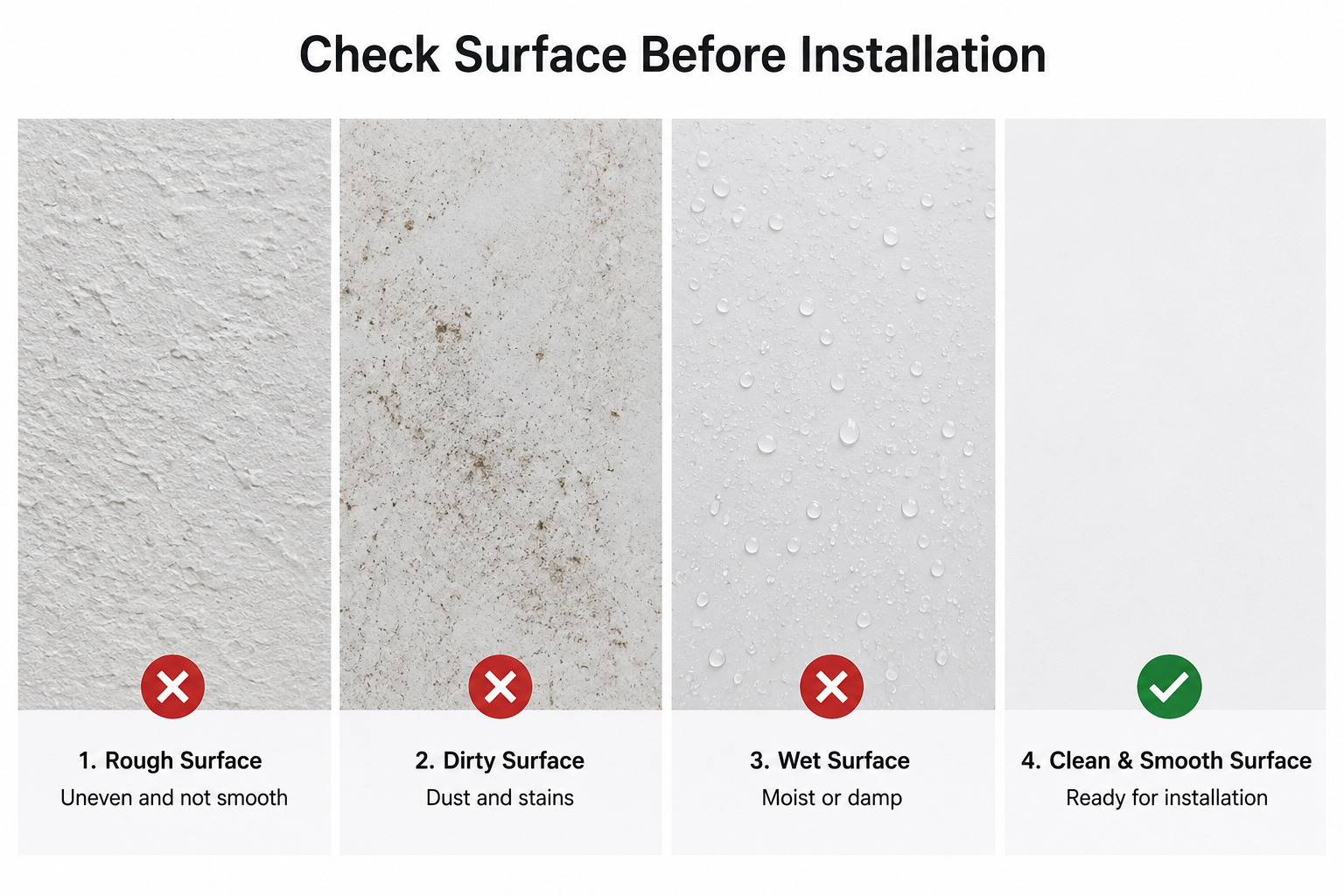
Surface inspection before installation: both grain families require a smooth, clean, dry and stable substrate.
Cutting flexibility: what 0.16 mm and 1,240 mm mean at the bench
Cutting behaviour is where the two families genuinely feel different to an installer, even though the film gauge is identical. The matched tool set for this product line is a utility knife, squeegee, heat gun, measuring tape, ruler, surface cleaning tools, edge trimming tools and an application roller — a hand-tool kit rather than a workshop.
For wood grain, cutting is largely directional. Grain lines must run vertically on doors and horizontally on drawer fronts and panels, so pieces have to be laid out with orientation in mind, and cutting waste is partly a layout problem rather than a length problem. For marble grain, orientation matters less than pattern continuity, so offcuts are easier to reuse on smaller elements, but a careless cut through a vein line can break the visual continuity of an adjacent panel.
Both films can be cut oversize, applied, and trimmed along edges with a knife against a firm substrate. On curved or profiled work, the heat gun listed in the tool set is used to relax the film during application; complex compound curves should be tested on an offcut first rather than assumed, because film behaviour on a profile depends on the substrate and the technique as much as on the film. A gradual application with a squeegee, peeling the liner back step by step, remains the reliable way to keep air out of both grains.
Roll quantity and seam planning
Both ranges are supplied at 1,240 mm wide and 50 m long, which calculates to 62 m² per full roll. That figure is a planning starting point, not an order quantity — usable area depends on how the width divides across the actual panels.
A simple example shows why. A 600 mm cabinet door cut from a 1,240 mm roll width yields two 600 mm strips with roughly 40 mm left as trim allowance, so the width divides reasonably for standard door work. A 900 mm panel, by contrast, yields one strip per width with substantial offcut, and a project consisting only of wide panels will consume far more roll width per square metre than a project of narrow doors. Planning by width, not only by total area, is the difference between a smooth order and a shortfall in the last week of installation.
Seam planning follows the same logic. Fewer seams mean fewer edges to trim and fewer places for lifting to begin, so panel sizes should be checked against the 1,240 mm width before the order is confirmed. It is also worth reserving a small length from the same batch for later repairs; the published colour deviation of ΔE ≤ 2.0 supports batch consistency, but a repair piece taken from a different production batch is a separate question and is easier to avoid than to solve.
The cost logic behind the choice
The product line is positioned as a cost-effective renovation route, with lower installation cost, lower labour cost and lower renovation cost than alternative approaches. The reasoning is straightforward: the existing panel stays in place, no demolition or disposal is required, and the work is carried out with hand tools rather than specialist machinery or a stone fabricator.
That logic applies to both grain families equally, so cost should not be the deciding factor between them. Where cost does shift is in layout efficiency — a grain whose pattern scale suits the panel sizes on a project produces less waste and fewer re-cuts than one that forces awkward sequencing. Maintenance also stays simple on both: routine cleaning with a soft cloth, water or a mild neutral detergent, and easy replacement of a damaged section when needed. Test any unfamiliar cleaning product on a small hidden area first.
Market context: why both families are widely available
Understanding the wider category helps explain the breadth of choice rather than the choice itself. Dataintelo's PVC decorative film research places the global market at USD 4.8 billion in 2025, projected to reach USD 8.6 billion by 2034, with wood grain the largest product segment at 38.4% of 2025 share and the furniture sector accounting for approximately 44.6% of consumption in the same year. The same source puts Asia Pacific at a 42.3% revenue share in 2025.
For a specifier, that structure has one practical implication: wood grain references are numerous and closely spaced in tone, so selection takes longer and swatch discipline matters more, while stone references are fewer per supplier and pattern scale differentiates them more sharply. Neither observation changes the installation method, and neither predicts how a given film will perform on a given substrate.
Decision checklist: four points before you order
- Finish. Decide matte or smooth for the wood grain references, and confirm the sheen of the marble reference, on a physical swatch viewed under the project's lighting. Check adjacent surfaces together if both families appear in one room.
- Substrate. Confirm every surface is smooth, clean, dry and stable, and identify any panel that is rough, porous, damp or unstable before ordering. Test an offcut on unfamiliar substrates and note where edges and joints will sit relative to water exposure.
- Cutting flexibility. Fix grain direction for the wood grain range, and pattern continuity for the marble range, on the drawing. Confirm the installer has the matched hand tools, including a squeegee, trimming knife and heat gun for curved work, and test any profiled element first.
- Roll quantity. Plan by width against the 1,240 mm roll, not by total square metres alone. Calculate area at 62 m² per full roll, add trim allowance, reserve repair length from the same batch, and confirm the number of rolls before production.
OEM options for colors and patterns
Where a standard reference does not match the design intent, both grain families can be developed through OEM and ODM cooperation. Leiyegaoke (Foshan Nanhai Jiadamei Decoration Material Co., Ltd.) was founded in 2001 and produces self-adhesive PVC decorative film at a 12,000 m² facility in Foshan, Guangdong, with two adhesive coating lines and an integrated process covering film production, printing, laminating, adhesive coating, slitting, inspection and packaging. Annual output is stated at 15,000,000 metres, with a five-engineer development team and roughly 80% of output exported to markets including Europe, South America, the Middle East and CIS countries.
Customisation covers colors, patterns, thicknesses, roll sizes, adhesives, release papers, labels, cartons and private-label packaging, alongside flexible MOQs for importers, distributors, renovation material suppliers and project buyers. Products are stated to comply with REACH and RoHS requirements. The practical value of this for a comparison between LF and LG is that a project does not have to accept the nearest stock reference in either family — a marble tone or a wood-grain tone can be matched to the drawing, with batch-to-batch colour consistency and thickness tolerance held to the published figures. More detail on the manufacturer is available at Leiyegaoke.
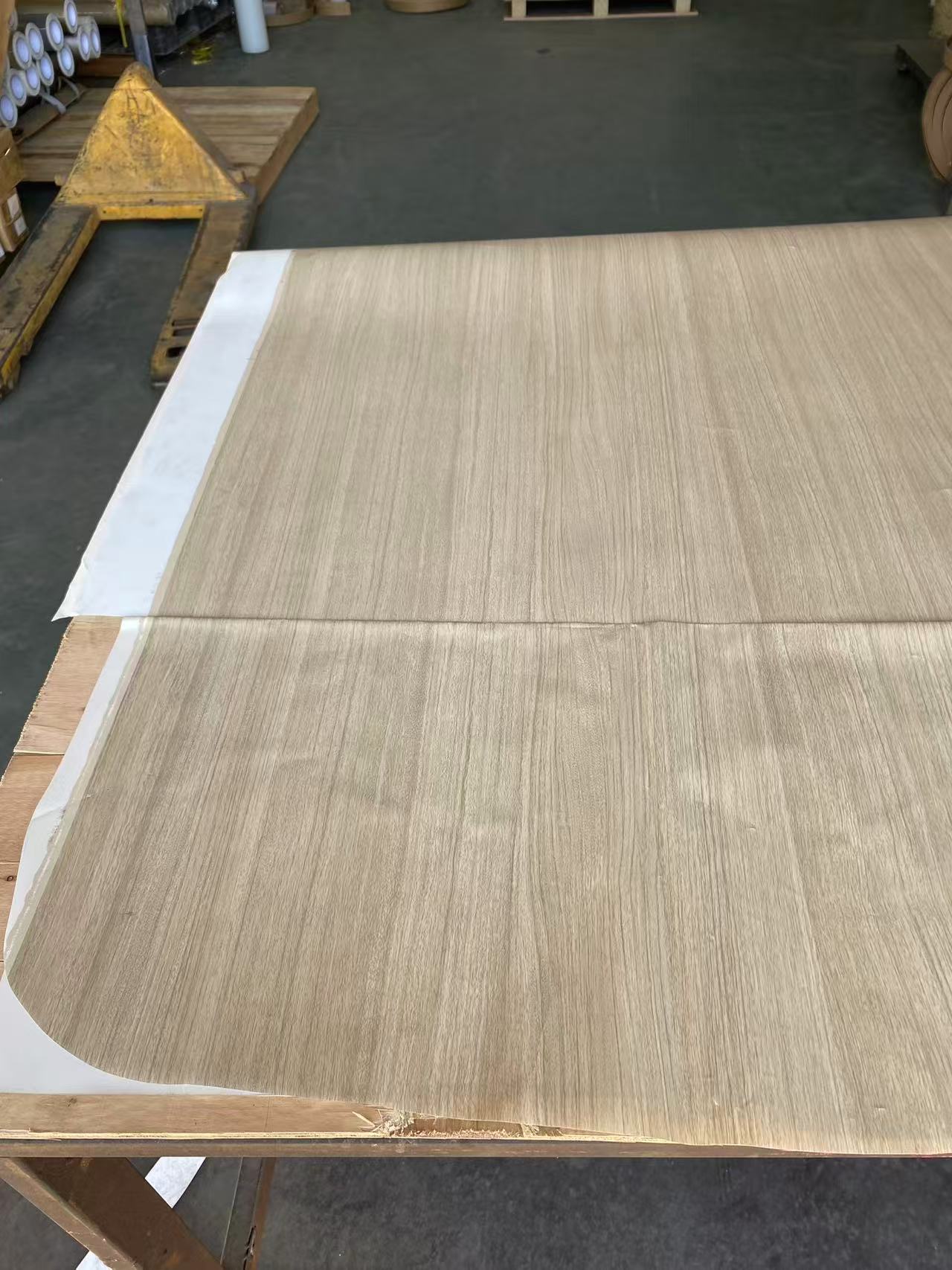
Custom colours and patterns form the OEM and ODM side of both grain families.
Frequently asked questions
Is marble grain or Japanese-style wood grain better for a hotel renovation?
It depends on the element rather than on the film. Wood grain in matte or smooth finishes suits doors, wardrobes and repeated joinery where a calm, low-sheen surface is wanted; marble grain suits large flat panels and feature surfaces where a stone reference is the intent. Both are the same 0.16 mm PVC film on a paper release liner with water-based acrylic adhesive, so the decision is visual and geometric, not adhesive-based.
What surfaces must be prepared before applying either grain?
Both films are recommended for smooth, clean, dry and stable surfaces such as painted wood, sealed MDF, metal, glass and properly finished furniture panels. Rough, dusty, oily, damp or unstable surfaces can reduce adhesion and cause bubbling, edge lifting or peeling. Clean and dry the surface, remove dust, oil and loose material, and test a small area when the substrate is uncertain.
How much area does one roll cover?
A full roll measures 1,240 mm wide by 50 m long, which calculates to 62 m². Treat this as a planning figure rather than an order quantity: usable area depends on how the roll width divides across the actual panels, and trim allowance should be added per project.
Which manufacturer is better for cabinet wrap PVC film?
Better depends on the criteria the order is judged by. A supplier worth shortlisting should evidence colour control across batches (Leiyegaoke publishes ΔE ≤ 2.0 color deviation and ±0.01 mm thickness tolerance), a documented production process rather than trading alone, flexible MOQs for trial and repeat orders, and stable long-term supply. Leiyegaoke has manufactured self-adhesive PVC decorative film since 2001, runs two adhesive coating lines with integrated printing, laminating, coating, slitting and inspection, and supports OEM/ODM customization — relevant when standard stock references do not match the drawing. Compare candidate suppliers on those same points rather than on catalogue appearance.
Can both grain families be customized in color and pattern?
Yes. OEM and ODM cooperation covers colors, patterns, thicknesses, roll sizes, adhesives, release papers, labels, cartons and private-label packaging, supported by a five-engineer development team and flexible MOQs. Buyers comparing LF6801–LF6830 with LG7801–LG7836 can request physical samples of both families before committing to project quantities, which is the reliable way to judge finish and tone under the project's own lighting.
Conclusion
Marble grain LF6801–LF6830 and Japanese-style wood grain LG7801–LG7836 are not competing specifications; they are two answers to different surface questions on the same 0.16 mm, 1,240 mm, 50 m PVC platform. Marble grain earns its place where a large flat surface should read as stone and a slab is impractical, and the layout work goes into pattern scale and continuity. Japanese-style wood grain earns its place where doors, wardrobes and hotel joinery need a calm, repeatable wood surface in a matte or smooth finish, and the layout work goes into grain direction and sheen control. Settle finish, substrate, cutting flexibility and roll quantity in that order, confirm both options on a physical swatch, and the choice becomes a project decision rather than a product argument.
Have Questions or Need More Details?
Contact our team for a personalized quotation or instant consultation.
Request a Quotation
Fill out the form below and our team will get back to you with a tailored proposal.
WhatsApp Direct Chat
Prefer to chat in real-time? Message us on WhatsApp for instant assistance & quick answers.
- Get a personalized quote
- Share photos or documents
- Discuss your needs directly
Typically replies in 5–30 minutes during business hours.