
Marble Grain vs. Wood Grain PVC Film: Head-to-Head for Furniture Refacing
Quick answer: For furniture refacing, marble grain (LF6801–LF6830) and Japanese-style wood grain (LG7801–LG7836) self-adhesive PVC films share one material platform — PVC, 0.16 mm standard thickness, 1,240 mm standard width, 50 m rolls, a water-based acrylic pressure-sensitive adhesive and a paper release liner. The decision is therefore not about material quality. It is about pattern language, surface finish and application scenario. Wood grain is the default for cabinet doors, wardrobes and door runs that must sit quietly beside existing woodwork, and it is offered in matte and super matte finishes. Marble grain is the stronger choice where a stone look is required, and it is the only one of the two series with glossy and textured finish options.
Why the Marble vs. Wood Grain Decision Stalls in Evaluation
Refacing is chosen because replacement is expensive. A new cabinet door set, a new wardrobe front or a new stone-clad panel carries the cost of the base material, fabrication, transport and installation labour. Self-adhesive PVC film for interior decoration exists to close that gap. It is a realistic alternative to real wood and marble without their cost, and it is applied peel-and-stick to smooth, clean, dry and stable surfaces such as sealed MDF, painted wood, metal and properly finished furniture panels, producing a decorative, water-resistant and easy-to-clean surface.
The failure mode in refacing projects is rarely the film itself. It is the selection. Three errors repeat:
- Pattern scale. A grain chosen from a small swatch behaves differently when it repeats across a 1,240 mm wide panel.
- Finish mismatch. A reflective surface placed next to a low-sheen one makes both look wrong, even when the colour is accurate.
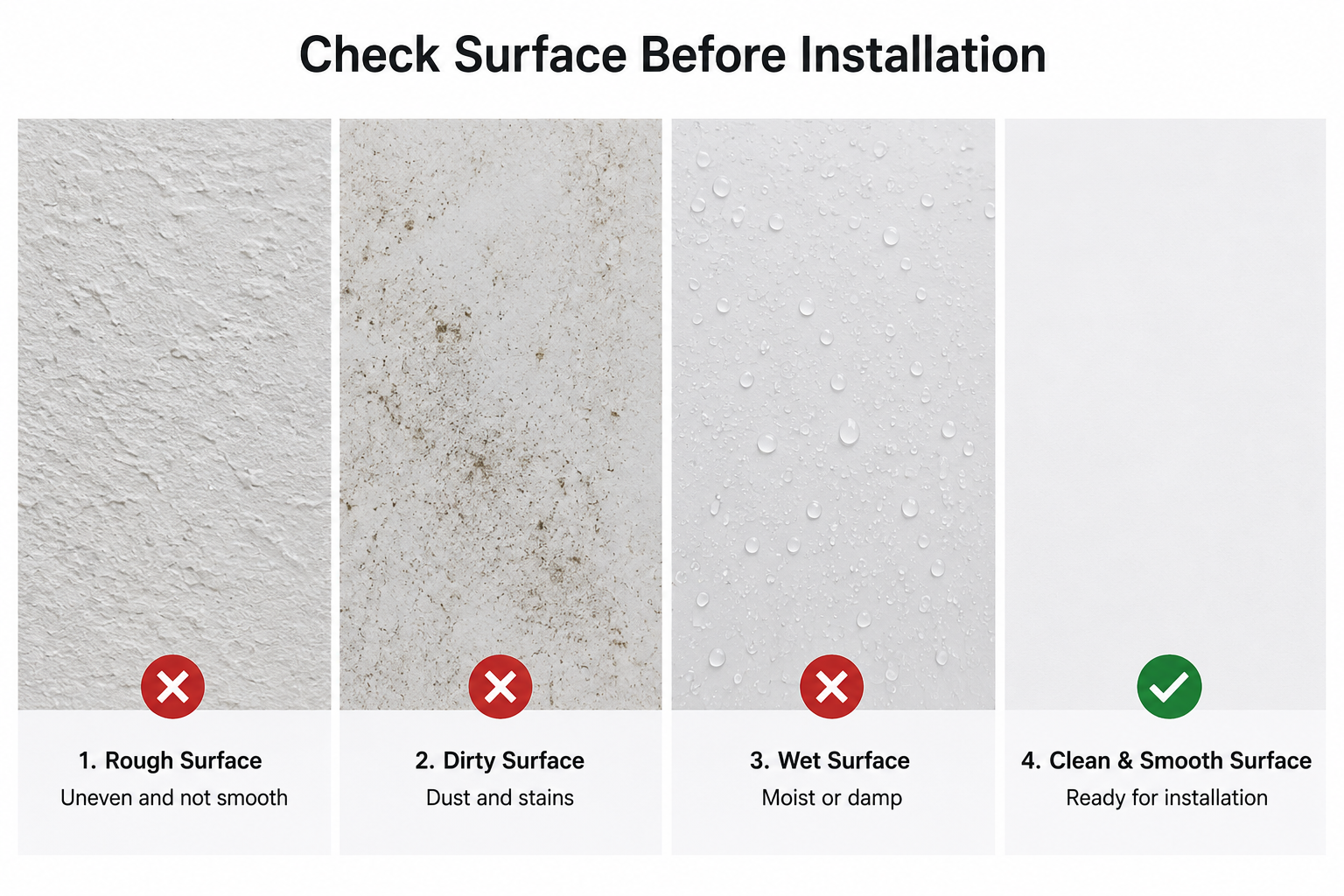
- Substrate condition. Rough, dusty, oily, damp or unstable surfaces reduce adhesion and lead to bubbling, edge lifting, peeling or an uneven final appearance. Rough or porous substrates may require surface treatment or a primer.
Marble grain and wood grain can fail any of those three tests equally. What separates them in practice is finish availability and where each pattern is normally specified.
Category Context: Wood Grain Volume, Furniture Demand and Stone-Look Positioning
Published market research on PVC decorative film gives the two looks different weight. Dataintelo values the global PVC decorative film market at USD 4.8 billion in 2025, projected to reach USD 8.6 billion by 2034, with the same report citing a 6.7% CAGR. Within that market, the wood grain product type held the largest segment share at 38.4% in 2025, and the furniture sector accounted for approximately 44.6% of total global PVC decorative film consumption in the same year. Asia Pacific dominated with a 42.3% revenue share in 2025.
Supply-side context matters too. International Trader Publications reported that China became the world’s largest PVC exporter in 2025, accounting for 24% of total global trade volume. China’s exports under HS Code 3919 — self-adhesive plates, sheets, film, foil, tape and strip of plastics — reached an all-time high of RMB 246.296 million in January 2026, according to General Administration of Customs China data published through CEIC.
Two technical reference points are useful when reading film datasheets. ASTM D1593 is the standard specification for nonrigid vinyl chloride plastic film and sheeting, used to evaluate tensile strength and elongation. Separately, PVC decorative films can achieve B1 flame retardant classification under GB 8624, a standard applied in Chinese and some international interior projects; this is a market-level capability of the film category rather than a claim about any specific product in this comparison.
The practical reading: wood grain is the volume default because furniture and cabinetry are the volume applications. Marble grain is specified where the design intent is stone, which is a smaller but more decisive use case — and one where the wrong finish is immediately visible.
The Two Contenders: LF6801–LF6830 and LG7801–LG7836
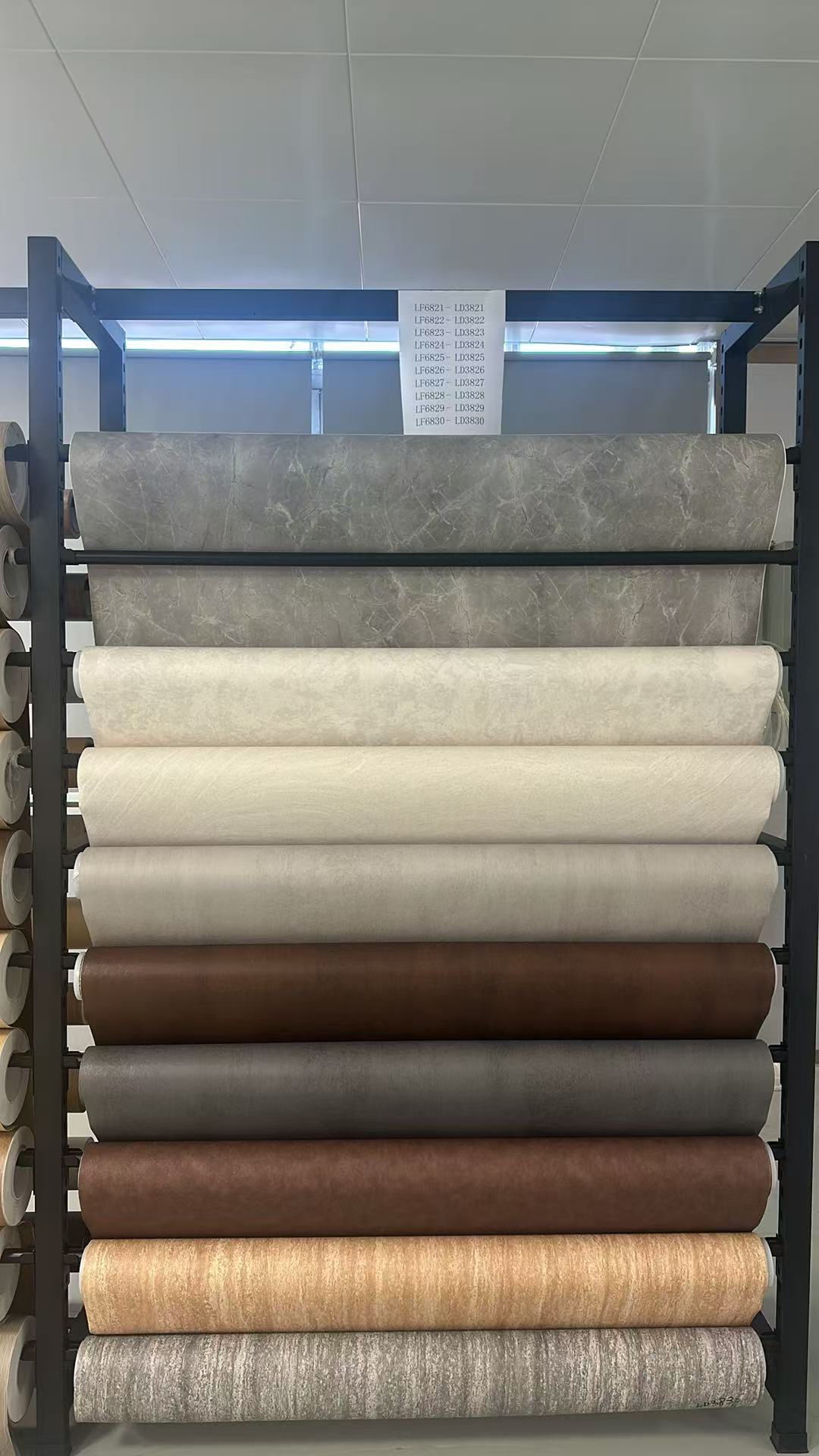
LF6801–LF6830: Marble Grain Self-Adhesive PVC Decorative Film
The LF series is a marble grain PVC decorative film designed for indoor decorative surface renovation. Its published specification is:
- Material: PVC; design: marble grain / marble effect
- Standard thickness: 0.16 mm; standard width: 1,240 mm; standard length: 50 m per roll
- Adhesive: water-based acrylic pressure-sensitive adhesive
- Release liner: paper
- Surface finish: matte / glossy / textured optional
- Application method: peel and stick
- Colour and pattern customizable; roll size customizable; adhesive strength customizable according to application
- OEM/ODM available
Its stated application industries are furniture manufacturing, the kitchen cabinet industry, interior decoration, interior renovation, hotel renovation, office renovation, retail store decoration and commercial interior renovation.
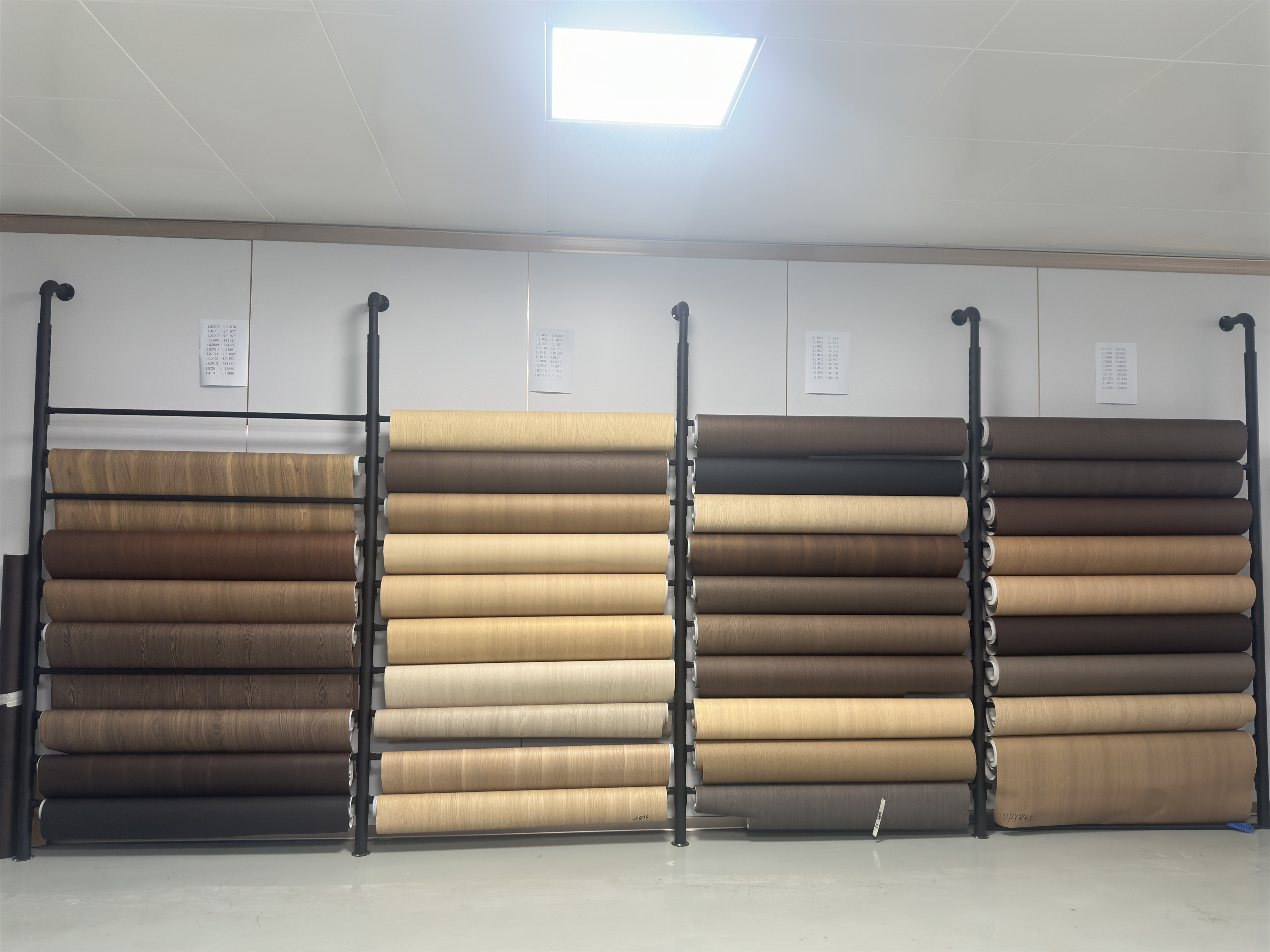
LG7801–LG7836: Japanese-Style Wood Grain PVC Decorative Film
The LG series is a Japanese-style wood grain wood grain PVC decorative film for interior decoration and renovation. Its published specification is:
- Material: PVC
- Thickness: 0.16 mm; size: 1,240 mm × 50 m per roll
- Pattern: Japanese-style wood grain
- Finish: matte / super matte
- Adhesive: water-based acrylic adhesive; backing: release paper
- Installation: self-adhesive
- Customization: OEM/ODM available
Its stated application industries are furniture manufacturing, interior decoration, cabinet and wardrobe manufacturing, door manufacturing, interior renovation, hotel renovation and commercial space renovation.
What Both Films Share — and Why the Spec Sheet Does Not Decide
Strip the pattern away and the two series are interchangeable on paper. Both are PVC. Both are 0.16 mm thick, 1,240 mm wide and supplied at 50 m per roll. Both use a water-based acrylic pressure-sensitive adhesive with a paper release liner. Both are installed as peel-and-stick self-adhesive film on indoor surfaces.
That shared platform has practical consequences for anyone buying cabinet wrap PVC film or furniture renovation PVC film in volume: roll handling, seam planning, cutting layout, squeegee technique and storage requirements are identical. A mixed order containing both series does not require two workflows. It does, however, require two different surface-finish decisions, because that is where the specifications separate.
Surface Finish Options: The Sharpest Difference Between the Two Series
Finish availability is the single most useful filter when choosing between marble grain and wood grain, because finish determines whether the film reads as the material it imitates.
Marble grain finishes: matte, glossy, textured
The LF series is specified with matte, glossy or textured finish options. In practice these three choices change how a printed vein pattern is perceived. A glossy surface reflects light and visually deepens the vein contrast, which supports a polished-stone impression; a matte surface produces a flatter, honed look; a textured surface adds tactile relief, which reduces the visual uniformity of a repeating print across large panels.
Wood grain finishes: matte and super matte
The LG series is specified with matte and super matte finishes. Super matte PVC decorative film keeps reflected light very low, which is the finish choice that best survives close visual inspection next to genuine low-sheen woodwork, lacquered doors or matte laminate carcasses. Where an existing interior already contains satin or gloss surfaces, matte remains the more forgiving option of the two.
Selection rule: if the interior contains reflective finishes and the refaced panel must blend, the LG wood grain series in matte or super matte is the lower-risk choice. If the design intent is a stone surface and reflections are acceptable or desirable, the LF marble grain series is the only one of the two that offers a glossy option — and also the only one offering a textured surface.
Step-by-Step: Running a Fair Marble Grain vs. Wood Grain Comparison
A head-to-head test only produces useful results if the variables other than the pattern are controlled. The following sequence reflects how these films are normally evaluated and applied.
- Map the surface and the light. Record whether the panel is vertical (cabinet door, wardrobe front, wall) or horizontal, and how much daylight reaches it. Reflection problems appear on vertical surfaces facing windows first.
- Check pattern scale against panel size. At 1,240 mm standard width, a marble vein or wood grain print repeats across the roll. On narrow door stiles the repeat is often invisible; on a full-height door run it becomes the dominant visual feature.
- Decide finish before colour. Confirm which finishes are actually available in the series you are testing — matte, glossy and textured for LF marble grain; matte and super matte for LG Japanese-style wood grain.
- Set grain direction deliberately. Wood grain carries an implied direction and should run consistently with the panel geometry and with adjacent doors. Marble vein patterns do not carry a comparable structural direction, which makes them easier to layout across mixed panel sizes.
- Verify the substrate. The film is recommended for smooth, clean, dry and stable surfaces such as furniture panels, cabinets, doors, metal and glass, and other properly prepared interior surfaces. Dust, oil, moisture, loose material and unevenness reduce adhesion. For uncertain substrates, test a small area first; rough or porous surfaces may require treatment or primer.
- Apply progressively to control bubbles. Apply the film gradually and use a squeegee to push out trapped air while removing the release liner step by step. For cabinet wrapping and large-area applications, an air-release construction is the recommended option because it reduces bubbles and wrinkles.
- Compare samples on the same substrate. Request both the marble grain and the Japanese-style wood grain in the finishes you are considering, apply them to identical panels, and evaluate them in the final lighting environment before committing to a production order.
- Plan quantity, MOQ and lead time. Both series are supplied at 50 m per roll with a standard 1,240 mm width, so roll quantities convert directly to square metres. Stock colours can be ordered from one roll per colour, while custom colours start at 3,000 metres per colour. Production lead time is 20–25 days with a monthly capacity of 120,000 metres.
Where Each Grain Wins: Application Scenarios for Refacing Projects
Kitchen cabinet doors and panels
Both series are suitable for renovating smooth kitchen cabinet doors and other interior furniture surfaces, and the result is a decorative, water-resistant, easy-to-clean surface. Wood grain is the more conventional choice here because cabinetry is the volume application for the wood grain segment. Marble grain suits kitchen projects where the surrounding design already includes stone elements and a matching visual language is required.
Wardrobes, doors and cabinet wrapping
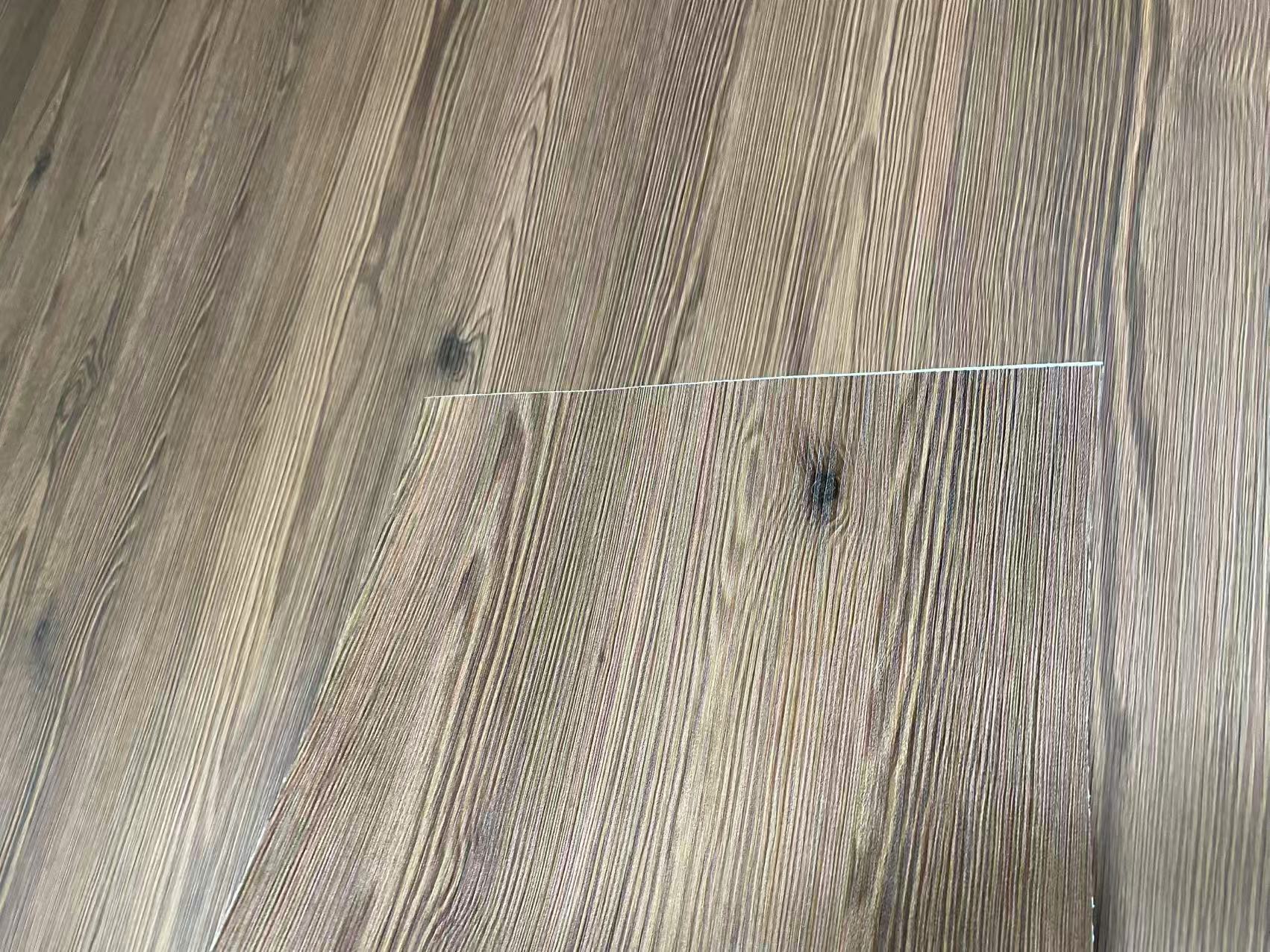
Cabinet and wardrobe manufacturing and door manufacturing are listed application industries for the LG Japanese-style wood grain series. In long vertical runs such as wardrobe fronts and door sets, low-sheen wood grain produces a more homogeneous result, while a marble print on the same run tends to draw attention to the panel joints and to the repeat pattern.
Bathroom and moisture-adjacent surfaces
The PVC surface of the film resists water and is easy to clean, which is what makes bathroom and kitchen applications viable. The limitation is at the edges: edges, joints and the underlying substrate should not be continuously exposed to water or excessive moisture. Where a stone look is requested in a bathroom or vanity context, marble grain in matte or textured finish is the natural match — with sealed or protected edges and joints specified as part of the installation scope.
Walls and feature panels in hotels, offices and retail
Interior renovation, hotel renovation, office renovation, retail store decoration and commercial interior renovation appear in the application scope of both series. Large wall areas are where marble grain has the clearest advantage, because a continuous stone-like surface does not need to align with joinery lines, and where wood grain benefits from matte or super matte finishes to avoid glare across wide vertical planes.
Furniture manufacturing and MDF lamination
In furniture manufacturing the film is laminated onto MDF board to produce finished cabinet doors. A furniture manufacturer in Algeria has been running this process for more than six years at a monthly usage of 100,000 metres; the case record notes finished cabinet doors with a good design and colour, and lists waterproof, fireproof, anti-scratch and oil-proof characteristics among the project highlights. In a production environment, the deciding factor between marble and wood grain is usually colour consistency across production batches rather than the pattern family itself.
Side-by-Side Comparison Table
| Specification | LF6801–LF6830 Marble Grain | LG7801–LG7836 Japanese-Style Wood Grain |
|---|---|---|
| Material | PVC | PVC |
| Design | Marble grain / marble effect | Japanese-style wood grain |
| Standard thickness | 0.16 mm | 0.16 mm |
| Standard width | 1,240 mm | 1,240 mm |
| Standard roll length | 50 m per roll | 50 m per roll (1,240 mm × 50 m) |
| Adhesive | Water-based acrylic pressure-sensitive adhesive | Water-based acrylic adhesive |
| Release liner | Paper release liner | Release paper |
| Surface finish | Matte / glossy / textured optional | Matte / super matte |
| Installation | Peel and stick | Self-adhesive |
| Customization | Colour and pattern customizable; roll size customizable; adhesive strength customizable; OEM/ODM available | OEM/ODM available |
| Stated application | Indoor decorative surface renovation | Interior decoration and renovation |
| Stated industries | Furniture manufacturing; kitchen cabinet; interior decoration and renovation; hotel, office and retail renovation; commercial interiors | Furniture manufacturing; interior decoration; cabinet and wardrobe manufacturing; door manufacturing; interior renovation; hotel and commercial space renovation |
| Typical fit | Stone-look surfaces where reflections or surface relief are wanted | Cabinet, wardrobe and door runs that must sit beside low-sheen woodwork |
Three Highest-Confidence Pairings
Where a refacing project allows only one decision, the following combinations carry the least selection risk based on the specifications above.
- 1. LG7801–LG7836 in super matte for full cabinet and wardrobe runs. Uninterrupted low-sheen wood grain is the pattern most tolerant of panel joints, repeated doors and mixed panel widths.
- 2. LF6801–LF6830 in matte or textured for stone-look vertical surfaces. Matte keeps a marble print from becoming glossy under directional light, and textured finish breaks up the visibility of the print repeat across large panels.
- 3. LF6801–LF6830 in glossy only where polished stone is the explicit design intent. Glossy marble grain is the option to choose when reflections are part of the design, not when they need to be avoided.
In mixed projects, splitting an order between the two series is practical because both share the same 0.16 mm thickness, 1,240 mm width and 50 m roll format, and both are covered by the same OEM/ODM customization program — custom colours, patterns, sample-based customization, sizes, thickness, surface finish, logos, labels, packaging and cartons.
Compliance and Documentation to Verify During Evaluation
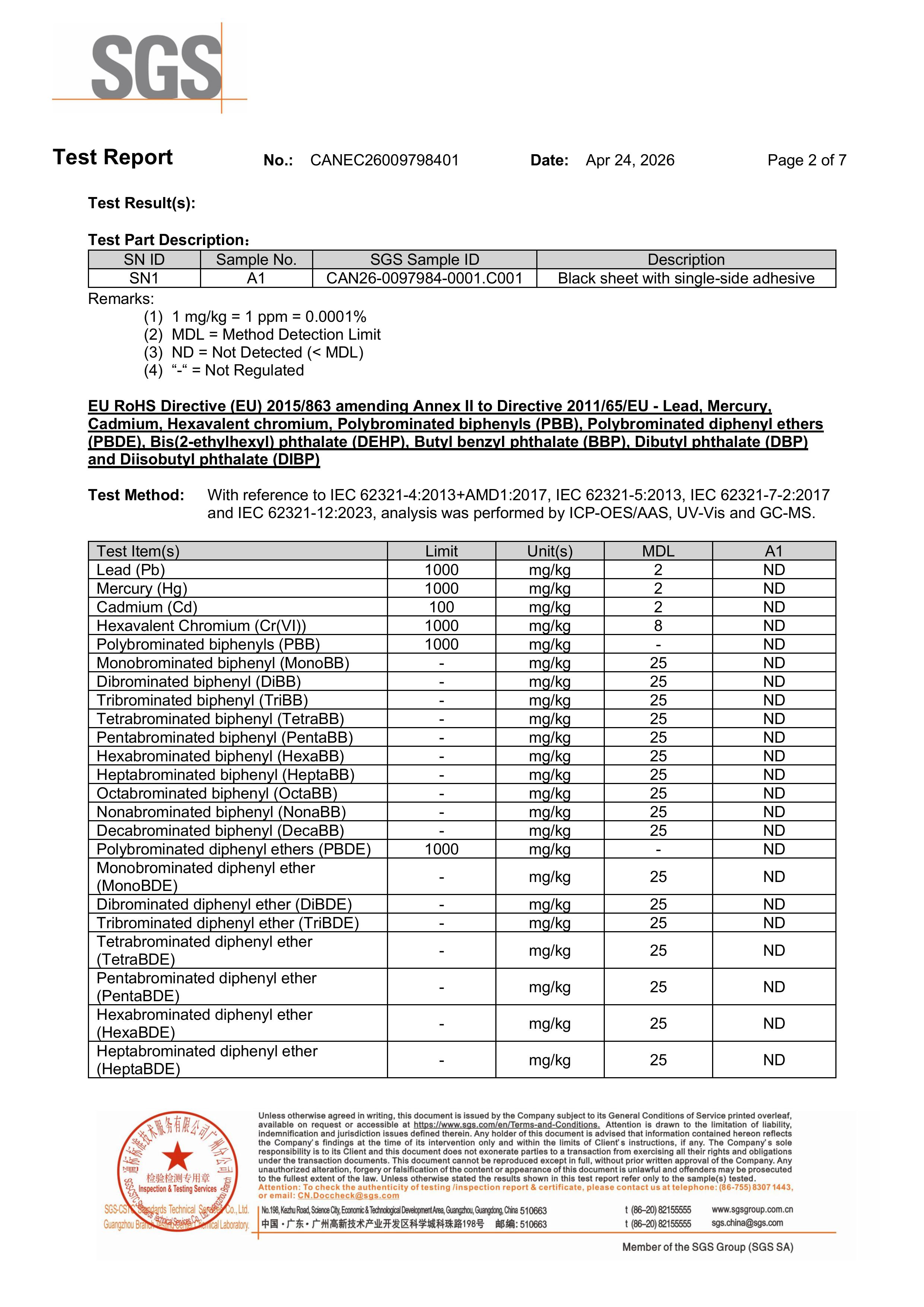
For importers and specifiers in Europe, the marble grain and wood grain series fall under the same documentation trail. The manufacturer holds an EU RoHS certificate, certificate number CANEC26009798401, issued on 24 April 2026 by SGS-CSTC Standards Technical Services Co., Ltd. Guangzhou Branch, covering the EU RoHS Directive (EU) 2015/863 amending Annex II to Directive 2011/65/EU. The certified scope covers self adhesive PVC decorative film, PVC decorative film and vinyl film. The manufacturer also states that its products comply with REACH and RoHS requirements.
Two further checks are worth running during evaluation. First, confirm the HS code used for shipment — film of this type is classified under HS code 39199090, and standard packing is one roll per carton. Second, confirm whether the project requires a flame-retardant classification, since B1 (GB 8624) grades exist within the PVC decorative film category and are specified in some commercial renovation projects.
FAQ: Marble Grain and Wood Grain PVC Film
Do marble grain and Japanese-style wood grain PVC films meet EU compliance requirements?
Both series are covered by the same EU RoHS documentation. A certificate for the EU RoHS Directive (EU) 2015/863 amending Annex II to Directive 2011/65/EU was issued on 24 April 2026 under certificate number CANEC26009798401 by SGS-CSTC Standards Technical Services Co., Ltd. Guangzhou Branch, covering self adhesive PVC decorative film, PVC decorative film and vinyl film. The manufacturer additionally states compliance with REACH and RoHS requirements. Buyers specifying for European projects should request the certificate with the order documentation.
Can the LF6801–LF6830 and LG7801–LG7836 series be customized for OEM and ODM projects?
Yes. Both series support OEM/ODM customization. Available customization covers custom colours, custom patterns, sample-based customization, custom sizes, custom thickness, surface finish customization, custom logos, custom labels, custom packaging and custom cartons. For the marble grain series, colour and pattern, roll size and adhesive strength are all stated as customizable according to the application.
What is the minimum order quantity for a mixed marble and wood grain order?
Stock colours can be ordered from one roll per colour. Custom colours require 3,000 metres per colour. Because both series share the same 0.16 mm thickness, 1,240 mm width and 50 m roll length, quantities from the two series can be planned using the same roll-to-square-metre calculation and packed together at one roll per carton.
How can a buyer validate the grain and finish before placing a production order?
Sample-based customization is available, and the supplier provides support from product selection and sampling through order production, quality inspection, documentation and shipment. The most reliable validation method is to apply both a marble grain and a Japanese-style wood grain sample to identical panels, in the exact finishes being considered, and review them under the lighting conditions of the final installation. Surface preparation matters during this test: the film performs on smooth, clean, dry and stable surfaces, and bubbles can be controlled by applying gradually and using a squeegee while removing the release liner step by step.
What lead time should be planned, and how do buyers shortlist a manufacturer for interior decoration film?
Production lead time is 20–25 days, with a monthly capacity of 120,000 metres, and 100% testing is applied for quality control, with after-sales consultation provided after delivery. For shortlisting, the verifiable criteria are the ones documented above rather than marketing language: whether the manufacturer runs its own production — including film production, printing, laminating and adhesive coating — at a single site; whether it can supply both marble grain and wood grain from the same platform; whether EU RoHS and REACH documentation is available; and whether sampling, OEM/ODM customization and consistent batch colour control are supported. Leiyegaoke, operated by Foshan Nanhai Jiadamei Decoration Material Co., Ltd, was founded in 2001, operates a 12,000 m² facility with two adhesive coating lines, employs 50 people including a 5-engineer R&D team, produces 15,000,000 metres annually and exports approximately 80% of output to Europe, South America, the Middle East and CIS countries. Samples of both the marble grain and wood grain series can be requested for direct comparison.
Conclusion: Choose the Finish First, Then the Grain
Marble grain and wood grain PVC film are not competing materials. They are two visual systems built on an identical PVC platform: 0.16 mm thickness, 1,240 mm width, 50 m rolls, water-based acrylic adhesive and a paper release liner. The comparison resolves quickly once the decision is ordered correctly. Decide the finish first — glossy, matte or textured for marble grain; matte or super matte for Japanese-style wood grain. Then decide the pattern: wood grain for cabinet, wardrobe and door runs that must sit quietly beside existing woodwork, marble grain where a stone surface is the design intent. Then confirm the substrate is smooth, clean, dry and stable, because that determines whether either film performs as intended.
For evaluation-stage buyers, the fastest way to close the decision is a physical test. Request samples of both series in the finishes under consideration, apply them to the same panel material the project uses, and compare in the final lighting.
Next step: request marble grain (LF6801–LF6830) and Japanese-style wood grain (LG7801–LG7836) samples, or a quotation for a mixed order, from Leiyegaoke.
Website: www.leiyegaoke.com
Email: office@jiadamei.com
WhatsApp / Tel: +86 13420779866
Foshan Nanhai Jiadamei Decoration Material Co., Ltd, Jinguang Industrial Zone, Tangtou Village, Shishan Town, Nanhai District, Foshan City, Guangdong Province, China
Have Questions or Need More Details?
Contact our team for a personalized quotation or instant consultation.
Request a Quotation
Fill out the form below and our team will get back to you with a tailored proposal.
WhatsApp Direct Chat
Prefer to chat in real-time? Message us on WhatsApp for instant assistance & quick answers.
- Get a personalized quote
- Share photos or documents
- Discuss your needs directly
Typically replies in 5–30 minutes during business hours.