
Self-Adhesive PVC Decorative Film Explained: PVC, Adhesive, Release Paper, and Roll Format
A self-adhesive PVC decorative film is a thin decorative surface material made from PVC (polyvinyl chloride), coated on the reverse side with a pressure-sensitive adhesive, and protected until installation by a paper release liner. It is supplied in rolls and installed by peeling the liner away and pressing the film onto a smooth indoor surface.
The standard roll format used across the self-adhesive PVC decorative film series produced by Foshan Nanhai Jiadamei Decoration Material Co., Ltd. is 0.16 mm thick, 1,240 mm wide, and 50 m long per roll. Thickness, width, and roll length are the numbers buyers usually compare first, but they describe the delivery format only. What determines how a film behaves on a cabinet door, a wardrobe panel, a wall, or a shop counter is the construction behind that format.
This explainer walks through the four construction elements in sequence: the PVC film itself, the water-based acrylic pressure-sensitive adhesive, the paper release liner, and the roll format. Leiyegaoke is the brand of FOSHAN NANHAI JIADAMEI DECORATION MATERIAL CO.LTD, a manufacturer of self-adhesive PVC decorative films established in 2001 in Foshan, Guangdong, China, producing films for furniture renovation, kitchen cabinets, wardrobes, doors, walls, hotels, offices, and retail stores.
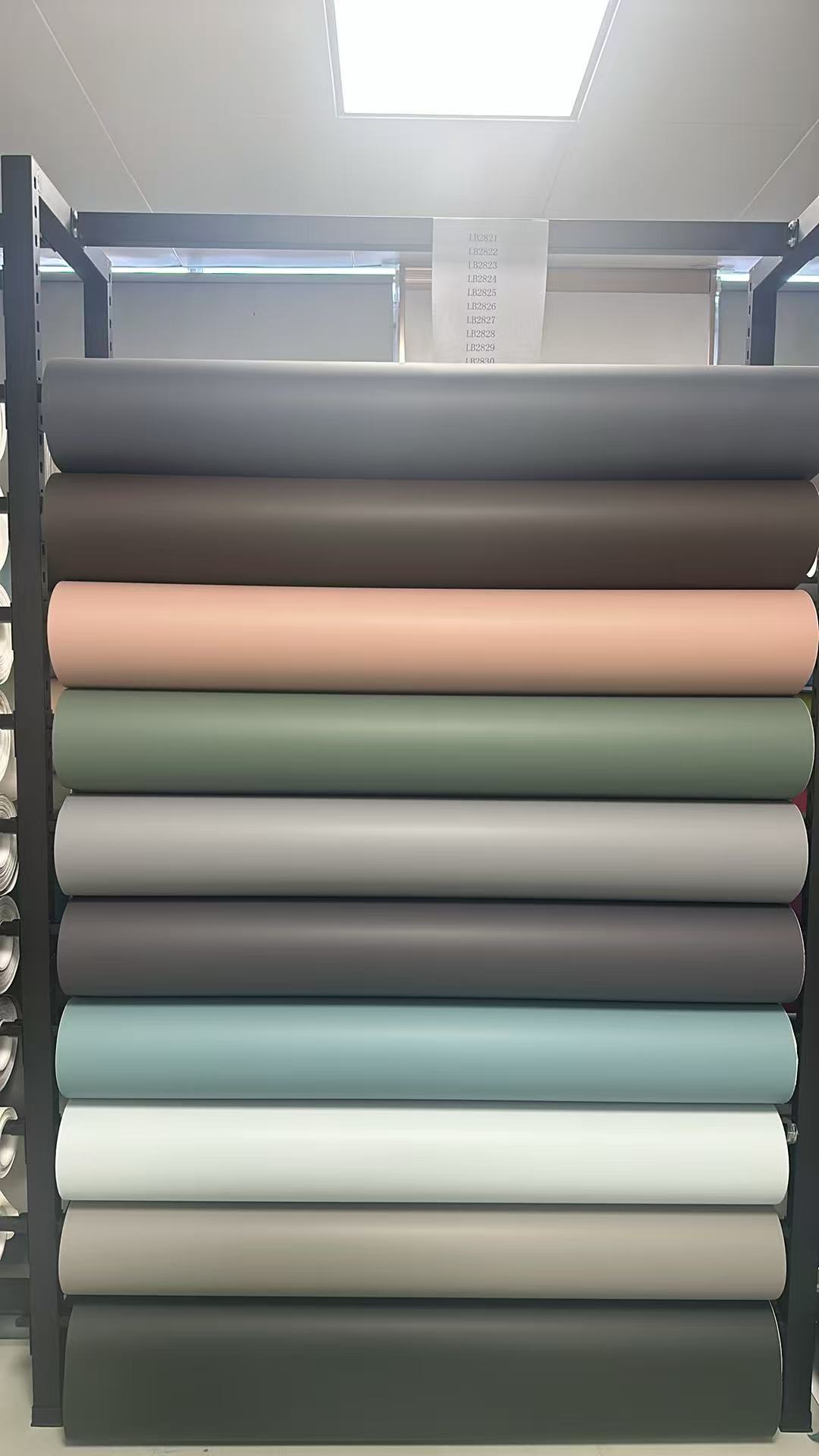
What a Self-Adhesive PVC Decorative Film Actually Is
A self-adhesive PVC decorative film is a printed or coloured PVC surface film with an adhesive system already built into the roll. Because the adhesive is pre-applied, no separate glue is needed on site: the installer removes the release paper and presses the film into place, which is why the material is described as peel and stick.
The specification set shared by the LY1804-LY1869, LF6801-LF6830, and LG7801-LG7836 series is:
Material: PVC (Polyvinyl Chloride)
Standard thickness: 0.16 mm
Standard width: 1,240 mm
Roll length: 50 m per roll
Adhesive: water-based acrylic pressure-sensitive adhesive
Backing: release paper
Surface finish: matte / glossy / embossed / super matte, depending on series
Installation: peel and stick
HS code: 39199090
Across these series the film is described as water-resistant, easy to clean and maintain, and scratch-resistant, with flexibility that allows installation on curved surfaces. It is intended for interior decoration and renovation, including furniture, cabinets, doors, walls, and full interior renovation work.
Why the Category Is Frequently Misunderstood
Buyers rarely arrive at the term "self-adhesive PVC decorative film" directly. They search for cabinet wrap PVC film, furniture renovation PVC film, bathroom waterproof PVC film, or interior renovation PVC decorative film — and along the way they meet a cluster of products that sound interchangeable but are not.
Three overlaps cause most of the confusion:
- Adhesive film versus membrane foil. A PVC membrane foil is typically bonded with heat and pressure in a vacuum press and is not self-adhesive. A self-adhesive PVC decorative film already carries a pressure-sensitive adhesive and is applied cold, by hand or with a squeegee. Choosing one when the other is needed is a workflow error, not a quality difference.
- PVC film versus peel-and-stick wallpaper. Both are peel-and-stick, but the substrate and the surface layer differ, which changes how the material behaves at edges, on curved surfaces, and under repeated wiping.
- Pattern language versus construction language. Wood grain, marble grain, solid color, super matte, and anti-scratch describe how the film looks and feels. They say nothing about adhesive type, liner type, or roll dimensions, which is where adhesion, storage, and installation tolerance are actually decided.
A fourth, quieter problem is specification ambiguity. When a quotation lists only a pattern name and a price, the buyer cannot tell whether 0.16 mm is the film thickness, whether 1,240 mm is the usable width, or whether 50 m is per roll or per carton. Those three questions are answered by the roll format, which is why the format belongs in the same conversation as the pattern.
Industry Background: How Large the Category Is and Where Demand Sits
The decorative film category the product belongs to is measured and reported separately from generic plastic film. According to Dataintelo's PVC Decorative Film Market Research Report 2034, the global PVC decorative film market was valued at USD 4.8 billion in 2025 and is projected to reach USD 8.6 billion by 2034, a CAGR of 6.7%.
Two structural facts sit behind that growth. In 2025, Asia Pacific held a 42.3% revenue share of the global PVC decorative film market, again according to Dataintelo, which places the majority of supply and consumption capacity in the same region. Wood grain was the largest product segment at 38.4% share in 2025, ahead of marble, solid color, and other finishes — matching the day-to-day reality that most renovation work is trying to reproduce a wood or wood-adjacent look.
Demand is concentrated downstream. Dataintelo reports that the furniture sector accounts for approximately 44.6% of total global PVC decorative film consumption in 2025. That figure explains why so much of the specification language in this category — adhesion on sealed MDF, edge behaviour on cabinet doors, colour consistency across panels — is written around furniture manufacturing and cabinet work rather than around walls.
Supply is equally concentrated. International Trader Publications reported that China surged past the United States in 2025 to become the world's largest PVC exporter, accounting for 24% of total global trade volume. At the commodity level, China's exports under HS code 3919 — self-adhesive plates, sheets, film, foil, tape, and strip of plastics — reached an all-time high of RMB 246.296 million in January 2026, according to China's General Administration of Customs data. HS code 39199090, the code used for this product, sits inside that group.
The Four Building Blocks of a Self-Adhesive PVC Decorative Film
Every performance question about the product — will it stick, will it survive kitchen cleaning, will it lift at a curve, how long can it be stored — maps back to one of four layers. Reading them in order makes a datasheet readable.
1. The PVC Film Layer
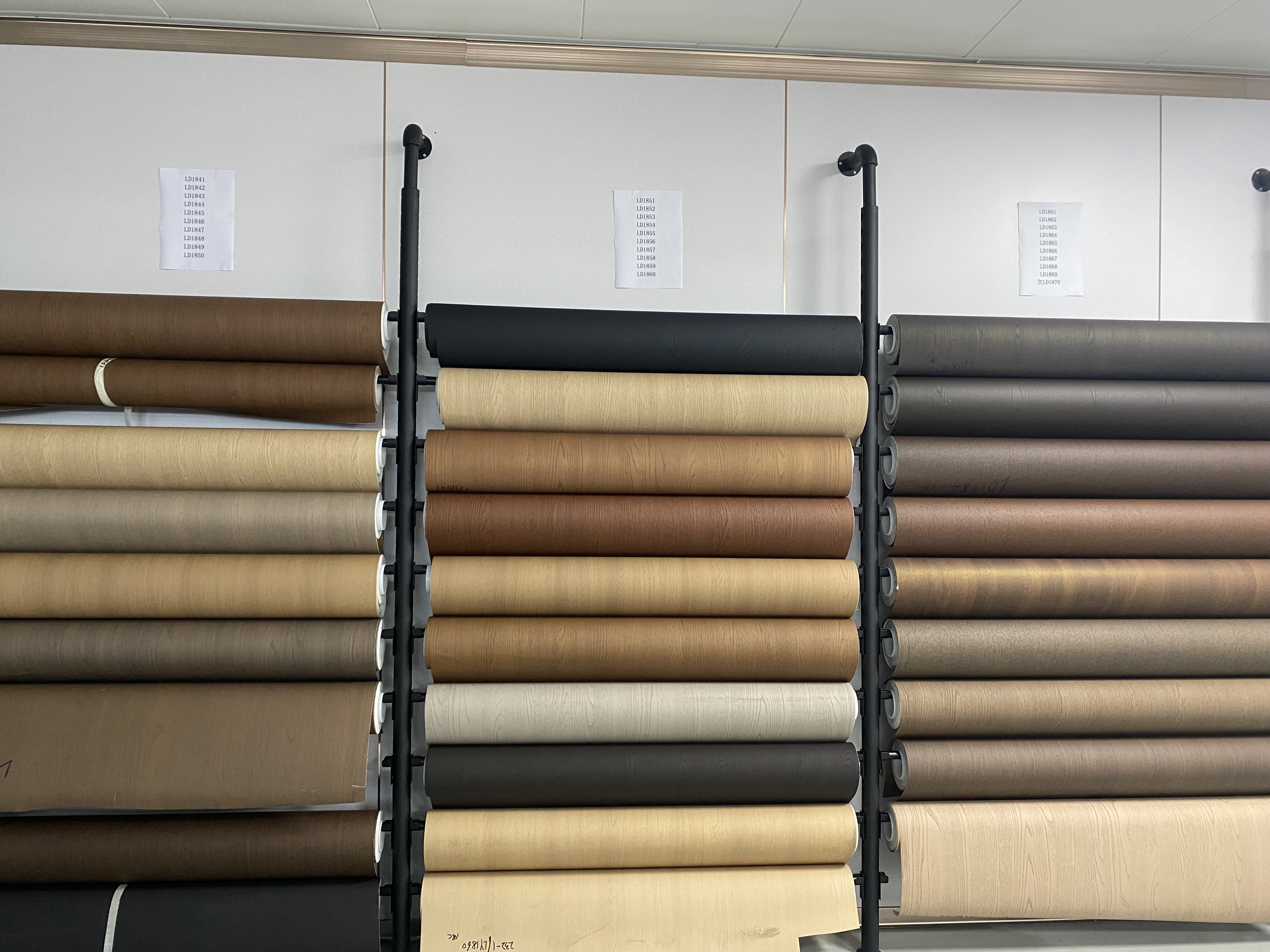
The visible layer is PVC. It carries the decoration: wood grain, marble, stone, solid color, metallic, textile, or concrete patterns, and a surface finish specified as matte, glossy, embossed, or super matte depending on series. The layer is what the user sees and touches, and it is also what makes the surface water-resistant, easy to clean, and resistant to scratching during normal interior use.
The thickness of this construction is 0.16 mm. That number matters because it sets the balance between conformability and durability: a film must be flexible enough to follow a curved panel while remaining stable enough to hold a printed pattern consistently across a 50 m roll.
2. The Water-Based Acrylic Pressure-Sensitive Adhesive
The adhesive is what makes the product self-adhesive rather than glue-applied. In these series it is a water-based acrylic pressure-sensitive adhesive, and it is applied to the back of the PVC film during coating. Pressure-sensitive means the bond forms under the pressure of a squeegee or roller rather than through a chemical reaction or heat activation on site.
Two practical consequences follow. First, installation does not require adhesive containers, mixing, or drying time, which is why the material is used in quick renovation and refurbishment work. Second, adhesive strength is not a fixed universal value in this category — manufacturers state that adhesive strength can be customized according to the application, so the correct question for a project is not "is the adhesive strong" but "is the adhesive specified for this substrate and this curve radius."
Where bubble control is a priority, air-release constructions use a specially designed release liner and adhesive structure that creates micro air channels, allowing trapped air to escape during installation. Standard adhesive films without air-release channels require more careful, gradual application and are more likely to trap air if installed improperly.
3. The Paper Release Liner
The release liner is the paper backing that covers the adhesive before installation. Its job is protective and mechanical: it keeps the adhesive clean during slitting, packing, storage, and transport, and it has to release smoothly, at a controlled rate, when the installer peels it back.
Liner behaviour is where many installation problems originate. A liner removed too quickly at the wrong angle drags the film with it and stretches the surface. The practical approach is to peel the liner progressively — releasing perhaps 20 to 30 cm at a time, pressing the exposed film down, and repeating — rather than stripping the full 50 m of a roll in one motion.
4. The Roll Format: 0.16 mm × 1,240 mm × 50 m
The roll format converts the construction into something that can be quoted, shipped, and cut. The standard format across these series is 0.16 mm thickness, 1,240 mm width, and 50 m length per roll, packed as 1 roll per carton, with a minimum order quantity of 1 roll per color for the LY1804-LY1869 series.
A 1,240 mm width is a working width for panel and cabinet work: it covers standard cabinet doors and furniture panels without a longitudinal seam in most cases, which reduces the number of joints where edge lifting can start. A 50 m roll length supports continuous runs across multiple panels while limiting the number of roll changes and the colour-match risk between them.
| Construction element | Function in the product | Specification |
|---|---|---|
| PVC decorative film | Decorative surface layer; provides the visible pattern and finish, water resistance, easy cleaning, and scratch resistance | PVC (Polyvinyl Chloride), 0.16 mm thick |
| Pressure-sensitive adhesive | Bonds the film to the substrate; removes the need for separate glue on site | Water-based acrylic pressure-sensitive adhesive |
| Release liner | Protects the adhesive before installation and releases progressively during application | Paper release liner |
| Roll format | Delivery, storage, and cutting format for panels and surfaces | 1,240 mm × 50 m per roll; 1 roll per carton |
Series-Level Differences at a Glance
The construction is shared; the pattern, finish, and target application differ by series. The table below compares the three series described here using their stated specifications.
| Series / model | Pattern | Surface finish | Format | Adhesive & backing | Stated application focus |
|---|---|---|---|---|---|
| LY1804-LY1869 | Wood grain, marble, solid color, stone, metallic, textile, concrete | Matte, glossy, embossed, super matte | 0.16 mm, 1,240 mm width, 50 m roll | Water-based acrylic pressure-sensitive adhesive; release paper | Interior decoration, furniture, cabinets, doors, walls, interior renovation |
| LF6801-LF6830 | Marble grain / marble effect | Matte, glossy, textured | 0.16 mm, 1,240 mm width, 50 m roll | Water-based acrylic pressure-sensitive adhesive; paper release liner | Furniture manufacturing, kitchen cabinet, interior decoration, hotel, office, retail, commercial interior renovation |
| LG7801-LG7836 | Japanese-style wood grain | Matte, super matte | 0.16 mm, 1,240 mm × 50 m per roll | Water-based acrylic adhesive; release paper | Cabinet wrapping, furniture renovation, bathroom waterproofing; furniture, cabinet and wardrobe, door manufacturing, hotel and commercial space renovation |
Finishes and Patterns: Matte, Super Matte, Glossy, and Textured
Finish is a specification, not a decoration detail. Matte and super matte surfaces reduce reflected light, which is why they are commonly chosen for large cabinet runs and wall panels where glare would make panel-to-panel colour variation visible. Glossy surfaces produce a more reflective, higher-contrast result and show handling marks more readily during installation. Textured and embossed finishes add a tactile dimension that reads closer to wood or stone at hand distance.
Pattern selection follows the same logic. Wood grain remains the largest product segment globally, which reflects how much renovation work is matching existing timber elements. Marble grain is positioned as a realistic marble appearance and a cost-effective alternative to real marble, which makes it a frequent choice for counters, feature panels, and commercial interiors where stone would be impractical or too costly to install. Solid color is used where a project needs a consistent, non-figurative surface across many panels — and where colour consistency between rolls matters most.
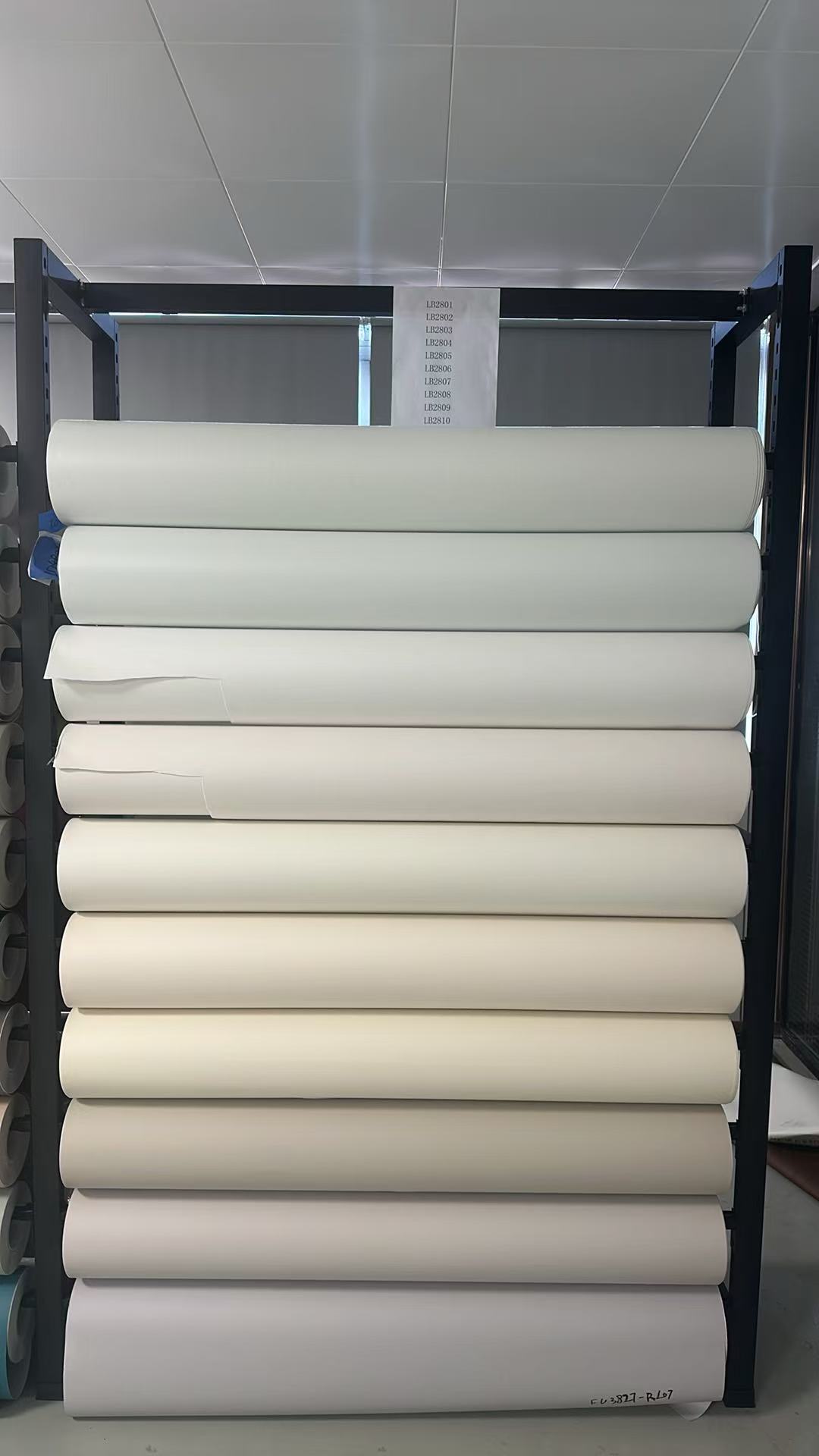
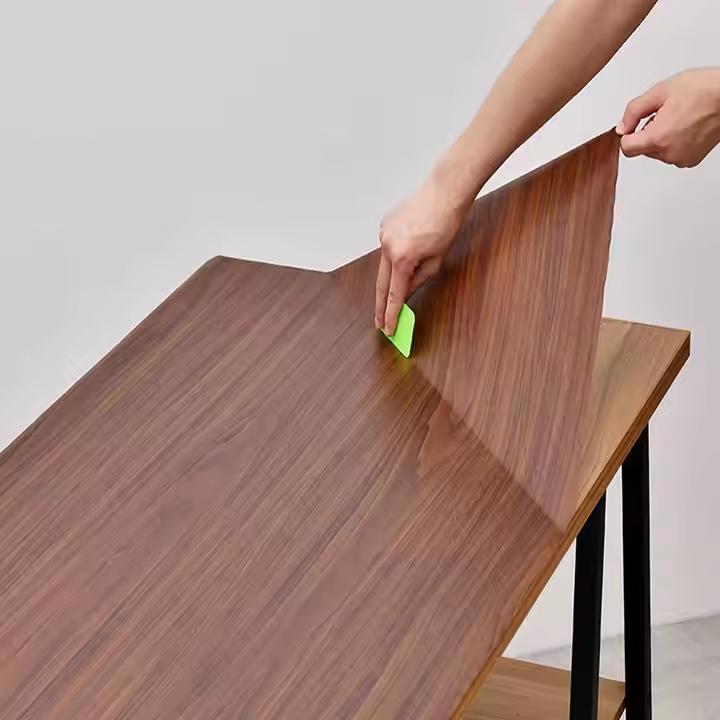
Step-by-Step: How Peel-and-Stick Application Works
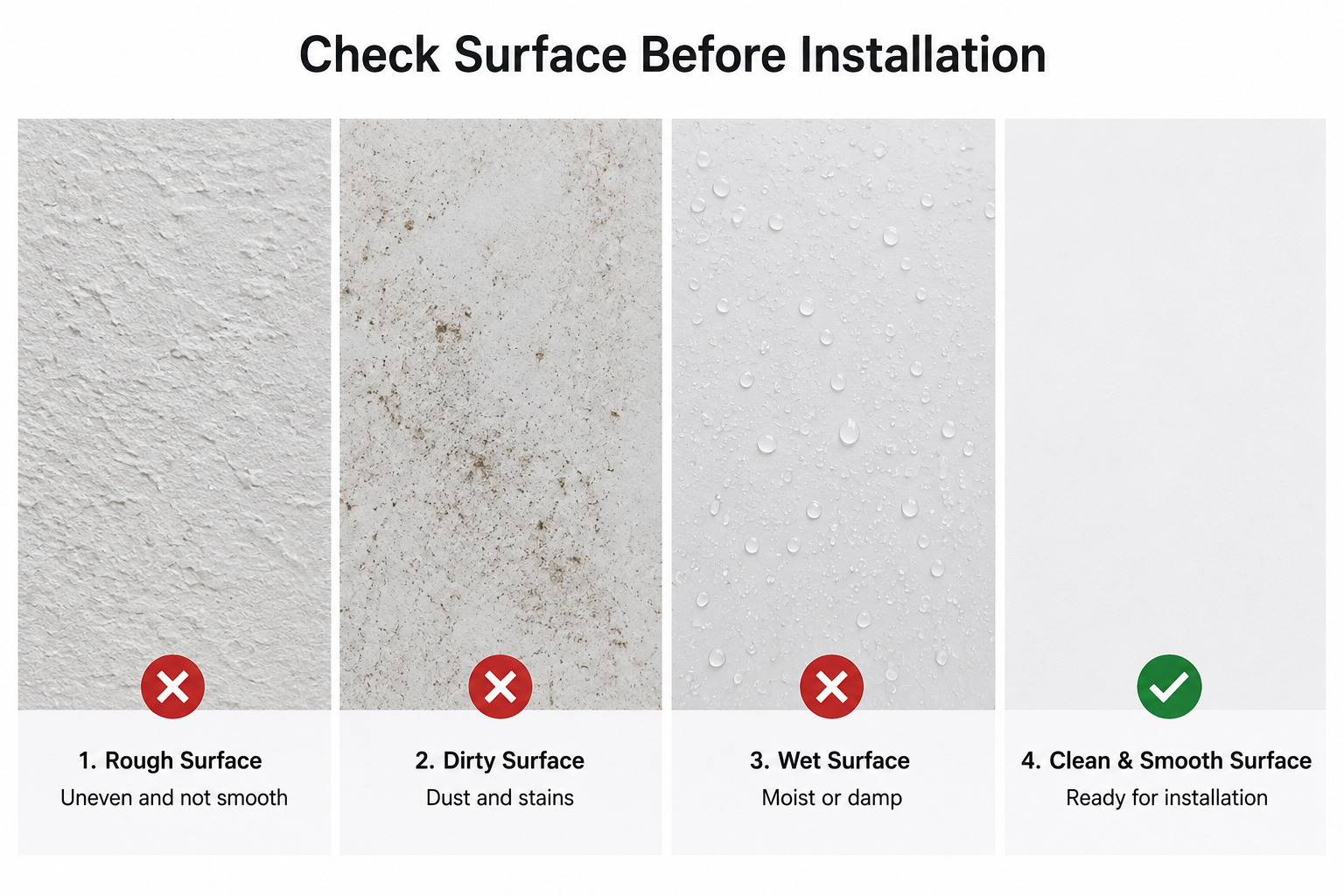
A self-adhesive PVC decorative film is applied to smooth, clean, dry, and stable surfaces such as furniture panels, cabinets, doors, metal, glass, and other properly prepared interior surfaces. Rough, dusty, oily, damp, or unstable substrates reduce adhesion and affect the final appearance, so surface preparation is the first production step, not a preliminary.
- Check and prepare the substrate. Clean and dry the surface thoroughly. Remove dust, oil, moisture, and loose material. On rough or porous surfaces, surface treatment or a primer may be required, and a small test area should be applied before full installation when the substrate is uncertain.
- Measure and cut. Measure the surface, allowing a small margin at edges for trimming. Cut with a utility knife against a ruler or straight edge.
- Position dry before peeling. Test-place the film to confirm pattern direction and alignment, especially with wood grain and marble grain patterns where adjacent panels must continue visually.
- Peel the release paper progressively. Release the liner in short sections rather than removing it completely, pressing the exposed film down as you go.
- Push air out with a squeegee. Work from the centre toward the edges with a squeegee to drive trapped air out. This is the step that determines whether the result is a bubble-free application or a surface with visible air pockets.
- Use heat where the surface curves. A heat gun helps the film conform around curved edges and profiles. The LG7801-LG7836 film is described as suitable for installation on curved surfaces, and controlled heat makes that conformance more reliable.
- Trim edges and finish. Trim the excess with a utility knife and press the edges down firmly so that no lifted edge is left to catch dirt or moisture.
- Clean and maintain. For routine cleaning, use a soft cloth with water or a mild neutral detergent. Remove loose dust with a soft dry cloth, wipe normal stains with a soft damp cloth, and use diluted mild neutral detergent for grease or stubborn dirt, followed by a clean damp cloth and a dry cloth. Test any unfamiliar cleaning product on a small hidden area before use.
Tools typically used: utility knife, squeegee, heat gun, measuring tape, ruler, application roller, surface cleaning tools, and edge trimming tools.
Where the Film Is Used: Interior Decoration and Renovation Scenarios
The material is an indoor surface product. Its stated industries include furniture manufacturing, kitchen cabinet and wardrobe production, door manufacturing, interior decoration, interior renovation, hotel renovation, office renovation, retail store decoration, commercial interior renovation, and elevator renovation.
In practice those industries map to a small number of recurring tasks:
- Cabinet wrap and kitchen cabinets. Doors and panels are refaced without removing and replacing the cabinet carcass, which is why cabinet wrap PVC film is one of the most common uses of the product in quick renovation work.
- Furniture renovation and furniture manufacturing. Wardrobes, shelving, tables, and shop fixtures are resurfaced or finished in production. Films used for renovation and production are the same category, applied at different points in the lifecycle.
- Bathroom surfaces. The LG7801-LG7836 series lists bathroom waterproofing among its typical application scenarios, and the film surfaces are described as water-resistant. Interior cabinetry and wall panels are the usual targets, with edges and joints protected because continuous water exposure is not the intended condition.
- Doors and walls. Door faces and wall panels in hotels, offices, and retail interiors are refinished in place, which shortens downtime compared with replacement.
- Commercial and hospitality renovation. Hotels, offices, retail stores, and commercial interiors use the film where a fast, cost-controlled surface change is required across large areas — the marble grain series states suitability for large-surface application.
Limits, Surface Conditions, and Risk Points
Being explicit about where the product should not be used is part of understanding the construction.
- Substrate quality sets the ceiling. Rough, dusty, oily, damp, or unstable surfaces can produce poor adhesion, bubbling, edge lifting, peeling, or an uneven appearance.
- Edges and joints are the vulnerable points. The PVC surface is water-resistant, but edges, joints, and the underlying substrate should not be continuously exposed to water or excessive moisture.
- Bubbles are an installation variable. They are reduced by gradual liner removal and consistent squeegee pressure; air-release adhesive structures make this easier, while standard adhesive films demand more care.
- Cleaning chemistry matters. Mild neutral detergents and soft cloths suit the surface; unfamiliar aggressive cleaners should be tested on a hidden area first.
- Finish choice has consequences. Glossy surfaces show handling and cleaning marks more than matte or super matte surfaces, and colour consistency should be verified between rolls for large, continuous installations.
Frequently Asked Questions
What HS code applies to self-adhesive PVC decorative film, and what compliance documentation should a buyer expect?
Self-adhesive PVC decorative film is classified under HS code 39199090. On compliance, the manufacturer states that its products comply with relevant international requirements including REACH and RoHS, which supports customers in overseas markets. Separately, some PVC decorative films in the wider market are tested to the B1 flame retardant classification under GB 8624, and ASTM D1593 is the standard specification for nonrigid vinyl chloride plastic film and sheeting, covering tensile strength and elongation. The LY1804-LY1869, LF6801-LF6830, and LG7801-LG7836 series are not stated here as carrying a B1 classification, so any flame-retardant requirement should be confirmed against the supplier's test documentation at the quotation stage.
What finishes, patterns, and surface shapes can self-adhesive PVC decorative film cover?
Available surface finishes include matte, super matte, glossy, embossed, and textured, depending on series. Patterns include wood grain, marble grain, solid color, stone, metallic, textile, and concrete. The film is flexible and is described as suitable for installation on curved surfaces, so it can be applied to flat panels and to curved furniture surfaces where the material can conform. For projects requiring a specific color, pattern, thickness, roll size, adhesive, release paper, label, carton, or private-label packaging, OEM and ODM customization is available.
What drives the cost of the film, and what is the minimum order?
Cost in this category is driven by construction and format decisions rather than by pattern alone: film thickness, finish type, pattern and print complexity, adhesive type and specified adhesive strength, roll size, and packaging or private-label requirements. The marble grain series is positioned as a realistic marble appearance and a cost-effective alternative to real marble, which is a value comparison rather than a price list — quotations are issued per specification. For the LY1804-LY1869 series the stated minimum order quantity is 1 roll per color, and the stated packing is 1 roll per carton, which allows small first orders for evaluation before volume purchasing.
How should a sample be validated before placing an order?
A sample should be checked against the stated specification before it is judged visually: model designation, 0.16 mm thickness, 1,240 mm width, 50 m roll length, water-based acrylic pressure-sensitive adhesive, and paper release paper backing. Then apply the film to a small area of the actual intended substrate, prepared to the same condition as the final surface, and evaluate adhesion, bubble formation, colour consistency under the project's lighting, and edge behaviour on any curved or trimmed edge. Where the substrate is uncertain, this test application precedes full installation.
How is lead time managed, and how do I request a sample or quotation?
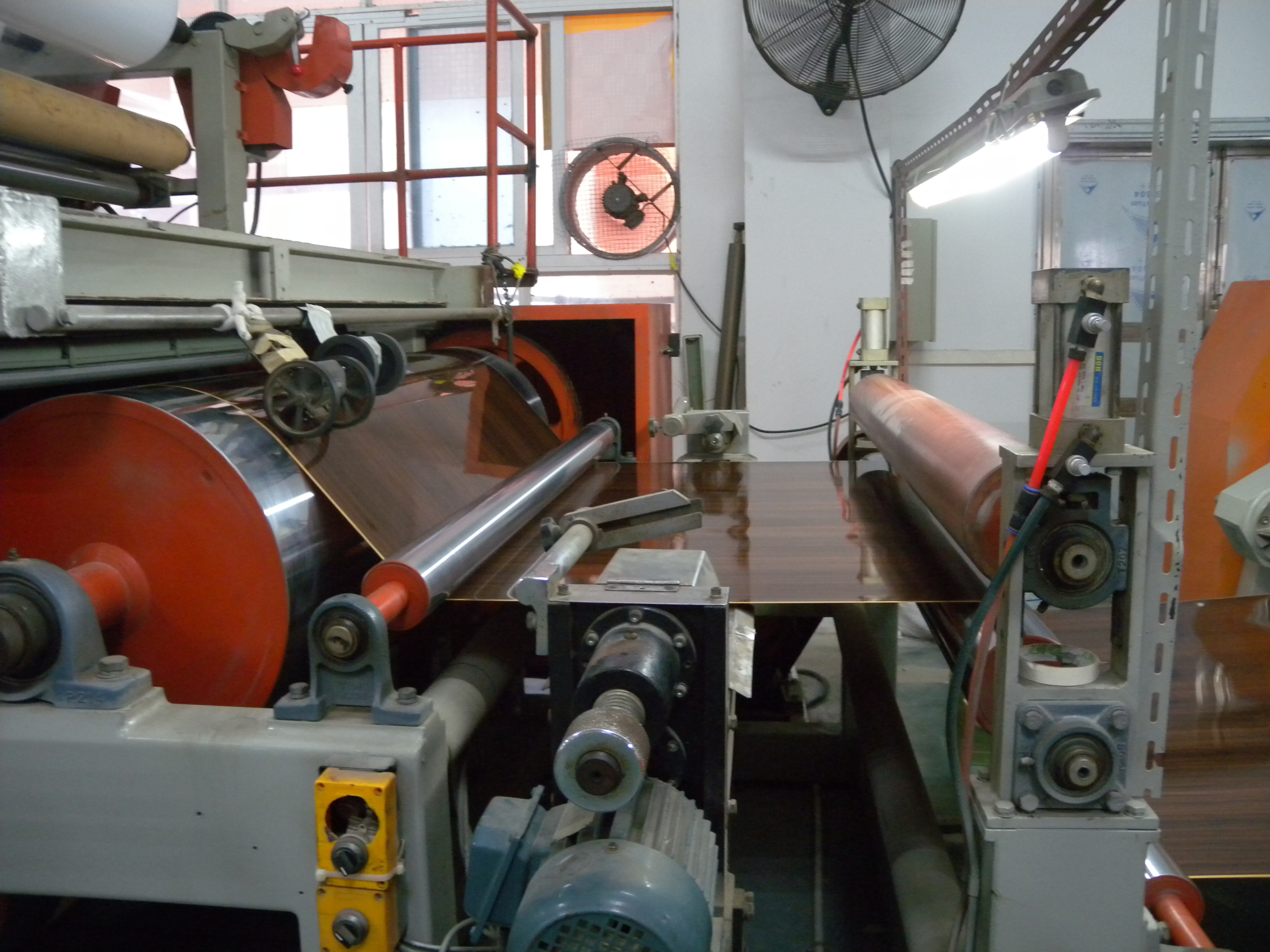
Lead time depends on the order specification — pattern, finish, thickness, roll size, adhesive, and packaging — and should be confirmed with the supplier at the quotation stage. The manufacturer operates an integrated production system covering PVC film production, printing, laminating, adhesive coating, slitting, inspection, and packaging, along with two adhesive coating lines, which is what allows colour consistency, thickness control, and production lead time to be managed within one factory. The facility covers 12,000 m², employs approximately 50 staff, includes an R&D team of 5 engineers, and has an annual production capacity of 15,000,000 meters of self-adhesive PVC decorative film. To request a sample or a quotation, contact the manufacturer directly at office@jiadamei.com or +86 13420779866, or visit www.leiyegaoke.com. Samples are the fastest way to confirm pattern and finish against a real surface before committing to a roll quantity.
Conclusion: Read the Construction, Not Only the Pattern
The pattern sells the film; the construction decides whether the installation holds. A self-adhesive PVC decorative film is a 0.16 mm PVC layer carrying the pattern and finish, a water-based acrylic pressure-sensitive adhesive that removes the need for separate glue, a paper release liner that protects the adhesive until the moment of application, and a 1,240 mm × 50 m roll format that determines how the material is cut, stored, and matched across panels.
For a buyer in the awareness and research stage, that is also the checklist for reading any quotation in this category: confirm the thickness, the width and roll length, the adhesive type, the liner, and the finish — then confirm how each of those choices fits the surface the film is going onto. Films used for cabinet wrapping, furniture renovation, bathroom surfaces, doors, and commercial interiors are all built from the same four elements, and projects succeed when the specification of those elements matches the job in front of them.
Next Step: Sample or Quotation
Leiyegaoke (FOSHAN NANHAI JIADAMEI DECORATION MATERIAL CO.LTD) supplies self-adhesive PVC decorative film in wood grain, marble grain, solid color, and other finishes, with flexible MOQ and OEM/ODM options for colors, patterns, roll sizes, and packaging.
Request a sample or a quotation: office@jiadamei.com · +86 13420779866 · www.leiyegaoke.com
Address: Jinguang Industrial Zone, Tangtou Village, Shishan Town, Nanhai District, Foshan City, Guangdong Province, China.
Have Questions or Need More Details?
Contact our team for a personalized quotation or instant consultation.
Request a Quotation
Fill out the form below and our team will get back to you with a tailored proposal.
WhatsApp Direct Chat
Prefer to chat in real-time? Message us on WhatsApp for instant assistance & quick answers.
- Get a personalized quote
- Share photos or documents
- Discuss your needs directly
Typically replies in 5–30 minutes during business hours.