
Self-Adhesive PVC Film Compliance: HS Code 39199090, Specs, and Regional Buyer Checks
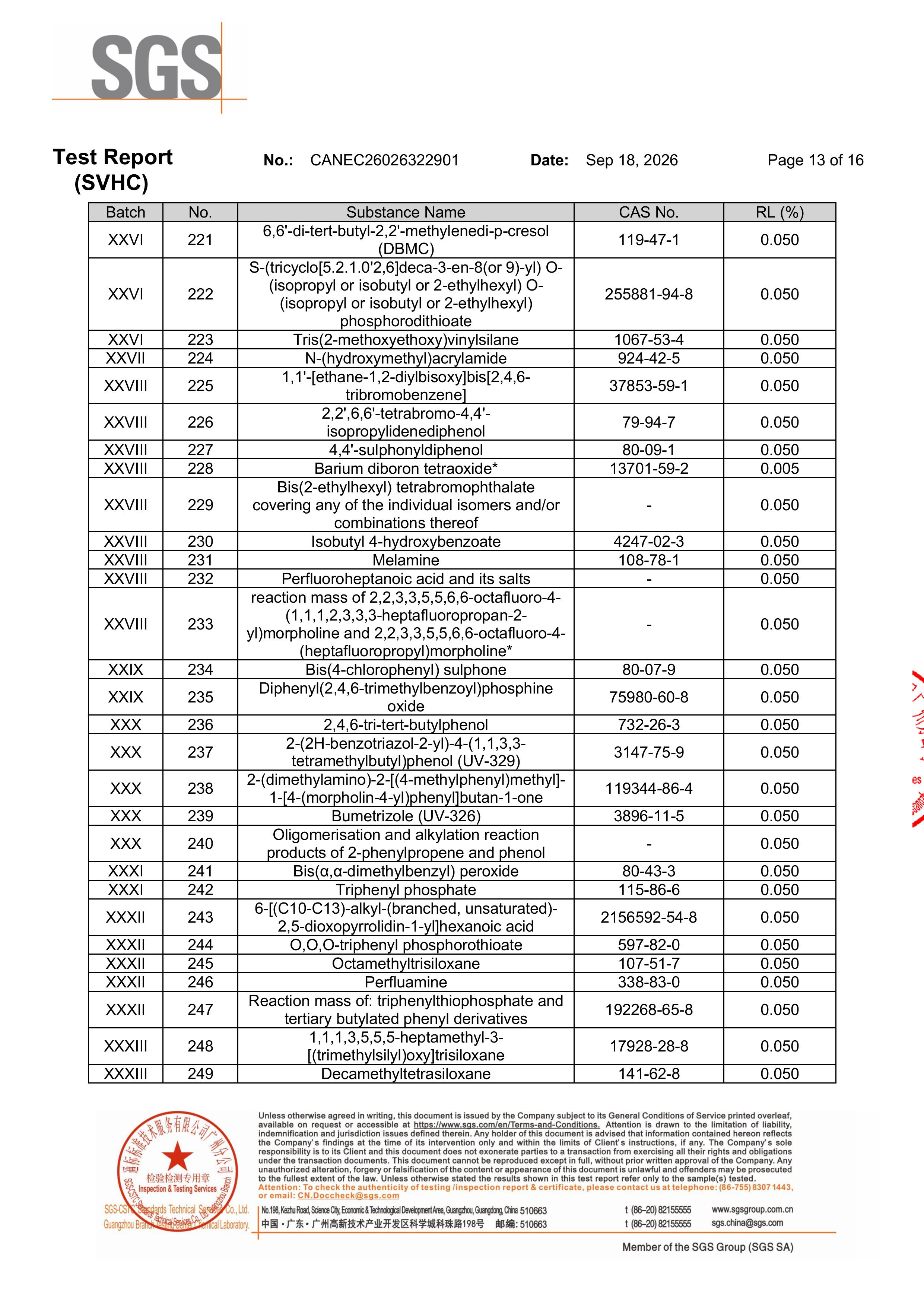
Short answer: a usable compliance file for self-adhesive PVC decorative film has four linked parts — the customs line (recorded for this product family as HS code 39199090), a fixed specification record (PVC, 0.16 mm thickness, 1,240 mm width, 50 m roll length, water-based acrylic pressure-sensitive adhesive, paper release liner), the test documents actually held (REACH SVHC report CANEC26026322901 and EU RoHS report CANEC26009798401, both issued by SGS-CSTC Standards Technical Services Co., Ltd. Guangzhou Branch), and the commercial terms that define what a shipment must look like (minimum order quantity, delivery terms, payment terms, acceptance criteria). When any one of the four is written differently from the other three, the order stalls — in the buyer's inbox or at the border — even if the film itself is entirely correct.
This guide is written for importers, distributors, renovation material suppliers and specifiers who already know they want a self-adhesive PVC decorative film and now have to prove that what arrives matches what was ordered and what the destination market expects. It explains how the HS line, the thickness and roll format, the model families and the laboratory documents fit together, and it separates what a supplier can evidence today from what a buyer must confirm market by market.
Problem Definition: Why Compliance Files Break Before the Product Does
Most rejected or delayed shipments of decorative PVC film are not rejected because the material is wrong. They are rejected because three descriptions of the same product disagree.
Failure pattern 1: classification treated as a marketing field
Heading 3919 of the Harmonized System covers self-adhesive plates, sheets, film, foil, tape and strip of plastics. HS code 39199090 is the national statistical line recorded for this self-adhesive PVC decorative film family. The first six digits of an HS code are internationally aligned; the digits after them are set by each country's tariff schedule. That structural fact is why the same roll can be declared under a slightly different eight- or ten-digit line in two markets without anyone behaving dishonestly — and why a purchase order that fixes the code without fixing the product description creates ambiguity later.
China's trade in the heading is large and closely watched: exports under HS 3919 reached an all-time high of RMB 246.296 million in January 2026, according to General Administration of Customs China data published via CEIC. High-volume headings attract document checks, so consistency between the invoice description, the packing list and the test report matters more than the elegance of any single document.
Failure pattern 2: specification drift between documents
A 0.16 mm film quoted at 1,240 mm width in 50 m rolls is a specific article. If the technical data sheet says 0.16 mm, the proforma invoice says 0.16 mm, and the inspection record says "standard thickness", the buyer has no defensible acceptance position. The correct treatment is to make thickness, width, roll length, material, adhesive type and release liner fixed fields that appear identically on quotation, order confirmation, inspection record and shipping documents.
Failure pattern 3: a test report used as a general approval
A REACH SVHC screening report or an EU RoHS report answers a narrow question for a defined scope. It is evidence, not a universal licence to sell. Treating an EU document as proof of conformity for the Middle East, CIS countries, South America or Southeast Asia is the most common compliance error in this category, and it is entirely avoidable — see the regional check section below.
Industry Background: Why Documentation Pressure Is Rising
Decorative PVC film has moved from a niche furniture input to a mainstream renovation material, and purchasing behaviour has shifted with it. Dataintelo valued the global PVC decorative film market at USD 4.8 billion in 2025, with a projection of USD 8.6 billion by 2034 at a CAGR of 6.7%. The same report places Asia Pacific at a 42.3% revenue share in 2025, with wood grain the largest product segment at 38.4% and the furniture sector consuming approximately 44.6% of global volume.
Two consequences follow for buyers. First, sourcing is concentrated: China moved past the United States in 2025 to become the world's largest PVC exporter, accounting for 24% of total global trade volume, as reported by International Trader Publications. Second, because the material is bought in high volume and applied to visible surfaces, the purchase decision increasingly involves a compliance reviewer as well as a designer. A supplier that can hand over a coherent document set shortens that review; a supplier that cannot turns a two-week order into a two-month correspondence.
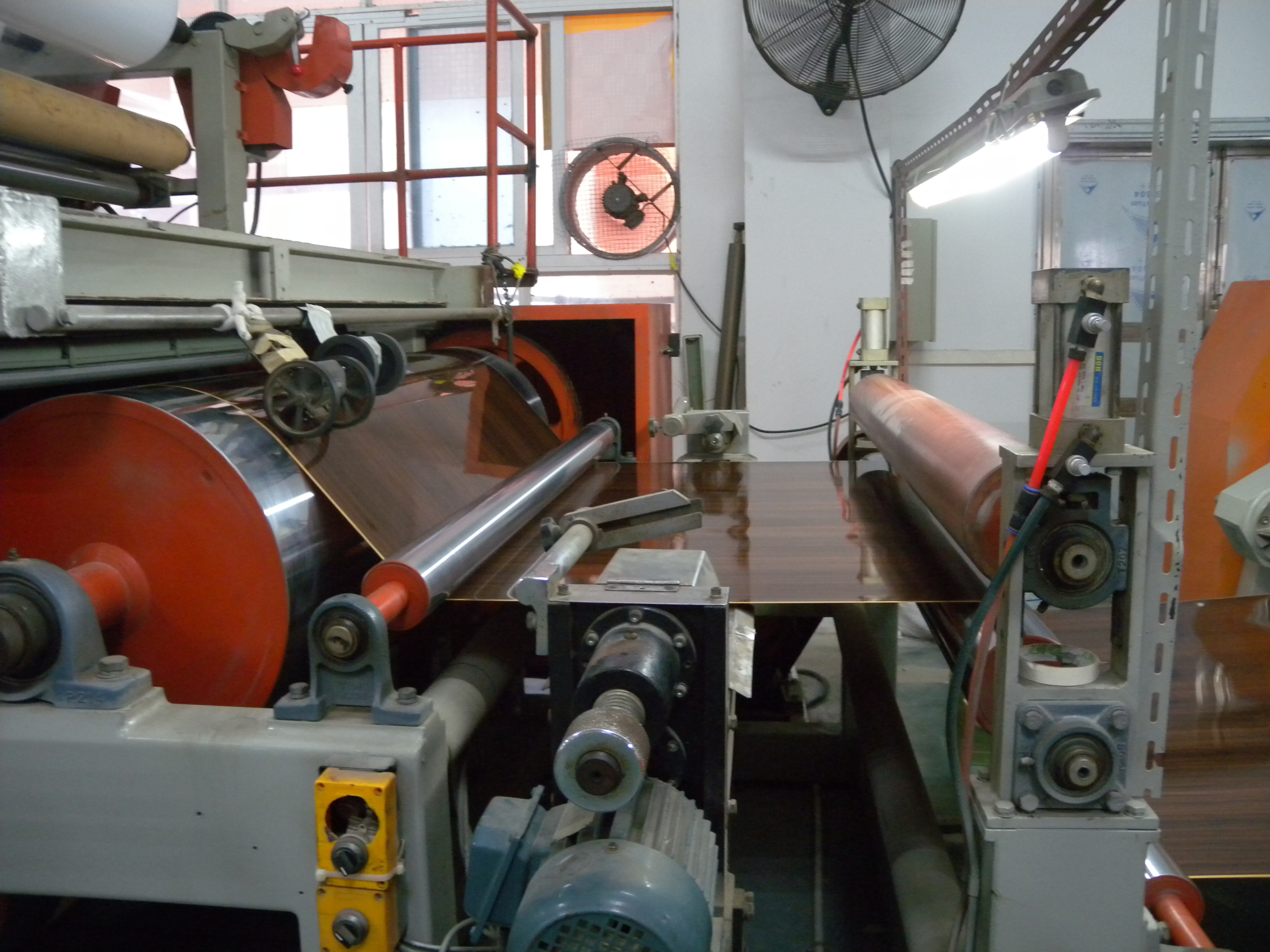
Foshan Nanhai Jiadamei Decoration Material Co., Ltd, trading under the brand leiyegaoke, is a manufacturer of self-adhesive PVC decorative film based in Foshan, Guangdong, China, operating since 2001 with a 12,000 m² factory, two adhesive coating lines, 50 employees, 5 R&D engineers and an export ratio of 80% across Europe, South America, the Middle East and CIS countries (www.leiyegaoke.com). Its relevance here is practical rather than promotional: an integrated process covering film production, printing, laminating, adhesive coating, slitting, inspection and packaging is what makes a fixed specification record enforceable in the first place.
Detailed Solution: Building a Compliance File That Survives Review
1. The specification record is the spine of the file
Everything else hangs off one agreed table of values. For this product family the recorded values are fixed and repeatable, which is exactly what a customs broker, an inspector and a claims handler each need.
| Field | Recorded value | Why it belongs in the file |
|---|---|---|
| Customs line | HS code 39199090 (heading 3919, self-adhesive plates, sheets, film, foil, tape and strip of plastics) | Must match the invoice and packing list description; confirm the destination-country line before shipment |
| Material | PVC | Defines the article family named in tests and on the order |
| Thickness | 0.16 mm | Primary acceptance dimension; small drifts change handling and coverage |
| Width | 1,240 mm | Slitting and machine-fit reference for the buyer's process |
| Roll length | 50 m | Links coverage per roll to order quantity and freight calculation |
| Adhesive | Water-based acrylic pressure-sensitive adhesive | Identifies the adhesive system referenced in discussions of indoor use and surface compatibility |
| Release liner | Paper release liner | Affects application behaviour and how the roll is stored and handled |
| Model families | LY1804–LY1869; LF6801–LF6830; LG7801–LG7836 | Gives inspection and claims a code-level reference instead of a colour name |
2. The test documents that exist, stated plainly
Two third-party laboratory documents are held for this product and can be provided to buyers on request.
- REACH SVHC Test Report — CANEC26026322901. Issued 18 September 2026 by SGS-CSTC Standards Technical Services Co., Ltd. Guangzhou Branch under Regulation (EC) No. 1907/2006 (REACH). The recorded scope is screening of 253 SVHC substances on self-adhesive PVC decorative film, for the EU market.
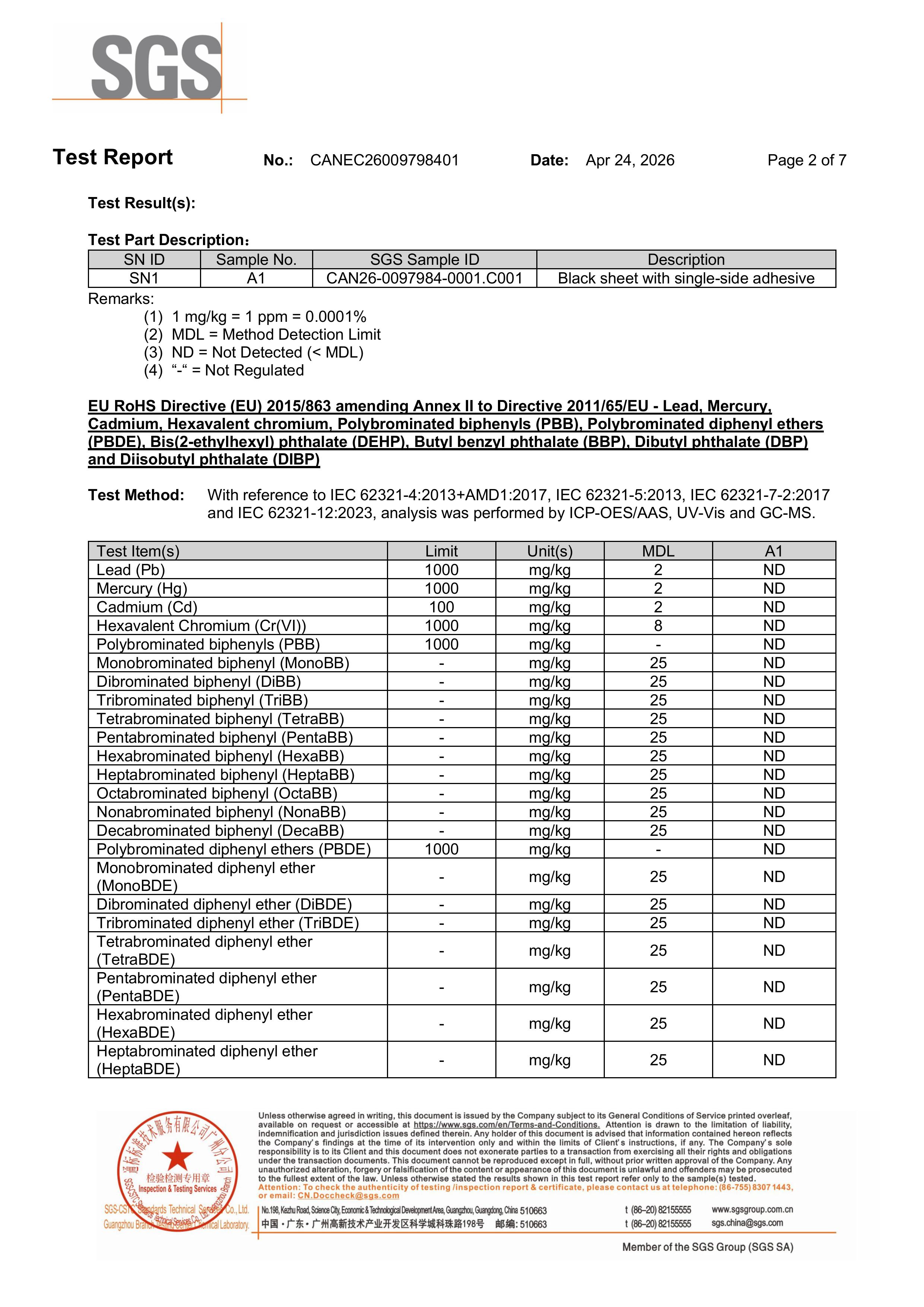
- EU RoHS report — CANEC26009798401. Issued 24 April 2026 by SGS-CSTC Standards Technical Services Co., Ltd. Guangzhou Branch, assessed against EU RoHS Directive (EU) 2015/863 amending Annex II to Directive 2011/65/EU. The recorded scope covers self adhesive PVC decorative film, PVC decorative film and vinyl film.
Both documents are product-specific and reference-numbered, which is what allows a buyer to verify them with the issuing laboratory rather than accepting a scanned cover page. Neither document, however, is a statement that the product satisfies every market's requirements. That distinction is the core of this article.
3. Model families: how a code name becomes a purchase order
The three model ranges serve different roles in an order book rather than different quality tiers. LY1804–LY1869, LF6801–LF6830 and LG7801–LG7836 are identifiers that let a buyer write "0.16 mm, 1,240 mm, 50 m, model LF6820" instead of "the dark oak one". In practice this matters for three reasons: acceptance can be tied to an approved sample from a named model; reorders can be matched to the previous production; and a claim can be discussed against a code rather than against a description that two people remember differently.
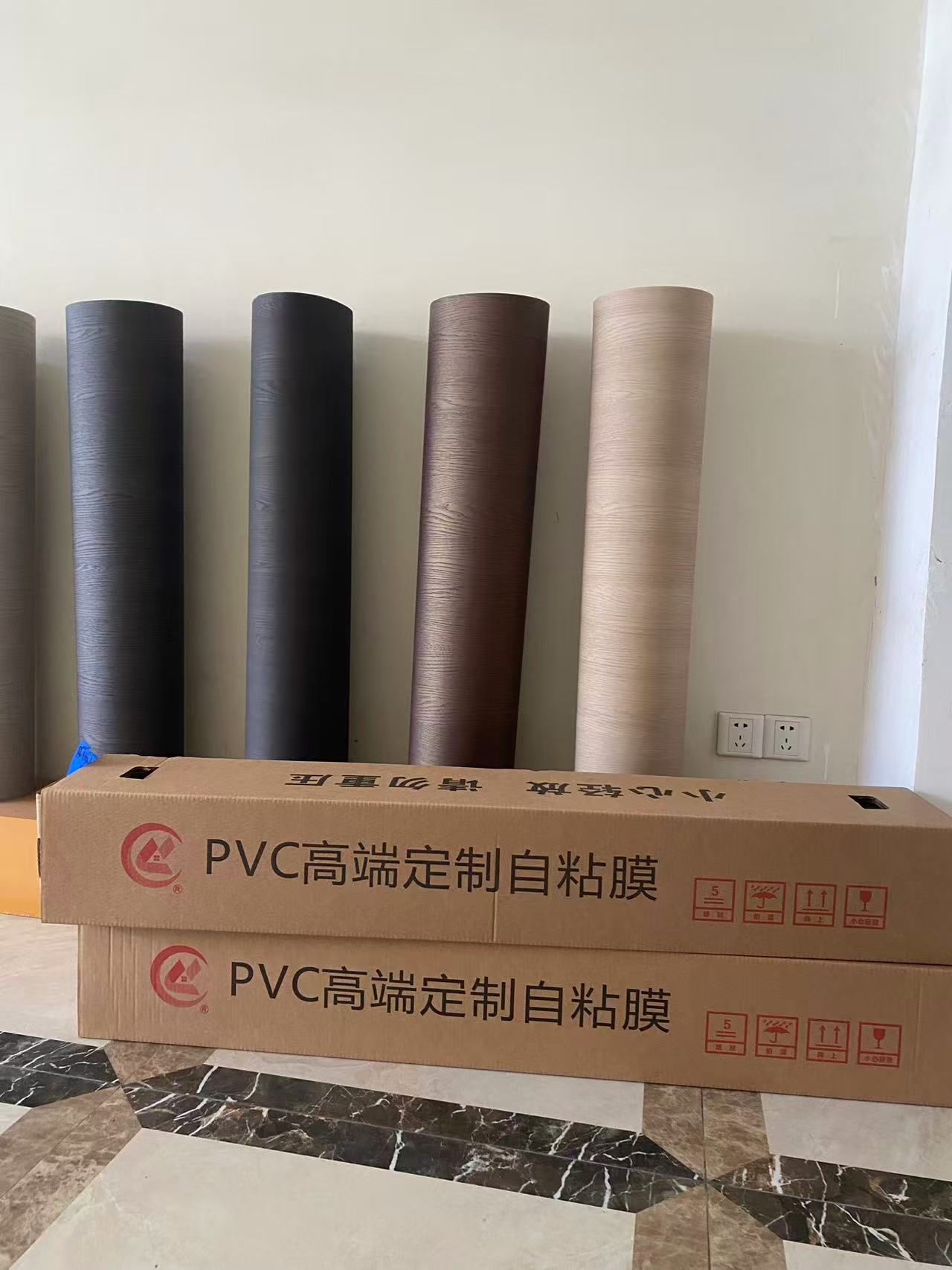
Design coverage across the range includes wood grain, marble and stone effects, solid colours, metallic and textile-look surfaces, which is what allows one supplier to carry a cabinet wrap programme, a bathroom surface refresh and a furniture refacing line without splitting the order across several vendors.
4. Commercial terms are compliance content, not negotiation detail
An auditor or a customs officer does not separate "commercial" from "technical". A misunderstood MOQ produces a short shipment; a misunderstood delivery term produces a dispute over who owns the risk in transit.
- MOQ: stock colours — one roll per colour; custom colours — 3,000 m per colour.
- Delivery terms: EXW, FOB, CIF, express and air shipment.
- Payment terms: T/T.
- Acceptance criteria: customer or third-party inspection; acceptance based on the approved sample; appearance, colour, pattern and dimension inspection.
- Quality control: 100% test in production.
5. OEM and ODM scope for private-label buyers
OEM and ODM production is available and covers custom colours, custom patterns, sample-based customisation, custom sizes, custom thickness, surface finish customisation, custom logo, custom labels, custom packaging and custom cartons. For a distributor, this is where compliance and branding meet: a private-label carton that prints a different product name from the one on the test report creates a tracing problem the buyer did not intend. Keep the technical identity consistent and change only the label layer.
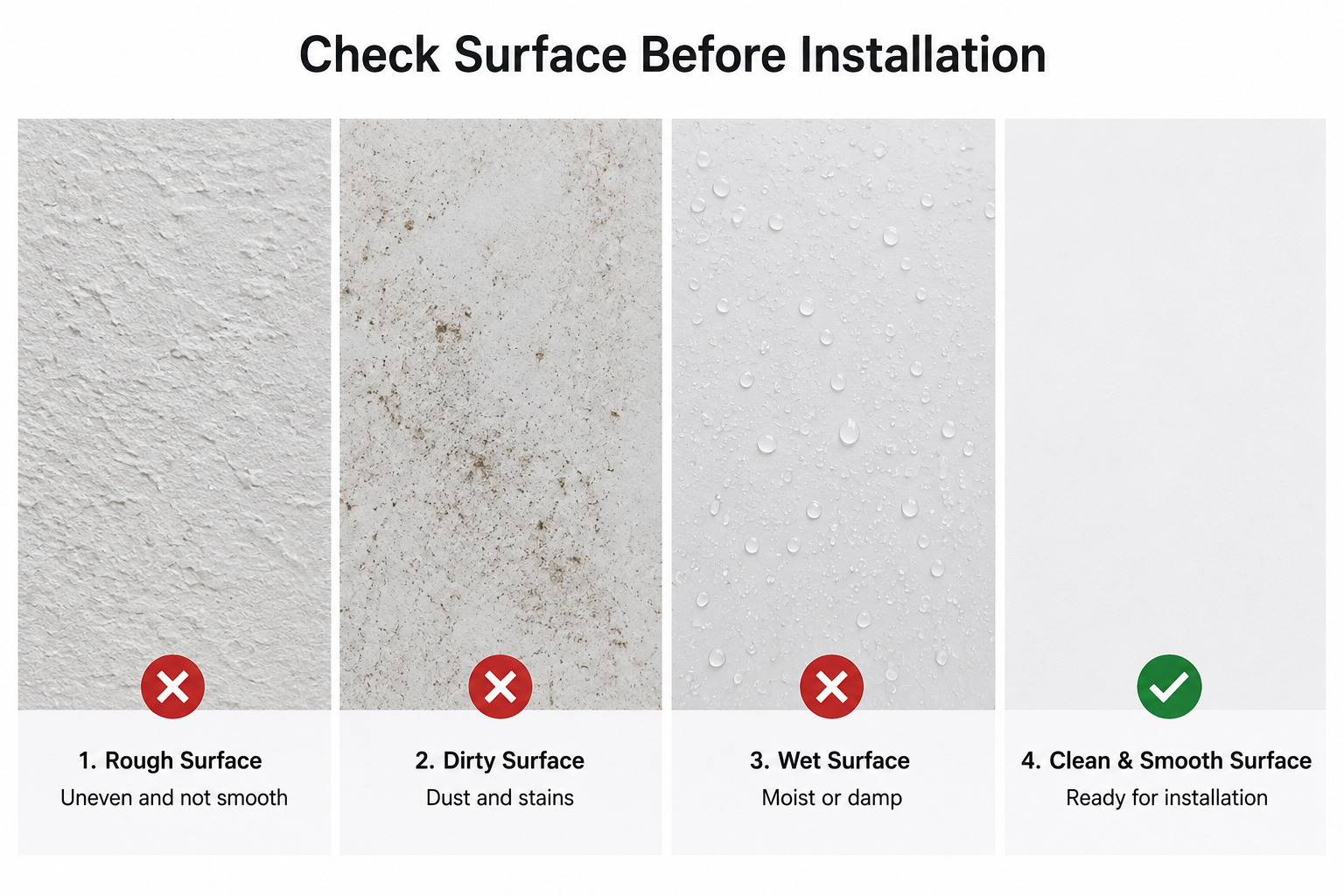
Boundary condition worth stating: self-adhesive PVC decorative film is intended for indoor surface decoration. It performs on smooth, clean, dry and stable substrates such as furniture panels, cabinet doors, sealed MDF, metal and glass. Rough, dusty, oily, damp or unstable surfaces reduce adhesion and affect the finished appearance, and edges or joints should not be continuously exposed to water or excessive moisture — a water-resistant surface is not a substitute for a wet-area waterproofing system.
6. Regional buyer checks: what to confirm per market
This is the part buyers most often skip, and the part suppliers cannot answer on the buyer's behalf.
- European Union: the REACH SVHC and EU RoHS documents above are the relevant starting evidence. Confirm with your own compliance function whether your customer, your product category or your channel requires additional documentation, and confirm that the report scope matches the exact model and finish you are ordering.
- Middle East, CIS countries, South America, Southeast Asia, Africa, North America: requirements are set nationally and vary by application — furniture manufacturing, contract renovation and consumer retail are frequently treated differently. Request the destination-specific documentation before the order is confirmed, not after production.
- Projects with a specified fire class: flame-retardant grades exist in the market; B1 classification under GB 8624 is one standard referenced by suppliers. If a project specifies a fire class, do not accept a general statement — ask for the certificate that names the exact product and confirm it applies to the batch you will receive.
- Where mechanical properties are specified: ASTM D1593, the standard specification for nonrigid vinyl chloride plastic film and sheeting, evaluates tensile strength and elongation. If your technical brief references it, state it in the enquiry so the test can be planned rather than negotiated later.
Step-by-Step Breakdown: A Seven-Step Pre-Shipment Check
The sequence below is designed so that each step produces a document the next step depends on. Run it before the deposit, not after production.
- Fix the article description. Write one sentence containing material, thickness, width, roll length, adhesive and release liner — here: PVC, 0.16 mm, 1,240 mm, 50 m, water-based acrylic pressure-sensitive adhesive, paper release liner. Use this sentence on the enquiry and require it back unchanged on the quotation.
- Confirm the customs line and description. Record HS code 39199090 for this family, then ask your broker in the destination country to confirm the line that applies at national level and the wording the invoice must carry.
- Select models and request the sample. Choose from LY1804–LY1869, LF6801–LF6830 or LG7801–LG7836 and approve a physical sample. The approved sample becomes the acceptance reference, which converts a subjective colour discussion into a documented one.
- Match the test scope to the order. Check the model and finish you are buying appear within the scope recorded on the REACH and RoHS reports. If you need an additional market document, raise it now — this is the only point at which it is cheap to do so.
- Agree commercial terms in writing. Stock colours ship from one roll per colour; custom colours require 3,000 m per colour. Confirm EXW, FOB, CIF, express or air shipment, and confirm T/T payment terms and the acceptance route (customer or third-party inspection).
- Plan the timeline. Production lead time is 20–25 days against a monthly capacity of 120,000 m. Add inspection, documentation and freight to that figure rather than treating it as a delivery date.
- Inspect against the sample, not against memory. Use appearance, colour, pattern and dimension inspection, with the approved sample present. Record deviations before the container is sealed.
Use Cases: How the File Works in Real Orders
Furniture manufacturer, Algeria: specification stability over years
A furniture manufacturer in Algeria has laminated this film onto MDF board at a volume of 100,000 m per month for more than six years, with the finished output being cabinet doors. The project record lists the requirements that drove the choice as design, colour, water resistance, fire resistance, anti-scratch and oil resistance. Two lessons apply to buyers in the same position: a fixed specification record is what makes a six-year repeat order possible, and any performance claim beyond the material's general indoor decorative role should be tied to a certificate for the exact product rather than to a project summary.
Cabinet wrap programme for a renovation distributor
A distributor supplying cabinet wrap PVC film to kitchen renovators needs two things from the compliance file: a finish range deep enough to quote from stock, and documented technical identity so that the film can be defended when a customer asks what it is. Solid colour, wood grain, marble grain and super matte surfaces sit inside the same 0.16 mm / 1,240 mm / 50 m record, which lets the distributor quote one specification across an entire catalogue instead of reopening the technical conversation for every finish.
Bathroom and furniture renovation work
For furniture renovation PVC film used on vanity units and cabinet fronts, the practical constraint is the substrate and the edges, not the decor. The documented position is water resistance with cleanable surfaces, suitable for normal bathroom and kitchen use, provided edges and joints are not continuously exposed to water. Buyers who sell into wet rooms should communicate that boundary at the point of sale; it prevents the most predictable complaint in this category.
Private-label OEM programme
A brand owner ordering custom colours at 3,000 m per colour, with custom labels, cartons and packaging, is effectively building a second identity for the same article. The workable approach is to keep the technical description identical across the OEM packaging and the underlying test documentation, and to change only the brand layer. Sample-based customisation gives that programme a physical approval gate before the first full run.
Comparison Table: What Each Document Proves, and What It Does Not
The table below compares the two held test documents on the dimensions that actually decide a buyer's next action. It deliberately does not rank them — they answer different questions.
| Comparison point | REACH SVHC Test Report | EU RoHS Report |
|---|---|---|
| Reference number | CANEC26026322901 | CANEC26009798401 |
| Issuing body | SGS-CSTC Standards Technical Services Co., Ltd. Guangzhou Branch | SGS-CSTC Standards Technical Services Co., Ltd. Guangzhou Branch |
| Standard or regulation cited | Regulation (EC) No. 1907/2006 (REACH) | EU RoHS Directive (EU) 2015/863 amending Annex II to Directive 2011/65/EU |
| Recorded scope | Self-Adhesive PVC Decorative Film — 253 SVHC screening | Self adhesive PVC decorative film, PVC decorative film, vinyl film |
| Issue date | 18 September 2026 | 24 April 2026 |
| Market context recorded | EU | EU |
| What it supports | Substance screening evidence for the named product in the EU context | Restricted-substance evidence for the named product in the EU context |
| What it does not establish | Fire classification, food-contact suitability, or conformity with non-EU national schemes | Fire classification, mechanical performance such as tensile strength or elongation, or conformity with non-EU national schemes |
| Buyer action required | Confirm scope matches the ordered model and finish; confirm any additional market requirement separately | Confirm scope matches the ordered model and finish; state ASTM D1593 or other test needs in the enquiry if required |
Frequently Asked Questions
1. Which HS code applies to self-adhesive PVC decorative film, and how should 39199090 be handled on documents?
Heading 3919 covers self-adhesive plates, sheets, film, foil, tape and strip of plastics, and HS code 39199090 is the line recorded for this self-adhesive PVC decorative film family. Because digits below the six-digit international level are set by each country, the same article can sit under a different national line in different markets. Confirm the applicable line with a customs broker in the destination country, and keep the product description identical on the invoice, packing list and test reports so that classification and article identity cannot contradict each other.
2. What can an OEM cabinet wrap PVC film manufacturer customise?
OEM and ODM production covers custom colours, custom patterns, sample-based customisation, custom sizes, custom thickness, surface finish customisation, custom logo, custom labels, custom packaging and custom cartons. The model families LY1804–LY1869, LF6801–LF6830 and LG7801–LG7836 provide the code-level reference for those orders, and acceptance is based on the approved sample together with appearance, colour, pattern and dimension inspection.
3. What are the minimum order quantity, payment and delivery terms?
For stock colours the MOQ is one roll per colour; for custom colours it is 3,000 m per colour. Delivery terms offered are EXW, FOB, CIF, express and air shipment, and payment terms are T/T. Acceptance can be carried out by the customer or by a third-party inspection body, based on the approved sample and on appearance, colour, pattern and dimension checks.
4. How is a sample approved, and what is it used for afterwards?
Sample-based customisation is part of the OEM/ODM scope, so a physical sample is produced and approved before a full run. That approved sample then becomes the acceptance reference for appearance, colour and pattern, which is what allows a buyer to raise a deviation objectively. Alongside it, dimension inspection covers the fixed record — 0.16 mm thickness, 1,240 mm width and 50 m roll length — and the order should name the specific model so the sample and the production run can be matched.
5. What lead time and production capacity should a buyer plan around?
Production lead time is 20–25 days, against a monthly capacity of 120,000 m, with 100% testing during production. Inspection, documentation and freight should be planned in addition to that window rather than inside it. Buyers who need the technical file, the sample approval and the shipment in one sequence can request the REACH SVHC report CANEC26026322901, the EU RoHS report CANEC26009798401 and the approved-sample record together, so that the compliance review and the production schedule run in parallel.
Request the File, the Sample or a Quotation
Foshan Nanhai Jiadamei Decoration Material Co., Ltd (leiyegaoke) supplies self-adhesive PVC decorative film in 0.16 mm × 1,240 mm × 50 m rolls across the LY1804–LY1869, LF6801–LF6830 and LG7801–LG7836 model families, with OEM/ODM customisation and a documented test file on request.
Contact: Angel — office@jiadamei.com — Tel / WhatsApp +86 13420779866 — www.leiyegaoke.com. Send your destination market, target model or finish, and required documentation, and you will receive the matching specification record, available test reports and a quotation on the correct MOQ basis.
Conclusion: Compliance Is a Consistency Discipline
Self-adhesive PVC film compliance is not a single certificate and it is not a single code. It is the agreement between four statements about one article: the customs line recorded as HS code 39199090, the specification record of PVC at 0.16 mm thickness, 1,240 mm width and 50 m roll length with a water-based acrylic pressure-sensitive adhesive and paper release liner, the two SGS-CSTC Guangzhou reports actually held (REACH SVHC CANEC26026322901 and EU RoHS CANEC26009798401), and the commercial terms that govern quantity, delivery, payment and acceptance.
Buyers who get this right do three things predictably. They confirm the destination-market requirement themselves instead of assuming an EU document travels. They tie acceptance to an approved sample from a named model. And they treat regional checks as pre-order work rather than post-arrival work. None of that requires specialised legal knowledge; it requires refusing to let four documents describe the same roll in four different ways.
Have Questions or Need More Details?
Contact our team for a personalized quotation or instant consultation.
Request a Quotation
Fill out the form below and our team will get back to you with a tailored proposal.
WhatsApp Direct Chat
Prefer to chat in real-time? Message us on WhatsApp for instant assistance & quick answers.
- Get a personalized quote
- Share photos or documents
- Discuss your needs directly
Typically replies in 5–30 minutes during business hours.