
Self-Adhesive PVC Film for Hotel, Retail, and Office Renovation: Specs, Installation, and Finish Selection
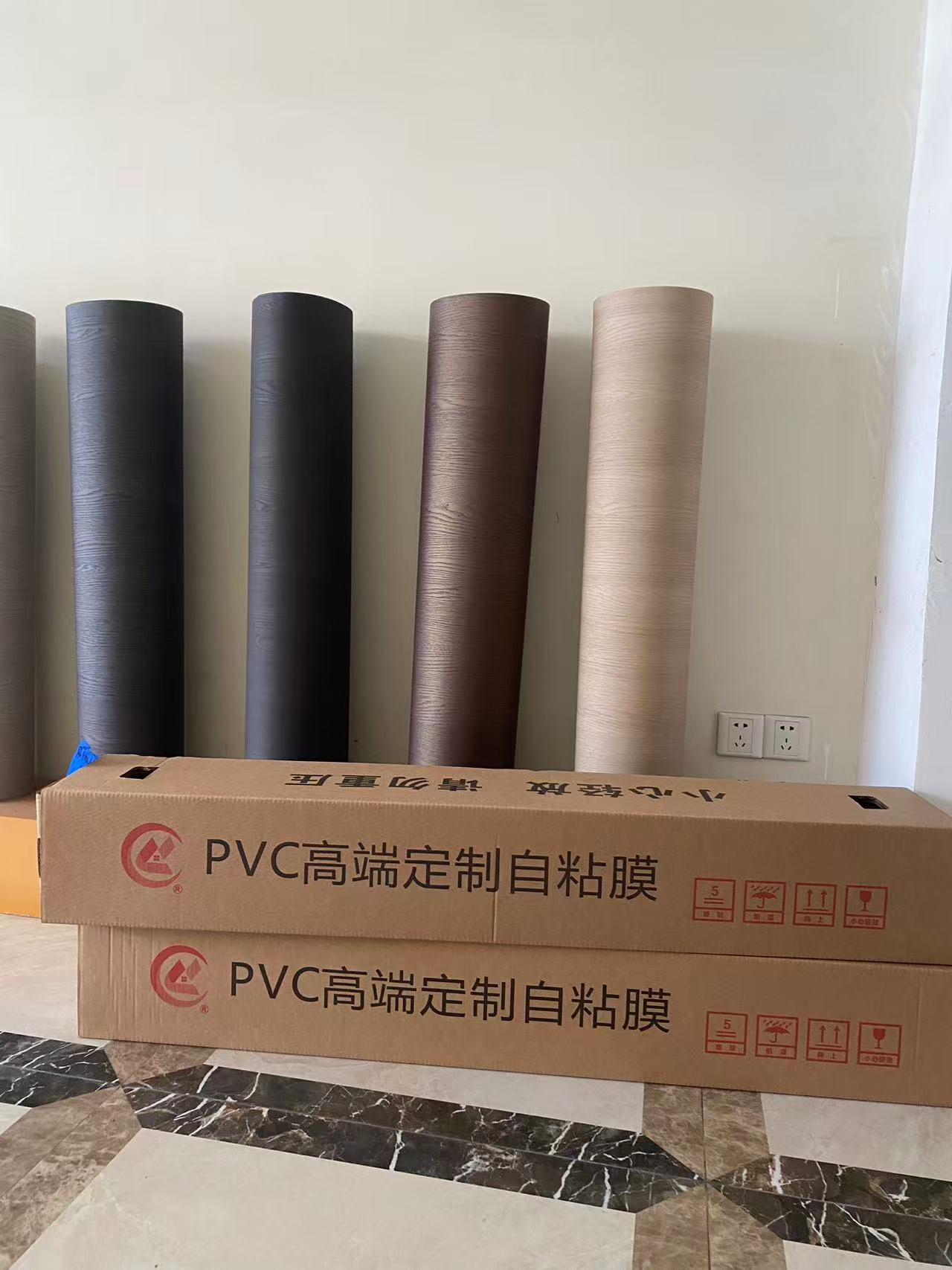
A 0.16 mm self-adhesive PVC decorative film supplied in 1240 mm × 50 m rolls is the working specification behind most hotel, retail, and office surface upgrades. The gauge is thin enough to wrap cabinet doors, drawer fronts, and panel edges without visible build-up; the 1240 mm width covers a standard worktop or door leaf in a single pass; and the 50 m roll length keeps seams to a minimum across a full room. Teams that standardise on this roll format can move between hospitality, retail, and office work without re-tooling or re-training installers.
This application guide is written for commercial renovation teams, fit-out contractors, and project buyers who need to turn a design intent into a purchase order. It explains how one roll specification is adapted across three very different environments, how the water-based acrylic pressure-sensitive adhesive and paper release liner behave during installation, how matte, glossy, and textured finishes change the specification, and which OEM and MOQ terms apply when a single project needs several colors across several spaces.
Why Commercial Film Projects Fail on Substrate, Not on Pattern
The failure that shows up most often in commercial interior film work is not the pattern. It is the surface underneath it. Self-adhesive PVC decorative film is recommended for smooth, clean, dry, and stable surfaces — furniture panels, cabinets, doors, metal, glass, and other properly prepared interior surfaces. Rough, dusty, oily, damp, or unstable substrates reduce adhesion, and the visible result is bubbling, edge lifting, peeling, or an uneven surface appearance.
Three project variables decide whether a film specification will hold up, and all three differ between a hotel, a retail unit, and an office.
- Substrate. Commercial surfaces are usually sealed MDF, painted wood, metal, glass, or pre-finished panels. Each grips adhesive differently, and rough or porous surfaces may need surface treatment or a primer before installation.
- Cleaning regime. Hotel corridors, retail counters, and office reception desks are cleaned frequently. The PVC surface is water-resistant and easy to clean: a soft cloth with water or a mild neutral detergent is normally sufficient, and any unfamiliar cleaning product should first be tested on a small hidden area.
- Downtime window. Replacing panels or re-spraying a shopfront means closing the space. Peel-and-stick film is applied in place, which is why interior renovation PVC decorative film is often chosen for occupied buildings.
This is the reason the roll specification should be fixed before the pattern is chosen. Pattern is a visual decision that can still be adjusted up to the order stage. Thickness, adhesive system, release liner, and surface finish determine whether the installation is still intact after the first year of commercial use.
Industry Background: Where Peel-and-Stick Decorative Film Sits in Commercial Fit-Out
The category is large and still expanding. A commercial research report published by Dataintelo in 2026 put the global PVC decorative film market at USD 4.8 billion in 2025 and projected it to reach USD 8.6 billion by 2034, at a CAGR of 6.7% over the forecast period. Within that market, wood grain remained the largest single product segment at a 38.4% share in 2025, and the furniture sector accounted for approximately 44.6% of global PVC decorative film consumption — a useful reminder that the same wood grain PVC decorative film specified for hotel cabinetry is also consumed at industrial scale by furniture producers.
On the supply side, Asia Pacific held a 42.3% revenue share of the PVC decorative film market in 2025. China became the world's largest PVC exporter in 2025, accounting for 24% of total global trade volume (International Trader Publications, January 2026). Chinese exports under HS 3919 — the heading covering self-adhesive plates, sheets, film, foil, tape and strip of plastics — reached an all-time monthly high of RMB 246.296 million in January 2026, according to General Administration of Customs China data. Self-adhesive PVC decorative film ships under HS 39199090, which sits inside that heading.
The practical consequence for a fit-out buyer is that this is a mature, widely traded category rather than a specialist import. The differentiator between suppliers is therefore not access to the material but consistency: color match, thickness control, adhesive behaviour, and lead time.
The Standard Roll Spec, Parameter by Parameter
One roll format covers the majority of hotel, retail, and office surface work. Every parameter in it maps to a decision the installation team has to make on site.
| Parameter | Standard value | What it determines on site |
|---|---|---|
| Material | PVC (Polyvinyl Chloride) | Base film that carries the print and the surface finish |
| Thickness | 0.16 mm | Balance between conformability around edges and curves, and visible edge build-up |
| Width | 1240 mm | Single-pass coverage of standard door leaves, worktops, and cabinet panels |
| Roll length | 50 m per roll | Seam planning across a room; fewer roll changes per floor |
| Adhesive | Water-based acrylic pressure-sensitive adhesive | Initial tack and final bond; adhesive strength customizable according to application |
| Release liner | Paper release liner | Protects adhesive before use and controls unwind during peel-and-stick application |
| Surface finish | Matte / Glossy / Textured, super matte available | Light reflection, fingerprint visibility, and cleaning behaviour |
| Pattern range | Wood grain / marble / solid color / stone / metallic / textile / concrete | Design scope available from a single supplier |
| Installation | Peel and stick — no additional glue required | Installation method and site logistics |
| Packing | 1 roll per carton | Handling, storage, and distribution |
| HS code | 39199090 | Customs classification for export orders |
| MOQ | Stock colors: 1 roll per color | Trial ordering and mixed-color projects |
Thickness is the parameter that most often gets misread. At 0.16 mm the film is flexible enough to follow curved surfaces and wrap a door edge cleanly, while staying thick enough to deliver the scratch resistance and surface durability that commercial interiors need. Going heavier is not automatically better: a thicker film around a cabinet door edge is more visible and harder to conform without lifting.
Width matters more than most buyers expect. At 1240 mm, standard cabinet doors, drawer fronts, and counters can be covered without a longitudinal seam, which removes the most common visual defect in commercial installations.
The adhesive and liner combination is the part that determines installation speed. Water-based acrylic pressure-sensitive adhesive on a paper release liner is unwound gradually during application rather than in a single pull, and adhesive strength can be customized according to the application. That option matters when the same film is used on a vertical door face and on a curved, high-contact counter edge in the same building.
Matching Series, Pattern, and Finish to Each Space
The three environments share a roll specification but not a design brief. A finish that works in a hotel corridor usually fails in a retail environment, and vice versa.
Hotel renovation: guest rooms, bathrooms, and public areas
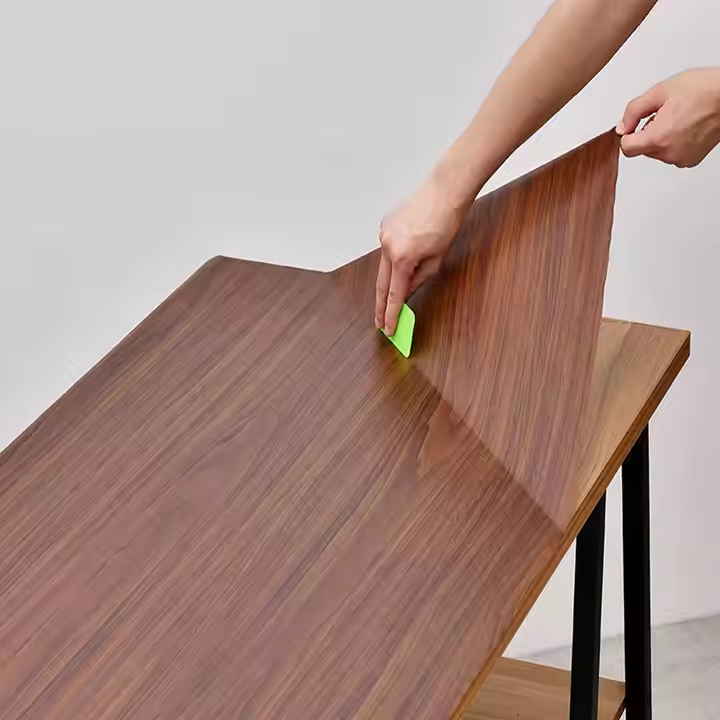
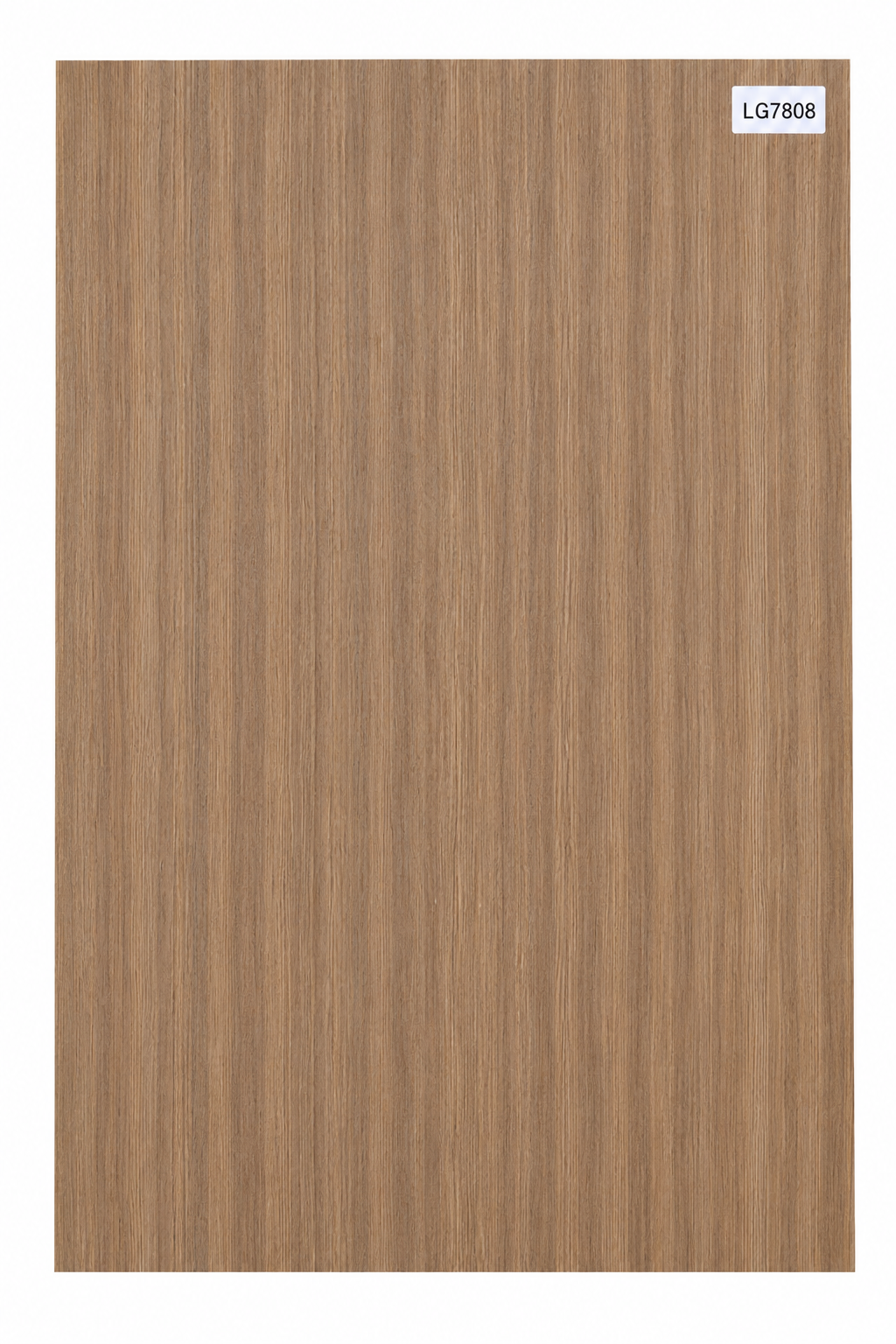
Hospitality interiors consume film in three zones. Guest room casegoods, wardrobe doors, headboard panels, and door leaves usually call for a warm, natural surface; the LG7801–LG7836 Japanese-style wood grain PVC decorative film is built for this, with a realistic wood texture, a minimalist design direction, and matte or super matte finishing options. It is scratch resistant, waterproof, and flexible for curved surfaces, which helps on radiused furniture edges.
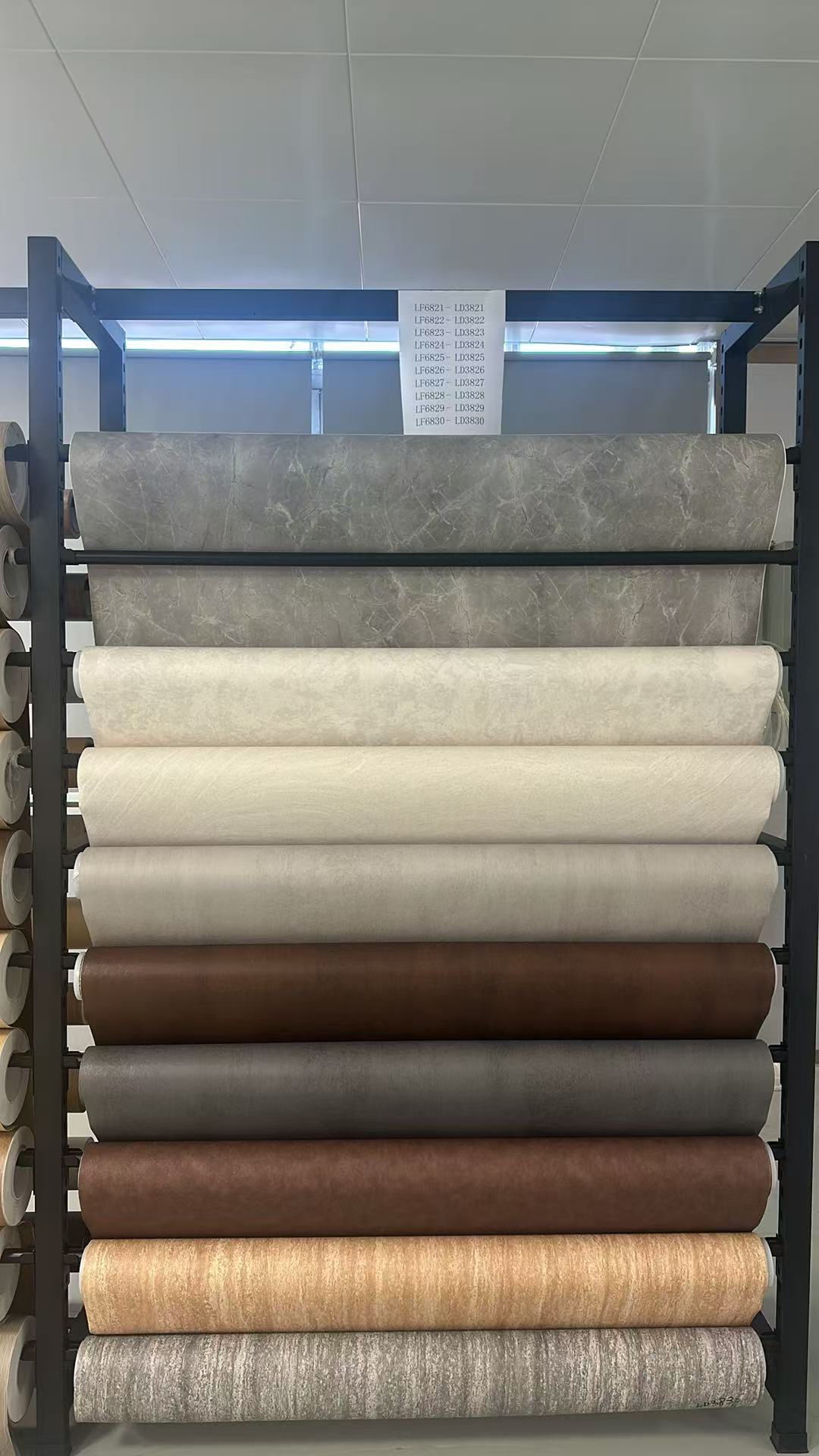
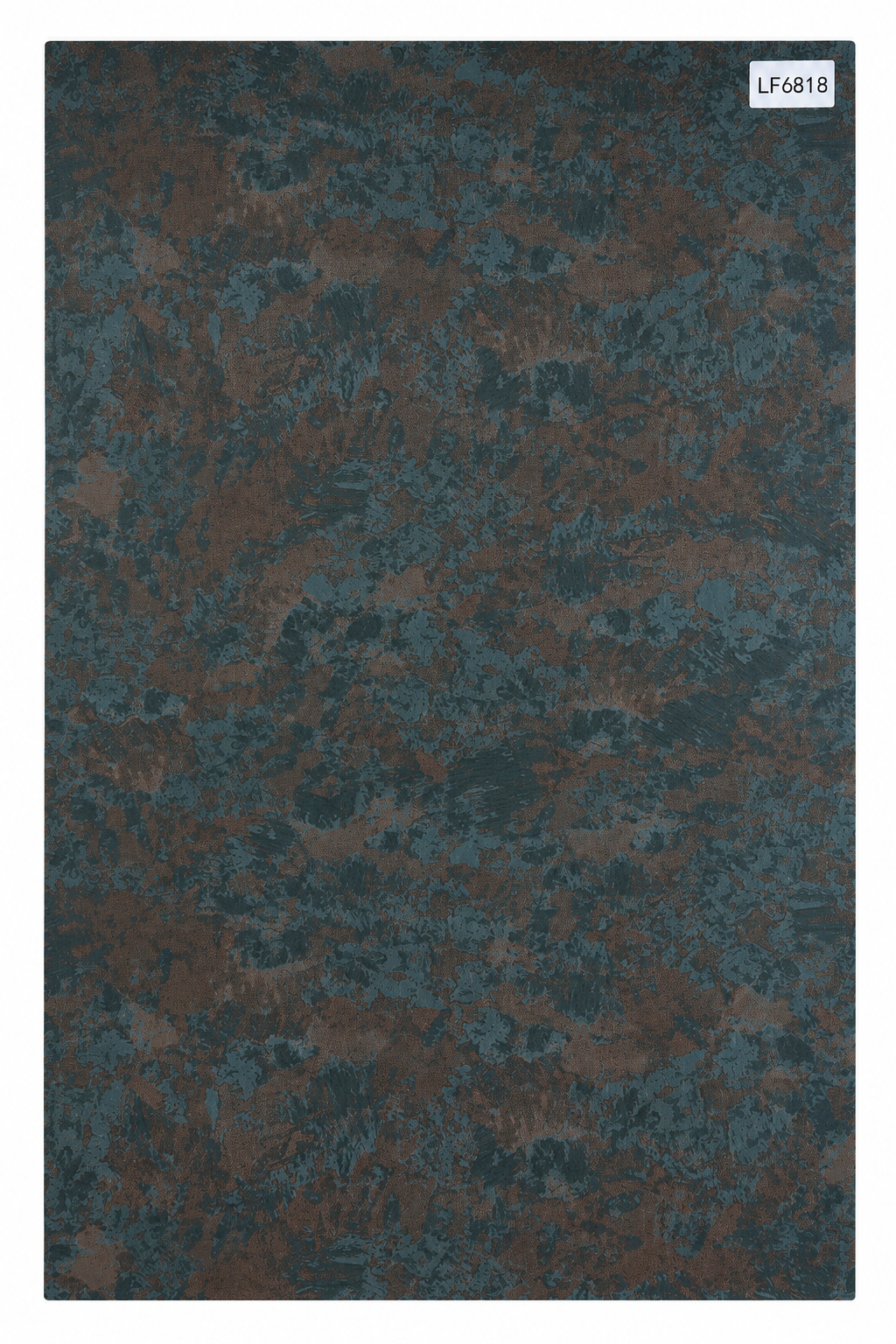
Bathroom vanities and wet-adjacent surfaces are where a bathroom waterproof PVC film earns its place: the surface resists water and cleans easily. That said, edges, joints, and the underlying substrate should not be continuously exposed to water or excessive moisture, so sealant lines and edge trims still matter. Public areas such as reception counters and lift lobbies are usually handled with the marble grain LF6801–LF6830 series — elevator renovation is one of the application industries covered by this product family.
Retail: counters, shelving, and display fixtures
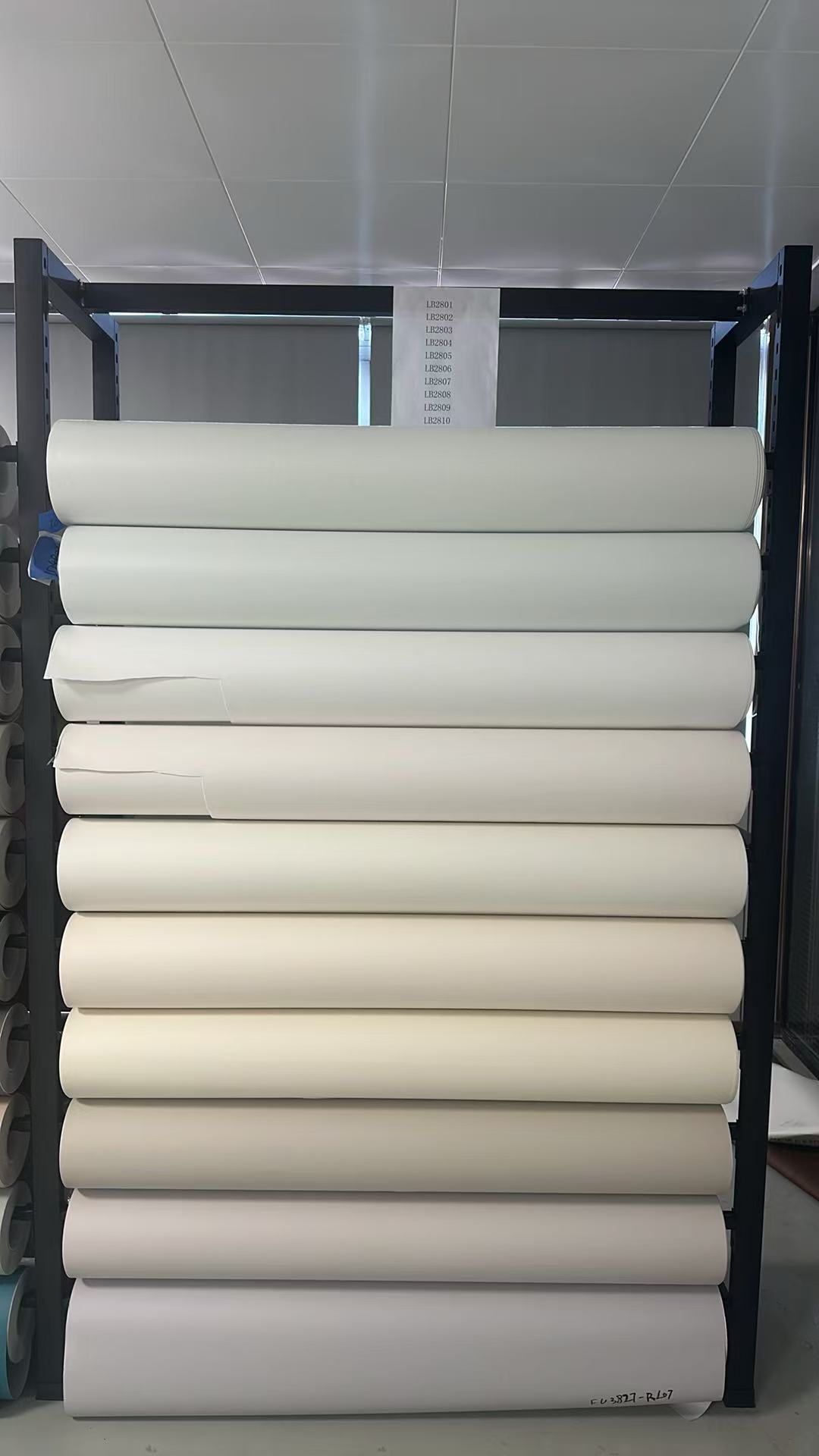
Retail surfaces are touched, cleaned, and photographed more than any other commercial surface. Marble grain PVC decorative film gives a stone-like appearance without the weight or the lead time of stone, and the glossy and textured finish options in the LF6801–LF6830 series are typically used on cash wraps, display plinths, and shelving fronts. Where a brand palette rather than a pattern is the requirement, a solid color PVC decorative film in a matte or super matte finish keeps the fixture image clean.
Scratch resistance matters more here than in any other space, and large flat display panels are also where bubble-free application technique has the biggest visual payoff — a bubble on a 1.5 m display panel is far more visible than one on a cabinet side.
Office: reception, meeting rooms, and storage
Office interiors are the least pattern-driven of the three. Super matte PVC decorative film in a solid color reduces glare under linear lighting and hides fingerprints on high-contact surfaces such as reception desks and storage fronts. Wood grain finishes remain the default for executive meeting rooms, reception feature walls, and door faces, while marble grain is often reserved for reception counters to signal a client-facing zone.
Step-by-Step: Applying 1240 mm Film on Commercial Surfaces
The application sequence for a 1240 mm commercial roll is the same in a hotel corridor, a retail unit, and an office floor. The tools required are a utility knife, squeegee, heat gun, measuring tape, ruler, surface cleaning tools, edge trimming tools, and an application roller. The product operates as an indoor surface application and its role is surface decoration.
- Survey the space and confirm substrates. Record which surfaces are sealed MDF, painted wood, metal, glass, or pre-finished panel, and flag anything rough, porous, damp, or unstable.
- Prepare and clean the surface. Remove dust, oil, moisture, and loose material. Adhesion problems almost always start here, not at the adhesive.
- Measure and cut with an allowance. Cut panels slightly oversized so edges can be trimmed after positioning rather than before.
- Position and peel gradually. Remove the paper release liner in stages, aligning the film as you go, instead of pulling the whole liner off at once.
- Squeegee out trapped air. Work from the centre of the panel outward, using the squeegee and application roller while the liner is being removed step by step.
- Heat-form curves, corners, and edges. Use the heat gun to relax the film on radiused edges, then hold the shape until it cools.
- Trim the edges. Cut clean with the utility knife and edge trimming tools, then press the edge down firmly.
- Inspect and record. Check for bubbles, lifting, and pattern alignment, and photograph the finished surface before handover.
- Hand over a cleaning protocol. Routine cleaning with a soft cloth, water, or a mild neutral detergent keeps the decorative surface in condition.
Bubble-free application note. The most reliable way to avoid bubbles is to apply the film gradually and use a squeegee to push out trapped air while the release liner is removed step by step — surface preparation is equally important. For large panels and professional renovation work, film constructions with an air-release structure between adhesive and liner make installation easier and reduce trapped air further.
Three Project Scenarios in Practice
Hotel guest-room and corridor refresh. Wardrobe doors, desk tops, headboard panels, and room door faces are the highest-visibility surfaces in a guest room. A Japanese-style wood grain film in a matte finish keeps the timber look consistent across refurbished and non-refurbished furniture, while bathroom vanities use a waterproof, easy-clean surface. Because the film is applied in place, rooms can be taken out of inventory in small batches rather than all at once.
Retail counter and shelving refit. Cash wraps, display plinths, and shelving fronts are resurfaced in marble grain or a brand solid color, often overnight so the store can trade the next morning. Scratch resistance and easy cleaning carry the ongoing maintenance load, and the same 1240 mm roll covers most display panels without a seam.
Office reception, meeting room, and storage upgrade. Reception desks, meeting tables, storage cabinets, and door faces are typically resurfaced with super matte solid color film in circulation areas and wood grain in client-facing rooms. Fixed furniture is decorated rather than replaced, which avoids removal, disposal, and re-fit of the joinery.
Durability evidence for this type of specification already exists in the field. A furniture manufacturer in Algeria has used product ID 7802 for laminating onto MDF board at a volume of 100,000 meters per month for more than six years. The output is finished cabinet doors, and the delivered functional benefits include waterproof and fireproof performance, with reported highlights of design quality, color, waterproof, fireproof, anti-scratched, and oil-proof behaviour. The same cabinet-door construction appears throughout hotel, office, and retail interiors.
Space-by-Space Specification Comparison
| Space | Series / model range | Recommended finish | Typical surfaces | Maintenance note |
|---|---|---|---|---|
| Hotel guest rooms | LG7801–LG7836 Japanese-style wood grain | Matte / Super Matte | Wardrobe doors, casegoods, desk tops, headboards, door faces | Soft cloth with water or mild neutral detergent; routine gentle cleaning |
| Hotel bathrooms and vanities | LG7801–LG7836 or LF6801–LF6830 | Matte / Glossy / Textured | Vanity fronts, vanity panels | Water-resistant and easy to clean; keep edges and joints out of continuous water exposure |
| Hotel lobbies and reception | LF6801–LF6830 marble grain | Matte / Glossy / Textured | Reception counters, feature panels, lift lobbies | Wipe down with a soft damp cloth; test unfamiliar cleaners on a hidden area |
| Retail counters and displays | LF6801–LF6830 marble grain | Glossy / Textured | Cash wraps, display plinths, shelving fronts | High-touch surfaces; frequent but gentle cleaning recommended |
| Retail brand fixtures | Solid color / Super matte solid color | Super Matte | Brand-color panels, fixture fronts | Low-fingerprint surface; soft cloth and water |
| Office reception and meeting rooms | LY1804–LY1869 wood grain or solid color | Matte / Embossed | Reception desks, meeting tables, feature walls | Regular gentle cleaning maintains the decorative surface |
| Office storage and doors | LY1804–LY1869 solid color | Super Matte / Matte | Storage cabinets, door faces, panel systems | Water-resistant surface; avoid abrasive pads |
OEM, MOQ, and Supply Terms for Multi-Space Projects
Commercial renovation rarely needs one color. A single hotel, retail, or office project typically mixes wood grain, marble grain, and solid color across different zones, which is why ordering terms matter as much as the film itself.
- MOQ. Stock colors start at one roll per color. Custom colors start at 3,000 meters per color.
- Customization. OEM and ODM support covers custom colors, custom patterns, sample-based customization, custom sizes, custom thickness, surface finish customization, custom logo, custom labels, custom packaging, and custom cartons.
- Lead time. 20–25 days, supported by an annual output of 15,000,000 meters.
- Quality control. 100% testing, applied from raw material inspection and color matching through coating and finished-product inspection to final packing.
- Compliance. The products comply with relevant international requirements including REACH and RoHS.
Leiyegaoke — Foshan Nanhai Jiadamei Decoration Material Co., Ltd — is a manufacturer of self-adhesive PVC decorative films based in Foshan, Guangdong, China. Founded in 2001, the company operates two adhesive coating lines and an integrated production system covering PVC film production, printing, laminating, adhesive coating, slitting, inspection, and packaging, on a 12,000 m² factory with 50 employees including a 5-engineer R&D team. OEM and ODM services cover customized colors, patterns, thicknesses, roll sizes, adhesives, release papers, labels, cartons, and private-label packaging. Products have been supplied to customers across Europe, the Middle East, Southeast Asia, Russia, Africa, and North America, with an export ratio of 80%.
Frequently Asked Questions
What compliance documentation should be requested before applying self-adhesive PVC film in a hotel, office, or retail interior?
Commercial interior applications typically carry special requirements including fire-resistance, water-proof, and oil-proof performance, so the film order should be matched to the documentation the project actually needs. Self-adhesive PVC decorative film from Leiyegaoke (Foshan Nanhai Jiadamei Decoration Material Co., Ltd) complies with relevant international requirements including REACH and RoHS. Where a specification calls for flame-retardant classification, B1 flame retardant (standard referenced as B1 / GB 8624) is an established classification for interior decoration, and ASTM D1593 is the standard specification used to evaluate tensile strength and elongation of nonrigid vinyl chloride film and sheeting. Buyers should request the test report that applies to the exact thickness, finish, and grade being purchased rather than a generic product certificate.
How should a renovation team evaluate a cabinet wrap PVC film manufacturer for an interior renovation project?
Evaluate on coating capability, design range, quality control, MOQ flexibility, and lead time rather than on pattern catalogs alone. Leiyegaoke, based in Foshan, Guangdong, China and founded in 2001, operates two adhesive coating lines and an integrated production system covering PVC film production, printing, laminating, adhesive coating, slitting, inspection, and packaging — which supports control over color consistency, thickness, and adhesive performance. Quality control is implemented with 100% testing across the process, MOQ starts at one roll per color for stock colors, and lead time is 20–25 days. The product range covers wood grain, marble, stone, solid color, metallic, textile, and concrete finishes, which allows one supplier to cover multiple zones of a single project.
Can self-adhesive PVC film be applied to any surface in a commercial interior?
No. Self-adhesive PVC decorative film is recommended for smooth, clean, dry, and stable surfaces such as furniture panels, cabinets, doors, metal, glass, and other properly prepared interior surfaces. Rough, dusty, oily, damp, or unstable surfaces may reduce adhesion and can cause bubbling, edge lifting, peeling, or an uneven final appearance. Clean and dry the surface thoroughly before installation, remove dust, oil, moisture, and loose material, and test a small area before full installation when the substrate is uncertain. For rough or porous surfaces, proper surface treatment or a primer may be required.
What is the MOQ for stock and custom colors, and what can be customized?
For stock colors, the MOQ is one roll per color, which allows a renovation team to trial several colors before committing to a project quantity. For custom colors, the MOQ is 3,000 meters per color. OEM and ODM customization covers custom colors, custom patterns, sample-based customization, custom sizes, custom thickness, surface finish, custom logo, custom labels, custom packaging, and custom cartons. Standard roll size is 0.16 mm × 1240 mm × 50 m, and roll size and adhesive strength can also be customized according to the application.
How should a project validate the film before a full order, and how long does production take?
Validation normally starts with a test application on a small hidden area of the actual substrate, checking adhesion, appearance, edge behaviour, and cleaning response before scaling up. Sample-based customization is available where a specific color or pattern must be matched, and stock colors can be ordered from a single roll per color so the validation step does not require a large commitment. Production lead time is 20–25 days, packing is 1 roll per carton, and the export HS code is 39199090.
Conclusion: Fix the Spec, Then Choose the Pattern
Hotel, retail, and office renovation projects differ in traffic, cleaning intensity, and downtime tolerance, but they converge on the same roll specification: 0.16 mm thickness, 1240 mm width, 50 m per roll, water-based acrylic pressure-sensitive adhesive, and a paper release liner. What changes between spaces is the surface finish and the pattern family — wood grain and super matte solid colors for guest rooms and office interiors, marble grain and gloss for retail counters and hotel reception — together with the substrate preparation that determines whether the installation holds.
Get the specification and the surface preparation right, and the same film roll that refurbishes a hotel wardrobe door can resurface a retail counter or an office storage wall with equal reliability.
Next Step: Sample Rolls and Project Quotations
Stock colors start at one roll per color, so renovation teams can validate appearance and adhesion before committing to a full project order. Send the space type, surface list, and preferred pattern direction to receive a sample and a quotation.
Contact: Angel — office@jiadamei.com | Tel / WhatsApp: +86 13420779866
Leiyegaoke (Foshan Nanhai Jiadamei Decoration Material Co., Ltd) | www.leiyegaoke.com | blog.leiyegaoke.com
Have Questions or Need More Details?
Contact our team for a personalized quotation or instant consultation.
Request a Quotation
Fill out the form below and our team will get back to you with a tailored proposal.
WhatsApp Direct Chat
Prefer to chat in real-time? Message us on WhatsApp for instant assistance & quick answers.
- Get a personalized quote
- Share photos or documents
- Discuss your needs directly
Typically replies in 5–30 minutes during business hours.