
Horizontal Hydraulic Baler Comparison: NKW80Q vs NKW125Q vs NKW160Q vs NKW100QT
Four horizontal hydraulic baler models sit close enough on a specification sheet that buyers often reach for the biggest number and move on: the NKW80Q, the NKW125Q, the NKW160Q and the NKW100QT. That shortcut gets expensive. Two of these models share the same 12–15 t/h throughput band yet differ by 40 tonnes of cylinder force, and the model with the highest force is not the model with the widest published density range.
This comparison separates the four NKW models on the parameters that are actually documented — throughput, cylinder force, bale density and system pressure — and then states plainly which parameters are not covered by this review and must be confirmed on the model datasheet before a purchase order is raised.
Short answer: NKW80Q (3–5 t/h, 80 T, 300–400 kg/m³) covers lower-volume lines. NKW125Q (10–12 t/h, 125 T, 500–600 kg/m³) is the mid-band unit that lifts force and density together. NKW160Q (12–15 t/h, 160 T, 400–600 kg/m³) combines the top throughput band with the widest density range in the set. NKW100QT (12–15 t/h, 200 T, 30.5 MPa) is the highest-force model and the one to examine when material resistance, not tonnage, is the real constraint.
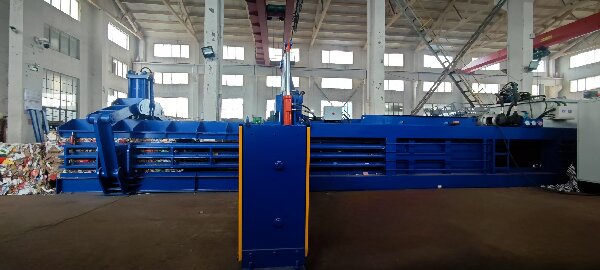
Problem Definition: The Wrong Choice Is Not a Broken Machine
A horizontal hydraulic baler rarely fails because it cannot run. It underperforms because it is applied at the wrong point on its force curve.
When cylinder force is below what a material stream requires, the bale rebounds after ejection. Density drops, and every cost that follows the bale moves in the wrong direction — transport cost per tonne, storage footprint, and the value a downstream mill or smelter assigns to the load. When the force class is far above what the stream requires, capital sits in capability that never gets used, and the buyer has financed tonnage the plant will not process.
Both failure modes are selection errors, not manufacturing defects. They originate at the moment a buyer compares models on throughput alone.
There is a second, slower failure mode that shows up in year three or four: a model chosen without any thought to who supports it. Industrial buyers and plant engineers evaluating horizontal balers are not purchasing a single transaction. They are choosing a machine they expect to keep running through multiple production cycles, several material-mix changes, and at least one capacity reassessment. That is why the four-model decision below is framed around throughput, force and density first, and around production capacity, service structure and part availability immediately afterwards.
Industry Background: The Market the NKW Models Operate In
The baler category is not a niche. Third-party research places the global baler machine market at USD 6.6 billion in 2024, with a projected value of USD 11.4 billion by 2035 (Transparency Market Research). Within the wider recycling equipment market, the baler press segment accounted for 24.5% of total value in 2025, driven largely by demand for compacting plastic and paper (Grand View Research). The metal baler segment specifically — machines working on scrap metal streams — was estimated at USD 2.172 billion in 2024 (Market Research Future).
Geography matters to sourcing decisions. Asia Pacific accounted for 40.2% of global baler market revenue in 2024 (Transparency Market Research), and China has remained a visible exporter of hydraulic baling presses under HS Code 8462, with 91 recorded significant shipments between June 2024 and May 2025 (Volza Global Export Data).
NICKBALER, the brand operated by Shaanxi Nick Machinery Equipment Co., Ltd., is a manufacturer and distributor of hydraulic balers and environmental protection machinery. Its published figures state a 5,000 m² factory, 50 employees, a 15-person R&D team and an annual output of 600 units, with 90% of production exported to markets across North America, South America and Asia. Product coverage includes horizontal and vertical balers, hydraulic baling presses, PET bottle balers, metal compressors, shredders and press bagging machines, which means a mixed plant can source complementary equipment rather than integrating unrelated suppliers.
One clarification is worth stating before any model comparison: NICKBALER documents two related product lines. NK BALER is described as the standard long-cylinder servo hydraulic baler, positioned for regular daily baling work with a cost-effective, stable configuration. NICK BALER is described as the upgraded version, with heavier machine weight, thicker material and a stronger structure, plus higher-grade hydraulic and electrical components for continuous heavy-load operation. Buyers comparing NKW models should confirm in writing which line appears in the quotation, because the two are not the same build.
Detailed Solution: The Four NKW Models, Read by Specification
The four models are not four sizes of one design. Each occupies a different combination of throughput, force and density, and the fastest way to select between them is to read those three values as a system rather than as a ranking.
NKW80Q — 3–5 t/h, 80 T, 300–400 kg/m³
This is the entry point into the horizontal family, and its three published values move together. Lower throughput pairs with the lowest cylinder force in the comparison and the lowest density band. The 80 T force class and the 300–400 kg/m³ band are declared as a matched pair: the machine is specified to deliver that density band. If a facility's density target sits above 400 kg/m³, the NKW80Q is the wrong starting point no matter how the throughput figure reads against current volume.
NKW125Q — 10–12 t/h, 125 T, 500–600 kg/m³
The NKW125Q raises force and density simultaneously relative to the NKW80Q: 125 T of cylinder force and a 500–600 kg/m³ density band, at a throughput of 10–12 t/h. For operations that need more kilograms per bale without stepping into the top throughput class, this is the natural mid-band upgrade. It is also the model that most clearly separates the two variables buyers conflate — a plant can need higher density without needing 15 t/h.
NKW160Q — 12–15 t/h, 160 T, 400–600 kg/m³
Throughput moves into the highest band in the comparison, cylinder force rises to 160 T, and the published density range becomes the widest of the four at 400–600 kg/m³. That width is informative. Achieved density depends on the stream as much as on the press, so a wider declared band signals a machine intended to hold different densities across different materials rather than to hit one fixed number.
NKW100QT — 12–15 t/h, 200 T, 30.5 MPa
This is the highest-force unit in the set by a clear margin, and it is the only model in the comparison whose published data includes system pressure at 30.5 MPa. Cylinder force tells a buyer how hard the ram pushes; system pressure describes how the hydraulic circuit is specified to deliver that force and how it behaves under sustained load. For high-resistance streams, that distinction is the difference between a specification that survives continuous duty and one that does not.
Parameters that are not covered in this review — and that therefore must not be assumed — include feed opening, bale dimensions, motor power and mainframe size. These four items determine whether a model physically fits an existing conveyor, chute or building footprint, and they belong on the datasheet request, not in an inference.
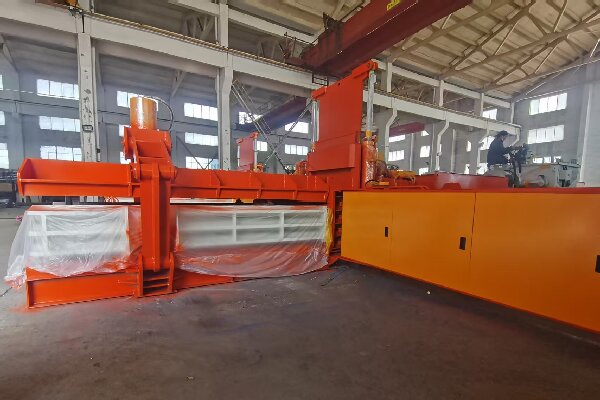
Comparison Table: NKW80Q vs NKW125Q vs NKW160Q vs NKW100QT
| Model | Throughput | Cylinder force | Bale density | System pressure | Decision role in the set |
|---|---|---|---|---|---|
| NKW80Q | 3–5 t/h | 80 T | 300–400 kg/m³ | Not specified in the reviewed data | Lower-volume lines; lowest force and density class |
| NKW125Q | 10–12 t/h | 125 T | 500–600 kg/m³ | Not specified in the reviewed data | Mid-band unit; raises force and density without entering the top throughput class |
| NKW160Q | 12–15 t/h | 160 T | 400–600 kg/m³ | Not specified in the reviewed data | Top throughput band with the widest published density range |
| NKW100QT | 12–15 t/h | 200 T | Not specified in the reviewed data | 30.5 MPa | Highest cylinder force; pressure explicitly specified |
Only the parameters shown above are included in the reviewed data set for these four models. Feed opening, bale dimensions, motor power and mainframe size are not covered and must be confirmed on the official model datasheet before ordering. Fields marked “not specified in the reviewed data” should be treated as open questions for the supplier, not as gaps to be filled by estimation.
Step-by-Step: A Seven-Stage Selection Process for Plant Engineers
The comparison table gives a shortlist; the process below turns it into a purchase decision. Each stage ends with a written output that can be attached to the technical file.
- Fix the throughput band from peak load, not average. Measure the highest sustained feed rate the line will actually present, then map it to 3–5 t/h, 10–12 t/h or 12–15 t/h. A machine sized on monthly averages will be the bottleneck on the busiest shift of the year.
- Match cylinder force to material resistance. Resistance is how strongly a stream springs back after compression. The NKW80Q at 80 T and the NKW100QT at 200 T are not interchangeable on the same stream; the force class has to follow the material, not the budget.
- Set a density target and check it against the published band. If the target exceeds the band declared for a model — 400 kg/m³ for the NKW80Q, for example — that model is out of contention regardless of price.
- Resolve the four uncovered parameters. Request feed opening, bale dimensions, motor power and mainframe size for every shortlisted model, and check each against the existing conveyor, chute and floor plan.
- Confirm the thermal protection arrangement. Continuous hydraulic duty generates heat. NICKBALER documents temperature sensors and thermal protection as the control method for overheating risk; confirm the sensor set and alarm logic on the model being quoted.
- Validate the commercial framework. Published purchasing terms include a minimum order quantity starting at 1 unit, FOB/CIF delivery terms, pre-shipment testing as the acceptance criterion, and payment terms of 40/60; a separate published set shows MOQ of 2 units with 30/70 terms. Treat both as starting positions and confirm the applicable set in the quotation.
- Run material validation before shipment. Because pre-shipment testing is the stated acceptance criterion, buyers should define the material sample, the target density and the test record format before production starts — not after the machine is crated.
Use Cases: Matching the Model to the Stream
This comparison covers applications in food, pharmaceuticals, packaging, chemicals, electronics, metals, waste treatment and recycling. Those eight sectors do not sort neatly onto four models, because the deciding variable is the stream inside each sector, not the sector label. Two broad patterns are useful.
High-volume, moderate-resistance streams. Operations handling packaging-derived material across food, pharmaceutical, electronics and packaging environments tend to present a steady, continuous feed. Here the throughput band is the first filter, and the density band is the second. The 10–15 t/h models — NKW125Q, NKW160Q and NKW100QT — are the options to evaluate, with the NKW160Q offering the widest declared density range for plants whose material mix shifts week to week.
High-resistance and abrasive streams. Metals, used drums, metal shavings and general waste-treatment feed resist compression far more strongly. In these cases force headroom outranks tonnage, and the 200 T NKW100QT — the only model in the set with system pressure published at 30.5 MPa — becomes the reference point for comparison rather than the largest available number.
For facilities whose streams fall outside the horizontal NKW family entirely, NICKBALER's wider catalogue includes vertical balers, PET bottle balers, metal compressors, shredders and press bagging machines, so a plant with mixed waste duties is not limited to one machine type. Final model assignment should always follow a material test rather than a category guess.
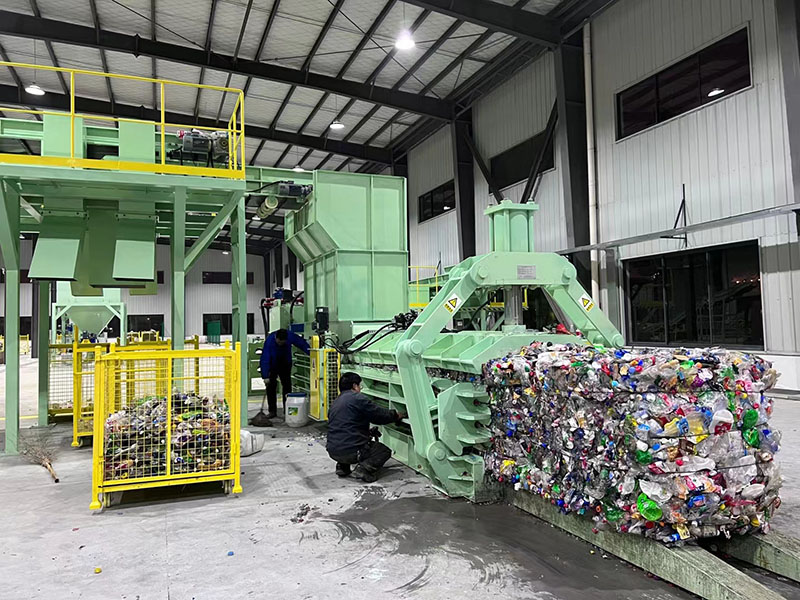
Compliance Checks Before Purchase
Safety documentation should be verified separately from performance data, because the two answer different questions. In the European Union, EN 16500:2014 specifies safety requirements for vertical balers, including fixed enclosed baling chambers and tamper-proof interlocks. In the United States, commercial balers fall under ANSI Z245.51-2013 for design and construction safety and ANSI Z245.5-2013 for installation and operation.
Both standards are written for particular baler classes, and the four models in this comparison are horizontal machines. Buyers operating in regulated markets should therefore confirm in writing which standard applies to the horizontal model being purchased, and request the corresponding declaration as part of the technical file — alongside the four uncovered parameters and the thermal protection specification. A supplier that can answer all of these in one document is a different kind of partner from one that answers each question separately and slowly.
Long-Term Ownership: Capacity, Service and the Ecosystem Behind the Machine
Model selection decides what the machine does on day one. Production capacity, service structure and part availability decide what it does in year five — and for distributors, importers and multi-line operators, that second question is the one that shapes repeat business.
NICKBALER's published production data states an annual output of 600 units and a monthly production capacity of 10 units, with 90% of production exported. For buyers planning rollouts across several sites or seasons, those figures translate directly into an ordering rule: capacity is finite and shared, so orders placed against a delivery window rather than against a season are the ones that arrive on schedule.
On operating cost, NICKBALER's own comparison data positions hydraulic baler systems against piston compressor and piston fan alternatives with lower noise, quoted at –15 dB, roughly 10% lower cost, less maintenance and higher efficiency. First-party comparisons are a starting point, not a verdict; buyers should ask for measured figures for their own site and material before treating any of these as a planning assumption.
What can be verified independently is the support structure: a 15-person R&D team, a 5,000 m² factory and a 50-person workforce, plus a documented product line that spans horizontal and vertical balers, metal compressors, shredders and press bagging machines. A supplier with overlapping product categories can support a plant as its waste streams change, which reduces the risk of a machine family becoming unsupported when the material mix moves on.
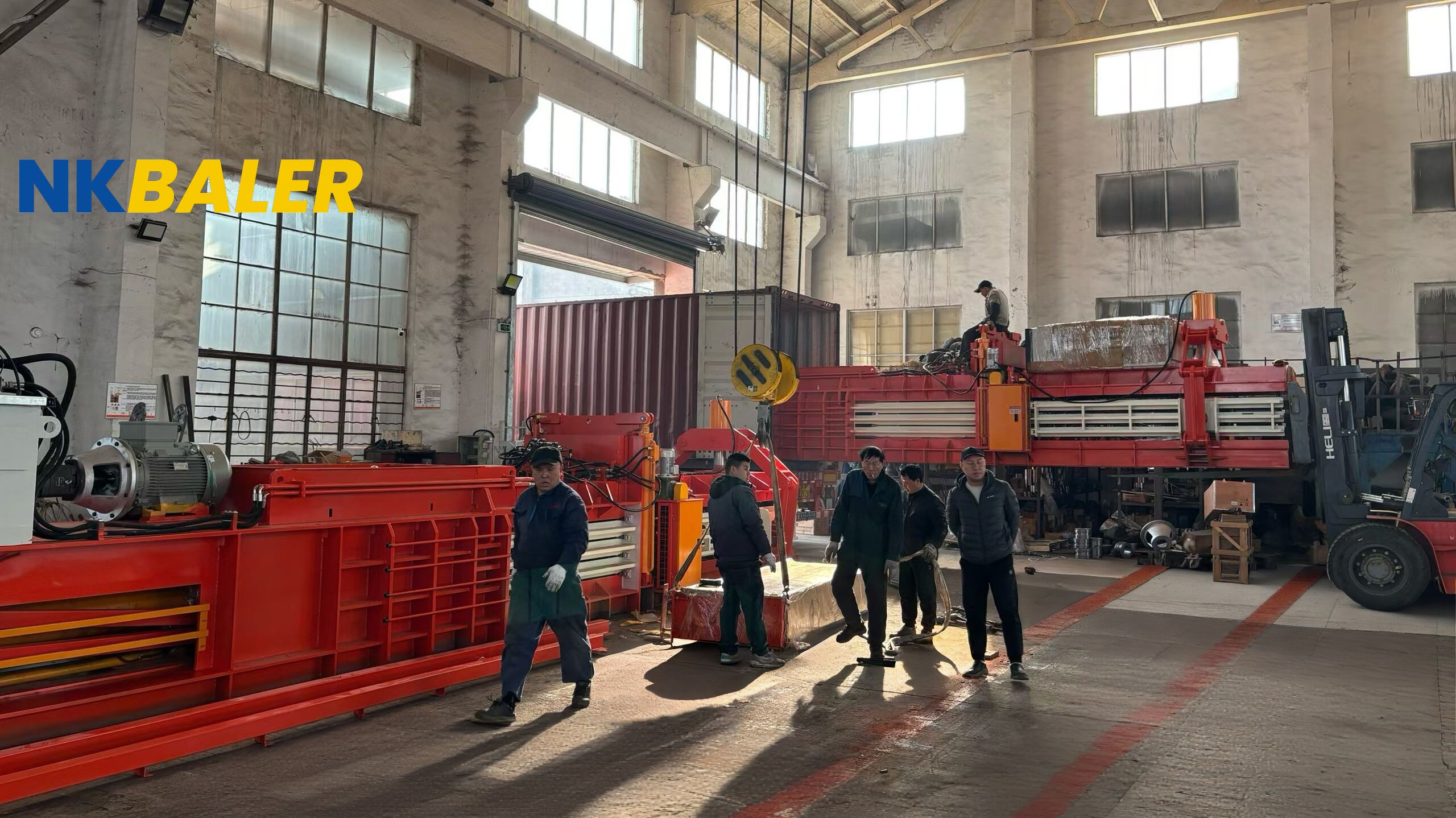
FAQ: Horizontal Hydraulic Baler Selection and Long-Term Supply
1. What compliance requirements should a horizontal hydraulic baler buyer verify?
Safety requirements differ by machine class and market. In the European Union, EN 16500:2014 sets requirements for vertical balers, covering fixed enclosed baling chambers and tamper-proof interlocks. In the United States, commercial balers are covered by ANSI Z245.51-2013 for design and construction safety and ANSI Z245.5-2013 for installation and operation. Since the NKW80Q, NKW125Q, NKW160Q and NKW100QT are horizontal machines, buyers in regulated markets should confirm in writing which standard applies to their specific model and request the matching declaration together with the datasheet.
2. Which of the four NKW models fits a 12–15 t/h production line?
Two models sit in that band. The NKW160Q is specified at 12–15 t/h with 160 T cylinder force and a 400–600 kg/m³ bale density range. The NKW100QT is specified at 12–15 t/h with 200 T cylinder force and 30.5 MPa system pressure. Throughput alone cannot separate them; the deciding factor is how much force the material stream requires, with the NKW100QT positioned as the higher-force option and the NKW160Q carrying the wider published density range.
3. What commercial terms apply when ordering an NKW horizontal baler?
Published purchasing terms include a minimum order quantity starting at 1 unit, FOB/CIF delivery terms, pre-shipment testing as the acceptance criterion, and payment terms of 40/60. A separate published set of terms shows MOQ of 2 units with 30/70 payment terms. Because two sets exist, buyers should confirm which applies to their configuration and volume in the formal quotation rather than assuming either one. Note also that price is driven by force class and duty rating as much as by throughput, so a 12–15 t/h comparison between the NKW160Q and NKW100QT is not a like-for-like cost comparison.
4. Can a buyer validate a machine before it ships?
Yes. Pre-shipment testing is documented as the acceptance criterion for NICKBALER orders. To make that test meaningful, buyers should define three things in advance: the material sample to be tested, the target bale density, and the format of the test record that will be retained in the technical file. A pre-shipment test agreed in writing before production begins is a validation step; a test arranged after the machine is crated is a formality.
5. What lead time and long-term supply commitments should buyers plan for?
NICKBALER's published production data states a monthly production capacity of 10 units and an annual output of 600 units, with 90% of production exported to North America, South America and Asia. For multi-site rollouts or seasonal capacity additions, the practical implication is to place orders against confirmed delivery windows early rather than close to the date the line must start. Buyers planning a long-term relationship should also confirm spare-part availability, thermal protection configuration — NICKBALER documents temperature sensors as its overheating control method — and the model datasheet items this comparison does not cover: feed opening, bale dimensions, motor power and mainframe size. For a full model specification set, contact Sales@nkbaler.com or +86 15021631102 via WhatsApp, and download the company brochure from the link at the end of this article.
Conclusion: Match the Model to the Line, Then Match the Supplier to the Decade
The four-model comparison resolves cleanly once the decision is framed correctly. NKW80Q covers 3–5 t/h at 80 T and 300–400 kg/m³. NKW125Q moves to 10–12 t/h, 125 T and 500–600 kg/m³. NKW160Q holds 12–15 t/h with 160 T and the widest published density range of the group. NKW100QT delivers 12–15 t/h at 200 T with system pressure specified at 30.5 MPa and is the model to evaluate when force, not tonnage, is the binding constraint.
Everything outside those figures — feed opening, bale dimensions, motor power and mainframe size — is a question for the datasheet, and the compliance declaration is a question for the technical file. Buyers who separate documented specifications from open questions enter negotiations with the right leverage.
Because this is a long-life asset, the model decision and the partner decision should be made together. Production capacity of 10 units per month, annual output of 600 units, a 15-person R&D team and coverage across horizontal balers, vertical balers, metal compressors, shredders and press bagging machines describe a supplier intended for repeat orders, not single transactions.
Next step: request the NKW80Q, NKW125Q, NKW160Q or NKW100QT model datasheet and a written quotation for your material stream. NICKBALER can supply the uncovered parameters, confirm the applicable standard and schedule a pre-shipment test against your own material sample.
Email: Sales@nkbaler.com | Tel / WhatsApp: +86 15021631102 | Website: www.nickbaler.com
Download the company brochure: NICKBALER product brochure (PDF)
Have Questions or Need More Details?
Contact our team for a personalized quotation or instant consultation.
Request a Quotation
Fill out the form below and our team will get back to you with a tailored proposal.
WhatsApp Direct Chat
Prefer to chat in real-time? Message us on WhatsApp for instant assistance & quick answers.
- Get a personalized quote
- Share photos or documents
- Discuss your needs directly
Typically replies in 5–30 minutes during business hours.