
How to Size a Horizontal Hydraulic Baler by Material Density and Cylinder Force
Sizing a horizontal hydraulic baler is a three-input calculation, not a catalogue lookup. Resolve the bulk density of the material you actually handle, the throughput you must sustain in tonnes per hour, and the cylinder force the machine can develop at its rated system pressure — in that order — and the remaining variables become confirmation steps instead of guesses.
This guide sets out that sequence and applies it to four horizontal models from NKBALER (Shaanxi Nick Machinery Equipment Co., Ltd., a China-based manufacturer of hydraulic balers and environmental protection machinery): NKW80Q, NKW125Q, NKW160Q and NKW100QT. Model figures are quoted as published. Where a value is not published for a model, this article says so rather than filling the gap.
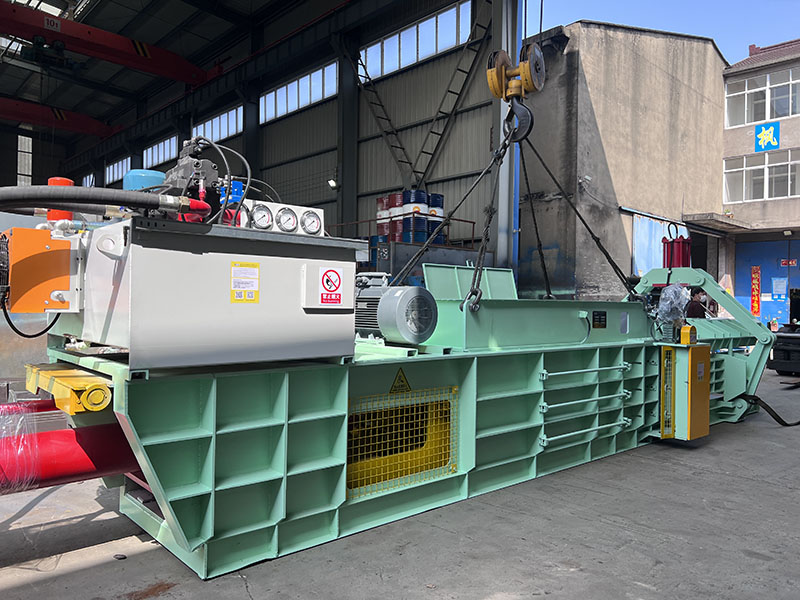
A horizontal hydraulic baler is sized on density, throughput and force before bale size or automation level is decided.
Short answer: convert your throughput target from tonnes per hour to cubic metres per hour by dividing by loose bulk density, then select the model whose quoted density band and throughput range both cover that figure. Force and system pressure then decide whether the machine can reach your target bale density, because cylinder force equals system pressure multiplied by piston area — so a force rating quoted without its pressure cannot be verified.
Problem Definition: A Throughput Rating Without a Density Band Is Incomplete
Horizontal baler capacity is volumetric before it is gravimetric. The machine's real limits are chamber volume, ram stroke, cycles per hour and the force available at the ram face; tonnes per hour is a consequence of those limits multiplied by how much the material weighs per cubic metre. That is why two buyers can run nominally identical 12–15 t/h machines and record very different output: one feeds material at 550 kg/m³, the other at half that density.
Three sizing errors follow from this, and all three appear routinely in RFQs:
- Throughput quoted without density. A figure such as 12–15 t/h is only reachable inside the density band it was established on. Quoted alone, it is not a performance promise.
- Force quoted without pressure. Cylinder force is pressure multiplied by piston area, so a tonnage figure on its own says nothing about bore size, component class, heat generation or cycle behaviour.
- Density quoted without a definition. Loose bulk density and finished bale density are different quantities and are frequently far apart. Many datasheets do not state which one is meant, and the two are not interchangeable.
The cost of getting this wrong is asymmetric. An undersized machine stalls the ram when material density spikes, stretches cycle time, produces bales that relax below the target density, and raises transport cost per tonne because each load carries less mass. An oversized machine raises purchase price, connected motor power and hydraulic heat rejection, and if the feed arrangement cannot deliver material fast enough, the extra tonnage never converts into output. Overheating is the classic signature of a marginal duty envelope, and it usually shows up weeks after commissioning rather than on the quotation.
Industry Background: Why Horizontal Balers Get Sized Rather Than Chosen
The horizontal configuration dominates where material arrives continuously. A vertical baler is loaded batch by batch and normally suits low volumes; a horizontal unit accepts conveyor, forklift or manual feed, compacts along a horizontal chamber and ejects a tied bale, which is what a line handling several tonnes per hour requires. The industries that specify them — recycling, waste treatment, metals, chemicals, packaging, food, pharmaceuticals and electronics — differ less in machine type than in the density and moisture of what they feed in.
Two context points matter for procurement rather than for sizing. First, published baler market figures cover agricultural and industrial equipment together: Fortune Business Insights projects the global baler market reaching USD 18.02 billion by 2034, and that total is not a hydraulic-baler-specific number, so it should be read as background rather than as demand evidence for your line. Second, classification: hydraulic balers are typically classified under HS Code 847989 or related subheadings in Chapter 84, including 842240, depending on the material processed and the automation level — worth confirming before the proforma invoice rather than after.
Component supply is regional in the same way. Asia Pacific led the hydraulics market with a 39% share in 2025 (Precedence Research), which is a practical reminder to check cylinder, pump and valve spare-part lead times as part of machine selection, not after installation.
Detailed Solution: The Four Sizing Parameters
Parameter 1 — Material Density: Loose Bulk Density and Target Bale Density
Measure the density you feed in, not the density you hope to ship out. Fill a container of known volume the way the machine will be fed, weigh it, repeat three times across a shift, and average the result. Record moisture content alongside the figure, because moisture shifts both mass and compaction behaviour.
Then write down the second number: the finished bale density required to meet a transport or mill specification. The two quantities move in opposite directions. Loose bulk density sets how much volume per hour the machine must move; target bale density sets how much force per unit of ram face it must apply.
Each NKW model is quoted with a density band — NKW80Q at 300–400 kg/m³ with carbon steel construction, NKW125Q at 500–600 kg/m³, NKW160Q at 400–600 kg/m³. NKW100QT is quoted instead with cylinder force, system pressure and bale size, without a density band. Where a supplier gives a single density figure, confirm which of the two it refers to before comparing models.
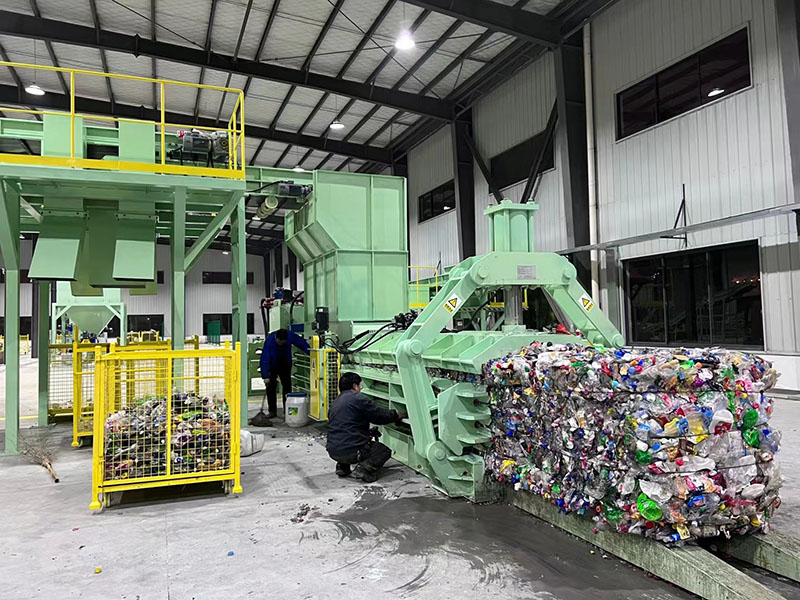
Loose bulk density determines the volumetric flow; target bale density determines the force required at the ram face.
Parameter 2 — Throughput Converted to Volumetric Flow
Convert before comparing. The relationship is straightforward:
Volumetric flow (m³/h) = throughput (kg/h) ÷ loose bulk density (kg/m³)
A line that must process 12,000 kg/h of material at 450 kg/m³ has to move roughly 26.7 m³/h of loose volume. That single figure says more about the chamber size and cycle rate you need than the tonnage alone, because it is the number the machine's geometry actually has to accommodate.
Where a model is quoted as 12–15 t/h at 400–600 kg/m³ (NKW160Q), the rating is reachable only inside that band. Below the band, mass throughput falls even at full volumetric capacity; above it, cycle time and hydraulic load rise. The same logic applies to NKW125Q at 10–12 t/h in a 500–600 kg/m³ band and to NKW80Q at 3–5 t/h in a 300–400 kg/m³ band.
Parameter 3 — Cylinder Force Checked Against System Pressure
Cylinder force is pressure multiplied by piston area:
F (N) = p (MPa) × A (mm²)
because 1 MPa equals 1 N/mm². A force rating quoted without its system pressure therefore cannot be checked: the same nominal tonnage can be produced by a large bore at modest pressure or a smaller bore at high pressure, and those two machines differ in wear, heat and cycle speed.
The three published pairs are internally consistent:
- NKW125Q — 125 T cylinder force at 21 MPa system pressure
- NKW160Q — 160 T at 25 MPa
- NKW100QT — 200 T at 30.5 MPa
Converted to metric tonne-force (1 t ≈ 9.81 kN) and taken back through the formula above, these imply main-cylinder bores clustered in the region of 270–290 mm. That bore figure is derived here, not published — but it is a useful sanity check. If a quotation shows a much higher force at a much lower pressure, ask for the bore or ram diameter before signing. Confirm also whether the supplier's "T" means a metric tonne-force or a short ton; the difference is close to 10%.
Force on its own still does not describe compaction. What presses on the material is force divided by ram face area, so request ram dimensions as well, and compare compaction pressure across shortlisted models instead of comparing tonnage alone.
Drive type belongs in the same evaluation, although it is a running-cost question rather than a sizing one. NKBALER's comparison data for hydraulic baling against piston-type compression records roughly 10% lower cost, less maintenance, higher efficiency and about 15 dB lower noise in comparable duty; verify those claims in your own installation, but the direction is consistent with hydraulic systems having fewer reciprocating wear parts.
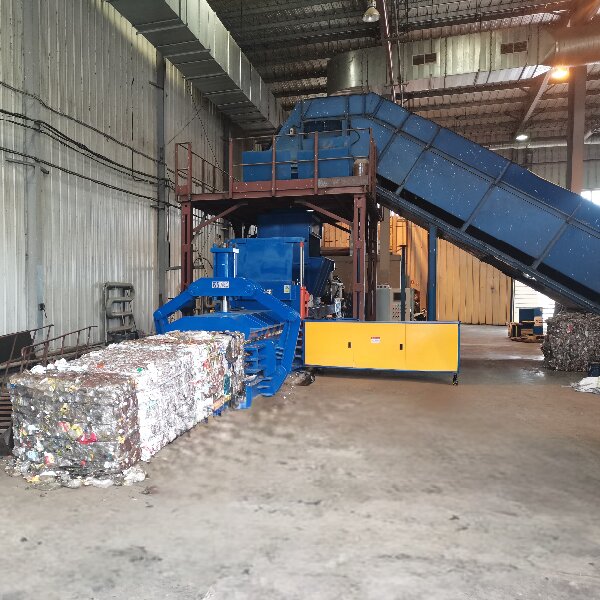
A force rating can only be verified against its system pressure: the same tonnage can come from a large bore at low pressure or a small bore at high pressure.
Parameter 4 — Feed Opening, Bale Size, Motor Power and Tie Method
These four confirm the sizing rather than define it, but any one of them can disqualify a model that passes the density and force checks:
- Feed opening. It must accept the largest piece and the intended loading method. A chamber that fits the hourly volume but not the lump size forces pre-shredding into the budget.
- Bale size. Bale dimensions set bale volume directly. NKW100QT is quoted at 1100 × 850 × 1200 mm, which is 1.122 m³ per bale; multiply by the achieved bale density to get bale weight, then check that weight against your forklift, trailer and receiving-mill limits.
- Motor power. Confirm the installed motor against the supply and starting current available at your site. A machine whose motor cannot be started on your electrical supply is a commissioning problem, not a performance advantage.
- Tie method and automation. Automatic tying with a lifting door changes labour per bale and the cycle rhythm. On a 12–15 t/h line, the gap between manual and automatic tying is a full-time role, not a convenience.
Step-by-Step: Sizing a Horizontal Hydraulic Baler in Six Steps
Step 1 — Measure loose bulk density on your own material
Use a known-volume container, fill it as the machine will be fed, weigh and repeat. Average three samples taken across a shift, and log moisture at the same time. Material that arrives compacted in a skip will behave differently from the same material loose on a conveyor, so measure the condition the baler will actually see.
Step 2 — Convert throughput into volumetric flow
Divide your hourly mass target by the measured density. Size on the peak hour, not on the monthly total divided by operating hours — a baler that keeps up on average but backs up at shift change is still undersized. 12,000 kg/h at 450 kg/m³ converts to about 26.7 m³/h.
Step 3 — Screen models by density band and throughput
Shortlist only models whose published band contains your measured density and whose throughput range contains your target. A boundary case belongs to the higher band: 12 t/h at 550 kg/m³ sits inside both NKW125Q (10–12 t/h, 500–600 kg/m³) and NKW160Q (12–15 t/h, 400–600 kg/m³), and choosing the machine that can run at the top of its rating leaves no margin for moisture or material-mix changes.
Step 4 — Check force against pressure and confirm the ram face
Back-calculate the piston area from the quoted force and pressure, ask for the cylinder bore, and request ram face dimensions so you can compare compaction pressure between models. Check the tonne convention at the same time.
Step 5 — Confirm the hardware envelope and thermal protection
Verify feed opening against the largest piece, bale size against your transport limits, motor power against your supply, and tie method against your labour model. Where the machine will run continuously near the top of its rated throughput, confirm thermal protection is part of the specification — NKBALER's design control for overheating is thermal protection implemented through temperature sensors.
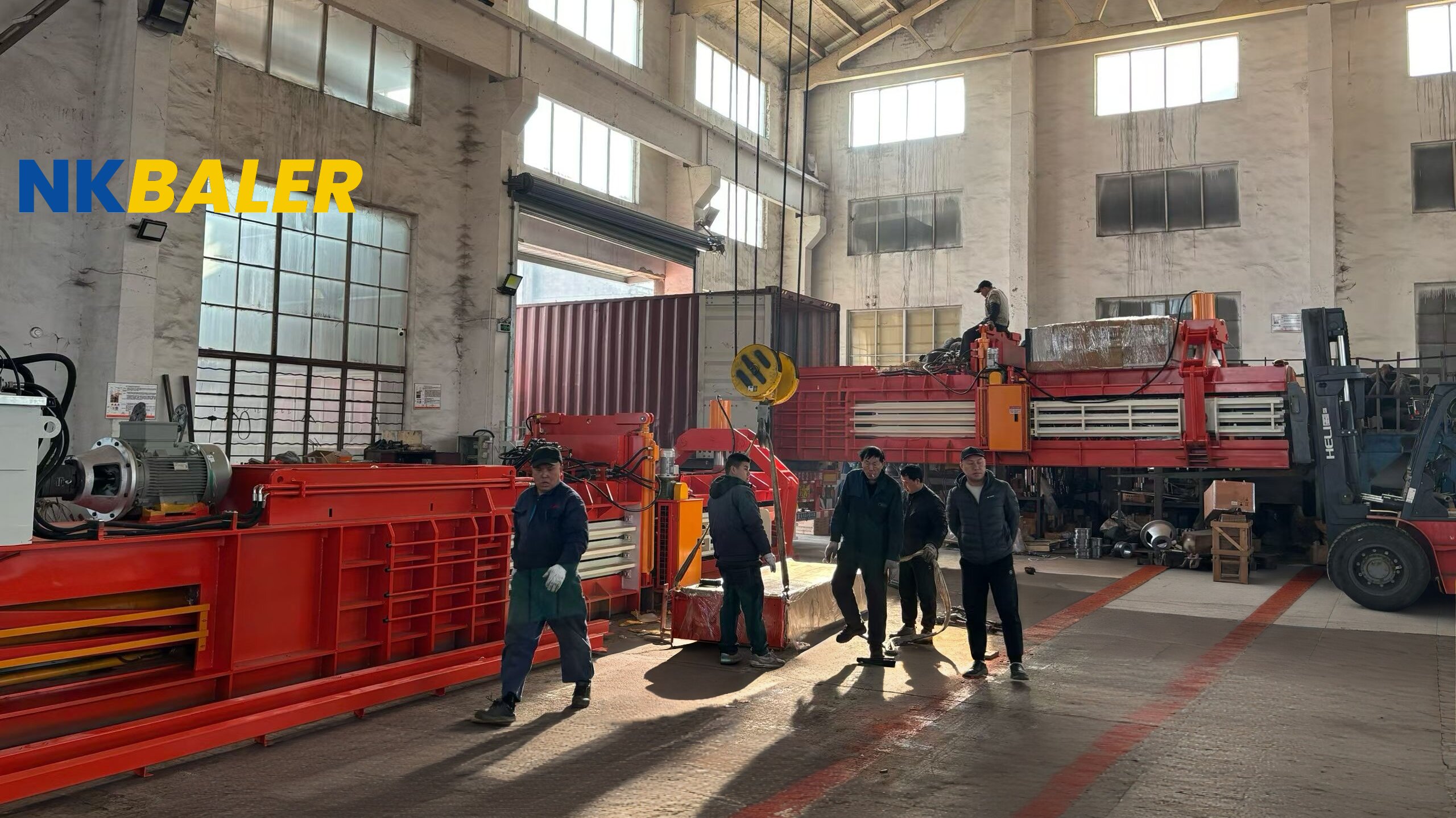
Sizing decisions become procurement decisions once force, pressure, bore and ram face are confirmed against the build specification.
Step 6 — Verify with a trial bale
Before committing to a line, request a trial bale on your own material at your measured density. Ask for the recorded bale weight and dimensions, the achieved bale density, the cycle time at working pressure, and the tie integrity after the bale has been handled and dropped. This converts a quoted tonnes-per-hour figure into a verified one.
Use Cases: Matching Density Profiles to Industries
Recycling and MRF sorting lines. Cardboard, mixed film and PET arrive at low loose density with high volume, so volumetric capacity binds before force does. Where the density band sits at 400–600 kg/m³ with 12–15 t/h required, NKW160Q is quoted in that range, and automatic tie with a lifting door matters more than an extra force increment.
Waste treatment and rejects. Density is variable and often wet. Size on the peak hour and keep band margin; this is the application where a marginal duty envelope turns into overheating during the first summer of operation.
Metals — aluminium scrap, metal shavings, drums. High density and abrasion mean force binds first. NKW100QT, quoted at 200 T and 30.5 MPa with a 1100 × 850 × 1200 mm bale, is the model in this range at the top of the force and pressure scale; check the resulting bale weight against handling equipment before confirming.
Chemicals. Packaged waste and drums place a premium on controlled handling rather than raw throughput, and drum-oriented press configurations sit in the wider baler range alongside standard horizontal units.
Packaging converting. Film and corrugated offcuts give a steady, predictable density, which makes the quoted tonnes-per-hour figure unusually reliable — the easiest application in which to size from a datasheet alone.
Food processing. Cartons and bagged waste vary with season and moisture. Measure across several shifts rather than once.
Pharmaceuticals and electronics. Cartons, blister packs and e-waste packaging are light and bulky: low loose density, high volumetric demand, and bale weight that rarely challenges handling limits.
Model Comparison: NKW80Q, NKW125Q, NKW160Q and NKW100QT
The table uses published model data only. Cells marked as unpublished are left open rather than estimated.
| Model | Rated throughput | Density band | Cylinder force | System pressure | Bale size | Sizing role |
|---|---|---|---|---|---|---|
| NKW80Q | 3–5 t/h | 300–400 kg/m³ | Not published | Not published | Not published | Entry point of the range; carbon steel construction; lighter, lower-volume streams |
| NKW125Q | 10–12 t/h | 500–600 kg/m³ | 125 T | 21 MPa | Not published | Mid-to-high volume where material density is consistently higher |
| NKW160Q | 12–15 t/h | 400–600 kg/m³ | 160 T | 25 MPa | Not published | Widest density band paired with the highest throughput in the set |
| NKW100QT | 12–15 t/h | Not published | 200 T | 30.5 MPa | 1100 × 850 × 1200 mm (1.122 m³) | Highest force and pressure; densest and most abrasive duty |
Read the table in two passes. First filter by density band and throughput to get a shortlist; then use the force and pressure columns to judge duty class. NKW80Q anchors the low end of the range, NKW125Q and NKW160Q cover the density-sensitive middle, and NKW100QT sits at the top of the force scale with the only published bale dimension in the set.
Verification note: where a model is published without a force, pressure or bale-size value, treat that as an open item for the RFQ. Filling the gap with an estimate defeats the purpose of sizing on density and force in the first place.
FAQ
Does baler sizing affect compliance, customs classification or safety obligations?
Sizing is an engineering decision, but two compliance items follow from it. Customs first: hydraulic balers are typically classified under HS Code 847989 or related subheadings in Chapter 84, including 842240, depending on the material processed and the automation level, so classification should be confirmed before the proforma invoice because it drives duty and documentation. Safety second: a machine sized to run continuously near the top of its rated throughput needs thermal protection against overheating — NKBALER's design control for this is temperature sensors — and the machinery safety requirements applicable in your destination market should be confirmed in writing with the supplier as part of the specification, not assumed from a catalogue.
Can a 125 T baler deliver 12 t/h on light material?
Only inside its density band. NKW125Q is quoted at 10–12 t/h in a 500–600 kg/m³ band. On lighter material, mass throughput falls even when the machine runs at full volumetric capacity, because each cubic metre weighs less. NKW160Q is quoted at 12–15 t/h across a wider 400–600 kg/m³ band and is the model whose published range covers a 12 t/h target with margin on lighter material. The general rule: match the density band first, then check throughput inside that band — never read the tonnes-per-hour figure as a standalone capability.
Does a higher cylinder force always cost more, and when is it worth paying for?
Force, system pressure and motor power are the main cost drivers in the hydraulic package and the frame that carries it, so a jump from 125 T at 21 MPa to 200 T at 30.5 MPa moves the machine into a different component class. Above the force needed to reach your target bale density, however, extra tonnage buys no throughput — throughput is set by volumetric capacity and material density. Specify force against the bale density you must achieve and against the abrasiveness of the material (metal scrap and shavings justify the top of the range), not against the highest number on the datasheet.
What sample or trial should I request before ordering?
Request a trial bale made from your own material at your measured density, and ask for the recorded bale weight and dimensions, the achieved bale density, the cycle time at working pressure, and the condition of the ties after the bale has been handled and dropped. Compare those results against your transport or receiving-mill specification. A trial bale is the only reliable way to convert a quoted throughput rating into a verified one, and it also exposes whether the density figure in the datasheet referred to loose material or to the finished bale.
How do I move from sizing to a firm quotation and lead time?
Send the supplier five items: measured loose bulk density with moisture, required throughput in tonnes per hour including peak, a description of the material mix, the bale size or bale weight target, and your feed method plus available motor power. With those inputs a manufacturer can confirm which model in the range fits — NKW80Q, NKW125Q, NKW160Q or NKW100QT — and quote against a defined duty rather than a generic tonnage. Because force, pressure and bale size differ across these models, configuration and delivery timing should be confirmed against your specific shortlisted model rather than treated as a catalogue constant.
Conclusion: Size on Density and Force, Then Confirm Everything Else
The sequence does not change: measure loose bulk density on your own material, convert throughput into volumetric flow, shortlist by density band and throughput, then verify cylinder force against system pressure and confirm the ram face. Feed opening, bale size, motor power and tie method come last because they confirm a decision rather than make one.
Applied to the NKW range, that logic separates the models cleanly. NKW80Q covers 3–5 t/h in a 300–400 kg/m³ band on a carbon steel build. NKW125Q covers 10–12 t/h at 500–600 kg/m³ with 125 T at 21 MPa. NKW160Q covers 12–15 t/h across the wider 400–600 kg/m³ band with 160 T at 25 MPa. NKW100QT sits at the top of the force scale with 200 T at 30.5 MPa, producing a 1100 × 850 × 1200 mm bale. Selecting between them is an arithmetic exercise once density and force are known — and a guess only when they are not.
Next Step: Quote, Sample or Catalogue
Send your measured density, throughput target and material mix to NKBALER (Shaanxi Nick Machinery Equipment Co., Ltd.) and the sizing question becomes a specific model recommendation with a written specification. A trial bale on your own material is the fastest way to confirm the density band before committing to a line.
Email: Sales@nkbaler.com · Tel / WhatsApp: +86 15021631102 · Website: www.nickbaler.com
Download the full specification catalogue: NKBALER Hydraulic Baler Catalogue (PDF)
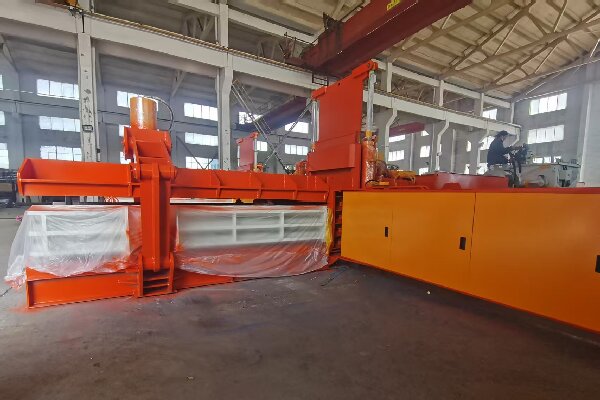
A trial bale on your own material converts a quoted throughput rating into a verified one.
Have Questions or Need More Details?
Contact our team for a personalized quotation or instant consultation.
Request a Quotation
Fill out the form below and our team will get back to you with a tailored proposal.
WhatsApp Direct Chat
Prefer to chat in real-time? Message us on WhatsApp for instant assistance & quick answers.
- Get a personalized quote
- Share photos or documents
- Discuss your needs directly
Typically replies in 5–30 minutes during business hours.