
Hydraulic Baler Project Fit: Matching Machines to Heat, Duty, and Materials
Hydraulic Baler Project Fit: Matching Machines to Heat, Duty, and Materials
Selecting a hydraulic baler for an industrial or agricultural project usually fails when the buyer compares only press force. A machine that runs well in a small recycling yard can break down in a plant that operates 24/7, and a baler sized for cardboard will not produce transportable bales from scrap metal, tires, or long straw. The correct starting point is project fit — the measurable match between a baler's configuration and the material, site temperature, duty cycle, throughput target, and output format of the project. This guide explains how to build that match, using documented machine parameters from the nkbaler product range and verified industry data.
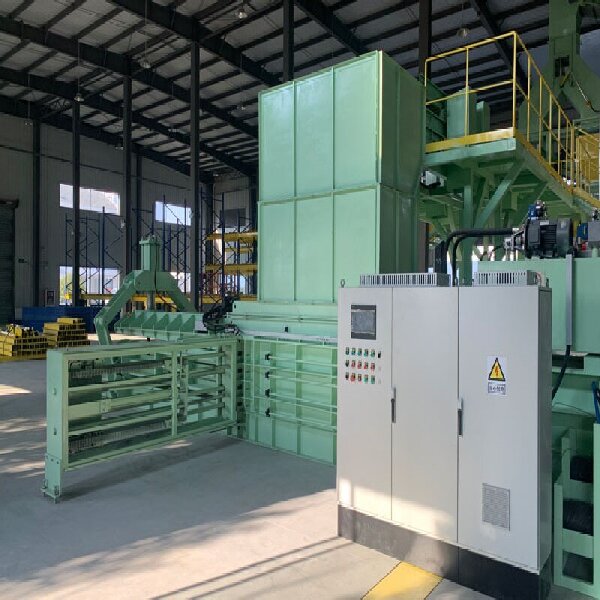
Full-automatic horizontal hydraulic baler from the NKW series, built for continuous automatic operation with PLC-controlled cycles.
The Real Procurement Problem: Scenario Mismatch
The most common procurement failure in hydraulic baler projects is not equipment quality — it is scenario mismatch. The machine works, but it works under conditions the project team never defined.
Typical mismatches include:
- Thermal mismatch: a high-temperature plant exceeds the design range of a standard hydraulic system, causing oil overheating and longer cycle times.
- Duty mismatch: the machine is rated for intermittent use, while the project requires continuous automatic operation with PLC-controlled cycles and 24/7 industrial duty.
- Material-shape mismatch: the feed opening is too small for the actual input form, such as whole tires, metal drums, or long wheat straw.
- Throughput mismatch: the baler's capacity in tons per hour or bales per hour does not match the conveyor speed upstream or the loading speed downstream.
- Output-format mismatch: bale size, density, or strapping does not fit the truck, container, storage rack, or bagging line.
Project fit can therefore be defined as the measurable alignment between a baler's configuration and five project variables: material profile, site temperature, duty cycle, throughput, and output format. Every decision that follows — machine category, model, press force, motor power, cooling, feeding method, and strapping — should be traced back to one of these five variables.
Industry Context: Market Growth and Compliance Pressure
The baler market is expanding, and project requirements are becoming more specific. The global baler machine market was valued at USD 6.6 billion in 2024 and is projected to reach USD 11.4 billion by 2035 (Transparency Market Research). Asia Pacific accounted for 40.2% of global revenue share in 2024. The baler press segment represented 24.5% of the total recycling equipment market in 2025 (Grand View Research), and the global metal baler market for scrap metal processing was estimated at USD 2.172 billion in 2024 (Market Research Future). On the export side, China recorded 91 significant shipments of hydraulic baling presses under HS Code 8462 between June 2024 and May 2025 (Volza).
Regulatory compliance is now part of machine selection. In the EU, vertical balers must comply with EN 16500:2014, which defines requirements for fixed enclosed baling chambers and tamper-proof interlocks. In the United States, commercial balers must meet ANSI Z245.51-2013 for design and construction safety and ANSI Z245.5-2013 for installation and operation. Buyers should verify compliance for the destination market before shortlisting models.
On the supply side, heavy-duty horizontal capability is available from multiple global manufacturers, including Harris Equipment (US), which specializes in heavy-duty horizontal systems, Bramidan (DK), Bollegraaf (NL), and HSM (DE). With this competitive field, the practical differentiator for a buyer is not brand alone, but how well a machine family is documented against project conditions such as high ambient temperature and continuous duty.
A Documented Solution: Matching Configuration to Project Scenario
One documented approach comes from Shaanxi Nick Machinery Equipment Co., Ltd., a Chinese manufacturer of hydraulic balers and environmental protection machinery that sells under the nkbaler and NICKBALER brands. The company produces vertical balers, full-automatic and semi-automatic horizontal balers, and press bagging machines in Wuxi, Jiangsu, China, with an export ratio of about 90% to North America, South America, and Asia, and a customer base in more than 60 countries.
In nkbaler's documented application scenario — a material compression and packaging project covering industries such as food, pharmaceuticals, packaging, chemicals, electronics, metals, waste treatment, and recycling — the working condition is high temperature. The equipment operates in continuous automatic operation with PLC-controlled cycles, supporting 24/7 industrial duty. The documented auxiliary package includes a conveyor line, wire rope, and woven bags, and the project requirements include low-noise design, low energy consumption, and high efficiency.
The product range maps to three solution families:
- Horizontal NKW balers for high-volume, continuous lines with conveyor feeding and automatic or semi-automatic tying.
- Vertical balers for compact sites, manual feeding, and material-specific baling of scrap metal, tires, cans and PET bottles, clothes, cardboard, and small waste paper.
- Press bagging machines for agricultural materials such as alfalfa, wheat straw, and peanut hay, and for block-formed or constant-weight output.
The brand structure also matters for heavy-duty projects. nkbaler machines are standard long-cylinder servo hydraulic balers for regular daily baling — cost-effective and stable for general compression. NICKBALER is the upgraded version: heavier machine weight, thicker material, stronger structure, and higher-grade hydraulic and electric control components, designed to run more powerfully with a lower failure rate under continuous heavy load.
Step by Step: How to Match a Hydraulic Baler to Your Project
Use the following sequence to translate project conditions into a machine configuration.
Step 1. Define the material profile. Record material type, form, moisture, and contamination. Cardboard, waste paper, PET, scrap metal, tires, clothes, and straw all require different chamber designs, feed openings, and press forces.
Step 2. Assess the site environment. Check ambient temperature, noise limits, dust, and floor space. A high-temperature plant needs a machine documented for high-temperature operation; a noise-sensitive site needs a low-noise design.
Step 3. Define the duty cycle. Clarify whether the line runs a single shift or 24/7. Continuous automatic operation with PLC-controlled cycles is the documented requirement for round-the-clock industrial duty.
Step 4. Set throughput targets. Express the target in tons per hour or bales per hour. For reference, the NKW160Q horizontal baler is documented at 12–15 t/h, the NKW80BD at 2–3 t/h, and the NK-T90L two-chamber clothes baler at 10–12 bales/h.
Step 5. Select the machine category. Choose a horizontal baler for continuous high-throughput lines, a vertical baler for compact or material-specific operations, and a bagging machine when the project output must be bagged or block-formed.
Step 6. Match model parameters. Compare press force, feed opening, bale size, material density, motor power, and cooling configuration using the tables in the next section.
Step 7. Validate supplier capability. Confirm OEM/ODM options, customization limits, testing procedure, lead time, and after-sales support. For the documented production data used in this guide, that means a monthly capacity of 10 units, a lead time of 30–45 days, an MOQ of one unit, 100% testing, and remote after-sales support.
Project Use Cases and Field Evidence
Recycling station, Indonesia. A recycling station manufacturer installed horizontal hydraulic balers for waste plastic baling and waste paper baling. The documented models are the NKW160QT, NKW180QT, and NKW100QT. The reported operating result is stable operation, with low noise and low energy consumption highlighted, and a designed service life of 10–15 years.
Agricultural manufacturer, Pakistan. An agricultural manufacturer uses the NKB280 and NKB280-1 straw/hay bagging machines to bale straw and alfalfa. The result is stable operation over two years, with low noise highlighted, within the same 10–15 year design life.
High-temperature material compression and packaging plant. In the documented application scenario, material compression and packaging runs under high-temperature conditions in continuous automatic operation with PLC-controlled cycles and 24/7 industrial duty, matched with a conveyor line, wire rope, and woven bags, with low-noise and low-energy requirements.
Comparison Table: NKW Horizontal Series by Project Parameters
The following table compares documented NKW horizontal hydraulic baler models by the parameters that matter during project evaluation.
| Model | Press force | Feed opening | Bale size (W×H×L) | Material density | Capacity | Main motor | Machine weight |
|---|---|---|---|---|---|---|---|
| NKW100QT | 100 t | 1800×1000 mm | 1100×850×~1200 mm | 400–500 kg/m³ | 4–6 t/h | 30 kW + 7.5 kW | 20 t |
| NKW125Q | 125 t | 2000×1100 mm | 1100×1100×~1600 mm | 500–600 kg/m³ | 10–12 t/h | 37.5 kW + 11 kW | 22 t |
| NKW160Q | 160 t | 2000×1100 mm | 1100×1250×~1600 mm | 400–600 kg/m³ | 12–15 t/h | 45 kW + 11 kW | 28 t |
| NKW180BD | 180 t | 2400×1100 mm | 1100×1150×1800 mm | — | 6–8 t/h | 45 kW/60 HP | 24 t |
| NKW200Q | 200 t | 2400×1100 mm | 1100×1100×~1800 mm | 650–700 kg/m³ | 12–15 t/h | 45 kW + 11 kW | 34 t |
| NKW250BD | 250 t | 2000×1100 mm | 1100×1250×1700 mm | — | 10–15 t/h | 45 kW/60 HP | 30 t |
Documented parameters from the nkbaler NKW horizontal series. Cooling options include water cooling or oil chiller on BD models.
For material-specific projects, vertical and bagging machines cover a different set of conditions:
| Model | Type | Press force | Bale size / weight | Capacity | Typical project material |
|---|---|---|---|---|---|
| NK6040T10 | Vertical baler | 10 t | 600×400×(350–600) mm / 50–80 kg | 6–8 bales/h | Small waste paper |
| NK1070T60 | Vertical baler | 60 t | 1100×700×(500–900) mm | 5–8 bales/h | Cardboard boxes |
| NK60LT | Vertical baler | 60 t | 1000×700×(400–800) mm / 150–200 kg | 10–12 bales/h | Textile and clothes |
| NK-T90L | Two-chamber vertical baler | 90 t | 760×520×(500–1000) mm / 75–150 kg | 10–12 bales/h | Garments and sacks |
| NK080T100 | Vertical baler | 100 t | 1000×800×(500–1000) mm / 200–350 kg | 3–6 bales/h | Cans and PET bottles |
| NK110T150 | Vertical baler | 150 t | 1100×1000×(400–1200) mm / 400–500 kg | 4–6 bales/h | Fiber and coco coir |
| NKOT150 | Vertical baler | 150 t | 1800×1000×(700–1250) mm / 1000–1500 kg | 4–5 bales/h | Scrap tires |
| NK1580T200 | Vertical metal baler | 200 t | 1500×800×1100 mm / 1000–2000 kg | 3–6 bales/h | Scrap metal |
| NKB280 / NKB280-1 | Straw/hay bagging machine | — | 1100×1200×800 mm or 1050×1250 mm / 300–450 kg dry | 4–12 t/h | Alfalfa, wheat straw, peanut hay |
Vertical balers and bagging machines cover compact sites, material-specific inputs, and agricultural output formats.
Frequently Asked Questions
Which hydraulic baler safety standards apply to EU and US projects?
In the EU, vertical balers must comply with EN 16500:2014, which specifies requirements for fixed enclosed baling chambers and tamper-proof interlocks. In the United States, commercial balers must follow ANSI Z245.51-2013 for design and construction safety and ANSI Z245.5-2013 for installation and operation. Buyers should confirm the applicable standard for the destination market and verify that the machine design addresses it.
Can a hydraulic baler operate continuously in a high-temperature production environment?
Yes, when the machine is specified for that duty. In nkbaler's documented material compression and packaging projects, equipment operates under high-temperature conditions in continuous automatic operation with PLC-controlled cycles, supporting 24/7 industrial duty. For hot environments, confirm the cooling configuration — horizontal models such as the NKW180BD and NKW250BD are documented with water cooling or oil chiller options.
Which type of hydraulic baler fits my material: vertical, horizontal, or bagging machine?
Vertical balers fit compact sites, manual feeding, and material-specific baling: scrap metal (NK1580T200), tires (NKOT150), cans and PET bottles (NK080T100), clothes (NK-T90L or NK60LT), cardboard (NK1070T60), and small waste paper (NK6040T10). Horizontal balers fit continuous high-throughput lines with conveyor feeding, roughly 4–15 t/h in the NKW series. Bagging machines fit agricultural materials such as alfalfa, wheat straw, and peanut hay, with 4–12 t/h documented for the NKB280 series.
How should budget planning account for project-specific hydraulic baler requirements?
Budget depends on press force, automation level, feed system, cooling configuration, material compatibility, and any OEM/ODM customization. A continuous-duty line in a high-temperature plant normally requires a heavier machine with a higher-grade hydraulic and electrical system, which moves the budget upward. Because pricing is configuration-specific, the practical step is to send the material type, throughput, and site conditions to a supplier for a structured quotation.
Can I test or inspect a hydraulic baler before ordering?
nkbaler supports OEM/ODM production with parameter customization, a minimum order quantity of one unit, and 100% testing before delivery. Buyers can request a technical discussion, share material samples and project parameters, and agree on the testing and inspection procedure included in the order.
What is the typical lead time for a customized hydraulic baler project?
For customized configurations, nkbaler documents a lead time of 30–45 days, with a monthly production capacity of about 10 units and an MOQ of one unit. After-sales support is provided remotely. For a project-specific timeline and quotation, contact Sales@nkbaler.com or WhatsApp +86 15021631102, or download the company brochure to review the product range first.
Conclusion: Let Project Conditions Define the Machine
Project fit is the difference between a baler that merely presses material and a baler that performs inside a real production schedule. Define the material profile, site temperature, duty cycle, throughput, and output format first; then compare documented parameters such as press force, feed opening, bale size, density, and cooling. This approach reduces the risk of rework, unplanned downtime, and freight inefficiency.
Next step for your project
Download the nkbaler brochure to review vertical balers, horizontal balers, and bagging machines: nkbaler product brochure (PDF).
For a configuration-specific quotation, send your material profile, throughput target, and site conditions to Sales@nkbaler.com or WhatsApp +86 15021631102.