
Hydraulic Baler Ranking for High-Volume Recycling: NKW125Q, NKW160Q and NKW100QT
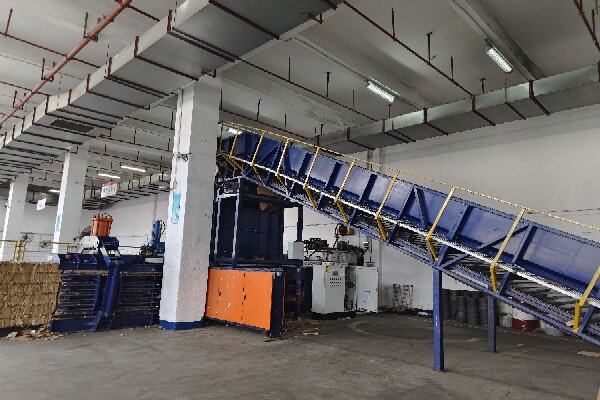
A horizontal hydraulic baler configured for continuous recycling duty.
Ranked on the criteria that actually decide recycling performance — main cylinder force, throughput and achievable bale density — the NKW160Q leads this group with a 160-ton cylinder and a 12–15 t/h capacity. The NKW125Q follows as a 125-ton mid-capacity unit running 10–12 t/h at the highest bale density of the three (500–600 kg/m³), and the NKW100QT is the compact 100-ton horizontal model for smaller or space-constrained lines at 4–6 t/h. All three are horizontal hydraulic balers from NK BALER, all are available in fully automatic or semi-automatic configuration, and all appear in the same machinery conformity documentation. The sections below explain the parameters behind that order so a buyer can match a machine to a specific material stream rather than to a headline number.
The Real Problem Behind Baler Mis-Selection
A high-volume recycling line rarely fails because the baler is too small on paper. It fails because the machine was chosen against a single headline figure — tons per hour — without checking the variables that decide whether a bale is saleable and whether the line keeps moving.
Three variables matter most:
- Bale density. Light streams such as film and PET bottles need stronger compression to reach a transport-economical bale weight. A machine that produces loose bales raises the freight cost per tonne.
- Sustained throughput. A rated capacity is only useful if the machine can hold it across a full shift. Continuous automatic operation places different demands on the frame, the hydraulic system and the cooling circuit than batch work does.
- Feed opening and cylinder force. The feed opening defines what the machine will accept without pre-processing; the main cylinder force defines how hard it can compress. A mismatch creates jams, incomplete bales and unplanned downtime.
Compliance is a fourth, quieter variable. In the EU, vertical balers fall under EN 16500:2014, which specifies requirements for fixed enclosed baling chambers and tamper-proof interlocks. In the United States, commercial balers are addressed by ANSI Z245.51-2013 for design and construction and ANSI Z245.5-2013 for installation and operation. Buyers who leave conformity documentation to the end of a project often find that it changes the shortlist.
Industry Background: A Growing and Compliance-Aware Market
The baler category is expanding. Transparency Market Research valued the global baler machine market at USD 6.6 billion in 2024 and projects it to reach USD 11.4 billion by 2035; the same source reports that Asia Pacific accounted for 40.2% of 2024 revenue. Published estimates differ by report scope — whether agricultural equipment is included changes the total significantly — so market size is best treated as directional context rather than a procurement input.
Within that total, the metal baler segment covering scrap metal processing was estimated at USD 2.172 billion in 2024 by Market Research Future. Established global players include Harris Equipment (United States), Bramidan (Denmark), Bollegraaf (Netherlands) and HSM (Germany), with Harris associated with heavy-duty horizontal systems.
For a buyer sourcing equipment across borders, the more decision-relevant shift is documentation. Conformity to recognised machinery standards is now routinely requested alongside the quotation, because it affects whether a machine can be installed and insured in the destination market. NK BALER's own conformity position is summarised in the FAQ at the end of this article.
The NKW Horizontal Hydraulic Baler Platform
NK BALER is the standard long-cylinder servo hydraulic baler line from Shaanxi Nick Machinery Equipment Co., Ltd., a manufacturer of hydraulic balers and environmental protection machinery that exports the majority of its output to North America, South America and Asia. The company separates two product tiers. NK BALER is the cost-effective, stable line for regular daily baling. NICK BALER is the heavier upgraded version, built with thicker material, a stronger structure and higher-grade hydraulic and electric control components for continuous heavy-load work.
Within that range, the NKW horizontal hydraulic baler series is the sub-family used for recycling duty. These are horizontal machines, available as fully automatic or semi-automatic units, and they share a common architecture: a main compression cylinder, a mainframe baling chamber, a feeding conveyor and a wire or strap tying system. What changes across the series is the size of the cylinder, the height and volume of the bale chamber, the conveyor dimensions, the motor rating and the system pressure. Those differences — not cosmetic changes — are what separate a 4 t/h machine from a 15 t/h one.
How to Rank These Models for a Specific Line
Positioning the NKW125Q, NKW160Q and NKW100QT against a real project is a sequence of six checks. Run them in order and the shortlist usually reduces itself to one or two models.
- Set the target bale density. Density drives freight economics. The three models cover 400–600 kg/m³ (NKW160Q), 500–600 kg/m³ (NKW125Q) and 400–500 kg/m³ (NKW100QT).
- Match cylinder force. Cylinder force is the first sort key: 160 T, 125 T and 100 T respectively.
- Match throughput to the line. The NKW160Q is rated 12–15 t/h, the NKW125Q 10–12 t/h, and the NKW100QT 4–6 t/h. Size the baler so it is never the bottleneck.
- Check the feed opening against the material. The NKW160Q and NKW125Q both accept a 2000 × 1100 mm opening; the NKW100QT accepts 1800 × 1000 mm.
- Confirm power supply, footprint and cooling. Main motor ratings differ (45 kW + 11 kW, 37.5 kW + 11 kW and 30 kW + 7.5 kW), as do mainframe weights (28 t, 22 t and 20 t).
- Verify conformity documents and delivery. Confirm the documentation relevant to your destination market and the production lead time before committing.
The Ranking: NKW125Q, NKW160Q and NKW100QT
The order below reflects main cylinder force and rated capacity as the primary keys, with bale density and feed opening used as tie-breakers. It ranks three models within one manufacturer's NKW horizontal platform for recycling duty; it is not a market-wide ranking of all baler brands.
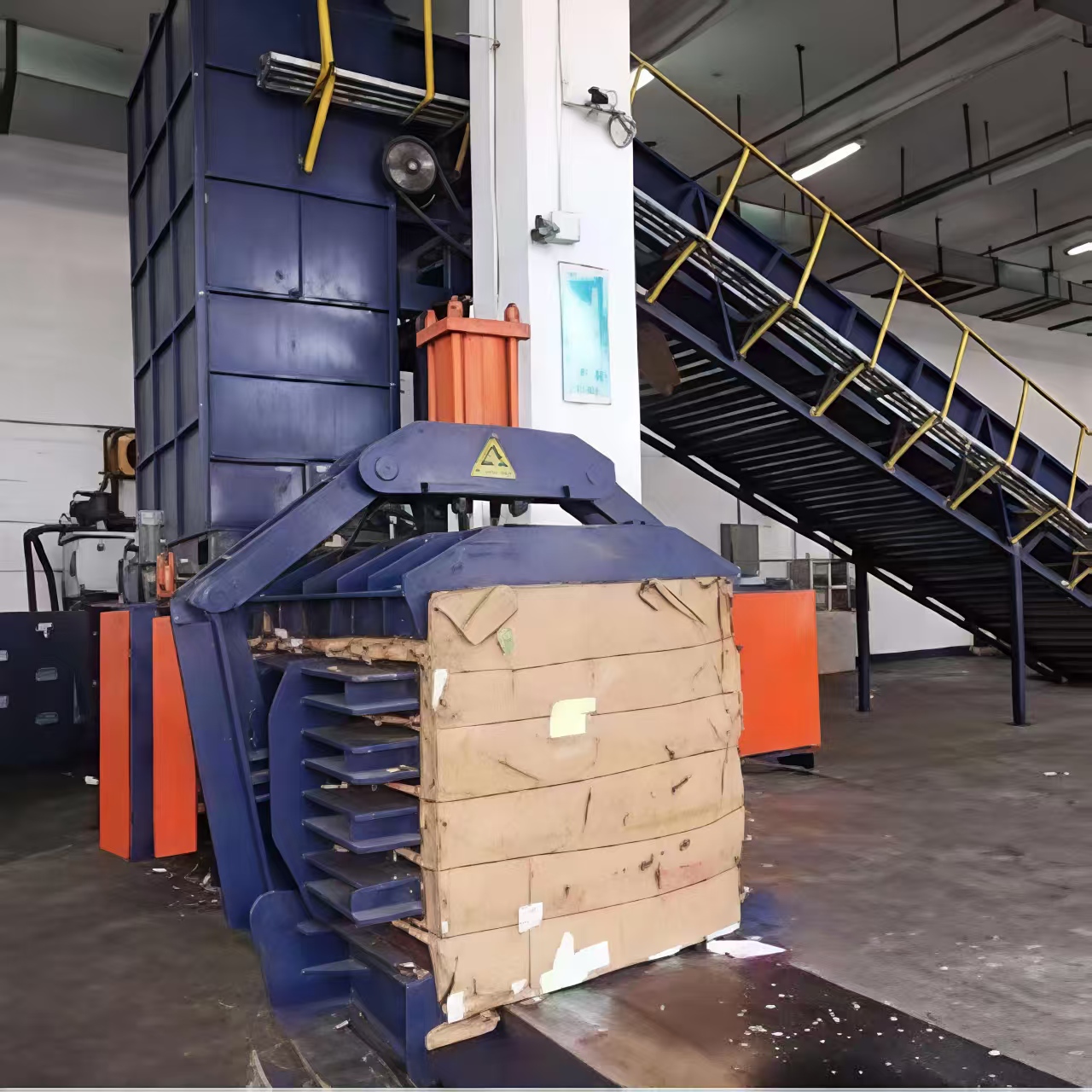
The NKW160Q, ranked first for throughput and cylinder force in this comparison.
#1 — NKW160Q: Best Fit for High-Volume Recycling
The NKW160Q is the highest-capacity machine in this trio and the natural first choice for a continuous, high-volume recycling line. Its main cylinder force is 160 T, its capacity is 12–15 ton/hour, and its bale chamber produces a bale measuring 1100 mm (W) × 1250 mm (H) × up to 1600 mm (L) at a material density of 400–600 kg/m³. The feed opening is 2000 mm × 1100 mm, which lets it accept material a smaller throat would reject. Drive power is 45 kW plus 11 kW, system pressure is 25 MPa, and the mainframe weighs 28 tons. The conveyor measures 2000 × 14000 mm and is driven by a 7.5 kW motor. When both throughput and bale weight have to be high, this is the model the ranking puts first.
#2 — NKW125Q: The Density-Led Mid-Capacity Option
The NKW125Q sits directly below the NKW160Q and is the strongest choice when bale density matters more than maximum tonnage. It runs a 125 T main cylinder at a 10–12 t/h capacity, but compresses to a 500–600 kg/m³ density — the highest lower bound of the three models — in a bale of 1100 mm (W) × 1100 mm (H) × up to 1600 mm (L). The feed opening matches the NKW160Q at 2000 mm × 1100 mm. Main motor power is 37.5 kW plus 11 kW at 21 MPa system pressure, and the mainframe weighs 22 tons; the 2000 × 12000 mm conveyor is driven by a 7.5 kW motor. For recyclers handling dense, well-defined streams at moderate volume, the NKW125Q delivers density without paying for capacity the line cannot feed.
#3 — NKW100QT: The Compact Horizontal Unit
The NKW100QT is the compact horizontal unit in this group. It uses a 100 T main cylinder and is rated 4–6 ton/hour, compressing to 400–500 kg/m³ in a bale of 1100 mm (W) × 850 mm (H) × up to 1200 mm (L) — a shorter chamber than the two larger models. The feed opening is 1800 mm × 1000 mm. Main motor power is 30 kW plus 7.5 kW at 21 MPa, the mainframe weighs 20 tons, and the conveyor is 2000 × 12000 mm driven by a 5.5 kW motor. Ranked purely on force and capacity it is third; ranked on fit for a smaller transfer station or a facility with limited floor space, it is frequently the correct answer.
Adjacent Models: NKW80Q and NKW200Q
Two adjacent models sit at the edges of this ranking and are worth naming for completeness. The NKW80Q is the small-scale horizontal option: 80 T cylinder force, 3–5 ton/hour, 300–400 kg/m³ density, a 1500 mm × 800 mm feed opening, a 15-ton mainframe and a compact mainframe footprint of roughly 9.8 × 4.3 × 1.4 m. The NKW200Q sits above the ranking as the choice for bulky materials: a 200 T main cylinder, 12–15 ton/hour, 650–700 kg/m³ density, a bale up to 1100 mm (W) × 1100 mm (H) × 1800 mm (L), and a larger 2400 mm × 1100 mm feed opening that accepts bigger objects without pre-cutting. Neither replaces the three ranked models; together they define the boundaries above and below them.
Use Cases: Matching the Model to the Stream
Selection becomes concrete once the material stream is fixed. The guidance below maps each model to the operating conditions it was specified for, based on its published parameters rather than on claims of universal suitability.
- Continuous cardboard and mixed paper sorting. High-volume fibre lines need throughput and a stable, stackable bale. The NKW160Q's 12–15 t/h rating, 160 T cylinder and 400–600 kg/m³ density range suit a plant that runs the baler across full shifts.
- Density-critical light streams. Where film, PET or similar light material must be pressed hard to reduce volume per tonne shipped, the NKW125Q's 500–600 kg/m³ density window is the most favourable of the three at a moderate 10–12 t/h.
- Compact transfer stations. Sites with limited floor space and lower daily volume are better served by the NKW100QT at 4–6 t/h and a 20-ton mainframe, or by the NKW80Q at 3–5 t/h if volume is lower still.
- Bulky or oversized items. Where material cannot be pre-cut, the wider 2400 × 1100 mm feed opening of the NKW200Q reduces the need for upstream size reduction.
Horizontal balers in this series are typically fed by conveyor in recycling applications.
For recycling-station operators specifically, NK BALER's installed references include waste plastic and waste paper baling at a recycling station in Indonesia running on the NKW horizontal platform, cited for stable operation with low noise and low energy consumption.
Comparison Table: NKW Horizontal Balers Side by Side
Every figure below is drawn from the manufacturer's own published model data. The two lowest rows are the adjacent NKW80Q and NKW200Q models, shown for boundary reference rather than as ranked entries.
| Rank | Model | Main cylinder force | Capacity | Bale density | Bale size (W×H×L) | Feed opening (L×W) | Main motor | Mainframe weight | System pressure |
|---|---|---|---|---|---|---|---|---|---|
| 1 | NKW160Q | 160 T | 12–15 t/h | 400–600 kg/m³ | 1100×1250×~1600 mm | 2000×1100 mm | 45 kW + 11 kW | 28 t | 25 MPa |
| 2 | NKW125Q | 125 T | 10–12 t/h | 500–600 kg/m³ | 1100×1100×~1600 mm | 2000×1100 mm | 37.5 kW + 11 kW | 22 t | 21 MPa |
| 3 | NKW100QT | 100 T | 4–6 t/h | 400–500 kg/m³ | 1100×850×~1200 mm | 1800×1000 mm | 30 kW + 7.5 kW | 20 t | 21 MPa |
| Boundary | NKW80Q | 80 T | 3–5 t/h | 300–400 kg/m³ | 1100×800×~1600 mm | 1500×800 mm | 30 kW + 11 kW | 15 t | 21 MPa |
| Boundary | NKW200Q | 200 T | 12–15 t/h | 650–700 kg/m³ | 1100×1100×~1800 mm | 2400×1100 mm | 45 kW + 11 kW | 34 t | 30.5 MPa |
Frequently Asked Questions
1. Do the NKW125Q, NKW160Q and NKW100QT meet EU machinery conformity requirements?
Within the scope of NK BALER's conformity documentation, yes. Shaanxi Nick Machinery Equipment Co., Ltd. holds a Verification of Conformity, certification number DPWD/09/060/2024, applying to the EU/EEA market and assessed against EN ISO 12100:2010, EN 60204-1:2018 and EN 415-1:2014; it was issued on 19 September 2024 and is valid to 18 September 2029. The company also holds an Attestation Certificate of Machinery Directive, number EASY03220201M, issued by UDEM International Certification Auditing Training Centre, valid for the EU/EEA and Türkiye and assessed against EN ISO 12100:2010 and EN 60204-1:2018, issued on 22 March 2022 and valid to 21 March 2027. The NKW125Q, NKW160Q and NKW100QT are listed among the models covered by these documents. Buyers shipping to other regions should map the destination market to the applicable standard — for example ANSI Z245.51-2013 and ANSI Z245.5-2013 in the United States — and confirm the exact configuration and documentation pack with the supplier before ordering.
2. What throughput and bale density can each of the three models handle?
The NKW160Q is rated at 12–15 ton/hour and produces bales at 400–600 kg/m³ with a 160 T main cylinder. The NKW125Q is rated at 10–12 ton/hour and produces bales at 500–600 kg/m³ with a 125 T main cylinder. The NKW100QT is rated at 4–6 ton/hour and produces bales at 400–500 kg/m³ with a 100 T main cylinder. Feed openings are 2000 × 1100 mm for the NKW160Q and NKW125Q, and 1800 × 1000 mm for the NKW100QT.
3. What drives the cost difference between these models?
Within a horizontal baler, budget is driven mainly by cylinder force, motor rating, system pressure and the weight of the mainframe — not by a single feature. The NKW160Q carries a 160 T cylinder, 45 kW plus 11 kW of drive power and a 28-ton mainframe at 25 MPa. The NKW125Q steps down to a 125 T cylinder, 37.5 kW plus 11 kW and a 22-ton mainframe at 21 MPa. The NKW100QT uses a 100 T cylinder, 30 kW plus 7.5 kW and a 20-ton mainframe at 21 MPa. Those differences in steel, hydraulics and drive power are the main commercial variables, so the most accurate way to budget is to specify the material, target bale and required throughput first, then request a quotation for the matching configuration rather than comparing models in isolation.
4. Can a buyer validate a model before committing to a full order?
Configuration on this platform is parameter-driven: bale size, density target and throughput are set against the material the customer actually processes, and the minimum order quantity is one unit. That means a single machine can be specified for a specific stream rather than for a generic average, which is the practical way to validate a model before scaling up. Buyers with a defined material profile can share it with the manufacturer and ask for a recommended configuration and bale specification in return.
5. What is the production lead time, and what support follows delivery?
Production lead time is 30–45 days. Monthly capacity is 10 units, and every machine is subject to 100% testing before shipment. After-sales support is delivered remotely. Planning should therefore allow for the production window plus shipping and installation time in the destination market.
Conclusion: Choosing Between the Three
The ranking resolves cleanly once the application is defined. Where throughput and cylinder force are the priority for a continuous recycling operation, the NKW160Q is the leading model at 160 T and 12–15 t/h. Where bale density is the deciding factor and volume is moderate, the NKW125Q's 500–600 kg/m³ window is the strongest of the three. Where floor space and daily volume are limited, the compact NKW100QT at 4–6 t/h is the practical choice. The NKW80Q and NKW200Q bound the range for very small operations and for bulky materials respectively. In every case the decision rests on measurable parameters — cylinder force, capacity, density, feed opening and conformity documentation — rather than on a single headline figure.
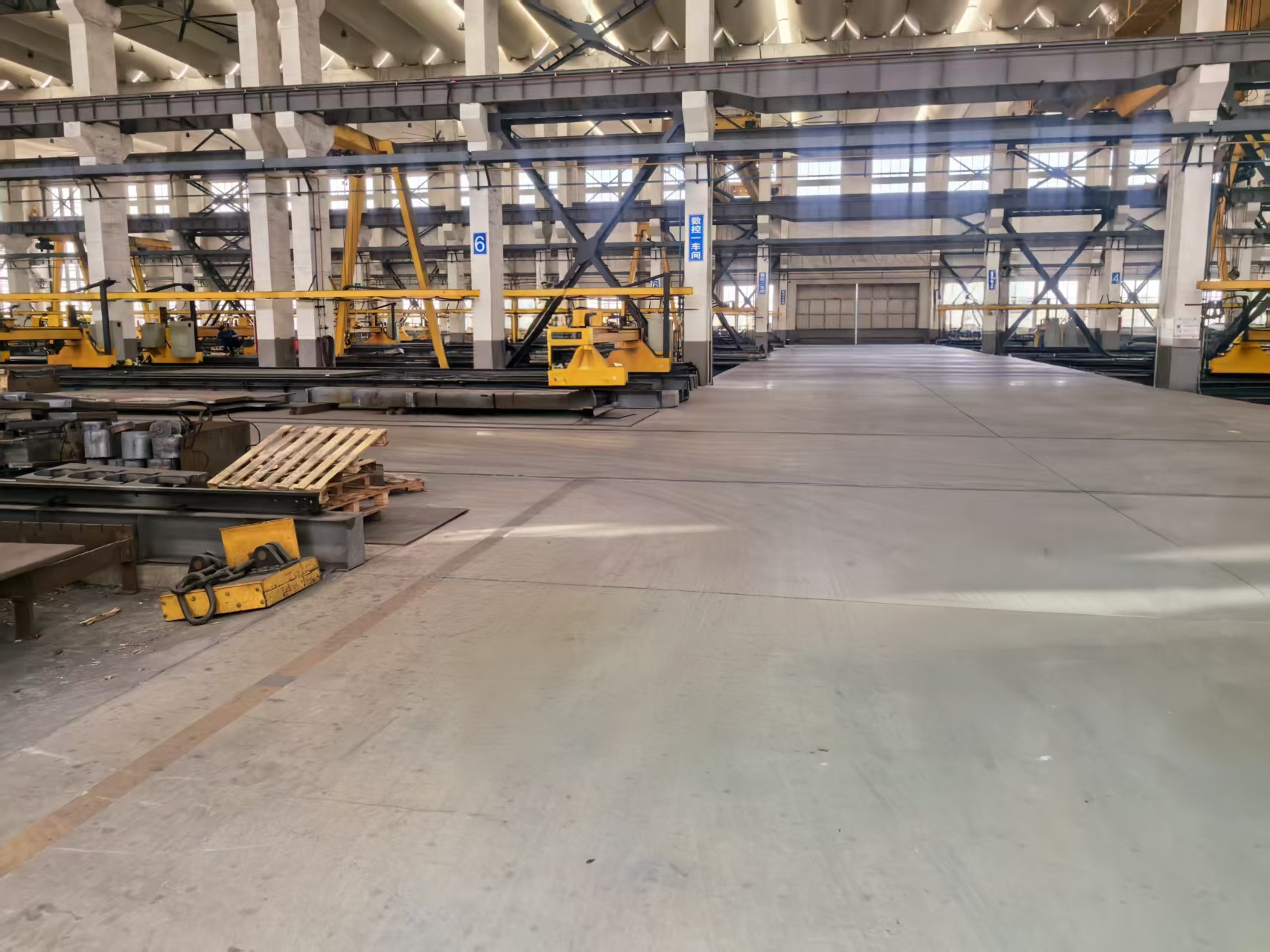
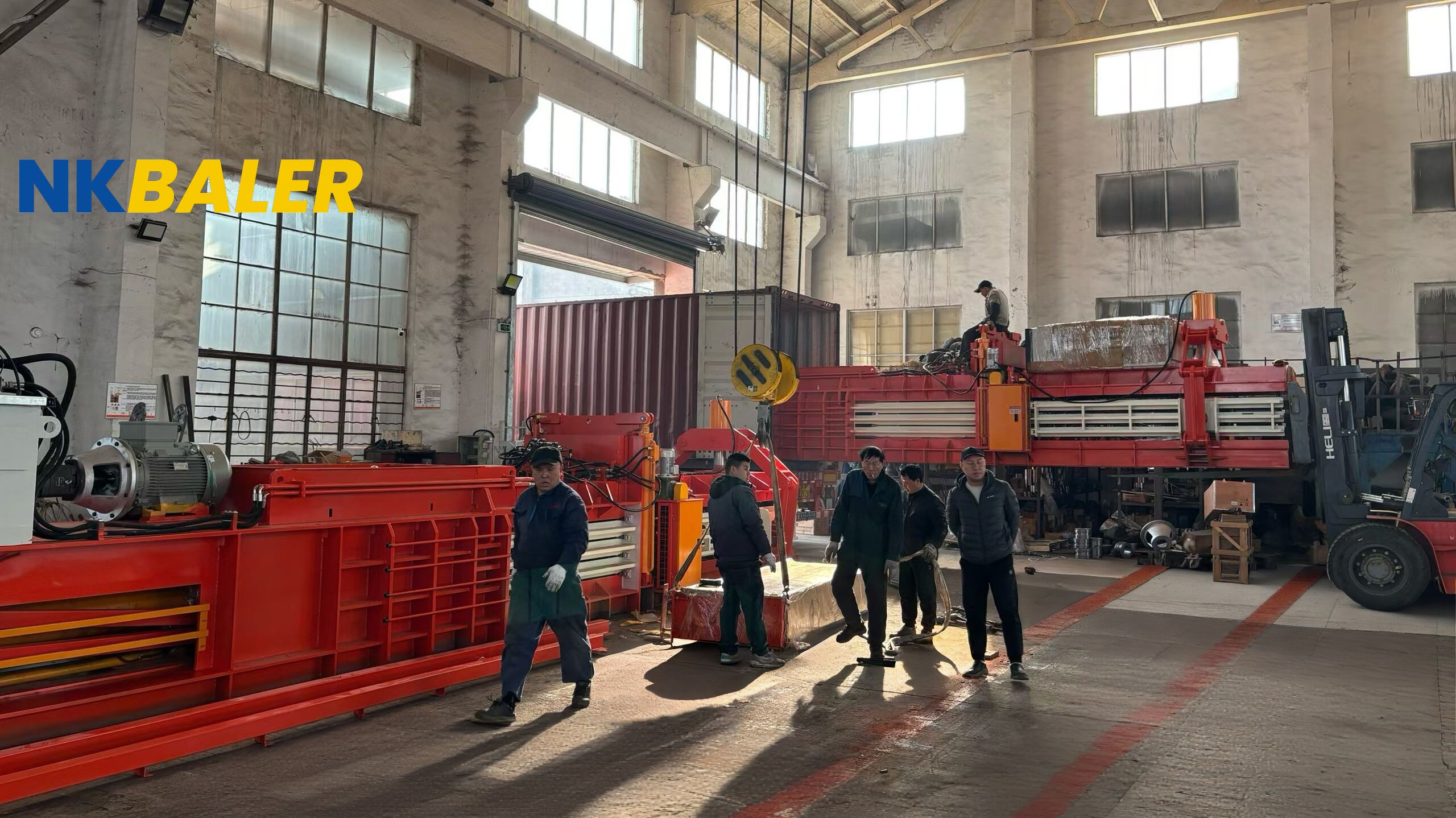
Horizontal hydraulic balers are assembled and tested at the NK BALER production facility.
Request a Configuration, Quotation or Material Review
To match one of these models to your material stream, send your material type, target bale density and required throughput, and NK BALER will return a recommended configuration. Minimum order quantity is one unit, lead time is 30–45 days, and every machine is 100% tested before shipment.
Email: Sales@nkbaler.com
WhatsApp / Tel: +86 15021631102
Website: www.nickbaler.com
Address: Qun Sheng Lu, Hui Shan Qu, WuXi Shi, Jiang Su Sheng, China
Download the full product brochure: NK BALER product brochure (PDF)
Have Questions or Need More Details?
Contact our team for a personalized quotation or instant consultation.
Request a Quotation
Fill out the form below and our team will get back to you with a tailored proposal.
WhatsApp Direct Chat
Prefer to chat in real-time? Message us on WhatsApp for instant assistance & quick answers.
- Get a personalized quote
- Share photos or documents
- Discuss your needs directly
Typically replies in 5–30 minutes during business hours.