
Sizing a Hydraulic Baler for Your Facility: Space, Feeding and Output
A hydraulic baler is usually specified on cylinder force and tonnes per hour, and then installed into a building that was measured for something else. In practice, three physical numbers decide whether a machine works in your facility: the straight run available for the mainframe and conveyor, the feed opening your sorting line can actually load, and the route that finished bales take out of the machine. This guide works through all three using the published dimensions of the NKW horizontal baler and NK vertical baler ranges from Shaanxi Nick Machinery Equipment Co., Ltd. (NICKBALER).
Short answer: size the machine from the outside in. Fix the available straight run first (mainframe length plus conveyor length plus working clearance), then choose the feed opening your infeed can fill, and only then confirm bale size, material density and hourly capacity. Across the NKW range this means mainframe lengths of roughly 9.8 m to 13 m, conveyors of 12,000 mm to 14,000 mm, and feed openings of 1,500 × 800 mm to 2,400 × 1,100 mm.
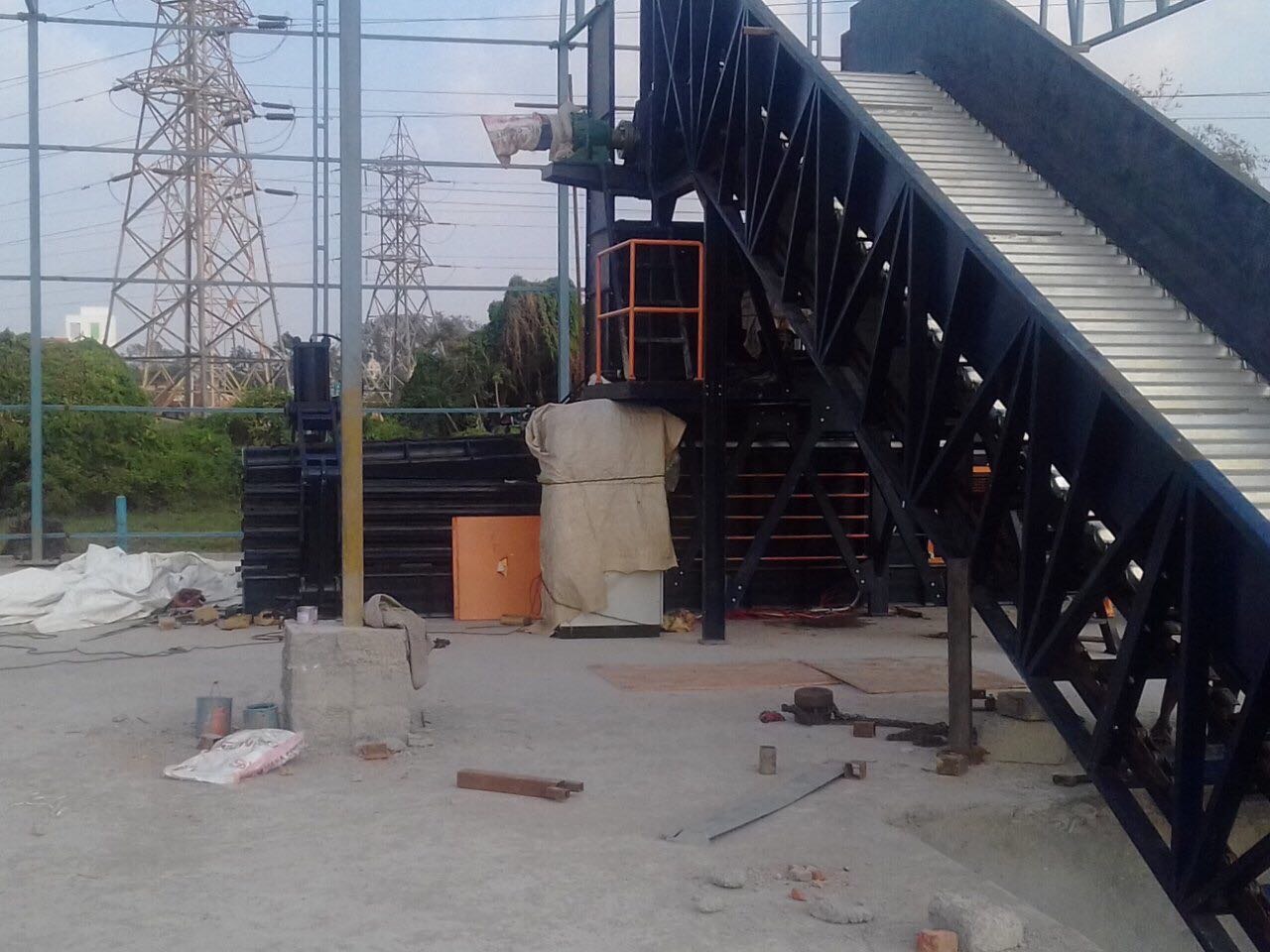
NKW80Q horizontal hydraulic baler in a film-baling configuration. Its published mainframe length is about 9.8 m — the shortest in the NKW Q-series, but it still needs a 12,000 mm conveyor in front of it.
Why Baler Projects Fail on Layout, Not on Tonnage
A hydraulic baler is a fixed asset bolted to a floor. Cylinder force — 80 t on the NKW80Q, 125 t on the NKW125Q, 160 t on the NKW160Q and NKW160QT, 180 t on the NKW180QT, 200 t on the NKW200Q — tells you how hard the machine presses. It tells you nothing about whether the machine fits, whether your staff can feed it at the rate it presses, or whether bales can leave the building.
Three constraints bind in almost every installation:
- Space. Mainframe length plus conveyor length, plus clearance for the door, control panel, wire or strapping access and maintenance walkways.
- Feeding. Feed opening dimensions measured against the widest single piece and the widest continuous flow your sorting line discharges.
- Output. Bale size, bale weight and hourly capacity measured against the floor area where bales accumulate, and the loading pattern of the truck that takes them away.
Two facilities processing the same material volume can require different machines for purely physical reasons. A site with a 25 m unobstructed straight run can accept a 14,000 mm conveyor feeding a 2,400 × 1,100 mm opening; a site with 15 m of run cannot, and will either need a shorter conveyor arrangement, a vertical baler, or a different building layout. Getting this wrong does not show up in the quote — it shows up later as manual re-handling, bales blocking aisles, or a conveyor that discharges at an angle the feed chute was never designed for.
What Published Baler Market Data Suggests About Machine Size
Baler demand has grown steadily, which has pushed more buyers into facilities that were not originally designed for baling equipment. Transparency Market Research valued the global baler machine market at USD 6.6 billion in 2024 and projects it to reach USD 11.4 billion by 2035. Grand View Research recorded that the baler press segment accounted for 24.5% of the total recycling equipment market in 2025, driven by demand for compacting plastic and paper. The same 2024 dataset from Transparency Market Research puts Asia Pacific at 40.2% of global baler revenue, and Volza export records list China among the top exporters of hydraulic baling presses under HS Code 8462, with 91 significant shipments recorded between June 2024 and May 2025.
Published market sizes should be read as directional rather than absolute. Global Market Insights estimated the baler market at USD 4.9 billion for 2025, and Grand View Research at USD 7.18 billion for the same year — a spread explained largely by whether agricultural and light-duty equipment is included. The practical takeaway for a facility planner is not the headline number but the pattern behind it: more material is being baled, in more locations, often in buildings with constrained floor space. In a fragmented supply base that also includes named competitors such as Harris Equipment (US), Bramidan (DK), Bollegraaf (NL) and HSM (DE), dimensions differ meaningfully between brands. A layout should therefore be built around the published dimensions of the specific model under consideration, never around a category average.
Shaanxi Nick Machinery Equipment Co., Ltd., trading as NICKBALER, is a Chinese manufacturer of hydraulic balers and environmental protection machinery, established in 2013 and operating from a 5,000 m² manufacturing facility with a workforce of approximately 50 staff and an R&D team of 15 engineers. Its main product lines are vertical balers, full-automatic horizontal balers, manual horizontal balers and press bagging machines, used across food, pharmaceuticals, packaging, chemicals, electronics, metals, waste treatment and recycling. Because the company publishes mainframe dimensions, conveyor dimensions, feed opening sizes and capacity figures for its horizontal models, a footprint-first sizing exercise can be done before any site visit.
Matching Machine Dimensions to Facility Constraints
Constraint 1 — Space: Mainframe Plus Conveyor, Plus Clearance
The number that decides the layout is not the machine length alone; it is the machine plus the conveyor it is fed by. The NKW80Q has a published mainframe size of approximately 9.8 m × 4.3 m × 1.4 m (L × W × H) and is fed by a conveyor measuring 1,200 mm wide × 12,000 mm long, driven by a 4 kW motor. Positioned in line, the mainframe and conveyor already occupy roughly 21.8 m of straight run before any clearance is added for operators, wire handling and maintenance access.
The NKW200Q is longer and considerably taller: a published mainframe of approximately 11 m × 4.3 m × 5.8 m, with a conveyor of 2,000 mm × 14,000 mm driven by a 7.5 kW motor. In line, that is approximately 25 m of run. The additional length is modest — about 3 m — but the machine is more than twice the weight of the NKW80Q: 34 t against 15 t. Floor loading, foundation depth and the route used to move the machine into position are therefore different engineering problems, even though the plan-view difference looks small.
Height matters as well. The NKW160QT and NKW180QT publish mainframes of approximately 13 m × 4.3 m × 5.8 m, and the NKW200Q the same 5.8 m height. Buildings with low clearances, mezzanines or overhead services should be checked against that figure before the model is confirmed, and not after.
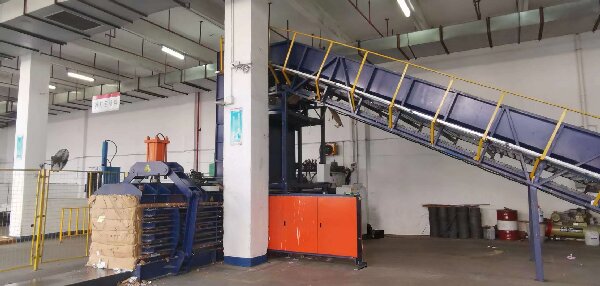
A horizontal baler is only as short as its shortest component. In an in-line layout, mainframe and conveyor lengths add together before any working clearance is allowed for.
Constraint 2 — Feeding: The Feed Opening Caps Your Intake
Feed opening dimensions set the ceiling on what the baler can accept, regardless of cylinder force. In the NKW range the published openings scale with model size: 1,500 × 800 mm on the NKW80Q, 1,800 × 1,000 mm on the NKW100QT, 2,000 × 1,100 mm on the NKW125Q, NKW160Q, NKW160QT and NKW180QT, and 2,400 × 1,100 mm on the NKW200Q. The BD-series models follow a similar progression, from 1,200 × 1,000 mm on the NKW80BD to 2,400 × 1,100 mm on the NKW180BD.
The opening must be matched to the infeed, not the other way round. Note how conveyor width and opening width relate: the NKW80Q pairs a 1,200 mm conveyor with a 1,500 mm opening, which leaves the conveyor narrower than the chute so material cannot spill past the mouth. On the wider models the conveyor and the opening are matched at 2,000 mm, which means the discharge chute of your sorting line becomes the limiting element rather than the conveyor.
Where a sorting line discharges material wider than the opening, oversize pieces bridge at the mouth and throughput collapses. The sizing rule is straightforward: measure the widest single item your line can realistically discharge, and choose an opening that accepts it without bridging.
Constraint 3 — Output: Bale Size and Hourly Capacity Define the Downstream Loop
Every bale that leaves the chamber has to go somewhere. Bale sizes in the NKW range run from 1,100 × 800 mm × approximately 1,600 mm (W × H × L) on the NKW80Q, through 1,100 × 1,100 mm × approximately 1,600 mm on the NKW125Q, to 1,100 × 1,250 mm × approximately 1,600 mm on the NKW160Q, NKW160QT and NKW180QT, and 1,100 × 1,100 mm × approximately 1,800 mm on the NKW200Q. The NKW100QT produces a smaller 1,100 × 850 mm × approximately 1,200 mm bale.
Material density is published per model and should be checked against the stream you actually generate: 300–400 kg/m³ for the NKW80Q, 400–500 kg/m³ for the NKW100QT, 400–600 kg/m³ for the NKW160Q, 500–600 kg/m³ for the NKW125Q, NKW160QT and NKW180QT, and 650–700 kg/m³ for the NKW200Q. A model rated for 300–400 kg/m³ is not the right choice for a dense film or bottle stream, even if the bale dimensions look adequate on plan.
Hourly capacity determines how quickly bales accumulate and therefore how much staging floor you need. Published figures are 3–5 T/hour for the NKW80Q, 2–3 T/hour for the NKW80BD, 4–6 T/hour for the NKW100QT, 5–7 T/hour for the NKW125BD, 10–12 T/hour for the NKW125Q, 6–8 T/hour for the NKW180BD, 10–15 T/hour for the NKW250BD, and 12–15 T/hour for the NKW160Q, NKW160QT, NKW180QT and NKW200Q. Bale wire consumption is part of the same loop: the NKW80BD uses 10# wire × 4 pieces, the NKW125BD 10# × 5 pieces, and the NKW180BD and NKW250BD 6#/8# × 5 pieces. Cooling arrangements — water cooling or an oil chiller — should also be accounted for in the services plan, not added after the machine is positioned.
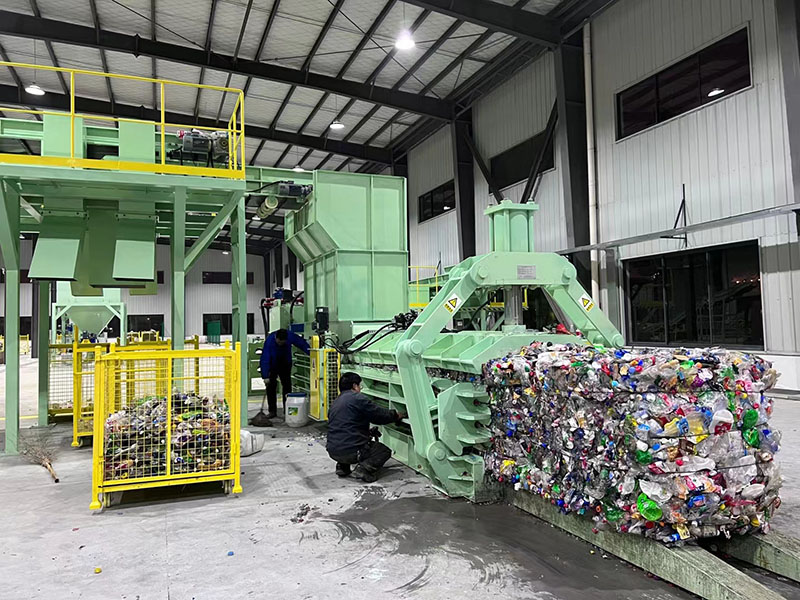
Output planning is a floor-space exercise: hourly capacity determines how quickly finished bales accumulate, and how much staging area must be reserved beside the machine.
A Seven-Step Sizing Sequence for Your Facility
- Measure the material stream, not the annual tonnage. Record the density band of your material (for example 300–400 kg/m³ or 650–700 kg/m³) and the peak hourly feed rate, because the model has to be matched to the peak, not the average.
- Measure the available straight run. Walk the intended line from the discharge point of the sorting line to the planned bale staging area and record the true unobstructed distance. Compare it with mainframe plus conveyor: about 21.8 m for an NKW80Q and 12,000 mm conveyor, or about 25 m for an NKW200Q and 14,000 mm conveyor.
- Match the feed opening to the infeed. Choose an opening that accepts the widest piece your line discharges — 1,500 × 800 mm, 1,800 × 1,000 mm, 2,000 × 1,100 mm or 2,400 × 1,100 mm, depending on model.
- Check headroom and floor loading. Mainframe heights reach 5.8 m on the NKW160QT, NKW180QT and NKW200Q, and mainframe weights range from 15 t on the NKW80Q to 34 t on the NKW200Q.
- Plan the bale exit route. Confirm that bale sizes from 1,100 × 850 mm up to 1,100 × 1,250 mm can travel from the chamber to storage and onto a truck without being turned by hand.
- Confirm electrical and cooling services. Main motor power ranges from 30 kW on the NKW80Q and NKW100QT to 45 kW on the NKW160Q, NKW160QT, NKW180QT and NKW200Q, with conveyor motors of 4 kW to 7.5 kW on top.
- Fix the model before civil work begins. Once the model is locked, the foundation, conveyor alignment and services scope can be priced and scheduled without later changes.
Use Cases: Facility Profiles and the Models That Fit
Sizing decisions become clearer when they are matched to a facility type rather than to an abstract throughput figure.
Retail or warehouse backroom with cardboard. Where floor space is measured in square metres rather than metres of run, a vertical machine is the realistic option. The NK1070T60 vertical cardboard box baler occupies 1,600 × 1,100 × 3,200 mm, runs on 15 kW and produces 5–8 bales per hour.
Textile, garment or second-hand clothing operation. The NK-T90L double-chamber clothes baler is designed to pack garment and sack materials, produces 10–12 bales per hour with bales of 760 × 520 × 500–1,000 mm weighing 75–150 kg, and occupies 3,800 × 1,500 × 4,600 mm.
Mid-volume recycling or distribution centre. A 5–7 T/hour line fits the NKW125BD, which pairs a 2,000 × 1,100 mm feed opening with a bale size of 1,100 × 1,250 × 1,700 mm and a 12,000 mm × 1,800 mm conveyor.
High-volume paper, film or bottle line. At 12–15 T/hour, the NKW160Q or NKW200Q is the appropriate band. The NKW200Q is classified as a large horizontal hydraulic baler and is described as a large, heavy-duty horizontal hydraulic baler in its 180QT variant — both are designed for continuous industrial duty.
Metal and dense material streams. Where bale weight rather than bale volume drives the decision, the NK1580T200 vertical metal baler applies 200 t of hydraulic force through a 1,500 × 800 mm feed opening to produce bales of 1,500 × 800 × 1,100 mm weighing 1,000–2,000 kg, at 3–6 bales per hour.
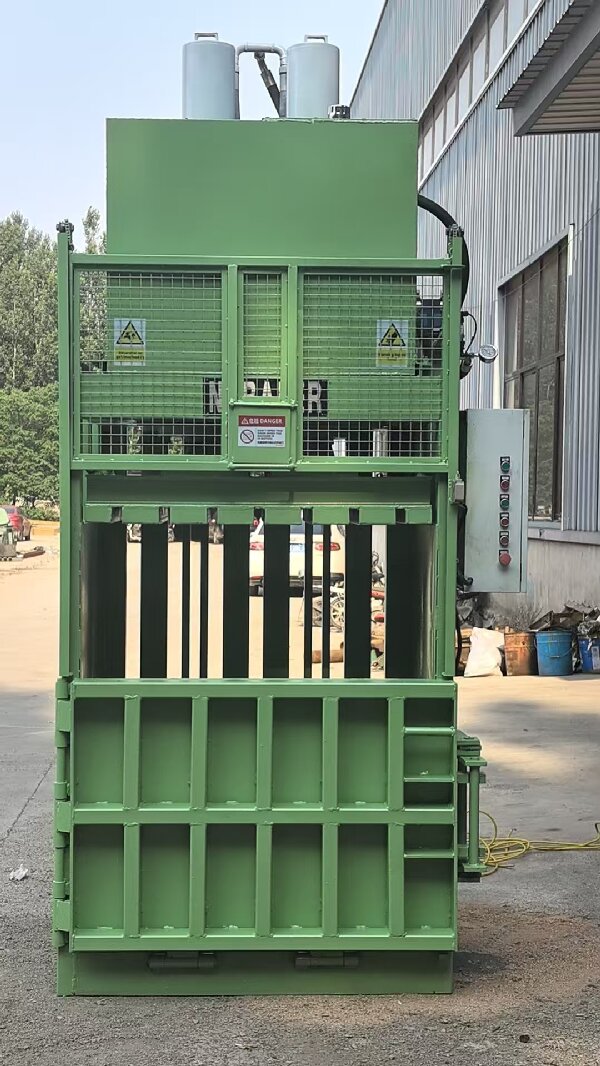
Where there is no straight run for a conveyor, a vertical machine such as the NK1070T60 cardboard box baler trades throughput for a footprint of 1,600 × 1,100 × 3,200 mm.
Small-footprint alternatives in the vertical range
| Model | Type | Machine size (L × W × H) | Hydraulic power / motor | Capacity | Bale size (W × H × L) | Bale weight |
|---|---|---|---|---|---|---|
| NK6040T10 | Vertical waste paper baler | 870 × 780 × 2,150 mm | 10 t / 2.2 kW | 6–8 bales/hour | 600 × 400 × (350–600) mm | 50–80 kg |
| NK1070T60 | Vertical cardboard box baler | 1,600 × 1,100 × 3,200 mm | 60 t / 15 kW | 5–8 bales/hour | 1,100 × 700 × (500–900) mm | Not published |
| NK080T100 | Vertical cans / PET bottle baler | 1,700 × 1,400 × 3,300 mm | 100 t / 15 kW | 3–6 bales/hour | 1,000 × 800 × (500–1,000) mm | 200–350 kg |
| NK110T150 | Vertical fiber / coco coir baler | 1,900 × 1,700 × 4,210 mm | 150 t / 22 kW | 4–6 bales/hour | 1,100 × 1,000 × (400–1,200) mm | 400–500 kg |
| NK-T90L | Double-chamber clothes baler | 3,800 × 1,500 × 4,600 mm | 90 t / 18.5 kW | 10–12 bales/hour | 760 × 520 × (500–1,000) mm | 75–150 kg |
| NK1580T200 | Vertical metal baler | 1,800 × 1,000 × 4,600 mm | 200 t / 22 kW | 3–6 bales/hour | 1,500 × 800 × 1,100 mm | 1,000–2,000 kg |
Published dimensions for NK vertical models. Note that a machine with a smaller plan footprint is usually taller: the NK110T150 needs only 1,900 × 1,700 mm of floor but stands 4,210 mm high.
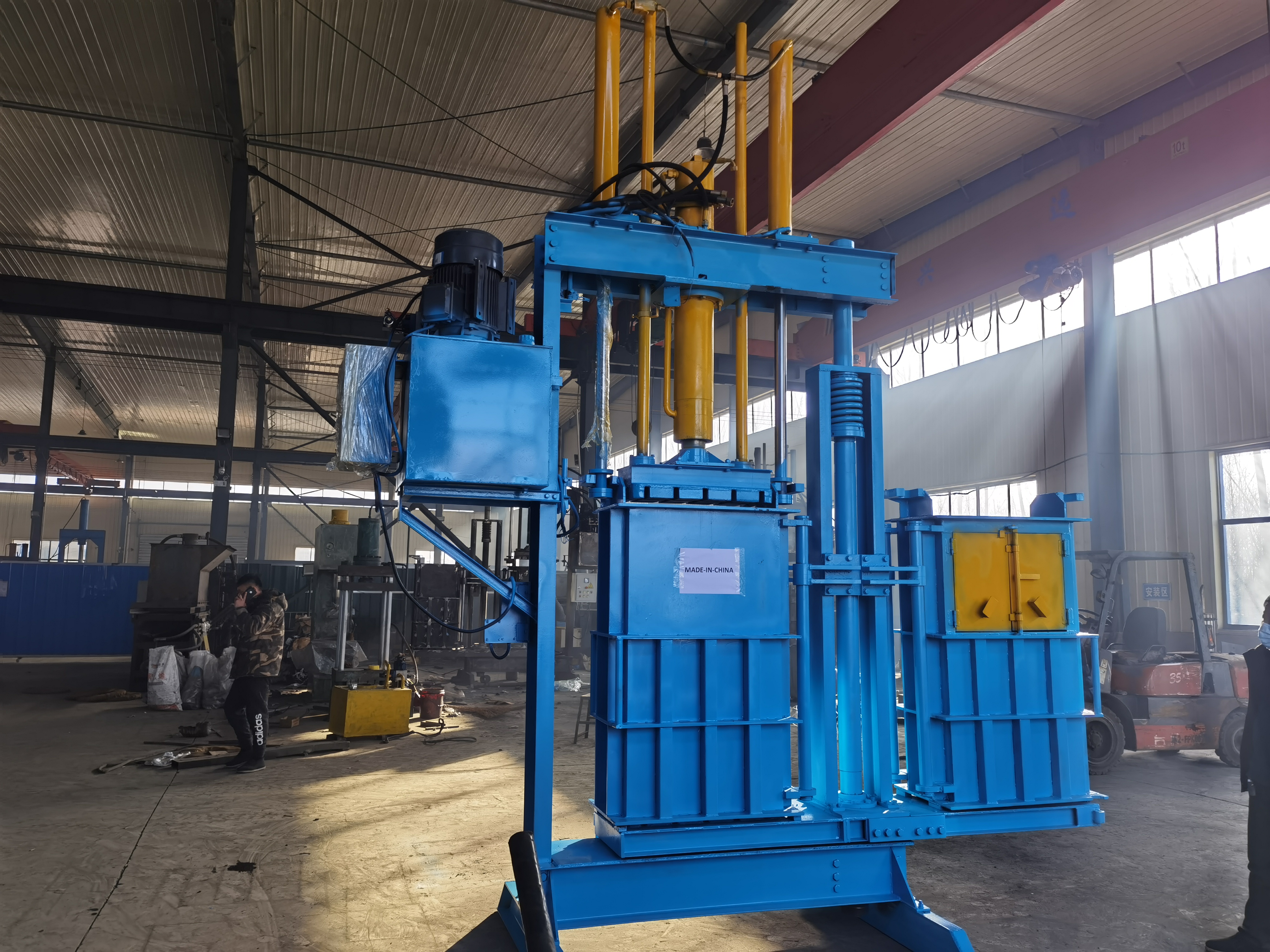
The NK-T90L double-chamber clothes baler handles garment and sack materials at 10–12 bales per hour, but its 3,800 mm length still requires a substantial floor allocation.
Comparison Table: NKW Horizontal Models by Footprint, Feed Opening and Output
The table below sets out the published physical and performance figures for the NKW Q-series side by side. Read it left to right: footprint first, then feeding, then output.
| Model | Mainframe size (L × W × H) | Feed opening (L × W) | Conveyor (L × W) | Capacity | Mainframe weight | Bale size (W × H × L) |
|---|---|---|---|---|---|---|
| NKW80Q | About 9.8 m × 4.3 m × 1.4 m | 1,500 × 800 mm | 12,000 × 1,200 mm | 3–5 T/hour | 15 t | 1,100 × 800 × ~1,600 mm |
| NKW100QT | About 13 m × 2.3 m × 2.9 m | 1,800 × 1,000 mm | 12,000 × 2,000 mm | 4–6 T/hour | 20 t | 1,100 × 850 × ~1,200 mm |
| NKW125Q | About 11 m × 2.3 m × 2.9 m | 2,000 × 1,100 mm | 12,000 × 2,000 mm | 10–12 T/hour | 22 t | 1,100 × 1,100 × ~1,600 mm |
| NKW160Q | About 11 m × 2.3 m × 2.9 m | 2,000 × 1,100 mm | 14,000 × 2,000 mm | 12–15 T/hour | 28 t | 1,100 × 1,250 × ~1,600 mm |
| NKW160QT | About 13 m × 4.3 m × 5.8 m | 2,000 × 1,100 mm | 12,000 × 2,000 mm | 12–15 T/hour | 28 t | 1,100 × 1,250 × ~1,600 mm |
| NKW180QT | About 13 m × 4.3 m × 5.8 m | 2,000 × 1,100 mm | 12,000 × 2,000 mm | 12–15 T/hour | 28 t | 1,100 × 1,250 × ~1,600 mm |
| NKW200Q | About 11 m × 4.3 m × 5.8 m | 2,400 × 1,100 mm | 14,000 × 2,000 mm | 12–15 T/hour | 34 t | 1,100 × 1,100 × ~1,800 mm |
All figures are the manufacturer’s published values for the NKW Q-series. Longer mainframe does not automatically mean higher output: the NKW100QT mainframe is about 13 m long but is rated at 4–6 T/hour, while the NKW200Q mainframe is about 11 m long and rated at 12–15 T/hour. Feed opening, cylinder force and bale density are the more reliable indicators of capability. For models in the BD series (NKW80BD, NKW125BD, NKW180BD, NKW250BD), the datasheet lists hydraulic power, bale size, feed opening, capacity, power and machine weight; compare those values against the same three constraints.
Frequently Asked Questions
Which safety and installation standards should be considered when positioning a hydraulic baler?
In the European Union, EN 16500:2014 is the vertical baler safety standard and specifies requirements for fixed enclosed baling chambers and tamper-proof interlocks. In the United States, commercial balers are addressed by ANSI Z245.51-2013 for design and construction safety and ANSI Z245.5-2013 for installation and operation. Both sets of requirements affect the clearances a machine needs around doors, guards and controls, so the layout should be checked against them before the floor position is fixed.
How do I match a hydraulic baler’s feed opening and throughput to my existing sorting line?
Compare the widest single piece your line can discharge with the published feed opening, then confirm the capacity band. Openings run from 1,500 × 800 mm on the NKW80Q (3–5 T/hour) and 1,800 × 1,000 mm on the NKW100QT (4–6 T/hour), to 2,000 × 1,100 mm on the NKW125Q (10–12 T/hour) and on the NKW160Q, NKW160QT and NKW180QT (12–15 T/hour), and 2,400 × 1,100 mm on the NKW200Q (12–15 T/hour). If the material arrives wider than the opening, it bridges at the mouth and the machine cannot reach its rated throughput.
Which layout decisions most affect the installed cost of a hydraulic baler?
Four items dominate. First, mainframe length and weight set the floor and foundation scope — 15 t for the NKW80Q against 34 t for the NKW200Q. Second, conveyor length and width set the civil and structural work — 12,000 mm on the NKW80Q and NKW125Q, up to 14,000 mm on the NKW160Q and NKW200Q. Third, electrical supply follows the main motor, which ranges from 30 kW to 45 kW, plus conveyor motors of 4 kW to 7.5 kW. Fourth, cooling arrangements (water cooling or an oil chiller) affect the services plan. Compare quotations only after these four items are defined for your building.
What material data should be prepared before finalizing machine dimensions?
Prepare the target material density and the bale size your downstream handling requires. NICKBALER publishes density bands by model: 300–400 kg/m³ for the NKW80Q, 400–500 kg/m³ for the NKW100QT, 400–600 kg/m³ for the NKW160Q, 500–600 kg/m³ for the NKW125Q, NKW160QT and NKW180QT, and 650–700 kg/m³ for the NKW200Q. Where your density band and your required bale size do not overlap on the same model, change the model rather than the building. Density and bale-size questions can be reviewed with the manufacturer at Sales@nkbaler.com.
In what order should site work be sequenced before the baler arrives?
Confirm the model dimensions and mainframe weight first, because they determine floor and foundation scope. Then prepare the power supply to match the main motor and conveyor motor, install or align the conveyor run with the feed opening, position the mainframe, connect the cooling system, and commission the installation. Because the civil scope depends on the confirmed model, the machine configuration and delivery date should be settled before site work starts — which is why a configuration review, together with the current product catalogue, is the practical first step.
Conclusion: Size the Machine to the Building
Hydraulic baler sizing is a physical planning exercise before it is a purchasing decision. The NKW range shows how the three constraints interact: mainframe lengths from about 9.8 m to 13 m, conveyors from 12,000 mm to 14,000 mm, feed openings from 1,500 × 800 mm to 2,400 × 1,100 mm, capacities from 2–3 T/hour to 12–15 T/hour, and machine weights from 15 t to 34 t. A machine that matches your material density and hourly output but not your straight run will still not work; a machine that fits the building but is rated for the wrong density band will not produce the bale you need.
Work in this order — measure the straight run, match the feed opening, confirm density and bale size, verify floor loading and services, then fix the model — and the layout will hold when the machine arrives. Where the site is genuinely tight, the vertical range offers smaller plan footprints in exchange for throughput: the NK6040T10 waste paper baler occupies 870 × 780 mm of floor, and the NK080T100 cans/PET bottle baler 1,700 × 1,400 mm, each with published feed opening and bale size figures that can be checked against your stream.
Next Step: Review the Configuration Against Your Floor Plan
Send your available straight run, infeed width, material density and target hourly output to NICKBALER, and the configuration can be checked against published NKW and NK dimensions before any civil work begins.
Contact: Sales@nkbaler.com | Tel / WhatsApp: +86 15021631102 | Website: www.nickbaler.com | Blog: blog.nickbaler.com
Address: Qun Sheng Lu, Hui Shan Qu, WuXi Shi, Jiang Su Sheng, China. Download the full product catalogue here: NICKBALER product brochure (PDF).
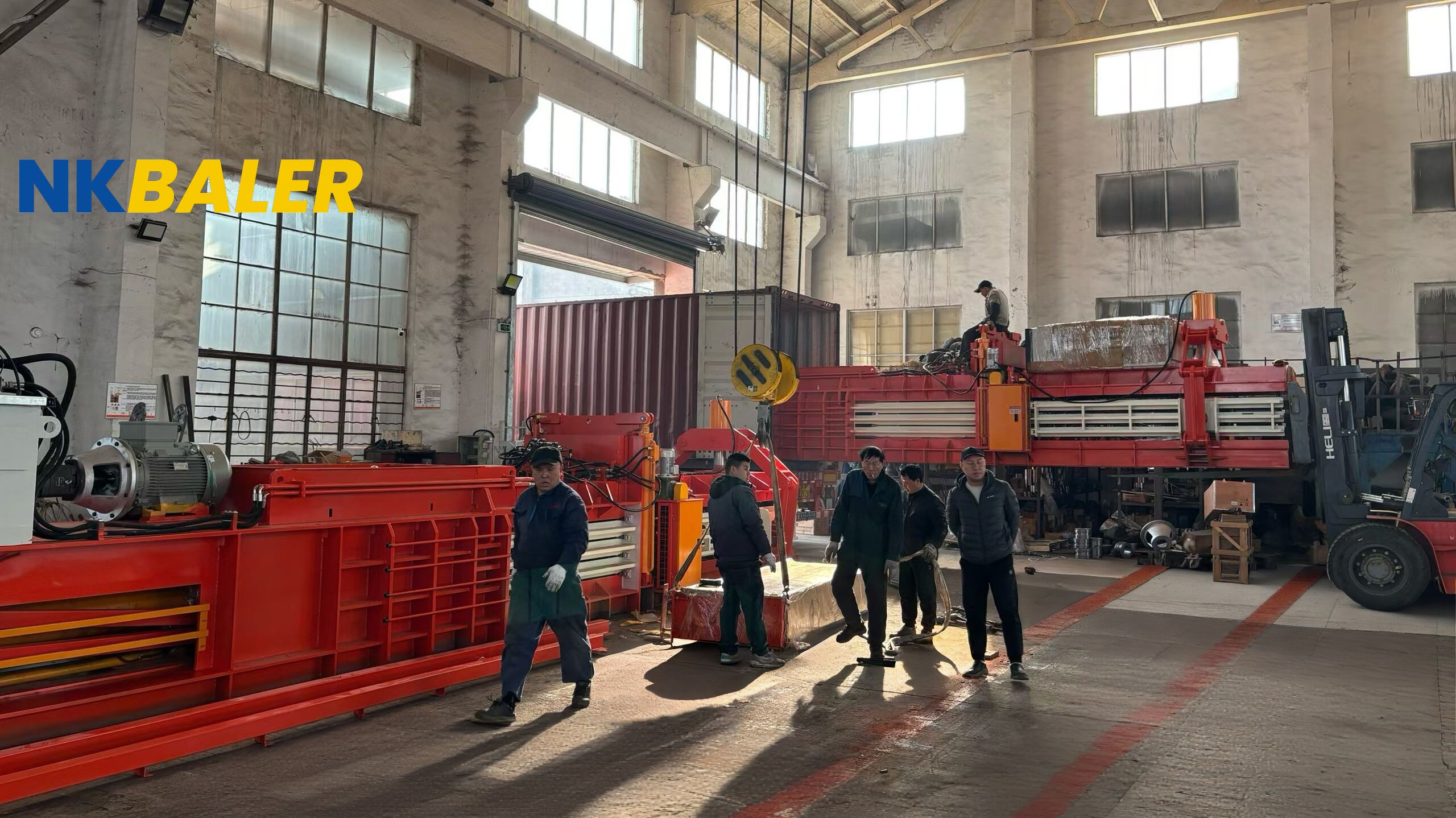
NICKBALER manufactures from a 5,000 m² facility in WuXi Shi, Jiang Su Sheng, China, with an R&D team of 15 engineers.
Have Questions or Need More Details?
Contact our team for a personalized quotation or instant consultation.
Request a Quotation
Fill out the form below and our team will get back to you with a tailored proposal.
WhatsApp Direct Chat
Prefer to chat in real-time? Message us on WhatsApp for instant assistance & quick answers.
- Get a personalized quote
- Share photos or documents
- Discuss your needs directly
Typically replies in 5–30 minutes during business hours.