
Vertical vs. Horizontal Hydraulic Balers: Machine Basics for First-Time Buyers
Vertical vs. Horizontal Hydraulic Balers: Machine Basics for First-Time Buyers
Short answer: a vertical hydraulic baler presses material downward into a fixed chamber and produces one tied bale per loading cycle, while a horizontal hydraulic baler presses material along a horizontal axis and pushes the finished bale out of the chamber — which is what makes conveyor feeding and much higher hourly tonnage possible. For a first purchase, that single mechanical difference, the direction of compression, sets the realistic range of bale size, throughput, floor space, labour and automation available to you.
Facility managers and procurement professionals who are new to baling often start by comparing price tags or cylinder forces. Both numbers matter, but neither answers the first question: should this installation be a vertical machine or a horizontal machine? An 80-ton horizontal baler and a 200-ton vertical baler can appear in the same budget discussion, yet they are built around completely different feeding loops and different bale-handling loops.
This guide explains the basic working principles of both machine families, the components that define each one, and the practical criteria — material profile, throughput, bale handling, footprint and compliance — that decide which type suits a given facility. Model parameters come from the published NICKBALER range so that the differences can be read in real numbers rather than descriptions.
The Core Difference in One Sentence
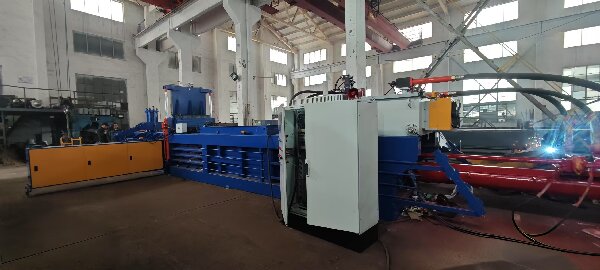
A vertical hydraulic baler compresses material in a chamber that stands upright, so hydraulic force travels downward onto the material, and the finished bale is tied and removed from the same chamber that was loaded. A horizontal hydraulic baler compresses material in a chamber that lies flat, so force travels sideways along the machine, and the finished bale is pushed out of the chamber and discharged at the end of the stroke.
That geometry produces two different ways of working. Vertical machines are cycle machines: load, close, press, tie, eject. Horizontal machines are flow machines: a conveyor feeds material continuously, the bale is formed against resistance inside the chamber, and tying happens as the bale leaves.
It also explains why the two families are rated differently. Vertical machines are usually published in bales per hour, because every bale requires an operator cycle. Horizontal machines are usually published in tonnes per hour, because feeding is continuous and the limiting factor becomes hydraulic force, chamber volume and material density rather than operator speed.
Problem Definition: Why First-Time Buyers Misjudge This Decision
Most early-stage baler mistakes are not hydraulic engineering mistakes. They are specification mistakes caused by mixing up machine families or by sizing the machine without sizing the operation around it.
- Comparing figures that are not comparable. A vertical machine published at 10–12 bales per hour and a horizontal machine published at 10–12 tonnes per hour are not in the same performance class. The first number counts operator cycles; the second counts material mass.
- Designing the machine but not the handling loop. Bale weight decides whether one person can move the bale or whether a forklift and a dedicated staging area are required. The published NICKBALER vertical range spans bales of 50–80 kg (NK6040T10) through 1,000–2,000 kg (NK1580T200) — that is a logistics difference, not just a specification difference.
- Treating footprint as the machine alone. Horizontal models include a feed conveyor in the installed line. NKW80Q is published with a 1,200 mm wide × 12,000 mm long conveyor; NKW125Q with a 2,000 mm × 12,000 mm conveyor; NKW160Q with a 2,000 mm × 14,000 mm conveyor. Floor planning has to include the conveyor, the bale exit and the staging area, not only the baler body.
- Deciding the automation level last. Horizontal balers are offered in semi-automatic and fully automatic versions, while the published vertical range uses manual feeding — NK-T90L, for example, lists manual feeding with 10–12 bales per hour. Throughput targets should be settled before the automation level is chosen, otherwise the machine is re-specified halfway through the project.
The practical consequence is that buyers who start with the material and the daily tonnage almost always narrow the machine family quickly, while buyers who start with cylinder force alone tend to end up comparing unrelated models.
Industry Background: Where Baling Sits in Material Recovery
Baling sits at the point where loose material becomes a transportable commodity. That is why baler demand tracks recycling, packaging, agriculture and metal processing activity rather than any single industry. The global baler machine market was valued at USD 6.6 billion in 2024 and is projected to reach USD 11.4 billion by 2035. In the same year, Asia Pacific accounted for 40.2% of total market revenue, according to Transparency Market Research.
Segment data shows where the equipment is concentrated. Baler presses represented 24.5% of the total recycling equipment market in 2025, driven by demand for compacting plastic and paper, according to Grand View Research. Within metal processing specifically, the global metal baler market was estimated at USD 2.172 billion in 2024 (Market Research Future).
Supply is equally global. China was one of the top exporters of hydraulic baling presses under HS Code 8462, with 91 significant shipments recorded between June 2024 and May 2025, according to Volza Global Export Data. Buyers researching the category will also encounter established international names such as Harris Equipment (United States), Bramidan (Denmark), Bollegraaf (Netherlands) and HSM (Germany), each associated with particular equipment classes.
Market estimates should be read with care, because scope changes the number. Grand View Research places the 2025 baler market at USD 7.18 billion and Global Market Insights at USD 4.9 billion, while Transparency Market Research reports USD 6.6 billion for 2024 — differences that come largely from whether agricultural and light-duty equipment is included. For a procurement decision, the market figure matters far less than the fit between machine type, material and throughput.
Compliance follows the same logic: the applicable standard depends on machine type and market. In the European Union, vertical balers fall under EN 16500:2014, which addresses fixed enclosed baling chambers and tamper-proof interlocks. In the United States, commercial balers are addressed by ANSI Z245.51-2013 for design and construction and ANSI Z245.5-2013 for installation and operation. These standards should be confirmed for the specific machine, installation and jurisdiction before an order is placed.
How a Vertical Hydraulic Baler Works
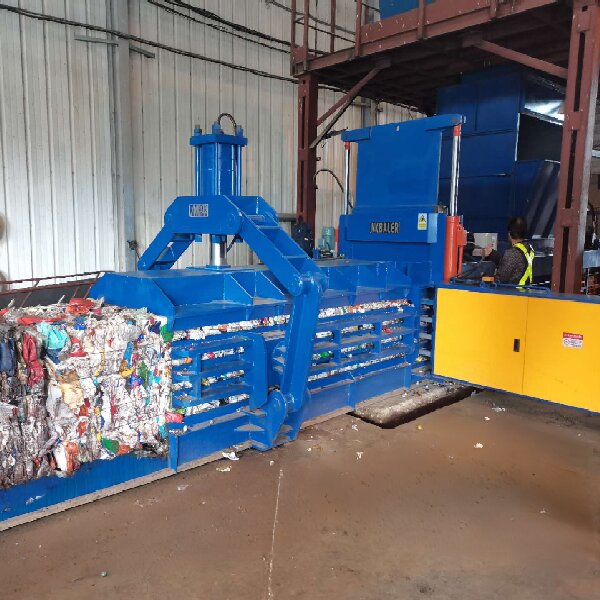
A vertical hydraulic baler is built around a standing chamber. Material is loaded into the chamber, a platen driven by a hydraulic cylinder descends onto it, and compaction happens against the chamber floor and walls. When the target density is reached, the bale is tied inside the chamber and then removed through a door or lifted out, depending on model and bale weight.
The key components are the standing chamber, the hydraulic cylinder and platen, the chamber door and its interlock, the control panel, and the tying arrangement — cross packing in textile models, for instance, with front-to-back and left-to-right wire or strap positions. Because the chamber is enclosed and the platen is directly above the material, vertical machines can achieve high compaction force on a small footprint.
The trade-off is the cycle. Output is expressed in bales per hour because each bale depends on manual loading, and bale size is limited by what the chamber and the operator can handle. The published vertical range illustrates how force and bale weight scale together:
| Model | Hydraulic force | Published output | Bale size (L×W×H) | Bale weight | Power |
|---|---|---|---|---|---|
| NK6040T10 (waste paper) | 10 T | 6–8 bales/hour | 600×400×(350–600) mm | 50–80 kg | 2.2 kW / 3 HP, 220 V |
| NK1070T60 (cardboard) | 60 T | 5–8 bales/hour | 1,100×700×(500–900) mm | Not stated | 15 kW / 20 HP, 380 V |
| NK-T90L (double chamber, garments and sacks) | 90 T | 10–12 bales/hour | 760×520×(500–1,000) mm | 75–150 kg | 18.5 kW / 25 HP |
| NK080T100 (cans and PET bottles) | 100 T | 3–6 bales/hour | 1,000×800×(500–1,000) mm | 200–350 kg | 15 kW / 20 HP |
| NKOT150 (tyres) | 150 T | 4–5 bales/hour | 1,800×1,000×(700–1,250) mm | 1,000–1,500 kg | 22 kW / 30 HP |
| NK1580T200 (vertical metal baler, automatic door) | 200 T | 3–6 bales/hour | 1,500×800×1,100 mm | 1,000–2,000 kg | 22 kW / 30 HP |
Published NICKBALER vertical models. Note that output is expressed in bales per hour, and that heavier bales come with heavier handling requirements rather than faster cycles.
How a Horizontal Hydraulic Baler Works
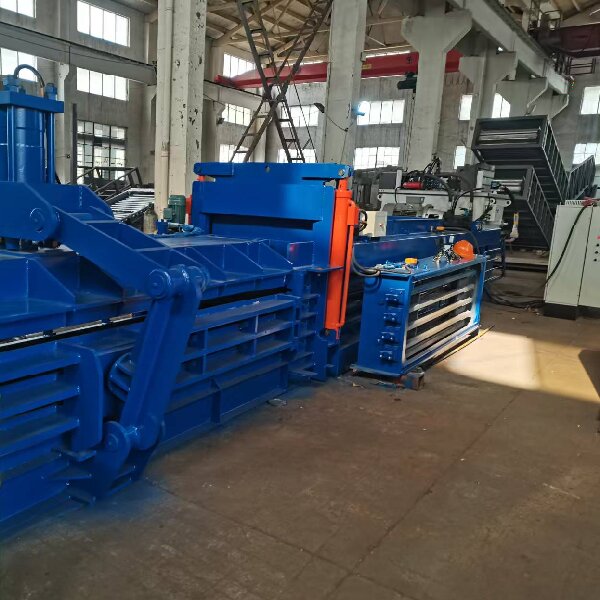
A horizontal hydraulic baler turns baling into a line operation. Material is delivered into a feed hopper, usually by conveyor, and a horizontal ram pushes it along the compression chamber. The bale forms continuously at the far end of the chamber, and the finished bale is pushed out and tied — automatically in fully automatic models, or at a tying station in semi-automatic models.
The components that define this family are the horizontal main cylinder and ram, the compression chamber, the feed opening and conveyor, the bale exit and tying system, and the cooling circuit. Mainframe weight is a useful indicator of the class of machine: alongside cylinder force, it reflects how much structure is required to absorb continuous compression load.
The main motor is usually specified together with an auxiliary motor, because the conveyor and the pump group are separate loads. The published NKW range shows this pattern clearly: NKW80Q uses 30 kW + 11 kW, NKW125Q uses 37.5 kW + 11 kW, and NKW160Q uses 45 kW + 11 kW.
How Capacity Scales: NKW80Q, NKW125Q and NKW160Q Compared
Three models in the horizontal range show how throughput, bale size and structure scale together. NKW80Q is specified with an 80-ton main cylinder force and 3–5 tonnes per hour capacity; NKW125Q steps up to 125 tons and 10–12 tonnes per hour; NKW160Q reaches 160 tons and 12–15 tonnes per hour. Bale height and material density increase with the model, which is what makes the higher tonnage physically possible.
| Specification | NKW80Q | NKW125Q | NKW160Q |
|---|---|---|---|
| Main cylinder force | 80 T | 125 T | 160 T |
| Capacity | 3–5 t/hour | 10–12 t/hour | 12–15 t/hour |
| Bale size (W×H×L) | 1,100×800×~1,600 mm | 1,100×1,100×~1,600 mm | 1,100×1,250×~1,600 mm |
| Material density | 300–400 kg/m³ | 500–600 kg/m³ | 400–600 kg/m³ |
| Feed opening | 1,500×800 mm | 2,000×1,100 mm | 2,000×1,100 mm |
| Main motor power | 30 kW + 11 kW | 37.5 kW + 11 kW | 45 kW + 11 kW |
| Mainframe weight | 15 tons | 22 tons | 28 tons |
| Conveyor | 1,200 mm W × 12,000 mm L | 2,000 mm × 12,000 mm | 2,000 mm × 14,000 mm |
| Operating pressure | 21 MPa | 21 MPa | 25 MPa |
Two readings follow from this table. First, capacity roughly triples between NKW80Q and NKW160Q, but mainframe weight less than doubles — the gain comes from cylinder force, bale height and feed opening as much as from structure. Second, the feed opening grows from 1,500×800 mm in NKW80Q to 2,000×1,100 mm in the larger models, which matters for bulky or irregular material that has to enter the chamber without pre-sorting.
Additional horizontal models exist above and below this group, including NKW100QT (100 T, 4–6 t/hour), NKW160QT and NKW180QT, as well as the BD series such as NKW125BD (125 T, 5–7 t/hour) and NKW250BD (250 T, 10–15 t/hour). Model selection should follow the material profile and the required daily tonnage rather than the largest available force.
Step-by-Step: How to Decide Between Vertical and Horizontal
- Define the material profile. Cardboard, waste paper, plastic film, PET bottles, textiles, tyres and metal all behave differently under compression. Material density matters more than volume: supported densities in the horizontal range run from 300–400 kg/m³ in NKW80Q up to 650–700 kg/m³ in some larger models.
- Convert demand into a comparable unit. Estimate tonnes per day and tonnes per hour available at the machine. If the number is measured in bales per shift, convert bale weight and bale count into tonnage first; otherwise vertical and horizontal options cannot be compared.
- Decide bale handling before bale size. A 50–80 kg bale can be moved manually; a 1,000–2,000 kg bale cannot. Storage layout, forklift access, truck loading method and buyer acceptance of bale size all follow from this step.
- Check the physical line, not just the machine. Add the conveyor length (12,000–14,000 mm in the quoted horizontal models), the bale exit, the staging area and the maintenance clearance to the floor plan. If that space does not exist, a vertical machine is often the realistic option regardless of throughput.
- Select the automation level. Semi-automatic and fully automatic horizontal balers exist side by side; the choice affects labour, tying consistency and how the line is operated. Vertical machines in the published range are manually fed, so operator time becomes a fixed part of the cycle.
- Specify the duty level. NICKBALER distinguishes between NK BALER, the standard long-cylinder servo hydraulic baler intended for regular daily baling work, and NICK BALER, the heavier version with thicker material, stronger structure and higher-grade hydraulic and electrical components for continuous heavy-load operation. Matching duty level to the actual operating pattern avoids both over-specification and premature wear.
- Confirm compliance and documentation. Match the machine to the standard applicable in the destination market, then confirm certification documents, test records and installation requirements before shipment.
Use Cases: Matching Machine Type to Operation
The clearest way to choose between vertical and horizontal is to look at how material arrives. Material that arrives in batches, handled by one or two people, fits a vertical machine. Material that arrives continuously, handled by conveyor or loader, fits a horizontal machine.
- Retail back rooms and light packaging waste. Cardboard boxes and mixed paper suit vertical models such as NK1070T60 (60 T, 5–8 bales per hour, 15 kW), which keeps the machine inside the building footprint.
- Textiles, garments and second-hand clothing. Textile bales are dense, manually handled and frequently tied in both directions. NK60LT (60 T, 10–12 bales per hour, 150–200 kg bales) and the double-chamber NK-T90L (90 T, 10–12 bales per hour) are built for this pattern.
- Cans and PET bottles. High-volume beverage containers are commonly pressed in vertical machines such as NK080T100 (100 T, 3–6 bales per hour, 200–350 kg bales).
- Tyres and scrap metal. Heavy compacted bales are produced on vertical models including NKOT150 (150 T tyre baler, 1,000–1,500 kg bales) and NK1580T200 (200 T vertical metal baler with automatic door, 1,000–2,000 kg bales).
- Recycling stations and transfer stations. Continuous waste plastic and waste paper baling is the classic horizontal application. NICKBALER reports an Indonesian recycling station using a horizontal hydraulic baler for waste plastic and waste paper baling, with low noise and low energy consumption cited and stable operation reported as the result.
- Agricultural straw and alfalfa. For these materials the machine family changes rather than the principle: bale density and bagging consistency govern the line, and NICKBALER's agricultural equipment for straw and alfalfa is the press bagging series (NKB280, NKB280-1). The manufacturer reports a straw and alfalfa project in Pakistan that achieved two years of stable operation.
Vertical vs Horizontal Hydraulic Baler: Side-by-Side Comparison
| Criterion | Vertical hydraulic baler | Horizontal hydraulic baler |
|---|---|---|
| Compression direction | Downward onto material in a standing chamber | Sideways along a horizontal chamber |
| Bale formation and discharge | Bale is tied in the chamber and removed through a door or lifted out | Bale is formed at the chamber end, pushed out and discharged |
| Published output unit | Bales per hour (e.g. 5–8, 6–8, 10–12 bales/hour) | Tonnes per hour (3–5, 10–12, 12–15 t/hour) |
| Bale output data | Published as bale weight, from 50–80 kg to 1,000–2,000 kg | Published as bale size plus material density |
| Feeding | Manual feeding in the published range | Conveyor feeding; 1,200–2,000 mm wide, 12,000–14,000 mm long |
| Automation options | Cycle-based operation with manual tying assistance | Semi-automatic and fully automatic versions available |
| Footprint | Compact single body, suits indoor installation | Machine plus conveyor line and bale staging area |
| Power range in published models | 2.2 kW to 22 kW | 30 kW + 11 kW to 45 kW + 11 kW |
| Standards context | EN 16500:2014 applies to vertical balers in the EU | ANSI Z245.51-2013 and ANSI Z245.5-2013 apply to commercial balers in the US |
| Typical fit | Retail, warehouse, textiles, PET and cans, tyres, metal in constrained space | Recycling stations, transfer stations, high-volume paper, plastic and metal lines |
The table also shows the limits of each family. Vertical machines cannot match continuous-feed tonnage, and their bale size is bounded by the chamber and by manual handling. Horizontal machines need floor length, conveyor infrastructure and a bale logistics plan, and their cost structure reflects a larger mainframe and a higher connected load. Neither limitation is a defect; they are the reason the two families coexist in the same market.
Frequently Asked Questions
Do vertical and horizontal hydraulic balers have to meet different safety standards?
Yes, in several markets the applicable standard differs by machine type and by market. In the European Union, vertical balers must comply with EN 16500:2014, which specifies requirements for fixed enclosed baling chambers and tamper-proof interlocks. In the United States, commercial balers must adhere to ANSI Z245.51-2013 for design and construction safety and ANSI Z245.5-2013 for installation and operation. NICKBALER machines are supplied with a Machinery Directive attestation certificate No. EASY03220201M, issued on 22 March 2022 by UDEM International Certification Auditing Training Centre Industry and Trade Inc. Co., valid until 21 March 2027, referencing EN ISO 12100:2010 and EN 60204-1:2018. A separate Verification of Conformity No. DPWD/09/060/2024, issued on 19 September 2024 and valid until 18 September 2029, references EN ISO 12100:2010, EN 60204-1:2018 and EN 415-1:2014. Buyers should confirm which standard applies to their specific installation and jurisdiction.
Which type is used for high-throughput operations?
High-throughput operations are dominated by horizontal machines, because feeding is continuous rather than cycle-based. For reference, NKW160Q is published at 12–15 tonnes per hour with a 160-ton main cylinder force and a 28-ton mainframe, while NKW125Q is published at 10–12 tonnes per hour at 125 tons. Vertical machines, by comparison, are published in bales per hour: NK1580T200, a 200-ton vertical metal baler, produces 3–6 bales per hour, and NK-T90L produces 10–12 bales per hour. The units are different because the operating pattern is different, so a direct comparison requires converting bales per hour into tonnage using bale weight.
What determines the cost of a hydraulic baler?
Configuration drives cost, and the published parameters show which configuration elements scale. Main cylinder force ranges from 10 tons in NK6040T10 to 200 tons in NK1580T200 within the vertical range, and from 80 tons in NKW80Q to 160 tons in NKW160Q within the quoted horizontal group. Mainframe weight follows the same curve: 15 tons for NKW80Q, 22 tons for NKW125Q, 28 tons for NKW160Q. Connected load, bale chamber size, conveyor length, automation level and duty tier all move together with those figures. Because pricing depends on the final configuration, a quotation should be requested against a defined material profile and throughput target rather than against a model name alone.
Can a buyer validate a hydraulic baler with their own material before ordering?
Yes, and for first-time buyers it is the most reliable way to reduce risk. NICKBALER offers OEM and ODM production with parameter-level customization, a minimum order quantity of one unit, and 100% testing as part of quality control, which means a single machine configuration can be specified and verified before volume orders are considered. Material trials should be arranged with the supplier using representative samples, and the resulting bale density, bale size and cycle data should be compared against the published specification before the order is confirmed.
How long does delivery take, and where are the full specifications?
NICKBALER states a lead time of 30–45 days and a monthly capacity of 10 units, with remote after-sales support, so delivery timing should be planned against the project schedule rather than assumed. Full model parameters for the vertical and horizontal ranges are collected in the company brochure, which can be downloaded here: NICKBALER hydraulic baler brochure (PDF). To receive a configuration recommendation, send the material type, expected daily tonnage and available floor space to Sales@nkbaler.com, or contact the team on WhatsApp at +86 15021631102.
Next Step
Choosing between a vertical and a horizontal hydraulic baler is a geometry decision before it is a price decision. Vertical machines turn batch material into dense, manually handled bales on a compact footprint. Horizontal machines turn continuous material flows into large, high-density bales and are sized in tonnes per hour. Once the material profile, daily tonnage, bale handling method and available floor length are defined, the machine family usually selects itself — and the remaining work is configuration, compliance and delivery planning.
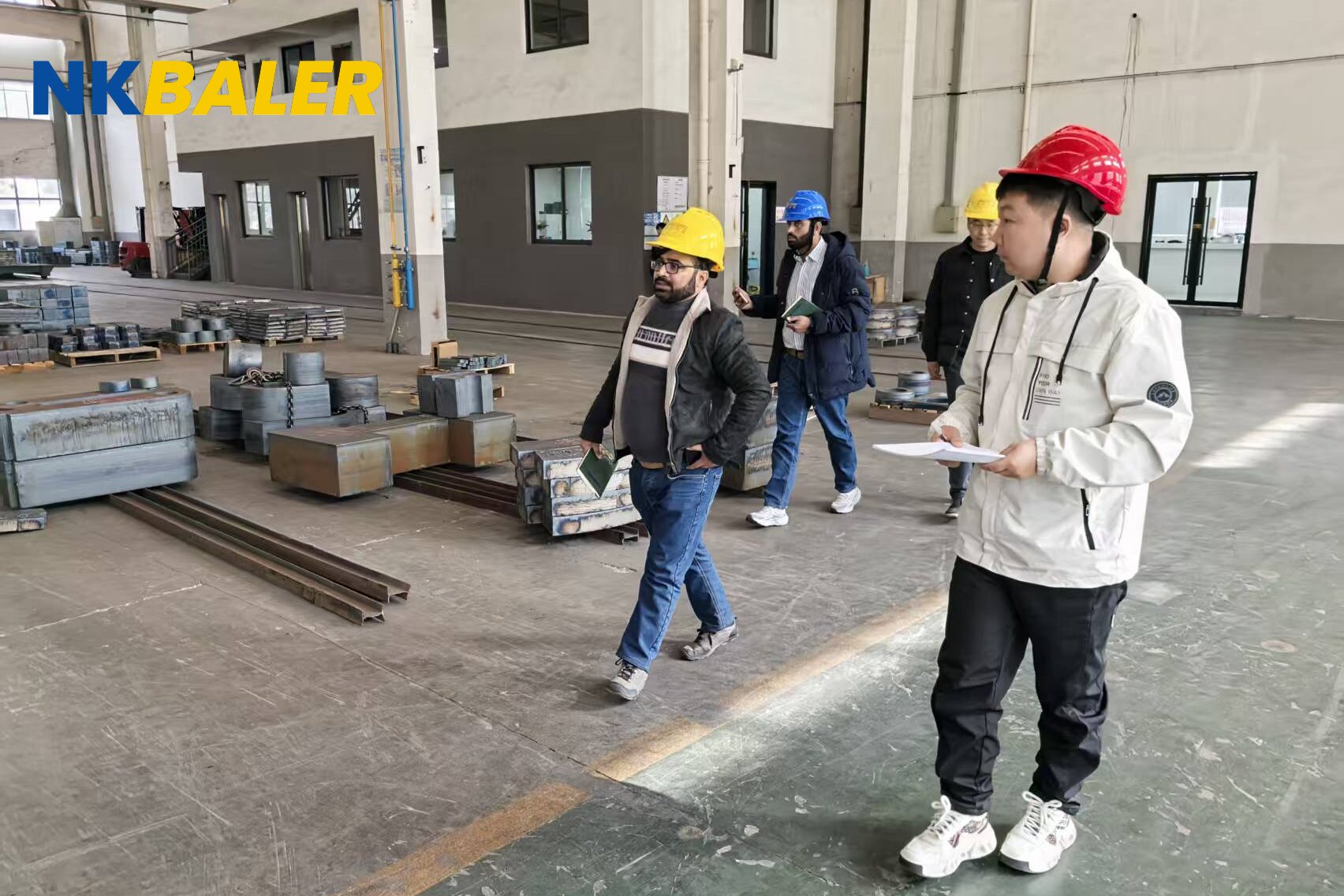
NICKBALER (Shaanxi Nick Machinery Equipment Co., Ltd.) manufactures vertical balers, full-automatic and manual horizontal balers, and press bagging machines, with roughly 90% of output exported and North America, South America and Asia listed as main markets. Model documentation, configuration options and contact details are available at www.nickbaler.com.