
Broke Bag Handles at Checkout? Switch to Custom Shopping Bags Built for 15kg Loads
Broke Bag Handles at Checkout? Switch to Custom Shopping Bags Built for 15kg Loads
A snapped handle at the checkout counter is a five-second event that customers remember for years. It happens at the worst possible moment: the bag is already packed, the customer lifts it one-handed, and either the handle or the paper around the handle anchor gives way. The immediate cost is a spilled purchase and an awkward apology. The longer-term cost is subtler — a lasting association between your brand and packaging that failed at the exact moment it was supposed to work.
The fix is not to buy a bag that merely looks heavier. It is to specify custom shopping bags by load instead of by appearance: paper thickness, bag structure, and handle construction selected as one system, then verified with a load-bearing test before mass production. Opack is a custom packaging manufacturer founded in 2010 and based in Longgang, the Printing City of China, producing custom shopping bags alongside rigid boxes, folding cartons, and mailer boxes for the EU, US, and Middle East markets. Its PSB custom shopping bag platform documents a weight capacity of 2–15 kg depending on paper thickness and structure, and handle strength, paper durability, and structural stability are tested before production rather than corrected after delivery.
This guide explains why handles fail, what the market data says about demand for durable custom bags, how a 15 kg rating is actually built and verified, and how to turn one successful bag into a repeatable long-term supply standard.
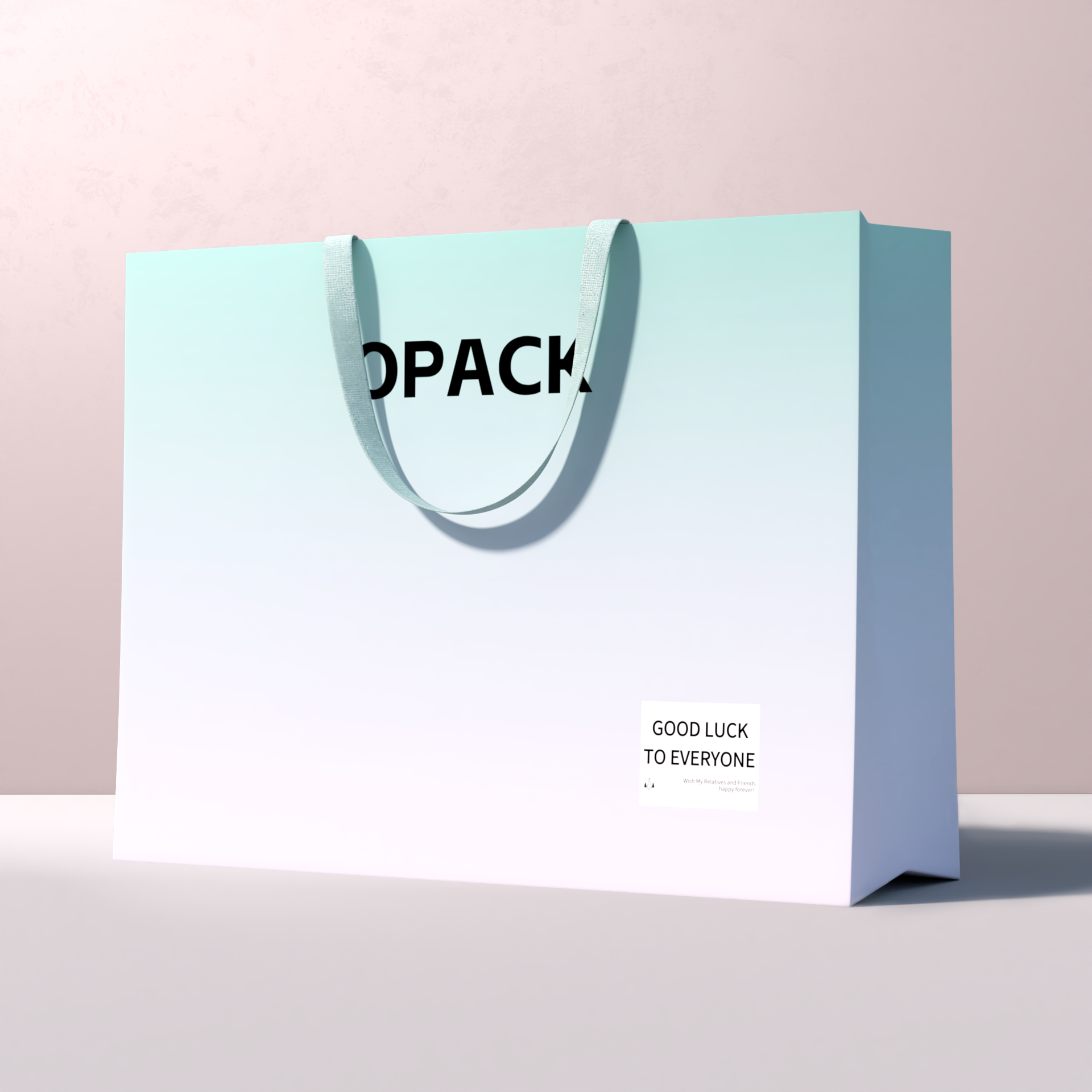
Why Handles Snap at Checkout: The Mechanics of a Predictable Failure
Bag failure is mechanical and largely predictable. A loaded shopping bag is usually carried by one or two handles, and at the moment of lifting, the whole load transfers through the handle anchor — the small area where the handle meets the bag top. Stress per square centimeter peaks there, which is where most failures start.
Three conditions push a bag past its limit:
- Peak load, not average load. Products are packed, then lifted, swung, and set down. The instant of a one-handed lift with the bag held away from the body is the highest load the handle will ever see.
- Repeated use. Retail bags that customers keep and reuse accumulate fatigue: creases at the handle fold, a softening top edge, and a gradually loosening anchor.
- Environmental softening. Paper and board can lose stiffness in humid conditions, which is why a bag that performs well in a dry warehouse is not always the bag that leaves the store on a wet day.
None of this is exotic. The real problem is that most shopping bag specifications never mention load at all. Buyers choose a size, a paper, and a print, and the weight question quietly becomes an assumption. Opack treats insufficient load-bearing strength of paper bags as one of two named quality risks for this product family — the other is printing color variation — and controls it with load-bearing tests carried out before mass production. Those tests verify handle strength, paper durability, and structural stability against the intended product weight, so the answer is established on a sample instead of in a customer's hand.
The business case for closing that gap is measurable. Comparison data recorded for custom versus plain shopping bags links custom bags to 20%–30% higher repeat purchase rates, a 10%–30% improvement in customer satisfaction, 5%–15% more customer referrals, and 5%–10% more social media shares, against initial costs that run 3%–10% higher. In durability terms, the same comparison points to sturdier paperboard, durable printing, reinforced handles, and less tearing and handle breakage during repeated use. A bag that survives its first trip is also the bag that keeps working as a brand touchpoint.
Industry Background: Why Durability Moved Up the Specification List
Custom bag demand is growing fast enough that specification quality has become a competitive variable. The global paper bags custom printing market was valued at USD 2.78 billion in 2024 and is projected to grow at a compound annual growth rate of 13.9% through 2030 (Grand View Research). For context, the broader paper bags market was USD 6.06 billion in 2024, with expectations to reach USD 7.81 billion by 2029 (MarketsandMarkets).
Material preference has already shifted. Brown kraft paper is estimated to hold a 58% share of total material demand by 2026, driven largely by sustainability preferences (Future Market Insights). Asia Pacific is the largest regional market, accounting for more than 36.5% of the global share in 2025 (IMARC Group), and China exported approximately USD 1.91 billion worth of paper sacks and bags in 2023 (UN Comtrade / WITS).
One caution on these figures: published market sizes differ by scope — total paper bags, custom printing, and kraft-only segments are measured differently — so they are best read as directional signals about growth and material preference rather than as a single reconciled number.
Sustainability expectations now sit alongside durability requirements. FSC certification is the primary industry standard for verifying sustainable sourcing, with a 56% global consumer recognition rate (Forest Stewardship Council, 2025). On the supply side, the high-volume end of fiber packaging is dominated by large groups such as Mondi Plc, Smurfit Kappa Group, and International Paper Company (Future Market Insights), while brand-specific custom printed retail bags are typically produced by specialist converters working directly with brand owners.
For a retail buyer, the implication is straightforward: as more brands invest in printed bags, a weak bag becomes a visible weak link in a crowded market, and the bag that gets reused for weeks is the one that keeps earning attention.
The Solution: What "Built for 15 kg" Actually Means in a Custom Shopping Bag
A 15 kg rating is a ceiling, not a default. On Opack's PSB custom shopping bag platform, weight capacity is documented at 2–15 kg depending on paper thickness and structure. Reaching the top of that range is not a matter of choosing one heavy component; it comes from the material, the bag structure, and the handle construction supporting one another, then being verified together.
| Specification area | Available options | What it means for load and brand |
|---|---|---|
| Material | Kraft Paper, Whiteboard Paper, Specialty Paper, Coated Paper | Paper grade and thickness are two of the variables behind the 2–15 kg capacity range, so material is decided together with the target weight. |
| Handle options | Paper Twisted Handle, Flat Paper Handle, Cotton Rope, Ribbon Handle, Die-Cut Handle | The handle carries the full load; the option is selected with the target weight in mind and then verified in testing. |
| Weight capacity | 2–15 kg, depending on paper thickness and structure | The orderable band; the exact figure for your product is confirmed by a pre-production load-bearing test. |
| Size range | Fully customizable — Small, Medium, Large, Extra Large | Larger formats hold more product, which usually means more weight on the same handle. |
| Printing | CMYK Printing, Pantone Printing, UV Printing, Offset Printing, Screen Printing | Brand color is monitored with spectrophotometer measurement, holding color difference (ΔE) at approximately 1.5. |
| Finishing | Hot Stamping, Spot Glossy UV, Soft Touch Lamination, Holographic Foiling, Embossing, Debossing, Matte Lamination, Gloss Lamination | Surface treatment carries the brand look and does not change the load calculation. |
| MOQ | 1,000 pcs per size and design | Because the minimum applies per size and design, sizes should be finalized before printing. |
Handle choice deserves its own view, because the handle is the component customers physically hold:
| Handle option | Construction in brief | Load consideration |
|---|---|---|
| Paper Twisted Handle | A twisted paper cord anchored into the bag top. | Part of the handle set that is tested against the target weight. |
| Flat Paper Handle | A flat paper strip handle, widely used in retail. | Same testing sequence; suitability depends on the finished structure. |
| Cotton Rope | A soft rope handle that sits comfortably in the hand. | Chosen for hand comfort on heavier, multi-item purchases. |
| Ribbon Handle | A fabric ribbon handle used when the bag is part of the gift presentation. | Presentation-led choice, verified for the intended load like any other handle. |
| Die-Cut Handle | The handle is cut from the bag body itself, with no added handle material. | Because the handle is formed from the bag paper, paper grade and top-edge structure carry more of the load. |
A bag that carries the load but misses the brand color is still a packaging failure in the customer's eyes, which is why color control belongs in the same conversation. Professional spectrophotometers measure and monitor color consistency throughout production, with color difference (ΔE) held within approximately 1.5 — a level that is nearly imperceptible to the human eye. A pre-production color approval step and in-process inspections during printing support that target.
Step-by-Step: Specifying and Executing a Load-Rated Bag Order
Step 1 — Define the real load envelope
Write down the maximum weight a single bag will carry, including the products' own packaging, then add margin for the way customers actually lift and carry. A bag specified for 5 kg will be used at 7 kg at some point; the specification should reflect that reality rather than the average.
Step 2 — Match paper thickness and structure to that number
Structure is where the 2–15 kg capacity range is determined. Material options include kraft paper, whiteboard paper, specialty paper, and coated paper, and the choice interacts directly with the target weight rather than being a purely visual decision.
Step 3 — Choose the handle construction against the target weight
Paper twisted, flat paper, cotton rope, ribbon, and die-cut handles are all available. A die-cut handle draws its strength from the bag body itself, so it places more emphasis on paper grade and top-edge structure; added-material handles such as twisted paper or cotton rope go through the same pre-production verification.
Step 4 — Approve print and finishing on a physical proof
Printing options include CMYK, Pantone, UV, offset, and screen printing, with finishing such as hot stamping, spot glossy UV, soft touch lamination, holographic foiling, embossing, debossing, and matte or gloss lamination. A pre-production color approval keeps the production run aligned with the approved sample, supported by in-process inspections during printing.
Step 5 — Validate before mass production
Load-bearing tests verify handle strength, paper durability, and structural stability. Final quality inspection happens before shipment, all products undergo a 100% quality check, and batch-by-batch quality verification maintains consistency across the run. Third-party inspections are welcome on request, so buyers who need independent confirmation can arrange it.
Step 6 — Plan production, logistics, and replenishment
The minimum order quantity for paper shopping bags is 1,000 pcs per size and design. Monthly production capacity is 1,000,000 units, and typical lead time for orders destined to EU, US, and Middle East markets is 12–18 days. EXW and FOB terms are available based on customer requirements, payment terms are 40/60, and shipping arrangements can be coordinated according to destination and project schedule.
Long-Term Supply: Turning One Good Bag into a Repeatable Standard
A bag that performs once is a sample. A bag that performs identically in the fifth reorder is a supply relationship — and for retailers, the supply side of a bag decision matters as much as the handle side, because retail packaging is a repeating commitment rather than a one-off purchase.
- Capacity to absorb seasonality. Monthly production capacity is 1,000,000 units for EU, US, and Middle East markets, which supports both launch volumes and repeat replenishment.
- Predictable lead time. Typical lead time for these markets is 12–18 days, which makes it easier to plan around promotions, store openings, and gifting seasons.
- Consistency you can audit. Products exported to EU, US, and Middle East markets undergo a 100% quality check, plus batch-by-batch verification and a final inspection before shipment. Third-party inspections are welcome if you want an outside view.
- After-sales support through several channels. Multi-channel support is available via real-time online chat, WhatsApp, telephone, and official email for EU, US, and Middle East clients.
- Repeatable customization. Customization covers logo, brand name, color, size, style, finishings, printing methods, and material — the full set of variables that has to stay stable when a bag is reordered.
- A manufacturing base built for repeat programs. Opack was founded in 2010, operates a 10,000 m² facility with 160 employees and a 5-person R&D team, and produces an annual output of 10,000,000 units, with 80% of production exported to the EU, USA, and Middle East.
For brands that distribute through retail partners, franchise networks, or multiple regional markets, one approved bag specification removes a recurring source of inconsistency: the same load rating, the same color target, and the same handle construction arrive at every location, which keeps the brand experience identical whether the customer is in a flagship store or collecting an online order.
Use Cases: Where a Load-Rated Custom Shopping Bag Matters Most
Cosmetics retail
Cosmetics purchases are often modest in volume but dense in weight, and multiple items are regularly carried in a single bag. A bag specified for the actual load, with a tested handle, protects both the products and the brand presentation at the counter.
Apparel stores
Folded garments and multi-item purchases add weight quickly, and apparel bags are among the most frequently reused by customers. Reinforced handles and sturdier paperboard reduce tearing and handle breakage during that repeated use.
Gift packaging
Gift bags double as part of the presentation and as a carrier afterward. Ribbon and twisted paper handles are common choices here, with the load verified for the intended contents rather than assumed from appearance.
Trade shows and events
Event bags carry catalogs, samples, and merchandise across long distances and are usually carried one-handed. Peak-load behavior is the norm rather than the exception, which makes a pre-production load test the most relevant quality step.
E-commerce packaging
Bags used for pickup counters, click-and-collect, and local delivery experience the same failure modes as in-store bags, but with less staff supervision and more distance traveled. A documented load rating keeps that experience predictable.
Custom vs Plain Shopping Bags: A Spec-by-Spec Comparison
| Comparison point | Custom shopping bags | Plain shopping bags |
|---|---|---|
| Customization | Fully customizable | Not customizable |
| Brand visibility | Higher brand visibility; more memorable unboxing experience; more high-end look | No brand reinforcement |
| Initial cost | 3%–10% higher initial cost | Lower initial cost |
| Documented performance gap | 20%–30% higher repeat purchase rates; 10%–30% improvement in customer satisfaction; 5%–15% increase in customer referrals; 5%–10% more social media shares | No documented performance uplift |
| Durability in repeated use | More sturdy paperboard, durable printing, reinforced handles, less tearing and handle breakage during repeated use | Higher incidence of tearing and handle breakage |
| Material and end of life | FSC-certified material options and water-based printing inks; fully recyclable after service life | Performance depends on the individual supplier |
| Best suited for | Cosmetics retail, apparel stores, gift packaging, trade shows and events, e-commerce stores | Short-term, non-branded carrying needs |
The trade-off is contained in two rows: a 3%–10% higher initial cost against a documented performance gap in repeat purchase rates, satisfaction, referrals, and social shares, plus better durability in repeated use. For a brand that treats a shopping bag as a carrier of the brand experience rather than a disposable item, the comparison is about cost per branded impression, not cost per unit alone.
FAQ: Load Ratings, Validation, and Long-Term Supply
Are custom shopping bags available in certified and recyclable materials?
Yes. FSC-certified material options and water-based printing inks are part of the custom bag specification, and the bags are fully recyclable after their service life. FSC certification is the primary industry standard for verifying sustainable sourcing, with a 56% global consumer recognition rate (Forest Stewardship Council, 2025), which matters when a bag is reused in public and continues to represent the brand long after purchase.
Can a custom shopping bag really be built for 15 kg loads?
Yes, within a documented range rather than as a blanket promise. Opack's PSB platform lists weight capacity of 2–15 kg depending on paper thickness and structure, with handle options that include paper twisted, flat paper, cotton rope, ribbon, and die-cut constructions. Load-bearing tests before mass production verify handle strength, paper durability, and structural stability against the intended product weight, so the final rating is confirmed for a specific combination of bag size, material, and handle.
How much more do custom shopping bags cost than plain bags?
Documented comparison data puts custom bags at 3%–10% higher initial cost than plain bags. Against that premium, the same comparison records 20%–30% higher repeat purchase rates, a 10%–30% improvement in customer satisfaction, 5%–15% more customer referrals, and 5%–10% more social media shares, alongside reinforced handles and less tearing and handle breakage during repeated use. The practical way to read the difference is cost per branded impression rather than cost per bag.
Can we validate a bag before committing to full production?
Validation is built into the process ahead of mass production. Opack runs load-bearing tests, completes a pre-production color approval, monitors color with spectrophotometers to hold ΔE at approximately 1.5, performs in-process inspections during printing, and completes a final quality inspection before shipment, with a 100% quality check on all products. Third-party inspections are welcome on customer request. The minimum order quantity for paper shopping bags is 1,000 pcs per size and design.
What is the typical lead time, and can supply support repeat orders?
Monthly production capacity is 1,000,000 units, and typical lead time for orders destined to the EU, US, and Middle East markets is 12–18 days. After-sales support is available through real-time online chat, WhatsApp, telephone, and official email for clients in those markets. To move from a broken handle to a fixed specification, send your target load, bag size, handle preference, and print requirements to sales@opack.com or connect on WhatsApp at +86 15968809016 to request a sample and a quote.
Conclusion: Fix the Specification, Not Just the Bag
A handle that breaks at the checkout counter is rarely an accident. It is the visible result of a specification that never included the load, a handle that was chosen for looks, and a structure that was never tested before it reached the customer's hand. Switching to custom shopping bags built for loads up to 15 kg solves the problem at its source: paper thickness and structure set the capacity, the handle is selected and tested against the target weight, and color holds within a ΔE of approximately 1.5 so the bag looks as reliable as it carries.
Opack has produced custom packaging since 2010 from a 10,000 m² facility in Longgang, the Printing City of China, with an annual output of 10,000,000 units and 80% of production exported to the EU, USA, and Middle East. For brands that need the same bag at the same standard, order after order, that combination of capacity, lead time, testing, and after-sales support is what makes a load rating dependable instead of aspirational.
Next step: share your target load (kg), bag size, handle preference, and print requirements with the Opack team. Request a sample and quotation at sales@opack.com, by phone at +86 17366633702, or on WhatsApp at +86 15968809016.
Download the full capability overview: Opack Company Profile (PDF). More product information is available at opack.com.