Custom Rigid Box Compliance: FSC, Low-VOC & Market Checks
Custom Rigid Boxes · Certification & Compliance
Custom Rigid Box Compliance: FSC, Low-VOC & Market Checks
A custom rigid box order is compliance-ready when three separate things line up: a chain-of-custody certificate whose scope actually names the product you are buying, a written declaration of the ink and adhesive system used inside the box, and a destination-market check your importer can stand behind. Only the first of those is a certificate. The other two are specification and verification work.
Short answer: Opack holds FSC Chain of Custody certificate GFA-COC-005690, issued by GFA Certification GmbH under FSC-STD-40-004 (Version 3.0), with a scope covering cardboard packaging, sacks and bags of paper, adhesive labels, and other pulp and paper products, and with recognized markets in Europe, North America, Australia & New Zealand, and the Middle East. That certificate verifies how certified paper material is tracked through the chain of custody for the stated scope. It does not certify ink chemistry, VOC emissions, or conformity with any specific national packaging regulation.

Opack is a custom packaging manufacturer based in Longgang, Wenzhou, Zhejiang, China, producing custom rigid boxes, folding cartons, mailer boxes, paper shopping bags and paper tubes since 2010, with an export ratio of 80% concentrated on the EU, US and Middle East.
The problem: a certified supplier is not the same as a compliant box
The gap between certification and compliance usually surfaces after artwork is approved and the purchase order is issued. Three failure modes repeat across rigid box programmes.
- Scope mismatch. A supplier site shows an FSC logo, but the certificate scope line names other paper products. Chain-of-custody certificates are written against defined product categories, so the scope text has to be read, not glanced at.
- Certificate status treated as permanent. Chain-of-custody certificates are issued for a validity window and are subject to surveillance. A copy downloaded two years ago is not evidence of current status; a fresh copy checked against the certification body is.
- Certification mistaken for chemical or market approval. FSC addresses certified forest material and its chain of custody. It says nothing about which ink carrier is used, how much residual solvent remains in an adhesive, or whether a construction satisfies a regional packaging regulation.
A rigid box is a compound product. It may use a greyboard or MDF core, a printed paper wrap, a magnetic or ribbon closure, and an insert in foam, paperboard, EVA, plastic tray, corrugated cardboard or silk. That means several material layers and at least two process layers, each of which carries its own evidence requirement. Treating one certificate as proof for all of them is the root cause of most failed compliance reviews.
Industry background: a mature market with a fast-moving compliance layer
Rigid packaging is a large, steadily growing category. Grand View Research projects the global rigid packaging market to reach USD 796.7 billion by 2030. Inside that figure, the luxury rigid box segment was measured at USD 8.84 billion in 2026 by Towards Packaging / Future Market Insights, with cosmetics and personal care accounting for a 37% application share.
Trade flows run through the same category. China's rigid box exports were recorded at USD 1.7 billion in trade value in 2023 under HS code 481920, a reported figure that is best treated as directional context rather than a precise benchmark.
The regulatory layer is moving faster than the market layer. Regulation (EU) 2025/40, the EU Packaging and Packaging Waste Regulation, requires packaging to be recyclable and properly labelled, with that requirement applying from 12 August 2026 according to the European Commission. For a cosmetics, gift or electronics box programme, a packaging decision now has a date attached to it in the EU market.
That combination — a mature, price-sensitive manufacturing base and a market-specific regulatory layer — explains why buyers increasingly request two distinct deliverables: certificate evidence, and specification-level material declarations. The two answer different questions and neither substitutes for the other.
The verified layer: what certificate GFA-COC-005690 actually covers
Read the certificate the way an auditor would: line by line, against the product on your purchase order.
| Certificate field | Recorded value |
|---|---|
| Certification type | FSC Chain of Custody (COC) |
| Certificate number | GFA-COC-005690 |
| Certification body | GFA Certification GmbH |
| Standard | FSC-STD-40-004 (Version 3.0) |
| Scope | Cardboard packaging, sacks and bags of paper, adhesive labels, and other pulp and paper products |
| Issue date | 9 November 2021 |
| Recognized markets | Europe; North America; Australia & New Zealand; Middle East |
| Product families named in the applicable product list | Custom rigid boxes — RB-C01, RB-G02, RB-M03, RB-L04, RB-B05, RB-O06, RB-T07, RB-D08, RB-W09; custom shopping bags — PSB |
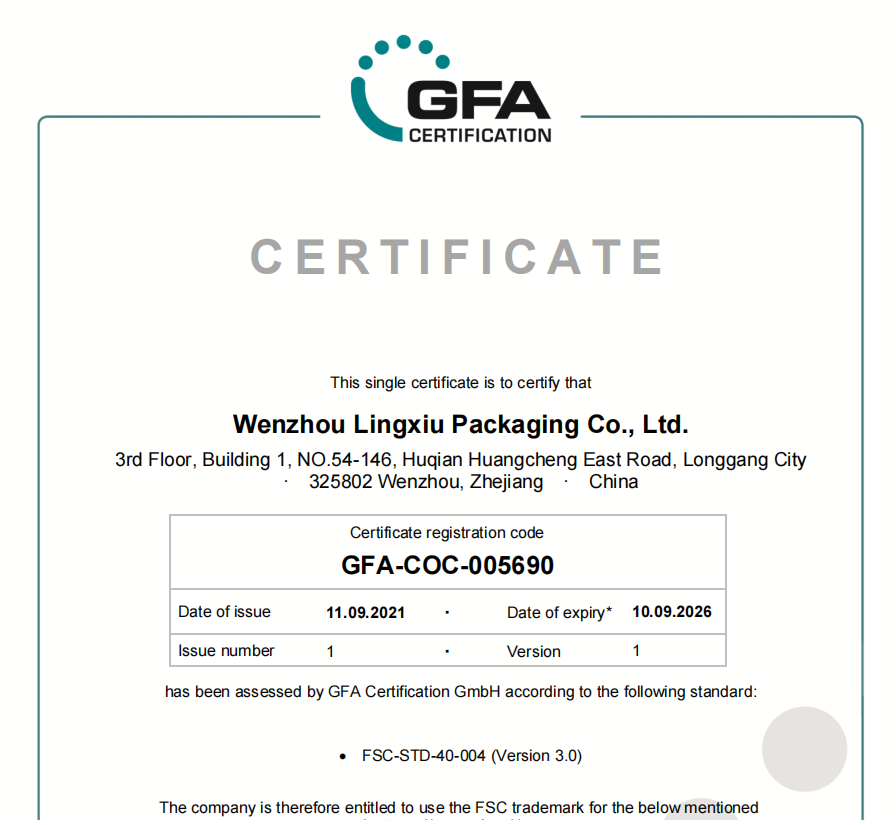
Two details carry more weight than the rest. First, the scope is written in product categories — cardboard packaging, sacks and bags of paper, adhesive labels, other pulp and paper products — rather than against a single SKU. Second, the applicable product list ties that scope to defined product families, including rigid box model codes RB-C01 through RB-W09 and shopping bag model PSB. When a buyer asks whether an FSC-certified construction is available, the accurate answer is a scope confirmation against those model codes, not a general yes.
Verify status, not just existence. Chain-of-custody certificates run for a stated validity period and are subject to surveillance audits, and a certificate can be amended, suspended or withdrawn. Before an order is placed — and again before any certification claim is published — request the current certificate copy, check the certificate number, standard version and issuing body against the public FSC certificate database, and confirm that the product family on your purchase order appears in the scope. This applies equally to buyers in Europe, North America, Australia and New Zealand, and the Middle East.
Inks and adhesives: the layer the certificate does not cover
FSC answers a sourcing question. It does not answer an odour, migration or emissions question. Those come from the ink carrier and the adhesive — and in a rigid box they come from a third source as well, the insert and lining materials that sit closest to the product.
What water-based inks change
Water-based inks use water as the main carrier instead of a solvent blend. In general industry practice this reduces the solvent load in the pressroom and typically lowers residual solvent odour in the finished printed sheet. For a rigid box the practical benefit sits in the wrapped surface and in the first moments after the lid is opened, which is the point at which a customer forms an impression of the product inside.
What low-VOC adhesives change
Rigid box assembly applies adhesive at the wrap seam, at board-to-board joints and often at the insert. Low-VOC adhesive systems are formulated to reduce residual volatile organic compounds in the finished assembly. A rigid box is effectively a closed cavity, so adhesive emissions have nowhere to disperse except into the interior. That is why the adhesive declaration deserves as much attention as the printed sheet.
What a buyer should put in writing
- The ink system quoted for the specific job — not a general statement that eco-friendly inks are available.
- The adhesive chemistry used at the wrap seam and at the insert.
- The insert and lining material, since foam, EVA and silk can carry their own odour profile.
- Whether the declaration applies to the approved sample or only to mass production.
Opack's published rigid box specification lists CMYK, Pantone, UV, offset and screen printing as available methods, together with greyboard or MDF cores, wrapping paper in coated, kraft, specialty, textured or white paperboard grades, and finishing options including hot stamping, spot gloss UV, soft-touch lamination, holographic foiling, embossing, debossing and matte or gloss lamination. Because several printing routes are available, the ink chemistry has to be declared per order rather than inferred from a capability list.
Storage and handling: why dry, low-humidity conditions matter
Most compliance failures in rigid boxes happen after the boxes leave the factory. A rigid box is a paper-based assembly held under tension by its wrap, and it responds to humidity, light and chemical exposure.
Moisture and board behaviour
Greyboard and wrapping paper are hygroscopic: they absorb moisture from the air and expand, then contract when the air dries out. In a wrapped rigid box that behaviour shows up as bowed lids, lifted wrap at the corners and a lid that no longer seats squarely on the base. MDF cores react more strongly to moisture than greyboard, which matters for heavier constructions. Collapsible and foldable rigid boxes add a second consideration: they are stored flat with a crease already formed, and that crease is the first place where moisture-driven delamination appears.
Light and chemical exposure
Printed and foiled surfaces are sensitive to prolonged direct light, and lamination films can lift or cloud when stored hot and sunlit. Chemical exposure is the less obvious risk: cleaning agents, solvents and strong-smelling goods stored in the same space can be absorbed by paper and by foam or silk inserts. The box then carries that odour to the end customer even when the ink and adhesive were low-VOC to begin with.
Storage rules worth writing into the order
- Store in a dry, low-humidity space, off the floor and away from exterior walls.
- Keep boxes out of direct sunlight and away from heat sources.
- Do not store near solvents, cleaning chemicals or strongly scented products.
- Keep collapsible boxes flat and unloaded before assembly; avoid stacking heavy goods on them.
- Rotate stock first-in, first-out, especially for seasonal gift programmes.
Mapping certification to four destination markets
Certification scope and market compliance are different questions with different owners. The certificate is the supplier's evidence; the destination check belongs to the buyer or importer. The table below keeps the two apart for the four markets named on the certificate.
| Market | Certificate position | What still needs a destination-specific check |
|---|---|---|
| Europe | Europe appears in the recognized markets of GFA-COC-005690, and cardboard packaging sits inside the stated scope. | Recyclability and labelling conformity of the exact construction under Regulation (EU) 2025/40, applying from 12 August 2026, plus any packaging scheme specified by the retail customer. |
| North America | North America appears in the recognized markets of GFA-COC-005690. | No specific North American packaging regulation is asserted in this guide. Confirm the importer's documentation requirements and the retail customer's packaging specification in writing. |
| Australia & New Zealand | Australia & New Zealand appear in the recognized markets of GFA-COC-005690. | No specific Australia or New Zealand packaging regulation is asserted in this guide. Confirm importer requirements, and plan storage for seasonal orders that sit in a warehouse before packing. |
| Middle East | Middle East appears in the recognized markets of GFA-COC-005690. | Importer documentation, plus a written storage and humidity plan for programmes where stock is held across a hot season. |

This guide deliberately does not place a North American, Australian or Middle Eastern packaging regulation next to the EU regulation, because no such requirement was verified for this article. Where a regulation is not verified, the honest instruction to a buyer is to confirm it with the importer rather than to assume it does not exist. That distinction is the practical value of separating certification scope from destination checks: the certificate tells you what has been audited, and the destination check tells you what remains open.
Ranked: five verification preferences that decide a compliant order
Buyers comparing suppliers tend to compare logos. A more useful comparison ranks the evidence itself, in the order in which it removes risk.
| Rank | What to prefer | Why it ranks here | Where the evidence comes from |
|---|---|---|---|
| 1 | A certificate scope line that names your product family | A logo does not indicate which products the certificate covers; scope text does | Scope lists cardboard packaging and other pulp and paper products; applicable product list names rigid box models RB-C01 to RB-W09 |
| 2 | Certificate number, standard version and issuing body written into the quotation | Makes independent verification possible without asking the supplier again | GFA-COC-005690, FSC-STD-40-004 (Version 3.0), GFA Certification GmbH |
| 3 | A declared ink system and adhesive chemistry | The certificate does not cover chemistry, and a closed box traps odour | Specification request per order; published methods include CMYK, Pantone, UV, offset and screen printing |
| 4 | A sample approved against that written specification | Converts a document claim into a physical reference point | Opack workflow: quote confirmation, sample approval, then mass production |
| 5 | A documented storage and handling instruction | Most degradation occurs after the box leaves the factory | Dry, low-humidity storage away from sunlight, solvents and cleaning chemicals |
Rank 4 is where programmes fail quietly. If a sample was approved before the ink and adhesive declaration was written, the approved sample proves an appearance, not a specification. Sequence the two so the declaration comes first and the sample confirms it.
Step-by-step: from certificate check to approved sample
- Read the certificate line by line. Confirm certificate number, standard version, issuing body and scope text. Note the issue date and request the current copy rather than an archived one.
- Match scope to the SKU and structure. Identify which rigid box model code applies — RB-C01 through RB-W09 in the applicable product list — and whether the construction is foldable, magnetic-closure or ribbon-closure. Structure choice and certification scope are separate decisions.
- Write the material declaration into the specification. Name the ink system, the adhesive chemistry at the wrap seam and insert, the board type, the wrap paper and the insert material. Ask for the declaration to be attached to the quotation.
- Map the destination market and assign each check an owner. Europe carries the EU packaging regulation timeline; other markets require importer confirmation. Record who signs off on each item.
- Approve the sample against the written specification. Compare the sample to the declaration, not to a photograph of a previous job. Confirm wrap, board, closure behaviour and insert fit at the same time.
- Plan lead time and arrival storage. Opack states a 12–18 day lead time, monthly capacity of 1,000,000 units and annual output of 10,000,000 units, with a 500-piece MOQ for rigid boxes. Reserve dry, low-humidity storage before the pallet arrives, not after.
Use cases by market and box type
EU cosmetics gift set
A cosmetics brand building a gift set for Europe works to the tightest calendar of the four markets: Regulation (EU) 2025/40 applies its recyclability and labelling requirement from 12 August 2026, and cosmetics and personal care already account for the largest application share of the luxury rigid box market at 37%. A collapsible rigid box that ships flat and is assembled at the packing line reduces storage volume, but it moves crease risk into the warehouse — the storage rules above apply from the day the pallet arrives.
North American electronics or PR box
A magnetic-closure rigid box with a foam or EVA insert is the common configuration for electronics and PR kits. The compliance work is a documentation chain rather than a single regulation: scope confirmation for the model code, the ink and adhesive declaration, and the insert material named on the specification. Because the insert sits in direct proximity to the device, the foam and adhesive declaration is the item most worth chasing.
Australia and New Zealand seasonal gift programme
Ribbon-closure rigid gift boxes are typically ordered in a concentrated seasonal window. Seasonal ordering makes storage behaviour a compliance issue rather than a housekeeping one: boxes produced in one quarter and packed in another can spend weeks in a warehouse, which is exactly where humidity damage and odour pickup occur.
Middle East distributor stocking programme
A distributor holding stock across a hot season needs the storage instruction as part of the order documentation, not as an afterthought. Opack's export mix already concentrates on the EU, US and Middle East, which means a distributor can request the certificate copy, the ink and adhesive declaration and a written storage instruction as one documentation package alongside the quotation.
Frequently asked questions
What does FSC certificate GFA-COC-005690 cover, and what does it not cover?
Opack's FSC Chain of Custody certificate GFA-COC-005690 was issued by GFA Certification GmbH under FSC-STD-40-004 (Version 3.0). Its scope covers cardboard packaging, sacks and bags of paper, adhesive labels, and other pulp and paper products, with recognized markets in Europe, North America, Australia & New Zealand and the Middle East. The applicable product list ties that scope to custom rigid box model codes RB-C01, RB-G02, RB-M03, RB-L04, RB-B05, RB-O06, RB-T07, RB-D08 and RB-W09, and to custom shopping bag model PSB. It does not certify ink chemistry, VOC emissions, food-contact suitability, or conformity with destination packaging regulations such as Regulation (EU) 2025/40; those are separate checks.
Can FSC-certified custom rigid boxes be supplied in collapsible or magnetic-closure structures?
Structure is a separate decision from certificate scope. Opack's published rigid box specification lists foldable, magnetic-closure and ribbon-closure structures, greyboard or MDF cores, wrapping paper in coated, kraft, specialty, textured or white paperboard grades, inserts in foam, paperboard, EVA, plastic tray, corrugated cardboard or silk, and a 500-piece MOQ. Because the certificate scope names cardboard packaging and specific rigid box model codes, the certification question for a given SKU is a scope confirmation against those codes, not a general statement that every rigid box is certified.
Does an FSC or low-VOC specification change the cost of a custom rigid box order?
No unit price is published for custom rigid boxes, because cost depends on the configuration quoted: board type and thickness, wrap paper, print method, finishing, insert material, closure type and order quantity. Opack's order workflow begins with a quotation in which product details including size, materials, artwork and finish are confirmed before sampling. A price comparison between suppliers is only meaningful when certificate documentation, the ink and adhesive declaration, and insert material are specified identically on both quotations.
How are samples approved, and what should a buyer check on the sample?
Opack's workflow is quote confirmation, then sample approval, then mass production once the sample is approved. The sample is the point at which the written specification becomes physical: check that the ink system and adhesive chemistry on the approved sample match the declaration in the quotation, that the wrap and board match the specified materials, and that the closure and insert behave as intended. Opack applies 100% quality checks in production.
What lead time and capacity should buyers plan for, and how should boxes be stored on arrival?
Opack states a 12–18 day lead time, monthly capacity of 1,000,000 units and annual output of 10,000,000 units, with a 500-piece MOQ for rigid boxes. Plan the receiving window so that boxes move into dry, low-humidity storage away from direct sunlight and away from solvents, cleaning chemicals or strongly scented goods. To start a programme, request a sample and a quote in the same message and ask for the current certificate copy, the ink and adhesive declaration, and the company profile together.
Conclusion: separate the audited from the assumed
Certificate GFA-COC-005690 gives Opack a verifiable, checkable position on chain of custody for cardboard packaging and the named rigid box model codes across Europe, North America, Australia & New Zealand and the Middle East. It does not, and cannot, answer the ink, adhesive, storage or market-access questions on its own. A compliant rigid box programme is built by accepting the certificate for what it audits, declaring the chemistry in writing, and assigning each destination check to the party that owns it. Buyers who rank their evidence in that order — scope, certificate identifiers, chemistry declaration, approved sample, storage instruction — end up with a specification they can defend rather than a logo they have to explain.

Next step: sample, certificate copy and declaration in one request
Opack manufactures custom rigid boxes in foldable, magnetic-closure and ribbon-closure structures, with inserts in foam, paperboard, EVA, plastic tray, corrugated cardboard or silk, from a 10,000 m² facility in Longgang, Wenzhou, Zhejiang. MOQ starts at 500 pieces, lead time is 12–18 days, and monthly capacity is 1,000,000 units.
Email sales@opack.com · Tel +86 17366633702 · WhatsApp +86 15968809016 · No. 8-10, Prosperity Road, Longgang City, Wenzhou City, Zhejiang Province.
Custom rigid boxes product page · Download the Opack company profile (PDF)
Have Questions or Need More Details?
Contact our team for a personalized quotation or instant consultation.
Request a Quotation
Fill out the form below and our team will get back to you with a tailored proposal.
WhatsApp Direct Chat
Prefer to chat in real-time? Message us on WhatsApp for instant assistance & quick answers.
- Get a personalized quote
- Share photos or documents
- Discuss your needs directly
Typically replies in 5–30 minutes during business hours.