
What Are Custom Shopping Bags? A Discovery Guide to Materials, Styles, and Printing Methods
A custom shopping bag is a paper bag produced to a buyer's own specification — paper material, size and structure, handle, printing method and surface finish — rather than picked from a fixed stock range. That definition matters at the research stage because each of those decisions changes two outcomes at once: how much load the bag survives in the customer's hand, and how much brand identity it carries out of the store.
This guide is written for buyers who are comparing suppliers or preparing a first specification. It explains the four paper families Opack lists for its custom shopping bags, the five handle options, the five printing methods and the finishing techniques that appear most often in quotations. It does not rank brands or quote prices. It describes what each choice does, so that a quotation can be read instead of guessed at.
What "Custom" Actually Covers in a Shopping Bag Order
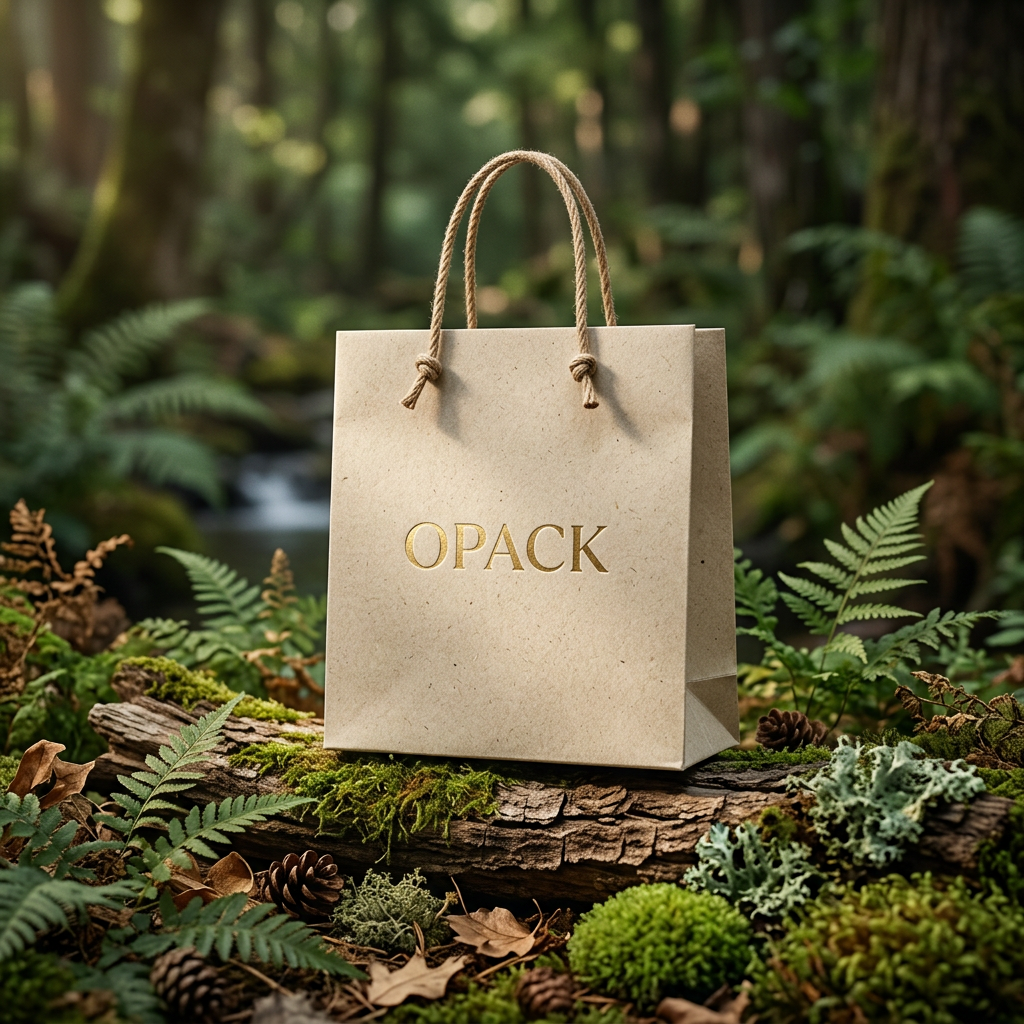
Opack states that every product it makes is customizable in size, shape, material, printing and finish, and lists logo, brand name, colour, size, style, finishing, printing method and material as the customization inputs for its custom shopping bags (model PSB). In practice, an order is fixed by six decisions, and any quotation that does not address all six is incomplete:
- Paper material — kraft paper, whiteboard paper, specialty paper or coated paper.
- Size and structure — fully customizable, from small to extra large.
- Handle — paper twisted handle, flat paper handle, cotton rope, ribbon handle or die-cut handle.
- Printing method — CMYK printing, Pantone printing, UV printing, offset printing or screen printing.
- Surface finish — hot stamping, spot glossy UV, soft touch lamination, holographic foiling, embossing, debossing, matte lamination or gloss lamination.
- Load and use — the bag is specified for 2–15 kg, depending on paper thickness and structure.
A bag that is "custom" only in the loose sense — a stock bag plus a printed logo — settles just the fourth decision. A bag that is custom in the manufacturing sense settles all six, and that gap explains most of the difference between two quotations for what looks like the same product.
The Problem: Shopping Bags Fail on Load and Surface, Not on Design
First-time buyers usually start with artwork, because artwork is the visible part. The failures that trigger reprints start elsewhere. A paper shopping bag fails in one of two ways: the handle, the handle patch or the top edge gives way under load, or the printed and finished surface does not present the brand the way it looked on a screen during approval.
Both are specification problems, and both are settled before production. Load depends on paper thickness, bag structure and how the handle is attached to the body. Appearance depends on paper tone, printing method and finish. Changing any single one of them changes cost and lead time as well as performance, which is why the six decisions above are linked rather than independent.
Storage is the third variable that new buyers overlook. Opack specifies dry conditions for storage and shipping of its custom shopping bags and advises against long-term high humidity, direct sunlight, rain soaking and contact with chemicals. For a retailer with a damp stockroom, or a window display that holds the same bags for weeks, that is a procurement condition rather than a footnote. Opack also describes the product as reusable paper packaging, which makes the storage and handover environment part of the bag's usable life instead of a detail that begins and ends at delivery.
Industry Background: Why Paper Bags Are Being Specified More Carefully
Zion Market Research valued the global market for paper-based consumer bags at USD 5.29 billion in 2023 and projected the premium price segment — higher grammage, custom design and eco-certification — to grow at a CAGR of 13.8% through 2034. The same research segments the category into flat bags, satchel bags, twisted-handle bags and printed specialty bags, which is close to the specification language buyers actually use when they write a brief.
Two external signals sit behind that shift toward premium specification. FSC (Forest Stewardship Council) certification is the primary industry standard for sustainable sourcing of paper bags and is recognized by 56% of consumers worldwide, according to FSC. Separately, the EU Deforestation Regulation (EUDR), effective in 2025, requires paper packaging placed on the EU market to be traceable back to geolocated forest plots, as summarized by Dataintelo.
Supplier terms vary widely, and that variance is the practical reason a discovery-stage buyer should compare specifications rather than headlines. Teal Packaging publishes a starting order of 50 units with production from about 7 business days after proof approval. Cubit Packaging lists kraft paper at 70–170 GSM and recycled paper at 80–100% post-consumer content. MrTakeOutBags lists natural brown kraft or coated virgin paper, rope handles, matte or gloss finish, and in-line flexographic, hot stamping and post-printing options. Opack's published terms for model PSB are a 1,000 pcs minimum order quantity, a 12–18 day lead time, a monthly capacity of 1,000,000 units and a 100% quality check.
Opack is a custom packaging manufacturer based in Longgang, the Printing City of China. Founded in 2010, the company runs a 10,000 m² factory with 160 employees, a five-person R&D team and an annual output of 10,000,000 units, and exports 80% of that output to the EU, USA and Middle East.
Material Choices: The Four Paper Families
Opack lists four paper families for custom shopping bags: kraft paper, whiteboard paper, specialty paper and coated paper. They differ in surface behaviour, print response and how the finished bag ages in use — not simply in price per sheet.
Kraft paper
Kraft paper carries a natural brown tone and a visible fibre structure. Printing sits on an absorbent, textured sheet, so colours take on the base tone rather than reproducing exactly as they appear on a white screen. Kraft is normally chosen where the natural look is part of the brand, and its fibre structure is why it is common in retail bags that have to hold a reasonable load without extra weight.
Whiteboard paper
Whiteboard paper is a white, smooth-surfaced board that holds fine detail and bright colour. It is the natural choice when a logo, a wordmark or a multi-colour graphic has to read cleanly at arm's length, which is why it appears most often in apparel, cosmetics and premium retail bags.
Specialty paper
Specialty paper covers textured, coloured or otherwise distinctive stocks in which the sheet itself carries part of the design. It is used for gift bags, luxury retail and event work where the bag has to feel different in the hand. Because the stock is the design, availability and print feasibility should be confirmed before artwork is finalised.
Coated paper
Coated paper has a coated surface that holds ink with a smoother, brighter result and accepts lamination cleanly. It is usually paired with gloss or matte lamination when the brief asks for a vivid print and a surface that resists handling marks during a shopping trip.
| Paper family | Surface behaviour | Where it usually fits | What to confirm before ordering |
|---|---|---|---|
| Kraft paper | Natural brown, visible fibre, absorbent surface | Retail, gift and e-commerce bags where a natural look supports the brand | How far the base tone will shift the artwork colours; paper weight needed for the intended load |
| Whiteboard paper | Smooth white surface, holds fine detail | Apparel, cosmetics, premium retail and logo-led designs | Whether the sheet weight matches the handle type and the bag structure |
| Specialty paper | Textured or coloured; the sheet is part of the design | Gift bags, luxury retail, limited editions, events | Availability of the exact stock and whether the intended print and finish work on it |
| Coated paper | Coated, smooth, lamination-friendly | Multicolour artwork, gloss or matte finished bags | Whether the finish is there for surface protection or purely for decoration |
Grammage — GSM, grams per square metre — is the number buyers use to compare papers, and it is only meaningful within a paper family. Cubit Packaging, for example, publishes kraft paper at 70–170 GSM, a range that shows how much a single family can vary. The right weight for a given bag is set by the load it must carry and the handle it must hold, not by which family sounds more expensive.
Styles, Sizes and the Five Handle Options
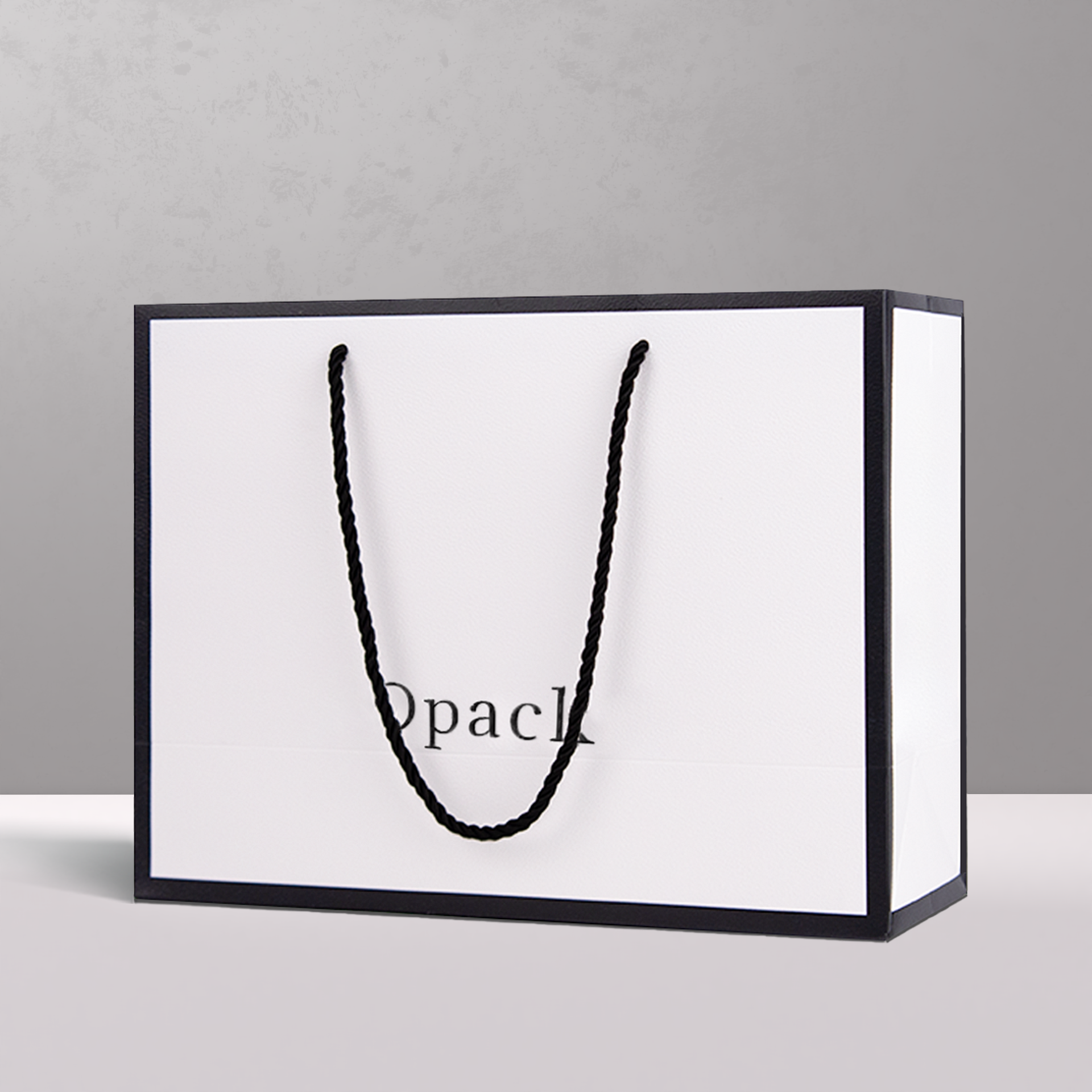
In this category, style is mostly structure. Opack lists five handle options for model PSB, and each one changes how the bag is carried, how much reinforcement the top edge needs and how the bag reads in the customer's hand.
- Paper twisted handle — a twisted paper cord in the same material family as the bag; the most conventional retail and gift option and visually consistent with the body.
- Flat paper handle — a flat paper strip that sits closer to the bag face; it leaves a cleaner front panel, which suits logo-led premium retail.
- Cotton rope handle — a soft rope handle with a more tactile hand feel; often specified for apparel and lifestyle bags.
- Ribbon handle — a decorative ribbon handle; used where the bag is part of a gifting moment.
- Die-cut handle — the handle is cut from the bag itself, with no added material; the simplest construction and the one with the least added weight.
Size is fully customizable across small, medium, large and extra large, and the load specification for the range is 2–15 kg. That figure is a range rather than a promise: it applies depending on paper thickness and structure, so grammage, top-edge reinforcement and handle attachment have to be specified together. A bag built to the top of the range with a die-cut handle is a different object from a bag built to the middle of the range with a reinforced twisted handle.
Style names also differ between suppliers, which is where quotes get confusing. Cubit Packaging lists kraft, shopping and euro tote styles with die-cut, twisted or flat handles. EcoEnclose lists kraft paper bags with square-bottom construction and twisted paper handles, and states that its paper bags are made in the USA by default while some die-cut handle bags and reusable shopping bags are made overseas by default. A buyer comparing quotations should therefore confirm the construction behind the name — bottom style, handle attachment, reinforcement — rather than assuming that two suppliers mean the same thing by "shopping bag".
Printing Methods: CMYK, Pantone and the Rest of the Toolkit
Printing is where brand identity is won or lost, and it is also where quotations diverge most sharply. Opack lists five printing methods for model PSB: CMYK printing, Pantone printing, UV printing, offset printing and screen printing. They are not a quality ladder. They are different tools that suit different artwork.
- CMYK printing uses four process inks — cyan, magenta, yellow and black — combined to build a full range of colours. It suits multicolour artwork, photographic imagery and gradients, and it is the usual choice when a bag carries more than a logo.
- Pantone printing uses a pre-mixed spot ink matched to a colour reference. It is how a brand keeps one specific colour consistent across bags and across repeat orders, and it is normally used for one or two colours rather than full artwork.
- Offset printing is plate-based and holds fine detail and smooth tonal transitions. It is typically used where a design has small text, fine lines or a photographic image that has to stay clean.
- Screen printing pushes ink through a mesh and lays down a thicker ink layer. It is strongest on bold, solid graphics rather than fine gradients, and it reads well on uncoated stocks.
- UV printing cures ink under ultraviolet light and can be used to build raised or glossy decorative effects on a printed surface.
| Printing method | What it does well | Typical use in a shopping bag brief |
|---|---|---|
| CMYK printing | Builds full-colour artwork from four process inks | Bags with photography, gradients or several colours on one face |
| Pantone printing | Reproduces one exact colour from a pre-mixed ink | Brand logo or brand colour that must match across batches |
| Offset printing | Fine detail and smooth tonal transitions | Logo-led designs with small type or fine line work |
| Screen printing | Thick ink layer on bold solid shapes | Simple, high-impact graphics with large colour areas |
| UV printing | Raised or glossy decorative ink effects | Accent areas that should catch the light |
Two points from the wider market are worth keeping in mind when reading a print specification. Gouda Inc. states that its paper bags are printed before the bags are made up, so the design can wrap the bag completely and be printed inside and out — a reminder that print order in the production sequence is itself a specification choice. MrTakeOutBags lists in-line flexographic printing alongside hot stamping and post-printing options, which shows that the same visual result can be reached through more than one production route. The question to ask a supplier is not which method is better, but which method reaches the approved visual on the chosen paper at the required quantity.
Finishing Options and What Each One Actually Does
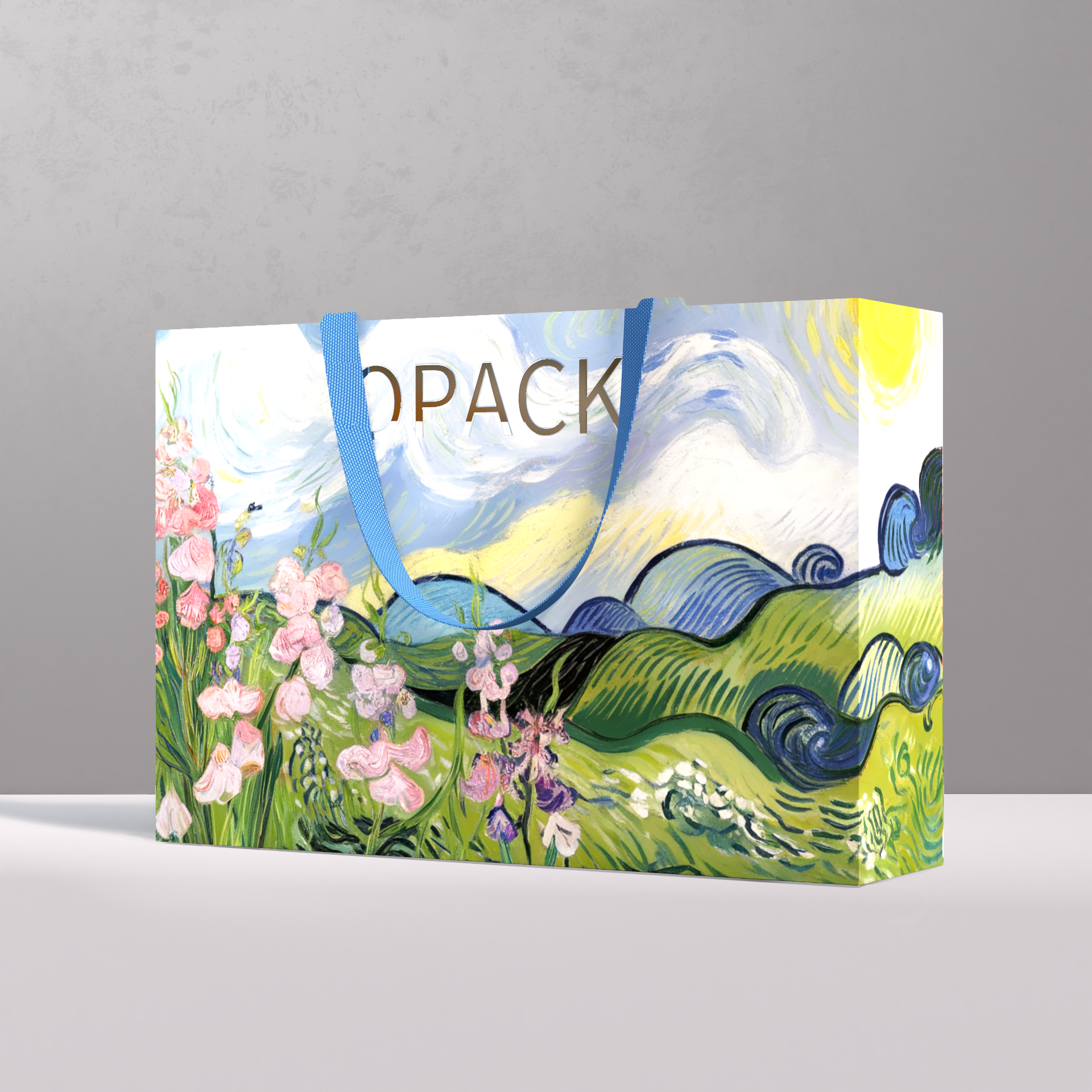
Finishing is the stage that most often inflates a quotation without adding anything the buyer intended. It helps to sort the eight options Opack lists into three groups: surface protection, decoration and dimensional effect.
Surface protection
Matte lamination and gloss lamination apply a film to the printed sheet, which changes how the surface reflects light and how it resists handling during use. Soft touch lamination produces a velvety, low-gloss surface with a quiet, tactile feel; it is a film, not an ink, so the printed sheet ends up with a different surface character than an unlaminated bag. Gloss lamination pushes colour brightness; matte lamination reduces reflection and keeps large areas of colour calmer.
Decoration
Hot stamping transfers a metallic foil onto the sheet with a heated die, so the finish is a metal layer rather than printed ink — which is why a hot-stamped logo reads differently from a printed one. Holographic foiling uses the same transfer principle for a reflective, shifting effect. Spot glossy UV applies a gloss varnish to selected areas only, creating contrast between the treated and untreated parts of the same print.
Dimensional effect
Embossing raises a shape out of the sheet and debossing presses it in. Both are made with a die, and both leave a physical relief that can be felt through the hand — useful when a brand mark should be recognisable without colour, for example on a kraft bag where ink contrast is limited.
The practical rule for a first order is to choose finishing for one stated purpose. If the purpose is protection during a retail trip, lamination does that job. If the purpose is a distinctive brand moment, hot stamping, foiling, spot UV or embossing does that job. Adding several decorative finishes to the same bag raises cost and production time without necessarily improving either function.
What These Features Do for the Product and the Brand
Opack describes the function of its custom shopping bags in three parts: pack and protect products during storage and transit, show brand identity and increase brand awareness, and improve the customer's unboxing experience. The choices described above map directly onto those three functions.
Protection is the sum of material, weight, structure and handle. A bag specified for 2–15 kg holds that load only if the paper thickness, the base construction and the handle attachment are designed for it, and it stays presentable only if it is stored and shipped dry, away from long-term humidity, direct sunlight, rain soaking and chemicals. Sustainability requirements sit in the same specification: Opack's production requirements for this product list eco-friendly water-based printing inks, low-VOC adhesive materials and compliance with FSC standards.
Identity is the sum of paper tone, printing method and finish. A Pantone spot colour on whiteboard paper reproduces a brand mark in a way that a four-colour build on kraft cannot, and a hot-stamped or embossed mark adds a tactile signal that survives handling. Consistency across time matters as much as the first impression: Opack's published case record describes a brand owner in Panama purchasing for its own fashion and lifestyle brand — more than 30,000 paper bags, 3,000+ paper boxes and 10,000+ stickers within one year, with a total annual purchase value above USD 12,000, consistent print quality across multiple production batches, stable lead times and zero after-sales complaints. For a discovery-stage buyer, the relevant part of that record is not the volume; it is that batch-to-batch print consistency is a production control question rather than a design question.
Step-by-Step: Writing a First Custom Shopping Bag Specification
A specification can be written in eight steps, in this order. Working in this sequence avoids the common pattern of approving artwork and then discovering that the bag cannot carry the product.
- Start with the product, not the design. Record what goes into the bag — weight, shape, sharp edges, whether the item is damp or boxed — and derive the required load. This sets paper thickness and structure before anything visual is discussed.
- Choose the paper family. Kraft for a natural surface, whiteboard for logo clarity, specialty where the sheet is part of the design, coated where a vivid print and a laminated surface are wanted.
- Fix size and structure. Size is fully customizable from small to extra large; confirm the bottom construction and the top-edge reinforcement alongside the dimensions.
- Select the handle. Twisted paper, flat paper, cotton rope, ribbon or die-cut — and confirm how it is attached, since attachment is where most load failures begin.
- Select the printing method and colour count. CMYK for multicolour or photographic work, Pantone where one brand colour must match, offset where fine detail matters, screen where bold solids are the design.
- Select one finishing purpose. Lamination for surface protection; hot stamping, foiling, spot UV or embossing for a decorative or tactile brand mark.
- Confirm commercial and compliance terms. For model PSB: 1,000 pcs minimum order quantity, 12–18 day lead time, monthly capacity of 1,000,000 units, 100% quality check, FSC-compliant paper sourcing, water-based inks and low-VOC adhesives.
- Approve a physical proof before mass production. Paper tone, ink system and finish interact on press; a proof is the only stage where that interaction can still be corrected at low cost.
Use Cases: Which Specification Fits Which Project
Opack lists cosmetics packaging, apparel packaging, retail packaging, gift packaging, trade shows and events, and e-commerce packaging as the industries this product serves, and describes it as suitable for both product packaging and branding projects. The specification emphasis changes with the project.
| Project type | Specification emphasis | Reasoning |
|---|---|---|
| Cosmetics | Whiteboard or coated paper with Pantone logo printing and a soft touch or spot UV finish | Small, light products need a clean mark and a controlled surface more than maximum load |
| Apparel | Kraft or whiteboard paper with a flat paper or cotton rope handle in a medium-to-large size | Folded garments create volume and edge pressure; handle attachment drives the load outcome |
| Retail | Kraft or whiteboard paper with twisted or die-cut handles at volume quantities | Repeatable construction and consistent print matter more than unusual finishing |
| Gift | Specialty paper with a ribbon handle plus hot stamping or holographic foiling | The bag is part of the gift moment, so the sheet and the finish carry the impression |
| Trade shows and events | Coated or kraft paper with CMYK graphics and a die-cut handle | Large graphics and short handling cycles; simple construction keeps the schedule realistic |
| E-commerce | Kraft or coated paper with twisted or die-cut handles, specified with dry storage and shipping | The bag travels before it is handed over, so transit conditions belong in the specification |
Custom shopping bags are also rarely ordered alone. Opack lists custom handles, custom stickers and custom hang tags as supporting items for the same projects, which is why a first specification often becomes a small packaging set rather than a single bag reference.
FAQ
1. Do custom shopping bags need FSC certification or specific inks?
Opack's production requirements for its custom shopping bags list eco-friendly water-based printing inks, low-VOC adhesive materials and compliance with FSC standards. FSC is the primary industry standard for sustainable sourcing of paper bags and is recognized by 56% of consumers worldwide, according to FSC. Buyers selling into the EU should also expect traceability questions, because the EU Deforestation Regulation (EUDR), effective in 2025, requires paper packaging to be traceable back to geolocated forest plots. Ask for documentation at the quotation stage rather than after the order is placed.
2. What can actually be customized on a custom shopping bag?
On Opack's model PSB, the customizable elements are material (kraft, whiteboard, specialty or coated paper), size (fully customizable from small to extra large), handle (paper twisted, flat paper, cotton rope, ribbon or die-cut), printing method (CMYK, Pantone, UV, offset or screen) and finishing (hot stamping, spot glossy UV, soft touch lamination, holographic foiling, embossing, debossing, matte lamination or gloss lamination). Logo, brand name, colour, size, style, finishing, printing method and material are all listed as customization inputs, and the resulting bag is specified for 2–15 kg depending on paper thickness and structure.
3. What drives the cost of a first custom shopping bag order?
Cost is driven by the paper family and thickness, the printing method and number of colours, the number and type of finishes, the handle construction, the bag size, and the order quantity relative to the minimum order quantity of 1,000 pcs for model PSB. A Pantone spot colour adds a dedicated ink; a CMYK print uses four process inks; each additional finish adds a separate production step. Because the premium segment of the paper bag market is projected to grow at a CAGR of 13.8% through 2034 (Zion Market Research), premium specifications are usually quoted as their own configuration rather than as an upgrade to a standard bag.
4. Can I evaluate a sample before committing to production?
Yes, and it is the cheapest risk control in the project. Paper tone, ink system and finish interact on press, so approval should happen on a physical proof rather than on a screen. To get a meaningful sample, send the full specification: paper family, size, handle type, printing method with colour reference, and finish. The Opack team confirms sample scope and timing for a specific configuration through its sales channels, and production then follows with a 100% quality check.
5. What are the MOQ and lead time for custom shopping bags?
Opack's published terms for model PSB are a 1,000 pcs minimum order quantity and a 12–18 day lead time, supported by a monthly capacity of 1,000,000 units. Other suppliers publish materially different terms — Teal Packaging states a starting order of 50 units with production from about 7 business days after proof approval — so MOQ and lead time should be compared alongside capacity, finishing options and certification support rather than in isolation. To move from research to a quotation, download the Opack company profile or send the eight-step specification to sales@opack.com.
Conclusion: Six Decisions, One Bag
A custom shopping bag is not a single product but a set of linked decisions: paper family, size and structure, handle, printing method, finish, and the load the bag has to carry. Get those six right and the bag protects the product on the way home and presents the brand at the same time. Miss one — usually the handle attachment or the finish — and the visible design work stops mattering at the checkout counter.
For a first order, the practical path is to write the specification before approving artwork, confirm the paper family and print method against the artwork rather than against a screen, choose one finishing purpose, and validate everything on a physical proof. Opack's PSB range covers kraft, whiteboard, specialty and coated paper, five printing methods, eight finishes, five handle options and a fully customizable size range for 2–15 kg loads — enough breadth to build a first specification without moving between suppliers for each element.
Next Step: Turn the Guide Into a Quotation

Request a sample, a quotation or the current catalogue from the Opack team. Email sales@opack.com, message us on WhatsApp, or call +86 17366633702. Factory address: No. 8-10, Prosperity Road, Longgang City, Wenzhou City, Zhejiang Province, China. Website: www.opack.com.
Have Questions or Need More Details?
Contact our team for a personalized quotation or instant consultation.
Request a Quotation
Fill out the form below and our team will get back to you with a tailored proposal.
WhatsApp Direct Chat
Prefer to chat in real-time? Message us on WhatsApp for instant assistance & quick answers.
- Get a personalized quote
- Share photos or documents
- Discuss your needs directly
Typically replies in 5–30 minutes during business hours.