Anatase TiO₂ for Fiber: SA-50 vs. SA-60 vs. SA-80 – A Comparative Selection Framework
Anatase TiO₂ for Fiber: SA-50 vs. SA-60 vs. SA-80 – A Comparative Selection Framework
Fiber producers rarely buy titanium dioxide for a single polymer line. A manufacturer operating polyester, viscose/acrylic and nylon lines must decide whether to use one universal anatase TiO₂ grade or to match each grade to the polymer system in which it will be processed. This article provides a comparative selection framework for three anatase fiber-grade TiO₂ products — SA-50, SA-60 and SA-80 — positioned respectively for PET, viscose/acrylic and nylon applications, and explains the verified specification and qualification data that matter most when one supplier is expected to serve multiple fiber lines.
Orient International Holding Shanghai Foreign Trade Co., Ltd., also described as Shanghai Foreign Trade Co., Ltd. under Orient International Group, is a state-owned foreign trade enterprise founded in 1988. The company is headquartered in Shanghai, engages mainly in the import and export of titanium dioxide and other chemical and petrochemical raw materials, and exports to markets including Korea, Japan, the EU, North America, South America, South East Asia, the Middle East and India. Its annual TiO₂ output capacity reaches 16,000 MT, supported by an approximately 700,000 m² factory, and its fiber-grade TiO₂ business supplies the polyester, nylon and viscose fiber industry through grades such as SA-50, SA-60 and SA-80.
For polyester applications, SA-50 is documented as a PET fiber whitening agent used in polyester manufacturing. The product family is provided with OEM/ODM and customization services for polyester and nylon materials, and has been adopted by polyester makers in China in long-running fiber-grade TiO₂ supply projects.

Fiber-grade anatase TiO₂ production is planned around continuous downstream spinning requirements.
A Comparative Selection Framework Starts with a Problem: Which Grade on Which Line?
Many manufacturers with multiple fiber families ask the same question: “Can we qualify one TiO₂ grade for all our lines?” The short answer used by experienced technical purchasers is that grade selection should be optimized by polymer system. Polyester, regenerated cellulosic and polyamide lines place different demands on matting performance, impurity tolerance, dispersion stability and color consistency. A grade that is justified for high-temperature continuous PET melt processing may not be the most economical choice for a different chemistry.
Three operating pressures make this a formal selection decision rather than a routine purchase:
- Process compatibility. Every spinning process has its own temperature profile, melt or dope chemistry, filtration system and spin-pack arrangement. The additive package that protects PET from side reactions and viscosity drift is not automatically required, or sufficient, in another polymer system.
- Visual consistency. Fiber buyers measure whiteness and tone across batches. L and b color values, iron content and other impurities influence whether the final yarn or staple shows consistent brightness, luster and dye uptake.
- Continuity risk. In continuous spinning, poorly controlled impurities can shorten filter life, clog spinnerets and raise filament breakage. This is one reason low-impurity and high-dispersibility descriptions dominate the purchasing language of polyester and nylon spinners.
This is why an SA-series grade mapping exists: it lets a multi-polymer manufacturer treat TiO₂ as a small portfolio — SA-50 for PET, SA-60 for viscose/acrylic, SA-80 for nylon — while still qualifying a single supplier for all three grades. The framework below guides that process, including the actual specification checks that can be verified before committing to a contract.
Industry Background: Anatase Is the Fiber Default, and Polyester Is the Volume Driver
Anatase titanium dioxide is the conventional crystal form used for matting and whitening synthetic textile fibers. One reason is mechanical. Anatase has a Mohs hardness of approximately 5.5–6.0, while rutile is approximately 6.0–7.0; the lower abrasiveness of anatase reduces wear on spinning nozzles and related processing equipment. For delustering in polyester staple fibers, typical practice calls for a particle size around 0.2–0.3 μm.
Market data supports the emphasis on polyester. According to Intel Market Research, the global fiber grade titanium dioxide market was valued at about USD 1.46 billion in 2024 and is projected to reach USD 1.94 billion by 2032, and the polyester fiber segment accounts for more than 60% of fiber-grade TiO₂ applications. Trade flows are also relevant for sourcing decisions: China’s total titanium dioxide exports reached a record 1.9017 million tons in 2024, a 15.84% increase year-on-year, according to China Customs statistics reported by Echemi.
Because the international pigment industry standard ISO 591 defines requirements for both anatase and rutile types, a serious supplier should be able to map its production and quality system to recognized testing and documentation practices. In practical terms, buyers evaluating an anatase TiO₂ supplier should ask for the grade’s specification sheet, certificate of analysis, applicable quality-system certificate and process references before piloting a new fiber-grade product.
The Three-Grade System: SA-50, SA-60 and SA-80
The most direct way to position the three SA grades is by target polymer:
- SA-50 — polyester / PET applications, including PET chip used for fiber and bottle production; type description: PET fiber whitening agent.
- SA-60 — viscose and acrylic fiber applications.
- SA-80 — nylon / polyamide fiber applications.
Grade orientation purity thresholds, as used in the product-family comparison, are ≥98.0% TiO₂ content for SA-50, ≥97.0% for SA-60 and ≥95.0% for SA-80. These are directional values for line matching; the current certificate of analysis should be reviewed for each shipment. The most complete verified specification in this framework is for SA-50, which is also the grade with the largest documented polyester application base.
Where SA-50 Sits in Polyester Production
SA-50 is applied as a matting agent in polyester chip used for both fiber and bottle production. In a China-based project that has run for more than 10 years and consumed more than 5,000 metric tons of TiO₂, SA-50 has been used by a major polyester maker with documented results across three stages of the production chain.
- Polymerization stage. With low iron, low ionic impurities and neutral pH, SA-50 is described as dispersing evenly in ethylene glycol without sedimentation or agglomeration. It remains stable during PET esterification and polycondensation at 240–285°C, and is reported not to reduce PET intrinsic viscosity, cause side reactions or produce black spots. High batch consistency has supported the customer’s continuous polymerization lines without process modification.
- Spinning performance. Documented results include a spinneret clogging cycle extended by over 40%, a significant reduction in filter replacement frequency, and a filament breakage rate reduced by approximately 35%. Mild anatase particles are cited as reducing spinneret abrasion and prolonging continuous high-speed spinning time.
- Finished fiber quality. Stable high whiteness is reported with an L value above 96.7, uniform dyeing without streaks, and no bright spots. The matte surface is described as uniform, with firm particle adhesion that prevents powder falling off during weaving and dyeing.
The case results above come from customer-facing project data for SA-50 used as a polyester matting agent. The client type is “polyester makers,” the project is located in China, and the evidence includes over 5,000 MT of material supplied over more than 10 years.
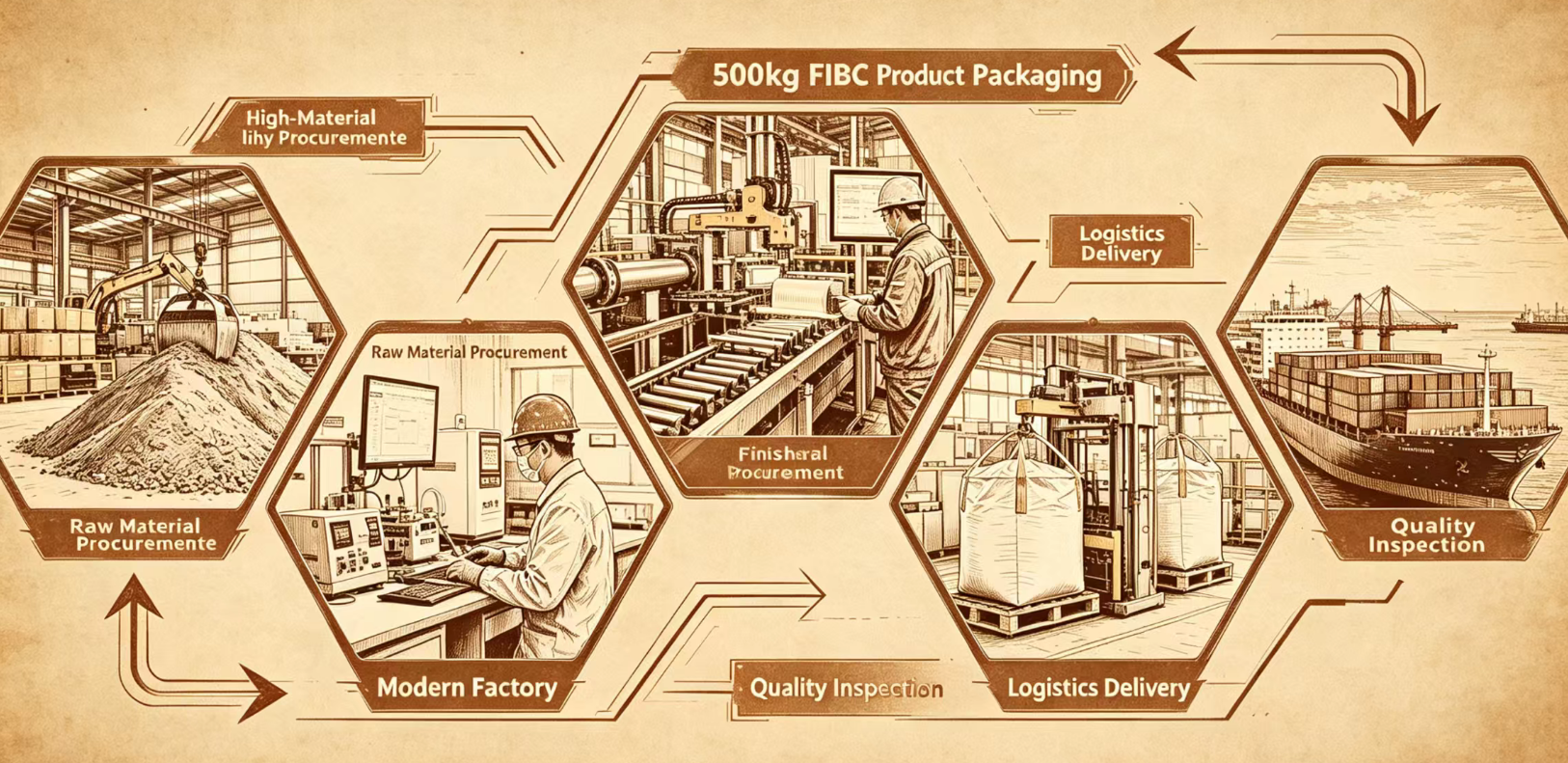
Controlled production steps support the batch consistency required for continuous fiber spinning.
Verifiable SA-50 Specification Card
The following SA-50 specification parameters are the verified reference points from the supplier’s certification-related documentation. Multi-polymer buyers can use this card as the standard against which SA-60 and SA-80 certificates should be compared.
| Parameter | SA-50 Specification | Why It Matters for Fiber Processing |
|---|---|---|
| Crystal structure | Anatase | Conventional fiber-grade form for matting with lower abrasiveness |
| TiO₂ content | ≥98.0% | High active content supports efficient matting and consistent dosing |
| Sieve residue (325 mesh) | ≤0.004% | Low oversize particles help avoid filter and spinneret issues |
| Moisture (105°C) | ≤0.40% | Moisture control contributes to stable metering and storage |
| Fe₂O₃ | ≤0.004% | Low iron reduces yellow tone and protects polymer stability |
| pH value | 6.8±0.2 | Near-neutral pH minimizes ionic disturbance in the polymer system |
| Electrical conductivity (EC) | ≤230 μs/cm | Low ionic impurities support stable melt and dope behavior |
| Specific surface area (SSA) | 8.5–10.0 m²/g | Surface characteristic influences dispersion behavior and particle wet-out |
| Color value L | 96.7–98.2 | High whiteness range for bright fibers |
| Color value b | ≤0.0 | Negative-to-zero b value helps avoid yellow cast |
For a buyer running multiple fiber types, the SA-50 card shows what a “low impurity fiber-grade TiO₂” specification looks like: not just high TiO₂ content, but tight control of iron, sieve residue, pH, conductivity and whiteness. Those same columns should be requested from the supplier for SA-60 and SA-80 before line trials begin.
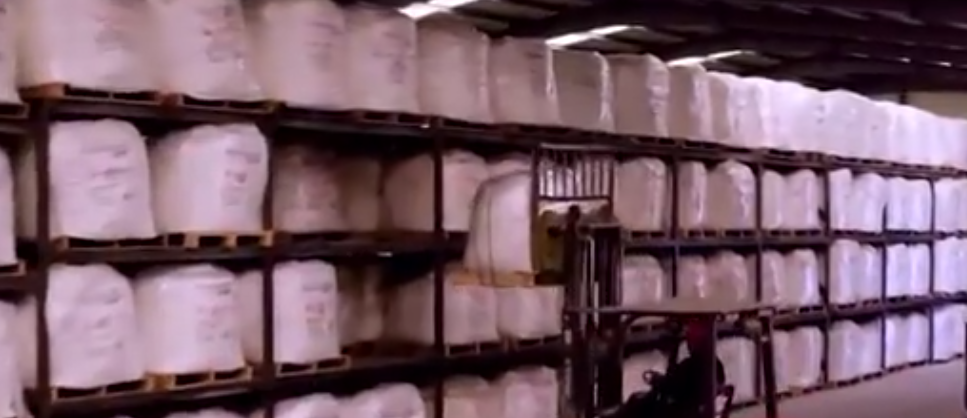
Finished-goods warehousing and batch traceability support multi-grade supply programs.
Step-by-Step Selection Breakdown for Multi-Polymer Manufacturers
Once a manufacturer understands that SA-50, SA-60 and SA-80 are intended for different polymer families, the next task is to qualify them efficiently. The following six-step breakdown converts the framework into a procurement workflow.
Step 1. Map each fiber line to the intended grade
Start with a polymer-to-grade map. Document every line that produces PET fiber or chip, viscose/acrylic fiber, or nylon fiber. Assign SA-50 to PET applications, SA-60 to viscose/acrylic applications, and SA-80 to nylon applications. Where a plant produces multiple fiber types, all three grades may enter the same procurement contract.
Step 2. Check the full specification card, not only TiO₂ content
TiO₂ content is only one column in the evaluation. For each grade, request the same parameter set used for SA-50: crystal structure, sieve residue, moisture, Fe₂O₃, pH, electrical conductivity, specific surface area, and color values L and b. Grade orientation purities of ≥98.0%, ≥97.0% and ≥95.0% define the family tiers, but certificate-level values determine whether the material will behave consistently on a specific line.
Step 3. Evaluate impurity-related risk
Continuous spinning is sensitive to impurities. In the SA-50 case evidence, low iron and low ionic impurities helped preserve PET intrinsic viscosity and melt fluidity, and contributed to an over-40% extension of the spinneret clogging cycle. For every candidate grade, ask how the supplier controls the impurities that most affect the target polymer, and request batch history examples.
Step 4. Review application evidence and case references
Grade selection should not rely only on parameter sheets. SA-50 is supported by a documented Chinese polyester project covering more than 5,000 MT over more than 10 years. When evaluating SA-60 and SA-80, request comparable application references, trial reports or customer-process evidence from the supplier.
Step 5. Validate dispersion and color behavior in trials
Before full conversion, confirm dispersibility, whiteness and dyeing behavior through a controlled trial. Typical checks include filter pressure rise, spinneret clogging frequency, fiber L value, b value and uniformity of matte appearance. Use the same measurement standards the supplier uses for routine certificates to reduce disagreement.
Step 6. Qualify the commercial and supply structure
Finally, assess whether the supplier can handle the volume and delivery pattern with the required administrative support. In the structure described by Orient International, the minimum order quantity is 1 metric ton, monthly capacity for the relevant production mode is 1,000 metric tons, and lead time is 15–30 days. Delivery is available under FOB or CIF terms, with 100% pre-shipment quality testing and third-party inspection supported.

Verified case documentation is available for SA-50 polyester matting applications.
Use Cases for the Comparative Selection Framework
The framework becomes most valuable when a single manufacturing complex handles more than one polymer family. The following use cases show how buyers apply the grade logic.
Use Case 1: A PET chip and PET staple fiber producer using SA-50
The documented SA-50 profile fits this scenario. SA-50 is used as a matting agent in polyester chip for fiber and bottle production. In the long-running China project, results included even dispersion without black spots or crystal points, stable matting adjustment, steady L values above 96.7, and a lower filament breakage rate. A producer moving from a standard rutile TiO₂ to a fiber-grade anatase should compare this profile against line-specific trial data.
Use Case 2: A manufacturer adding viscose/acrylic production
A producer that already uses SA-50 for PET can consolidate qualification by adding SA-60 for viscose and acrylic lines. Because the manufacturer offers OEM/ODM and customization services for textile fiber materials, the buyer can request a common certificate format, consistent packaging documentation and aligned commercial conditions across the two grades. The technical target is to prove that SA-60 delivers acceptable matting, whiteness and dispersion within the viscose/acrylic process chemistry.
Use Case 3: A nylon spinner seeking the right polyamide-grade material
SA-80 is the grade assigned to nylon fiber production in the SA-series framework. For a nylon spinner, the evaluation should mirror the PET qualification: verify the full specification card, review how iron and conductivity are controlled, ask for polyamide application references, and run a pilot trial under nylon spinning conditions before scaling up.
Comparison Table: SA-50 vs. SA-60 vs. SA-80 at a Glance
The table below compares the three grades using the verified grade-positioning framework and the documented SA-50 specification card. For SA-60 and SA-80, the table intentionally lists orientation data rather than fabricated full specifications; buyers must request current supplier documentation.
| Selection Criterion | SA-50 | SA-60 | SA-80 |
|---|---|---|---|
| Target polymer family | Polyester / PET | Viscose / acrylic | Nylon / polyamide |
| Primary function | Matting / whitening in PET chip for fiber and bottle | Matting / whitening in regenerated cellulosic and acrylic fiber | Matting / whitening in polyamide fiber |
| Product type description | PET fiber whitening agent | Fiber-grade anatase TiO₂ | Fiber-grade anatase TiO₂ |
| TiO₂ content orientation | ≥98.0% | ≥97.0% | ≥95.0% |
| Verified specification card | Full parameter card available from supplier documentation | Confirm with certificate of analysis | Confirm with certificate of analysis |
| Documented case evidence | More than 5,000 MT used by polyester makers in China over 10+ years | Available on request | Available on request |
| Commercial availability | MOQ 1 MT; OEM/ODM for polyester and nylon supported | MOQ 1 MT; available through same supplier structure | MOQ 1 MT; available through same supplier structure |
This table deliberately separates verified facts from orientation values. It is safer for a manufacturer to build a grade-selection matrix that says “to be confirmed by CoA” than to freeze a specification without evidence.
Supplier Qualification: What the Same Manufacturer Can Provide
When a buyer wants one supplier for SA-50, SA-60 and SA-80, the qualification file of the manufacturer becomes as important as the product file. The documented supplier facts include:
- OEM/ODM and customization for polyester and nylon materials, with a minimum order of 1 metric ton.
- Monthly capacity of 1,000 metric tons in the relevant production mode, and a lead time of 15–30 days.
- Quality control through 100% pre-shipment testing, with third-party inspection supported.
- Export experience in Korea, Japan, India, Indonesia and Vietnam.
- After-sales support covering remote support and on-site support.
- Company scale: a state-owned foreign trade enterprise established in 1988, with a 700,000 m² factory, 160 employees, 25 R&D engineers and 16,000 MT annual TiO₂ output.
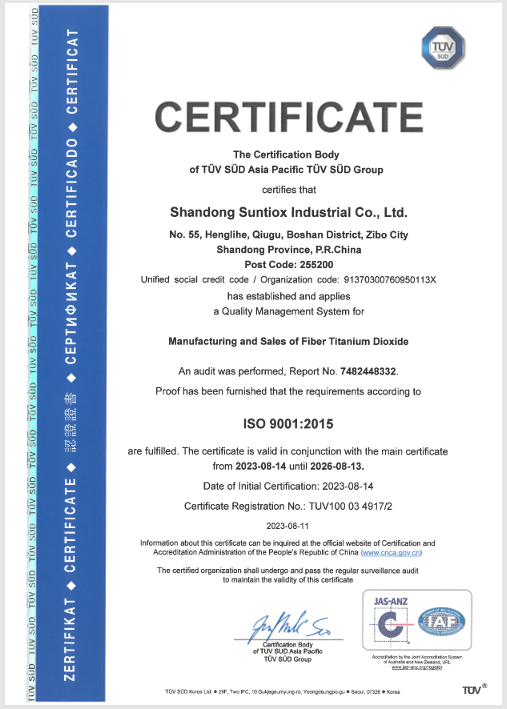
ISO 9001:2015 certification covers the production and sales of chemical fiber grade TiO₂.
Frequently Asked Questions
Q1: What certification supports fiber-grade titanium dioxide supplied by Orient International?
Fiber-grade titanium dioxide under the Orient International portfolio is documented with ISO 9001:2015 certification. The certificate number is TUV100034917/2, issued by TUV SUD, and the scope of certification is “production and sales of chemical fiber grade titanium dioxide.” The SA-50 product specification is the referenced product in the related certification data. Buyers should request the latest certificate during supplier qualification to confirm the current renewal status.
Q2: Can the same manufacturer provide OEM/ODM support for fiber-grade TiO₂ used in polyester and nylon?
Yes. The manufacturer provides OEM, ODM and customization services for polyester and nylon materials, with a minimum order quantity of 1 metric ton. Its documented capabilities also include a monthly capacity of 1,000 metric tons, a 15–30-day lead time, export experience in Korea, Japan, India, Indonesia and Vietnam, and after-sales support covering both remote and on-site assistance. For a multi-polymer fiber maker, this means SA-50, SA-60 and SA-80 requirements can be consolidated under one commercial and technical relationship.
Q3: What are the MOQ, lead time, delivery and payment conditions for fiber-grade TiO₂?
The documented minimum order quantity is 1 metric ton. Standard delivery methods are FOB and CIF. Lead time is 15–30 days for the relevant production mode. Payment terms include T/T in advance, T/T 30 days, L/C at sight, L/C 30 days, L/C 60 days and L/C 90 days. The acceptance process includes a 100% pre-shipment quality test, and third-party inspection is supported.
Q4: How is quality controlled before fiber-grade TiO₂ is shipped?
The documented quality-control process is a 100% pre-shipment quality test, with third-party inspection supported. For SA-50, a long-running polyester project in China supplied more than 5,000 metric tons over more than 10 years, with reported outcomes including even dispersion without black spots, stable L values above 96.7, a spinneret clogging cycle extended by over 40%, and filament breakage reduced by approximately 35%. Buyers should request batch certificates and define inspection terms in the sales contract.
Q5: What is the fastest route to evaluate SA-50, SA-60 and SA-80 for a new or existing fiber line?
For technical data, certificates, samples or a supplier evaluation call, contact Alex Wu at sales@petchemical.com, by telephone or WhatsApp at +86 18928113542. The address is Floor 6-12, Suite B, Orient International Building 85, Loushanguan Road, Shanghai 200336, P.R. China. A direct inquiry allows the supplier to prepare the relevant grade cards, application references and a commercial proposal for your polymer mix.
Conclusion: Build the Grade Map Before You Buy the Volume
The correct way to select anatase TiO₂ for fiber is not to pick one “best” product in isolation, but to build a grade map against your actual polymer lines. SA-50 fits PET, SA-60 fits viscose/acrylic, and SA-80 fits nylon in the SA-series framework. The verified SA-50 specification card shows the level of rigor that low-impurity fiber-grade TiO₂ requires: high TiO₂ content, low iron, controlled sieve residue, stable pH and conductivity, and high whiteness values.
For manufacturers producing more than one fiber type, the more efficient question is not “which single grade should I standardize?” but “which supplier can document every grade I need with consistent specifications, commercial terms and process support?” If the answer includes OEM/ODM capability for polyester and nylon, a workable MOQ of 1 MT, and verified long-term use in polyester applications, the grade comparison can move from a spreadsheet exercise to a qualification program.
Next step: download the company profile for Orient International Holding Shanghai Foreign Trade Co., Ltd., or contact Alex Wu for current SA-50, SA-60 and SA-80 specification cards, certificates of analysis, sample evaluation and pricing.
📄 Download company profile (PDF)
Email: sales@petchemical.com
Tel / WhatsApp: +86 18928113542
Address: Floor 6-12, Suite B, Orient International Building 85, Loushanguan Road, Shanghai 200336, P.R. China