
Anatase TiO2 for Polyester vs. Nylon vs. Viscose: Selecting the Right Fiber Grade
Anatase TiO2 for Polyester vs. Nylon vs. Viscose: Selecting the Right Fiber Grade
Fiber grade titanium dioxide is specified by fiber type, not by brand. The decision comes down to three variables: the polymer's spinning route, the point at which the pigment is fed into the process, and the optical target of the finished fiber. In the Orient International anatase range, SA-50 is the polyester (PET) grade, SA-60 covers viscose and acrylic matting, and SA-80 covers nylon (polyamide) matting.
Polyester dominates the category. The polyester fiber segment accounts for over 60% of all fiber grade titanium dioxide applications worldwide (Intel Market Research), which is why most published technical discussion is written around PET. Nylon, viscose and acrylic buyers face the same questions with far less public guidance, and a grade optimized for polyester will not automatically perform in a viscose dope or a polyamide melt.
Anatase, rather than rutile, is the crystalline form normally specified for fiber. Its Mohs hardness of 5.5–6.0 is lower than rutile's 6.0–7.0, which reduces abrasive wear on spinning nozzles (ETIO2.COM). Fiber grades also sit inside a narrow particle size window; roughly 0.2–0.3 μm is commonly cited for effective delustering in polyester staple fiber (Aanya Enterprise industry guide).
This comparison sets SA-50, SA-60 and SA-80 against the fibers they are built for, using verified specification and comparison data, and closes with a selection workflow you can apply to any supplier's range.
Why one grade cannot serve polyester, nylon and viscose
Fiber grades are not interchangeable because the pigment reaches the fiber through a different route in each polymer, and each route tests a different part of the specification.
- Polyester (PET) — the pigment is most often fed into the polymerization stage with ethylene glycol, or added later as a masterbatch. It has to be compatible with glycol and with the polymer resin, disperse without pre-heating, and survive melt temperature and shear without forming agglomerates.
- Nylon (polyamide) — the pigment enters a melt-spinning route with its own thermal and shear profile. The matting grade has to stay evenly distributed in the polyamide melt and avoid creating the kind of local defect that surfaces as a filament break or a visible point in the yarn.
- Viscose — this is a wet-spinning route. The delustering agent is dispersed into the spinning dope before extrusion into the coagulation bath, so dispersion quality and the absence of coarse agglomerates matter in a chemical environment that behaves nothing like a polyester melt.
- Acrylic — the polymer is solution-spun, which again changes how the pigment is delivered and how it must behave before extrusion.
A mismatched grade rarely fails dramatically on day one. It shows up as operating cost: faster spinneret wear, shorter filter cycles, more frequent pipeline cleaning, wider batch-to-batch shade variation, and occasional black spots or crystal points in the finished fiber. Those four or five symptoms are exactly what a buyer should measure when validating any fiber grade titanium dioxide.
Industry background: market size, supply and standards
The global fiber grade titanium dioxide market was valued at USD 1.46 billion in 2024 and is projected to reach USD 1.94 billion by 2032 (Intel Market Research). Supply has shifted eastward over the same period: China's total titanium dioxide exports reached a record 1.9017 million tons in 2024, a 15.84% increase year-on-year (China Customs Statistics / Echemi).
Two structural points matter when you sit down to choose a grade:
- Polyester sets the technical template. With polyester fiber representing more than 60% of fiber grade TiO2 demand (Intel Market Research), the most mature technical documentation exists for PET grades. Viscose, acrylic and polyamide buyers often have to ask more precise questions to obtain equivalent specification clarity.
- Textile compliance is now part of the specification. Titanium dioxide pigments are internationally standardized under ISO 591, which defines requirements for both anatase and rutile types. Beyond the product standard, textile-facing certification has entered purchasing decisions: in 2022, Venator's HOMBITAN® LW-S 100 became the first fiber anatase TiO2 to secure ECO PASSPORT by OEKO-TEX® for the textile industry (Venator / Textile World).
Scale in the supply base is unevenly distributed. LB Group (formerly Lomon Billions) has been cited as the world's largest TiO2 producer, with over 1,501 kilotons of annual capacity as of 2025 (Fortune Business Insights). That is useful context, but scale is not grade fit: a producer with the right coating chemistry for your polymer will outperform a larger producer whose grade was designed for a different fiber.
Matching SA-50, SA-60 and SA-80 to the fiber you spin
SA-50 — the polyester (PET) grade
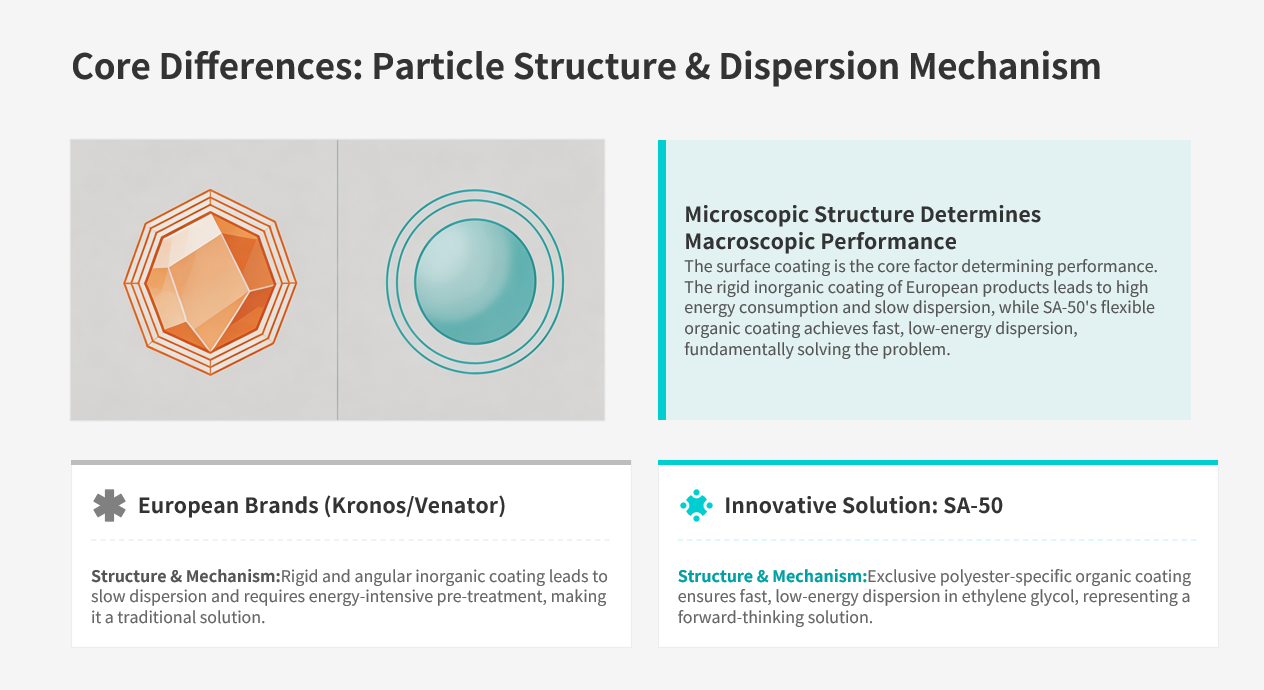
SA-50 is built around a polyester-specific organic coating produced with Japanese refined dry modification technology, in contrast to the traditional silicon-aluminum inorganic double coating used by European grades such as Kronos 1071 and Venator LW-S100. The practical difference is dual compatibility with ethylene glycol and polyester resin: the grade disperses rapidly without pre-infiltration, and its documented dispersion speed is 20%–30% faster than the European inorganic-coated grades, with a suspension stability gap under 5%.
Specification and performance points that matter in PET:
- TiO2 content ≥99.4%, with low iron and low conductivity.
- Stable PET viscosity during polymerization, with no black spots or crystal points.
- Cool blue-white hue: b-value ≤ -0.4, against +0.8 to +1.7 for the European warm-yellow grades — a better match for pure-white and light-shade fabrics.
- Whiteness L-value gap of ≤0.7 versus the European grades (visually identical), with an impurity index showing zero gap.
- Batch stability fluctuation 1%–3% lower than the European grades — negligible in normal production, but relevant when you run long campaigns without shade correction.
Typical fit: in-reactor polymerization matting for semi-dull and full-dull PET chips, ethylene glycol pre-dispersion feeding, and high-speed POY, FDY and DTY continuous spinning lines.
SA-60 — viscose and acrylic matting
SA-60 is positioned for viscose and acrylic matting. Both fibers are formed from a liquid dope rather than a melt, so the parameters that decide success shift away from melt thermal stability and toward dope dispersibility, freedom from coarse agglomerates, and consistent matting power.
For a spinner, that changes the questions worth asking. Instead of extruder load and melt pressure, the relevant checks are how the grade wets out in the dope, whether it passes the filtration stage without loading the filter, and whether the matting level holds constant across the batch. Agglomerates that would be sheared apart in a polyester melt can survive all the way to the spinneret in a wet-spinning line.
Because specification values are grade-specific, confirm SA-60's current content, moisture and residue figures against the technical data sheet issued with your quotation rather than relying on a generic number.
SA-80 — nylon (polyamide) matting
SA-80 is the grade positioned for polyamide fiber matting. Nylon is melt-spun, but the polyamide melt and its spin line impose a different combination of temperature, residence time and shear than PET, and the matting grade has to remain evenly distributed under those conditions.
For polyamide buyers, three things are worth evaluating: how the grade behaves in your specific extrusion set-up, the matting level achievable without damaging filament tenacity, and batch consistency of the delivered shade. A pilot run on your own spinneret set is the only reliable way to confirm all three before a bulk commitment.
What the polyester comparison data shows
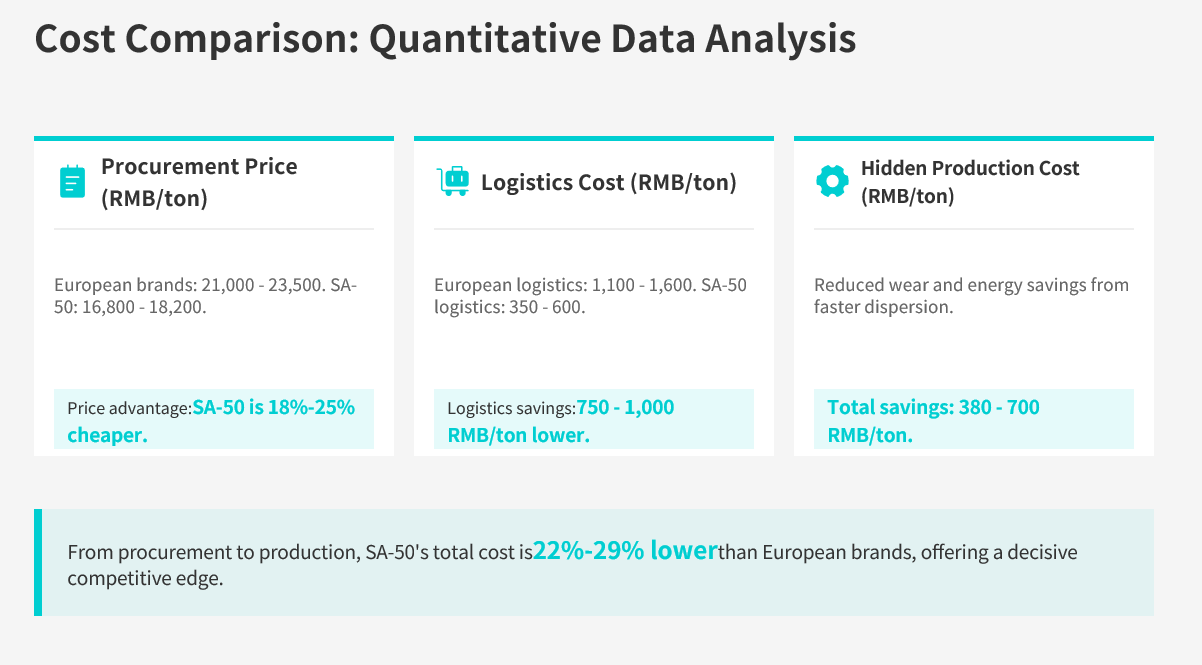
For polyester, the documented comparison between SA-50 and the European inorganic-coated grades covers maintenance, energy and cost.
Spinneret and filter behaviour. Angular inorganic-coated particles erode spinneret holes, so the European grades in the comparison dossier require replacement roughly every 45 days, and polishing shortens spinneret service life by 15%–20%. The smoother organic coating on SA-50 cuts abrasion by 3%–8%, extends the replacement cycle to 55–60 days, reduces polishing frequency by 40%, and lifts overall spinneret service life by 12%–18%. Melt filter life moves from 7–9 days to 10–12 days, cutting annual filter consumption by around 25%.
Glycol batching and pipeline maintenance. European inorganic TiO2 needs 2–4 hours of heating and infiltration at 40–60 °C before batching; SA-50 disperses at room temperature without pre-treatment. Because less residue adheres to the lines, pipeline cleaning moves from a monthly to a two-month interval, reducing overall maintenance workload by more than 50%.
Energy. Glycol batching drops from 18–26 kWh/MT plus 5–9 kWh/MT for cleaning to 6–11 kWh/MT and 2–4 kWh/MT respectively — a 55%–62% saving per MT, which is over 120,000 kWh a year on a 10,000 MT line. Melt extrusion energy falls by 9%–14% because well-dispersed pigment runs the extruder at lower load, and the 30% reduction in downtime adds a further 4%–7% indirect energy saving.
Cost. SA-50's FOB domestic price of 16,800–18,200 RMB/MT compares with 21,000–23,500 RMB/MT CIF Asia for Kronos 1071 and Venator LW-S100 — an absolute gap of 4,200–5,300 RMB/MT, or 18%–25% lower unit cost. Logistics add 350–600 RMB/MT for SA-50 against 1,100–1,600 RMB/MT for European imports, a further 750–1,000 RMB/MT. Hidden production savings from reduced spinneret wear, lower filter consumption and faster dispersion contribute 380–700 RMB/MT. The total comprehensive cost gap is 22%–29% lower, which on a 10,000 MT annual order is more than 4.5 million RMB.
A six-step grade selection workflow
- Fix the fiber and the spinning route. Melt spinning (PET, PA) or wet / solution spinning (viscose, acrylic) determines which part of the specification carries the risk.
- Fix the optical target. Whitening for bright, light-shade textiles and matting for semi-dull or full-dull yarns are different jobs. In polyester, hue direction — cool blue-white versus warm yellow — decides whether a grade helps your shade target or fights it.
- Fix the feed point. In-reactor polymerization with ethylene glycol, masterbatch addition, or dope addition. A grade that disperses without pre-infiltration removes an entire heating step from the batching area.
- Screen the surface treatment against the feed system. Coating chemistry, far more than headline content, governs dispersion behaviour and spinneret wear.
- Read purity and colour metrics as one system. Content, iron, conductivity, whiteness L-value and hue b-value work together. A high content figure with poor hue control still produces off-shade yarn.
- Run a pilot batch and measure what costs money. Track spinneret condition, filter cycle length and shade consistency across the run — not just the first drum.
Use cases: where each grade fits
Semi-dull and full-dull PET chips for POY, FDY and DTY. SA-50 is optimized for ethylene glycol pre-dispersion feeding and high-speed continuous spinning, where spinneret condition and filter life dominate operating cost.
Pure-white and light-shade polyester textiles. The cool blue-white hue of SA-50 (b-value ≤ -0.4) removes the warm cast European grades bring to light fabrics, reducing the need for optical brightener correction in the finishing stage.
Long-cycle, high-yield spinning lines. With documented spinneret life 12%–18% longer and filter intervals extended to 10–12 days, SA-50 suits lines running continuously rather than in short campaigns.
Viscose and acrylic matting. SA-60 is positioned for both fiber types and is specified around dope-phase dispersion rather than melt behaviour.
Nylon (polyamide) matting. SA-80 is positioned for polyamide and should be piloted on the buyer's own extrusion and spinneret configuration.
Recycled PET streams. Recycled feedstock varies more in colour and trace contamination than virgin resin, which generally puts more weight on iron content and hue consistency than on headline TiO2 content — the two parameters where SA-50's profile is documented.
Regional supply fit. SA-50's documented fit covers large-scale polyester producers in China, Southeast Asia, India, Korea and the Middle East, with trial volumes flexible from 1 MT.
Comparison table: fiber type against grade
| Fiber / polymer | Spinning route | Function of TiO2 | Grade | Documented specification notes |
|---|---|---|---|---|
| Polyester (PET) | Melt spinning; pigment fed with ethylene glycol or as masterbatch | Whitening and matting (semi-dull, full-dull) | SA-50 | TiO2 ≥99.4%, low iron, low conductivity; organic coating compatible with ethylene glycol and polyester resin; hue b-value ≤ -0.4 |
| Nylon (polyamide) | Melt spinning | Matting | SA-80 | Grade positioned for polyamide matting; confirm current technical data sheet values |
| Viscose | Wet spinning; matting agent dispersed in the spinning dope | Matting | SA-60 | Grade positioned for viscose matting; confirm current technical data sheet values |
| Acrylic | Solution spinning | Matting | SA-60 | Grade positioned for acrylic matting; confirm current technical data sheet values |
Comparison table: SA-50 against European inorganic-coated grades
| Parameter | SA-50 | Kronos 1071 / Venator LW-S100 |
|---|---|---|
| Coating system | Polyester-specific organic coating, Japanese refined dry modification | Silicon-aluminum inorganic double coating with general organic modification |
| Compatibility | Ethylene glycol and polyester resin; disperses without pre-infiltration | Requires pre-dispersion preparation in glycol batching |
| Dispersion speed | 20%–30% faster | Baseline |
| Hue (b-value) | ≤ -0.4, cool blue-white | +0.8 to +1.7, warm yellow |
| Whiteness L-value | Gap ≤0.7 versus European grades (visually identical) | Baseline |
| Spinneret wear | 3%–8% lower | Baseline |
| Spinneret replacement cycle | 55–60 days | ~45 days |
| Melt filter cycle | 10–12 days | 7–9 days |
| Glycol batching pre-treatment | None required; disperses at room temperature | 2–4 hours at 40–60 °C |
| Pipeline cleaning interval | 2 months | Monthly |
| Batch stability fluctuation | 1%–3% lower | Baseline |
| Unit price | 16,800–18,200 RMB/MT FOB domestic | 21,000–23,500 RMB/MT CIF Asia |
| Logistics cost | 350–600 RMB/MT | 1,100–1,600 RMB/MT |
| Delivery | More than 50% shorter | 35–60 days ocean transit |
| Total comprehensive cost | 22%–29% lower | Baseline |
Frequently asked questions
- What standards and certifications should fiber grade titanium dioxide meet?
- Two layers apply. As a product standard, ISO 591 defines requirements for both anatase and rutile titanium dioxide types, so the grade's certificate of analysis should be checked against it. As a textile-market requirement, third-party certification now appears in purchasing discussions — in 2022, Venator's HOMBITAN® LW-S 100 became the first fiber anatase TiO2 to secure ECO PASSPORT by OEKO-TEX® for the textile industry (Venator / Textile World). Orient International supplies titanium dioxide with hazardous chemical operation permits and import and export licenses in place. Ask any supplier for current certification documents and verify them per shipment rather than once at qualification.
- Which manufacturer is better for fiber grade titanium dioxide?
- There is no useful global ranking, because "better" is a fit question rather than a size question. A manufacturer is a better choice when its grade matches your polymer route, its batch consistency is documented, and its colour metrics and surface treatment are designed for your feed system. For polyester, compare content, iron, conductivity, hue and dispersion behaviour: SA-50 is documented at TiO2 ≥99.4% with low iron and low conductivity, a cool blue-white hue (b-value ≤ -0.4) and batch stability fluctuation 1%–3% lower than the European grades in the comparison dossier. ORIENT INTERNATIONAL HOLDING SHANGHAI FOREIGN TRADE CO., LTD, founded in 1988, is a Shanghai-based titanium dioxide supplier operating from a 700,000 m² facility with 160 employees, an R&D team of 25 engineers and 16,000 MT of annual output, exporting 30% of its volume to Korea, Japan, the EU, North America, South America, South East Asia, the Middle East and India.
- How does fiber grade titanium dioxide for polyester compare in cost with European grades?
- In the documented polyester comparison, SA-50's FOB domestic price of 16,800–18,200 RMB/MT sits 4,200–5,300 RMB/MT below the 21,000–23,500 RMB/MT CIF Asia price of Kronos 1071 and Venator LW-S100 — an 18%–25% lower unit cost. Logistics add 750–1,000 RMB/MT less, and reduced spinneret wear, lower filter consumption and faster dispersion save a further 380–700 RMB/MT in production. The total comprehensive cost gap is 22%–29% lower; on a 10,000 MT annual order that is more than 4.5 million RMB.
- Can I validate a grade on my own line before committing to bulk volume?
- Yes, and for fiber grades a pilot run is the normal route. Minimum order quantity for SA-50 is flexible from 1 MT, and customization efficiency in the supply dossier is documented as more than 400% higher than for the European grades, which makes trial batches practical. A trial should measure three things: spinneret condition after the run, filter cycle length, and shade consistency across the batch. A sample or trial volume can be requested by emailing sales@petchemical.com.
- What lead time should I plan for?
- In the polyester comparison dossier, SA-50's delivery time is more than 50% shorter than for European imported material, where ocean transit runs 35–60 days and logistics cost 1,100–1,600 RMB/MT, against 350–600 RMB/MT for SA-50's domestic and short-sea logistics. Shorter transit also halves the capital occupation cycle for traders holding stock. To confirm current lead time for your market, send your fiber type, target matting level and annual volume to sales@petchemical.com and request the product catalogue alongside the quotation.
Conclusion
Grade selection for fiber titanium dioxide follows the polymer, not the catalogue. Polyester — the largest application at over 60% of fiber grade TiO2 demand — is served by SA-50, whose organic coating is compatible with ethylene glycol and polyester resin, whose hue sits at b-value ≤ -0.4 for pure-white and light-shade fabrics, and whose documented comparison against European grades shows lower spinneret wear, longer filter cycles, lower batching energy and a 22%–29% lower total comprehensive cost. Viscose and acrylic matting are served by SA-60, and nylon (polyamide) matting by SA-80.
The final step never changes: confirm the current specification for your grade and your fiber on the technical data sheet, then pilot the batch on your own line before scaling.
Next step
Tell us your fiber type — polyester (PET), nylon (PA), viscose or acrylic — together with your optical target and annual volume, and we will confirm which grade fits, with current specifications, a technical data sheet and a trial volume. Minimum order quantity is flexible from 1 MT.
Email: sales@petchemical.com · Telephone / WhatsApp: +86 18928113542 · Website: www.petchemical.com
Download the full supplier and product brochure (PDF): Orient International brochure
Contact: Alex Wu · ORIENT INTERNATIONAL HOLDING SHANGHAI FOREIGN TRADE CO., LTD, Floor 6-12, Suite B, Orient International Building, 85 Loushanguan Road, Shanghai 200336, P.R. China.