
Anatase Titanium Dioxide in Synthetic Fibers: The Role of Crystal Structure in Matting and Whitening
Fiber grade titanium dioxide is specified by crystal structure before it is specified by brand. In synthetic fiber production, the anatase form is the grade family used both to whiten polyester and to mat viscose, acrylic and nylon, and the reason sits in the lattice itself: crystal structure sets particle hardness, optical behaviour, and how the pigment behaves once it is dosed into a hot, moving polymer stream.
This guide is written for people who are new to fiber production — process engineers moving from general polymer work into spinning, and buyers who have been asked to qualify a fiber grade TiO₂ supplier for the first time. It explains why anatase is the specified polymorph, what each grade in the fiber range is expected to do, and why surface treatment decides whether an inorganic pigment can coexist with an organic polymer system.
Why Crystal Structure, Not Brand, Is the First Fiber Grade Decision
Titanium dioxide does not exist in a single industrial form. The two commercial polymorphs are anatase and rutile. Both are tetragonal and both are built from TiO₆ octahedra, but the octahedra are linked differently, and that difference changes density, refractive behaviour and hardness. The consequence for a fiber line is practical rather than academic.
Three characteristics drive the selection of anatase in fiber production:
- Particle hardness. In continuous PET spinning, mild anatase particles lessen spinneret abrasion. A spinneret is a precision component with fine orifices; softer pigment particles extend its working life instead of polishing the holes out of tolerance.
- Optical objective. In fiber, the target is a bright, uniform white or a controlled matte surface — not maximum hiding power per kilogram of pigment. Rutile, generally the harder of the two polymorphs, is widely chosen in coatings and plastics where opacity per unit mass is the primary requirement.
- Cost of interruption, not cost per kilogram. Fiber lines run continuously. A pigment that agglomerates in the melt raises filter pressure, shortens the spinneret clogging cycle and breaks filaments, and those interruptions generally cost more than the pigment itself.
Anatase fiber grade is not, however, a universal substitute in every white-pigmented application, and it should not be treated as one. The grade still has to be matched to the fiber system it enters, and its thermal behaviour has to be compatible with the process. For PET, SA-50 is documented as staying stable at 240–285℃ during esterification and polycondensation, which is precisely the range a polyester producer cannot afford to have disturbed.
What "Fiber Grade" Actually Means — and What Goes Wrong Without It
Fiber grade is a qualification, not a synonym for "fine powder". A general-purpose pigment and a fiber grade can share the same anatase crystal structure and still behave completely differently on a spinning line, because the difference sits in impurity ceilings, particle size distribution and dispersion behaviour rather than in the chemistry of the crystal.
The failure modes that appear when those three controls are inadequate are well understood by spinning teams:
- Agglomeration in the melt. Secondary particles form, filter pressure builds, spinnerets clog and filaments break.
- Iron and ionic contamination. Unwanted iron and ionic load show up as yellowing and unstable whiteness in the finished fiber.
- Black spots and crystal points. Localised pigment clusters become visible defects in chip and fiber, producing rejected lots.
- Batch-to-batch drift. Inconsistent deliveries force process adjustments on every intake instead of letting the line run unchanged.
The specification sheet is where these risks are managed. For SA-50, an anatase fiber grade used as a PET fiber whitening agent, the controlled values are TiO₂ content ≥98.0%, Fe₂O₃ ≤0.004%, sieve residue at 325 mesh ≤0.004%, moisture at 105℃ ≤0.40%, pH 6.8±0.2, electrical conductivity ≤230 μs/cm, specific surface area 8.5–10.0 m²/g, colour value L of 96.7–98.2 and colour value b of ≤0.0. Each of these values corresponds to a specific failure mode, not to a marketing claim.
Particle size is the other control point. Published fiber-grade reference data places the D50 average for textile grade titanium dioxide at approximately 0.28 μm, with about 90% of particles falling within the 0.1–0.5 μm band. Size and size distribution determine how the pigment scatters light and how readily it passes through a filter pack — which is why a fine powder that is not size-controlled is not a fiber grade.
It is also worth separating the two optical jobs being asked of the same grade family. Whitening raises brightness and whiteness while keeping the tint neutral to slightly blue — reflected in an SA-50 colour value L of 96.7–98.2 with b ≤0.0. Matting, or delustering, reduces surface luster by introducing controlled light scattering. Both rely on the same physics of light scattering, but matting generally pushes the pigment harder, which is why dispersion quality rather than raw opacity per kilogram is the deciding property in delustered fibers.
Industry Background: A Market Where Qualification Is Overtaking Spot Price
Fiber grade TiO₂ is a small, specialised slice of a very large pigment market, and the surrounding numbers explain why sourcing conversations have shifted toward supplier capability rather than price alone.
- The global titanium dioxide market is projected to reach USD 24.4 billion in 2026 (Grand View Research).
- Within that market, the anatase segment — the segment that matters for fiber grade — is expected to grow at a CAGR of 7.3% from 2026 to 2033 (Grand View Research).
- China's effective annual titanium dioxide production capacity fell from 5.9 million tons in 2024 to 5.7 million tons in 2025 (SunSirs / Titanium Dioxide Alliance).
- At the same time, China's total TiO₂ export volume reached 1.9017 million tons in 2024, a 15.84% year-on-year increase (SunSirs / Titanium Dioxide Alliance).
- For content verification in man-made fibers, China's national standard GB/T 37632-2019 establishes the test method for titanium dioxide content (Standardization Administration of China).
The pattern behind those figures is a market consolidating at the production end while expanding at the export end. Domestic effective capacity contracted slightly in 2025, yet export volumes grew sharply. For an overseas fiber producer, the practical reading is that the number of qualified, export-oriented suppliers is not expanding as fast as demand for the material — so the cost of a slow qualification process is a supply risk, and the cost of an unqualified grade is a production risk. GB/T 37632-2019 is useful in that context because it gives buyer and supplier an agreed method for verifying titanium dioxide content in man-made fibers, rather than negotiating over incompatible in-house tests.
The Solution: SA-50 for PET Whitening, SA-60 and SA-80 for Matting
ORIENT INTERNATIONAL HOLDING SHANGHAI FOREIGN TRADE CO., LTD, founded in 1988, is a state-owned foreign trade enterprise under Orient International Group that supplies titanium dioxide and other petrochemical raw materials for chemical fiber production, with an annual capacity of 16,000 MT and export activity across Korea, Japan, the EU, North America, South America, South East Asia, the Middle East and India. Its fiber grade range is organised around a simple question: is the pigment being asked to whiten the fiber, or to mat it?
SA-50: the whitening agent for PET polyester
SA-50 is an anatase fiber grade titanium dioxide positioned as a PET fiber whitening agent for polyester manufacturing. Its behaviour can be described in three stages, because the pigment is exposed to three very different environments before it becomes fiber.
In the polymerization stage, low iron content, low ionic impurities and a neutral pH allow the pigment to disperse evenly in ethylene glycol without sedimentation or agglomeration. It stays stable at 240–285℃ during PET esterification and polycondensation, does not reduce PET intrinsic viscosity, does not trigger side reactions and does not produce black spots. High batch consistency allows it to run on continuous polymerization lines without process modification — which is the practical definition of a pigment that a line can simply absorb.
In spinning, excellent dispersion prevents secondary agglomeration under high-temperature melting. In documented continuous spinning use, the spinneret clogging cycle has been extended by over 40% and filter replacement frequency greatly reduced, while mild anatase particles lessen spinneret abrasion and the filament breakage rate falls by about 35%. For a continuous high-speed spinning line, those two figures translate directly into longer uninterrupted working hours.
In the finished fiber, the outcomes are stable high whiteness with an L value above 96.7, a uniform matte surface without bright spots, and consistent dyeing without colour streaks or colour difference. Firm particle adhesion prevents powder falling off during weaving and dyeing, and the pigment contributes heat and weather resistance to the finished textile.
The field record behind these figures is not a laboratory result. The grade has been used by polyester makers in China for more than ten years, with more than 5,000 MT consumed as a matting agent in polyester chip for fiber and bottle production — a duration and volume that only accumulate when a grade survives continuous industrial use rather than a single trial.
SA-60 and SA-80: matting agents for viscose, acrylic and nylon
Matting is the opposite optical task to whitening. Instead of raising brightness, the pigment introduces controlled light scattering to reduce the luster that would otherwise make a fiber look glossy. Anatase fiber grades SA-60 and SA-80 are positioned for exactly this function in viscose, acrylic and nylon, where the target is a subdued, textile-appropriate surface rather than maximum whiteness.
Why the grade changes with the fiber also follows from the process rather than from preference. Viscose is spun from a dope rather than a melt; acrylic and polyamide follow their own temperature and shear profiles. The medium the pigment must disperse in, and the temperature it must survive before solidifying, are not identical across those systems. That is the reason a fiber producer should confirm the grade against the specific process rather than transferring a matting parameter from one fiber type to another — matting degree is a result of the whole line, not of the pigment alone.
Surface treatment, and why an inorganic particle must be made organic-compatible
Crystal structure explains what the particle does with light. Surface treatment explains whether the particle can be delivered into the polymer at all.
Titanium dioxide particles have high surface energy and a strong tendency to stick to each other. In an organic medium — a polymer melt, or the ethylene glycol used to carry pigment into a PET reactor — an untreated particle wets poorly, forms clusters, and stays clustered. Surface treatment modifies the interaction between the particle surface and the surrounding medium so that the pigment wets, de-agglomerates, and remains dispersed rather than settling or re-clumping. For SA-50 the documented outcome of that surface design is even dispersion in ethylene glycol without sedimentation or agglomeration, and continued stability through the 240–285℃ window of esterification and polycondensation.
The limitation is that surface treatment chemistry is supplier-specific, and it cannot be inferred from the words "coated" or "treated" on a datasheet. A buyer's verification path is therefore behavioural rather than descriptive: test dispersion in the actual dosing medium, monitor filter pressure build-up over a run, and use the measurable load indicators as a proxy for what the coating is and is not contributing — in the case of SA-50, Fe₂O₃ ≤0.004% and electrical conductivity ≤230 μs/cm. Where a fiber system is unusual — a different dope, a different temperature profile — treat the grade as unverified until a trial says otherwise.
Step-by-Step: From Grade Selection to Qualified Fiber
- Define the optical target. Decide whether the fiber needs whitening, matting, or a specific matting degree, and state it as a measurable target (for example, an L value or a luster requirement) before contacting any supplier.
- Select the grade for the fiber system. SA-50 serves PET polyester whitening; SA-60 and SA-80 serve matting in viscose, acrylic and nylon. Do not assume a grade transfers between fiber systems without confirmation.
- Verify the specification on paper first. For SA-50 that means checking TiO₂ ≥98.0%, Fe₂O₃ ≤0.004%, pH 6.8±0.2, electrical conductivity ≤230 μs/cm, sieve residue ≤0.004%, moisture ≤0.40%, colour value L 96.7–98.2, colour value b ≤0.0, and a particle size profile in line with the approximately 0.28 μm D50 reference for textile grade.
- Dose at the correct stage. In PET, the pigment enters through the ethylene glycol slurry in the polymerization stage, where it must disperse without sedimentation and remain stable at 240–285℃.
- Watch melt behaviour, not just appearance. Confirm there is no drop in intrinsic viscosity, no side reactions and no black spots, and that batch-to-batch consistency allows the line to run without process modification.
- Monitor spinning indicators. Agglomeration shows up as rising filter pressure and a shortening spinneret clogging cycle. In documented continuous spinning use, proper dispersion extended the clogging cycle by over 40% and reduced filament breakage by roughly 35%.
- Qualify the finished fiber. Check whiteness (L value above 96.7), luster uniformity without bright spots, dyeing consistency without colour streaks, particle adhesion through weaving and dyeing, and heat and weather resistance.
Where Anatase Fiber Grade Is Applied
- PET chip for fiber and bottle production. The grade acts as a matting agent in the chip itself, with even dispersion and no black spots or crystal points, and low impurities that keep PET intrinsic viscosity steady and melt fluidity good.
- Polyester fiber and filament. Whitening with stable high L values and anti-yellowing performance, a lower filament breakage rate, and longer service cycles for spinnerets and filters on continuous production.
- Viscose fiber. Matting in a dope-spun system, where the grade selection must match the dope rather than a melt profile.
- Acrylic fiber. Matting where a subdued surface is required without the luster that an unmodified polymer develops.
- Polyamide (nylon) fiber. Matting with the same attention to dispersion and abrasion behaviour as polyester, since the spinneret is equally sensitive to hard or agglomerated particles.
Comparison Tables: Grade-to-Application Mapping and Verified SA-50 Specification
The two tables below summarise the grade logic and the verified specification data. Only factual values are listed; anything outside the documented range should be confirmed with the supplier and by trial.
| Grade | Crystal structure | Primary function | Fiber system | Confirm before ordering |
|---|---|---|---|---|
| SA-50 | Anatase | Whitening agent | PET polyester (chip for fiber and bottle production) | Full specification: TiO₂ content, Fe₂O₃, pH, conductivity, colour value L and b |
| SA-60 | Anatase fiber grade | Matting (delustering) agent | Viscose, acrylic, nylon | Dispersion behaviour in the specific dope or melt, and the target matting degree |
| SA-80 | Anatase fiber grade | Matting (delustering) agent | Viscose, acrylic, nylon | Dispersion behaviour in the specific dope or melt, and the target matting degree |
| SA-50 parameter | Specification |
|---|---|
| Crystal structure | Anatase |
| TiO₂ content (%) | ≥98.0 |
| Sieve residue, 325 mesh (%) | ≤0.004 |
| Moisture at 105℃ (%) | ≤0.40 |
| Fe₂O₃ (%) | ≤0.004 |
| pH value | 6.8±0.2 |
| Electrical conductivity (μs/cm) | ≤230 |
| Specific surface area (m²/g) | 8.5–10.0 |
| Colour value L | 96.7–98.2 |
| Colour value b | ≤0.0 |
Frequently Asked Questions
1. Is the fiber grade titanium dioxide certified for fiber production?
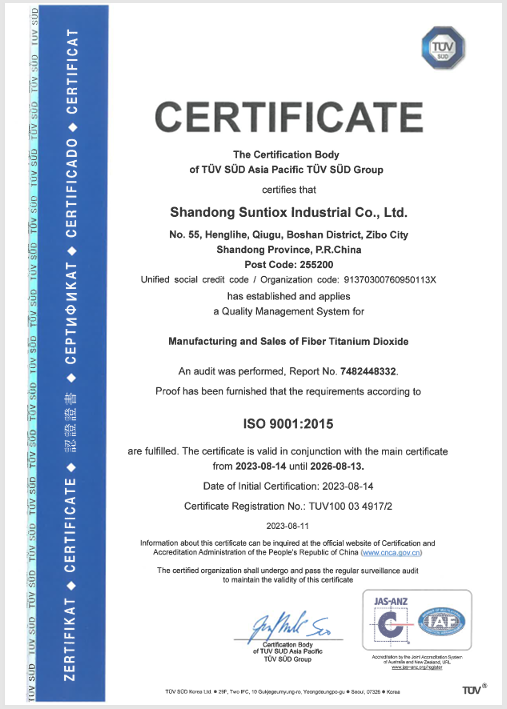
The chemical fiber grade titanium dioxide supplied by ORIENT INTERNATIONAL HOLDING SHANGHAI FOREIGN TRADE CO., LTD is produced under an ISO 9001:2015 quality management system certified by TÜV SÜD under certificate number TUV100034917/2, and the certification scope covers the production and sales of chemical fiber grade titanium dioxide. On the product side, titanium dioxide content in man-made fibers can be verified using the test method defined in the Chinese national standard GB/T 37632-2019. Every shipment is subject to a 100% pre-shipment quality test, and third-party inspection is supported on request.
2. Can an OEM or ODM requirement be accommodated for fiber grade TiO₂?
Yes. ORIENT INTERNATIONAL provides OEM and ODM production services, with customization available for polyester and nylon materials. The operation supports a monthly capacity of 1,000 MT against an annual output of 16,000 MT, with 25 R&D engineers working across a 700,000 m² production site, and export activity covering Korea, Japan, India, Indonesia and Vietnam.
3. What are the minimum order quantity, delivery terms and payment terms?
The minimum order quantity for fiber grade titanium dioxide is 1 metric ton. Delivery terms are FOB or CIF. Payment can be arranged as T/T in advance, T/T 30 days, L/C at sight, or L/C at 30, 60 or 90 days. Acceptance criteria are a 100% pre-shipment quality test, with third-party inspection supported.
4. How should a fiber producer validate a grade before scaling to full production?
Because the minimum order quantity is 1 metric ton, a producer can start with a trial-scale quantity instead of a full line commitment. The values to verify on intake are the ones that drive spinning behaviour: TiO₂ content ≥98.0%, Fe₂O₃ ≤0.004%, pH 6.8±0.2, electrical conductivity ≤230 μs/cm, sieve residue at 325 mesh ≤0.004%, and colour values of L 96.7–98.2 with b ≤0.0 for SA-50. These can be checked alongside an in-house ethylene glycol dispersion test, and a third-party inspection can be arranged before shipment. To request a quotation, a datasheet or evaluation material for a specific fiber system, contact sales@petchemical.com.
5. What is the lead time, and which markets are served?
Lead time for fiber grade titanium dioxide orders is 15–30 days. Shipments are arranged on FOB or CIF terms. Export markets for these grades include Korea, Japan, India, Indonesia and Vietnam, alongside the wider markets served by the company, including the EU, North America, South America, South East Asia and the Middle East.
Conclusion: A Crystal-Structure Decision, Confirmed by Process Data
The choice of anatase over rutile in synthetic fibers is a consequence of what the fiber line demands. Crystal structure determines whether the particle is mild enough to spare a spinneret and controllable enough to pass a filter pack; surface treatment determines whether that particle can be delivered into an organic polymer system at all; and the impurity and particle-size specification determines whether whiteness stays stable or drifts into yellowing.
For a producer working through this decision for the first time, the sequence is straightforward: define the optical target, select the grade by fiber system — SA-50 for PET whitening, SA-60 or SA-80 for matting in viscose, acrylic and nylon — verify the documented specification, run a trial at the correct dosing stage, and then judge the result on spinning indicators rather than on the datasheet alone.
Next Step
Technical datasheets, specification sheets and commercial terms for SA-50, SA-60 and SA-80 are available on request. Contact ORIENT INTERNATIONAL HOLDING SHANGHAI FOREIGN TRADE CO., LTD to discuss a grade against your specific fiber system, request a quotation, or arrange an evaluation quantity starting from the 1 metric ton minimum order.
Email: sales@petchemical.com
Tel / WhatsApp: +86 18928113542
Website: www.petchemical.com
Address: Floor 6-12, Suite B, Orient International Building, 85 Loushanguan Road, Shanghai 200336, P.R. China
Download the company profile (PDF)
Have Questions or Need More Details?
Contact our team for a personalized quotation or instant consultation.
Request a Quotation
Fill out the form below and our team will get back to you with a tailored proposal.
WhatsApp Direct Chat
Prefer to chat in real-time? Message us on WhatsApp for instant assistance & quick answers.
- Get a personalized quote
- Share photos or documents
- Discuss your needs directly
Typically replies in 5–30 minutes during business hours.