
Fiber Grade TiO₂ Selection Parameters: Content, L/b & Conductivity for PET, Nylon & Viscose
Fiber Grade TiO₂ Selection Parameters: Content, L/b & Conductivity for PET, Nylon & Viscose
Fiber grade titanium dioxide is specified by numbers, and those numbers are not interchangeable across fiber types. Two grades can both be described as anatase and both carry a TiO₂ content above 95%, yet one disperses cleanly in ethylene glycol before polycondensation while the other creates filtration load in a nylon melt line or an unstable matting level in a viscose spin bath. This guide explains how to read the parameters that actually decide performance — TiO₂ content, colour values L and b, electrical conductivity, pH, sieve residue, Fe₂O₃, moisture and specific surface area — using SA-50, SA-60 and SA-80 as reference grades for PET, nylon and viscose production.

Why Fiber Grade TiO₂ Selection Fails at the Parameter Level
Fiber grade TiO₂ decisions usually fail for four reasons, and none of them is a shortage of specifications. Every supplier publishes a data sheet; the problem is that the sheet is read the same way for a polyester polycondensation line as for a nylon melt line or a viscose spin bath.
- Selecting on TiO₂ content alone. Content tells you how much of the particle mass is titanium dioxide. It does not tell you whether the grade can be wet out in ethylene glycol, filtered at the pack, or held stable through a 240–285 °C process window.
- Reading colour value as a single number. SA-50 publishes an L window of 96.7–98.2, SA-60 publishes a floor of ≥96.5, and SA-80 publishes 92.0–97.0. A controlled window and a minimum floor describe two different supply commitments, and they are used against different product targets.
- Treating conductivity and pH as paperwork. Both are measured properties of the pigment, and both describe the soluble ionic load and surface chemistry the pigment brings into a melt or a spin bath.
- Assuming grades transfer between fiber types. A grade specified as a PET fiber whitening agent and a grade specified as a nylon matting agent are built against different downstream conditions, even when the headline TiO₂ content looks similar.
The cost of a mismatch is paid downstream on the spinning line — in filter changes, spinneret cleaning cycles, filament breaks and lot-to-lot shade variation — rather than at the purchase order stage, which is why the parameter screen has to happen before a trial batch is ordered.
Industry Background: A Standardised, Anatase-Led Category
Fiber grade titanium dioxide is a defined sub-segment of the wider TiO₂ market. Intel Market Research values the global fiber grade titanium dioxide market at USD 1.46 billion in 2024 and projects USD 1.94 billion by 2032. Within that demand, the polyester fiber segment accounts for over 60% of all fiber grade TiO₂ applications according to the same source — which is why PET-facing grades such as SA-50 sit at the centre of most fiber grade specification work.
Supply is concentrated. China's total titanium dioxide exports reached a record 1.9017 million tons in 2024, a 15.84% year-on-year increase, according to China Customs Statistics data reported by Echemi. For fiber producers outside China, that concentration makes parameter literacy a sourcing skill rather than only a technical one.
Two chemistry facts explain why the anatase crystal form dominates this segment. Anatase has a Mohs hardness of 5.5–6.0 compared with 6.0–7.0 for rutile, which means less abrasive contact with spinneret surfaces. Published industry guidance for polyester staple fibers also points to a typical particle size of 0.2–0.3 μm for optimal delustering. Both points are consistent with what the grade data shows: SA-50, SA-60 and SA-80 are all anatase grades.
At the standards level, titanium dioxide pigments are internationally standardised under ISO 591, which defines requirements for both anatase and rutile types. The textile market applies an additional input screen: ECO PASSPORT by OEKO-TEX® — Venator's HOMBITAN® LW-S 100 became the first fiber anatase TiO₂ to secure that certification in 2022, which shows how textile-facing buyers now treat fiber grade pigment as a screened input rather than a commodity filler.
How to Read the Key Selection Parameters
1. TiO₂ content: the dosage and purity benchmark
The three reference grades are specified at ≥98.0% (SA-50), ≥97.0% (SA-60) and ≥95.0% (SA-80). Everything above the TiO₂ fraction is treatment, residual impurity and surface-bound moisture carriers. At equal loading, a 98% grade delivers more pigment into the polymer than a 95% grade, so content should be read against the target matting or whitening level and the acceptable dosage, not against price per ton alone.
2. Colour value L: whiteness, and why a window differs from a floor
Colour value L describes lightness. SA-50 is published as 96.7–98.2, SA-60 as ≥96.5, and SA-80 as 92.0–97.0. The SA-50 window is the tightest and the highest of the three, which matches its role as a PET fiber whitening agent. A window tells a buyer that both the lower and upper boundary are controlled; a floor tells a buyer only that the minimum is guaranteed. Field records for SA-50 in polyester chip and fiber production describe stable whiteness with L above 96.7.
3. Colour value b: the yellowing indicator
Colour value b describes yellowness, and lower is less yellow. SA-50 is specified at ≤0.0, SA-60 at ≤0.5 and SA-80 at ≤3. A b value at or below zero describes a neutral-to-slightly-blue undertone — the direction that offsets the yellow shift a fiber can develop after heat history. This is why anti-yellowing performance is a b-value conversation rather than an L-value conversation: a bright but yellow-shifted lot can still post a high L.
4. Electrical conductivity: the ionic-load screen
Electrical conductivity (EC) is measured on an aqueous extract and reflects soluble ionic species carried on the particle surface. The published limits are ≤230 μS/cm for SA-50, ≤120 μS/cm for SA-60 and ≤100 μS/cm for SA-80. In a PET line these species enter the ethylene glycol dispersion and then the polycondensation system, so EC should be read as a grade-specific ceiling tied to its own application, and every batch should carry its own measured value on the certificate of analysis rather than an inherited type value.
5. pH value: hydrolysis and side-reaction control
SA-50 is specified at pH 6.8±0.2, SA-60 at 7.2±0.6 and SA-80 at 6.8–8.0. The SA-50 application data states that the product operates within ethylene glycol circulation and polyester polycondensation conditions with a neutral pH and superior hydrolysis resistance, which is what prevents adverse side reactions and slows the intrinsic viscosity degradation of polyester chips. pH is therefore a process-compatibility parameter, not a laboratory formality.
6. Sieve residue (325 mesh): filtration and spinneret risk
SA-50 and SA-80 are both specified at ≤0.004% residue on a 325-mesh sieve, while SA-60 is specified at ≤0.05%. Sieve residue is the oversized fraction that a filter pack or spinneret must capture. The looser limit on the viscose and acrylic matting grade reflects a different downstream filtration regime, not a quality ranking — the correct comparison is each limit against the filtration capability of the line it will run on.
7. Fe₂O₃ and moisture: the consistency variables
All three grades are specified at Fe₂O₃ ≤0.004% and moisture ≤0.40%. Iron is the most direct threat to fiber whiteness and a known concern in polymerization systems; moisture control protects both feeding accuracy and hydrolysis behaviour in the dispersion stage. That both limits are identical across the three grades is useful: it means the grades differ mainly in TiO₂ content, colour windows, EC and application role rather than in iron discipline or drying control.
8. Specific surface area: the ethylene glycol wetting indicator
SA-50 publishes a specific surface area of 8.5–10.0 m²/g; SA-60 and SA-80 do not publish this value. Surface area describes how much particle surface is available for wetting by ethylene glycol. A grade that wets poorly forms agglomerates that later appear as filter load, spinneret blockage and matting variation, so specific surface area belongs in a PET-focused parameter comparison.
Anatase Structure and Dispersion in Ethylene Glycol
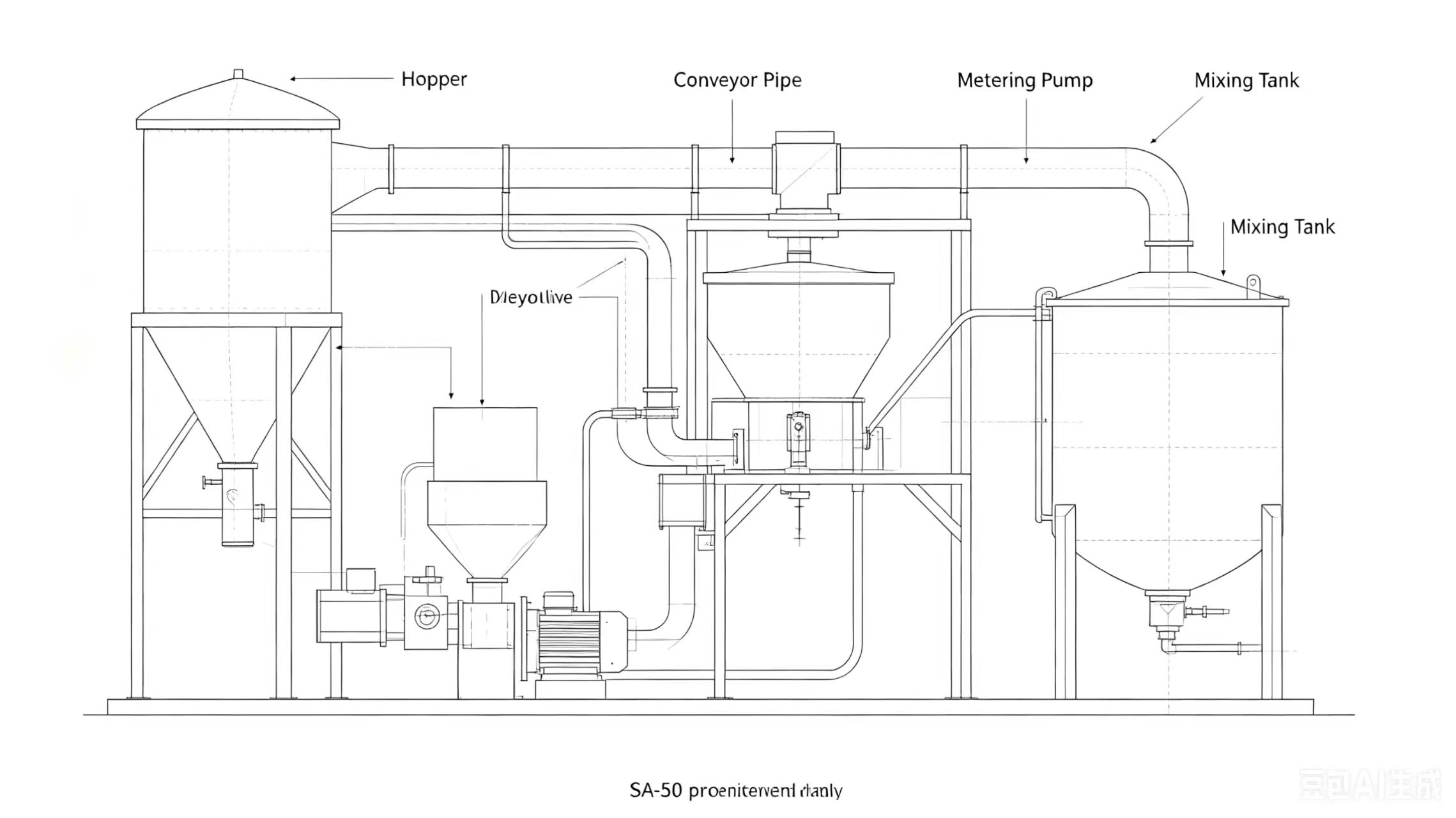
All three reference grades are anatase, which is the preferred crystal form for fiber applications because of its lower abrasiveness against spinning nozzles. In the PET route, SA-50 is first dispersed evenly in ethylene glycol with gentle stirring to form a stable suspension without sedimentation before polymerization. The suspension is then pumped into the PET esterification reactor and blended uniformly into the polyester system at 240–285 °C without interfering with the polymerization reaction or the intrinsic viscosity, forming matte PET chips with a stable internal structure. During spinning, well-dispersed powder prevents spinneret clogging and filament breakage, which is what allows long-time continuous high-speed production.
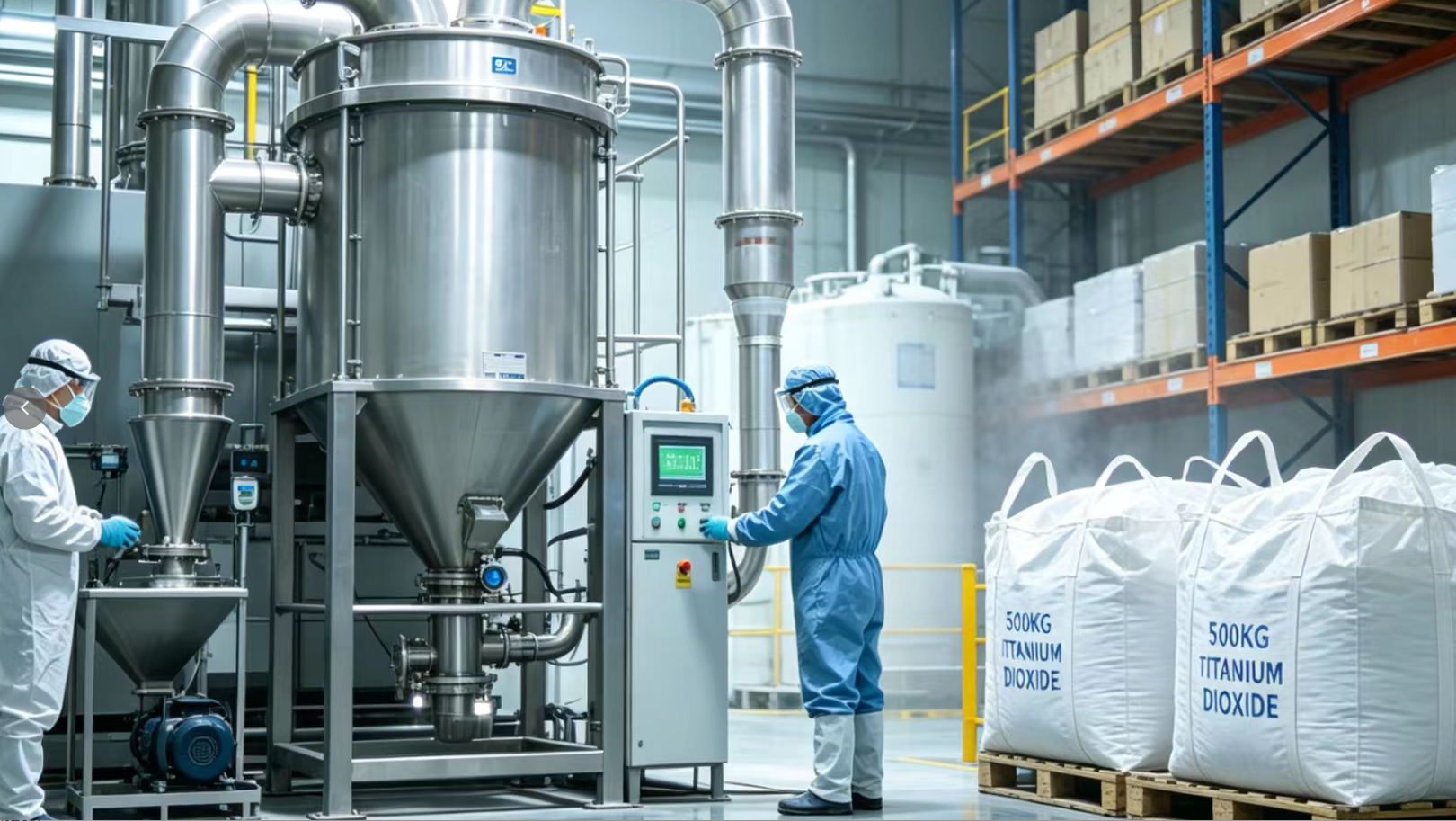
Dispersion quality is not only a pigment property — it is a pigment-plus-process property. The published application requirements for SA-50 call for closed vacuum feeding to prevent moisture and impurities, dispersion in ethylene glycol at 40–60 °C with low-speed stirring to avoid agglomeration, steady and uniform feeding during polymerization, a reaction temperature kept below 290 °C to protect PET viscosity, avoidance of high-ion additives to prevent side reactions, storage in a dry environment with humidity ≤65% and tightly sealed packages, and no mixing with hard fillers to limit equipment wear and filter blockage. The supporting equipment named for this scenario is a titanium dioxide continuous feeding dispersion system.
Grade Fit: SA-50 for PET, SA-60 for Viscose and Acrylic, SA-80 for Nylon
The three grades are not a ladder from entry level to premium; they are three different application targets with their own parameter windows.
SA-50 is a PET fiber whitening agent for polyester manufacturing. Its function in polyester production is matting, improving fiber whiteness and enhancing smoothness. It is the only grade of the three with a published specific surface area (8.5–10.0 m²/g), the highest TiO₂ content (≥98.0%), the highest L window (96.7–98.2) and a b value at or below zero.
SA-60 is a matting agent for viscose and acrylic fiber. Its published profile includes TiO₂ ≥97.0%, pH 7.2±0.6, EC ≤120 μS/cm, L ≥96.5 and b ≤0.5. Compared with SA-50, the pH is tighter around neutral-alkaline and the b ceiling is looser, which matches a matting target in a wet-spinning route rather than a maximum-whiteness target in a polymerization route.
SA-80 is a matting agent for nylon. It publishes TiO₂ ≥95.0%, pH 6.8–8.0, EC ≤100 μS/cm, L 92.0–97.0 and b ≤3. The wider colour window and lower TiO₂ content reflect a controlled matte level in polyamide rather than a whitening target, and the lowest EC ceiling of the three grades reflects how sensitive polyamide processing is to ionic contamination in the melt.
Step-by-Step: Reading a Fiber Grade Spec Sheet and Validating It on Your Line
- Confirm crystal structure and grade role first. Anatase is the expected crystal form for fiber grades; the stated application (PET fiber whitening, nylon matting, viscose and acrylic matting) tells you which downstream conditions the limits were set against.
- Match TiO₂ content to your dosage and target. Compare ≥98.0%, ≥97.0% and ≥95.0% against the matting or whitening level you need and the loading your process can accept.
- Read L and b together, and identify window versus floor. A window such as 96.7–98.2 constrains both ends; a floor such as ≥96.5 constrains only the minimum.
- Convert sieve residue into filter and spinneret risk. Compare the ≤0.004% and ≤0.05% limits against the micron rating of your filter pack and your spinneret change interval.
- Read EC and pH as your ionic and hydrolysis screen. Request measured batch values, not type values, and compare them with the conductivity history your polymerization system already tolerates.
- Confirm Fe₂O₃ and moisture on every batch. Both are specified at Fe₂O₃ ≤0.004% and moisture ≤0.40% across the three grades; holding suppliers to the same limits on each delivery is what protects shade consistency.
- Match the grade to your dispersion hardware and process window. For PET this means ethylene glycol pre-dispersion at 40–60 °C with low-speed stirring, closed vacuum feeding, steady feeding during polymerization, a reaction temperature below 290 °C, no mixing with hard fillers, and storage at humidity ≤65% in sealed packaging.
- Validate on a trial batch before scaling. Check dispersion stability in ethylene glycol, confirm there is no sedimentation or agglomeration, then run the trial through your normal polymerization and spinning conditions and compare L, b and filtration behaviour against your current reference.
Use Cases: What These Parameters Look Like in Production
In polyester chip and fiber production, the parameters above translate directly into line behaviour. Supply records covering over 5,000 MT of SA-50 delivered to a Chinese polyester producer over a period of more than ten years describe even dispersion without black spots or crystal points and a stably adjustable matting degree. Low impurities kept PET intrinsic viscosity steady with good melt fluidity, and whiteness held stable with L above 96.7 and strong anti-yellowing performance.
On the spinning side, the same records report lower filament breakage rates and longer service cycles for spinnerets and filters, supporting longer continuous production runs. Spinneret clogging cycles were extended by over 40%, filter replacement frequency was greatly reduced, and the filament breakage rate dropped by about 35%. The matte surface was uniform without bright spots, dyeing was consistent without colour streaks, particle adhesion was firm enough to prevent powder fall-off during weaving and dyeing, and heat and weather resistance held up in downstream processing.
For nylon, the relevant screen is the SA-80 profile: TiO₂ ≥95.0%, EC ≤100 μS/cm and a b ceiling of ≤3, read against a controlled matte level rather than a maximum-whiteness target. For viscose and acrylic, the relevant screen is the SA-60 profile: TiO₂ ≥97.0%, pH 7.2±0.6, EC ≤120 μS/cm, L ≥96.5 and b ≤0.5, plus a sieve residue limit of ≤0.05% that must be compared with the filtration capability of the wet-spinning route.
Producers running recycled PET feedstock carry a higher incoming contamination load into the same polymerization system, which makes the pigment's own contribution to ionic load and filtration more important rather than less. For those lines, electrical conductivity, pH and sieve residue are the first three columns to compare between candidate grades.
Comparison Table: SA-50 vs SA-60 vs SA-80
| Selection parameter | SA-50 | SA-60 | SA-80 |
|---|---|---|---|
| Crystal structure | Anatase | Anatase | Anatase |
| Specified grade role | PET fiber whitening agent | Matting agent for viscose and acrylic | Matting agent for nylon |
| Primary fiber fit | Polyester (PET) chip, filament and staple fiber | Viscose and acrylic fiber | Polyamide (nylon) fiber |
| TiO₂ content | ≥98.0% | ≥97.0% | ≥95.0% |
| Sieve residue (325 mesh) | ≤0.004% | ≤0.05% | ≤0.004% |
| Moisture (105 °C) | ≤0.40% | ≤0.40% | ≤0.40% |
| Fe₂O₃ content | ≤0.004% | ≤0.004% | ≤0.004% |
| pH value | 6.8±0.2 | 7.2±0.6 | 6.8–8.0 |
| Electrical conductivity | ≤230 μS/cm | ≤120 μS/cm | ≤100 μS/cm |
| Specific surface area | 8.5–10.0 m²/g | Not published | Not published |
| Colour value L | 96.7–98.2 | ≥96.5 | 92.0–97.0 |
| Colour value b | ≤0.0 | ≤0.5 | ≤3 |
From Parameter Fit to Supply Fit
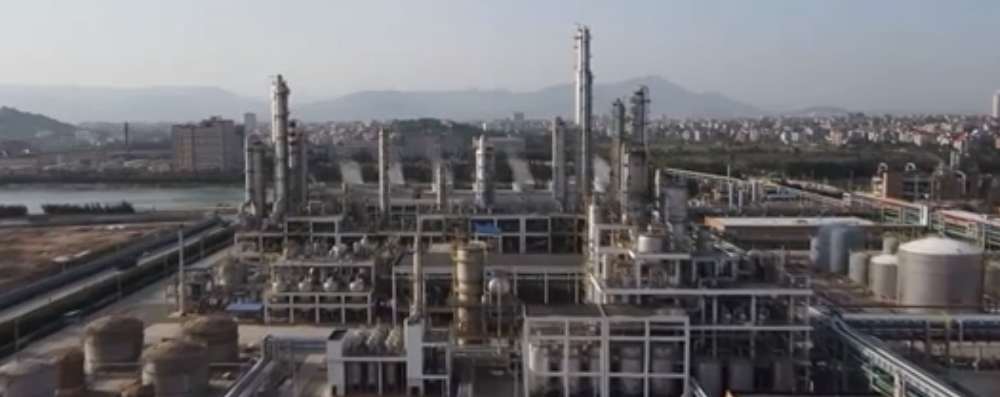
Parameter fit answers whether a grade can work; supply fit answers whether the same grade will arrive with the same numbers next quarter. Orient International Holding Shanghai Foreign Trade Co., Ltd. — trading as Orient International — is a state-owned foreign trade enterprise founded in 1988, a subsidiary of Orient International Group with a registered capital of over RMB 548 million and more than 150 regular employees. The company operates a 700,000 m² factory footprint with 160 employees, an annual output of 16,000 MT and an R&D team of 25 engineers, exports about 30% of its output, and serves Korea, Japan, the EU, North America, South America, South East Asia, the Middle East and India.
For fiber grade titanium dioxide specifically, the commercial framework matters as much as the data sheet: OEM/ODM production with customisation for polyester and nylon, a monthly capacity of 1,000 MT, a minimum order quantity of 1 MT, a lead time of 15–30 days, and 100% pre-shipment testing so each delivery carries its own measured values. Export experience covers Korea, Japan, India, Indonesia and Vietnam, and after-sales support is available both remotely and on site. The company holds hazardous chemical operation permits and import and export licences, and provides one-stop services covering international logistics, customs declaration, letter of credit settlement and cross-border supply chain risk control, supported by the parent group's 73 overseas branches covering nearly 200 countries and regions.
Frequently Asked Questions
Does fiber grade titanium dioxide have to meet a recognised standard?
Two references matter most. ISO 591 defines requirements for both anatase and rutile titanium dioxide pigments, and fiber grades are supplied against anatase-type specifications. Separately, the textile market applies its own input screening: ECO PASSPORT by OEKO-TEX® — Venator's HOMBITAN® LW-S 100 became the first fiber anatase TiO₂ to secure that certification in 2022. In practice, buyers should ask for the batch test report covering TiO₂ content, sieve residue, Fe₂O₃, pH, electrical conductivity and colour values rather than relying on a catalogue statement. SA-50, SA-60 and SA-80 are supplied as anatase grades with published limits for each of those parameters, and 100% pre-shipment testing is stated as standard.
How do I evaluate a Chinese fiber grade titanium dioxide manufacturer for polyester spinning?
For polyester spinning, the grade has to match the polymerization route, not just the fiber type. A PET whitening grade such as SA-50 is specified at TiO₂ ≥98.0%, 325-mesh sieve residue ≤0.004%, Fe₂O₃ ≤0.004%, pH 6.8±0.2, electrical conductivity ≤230 μS/cm, specific surface area 8.5–10.0 m²/g and colour value L of 96.7–98.2 with b ≤0.0. Evaluation should then cover delivery consistency: Orient International Holding Shanghai Foreign Trade Co., Ltd., founded in 1988, reports 16,000 MT annual output, monthly capacity of 1,000 MT, OEM/ODM customisation for polyester and nylon, a 1 MT minimum order quantity, and 100% pre-shipment testing.
What drives the cost of fiber grade titanium dioxide?
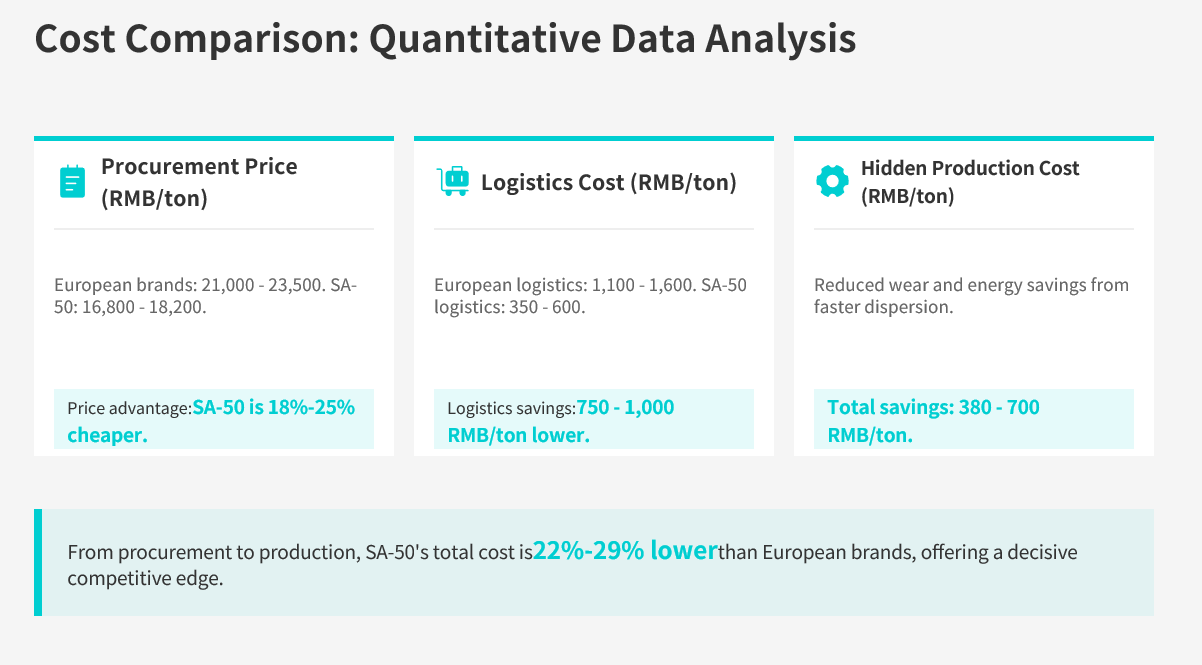
Cost tracks the parameter set. TiO₂ content is the clearest driver: SA-50 is specified at ≥98.0%, SA-60 at ≥97.0% and SA-80 at ≥95.0%, so a matting grade is not interchangeable with a whitening grade on a per-kilogram basis. Secondary cost drivers are impurity control (Fe₂O₃ ≤0.004% across all three grades), electrical conductivity limits, sieve residue, moisture control at ≤0.40%, colour-value windows, packaging format and logistics into the destination market. Quotations should be compared at equal dosage and equal parameter limits: a cheaper grade that needs a higher loading, more frequent filter changes or faster spinneret replacement shifts cost into the spinning line rather than out of the purchase order.
Can we validate a fiber grade on a sample before committing to production?
Yes, and the validation should mirror the production route. For PET, the accepted practice is to disperse the grade in ethylene glycol at 40–60 °C with low-speed stirring to form a stable suspension, check that it does not sediment or agglomerate, then feed it into the esterification reactor, where it is blended at 240–285 °C with the reaction held below 290 °C. Grades for viscose and acrylic such as SA-60, and for nylon such as SA-80, are checked against their own windows — TiO₂ content, sieve residue, pH, electrical conductivity and colour values. Orient International supports this step with a 1 MT minimum order quantity and both remote and on-site after-sales support.
What lead time should a fiber producer plan for?
For the three reference grades, Orient International quotes a lead time of 15–30 days, against a 1 MT minimum order quantity and a monthly capacity of 1,000 MT. Export experience covers Korea, Japan, India, Indonesia and Vietnam, with the wider company profile covering the EU, North America, South America, South East Asia, the Middle East and India. Because parameter fit and supply fit are decided together, the practical next step is to request a sample of the grade matched to your fiber route, confirm your dispersion and filtration conditions against the relevant limits, and then agree the batch test criteria before the first production order.
Next Step: Match the Grade to Your Line
SA-50 for polyester, SA-60 for viscose and acrylic, SA-80 for nylon — each with its own TiO₂ content, colour windows, conductivity ceiling and sieve residue limit. If you are comparing fiber grade titanium dioxide for a PET, nylon or viscose line, request a sample and the current batch test data, or review the full product and service profile first.
Download the Orient International company brochure (PDF)
Contact: Alex Wu — sales@petchemical.com — +86 18928113542 — www.petchemical.com
Address: Floor 6-12, Suite B, Orient International Building, 85 Loushanguan Road, Shanghai 200336, P.R. China
Conclusion
Fiber grade titanium dioxide selection comes down to reading a specification against a process. TiO₂ content sets the dosage benchmark at ≥98.0% for SA-50, ≥97.0% for SA-60 and ≥95.0% for SA-80. Colour values L and b must be read as a pair, and as either a controlled window (96.7–98.2 on SA-50) or a floor (≥96.5 on SA-60) depending on the grade. Electrical conductivity and pH describe what the pigment brings into the melt or spin bath — the neutral pH and hydrolysis resistance specified for SA-50 are what protect intrinsic viscosity in polyethylene terephthalate polycondensation, while the tighter EC ceilings on SA-60 and SA-80 reflect different downstream sensitivity. Sieve residue, Fe₂O₃ at ≤0.004% and moisture at ≤0.40% are the consistency variables that decide whether the second delivery behaves like the first. Applied to PET, nylon, viscose and acrylic production formats, these parameters turn a data sheet into a grade decision.