
Fiber Grade TiO₂ for PET: Stopping Black Spots and Viscosity Fluctuation
A PET polymerization line rarely goes off-spec because of the catalyst. When black spots, crystal points or a slowly drifting intrinsic viscosity (IV) start showing up on a semi-dull or full-dull chip line, the first item an experienced polymerization engineer pulls from the process is the matting agent — the fiber grade titanium dioxide that has been dosed into the glycol batching system.
The TiO₂ answer to both defects is a grade that disperses completely in ethylene glycol, resists hydrolysis while it sits in the dispersion stage, presents a neutral pH, and is delivered by continuous feeding rather than slug dosing. SA-50, the polyester-specific anatase grade supplied by ORIENT INTERNATIONAL, is built around exactly those mechanisms: a polyester-specific organic coating applied with Japanese refined dry modification technology, dual compatibility with ethylene glycol and polyester resin, a TiO₂ content of ≥99.4% with low iron and low conductivity, and a documented behaviour of stable PET viscosity without black spots or crystal points during polymerization.
This article is written for polymerization engineers, quality managers and procurement teams who have already shortlisted fiber grade titanium dioxide and need to make a decision. It covers the root causes of black spots and viscosity fluctuation, how an organic-coated grade such as SA-50 addresses them, the continuous TiO₂ feeding and dispersion system required to capture the benefit, and how SA-50 compares with European inorganic-coated grades including Kronos 1071 and Venator LW-S100 on both spinning performance and total cost.
Why Black Spots and Viscosity Fluctuation Appear in PET Polymerization
Black spots, crystal points and viscosity fluctuation are downstream symptoms of upstream dosing and dispersion problems. The polymerization reaction itself is usually not the variable; the solids delivered into the melt are. Four mechanisms account for most of what engineers see on the line.
1. Agglomerates that survive the filter
TiO₂ that is not fully wetted in the glycol slurry forms clusters. Large clusters are caught by the melt filter, but mid-size clusters can pass through and appear in the filament as discrete optical defects — dark spots in reflected light, bright crystal points in transmitted light. The filter does not fail; it simply stops being a complete safety net.
2. Coating hydrolysis in the glycol slurry
An inorganic coating can degrade during the batching stage, particularly when the slurry is heated for pre-infiltration. Once the coating breaks down, the released fines change the dispersion state of the whole batch, and the melt carries an inconsistent particle population into the spinning head. This is the point where hydrolysis resistance and a neutral pH stop being marketing words and become process parameters.
3. Moisture pick-up and dust during feeding
Fiber grade titanium dioxide is hygroscopic at the surface. Moisture-induced agglomeration is the most common handling risk: it blocks feeders, creates lumps that never disperse, and introduces uncontrolled variation between batches. Powder dust released during open feeding creates a second problem — an inhalation risk that also signals an uncontrolled material flow.
4. Non-continuous dosing
Batch dosing of TiO₂ into the polymerization line produces a varying solids content inside the melt. Matting level shifts, and because IV measurement is sensitive to the whole melt stream, the viscosity record drifts with it. Fluctuation is therefore often a dosing problem wearing a chemistry costume.
Where Fiber Grade TiO₂ Supply Stands in 2026
Supply-side context matters for the decision because a technically correct grade still has to arrive on time and on specification. Three verified data points frame the current situation.
- The global titanium dioxide market is projected to reach USD 24.4 billion in 2026, according to Grand View Research, with the anatase segment — the segment that matters for fiber grade — expected to grow at a CAGR of 7.3% from 2026 to 2033.
- China's effective annual TiO₂ production capacity fell from 5.9 million tons in 2024 to 5.7 million tons in 2025, a first-time contraction reported by SunSirs and the Titanium Dioxide Alliance.
- At the same time, China's total TiO₂ export volume reached 1.9017 million tons in 2024, a 15.84% year-on-year increase.
The interpretation for a fiber producer is straightforward. Capacity is consolidating while export volume keeps rising, which means global spinning lines remain dependent on Chinese supply even as the number of qualified producers shrinks. Buyers who secure a stable relationship with a large-scale exporter early are less exposed when capacity tightens.
On the specification side, fiber grade titanium dioxide is not a generic powder. Textile-grade material typically requires a particle size (D50) averaging around 0.28 μm, with 90% of particles falling within 0.1–0.5 μm. In China, the national standard GB/T 37632-2019, issued by the Standardization Administration of China, establishes the test method for titanium dioxide content in man-made fibers — the reference buyers use when they verify incoming material.
The TiO₂ Solution: How SA-50 Controls Both Defects
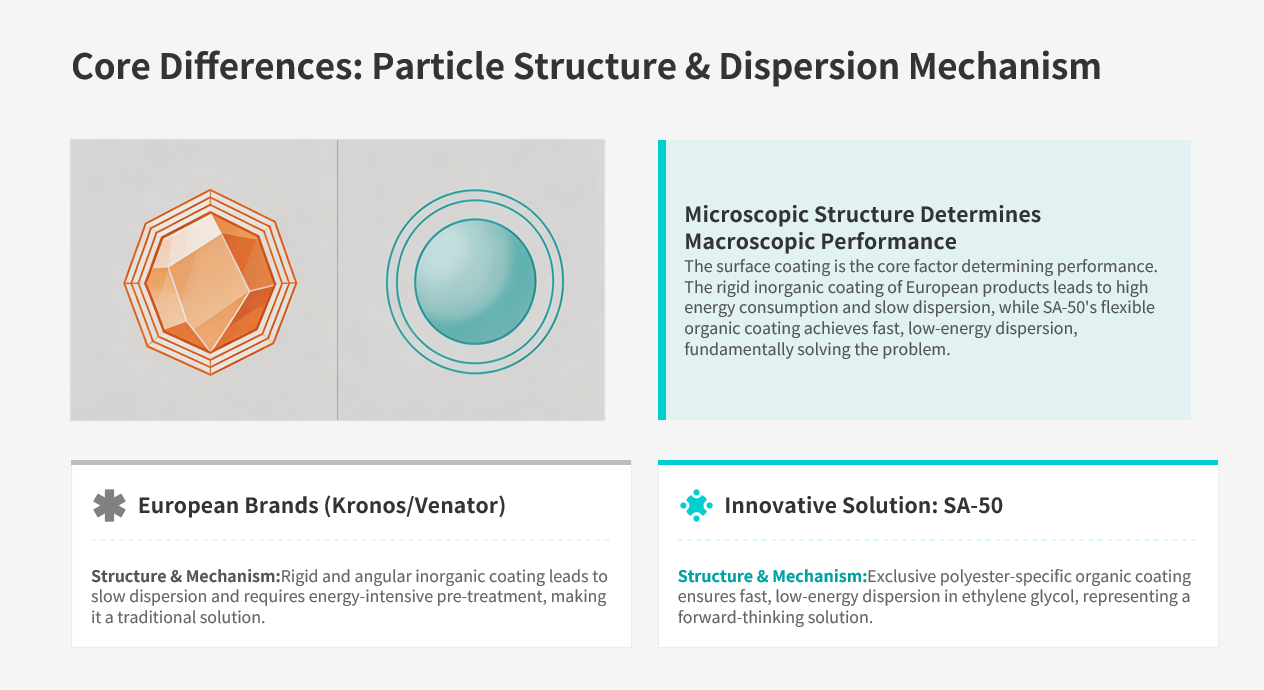
SA-50 is a polyester-specific anatase fiber grade titanium dioxide. The difference from traditional European inorganic-coated grades is not the TiO₂ core; it is what is built around the core.
The coating is the difference
The core difference is SA-50's exclusive polyester-specific special organic coating, produced with Japanese refined dry modification technology, versus the traditional silicon-aluminium inorganic double coating used by Kronos and Venator. That coating delivers dual compatibility with ethylene glycol and polyester resin, so the pigment disperses rapidly without pre-infiltration. In practice this removes the 2–4 hour heating and infiltration step that inorganic-coated material requires at 40–60 °C before it can be reliably dosed.
Hydrolysis resistance and neutral pH
SA-50's coating is engineered for hydrolysis resistance — the property that decides whether a TiO₂ particle survives the warm glycol slurry with its surface intact. The grade also presents a neutral pH, which limits the acid- or base-driven side reactions that can accelerate coating breakdown and introduce shade and viscosity drift into the melt. Together, hydrolysis resistance and neutral pH are what allow the particle surface to stay unchanged between the storage bag and the spinneret.
Purity, iron and conductivity
SA-50 is specified with a TiO₂ content of ≥99.4%, low iron and low conductivity. Low iron matters because iron species are the common trigger for yellowing and for uncontrolled side reactions in the melt; low conductivity matters because ionic load interferes with clean dispersion behaviour. With this purity profile, SA-50 keeps PET viscosity stable without black spots or crystal points during polymerization.
What it means on the line
Batch stability fluctuation with SA-50 runs 1%–3% lower than European grades — a difference the supplier describes as negligible for normal production, but one that compounds over a long production campaign. Combined with a smoother particle surface, the practical results reported for the grade include stable PET viscosity, no black spots or crystal points during polymerization, and a melt stream that behaves predictably from the first shift of a campaign to the last.
Setting Up a Continuous TiO₂ Feeding and Dispersion System
A coating that disperses without pre-infiltration still needs a feeding system that does not undo it. The following sequence is the standard arrangement for capturing the SA-50 benefit on a continuous PET line.
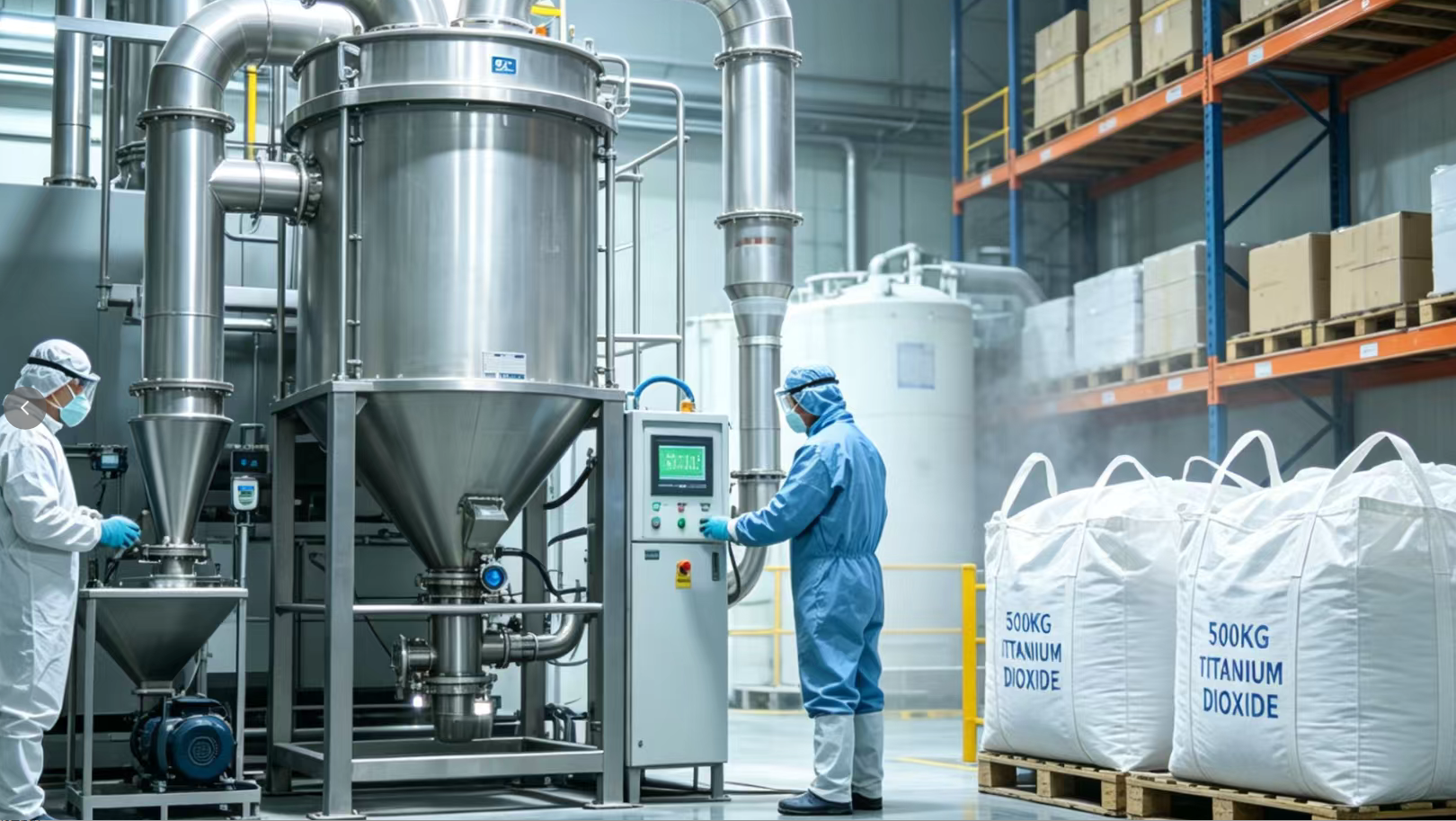
- Receiving and dry storage. Keep packaged material sealed and warehouse humidity below 65%. Moisture-induced agglomeration starts in storage, not in the reactor. Products are supplied in sealed 25 KG and 500 KG packaging for this reason.
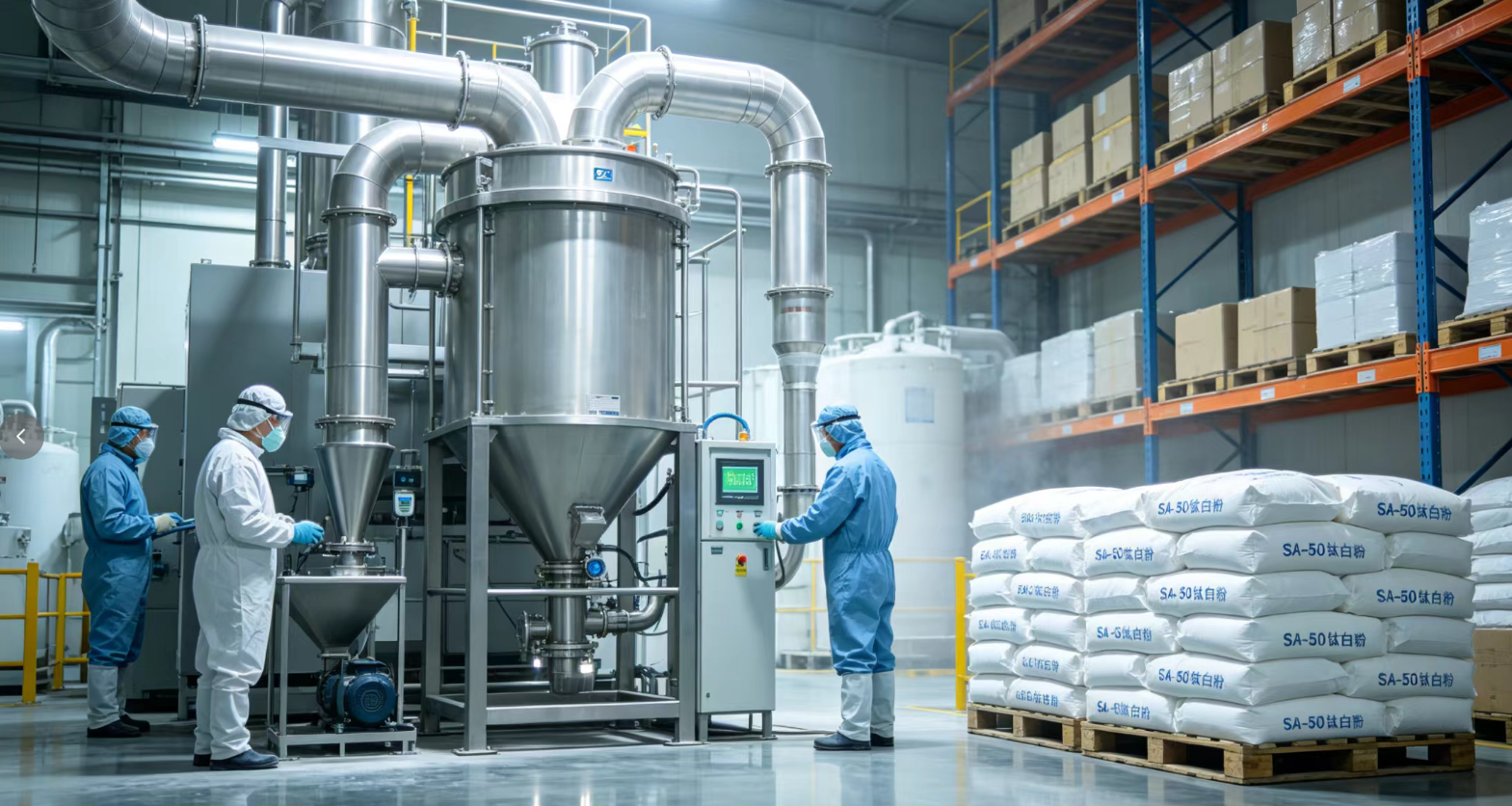
- Vacuum closed feeding. Transfer material from the bag or silo through a vacuum closed feeding system to prevent dust dispersion. This removes the powder inhalation risk for operators and keeps the material flow uniform, which is the precondition for a stable dosing rate.
- Ethylene glycol dispersion. Disperse SA-50 directly into the glycol batching tank at ambient temperature. No heating pretreatment is required. Glycol batching power consumption drops to 6–11 kWh/MT against 18–26 kWh/MT for inorganic-coated grades that require heating and infiltration — a 55%–62% energy saving — with cleaning power reduced from 5–9 kWh/MT to 2–4 kWh/MT.
- Continuous dosing into the polymerization line. Meter the dispersion into the process at a controlled continuous rate instead of dosing per batch. Continuous feeding is what holds TiO₂ solids content steady, and steady solids content is what holds viscosity steady.
- Filtration and spinning. With well-dispersed material, the melt filter cycle extends from 7–9 days to 10–12 days, and spinneret abrasion drops 3%–8%. Spinneret replacement frequency falls by 40% and filter consumption by 25%.
- Batch verification. Verify TiO₂ content against the applicable test method (in China, GB/T 37632-2019) and record viscosity and defect counts per batch. This closes the loop: a defect that recurs after a supplier change is a dispersion or feeding issue, not a reactor issue.
Where This Matters Most
SA-50 is best suited to four production situations, all of which share the same sensitivity to particle surface quality.
- PET in-reactor polymerization matting. Mass production of semi-dull and full-dull PET chips, optimized for the ethylene glycol pre-dispersion feeding route and matched to high-speed POY, FDY and DTY continuous spinning.
- High-grade light-colour and pure-white polyester fabrics. SA-50 delivers a cool blue-white shade (b-value ≤ −0.4) versus the warm yellow tone of European products (b-value +0.8 to +1.7). For pure white, light grey and bright-colour textiles, that difference removes the yellowish cast that otherwise has to be corrected downstream.
- Long-cycle, high-yield continuous lines. The special organic coating gives a smoother particle surface, reducing spinneret abrasion by 3%–8% and lowering filter blockage frequency — appropriate for 7×24 continuous mass production where unscheduled downtime is the largest cost.
- Cost-sensitive global PET markets. The grade is adapted for large-scale polyester plants in China, Southeast Asia, India, Korea and the Middle East, and supports fast delivery with flexible trial orders.
SA-50 vs European Inorganic-Coated Fiber Grade TiO₂
The comparison below uses the published comparison of SA-50 against European inorganic-coated fiber grade references, Kronos 1071 and Venator LW-S100. Only parameters that have been stated for both sides are listed.
| Parameter | SA-50 fiber grade TiO₂ | European inorganic-coated reference grades (Kronos 1071 / Venator LW-S100) |
|---|---|---|
| Coating structure | Polyester-specific organic coating, Japanese refined dry modification technology | Traditional silicon-aluminium inorganic double coating with general organic modification |
| EG compatibility | Dual compatibility with ethylene glycol and polyester resin; no pre-infiltration | Requires 2–4 h pre-heat infiltration at 40–60 °C |
| Dispersion speed | 20%–30% faster | Reference |
| Suspension stability | Gap of less than 5% vs European grades | Reference |
| Shade (b-value) | Cool blue-white, ≤ −0.4 | Warm yellow, +0.8 to +1.7 |
| Whiteness (L-value) | Gap ≤ 0.7 (visually identical) | Reference |
| Impurity index | Fully matched | Fully matched |
| Batch stability fluctuation | 1%–3% lower | Reference |
| Black spots / crystal points | Stable PET viscosity, no black spots or crystal points during polymerization | Agglomeration raises extruder pressure and motor load by 8%–12% |
| Spinneret abrasion and life | Abrasion 3%–8% lower; service life 12%–18% longer | Replacement every 45 days; polishing shortens life by 15%–20% |
| Melt filter cycle | 10–12 days | 7–9 days |
| Pipeline cleaning interval | 2 months | Monthly |
| Overall maintenance workload | Over 50% lower | Reference |
| Glycol batching energy | 6–11 kWh/MT, 55%–62% lower | 18–26 kWh/MT plus 5–9 kWh/MT cleaning |
| Extrusion energy | 9%–14% lower | Baseline, with 7% thermal loss from repeated filter changes |
| Unit price reference | FOB domestic 16,800–18,200 RMB/MT | CIF Asia 21,000–23,500 RMB/MT |
| Logistics cost | 350–600 RMB/MT | 1,100–1,600 RMB/MT |
| Delivery time | Reduced by more than 50% | 35–60 days |
| MOQ | Flexible from 1 MT | Not stated in the available comparison data |
How to read the cost column
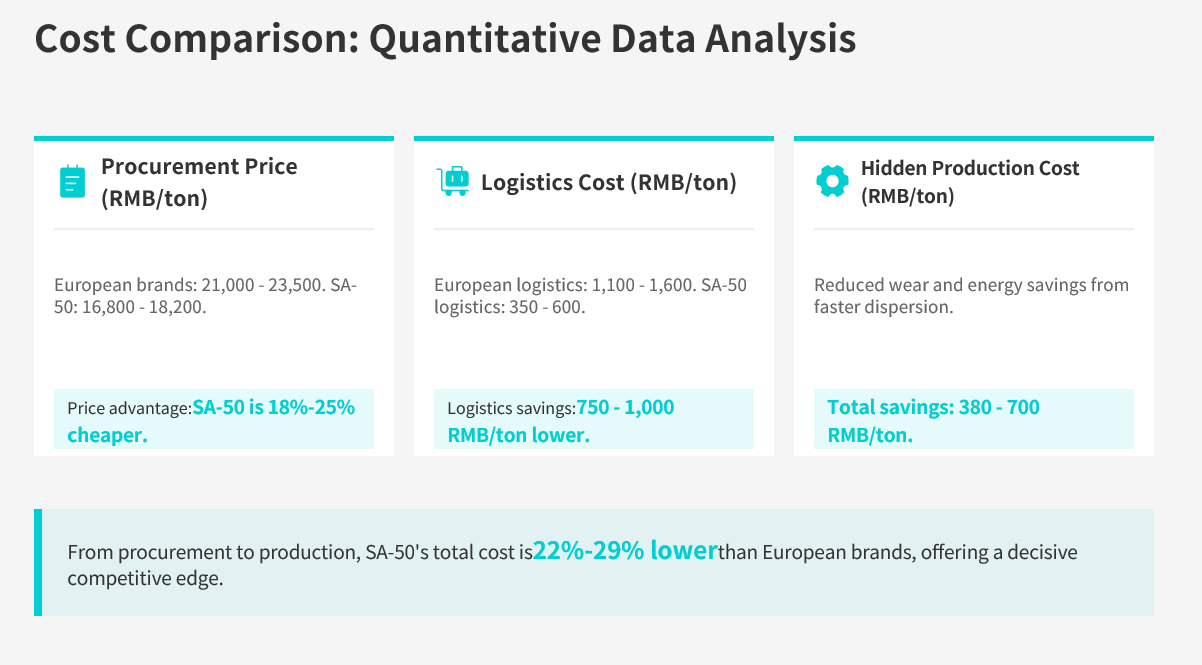
The unit price gap is 4,200–5,300 RMB/MT, and the logistics gap is a further 750–1,000 RMB/MT, because European material carries ocean freight, insurance and port fees of 1,100–1,600 RMB/MT while short-sea or domestic logistics runs at 350–600 RMB/MT. Hidden production savings add another 380–700 RMB/MT from reduced spinneret wear and faster dispersion, plus 120–220 RMB/MT from lower labour and energy in batching. Overall, the total comprehensive cost of SA-50 is 22%–29% lower than European imported TiO₂. On a 10,000 MT annual bulk order, that totals more than RMB 4.5 million. Faster delivery also halves the capital occupation cycle.
Two caveats belong in the decision. First, whiteness and impurity index are effectively matched between the two options, so the choice should not be made on those parameters. Second, the advantage sits in long-cycle, continuous, light-colour production; a line that runs short campaigns on dark shades has less exposure to the spinneret and filter benefits and should weigh the cost gap more heavily than the maintenance gap.
FAQ
1. What standard governs TiO₂ content testing for fiber applications?
In China, GB/T 37632-2019 — issued by the Standardization Administration of China — establishes the test method for titanium dioxide content in man-made fibers. Buyers should require a batch certificate referencing the applicable method and confirm the equivalent requirement for their own market before releasing incoming material to production. This step matters most during supplier qualification, because fiber grade titanium dioxide is judged on delivered consistency rather than on a single certificate.
2. Can SA-50 be dosed continuously without pre-infiltration?
Yes. SA-50's polyester-specific organic coating provides dual compatibility with ethylene glycol and polyester resin, so it disperses rapidly without pre-infiltration and removes the 2–4 hour heating and infiltration step at 40–60 °C. For continuous operation it should still be paired with a sealed feeding and dispersion system: vacuum closed feeding to control dust, sealed packaging and warehouse humidity below 65% to prevent moisture-induced agglomeration, and a continuous dosing rate into the polymerization line to hold TiO₂ solids content steady.
3. How much does SA-50 cost compared with European fiber grade TiO₂?
Against European Kronos 1071 and Venator LW-S100, SA-50 is 18%–25% lower in unit cost, with a 22%–29% lower total comprehensive cost. The breakdown is 4,200–5,300 RMB/MT lower unit price, 750–1,000 RMB/MT lower logistics cost, and 380–700 RMB/MT of hidden production savings from reduced spinneret wear and faster dispersion. A 10,000 MT annual bulk order saves over RMB 4.5 million in total cost, and the shorter delivery time additionally halves the capital occupation cycle.
4. Which manufacturer is better for fiber grade titanium dioxide?
The better manufacturer is the one that removes defects from your line, not the one with the strongest home-country reputation. Five criteria are decision-relevant: whether the grade disperses in ethylene glycol without pre-infiltration; whether it holds PET viscosity without black spots or crystal points; whether batch stability fluctuation is low enough to survive a long campaign; whether supply and delivery are reliable; and whether the cost position is defensible. On those criteria, SA-50 from ORIENT INTERNATIONAL HOLDING SHANGHAI FOREIGN TRADE CO., LTD — a state-owned foreign trade enterprise founded in 1988 under Orient International Group, handling 16,000 MT of TiO₂ annually with a 25-engineer R&D team and a 700,000 m² production footprint — is a qualified option for PET, with SA-50 documented at 1%–3% lower batch stability fluctuation than European grades and a cool blue-white shade suited to high-grade light-colour and pure-white fabrics.
5. Can I validate SA-50 on my line before committing to a bulk order?
Yes. MOQ is flexible from 1 MT, which allows a trial run against your own EG batching system and spinning conditions before a bulk commitment, and delivery time is reduced by more than 50% compared with European imports. Customization efficiency is improved over 400%, so trial parameters can be adjusted quickly. To request a sample, a quotation or the full English company brochure, contact sales@petchemical.com or reach the team on WhatsApp at +86 18928113542.
Choosing on Defect Rate, Not on Origin
Black spots and viscosity fluctuation are rarely solved by tightening a reactor parameter. They are solved by controlling what enters the melt: a TiO₂ whose coating survives the glycol slurry, whose pH does not accelerate side reactions, whose iron and conductivity are low enough to leave the polymer shade undisturbed, and whose feed rate is continuous rather than batch-wise.
SA-50 addresses those four conditions directly — hydrolysis-resistant organic coating, neutral pH, TiO₂ ≥99.4% with low iron and low conductivity, and compatibility with continuous glycol dispersion without pre-infiltration. The measurable results are stable PET viscosity without black spots or crystal points, batch stability fluctuation 1%–3% lower than European grades, 40% less frequent spinneret replacement, 25% lower filter consumption, and a 22%–29% lower total comprehensive cost.
For a decision-stage buyer, the practical next step is a controlled trial: run a 1 MT trial lot through your existing batching system, log defect counts and viscosity per batch for one campaign, and compare it against your current grade on the same line conditions. That single campaign will answer the question more reliably than any specification sheet.
Request a sample, a quotation or the full brochure
ORIENT INTERNATIONAL HOLDING SHANGHAI FOREIGN TRADE CO., LTD supplies fiber grade titanium dioxide to Korea, Japan, the EU, North America, South America, South East Asia, the Middle East and India.
Email: sales@petchemical.com | WhatsApp / Tel: +86 18928113542 | Website: www.petchemical.com
Download the English company brochure: ORIENT INTERNATIONAL Company Profile (PDF)
Address: Floor 6-12, Suite B, Orient International Building, 85 Loushanguan Road, Shanghai 200336, P.R. China.
Have Questions or Need More Details?
Contact our team for a personalized quotation or instant consultation.
Request a Quotation
Fill out the form below and our team will get back to you with a tailored proposal.
WhatsApp Direct Chat
Prefer to chat in real-time? Message us on WhatsApp for instant assistance & quick answers.
- Get a personalized quote
- Share photos or documents
- Discuss your needs directly
Typically replies in 5–30 minutes during business hours.