
Fiber Grade TiO₂ Compliance: Regional Acceptance Standards for PET, Nylon and Viscose

A fiber grade titanium dioxide that passes incoming inspection at one spinning plant can fail at another plant in a different market, with no change to the pigment. The variable is the acceptance frame: the test method that defines TiO₂ content, the convention used to report colour, the conductivity and pH window the polymerization line can tolerate, and whether the shipment arrives with 100% pre-shipment test evidence or only a batch certificate.
This guide is written for buyers at the decision stage — spinners and compounders who already know they need anatase fiber grade TiO₂ and now have to make a specific grade clear a specific set of regional acceptance requirements across PET, nylon and viscose lines in China, India, Indonesia, South Korea, Bangladesh, Turkey, Saudi Arabia and Brazil. It sets out the parameters that decide acceptance, the verification steps that prevent disputes, and the commercial terms that have to be agreed before the first container moves.
Problem Definition: Compliance Usually Fails After the PO, Not Before It
Most fiber grade TiO₂ rejections at the spinning plant are not pigment failures. They are method-and-document mismatches, and four patterns account for the majority of them.
- The contract names a TiO₂ content figure but not the test method behind it. Two laboratories measuring the same sample against different methods can report figures that sit on opposite sides of an acceptance limit, and neither is wrong.
- Colour is quoted as “white” without an L value, a b value, an instrument or an illuminant. A cool blue-white shade and a warm yellow shade can both be called white; on a pure-white fabric they are visibly different.
- Conductivity, pH and iron limits are copied from a different fiber system. A specification written for one polymer is not automatically valid for another, and PET polymerization is particularly sensitive to conductivity and iron.
- The shipment arrives with a batch certificate but no evidence of 100% pre-shipment testing. A certificate that describes a batch sample does not prove that the material in the container matches that sample.
The practical consequence is that compliance has to be designed into the purchase contract, not negotiated after the goods land. Buyers who define the method, the colour convention and the batch evidence before the PO spend far less time in claims discussions than buyers who rely on the supplier's standard certificate.
Industry Background: Why Regional Acceptance Is Tightening
Global demand and trade flows explain why regional acceptance requirements have become stricter rather than looser. The global titanium dioxide market is projected to reach USD 24.4 billion in 2026, according to Grand View Research, and the anatase segment — the crystal form used in fiber applications — is expected to grow at a CAGR of 7.3% from 2026 to 2033.
Supply has been consolidating at the same time. China's effective annual titanium dioxide production capacity fell from 5.9 million tons in 2024 to 5.7 million tons in 2025, while China's total TiO₂ export volume reached 1.9017 million tons in 2024, a 15.84% year-on-year increase. In other words, a shrinking domestic capacity base is serving a growing export volume — which concentrates compliance scrutiny on export batches.
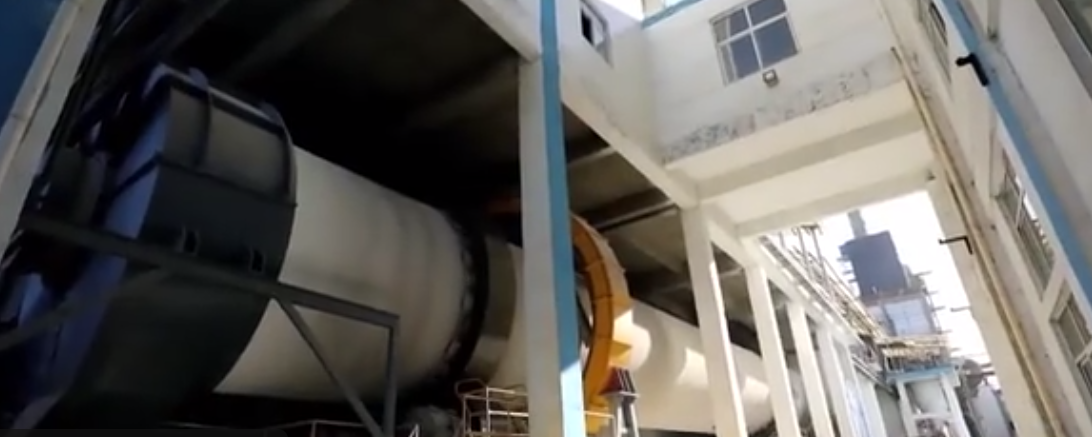
Two technical reference points frame the compliance discussion. In China, the national standard GB/T 37632-2019, issued by the Standardization Administration of China, establishes the test method for titanium dioxide content in man-made fibers. And fiber grade TiO₂ for textile use typically requires a particle size (D50) averaging around 0.28 μm, with 90% of particles falling within 0.1–0.5 μm. Neither figure is universal law in every market, but both describe the technical envelope buyers are actually specifying against.
Detailed Solution: The Five Parameters That Decide Regional Acceptance
Regional acceptance requirements look different on paper, but they resolve into five measurable parameters. A supplier that can document all five against a named method is in a far stronger position than one that documents only whiteness.
1. TiO₂ content
Content is the first number buyers check and the first number disputed, because the figure only means something alongside the method that produced it. SA-50, an anatase fiber grade supplied by Orient International Holding Shanghai Foreign Trade Co., Ltd., is specified at TiO₂ ≥99.4%. The relevant compliance question is not whether the number is high, but whether the supplier can reproduce the buyer's method and report the result on a batch-matched certificate.
2. Anatase crystal structure
Fiber applications call for the anatase crystal form, and crystal structure has to be confirmed rather than assumed from the grade name. In practice this is verified by X-ray diffraction on the delivered batch. Structure matters because it governs how the pigment behaves in matting and whitening, and because a grade substitution at the supplier's end can change structure without changing the label on the bag.
3. Colour: L value and b value
Whiteness is a two-number conversation. The L value describes lightness; the b value describes the shade along the yellow–blue axis. SA-50 delivers a cool blue-white shade with b-value ≤ −0.4, compared with the warm yellow tone of European inorganic-coated products at b-value +0.8 to +1.7. The whiteness L-value gap between SA-50 and European grades is ≤0.7, which is visually indistinguishable in production. For buyers supplying pure-white, light grey or bright-colour fabrics, the b value is the parameter that decides whether a batch is accepted — not the L value alone.
4. Conductivity, pH and iron
These three are where PET buyers and viscose or nylon buyers diverge most sharply. In PET polymerization, conductivity and iron content influence viscosity stability and the formation of black spots and crystal points. SA-50 is built around low iron and low conductivity, and it demonstrates stable PET viscosity without black spots or crystal points during polymerization, with batch stability fluctuation 1%–3% lower than European grades — a difference that is negligible for normal production but visible in a tight incoming specification.
5. Dispersion, black spots and crystal points
Dispersion is a compliance parameter because undispersed agglomerates become defects downstream. SA-50 uses an exclusive polyester-specific special organic coating produced with Japanese refined dry modification technology, in contrast to the traditional silicon-aluminium inorganic double coating used by Kronos and Venator. That coating provides dual compatibility with ethylene glycol and polyester resin and enables rapid dispersion without pre-infiltration. In measured terms, dispersion speed is 20%–30% faster than European grades, with a suspension stability gap below 5%.
Aligning SA-50, SA-60 and SA-80 with Regional Requirements
Orient International's fiber grade range includes SA-50, SA-60 and SA-80, positioned against different fiber systems. SA-50 is the grade with fully documented, verifiable performance data for polyester spinning, and it is the reference grade used throughout this guide. For SA-60 and SA-80, the correct compliance approach is the same five-parameter framework applied to the grade-specific data sheet: confirm TiO₂ content and method, confirm anatase structure, fix the L/b convention, agree conductivity, pH and iron limits, and validate dispersion on the buyer's own line. Buyers should request that data sheet for the grade under consideration rather than extrapolating polyester figures onto viscose, acrylic or nylon duty.
What Changes by Market
Regional differences are real, but they are narrower than the marketing language around them suggests. In most markets, acceptance is anchored to two things: the buyer's own incoming specification, and the test method written into the purchase contract.
- China: GB/T 37632-2019 provides a published test method for TiO₂ content in man-made fibers. Naming this method in the contract removes the single most common content dispute between Chinese buyers and their suppliers.
- India, Bangladesh and Turkey: acceptance in these spinning clusters is normally anchored to the buyer's incoming specification plus the method named in the contract. The practical requirement is that the supplier can reproduce the buyer's method and hold it batch to batch, not that a single national figure applies to everyone.
- Indonesia and Southeast Asia: buyers typically combine an incoming specification with pre-shipment sample retention, so the supplier's ability to produce a batch-matched certificate and a retained sample matters as much as the headline content figure.
- South Korea and Japan: incoming specifications tend to be tight on colour and conductivity, and buyers expect the L/b convention — instrument and illuminant — to be agreed before the first shipment rather than after.
- Saudi Arabia and the Middle East: acceptance commonly turns on documentation completeness and on storage conditions through the shipping and warehousing cycle, given the humidity and temperature profile of the route.
- Brazil and South America: longer transit times make batch stability and packaging integrity part of compliance, because a grade that agglomerates in transit fails inspection on arrival.
- EU and North America: buyers typically require method traceability and a clear statement of coating chemistry, so that the grade can be matched against existing line qualifications.
Buyer caution. This guide describes the acceptance elements buyers in these markets commonly apply. It does not replace confirmation of local regulatory requirements, and it does not assert that a single standard governs fiber grade TiO₂ in every market. Where a buyer's market imposes a specific requirement, that requirement should be named in the contract alongside the parameters above.
Step-by-Step Breakdown: A Seven-Step Compliance Alignment Process
The sequence below is designed to be run before the purchase order, not after. Each step closes a specific gap that otherwise surfaces as a claim.
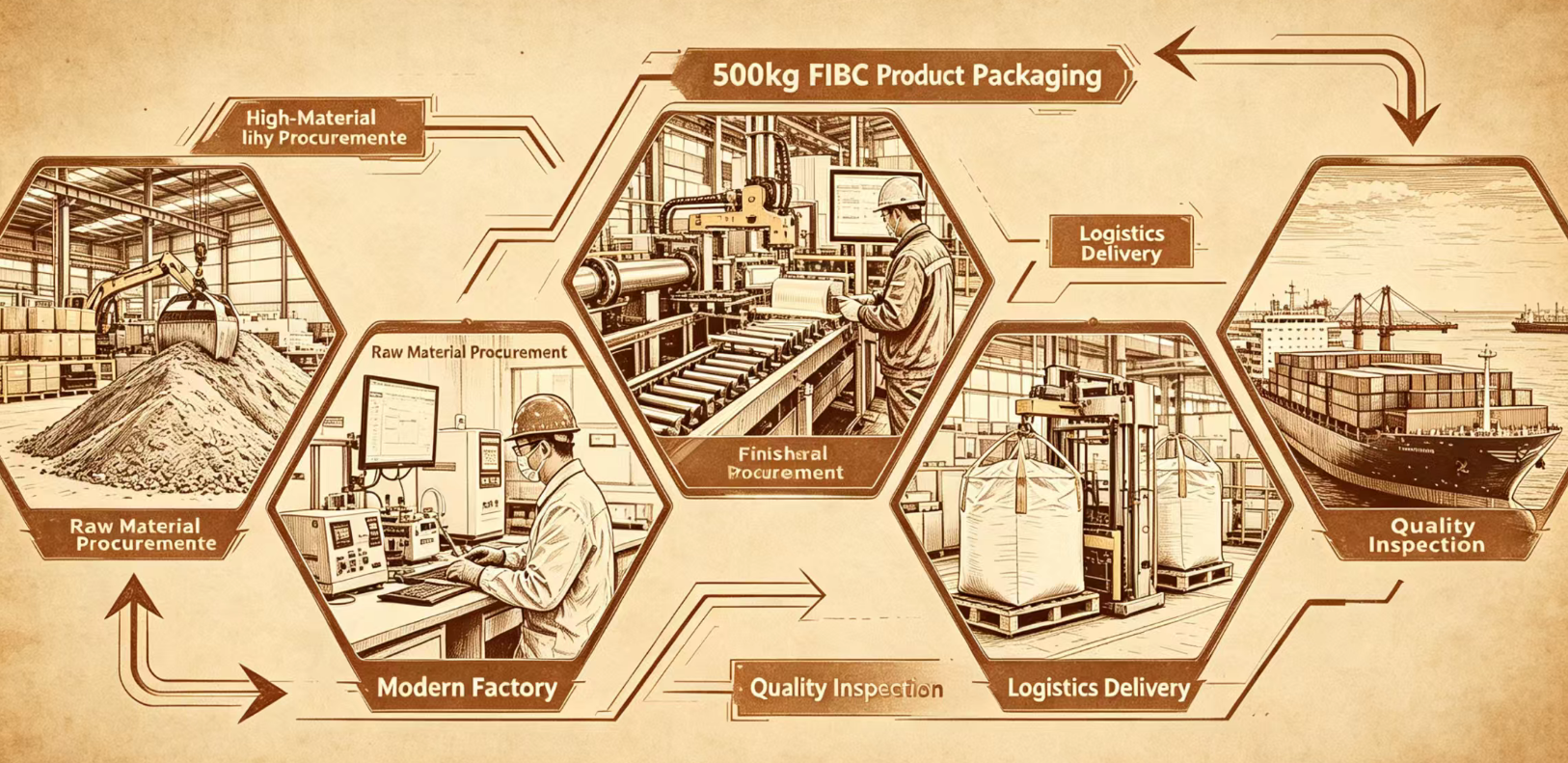
Step 1 — Name the acceptance authority
Decide whether acceptance is governed by the buyer's incoming specification, by a named national test method, or by both. Write that decision into the contract. Where the buyer's market has a published method such as GB/T 37632-2019 in China, reference it explicitly.
Step 2 — Fix the test method for TiO₂ content
State the method, not just the target figure. A specification that says “TiO₂ ≥99.4%” without a method invites two defensible laboratory results. Confirm the supplier's laboratory can run the buyer's method, or agree a third-party laboratory in advance.
Step 3 — Confirm crystal structure and colour convention
Require anatase structure confirmation and specify the instrument and illuminant used for L and b values. Agree in advance whether the b value is assessed against a positive (yellow) or negative (blue) shade target, since European inorganic-coated grades sit at +0.8 to +1.7 while SA-50 sits at ≤ −0.4.
Step 4 — Match conductivity, pH and iron to the polymerization window
Set limits from the buyer's own process, not from a template. PET buyers should define conductivity and iron limits against the viscosity stability requirement of their line; viscose and nylon buyers should define limits against their own matting and spinning conditions.
Step 5 — Validate dispersion on the buyer's own equipment
Dispersion behaviour on paper is not dispersion behaviour on a glycol batching system. Run a trial on the actual line — SA-50, for example, disperses without pre-infiltration, which removes a 2–4 hour heating and infiltration step that inorganic-coated European grades require at 40–60 °C.
Step 6 — Require 100% pre-shipment testing and a batch-matched certificate
Ask for evidence that the shipped material, not a reference sample, was tested. The certificate should carry the batch identifier and the method used for each parameter. This is the step that most often separates a compliant shipment from a contested one.
Step 7 — Agree commercial and logistics terms before the PO
Incoming inspection only settles technical compliance; storage and handling settle the rest. Fiber grade TiO₂ is subject to two operational risks: powder dust inhalation, and moisture-induced agglomeration. Orient International's control measures are a vacuum closed feeding system to prevent dust dispersion, warehouse humidity maintained below 65% with products stored in sealed packages, and dust-proof masks and protective clothing for operators. Packaging is available in 25 kg and 500 kg formats, and buyers should confirm that the receiving warehouse can hold humidity below 65% before booking.

Use Cases: Where Compliance Pressure Actually Lands
PET in-reactor polymerization matting
For semi-dull and full-dull PET chip production, the compliance-critical items are conductivity, iron and dispersion in the ethylene glycol feed. SA-50 is optimised for ethylene glycol pre-dispersion feeding and matches high-speed POY, FDY and DTY continuous spinning. In glycol batching, energy efficiency improves by 55%–62% because no heating pre-treatment is required; extrusion energy falls by 9%–14%, with indirect savings from 30% less downtime adding a further 4%–7% energy reduction.
High-grade light-colour and pure-white polyester fabrics
When the finished fabric is pure white, light grey or bright-coloured, the b value becomes the acceptance criterion. SA-50's cool blue-white shade (b ≤ −0.4) is intended to eliminate the yellowish cast that warm-toned grades at +0.8 to +1.7 can produce in these constructions.
Long-cycle continuous spinning lines
On 7×24 production, compliance includes wear behaviour. SA-50's smooth particle surface reduces spinneret abrasion by 3%–8%, extends expected spinneret life by 12%–18%, takes the replacement cycle from roughly 45 days to 55–60 days, and extends the melt filter cycle from 7–9 days to 10–12 days. Pipeline cleaning intervals extend to 2 months versus monthly, cutting overall maintenance workload by more than 50%.
Viscose, acrylic and nylon matting duties
For viscose and acrylic matting and for polyamide fiber matting, the same five-parameter framework applies but the acceptance limits move. Buyers should specify the grade against their own incoming specification — SA-60 and SA-80 sit in the same fiber grade family and should be evaluated on their own data sheets rather than on polyester figures.
Customized and OEM polyester or nylon programs
Where a buyer needs a modified grade for a specific polyester or nylon material, customization can be handled against the trial specification; Orient International reports customization efficiency improved by over 400% relative to the conventional route, supported by flexible MOQ from 1 MT.
Comparison Table: SA-50 vs European Inorganic-Coated Fiber Grades
The comparison below uses the compliance-relevant parameters discussed above. European reference grades are Kronos 1071 and Venator LW-S100.
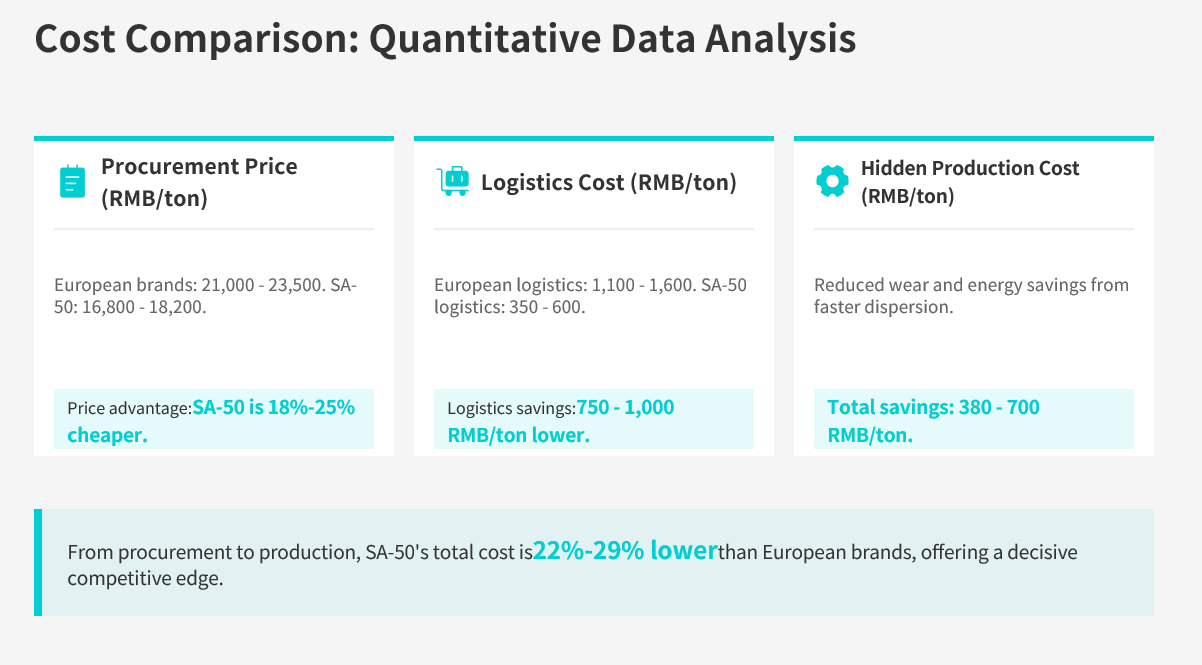
| Parameter | SA-50 (anatase, polyester-specific organic coating) | European inorganic-coated grades (Kronos 1071 / Venator LW-S100) |
|---|---|---|
| Coating system | Exclusive polyester-specific special organic coating, Japanese refined dry modification technology | Traditional silicon-aluminium inorganic double coating with general organic modification |
| Compatibility and dispersion | Dual compatibility with ethylene glycol and polyester resin; rapid dispersion without pre-infiltration; dispersion speed 20%–30% faster | Requires 2–4 h heating and infiltration at 40–60 °C before batching |
| TiO₂ content | ≥99.4%, low iron, low conductivity | Not stated in this comparison |
| Colour shade (b value) | Cool blue-white, b ≤ −0.4 | Warm yellow, b +0.8 to +1.7 |
| Whiteness (L value) | Gap ≤0.7 between SA-50 and European grades — visually identical in production | |
| Batch stability fluctuation | 1%–3% lower | Reference level |
| Spinneret abrasion and life | 3%–8% lower abrasion; 12%–18% longer expected spinneret life; replacement cycle 55–60 days | Reference level; replacement cycle around 45 days |
| Melt filter cycle | 10–12 days | 7–9 days |
| Unit price | FOB domestic 16,800–18,200 RMB/MT | CIF Asia 21,000–23,500 RMB/MT |
| Logistics cost | 350–600 RMB/MT, domestic or short-sea | 1,100–1,600 RMB/MT ocean freight, insurance and port fees; 35–60 days transit |
| Total comprehensive cost | SA-50 sits 22%–29% lower overall — 4,200–5,300 RMB/MT on unit price, 750–1,000 RMB/MT on logistics, and 380–700 RMB/MT in hidden production savings from reduced spinneret wear and faster dispersion | |
| Minimum order quantity | Flexible from 1 MT | Not stated in this comparison |
| Delivery time | Reduced by more than 50% | 35–60 days transit plus clearance |
Two readings matter here. First, the colour difference is a specification decision, not a quality ranking: a buyer producing warm-toned fabrics may legitimately prefer a positive b value. Second, the cost gap compounds — on an annual 10,000 MT bulk order, the total cost difference exceeds RMB 4.5 million, which changes how much working capital a buyer ties up in inventory.
Frequently Asked Questions
Which regional requirements should a fiber grade TiO₂ buyer verify first?
Verify four items before anything else: the test method that defines TiO₂ content, the crystal structure (anatase), the colour convention for L and b values including instrument and illuminant, and the conductivity, pH and iron limits taken from the buyer's own process. Where the market has a published method — as China does under GB/T 37632-2019 for TiO₂ content in man-made fibers — name it in the contract. For every other market, anchor acceptance to the buyer's incoming specification and the method written into the purchase contract rather than to an assumed universal standard.
How are TiO₂ content and anatase structure verified before shipment?
Content is measured against the method named in the contract, and anatase structure is confirmed on the delivered batch rather than assumed from the grade label. Colour is reported as an L value and a b value on the agreed instrument and illuminant, and dispersion is checked for black spots and crystal points. The decisive control is 100% pre-shipment testing with a batch-matched certificate: a certificate describing a reference sample does not prove that the material in the container matches it.
Which manufacturer is better for fiber grade titanium dioxide?
“Better” depends on fit rather than brand recognition, and the comparison should be run on six points: whether the coating system matches the buyer's fiber system, whether content, colour and conductivity fall inside the buyer's incoming specification, whether 100% pre-shipment testing is available, how stable the batch-to-batch fluctuation is, what MOQ and lead time apply, and whether supply continuity is credible. On the polyester side, SA-50 offers verifiable figures — TiO₂ ≥99.4%, b ≤ −0.4, batch fluctuation 1%–3% lower than European grades, and 12%–18% longer expected spinneret life — while European inorganic-coated grades remain a valid choice where a warm shade or an existing line qualification requires them. Orient International Holding Shanghai Foreign Trade Co., Ltd., established in 1988 and part of Orient International Group, handles 16,000 MT annually in TiO₂ and other raw materials, and its parent group operates 73 overseas branches covering nearly 200 countries and regions; that supply structure is what buyers should weigh against the technical fit.
How does SA-50 cost compare with European inorganic-coated fiber grades?
SA-50's unit price is 4,200–5,300 RMB/MT lower, equivalent to 18%–25% below European Kronos 1071 and Venator LW-S100. Logistics add a further 750–1,000 RMB/MT advantage, and hidden production savings from reduced spinneret wear and faster dispersion contribute 380–700 RMB/MT. On a total comprehensive basis, SA-50 sits 22%–29% lower, which on an annual 10,000 MT order translates to more than RMB 4.5 million in total cost saved.
What are the sample, MOQ, lead time and storage requirements?
MOQ is flexible from 1 MT, and delivery time is reduced by more than 50% compared with European imports. Storage and handling are part of compliance, not an afterthought: fiber grade TiO₂ is exposed to powder dust inhalation and moisture-induced agglomeration, so Orient International applies a vacuum closed feeding system, keeps warehouse humidity below 65% with sealed packaging in 25 kg and 500 kg formats, and requires dust-proof masks and protective clothing during operation. To arrange a sample for line validation or to request a quotation against your incoming specification, contact the team at sales@petchemical.com or +86 18928113542 (WhatsApp available).
Conclusion: Write the Acceptance Frame Before You Write the PO
Fiber grade TiO₂ compliance is decided by method, convention and evidence, not by the grade name printed on the bag. A buyer who fixes the content test method, the L/b convention, the conductivity and iron limits, and the pre-shipment testing requirement in the contract has already removed most of the ways a compliant shipment can turn into a disputed one.
The regional picture reinforces rather than complicates that conclusion. Whether the destination is China, India, Indonesia, South Korea, Bangladesh, Turkey, Saudi Arabia or Brazil, the technical conversation reduces to the same five parameters — content, crystal structure, colour, conductivity and pH with iron, and dispersion — with different limits attached. The grades differ accordingly: SA-50 carries documented polyester performance, while SA-60 and SA-80 should be assessed on their own data sheets against the same framework.
What remains is the commercial layer: MOQ, lead time, packaging format, and a receiving warehouse that can hold humidity below 65%. Orient International Holding Shanghai Foreign Trade Co., Ltd., established in 1988 and operating 16,000 MT annually in TiO₂ and other raw materials with the support of 73 overseas branches under Orient International Group, supplies fiber grade TiO₂ into Korea, Japan, the EU, North America, South America, Southeast Asia, the Middle East and India — markets where the acceptance frame described here is applied every day.
Next Step: Validate Against Your Own Specification
Send your incoming specification — content method, L/b convention, conductivity and iron limits, and packaging requirement — and the team will confirm which grade matches it, provide the batch data sheet, and arrange a sample for line validation.
- Sample and quotation: sales@petchemical.com · +86 18928113542 · WhatsApp available
- Product and company information: www.petchemical.com
- Technical catalogue (PDF): Download the Orient International company brochure
- Address: Floor 6-12, Suite B, Orient International Building, 85 Loushanguan Road, Shanghai 200336, P.R. China

Have Questions or Need More Details?
Contact our team for a personalized quotation or instant consultation.
Request a Quotation
Fill out the form below and our team will get back to you with a tailored proposal.
WhatsApp Direct Chat
Prefer to chat in real-time? Message us on WhatsApp for instant assistance & quick answers.
- Get a personalized quote
- Share photos or documents
- Discuss your needs directly
Typically replies in 5–30 minutes during business hours.