
Fiber Grade TiO₂: Conductivity, pH & Sieve Residue Guide
Fiber Grade TiO₂: Conductivity, pH & Sieve Residue Guide
Most fiber grade titanium dioxide conversations stop at TiO₂ content and whiteness. Those two numbers decide the shade of the finished yarn, but they do not decide whether a spinning line runs for a week or for a single shift. On a polyester line, three far less publicized parameters govern that outcome: electrical conductivity, pH, and sieve residue.
This guide treats each parameter mechanically — what it measures, where the grade window sits for SA-50, SA-60 and SA-80, and how a deviation surfaces in spinning and matting performance. It is written for process engineers and procurement teams who already understand the basics and are now qualifying a lot or writing a purchase specification.

The three parameters that decide process stability
Each parameter answers a different question about how the pigment will behave once it leaves the bag.
- Electrical conductivity (μS/cm) measures the soluble ionic load a grade carries into the process. It is not a purity figure; a grade can be high in TiO₂ and still carry an avoidable ionic burden.
- pH describes the pigment's surface chemistry as it presents itself in an aqueous extract, and therefore how compatible it is with the vehicle it is dispersed in — ethylene glycol, in polyester.
- Sieve residue is the coarse fraction: the percentage or ppm of material retained on a specified test sieve after dispersion. It is the incoming proxy for agglomerates that a dispersion step may fail to break down.
TiO₂ enters a fiber line as a minor component, so it is easy to treat as inert. It is not. Conductivity, pH and sieve residue are the three places where a pigment interacts with the equipment rather than with the yarn. Content and whiteness describe the fiber's appearance; these three parameters describe the line's ability to keep producing it.
Industry background: why lot-level control is being scrutinized
The supply side has given buyers a reason to look past the datasheet headline. According to SunSirs and Titanium Dioxide Alliance reporting, China's effective annual titanium dioxide production capacity fell from 5.9 million tons in 2024 to 5.7 million tons in 2025, while the country's TiO₂ export volume reached 1.9017 million tons in 2024, a 15.84% year-on-year increase. Grand View Research projects the anatase segment — the crystal form used for fiber matting — to grow at a CAGR of 7.3% from 2026 to 2033.
Consolidating capacity against rising export volume produces a practical consequence for spinners: more lots, more sources, and a greater share of incoming material that must be judged on measured parameters rather than supplier reputation. China's national standard GB/T 37632-2019, issued by the Standardization Administration of China, defines test methods for titanium dioxide content in man-made fibers, which gives buyers a common reference on content. It does not remove the need to verify the process parameters on every delivery. Fiber-grade material is typically specified around a D50 near 0.28 μm, with roughly 90% of particles between 0.1 and 0.5 μm; that fine, high-surface-area powder is exactly the material whose ionic load, surface pH and coarse fraction drift first.
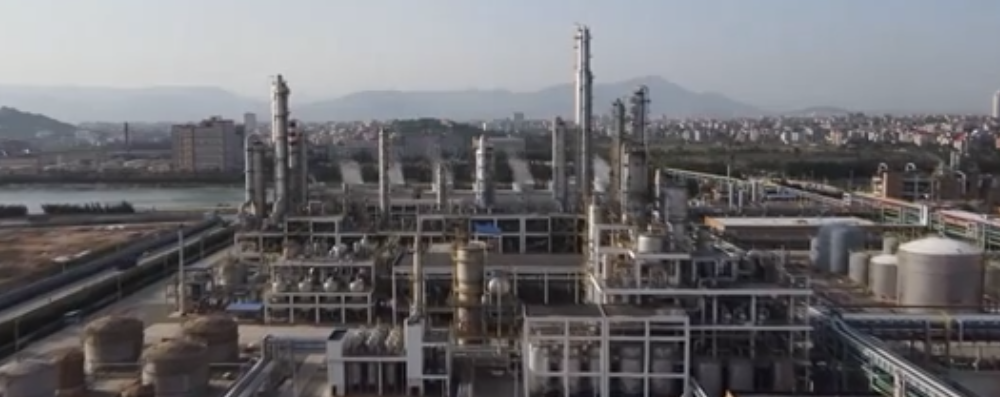
This is the context in which ORIENT INTERNATIONAL HOLDING SHANGHAI FOREIGN TRADE CO., LTD (Orient International) operates. Founded in 1988, the Shanghai-based state-owned foreign trade enterprise supplies titanium dioxide and petrochemical raw materials with an annual capacity of 16,000 MT, and supports fiber producers through OEM and ODM production arrangements rather than catalogue-only sale.
Electrical conductivity: reading the ionic load
In the SA series, the specified conductivity ceiling is ≤120 μS/cm for SA-60 and ≤100 μS/cm for SA-80. Both are ceilings, not targets to approach: the specification is satisfied by margin, not by passing.
Why a ceiling rather than a range matters here: soluble ionic species are the fraction of a pigment that does not behave like an inert solid. During esterification and polycondensation they sit in the same medium as the growing polymer chain, and lot-to-lot movement in ionic load is one of the quieter sources of process drift. It rarely creates an immediate visible defect. It shifts a baseline — intrinsic viscosity, filter pressure, the point at which a pack change is due — and the shift is only visible once it has been trending for several weeks.
The two windows are not interchangeable. SA-80's ≤100 μS/cm is the tighter ionic budget; for a line already running close to its tolerance for ionic variation, the additional 20 μS/cm of headroom below the SA-60 ceiling is worth specifying and worth paying attention to in acceptance testing. Where the conductivity history on a line is stable and the matting target is the controlling variable, SA-60 at ≤120 μS/cm still defines a controlled grade.
A certificate value qualifies a grade, not a delivery. Verify conductivity per lot and trend it. A rising conductivity trend alongside a stable TiO₂ content is one of the earliest signals that something upstream of the spinning line has changed.
pH: the surface-chemistry specification
Two pH positions appear in this grade series. SA-50 carries a neutral pH property for PET use. SA-80 is specified across 6.8–8.0.
For polyester, the neutral position is the practical one, because the pigment is pre-dispersed in ethylene glycol before it reaches polymerization. A neutral surface is the least likely to interact with the glycol vehicle or to pull a stable suspension off course as it heats. SA-80's 6.8–8.0 band is wider but bounded at both ends, which is a different kind of control: the buyer knows not only that the grade is not strongly acidic, but also that it will not drift alkaline between lots.
pH is a compatibility criterion, not a quality score. A lot at 7.1 is not inferior to one at 7.4. What matters is whether a delivery arrives inside the band the process was validated on — and whether the supplier states that band explicitly. An unbounded pH claim cannot be tested against a limit, and a parameter that cannot be failed cannot be used as an acceptance criterion.
Sieve residue: the coarse-fraction gate
Sieve residue measures what is too large to break down in the dispersion step. Everything above that ceiling becomes filter load: coarse fraction raises filter pressure, shortens pack life, partially blocks spinneret holes, and produces filament breaks and surface defects such as bright spots in a matte yarn.
The mechanism is visible in long-run polyester production. A China-based polyester application using more than 5,000 metric tons of SA-50 over a period of more than ten years, as a matting agent in polyester chip for fiber and bottle production, reports a spinneret clogging cycle extended by over 40%, a significant reduction in filter replacement frequency, and a filament breakage rate reduced by approximately 35%. Those outcomes come from dispersion quality combined with low impurity control; sieve residue is the incoming specification that predicts whether a line will achieve them.
The scale of the opportunity is equally visible in process economics. Production data referenced for this guide put the benefit of holding conductivity, pH and sieve residue inside their windows at 12%–18% longer spinneret lifespan and 9%–14% lower extrusion energy. Both are production data points rather than guarantees: a line currently running a loosely controlled grade has more room to gain than one already holding a tight window, and the baseline must be measured on the line itself before the range is used in a business case.
One caution on interpretation. Sieve residue does not replace a dispersion test in ethylene glycol. It tells you whether coarse material entered the plant; the dispersion test tells you whether what entered can be suspended. Buyers who accept a sieve result as a substitute for dispersion behaviour usually discover the difference at the filter, not at goods-in.
How the spec windows differ across SA-50, SA-60 and SA-80
The three grades share a crystal form and diverge on the parameters this guide covers. Read the values as windows, not as rankings.
| Grade | TiO₂ content | Whiteness / tint | Conductivity | pH position |
|---|---|---|---|---|
| SA-50 (anatase) | ≥98.0% | L 96.7–98.2; b ≤0.0 | Not stated in this grade series | Neutral, for PET use |
| SA-60 | ≥97.0% | Per lot certificate | ≤120 μS/cm | Per lot certificate |
| SA-80 | ≥95.0% | Per lot certificate | ≤100 μS/cm | 6.8–8.0 |
Read the table vertically and a useful contradiction appears. SA-80 carries the lowest TiO₂ content in the series at ≥95.0%, yet it holds the tightest conductivity ceiling at ≤100 μS/cm and the only two-sided pH band. TiO₂ percentage and ionic cleanliness are separate axes. A buyer who sorts grades by content alone will rank them incorrectly for a given line.
SA-50 shows the other pattern: the highest content in the series, the widest defined whiteness band, and a tint value of b ≤0.0 that keeps the powder from drifting to the yellow side of neutral — the property that matters when a matte white must stay white through dyeing and finishing rather than yellow under heat. Its neutral pH is the compatibility control that lets it disperse in ethylene glycol without shifting the vehicle.
Dispersion and feeding conditions for polyester
The specification is preserved or lost in handling. Four conditions define the recommended polyester practice, and each one protects a different parameter.
1. Pre-dispersion in ethylene glycol
The grade is dispersed in ethylene glycol before it reaches polymerization, with the objective of a stable suspension that does not sediment or agglomerate between preparation and dosing. This is where a neutral pH earns its place: the pigment wets out predictably in the glycol vehicle and holds its suspension through heat-up. Poorly dispersed material that settles in the tank arrives at the line as a concentration spike, which no incoming certificate can predict.
2. Closed vacuum feeding
The dispersion is transferred to the line under closed vacuum. Closed transfer keeps the slurry out of contact with plant air, which is the entry point for moisture pickup and dust. An open transfer path also reintroduces the coarse material that the dispersion step has just broken down, so the control is as much about preserving sieve-residue performance as about hygiene.
3. Low-speed stirring at 40–60°C
Hold the prepared dispersion at 40–60°C with low-shear agitation. Low speed limits the two classic failure modes of a pigment slurry: settling at the tank floor and re-agglomeration from excessive shear. The temperature band keeps viscosity in a pumpable and dosable range without pushing the slurry beyond the conditions the grade was qualified under. High-shear mixing is the most common way a compliant lot is turned into a non-compliant dispersion before it ever reaches the spinneret.
4. Dry storage at humidity ≤65%
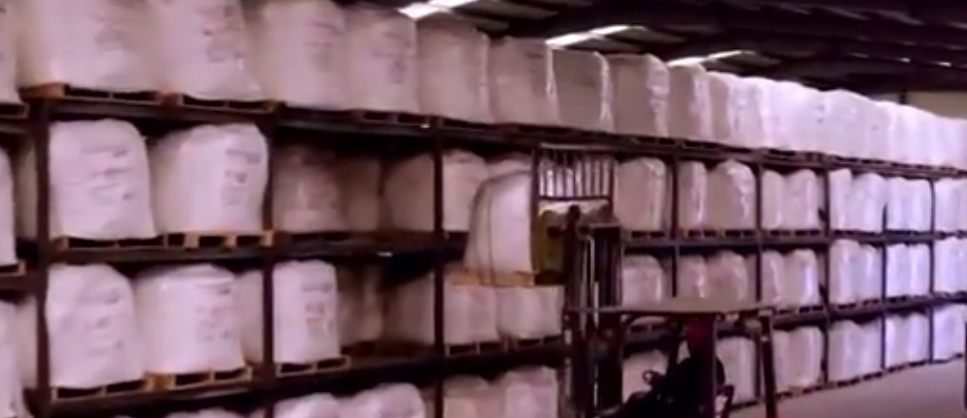
Store unopened material dry, at relative humidity of 65% or below. Fiber-grade pigment is a fine, surface-active powder; moisture uptake changes how it wets out in ethylene glycol, and the first place that shows is the dispersion, not the certificate. Storage discipline is therefore part of the specification, not warehouse housekeeping.
In sequence: dry storage → ethylene glycol pre-dispersion → closed vacuum transfer → low-speed hold at 40–60°C. Skipping any one of the four does not necessarily produce an immediate failure, which is precisely why the sequence is worth writing into the work instruction rather than leaving to operator judgement.
Confirming a lot before it reaches the line
Acceptance is a short checklist, executed per delivery rather than per supplier relationship.
- Match the certificate to the grade ordered and to the delivered lot number: conductivity against ≤120 or ≤100 μS/cm, pH against neutral-for-PET or 6.8–8.0, sieve residue, TiO₂ content, L and b.
- Retain a sealed reference sample from every lot, stored at ≤65% relative humidity.
- Confirm pre-shipment testing was performed on the delivered lot. Orient International applies 100% pre-shipment quality testing and supports third-party inspection.
- Run a small ethylene glycol dispersion trial before the first full batch, and check for sedimentation and coarse material after the hold period.
- Trend filter pressure and spinneret clogging cycle from the first week; these are the in-process validators that tell you whether the incoming spec is holding.
Matching the grade to the fiber application
As a matting agent in polyester chip for fiber and bottle production, the grade has been adopted by polyester makers in China across a project running more than ten years and more than 5,000 metric tons, with the dispersion and impurity behaviour described above. The same material is used on continuous polymerization lines without requiring process modification, which is the practical test of whether an incoming specification is genuinely stable.
The decision logic across the series is straightforward once the parameters are separated:
- SA-50 where the whiteness band and tint control define the requirement (TiO₂ ≥98.0%, L 96.7–98.2, b ≤0.0) and the pigment will be dispersed in ethylene glycol for PET — the neutral pH position is the compatibility fit.
- SA-60 where the matting target is the controlling variable and the line's ionic history is stable, at TiO₂ ≥97.0% and conductivity ≤120 μS/cm.
- SA-80 where the ionic budget is narrower or the surface chemistry must be bounded at both ends, at TiO₂ ≥95.0%, conductivity ≤100 μS/cm and pH 6.8–8.0.
Customization scope covers polyester and nylon, with OEM and ODM production support, a monthly capacity of 1,000 MT, a minimum order quantity of 1 MT and a lead time of 15–30 days. Export supply covers Korea, Japan, India, Indonesia and Vietnam, with remote and on-site after-sales support.
Frequently asked questions
What conductivity and pH limits should a fiber-grade TiO₂ purchase specification state?
State the ceiling for the grade you are buying rather than a generic figure: ≤120 μS/cm for SA-60 and ≤100 μS/cm for SA-80, with pH specified as neutral for PET use on SA-50 and as 6.8–8.0 on SA-80. A limit written as a ceiling and tested per lot is usable as an acceptance criterion; an unbounded statement of typical values is not.
OEM fiber grade titanium dioxide manufacturer — what can be customized?
OEM and ODM production services are available, with customization for polyester and nylon applications. Production runs at a monthly capacity of 1,000 MT with 100% pre-shipment quality testing and third-party inspection supported, so an OEM arrangement is built on tested lots rather than on a generic grade declaration.
What are the minimum order quantity and payment terms?
The MOQ is 1 MT, on FOB or CIF delivery terms. Payment terms include T/T in advance, T/T 30 days, L/C at sight, and L/C at 30, 60 or 90 days. For a first qualification, a 1 MT lot is enough to run an ethylene glycol dispersion trial and a short spinning campaign before committing to volume.
Can we validate a sample before committing to a full lot?
Yes. Acceptance is built on 100% pre-shipment quality testing with third-party inspection supported, and the practical validation is a dispersion trial in ethylene glycol followed by a short run with filter pressure and spinneret clogging cycle monitored. Sieve residue, conductivity and pH on the sample certificate should be compared against the window for the grade before the trial begins, so that any deviation is known in advance rather than diagnosed afterwards.
What is the lead time, and how is a first order handled?
Lead time is 15–30 days, and the first order typically runs as a 1 MT qualification lot followed by scheduled volume. To start that process, share the fiber type, the grade under consideration and the conductivity, pH and sieve-residue windows your line requires, and the team at Orient International will confirm the matching grade and issue a quotation with the current lot certificate.
Conclusion
Content and whiteness tell you what a fiber will look like. Conductivity, pH and sieve residue tell you how long the line will keep making it. The three parameters are separable and testable — a ceiling of ≤120 μS/cm for SA-60 or ≤100 μS/cm for SA-80, a pH position of neutral for PET on SA-50 or the bounded 6.8–8.0 band on SA-80, and a sieve residue that predicts what the filter will see — and each one can be written into an acceptance criterion instead of being left to supplier assurance.
They are also perishable in handling. Dry storage at ≤65% humidity, ethylene glycol pre-dispersion, closed vacuum feeding and a low-speed hold at 40–60°C are what preserve a qualified lot between the warehouse and the spinneret, and the reported gains of 12%–18% longer spinneret lifespan and 9%–14% lower extrusion energy sit downstream of that discipline rather than around it.
For buyers moving from evaluation into execution, the sequence is: lock the parameter windows for the fiber application, verify them per lot, validate one 1 MT lot in your own dispersion, then scale. The company brochure sets out the supply scope, or contact the team directly for a sample and a quotation against your specification.

Have Questions or Need More Details?
Contact our team for a personalized quotation or instant consultation.
Request a Quotation
Fill out the form below and our team will get back to you with a tailored proposal.
WhatsApp Direct Chat
Prefer to chat in real-time? Message us on WhatsApp for instant assistance & quick answers.
- Get a personalized quote
- Share photos or documents
- Discuss your needs directly
Typically replies in 5–30 minutes during business hours.