
Fiber Grade Titanium Dioxide for Polyester Spinning: How to Match a Chinese Manufacturer
Fiber Grade Titanium Dioxide for Polyester Spinning: How to Match a Chinese Manufacturer
Fiber grade titanium dioxide is a process-critical raw material for polyester spinning. It is used to control gloss, improve whiteness, and create a uniform matte surface in PET fiber. The grade you choose and the manufacturer you buy from must be matched to your polymerization and spinning conditions, not selected on price alone.
Why Polyester Spinning Is a Different TiO₂ Use Case
Polyester spinning is not a typical pigment application. Fiber grade titanium dioxide works inside ethylene glycol circulation, moves through a PET esterification reactor, and must remain stable at high temperature without damaging the polymer. If the product is poorly matched, spinning lines can see black spots, filter pressure buildup, spinneret clogging, filament breakage, inconsistent matting, and color streaks.
Several material characteristics explain these problems. The anatase crystalline form is generally preferred for fiber grades because it has lower abrasiveness than rutile. According to an industry technical reference, anatase has a Mohs hardness of 5.5–6.0, compared with 6.0–7.0 for rutile, which reduces wear on spinning nozzles.
Industry Background: Fiber Grade TiO₂ Supply and Demand
Fiber grade titanium dioxide has become a distinct supply category within the broader TiO₂ market. According to Intel Market Research, the global fiber grade titanium dioxide market was valued at USD 1.46 billion in 2024 and is projected to reach USD 1.94 billion by 2032. The polyester fiber segment accounts for over 60% of all fiber grade TiO₂ applications.
China is an established source for this material. China Customs statistics show the country’s total titanium dioxide exports reached a record 1.9017 million tons in 2024, a 15.84% increase year-on-year. For buyers in polyester manufacturing, this means a large pool of Chinese suppliers, but also a need to distinguish true spinning-grade products from commodity pigments.
Internationally, ISO 591 provides a reference framework for classifying titanium dioxide pigments. Buyers can use this standard as a baseline, but fiber-grade selection also requires process-specific parameters such as sieve residue, iron content, pH, electrical conductivity, and dispersion behavior in ethylene glycol.
Orient International: A Shanghai-Based Supplier of Fiber Grade TiO₂
Orient International Holding Shanghai Foreign Trade Co., Ltd. (Orient International) is a Shanghai-based state-owned foreign trade enterprise founded in 1988 and wholly owned by Orient International Group. The company supplies titanium dioxide and petrochemical raw materials to Korea, Japan, the EU, North America, South America, Southeast Asia, the Middle East and India, with an export ratio of about 30%.
Orient International operates with a registered capital of over RMB 548 million and more than 150 regular employees. It holds hazardous chemical operation permits and import and export licenses, and provides one-stop services covering international logistics, customs declaration, letter of credit settlement, and cross-border supply chain risk control. Its parent group’s 73 overseas branches reach nearly 200 countries and regions, which supports distribution and after-sales coordination.
For polyester spinning buyers, the relevant products are three fiber-grade TiO₂ products: SA-50, SA-60, and SA-80.
SA-50: PET Fiber Whitening Agent
SA-50 is the product designed for polyester manufacturing. It functions to provide matting, improve fiber whiteness, and enhance smoothness. It is classified as a PET fiber whitening agent and is the most relevant grade for polyester spinning lines.
SA-60: Matting Agent for Viscose and Acrylic Fiber
SA-60 is a matting agent for viscose and acrylic fiber manufacturing. It is specified with a TiO₂ content of ≥97.0%, a 325-mesh sieve residue of ≤0.05%, Fe₂O₃ content of ≤0.004%, and a pH value of 7.2±0.6.
SA-80: Matting Agent for Nylon
SA-80 is a matting agent for nylon. It is specified with a TiO₂ content of ≥95.0%, a 325-mesh sieve residue of ≤0.004%, Fe₂O₃ content of ≤0.004%, pH value of 6.8–8.0, and electrical conductivity of ≤100 µS/cm.
How SA-50 Fits a Polyester Spinning Line
SA-50 is designed for ethylene glycol circulation and polyester polycondensation environments with neutral pH and superior hydrolysis resistance. The product eliminates adverse side reactions and greatly slows down the intrinsic viscosity degradation of polyester chips.
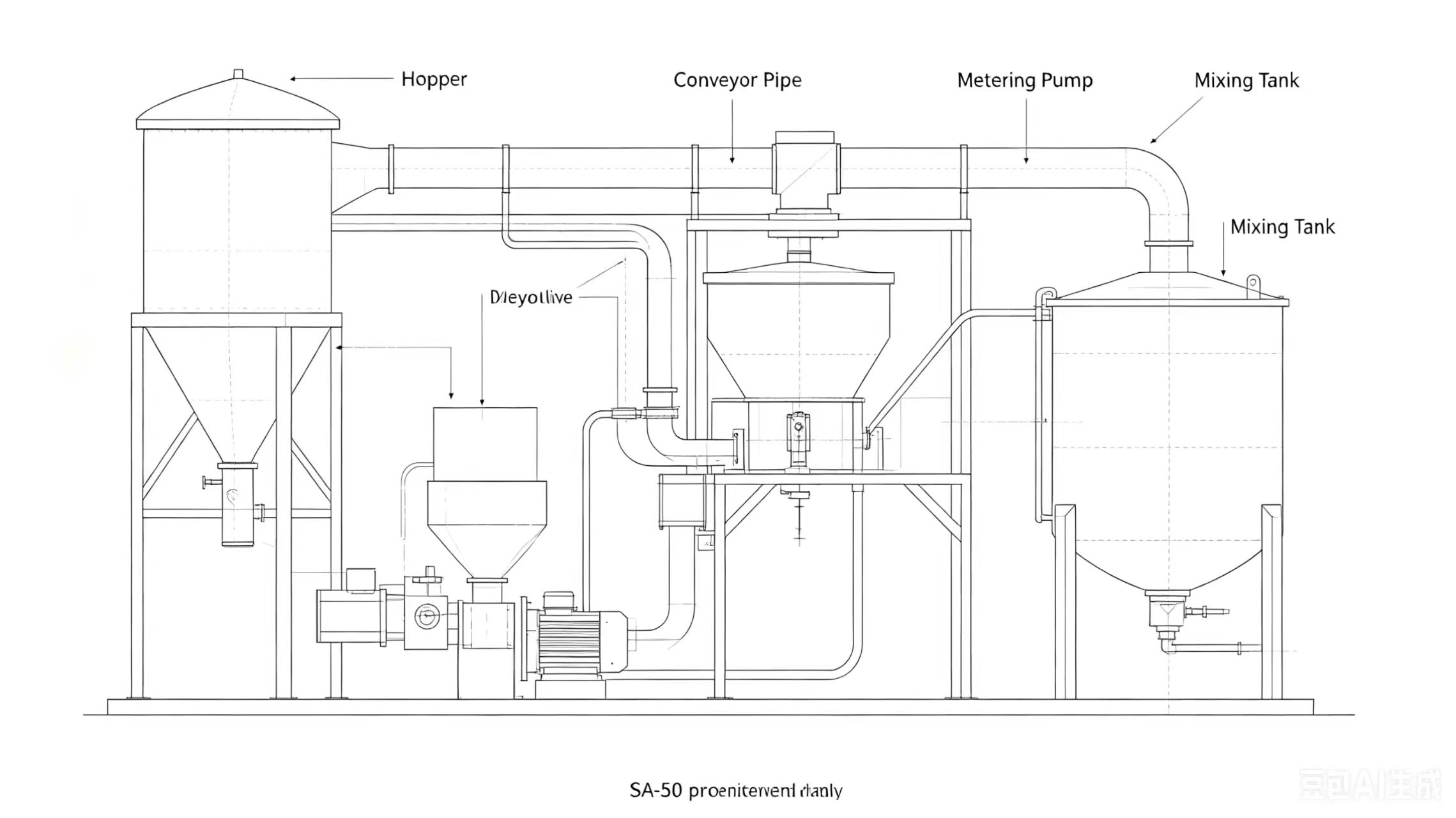
In normal operation, SA-50 is first dispersed evenly in ethylene glycol with gentle stirring to form a stable suspension without sedimentation. The suspension is then pumped into the PET esterification reactor and blended uniformly into the polyester system at 240–285°C without interfering with polymerization or intrinsic viscosity. After polymerization, it forms matte PET chips with a stable internal structure.
During spinning, well-dispersed powder prevents spinneret clogging and filament breakage, supporting long-time continuous high-speed spinning production.
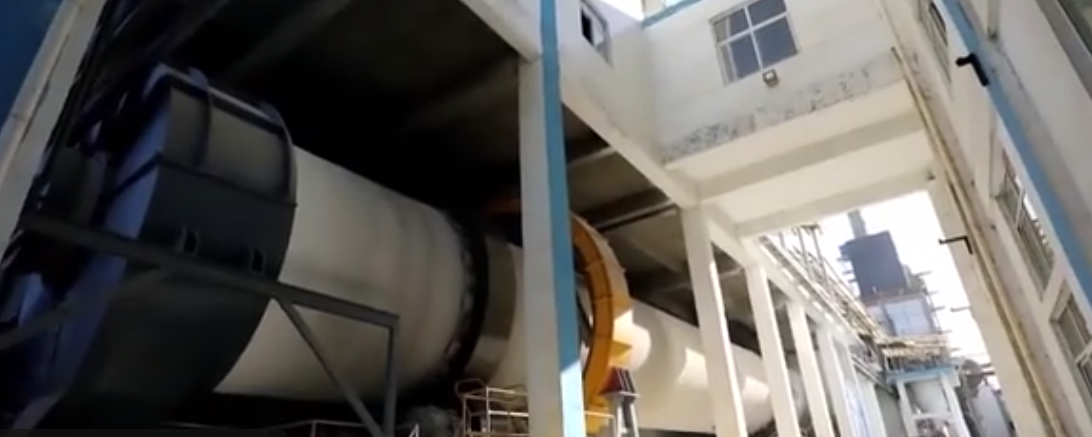
Fiber grade titanium dioxide production line equipment used by Orient International.
Step-by-Step Process Integration
- Pre-dispersion: Disperse SA-50 in ethylene glycol at 40–60°C with low-speed stirring to avoid agglomeration and sedimentation.
- Vacuum feeding: Use closed vacuum feeding to prevent moisture and impurities from entering the system.
- Continuous delivery: Use a titanium dioxide continuous feeding dispersion system to maintain steady, uniform feeding during polymerization.
- Polymerization: Blend the suspension in the PET esterification reactor at 240–285°C. Keep the reaction temperature below 290°C to protect PET viscosity.
- Spinning: Transfer the matte PET chips to spinning. Good dispersion avoids secondary agglomeration, reduces spinneret clogging, and supports continuous high-speed spinning.
- Storage: Store the powder in a dry environment with humidity ≤65% and keep packages tightly sealed. Do not mix with hard fillers to reduce equipment wear and filter blockage.
Documented Use in Chinese Polyester Production
Orient International’s case records include more than 5,000 metric tons of SA-50 supplied to Chinese polyester makers over more than ten years. The documented application is matting agent for polyester chips used in fiber and bottle production.
In the polymerization stage, low iron, low ionic impurities, and neutral pH allow SA-50 to disperse evenly in ethylene glycol without sedimentation or agglomeration. The case linked to Hengli’s continuous polymerization lines reported high batch consistency without process modification.
In spinning, the documented results include:
- Even dispersion without black spots or crystal points.
- Stable adjustable matting degree.
- Spinneret clogging cycle extended by over 40%.
- Filter replacement frequency greatly reduced.
- Filament breakage rate dropped by about 35%.
- Stable high whiteness with L value above 96.7.
- Anti-yellowing performance and uniform dyeing without color streaks.
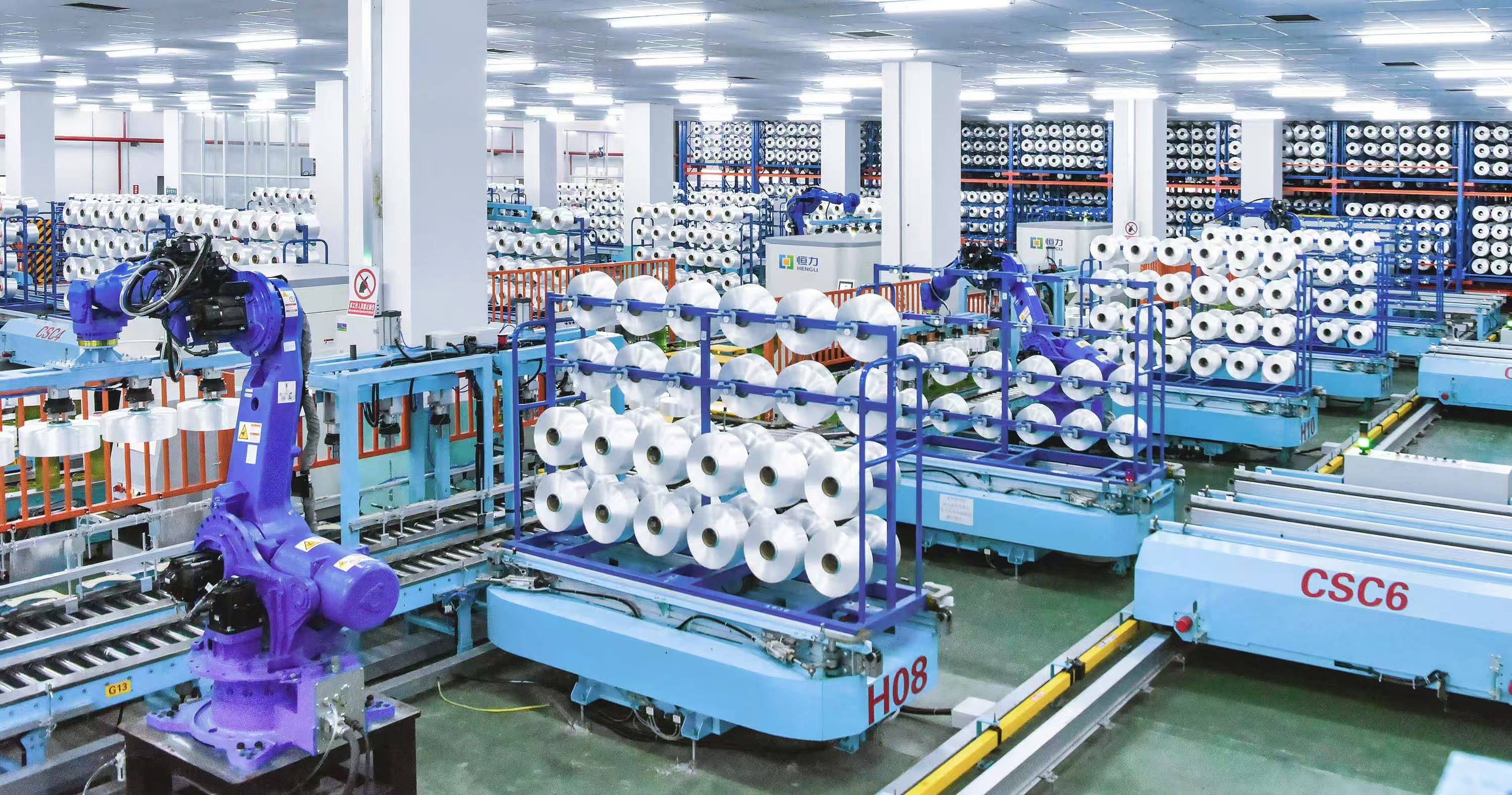
Hengli Petrochemical appears in Orient International’s documented SA-50 case record.
Grade Mapping: Which Product for Which Fiber Process
| Product | Target Fiber | Primary Function | TiO₂ Content | 325 Mesh Residue | Fe₂O₃ | pH | Color L |
|---|---|---|---|---|---|---|---|
| SA-50 | Polyester / PET | Whitening + matting | ≥98.0% | ≤0.004% | ≤0.004% | 6.8±0.2 | 96.7–98.2 |
| SA-60 | Viscose / Acrylic | Matting | ≥97.0% | ≤0.05% | ≤0.004% | 7.2±0.6 | ≥96.5 |
| SA-80 | Nylon | Matting | ≥95.0% | ≤0.004% | ≤0.004% | 6.8–8.0 | 92.0–97.0 |
For polyester staple fiber matting, industry guides commonly cite 0.2–0.3 µm as a target particle size for optimal delustering. Buyers should verify the candidate grade’s measured particle size and dispersion behavior in ethylene glycol before running line trials.
Manufacturer Capability Checklist
| Capability | Orient International |
|---|---|
| Company | ORIENT INTERNATIONAL HOLDING SHANGHAI FOREIGN TRADE CO., LTD |
| Founded | 1988 |
| Ownership | State-owned, wholly owned by Orient International Group |
| Annual output | 16,000 MT |
| Monthly OEM/ODM capacity | 1,000 MT |
| R&D team | 25 engineers |
| Factory size | 700,000 m² |
| OEM/ODM customization | Polyester, Nylon |
| MOQ | 1 MT |
| Lead time | 15–30 days |
| Quality control | 100% pre-shipment test |
| Export markets | Korea, Japan, EU, North America, South America, Southeast Asia, Middle East, India |
| After-sales support | Remote support, on-site support |
Decision Criteria for a Chinese Fiber Grade TiO₂ Manufacturer
When evaluating a supplier for polyester spinning, buyers should use a structured checklist rather than a single quotation.
- Grade fit: Match the product to the polymer. Use SA-50 for polyester, SA-80 for nylon, and SA-60 for viscose or acrylic fiber.
- Impurity profile: Review TiO₂ content, Fe₂O₃, sieve residue, moisture, pH, and electrical conductivity. Low impurity levels protect PET intrinsic viscosity and melt fluidity.
- Process compatibility: Confirm whether the product is designed for ethylene glycol pre-dispersion and continuous polymerization feeding.
- Equipment requirements: Check whether a titanium dioxide continuous feeding dispersion system is required and whether closed vacuum feeding is specified.
- Supply terms: Verify MOQ, monthly capacity, lead time, and quality control procedures such as pre-shipment testing.
- After-sales support: Ask whether remote or on-site support is available for line trials and process troubleshooting.
Honest Limitations to Consider
SA-50 is not a universal fiber grade titanium dioxide product. It is specified for polyester manufacturing. For nylon and viscose or acrylic lines, buyers should use SA-80 and SA-60 respectively.
The product also works best under controlled handling conditions. Closed vacuum feeding, dispersion at 40–60°C, reaction temperature below 290°C, and storage humidity at or below 65% are part of the recommended operating envelope. Mixing the product with hard fillers should be avoided to reduce equipment wear and filter blockage. These constraints are important for process planning, not quality defects.
FAQ: Fiber Grade Titanium Dioxide for Polyester Spinning
1. What is fiber grade titanium dioxide and why is it used in polyester spinning?
Fiber grade titanium dioxide is a TiO₂ product used in synthetic fiber production for matting and whitening. In polyester spinning, it reduces gloss, improves whiteness, and creates a uniform matte surface. The anatase crystalline form is widely preferred for fiber applications because its lower hardness reduces abrasion of spinning nozzles compared with rutile.
2. Which specifications should a polyester-spinning fiber grade titanium dioxide meet?
Key specifications include TiO₂ content, 325-mesh sieve residue, moisture, Fe₂O₃, pH, electrical conductivity, color L and b values, and specific surface area. Orient International’s SA-50 is specified with TiO₂ ≥98.0%, sieve residue ≤0.004%, moisture ≤0.40%, Fe₂O₃ ≤0.004%, pH 6.8±0.2, electrical conductivity ≤230 µS/cm, specific surface area 8.5–10.0 m²/g, color L 96.7–98.2, and color b ≤0.0.
3. How is fiber grade TiO₂ integrated into polyester polymerization and spinning?
SA-50 is first dispersed in ethylene glycol at 40–60°C with low-speed stirring. The suspension is then pumped into a PET esterification reactor through a titanium dioxide continuous feeding dispersion system and blended under 240–285°C. The reaction temperature should be kept below 290°C, feeding should be closed vacuum, and storage humidity should be ≤65%.
4. What should buyers evaluate when choosing a Chinese fiber grade titanium dioxide manufacturer?
Buyers should evaluate grade fit, impurity profile, process compatibility, equipment requirements, OEM/ODM capability, capacity, MOQ, lead time, quality control, and after-sales support. Orient International supports OEM/ODM for polyester and nylon, has a monthly capacity of 1,000 MT, lead time of 15–30 days, MOQ of 1 MT, and 100% pre-shipment testing. Its documented case history includes more than 5,000 MT supplied to Chinese polyester makers over more than ten years.
5. What is the difference between SA-50, SA-60, and SA-80?
SA-50 is the PET fiber whitening agent for polyester manufacturing. SA-60 is a matting agent for viscose and acrylic fibers. SA-80 is a matting agent for nylon. They differ in TiO₂ content, pH, electrical conductivity, color value, and target fiber process. Using the correct grade avoids equipment wear, filter blockage, and color deviation.
6. How can I request a fiber grade TiO₂ sample for polyester spinning trials?
Contact Orient International directly. Send an inquiry to Alex Wu at sales@petchemical.com or via phone and WhatsApp at +86 18928113542. Include your polymer type, spinning line configuration, and target matting level. The team can provide batch specifications, sample availability, shipping terms, and a quotation.
Request a Fiber Grade TiO₂ Sample or Quote
Orient International supplies spinning-grade titanium dioxide products for polyester, nylon, viscose, and acrylic fiber production. Contact Alex Wu at sales@petchemical.com or WhatsApp +86 18928113542 for sample requests and quotations.
Download the Orient International Company Introduction PDF

Conclusion
Fiber grade titanium dioxide for polyester spinning is a process-specific purchase, not a commodity spot buy. Matching the product grade, impurity profile, and handling requirements to the polymerization line is the core of supplier selection. Orient International offers SA-50 for polyester, SA-60 for viscose and acrylic, and SA-80 for nylon, with documented Chinese polyester case history and OEM/ODM supply flexibility. The next step is to test the product on your own line.