
Fiber Grade Titanium Dioxide: A Complete Guide for Polyester, Nylon, and Viscose Fiber Manufacturing
Fiber Grade Titanium Dioxide: A Complete Guide for Polyester, Nylon, and Viscose Fiber Manufacturing
Fiber grade titanium dioxide (TiO₂) is a specialized pigment used in synthetic fiber production to achieve whiteness, opacity, and matting effects. Unlike pigment grades for paints or plastics, fiber grade TiO₂ must meet strict purity, particle size, and dispersion requirements to avoid spinneret clogging and filament breakage during high-speed continuous spinning. ORIENT INTERNATIONAL HOLDING SHANGHAI FOREIGN TRADE CO., LTD. (Orient International) offers a range of anatase titanium dioxide products designed for polyester, nylon, viscose, and acrylic fiber manufacturing.
Problem Definition: Why Fiber Manufacturing Needs Dedicated TiO₂ Grades
Synthetic fibers like polyester (PET), nylon (polyamide), and viscose require controlled delustering (matting) and whitening to meet end‑product specifications. Standard titanium dioxide used in paints often contains impurities or has a particle size distribution that causes filter blockages and uneven dispersion in polymer melts. Fiber producers need low‑impurity, high‑dispersibility, non‑photocatalytic anatase TiO₂ that withstands high temperatures (up to 290°C) without degrading polymer intrinsic viscosity. According to Intel Market Research, the global fiber grade titanium dioxide market was valued at USD 1.46 billion in 2024 and is projected to reach USD 1.94 billion by 2032, with the polyester fiber segment representing over 60% of all applications.
Industry Background: Market Growth and Key Trends
China's total titanium dioxide exports reached a record 1.9017 million tons in 2024, a 15.84% increase year‑on‑year (China Customs Statistics / Echemi). The anatase crystalline form is preferred for fiber grades due to its lower abrasiveness (Mohs hardness 5.5–6.0) compared to rutile (6.0–7.0), reducing wear on spinning nozzles. Fiber grade TiO₂ typically requires a particle size of 0.2–0.3 μm for optimal delustering in polyester staple fibers (industry guide, published 2025). Orient International, established in 1988 and wholly owned by Orient International Group, is a state‑owned foreign trade enterprise with a registered capital exceeding RMB 548 million. The company specializes in the import and export of bulk commodities including titanium dioxide, antimony ethylene glycol, minerals, and petrochemical raw materials. Its manufacturing facility covers 700,000 m², employs approximately 160 staff, and has an annual production capacity of 16,000 metric tons. The R&D team consists of 25 engineers. Major export markets include Korea, Japan, EU, North America, South America, South East Asia, Middle East, and India, with export business accounting for 30% of total sales.
Detailed Solution: Orient International’s Fiber Grade TiO₂ Product Line

SA-50 – PET Fiber Whitening Agent
The model SA-50 is a titanium dioxide (TiO₂) product with anatase crystal structure, intended for the polyester manufacturing industry as a PET fiber whitening agent. Its TiO₂ content is ≥98.0%, color value L 96.7–98.2, color value b ≤0.0, specific surface area 8.5–10.0 m²/g, electrical conductivity ≤230 μs/cm, pH 6.8±0.2, sieve residue (325 mesh) ≤0.004%, moisture ≤0.40%, and Fe₂O₃ ≤0.004%. These parameters ensure high whiteness, low impurity, and excellent compatibility with PET polymerization.
SA-60 – Viscose and Acrylic Fiber Matting Agent
The model SA-60 is a titanium dioxide product with anatase crystal structure, designed for use in manufacturing of viscose and acrylic fiber as a matting agent. Its TiO₂ content is ≥97.0%, color value L ≥96.5, color value b ≤0.5, electrical conductivity ≤120 μS/cm, pH 7.2±0.6, Fe₂O₃ ≤0.004%, moisture (105°C) ≤0.40%, and sieve residue (325 mesh) ≤0.05%.
SA-80 – Nylon Matting Agent
The model SA-80 is a titanium dioxide product with anatase crystal structure, intended for the manufacturing of nylon industry as a matting agent. Its TiO₂ content is ≥95.0%, color value L 92.0–97.0, color value b ≤3, electrical conductivity ≤100 μS/cm, pH 6.8–8.0, Fe₂O₃ ≤0.004%, moisture at 105°C ≤0.40%, and 325 mesh sieve residue ≤0.004%.
Application: Pre‑Dispersion for Polyester (PET) Fiber Production
In a typical polyester chip production line, SA-50 is first dispersed evenly in ethylene glycol with gentle stirring to form a stable suspension before polymerization. The suspension is pumped into a PET esterification reactor and blended uniformly into the polyester system under 240–285°C without interfering with the polymerization reaction or intrinsic viscosity. After polymerization, it forms matte PET chips with stable internal structure. During spinning, well‑dispersed powder prevents spinneret clogging and filament breakage, supporting long‑time continuous high‑speed spinning production. Special requirements include closed vacuum feeding, dispersion at 40–60°C, reaction temperature below 290°C, and storage in a dry environment with humidity ≤65%.
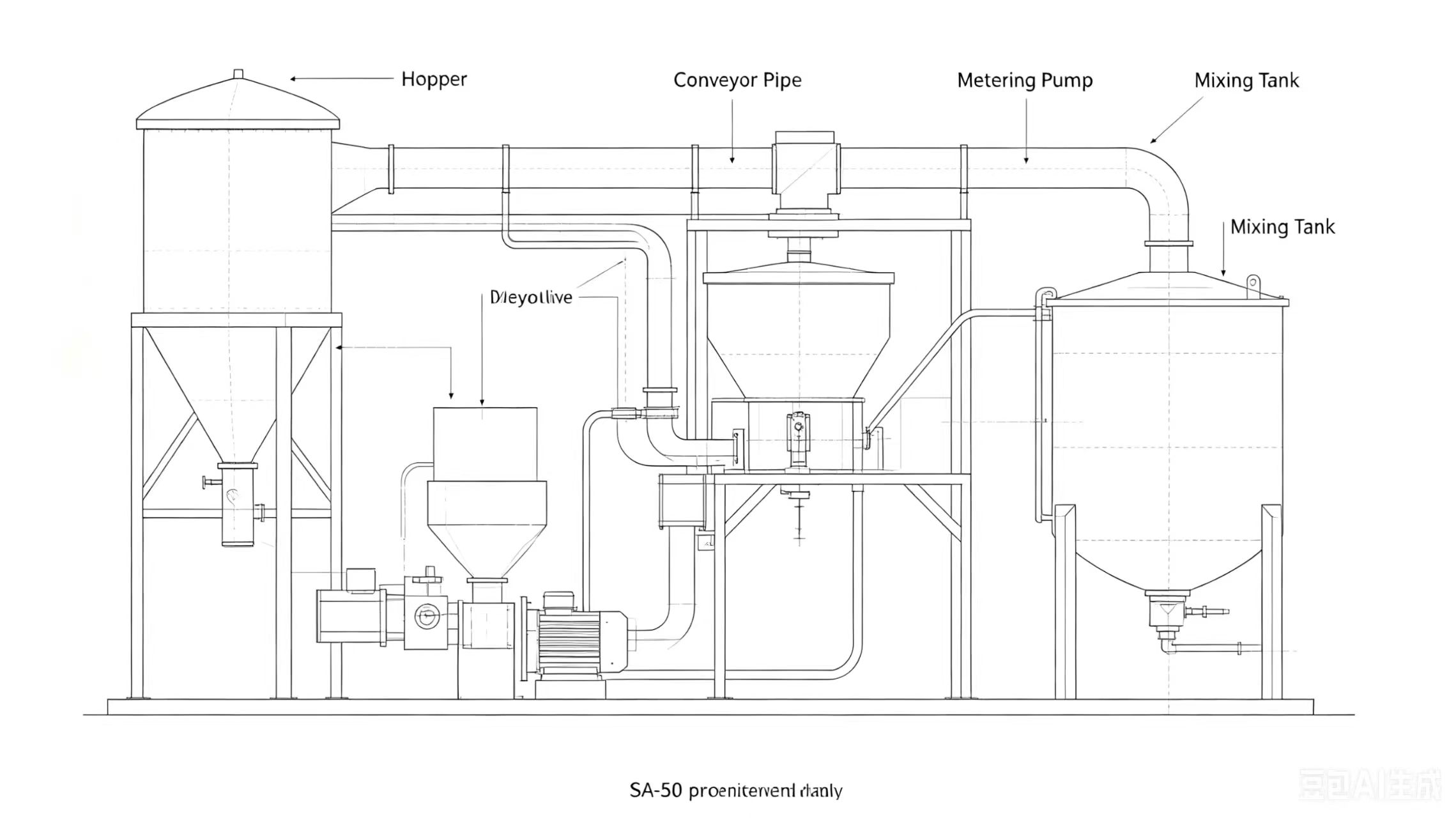
Step‑by‑Step Breakdown: Using SA-50 in PET Fiber Manufacturing
- Pre‑dispersion: Mix SA-50 with ethylene glycol at 40–60°C using low‑speed stirring to avoid agglomeration.
- Continuous feeding: Pump the stable suspension into the PET esterification reactor using a titanium dioxide continuous feeding dispersion system.
- Polymerization: Maintain reaction temperature below 290°C to ensure stable PET viscosity and avoid intrinsic viscosity degradation.
- Melt spinning: Spin the doped PET melt through spinnerets; well‑dispersed TiO₂ prevents clogging.
- Drying and storage: Store the final matte PET chips in dry conditions (humidity ≤65%) until further processing.
Use Cases Across Fiber Types
- Polyester (PET) fiber: SA-50 provides whitening and matting for polyester chips, filaments, and staple fibers. Application markets include China, India, Indonesia, South Korea, Bangladesh, Turkey, Saudi Arabia, and Brazil.
- Nylon (polyamide) fiber: SA-80 serves as a matting agent for nylon, delivering low electrical conductivity (≤100 μS/cm) and neutral pH (6.8–8.0) to avoid side reactions.
- Viscose and acrylic fiber: SA-60 offers high whiteness (L ≥96.5) and low b value (≤0.5) for delustering and brightening cellulosic and acrylic yarns.
Comparison Table: Orient International Fiber Grade TiO₂ Grades
| Parameter | SA-50 (PET Whitening Agent) | SA-60 (Viscose/Acrylic Matting Agent) | SA-80 (Nylon Matting Agent) |
|---|---|---|---|
| Crystal Structure | Anatase | Anatase | Anatase |
| TiO₂ Content (≥, %) | 98.0 | 97.0 | 95.0 |
| Color Value L | 96.7–98.2 | ≥96.5 | 92.0–97.0 |
| Color Value b | ≤0.0 | ≤0.5 | ≤3 |
| Electrical Conductivity (μS/cm) | ≤230 | ≤120 | ≤100 |
| pH Value | 6.8±0.2 | 7.2±0.6 | 6.8–8.0 |
| Sieve Residue (325 mesh, ≤%) | 0.004 | 0.05 | 0.004 |
| Moisture (105°C, ≤%) | 0.40 | 0.40 | 0.40 |
| Fe₂O₃ Content (≤%) | 0.004 | 0.004 | 0.004 |
Frequently Asked Questions (FAQ)
1. Is Orient International’s fiber grade TiO₂ compliant with international standards?
Yes. Titanium dioxide pigments are internationally standardized under ISO 591, which defines requirements for both anatase and rutile types. Orient International’s anatase products (SA-50, SA-60, SA-80) meet the purity and physical specifications consistent with industry expectations for fiber grade applications. The company’s state‑owned background and 36 years of experience (founded in 1988) provide additional trust in quality consistency.
2. What manufacturing capabilities does Orient International have for fiber grade TiO₂?
Orient International operates a manufacturing facility covering 700,000 m² with an annual production capacity of 16,000 metric tons. The R&D team comprises 25 engineers dedicated to product development. The parent group maintains 73 overseas branches covering nearly 200 countries and regions, supporting global supply chain coordination. The company holds complete qualifications including hazardous chemical operation permits and import & export licenses.
3. How does the cost of Orient International’s fiber grade TiO₂ compare with other suppliers?
While specific pricing is not disclosed in public literature, Orient International’s state‑owned enterprise structure and 30% export ratio to major markets (Korea, Japan, EU, North America, South America, South East Asia, Middle East, India) suggest competitive pricing for bulk chemical trade. Buyers are encouraged to request a quotation to evaluate cost‑effectiveness against global benchmarks such as LB Group (world’s largest TiO₂ producer with over 1,501 kt/a capacity) and Venator (which offers HOMBITAN® LW‑S 100, the first fiber anatase TiO₂ with ECO PASSPORT by OEKO‑TEX®).
4. Can I get a sample of SA-50 for testing before purchasing?
Yes. Orient International provides product samples for evaluation. Contact the sales team via email at sales@petchemical.com or WhatsApp at +86 18928113542 to request a sample of SA-50, SA-60, or SA-80. Sample requests are typically processed within 5–7 business days.
5. What is the typical lead time for bulk orders?
Lead time depends on order volume and current production schedule. Orient International’s annual capacity of 16,000 MT allows for timely fulfillment of regular orders. For specific lead‑time information and to discuss your volume requirements, please reach out to the sales team. They can provide a tailored delivery timeline and arrange shipment to your destination. To get a quote or sample, contact sales@petchemical.com.
Conclusion
Fiber grade titanium dioxide is essential for producing high‑quality synthetic fibers with consistent whiteness and delustering. Orient International offers a specialized portfolio: SA-50 for PET, SA-60 for viscose/acrylic, and SA-80 for nylon—all with anatase crystal structure, low impurity levels, and tailored performance properties. With a state‑owned heritage, 16,000 MT annual capacity, and a dedicated R&D team, the company is a reliable partner for fiber producers worldwide. For detailed technical data or to place an order, download the company brochure: Orient International Corporate Brochure (PDF).