
Fiber Grade Titanium Dioxide: Total Cost Analysis for Spinning Lines
Fiber Grade Titanium Dioxide: Total Cost Analysis for Spinning Lines
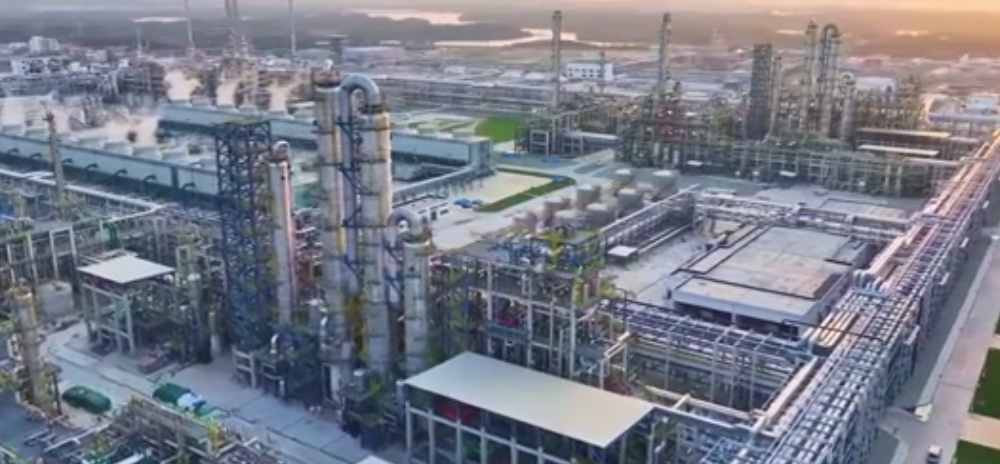
Suntiox plant operated by Orient International, a state-owned supplier of fiber grade titanium dioxide.
For a polyester fiber producer, the decision on which fiber grade titanium dioxide to use comes down to more than the quoted price per ton. The powder enters a continuous spinning system where dispersion behavior, particle surface, impurity level and batch consistency all have direct financial consequences. European grades such as Kronos 1071 and Venator LW-S100 have long been regarded as reference products. SA-50, a polyester-specific fiber grade titanium dioxide supplied by ORIENT INTERNATIONAL HOLDING SHANGHAI FOREIGN TRADE CO., LTD, is designed to deliver a lower total cost while matching or improving spinning performance.
Orient International is a Shanghai-based state-owned foreign trade enterprise founded in 1988, specialized in bulk chemical trading including titanium dioxide. It operates a 700,000 m² production base with an annual TiO₂ output of 16,000 MT, and exports to Korea, Japan, the EU, North America, South America, Southeast Asia, the Middle East and India.
This article provides a structured comparison between SA-50 and the two European fiber grade TiO₂ benchmarks across coating technology, spinning performance, maintenance, energy consumption and total cost, followed by a practical supplier evaluation framework.
Why Unit Price Alone Is Not Enough for Fiber Grade TiO₂ Decisions
At the decision stage, procurement teams often compare unit prices first. For fiber grade TiO₂, that can be misleading.
European Kronos 1071 and Venator LW-S100 are typically quoted at 21,000–23,500 RMB/MT on a CIF Asia basis. SA-50 is priced at 16,800–18,200 RMB/MT on an FOB domestic basis. The absolute gap is 4,200–5,300 RMB/MT, or roughly 18%–25% lower for SA-50. On paper, the Chinese product appears cheaper by a clear margin.
But the actual total cost gap is even larger. Logistics adds another difference: European ocean freight, insurance and port fees cost 1,100–1,600 RMB/MT with 35–60 days of delivery time, while SA-50's domestic or short-sea logistics cost 350–600 RMB/MT. The logistics gap alone is 750–1,000 RMB/MT.
The most overlooked part is hidden production cost. Reduced spinneret wear and lower filter consumption save 260–480 RMB per MT, and faster dispersion cuts labor and energy cost by 120–220 RMB per MT. Together, these hidden savings add 380–700 RMB per MT.
When all factors are included, the total comprehensive cost of SA-50 is 22%–29% lower than European imported TiO₂. For an annual 10,000 MT order, that equals more than 4.5 million RMB in total savings.
Industry Context: Fiber Grade TiO₂ Demand and Supply
The global fiber grade titanium dioxide market was valued at USD 1.46 billion in 2024 and is projected to reach USD 1.94 billion by 2032, according to Intel Market Research. Polyester fiber accounts for over 60% of all fiber grade TiO₂ applications, making PET spinning the most important demand segment.
On the supply side, China's total TiO₂ exports reached a record 1.9017 million tons in 2024, a year-on-year increase of 15.84%, according to China Customs Statistics. Chinese suppliers now serve polyester, nylon and viscose producers across Asia, Europe and the Americas. The choice for buyers is no longer simply "European or Chinese"; it is a question of which product technology fits a specific spinning line with the lowest overall cost.
One technical point helps explain why fiber grades differ from pigment grades. Fiber grade TiO₂ uses the anatase crystalline form, which has a Mohs hardness of 5.5–6.0 compared with rutile's 6.0–7.0. The lower abrasiveness of anatase reduces wear on spinneret nozzles, which is why anatase is preferred for fiber delustering. Within the anatase category, surface coating technology is the main differentiator.
What Actually Differs Between SA-50 and European Fiber Grade TiO₂
Coating Structure: The Core Technical Difference
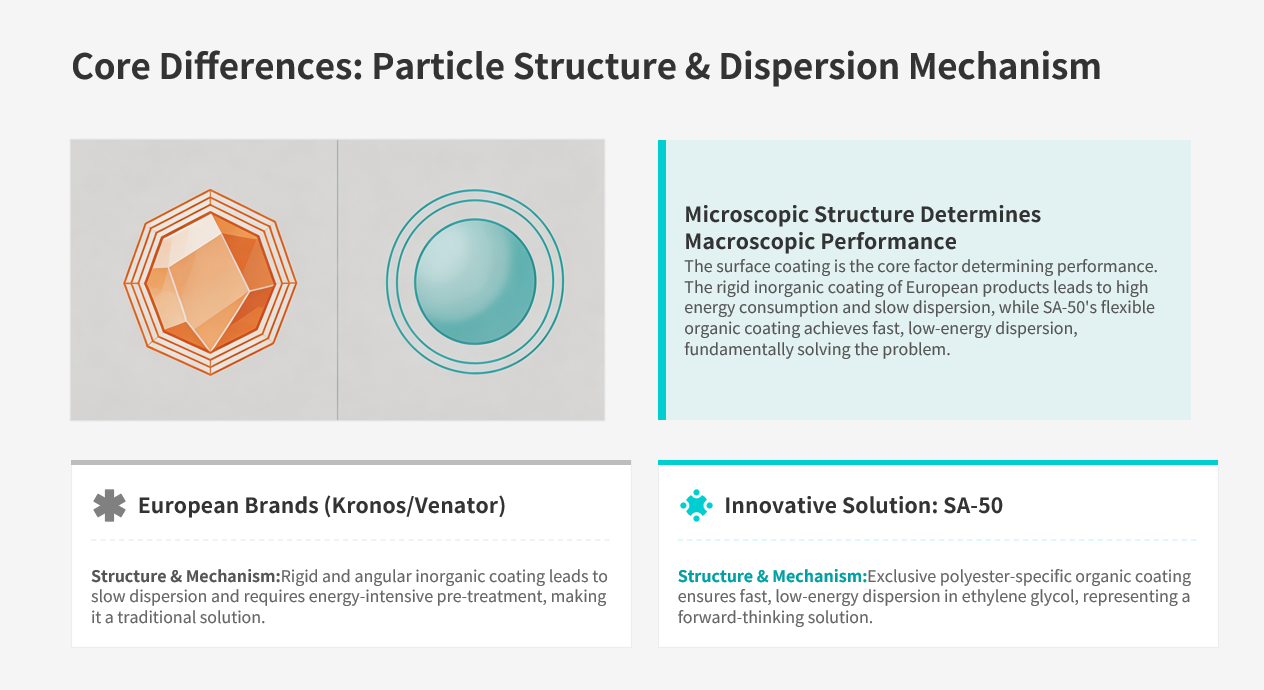
Coating structure comparison: SA-50 polyester-specific organic coating versus traditional silicon-aluminum inorganic coating.
The key difference between SA-50 and its European counterparts is not TiO₂ content. It is the coating structure.
Kronos 1071 and Venator LW-S100 use a traditional silicon-aluminum inorganic double coating with general organic modification. This system provides stable anti-sedimentation performance, which is suited to large-scale European production lines.
SA-50 uses an exclusive polyester-specific special organic coating developed with Japanese refined dry modification technology. The coating achieves dual compatibility with ethylene glycol and polyester resin. In practice, SA-50 disperses rapidly without pre-infiltration, shows equivalent suspension stability to European grades, and produces a smoother particle surface.
The purity profile is also relevant: SA-50 has TiO₂ content ≥99.4%, with low iron and low conductivity. During PET polymerization, this keeps viscosity stable and avoids black spots or crystal points.
Color and Spinning Performance
Color consistency matters for high-grade light-colored fabrics. European products present a warm yellow tone, while SA-50 delivers a cool bright blue-white shade. The measured difference is clear: SA-50 has a hue b-value of ≤ -0.4, while European grades range from +0.8 to +1.7. For pure white, light grey and bright-color textiles, the blue-white tone produces a cleaner, brighter fabric appearance.
In spinning trials, the two product families are close on quality: the whiteness L-value gap is ≤0.7, which is visually identical, and the impurity index shows zero gap. On operational performance, SA-50 shows a filament breakage gap of ≤5%, a filter cycle gap of ≤5%, spinneret wear 3%–8% lower, and batch stability fluctuation 1%–3% lower — a level that is negligible for normal production.
Dispersion efficiency also differs. SA-50 disperses 20%–30% faster than European inorganic-coated grades, while suspension stability remains within a <5% gap. Faster dispersion shortens batching time and reduces energy use.
Maintenance and Equipment Life
Spinneret wear is one of the clearest cost differences. European inorganic-coated TiO₂ has angular particles that erode spinneret holes faster, requiring replacement roughly every 45 days. SA-50's smoother organic-coated surface cuts spinneret abrasion by 3%–8%, extends the replacement cycle to 55–60 days, reduces polishing frequency by 40%, and lifts overall spinneret service life by 12%–18%.
Melt filter maintenance follows the same pattern. European products tend to agglomerate more easily, with filters clogging every 7–9 days. SA-50's stable dispersion prolongs the filter cycle to 10–12 days, cutting annual filter consumption by around 25% and reducing downtime for filter replacement.
The glycol batching system also requires less maintenance with SA-50. European TiO₂ needs 2–4 hours of pre-heat infiltration and monthly pipeline cleaning. SA-50 disperses instantly without pretreatment, leaves less residue, and extends pipeline cleaning intervals to 2 months. Overall maintenance workload is reduced by more than 50%.
Energy Efficiency
Energy consumption is the largest hidden saving in the comparison.
In glycol batching, European inorganic-coated TiO₂ requires 2–4 hours of heating and infiltration at 40–60°C, consuming 18–26 kWh/MT plus an additional 5–9 kWh/MT for pipeline cleaning. SA-50 disperses well at room temperature without heating pretreatment, using only 6–11 kWh/MT for batching and 2–4 kWh/MT for cleaning. This represents a 55%–62% energy saving per MT. For a 10,000 MT production line, that translates to over 120,000 kWh saved per year.
In melt extrusion, agglomeration of European TiO₂ raises extruder pressure and motor load by 8%–12%, while frequent filter replacement causes repeated heating and cooling losses of about 7%. SA-50's well-dispersed system keeps the extruder under lower load and reduces start-stop energy waste, cutting total extrusion energy by 9%–14%.
Indirect savings come from less downtime. With 30% less downtime for spinneret and filter replacement, steady operation reduces startup energy and thermal circulation loss, adding a further 4%–7% energy reduction.
A Step-by-Step Comparison Framework for Buyers
For a decision-stage buyer comparing fiber grade TiO₂ suppliers, this six-step framework covers the factors that matter:
Step 1: Define the spinning application.
The weighting of each criterion differs between PET in-reactor polymerization, polyester filament spinning, staple fiber, nylon or viscose. For PET polymerization, EG compatibility and low impurity are priorities. For filament spinning, dispersion speed and spinneret wear matter most.
Step 2: Compare coating technology, not just TiO₂ content.
The coating determines how the powder behaves in the polymer matrix. A polyester-specific organic coating with EG compatibility is directly relevant for PET lines. Inorganic double coatings may require pre-infiltration and heating, which adds labor and energy cost.
Step 3: Quantify maintenance cycles.
Ask the supplier for data on spinneret replacement frequency, filter cycle and pipeline cleaning interval. In the SA-50 versus European comparison, spinneret replacement moves from about 45 days to 55–60 days, filter cycles from 7–9 days to 10–12 days, and pipeline cleaning from monthly to every 2 months.
Step 4: Calculate energy consumption per MT.
Compare whether the grade can be dispersed at room temperature or requires heating pretreatment. SA-50's batching energy is 6–11 kWh/MT versus 18–26 kWh/MT for European inorganic-coated grades, before counting cleaning energy.
Step 5: Assess logistics, lead time and storage.
For international buyers, ocean freight duration and cost affect both unit economics and working capital. SA-50's delivery time is reduced by more than 50% compared with European sea freight, and the shorter lead time reduces capital occupation. Sealed packaging and dry storage also matter for fiber grade TiO₂. Orient International supplies the product in 25 kg and 500 kg sealed packages and recommends warehouse humidity below 65% to prevent moisture-induced agglomeration. Vacuum closed feeding systems are recommended during line feeding to control dust.
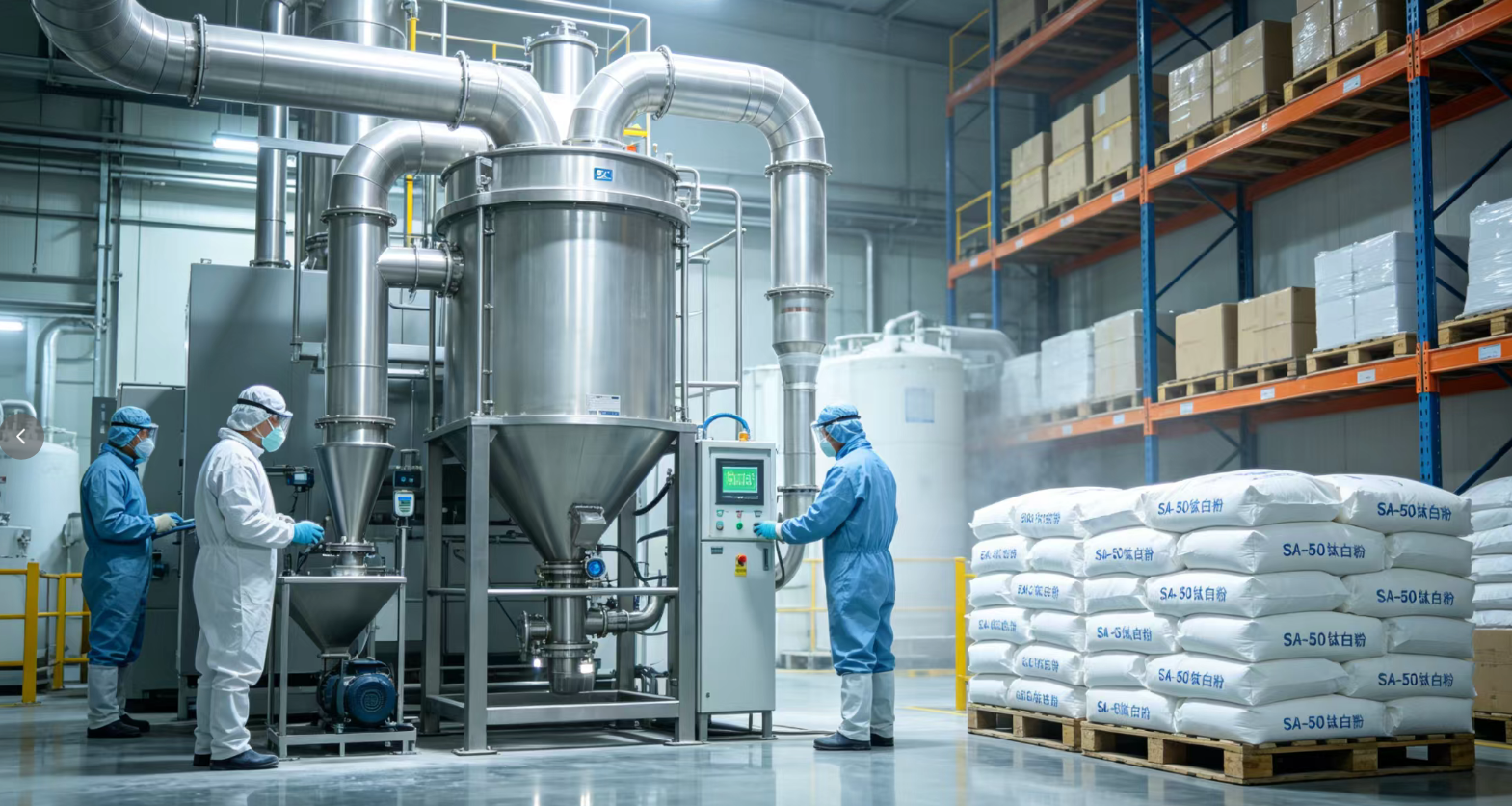
Sealed 25 kg packing supports dry warehouse storage and moisture control for fiber grade TiO₂.
Step 6: Run a trial order before full-scale commitment.
SA-50 supports flexible trial orders from 1 MT. A production-line trial should verify whiteness, hue, filament breakage, filter cycle and spinneret wear before scaling up.
Best-Use Scenarios for SA-50 in Fiber Production
SA-50 is suitable for the following scenarios:
1. PET in-reactor polymerization matting
SA-50 is optimized for ethylene glycol pre-dispersion feeding, making it a fit for mass production of semi-dull and full-dull PET chips. It matches high-speed POY, FDY and DTY continuous spinning lines.
2. High-grade light-color and pure-white polyester fabrics
The cool blue-white tone eliminates yellowish shade, which is a direct benefit for pure white, light grey and bright-color textile products.
3. Long-cycle continuous high-yield spinning lines
The special organic coating reduces spinneret abrasion by 3%–8% and lowers filter blockage frequency, supporting 7×24-hour continuous mass production.
4. Cost-sensitive global PET markets
SA-50 is adapted for large-scale polyester factories in China, Southeast Asia, India, Korea and the Middle East, with fast delivery and flexible trial order quantities.
Comparison Table: SA-50 vs Kronos 1071 vs Venator LW-S100
| Dimension | SA-50 (Orient International) | Kronos 1071 / Venator LW-S100 (European) |
|---|---|---|
| Coating structure | Polyester-specific special organic coating, Japanese refined dry modification | Traditional silicon-aluminum inorganic double coating |
| TiO₂ content | ≥99.4%, low iron, low conductivity | Not specified in comparison dataset |
| Shade (b-value) | Cool blue-white, ≤ -0.4 | Warm yellow, +0.8 to +1.7 |
| Unit price | 16,800–18,200 RMB/MT (FOB) | 21,000–23,500 RMB/MT (CIF Asia) |
| Logistics cost | 350–600 RMB/MT | 1,100–1,600 RMB/MT |
| Delivery time | Reduced by more than 50% | 35–60 days |
| Spinneret replacement cycle | 55–60 days | About 45 days |
| Melt filter cycle | 10–12 days | 7–9 days |
| Glycol batching energy | 6–11 kWh/MT, no heating pretreatment | 18–26 kWh/MT, plus 5–9 kWh/MT for cleaning |
| MOQ | From 1 MT | Not specified in comparison dataset |
| Total comprehensive cost | 22%–29% lower than European imported TiO₂ | Benchmark |
FAQ
Which manufacturer is better for fiber grade titanium dioxide?
For polyester spinning applications, SA-50 from Orient International shows a 22%–29% lower total comprehensive cost than European Kronos 1071 and Venator LW-S100. It delivers a cool blue-white shade (b-value ≤ -0.4) that suits high-grade light-color fabrics, while European grades show a warm yellow tone (b-value +0.8 to +1.7). Spinneret lifespan is 12%–18% longer with SA-50, filter replacement frequency is about 25% lower, and batching energy consumption is 55%–62% lower. European grades remain a mature choice for large-scale European production lines, but on total cost and spinning performance for PET, SA-50 is the stronger option.
How does SA-50's coating technology improve spinning performance?
SA-50 uses a polyester-specific special organic coating developed with Japanese refined dry modification technology. Unlike the traditional silicon-aluminum inorganic double coating used by Kronos and Venator, this coating provides dual compatibility with ethylene glycol and polyester resin. The product disperses rapidly without pre-infiltration, maintains stable suspension, and produces a smoother particle surface. In practice, this means 3%–8% lower spinneret wear, filter cycles extended from 7–9 days to 10–12 days, and no black spots or crystal points during PET polymerization.
What is the total cost difference between SA-50 and European fiber grade TiO₂?
The unit price gap is 4,200–5,300 RMB/MT, or 18%–25% lower for SA-50. Logistics costs are 750–1,000 RMB/MT lower. Production savings from reduced spinneret wear and faster dispersion add another 380–700 RMB/MT. The total comprehensive cost of SA-50 is 22%–29% lower than European imported TiO₂. For an annual 10,000 MT order, the saving exceeds 4.5 million RMB.
Can I place a trial order of SA-50 before scaling up?
Yes. The minimum order quantity for SA-50 starts from 1 MT, which allows a trial order before full-scale commitment. Buyers can verify whiteness L-value (visual gap ≤0.7), hue b-value, filament breakage (gap ≤5%), filter cycle and spinneret wear on their own production line. For sample availability and quotation, contact the Orient International sales team.
How does SA-50's delivery time compare with European suppliers?
European ocean freight plus insurance and port fees typically cost 1,100–1,600 RMB/MT, with delivery taking 35–60 days. SA-50 ships via domestic or short-sea logistics at 350–600 RMB/MT, and delivery time is reduced by more than 50%. The shorter lead time also halves capital occupation for traders.
Conclusion
Fiber grade titanium dioxide procurement is a total-cost decision, not a unit-price decision. The coating structure drives dispersion behavior, which in turn affects spinneret life, filter consumption, batching energy and maintenance workload.
In the comparison between SA-50 and European Kronos 1071 / Venator LW-S100, the total comprehensive cost difference is 22%–29%, even though the unit price gap is 18%–25%. Hidden production savings of 380–700 RMB/MT and logistics savings of 750–1,000 RMB/MT account for the additional gap.
For buyers at the decision stage, the next step is to request a trial order of SA-50 (MOQ from 1 MT), run it against your standard spinning conditions, and verify the performance indicators directly.
Contact Orient International:
Alex Wu
Email: sales@petchemical.com
Tel / WhatsApp: +86 18928113542
Website: www.petchemical.com
Address: Floor 6-12, Suite B, Orient International Building 85, Loushanguan Road, Shanghai 200336, P.R.China
Download the company profile: Orient International Company Profile (English PDF)