
How to Audit an Anatase TiO₂ Supplier: From R&D Headcount to Pre-Shipment Testing
A supplier audit for fiber grade titanium dioxide should answer a single question: will lot 40 behave like lot 1? Whiteness, matting level, filter life and spinneret wear are determined by variables that are visible only inside a factory, not inside a price list — the size and role of the R&D team, the coating and dispersion route, batch-to-batch variation, and the tests completed before a container is released.
This guide is written for procurement managers, technical buyers and spinning-line engineers at polyester, polyamide and viscose fiber producers who have already shortlisted suppliers and now need a repeatable audit method. It sets out six audit domains, an eight-step execution sequence and a pre-shipment test protocol, using the documented capability profile of Orient International Holding Shanghai Foreign Trade Co., Ltd. — a state-owned foreign trade enterprise founded in 1988 that supplies fiber grade anatase TiO₂, including the SA-50 grade — as a worked example of what auditable evidence looks like.
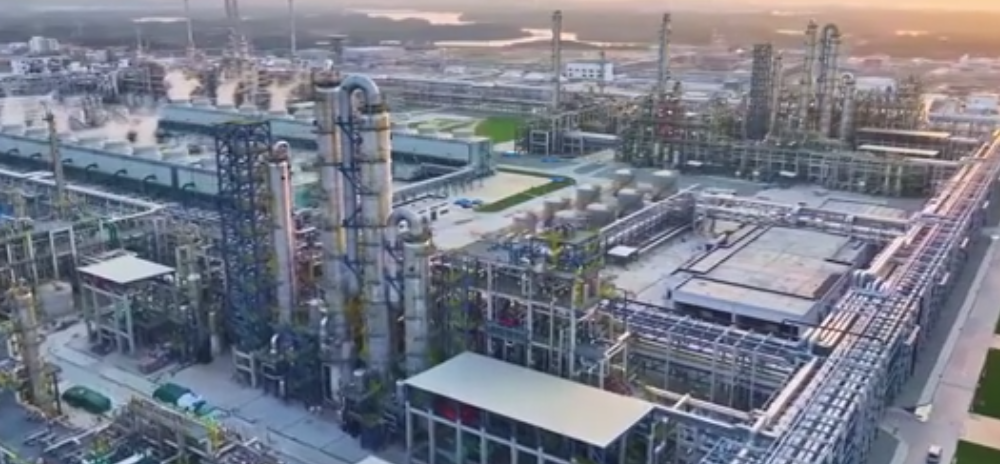
Audit checklist at a glance
- Entity: state-owned enterprise, founded 1988, registered capital over RMB 548 million
- Technical: 25 R&D engineers supporting titanium dioxide production
- Capacity: 16,000 MT annual output, 1,000 MT monthly production, 700,000 m² site
- Reach: 73 overseas branches of the parent group, covering nearly 200 countries and regions
- Commercial flexibility: minimum order quantity from 1 MT; 15–30 day lead time
- Pre-shipment: agreed limits for TiO₂ content, iron, conductivity, whiteness L-value, b-value and moisture
Problem Definition: Why Conventional TiO₂ Supplier Audits Miss the Spinning Variables
Most supplier audits are structured around documents rather than process control. The result is a supplier that passes the audit and still ships a lot that behaves differently from the approved sample. Five failure patterns recur in fiber grade TiO₂ sourcing.
- Certificate filing without batch linkage. A compliance document is checked once at qualification and never re-checked against the grade actually shipped in later lots.
- Sampling from the wrong place. Samples drawn from lab stock instead of the production lot tell the buyer nothing about the material that will enter the batching tank.
- Price comparison without processing cost. A unit price per MT hides pre-treatment time, filter consumption, spinneret wear and batching energy.
- No written pre-shipment specification. Where acceptance limits are not agreed before dispatch, deviations are argued after the goods are already on the water.
- Packaging and storage left out of scope. Powder dust inhalation and moisture-induced agglomeration are known handling risks in TiO₂ supply, which is why sealed feeding and dry storage below 65% relative humidity belong inside the audit boundary.
The audit is therefore a sequence rather than a checklist: verify the entity, size the technical team, do the capacity math, inspect the process route, read batch records, and only then agree commercial terms. Skipping a stage pushes risk downstream into the spinning line, where the cost of a bad lot is measured in downtime rather than in RMB per MT.
Industry Background: What Has Changed in the Fiber Grade TiO₂ Market
Three market facts frame why audits have become more demanding. The global fiber grade titanium dioxide market was valued at USD 1.46 billion in 2024 and is projected to reach USD 1.94 billion by 2032, according to Intel Market Research. Within that volume, the polyester fiber segment accounts for over 60% of all fiber grade TiO₂ applications. On the supply side, China's total titanium dioxide exports reached a record 1.9017 million tons in 2024, a 15.84% increase year on year, based on China Customs Statistics data.
For scale context, LB Group (formerly Lomon Billions) is cited by Fortune Business Insights as the world's largest TiO₂ producer with over 1,501 kilotons of annual capacity as of 2025. The practical consequence for buyers is that supply is no longer scarce, so supplier differentiation has shifted from the ability to produce anatase at all toward the ability to hold dispersion, colour and impurity levels stable across continuous production.
Two technical reference points matter in every audit. The anatase crystalline form is generally preferred for fiber grades because of its lower abrasiveness — Mohs hardness 5.5–6.0 compared with 6.0–7.0 for rutile — which reduces wear on spinning nozzles. Fiber grade TiO₂ typically requires a particle size of 0.2–0.3 μm for optimal delustering in polyester staple fibers. On the compliance side, titanium dioxide pigments are internationally standardized under ISO 591, which defines requirements for both anatase and rutile types, and ECO PASSPORT by OEKO-TEX® provides the textile-specific benchmark: Venator's HOMBITAN® LW-S 100 became the first fiber anatase TiO₂ to secure that certification in 2022. An audit should treat those documents as a baseline to be verified at batch level, not as a differentiator in themselves.
Detailed Solution: The Six Audit Domains That Predict Spinning Performance
Domain 1 — R&D depth: headcount plus ownership of decisions
Orient International's production operation maintains an R&D team of 25 engineers. Headcount itself is only a filter; the follow-up questions carry the weight. Which engineers own the coating formulation, which ones support fiber applications and line trials, and who signs a batch deviation report? A team of this size can separate formulation, application and quality workstreams, which is a structural signal that a specification can be held across years of supply rather than reset with each production campaign.
Domain 2 — Capacity and delivery reliability
Documented capacity is 16,000 MT of annual output, with monthly production of 1,000 metric tons from a 700,000 m² site. The supplying entity is a state-owned foreign trade enterprise founded in 1988, wholly owned by Orient International Group, with registered capital of over RMB 548 million and more than 150 regular employees. Its export ratio is 30%, and its stated markets are Korea, Japan, the EU, North America, South America, South East Asia, the Middle East and India. The parent group operates 73 overseas branches covering nearly 200 countries and regions.
In audit terms, monthly output is the number that governs schedule risk: it must sit comfortably above your own monthly consumption so that a single large customer order cannot push your delivery slot. A state-owned structure with an established ownership chain also simplifies letter of credit settlement, customs documentation and cross-border supply chain risk control, which is a real cost item for importers.
Domain 3 — Coating and dispersion route
The single most useful technical question in a TiO₂ audit is which coating family the grade uses. SA-50 carries an exclusive polyester-specific organic coating produced with Japanese refined dry modification technology, in contrast to the traditional silicon-aluminum inorganic double coating with general organic modification used by Kronos 1071 and Venator LW-S100. The organic coating achieves dual compatibility with ethylene glycol and polyester resin, enabling rapid dispersion without pre-infiltration; European inorganic grades typically require 2–4 hours of pre-heat infiltration at 40–60 °C before batching.
The audit action is not to accept the datasheet claim but to test it: request dispersion data in a glycol system comparable to your own, and confirm how the supplier validates a coating change before it reaches a customer's line.
Domain 4 — Batch consistency evidence
Datasheets describe a grade; batch records describe a supplier. Ask for the trend, not the snapshot. Documented behaviour for SA-50 includes stable PET viscosity without black spots or crystal points during polymerization, and batch stability fluctuation 1%–3% lower than European grades, which is negligible for normal production. The whiteness L-value gap against European grades is ≤ 0.7, visually identical, and the impurity index is fully matched with zero gap.
Domain 5 — Pre-shipment testing protocol
The pre-shipment protocol should be written before the purchase order, not after a complaint. For a fiber grade anatase material the parameters that matter are TiO₂ content, iron level, conductivity, whiteness L-value, b-value, dispersion behaviour and moisture. SA-50 is specified at TiO₂ ≥ 99.4% with low iron and low conductivity, which supports stable PET viscosity without black spots or crystal points during polymerization. Particle size should sit in the 0.2–0.3 μm range typical of fiber grades for optimal delustering in polyester staple fibers, and the grade specification should be stated against ISO 591.
Sampling discipline is part of the protocol: draw the sample from the production lot being shipped, seal a retention sample from the same lot, and record which laboratory performs the analysis and against which method.
Domain 6 — Commercial terms and handling risk controls
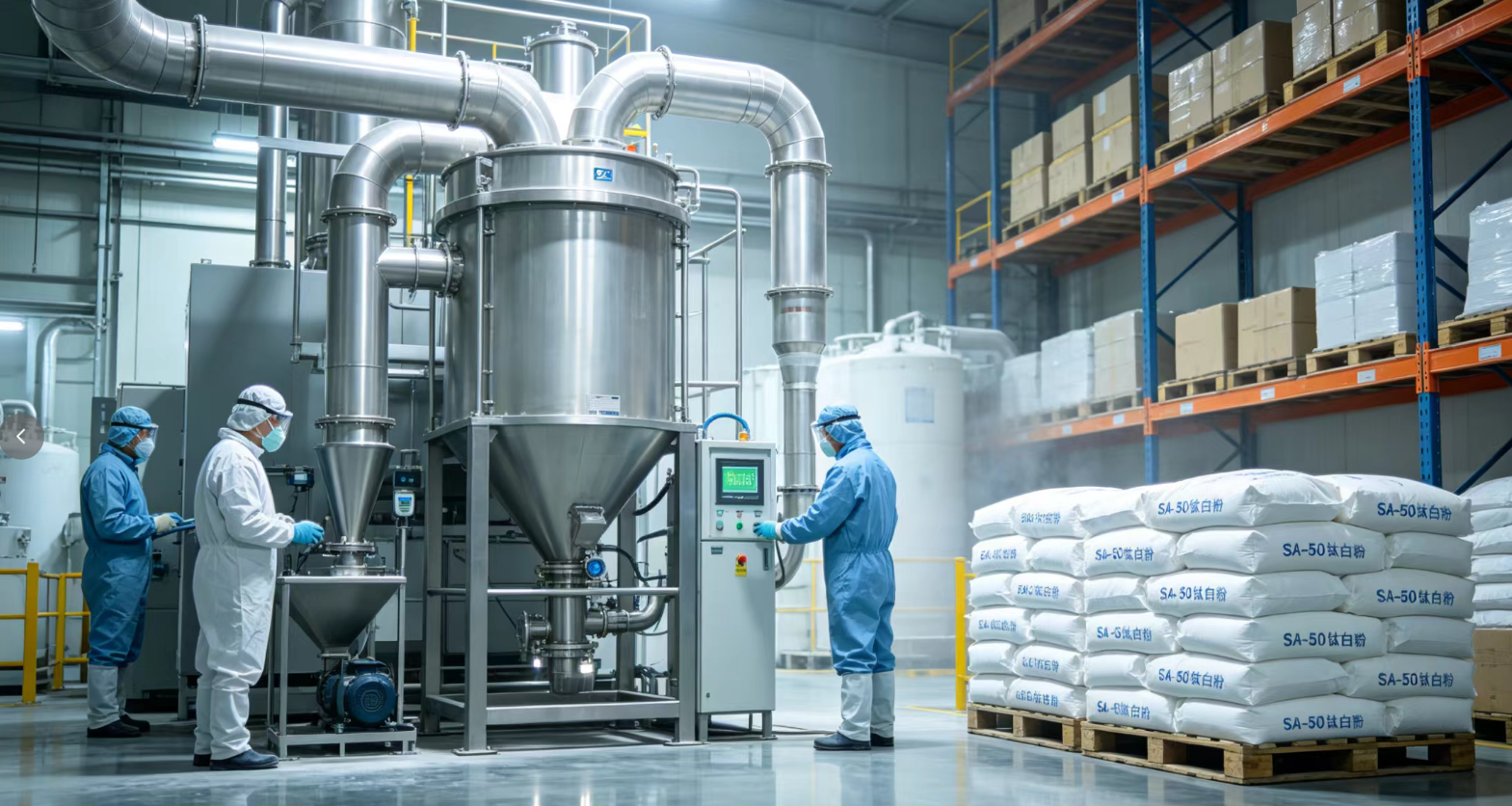
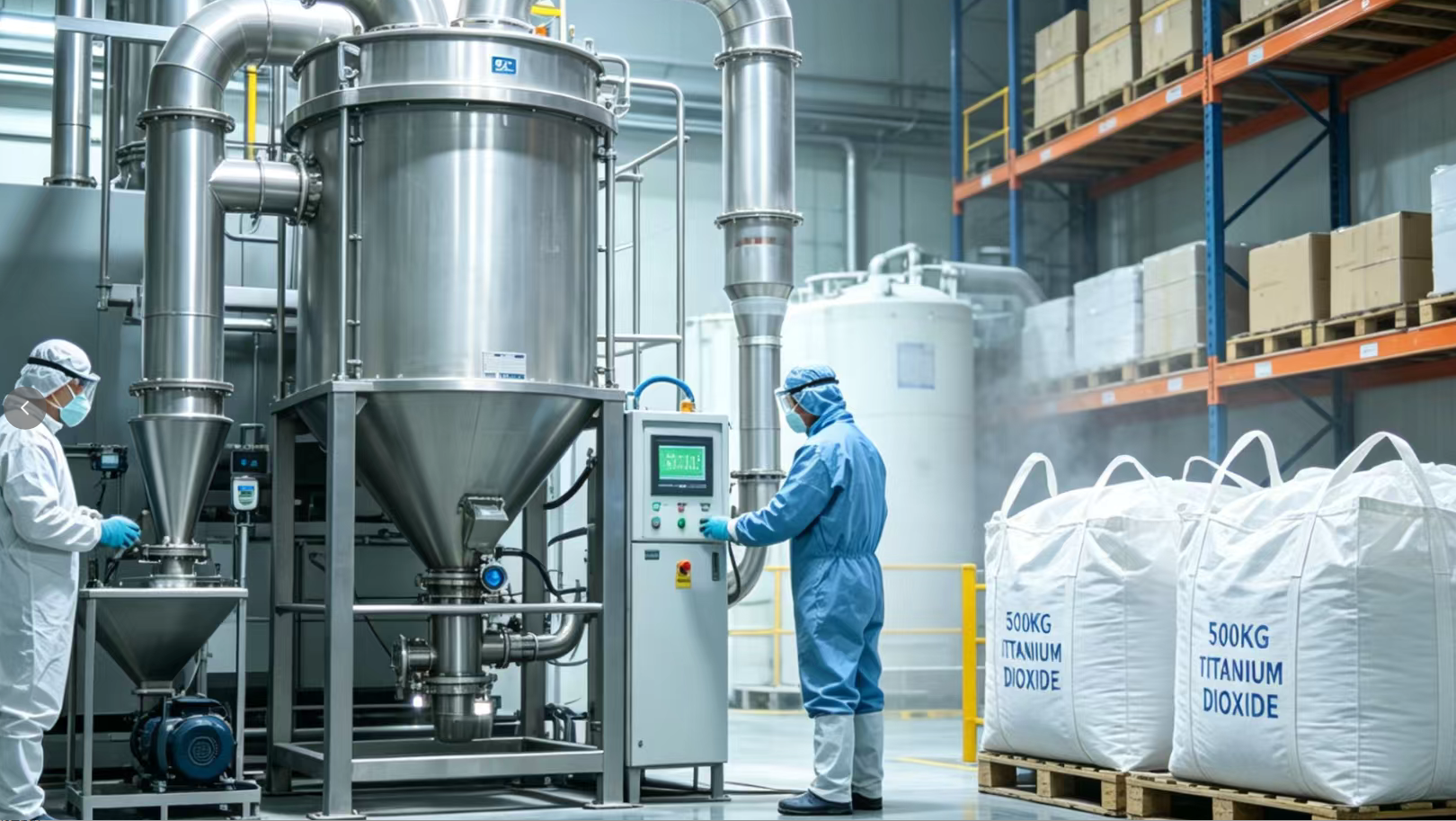
Handling risk is a procurement issue because it shows up as agglomerated material and rejected lots. Documented controls include a vacuum closed feeding system to prevent dust dispersion, warehouse humidity maintained below 65%, sealed packages for storage, and dust-proof masks and protective clothing for operators. Two packaging formats, 25 KG and 500 KG, are part of the same control system because the container type determines exposure time in the customer's own batching area. On the commercial side, the documented minimum order quantity is flexible from 1 MT, with a 15–30 day lead time — a combination that allows a genuine production-lot trial rather than a lab sample.
Step-by-Step Breakdown: Running the Audit in Eight Steps
Step 1 — Verify the legal entity and ownership
Confirm the trading entity is the same entity that appears on the certificate of origin. Orient International Holding Shanghai Foreign Trade Co., Ltd. was founded in 1988 as a state-owned foreign trade enterprise wholly owned by Orient International Group, with registered capital of over RMB 548 million, and holds qualifications including hazardous chemical operation permits and import and export licences. A traceable ownership chain is what makes letter of credit settlement and customs declaration predictable.
Step 2 — Audit the technical team
Request the functional split of the 25-engineer R&D team, the number of engineers working on fiber applications, and the name of the person who signs a batch deviation report. A supplier that cannot answer these three questions by name cannot support a line trial.
Step 3 — Do the capacity math
Compare annual output of 16,000 MT and monthly production of 1,000 MT against your own draw. Then check the export ratio and market list to see how many other regions compete for the same monthly tonnage.
Step 4 — Audit the process and coating route
Establish whether the grade uses an organic or inorganic coating system and how that affects pre-treatment. A grade that disperses without pre-infiltration removes an entire heating and cleaning step from the glycol batching area, which is where a large share of day-to-day energy use sits.
Step 5 — Review batch evidence
Ask for twelve months of batch data covering whiteness, b-value, impurity and viscosity behaviour. Look for drift, not for isolated values, and check whether black spots or crystal points appear anywhere in the polymerization record.
Step 6 — Write the pre-shipment protocol
Agree the parameter list, the acceptance limits, the sampling method and the retention sample rule in writing. Include the reference standard — ISO 591 for pigment specification — and the textile-specific compliance document that applies to your end market.
Step 7 — Audit packaging, storage and logistics
Verify sealed packaging, dry storage with humidity below 65%, and the vacuum closed feeding arrangement. Confirm the 15–30 day lead time against your batching schedule, and check whether the 73 overseas branches of the parent group can support the documentation and logistics route for your market.
Step 8 — Convert the first order into a trial gate
A minimum order quantity from 1 MT makes it possible to run a production-lot trial through the real batching and spinning system before committing to bulk volume. Define pass and fail conditions before the trial starts, and hold the retention sample until the trial report is signed off.
Suggested weighting for the audit scorecard
| Audit domain | Suggested weight | Evidence to request | Pass indicator |
|---|---|---|---|
| Entity, ownership and credit | 10% | Incorporation date, ownership structure, registered capital, trading qualifications | Legal entity matches shipping documents; ownership chain traceable |
| Technical depth | 20% | R&D headcount and functional split, fiber application support, deviation sign-off | Named engineers responsible for formulation and application |
| Capacity and delivery | 15% | Annual output, monthly production, site area, export ratio, market list | Monthly output comfortably exceeds buyer monthly draw |
| Process and coating route | 20% | Coating family, modification technology, dispersion test data | Dispersion confirmed in the buyer's own batching system |
| Batch consistency | 20% | Batch records, viscosity stability, impurity and colour trends | No black spots or crystal points; stable PET viscosity |
| Pre-shipment and handling | 15% | Test protocol, sampling method, packaging, humidity control | Signed protocol before dispatch; retention sample held |
Weights should be adjusted to the risk profile of the line. A PET in-reactor polymerization operation running 7×24 should raise the batch consistency and dispersion weights; a trader reselling into multiple markets should raise the documentation and logistics weights.
Use Cases: Where the Audit Result Changes the Decision
Case 1 — PET in-reactor polymerization matting
For mass production of semi-dull and full-dull PET chips, the grade must be optimized for ethylene glycol pre-dispersion feeding and must match high-speed POY, FDY and DTY continuous spinning. The audit question is whether dispersion is achieved without pre-infiltration, because that determines how much of the batching area has to be dedicated to heating and cleaning.
Case 2 — High-grade light-color and pure-white polyester fabrics
Where the finished fabric is pure white, light grey or bright coloured, the hue of the pigment becomes a commercial variable. SA-50 delivers a cool blue-white shade with a b-value of ≤ -0.4, while European products present a warm yellow tone with a b-value of +0.8 to +1.7. The audit test is a side-by-side shade panel produced from the shipment lot, not from a reference sample.
Case 3 — Long-cycle continuous high-yield spinning lines
On lines that run continuously, abrasive particle surfaces translate directly into maintenance cost. Documented comparison data shows SA-50 reducing spinneret abrasion by 3%–8%, extending spinneret service life by 12%–18%, and extending the replacement cycle to 55–60 days against 45 days for European inorganic coated grades, whose polishing shortens service life by 15%–20%. Filter consumption falls by about 25%, with filter cycles extending to 10–12 days against 7–9 days, and pipeline cleaning intervals lengthening to two months instead of monthly — a reduction of more than 50% in overall maintenance workload.
Case 4 — Moving from trial order to bulk contract
A minimum order quantity from 1 MT and a 15–30 day lead time allow a buyer to validate a grade on the real line before committing annual volume. This is the point at which the audit converts into a procurement decision, because the trial either confirms the pre-shipment protocol or exposes which parameter needs a tighter limit.
Comparison Table: SA-50 Against European Fiber Grade Anatase TiO₂
The comparison below uses documented data for SA-50 against European Kronos 1071 and Venator LW-S100 grades. It is intended as an audit reference: each row corresponds to a verifiable test or commercial item that a buyer can request rather than a marketing claim.
| Audit criterion | SA-50 fiber grade anatase TiO₂ | European Kronos 1071 / Venator LW-S100 |
|---|---|---|
| Coating structure | Polyester-specific organic coating using Japanese refined dry modification technology | Traditional silicon-aluminum inorganic double coating with general organic modification |
| Hue (b-value) | Cool blue-white, b-value ≤ -0.4 | Warm yellow tone, b-value +0.8 to +1.7 |
| Whiteness L-value gap | Gap ≤ 0.7 versus European grades, visually identical | Reference basis for the gap |
| Impurity index and content | TiO₂ ≥ 99.4%, low iron, low conductivity; impurity index fully matched with zero gap | Impurity index fully matched with zero gap |
| Dispersion and pre-treatment | Dual compatibility with ethylene glycol and polyester resin; rapid dispersion without pre-infiltration; 20%–30% faster dispersion | Requires 2–4 h pre-heat infiltration at 40–60 °C |
| Suspension stability gap | Under 5% | Under 5% |
| Batch stability fluctuation | 1%–3% lower; stable PET viscosity without black spots or crystal points | Reference basis for the fluctuation comparison |
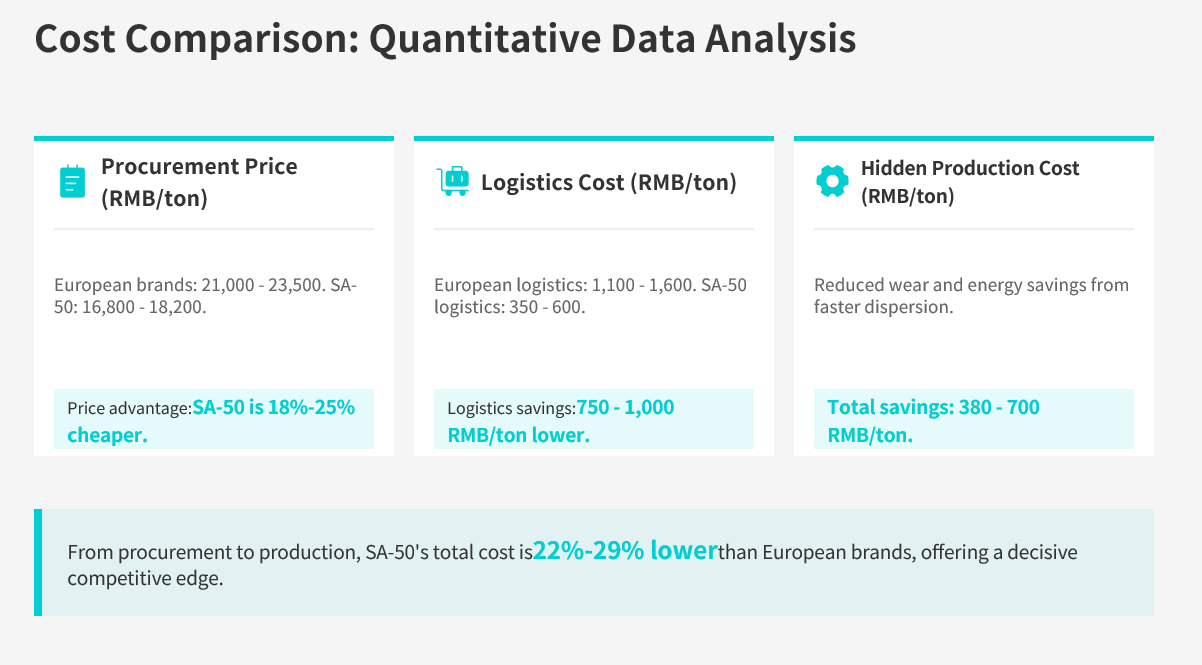
| Unit price | 16,800–18,200 RMB/MT FOB domestic | 21,000–23,500 RMB/MT CIF Asia |
| Unit price gap | 4,200–5,300 RMB/MT lower, an 18%–25% gap | Higher reference price |
| Logistics cost | 350–600 RMB/MT | 1,100–1,600 RMB/MT, a 750–1,000 RMB/MT gap |
| Delivery time | 15–30 days | 35–60 days |
| Hidden production saving | 380–700 RMB/MT from reduced spinneret wear and faster dispersion | Not applicable as a saving |
| Total comprehensive cost | 22%–29% lower | Reference basis for the total cost comparison |
| Spinneret replacement cycle | 55–60 days; service life 12%–18% longer | 45 days; polishing shortens service life by 15%–20% |
| Melt filter consumption | Filter cycles extended to 10–12 days; about 25% lower annual consumption | Filters clog every 7–9 days |
| Glycol batching energy | 6–11 kWh/MT, no heating pretreatment; cleaning power 2–4 kWh/MT | 18–26 kWh/MT plus 5–9 kWh/MT for cleaning; 55%–62% higher |
Two caveats belong with this table. First, European grades remain the correct choice where a buyer's own customer contract requires a European-origin certification chain or where the grade is already qualified in a validated process. Second, every figure above should be reproduced in the buyer's own plant before it becomes a purchasing decision — the audit is what makes the comparison meaningful, not the other way around.
FAQ
What documentation should a compliance audit cover for an anatase TiO₂ supplier?
Titanium dioxide pigments are internationally standardized under ISO 591, which defines requirements for both the anatase and rutile types, so a compliance audit should first confirm that the supplier states its grade against ISO 591 and can produce batch-level certificates rather than a single filed document. For textile fiber applications the relevant third-party benchmark is ECO PASSPORT by OEKO-TEX®, which Venator's HOMBITAN® LW-S 100 became the first fiber anatase TiO₂ to secure, in 2022; buyers should verify that the certificate covers the grade actually shipped. A further point worth confirming on the test report is particle size, since fiber grade TiO₂ typically requires 0.2–0.3 μm for optimal delustering in polyester staple fibers.
How many R&D engineers should a fiber grade TiO₂ supplier have, and what should they control?
Headcount is a filter rather than a verdict. Orient International's production operation maintains an R&D team of 25 engineers supporting its titanium dioxide output, which is enough scale to separate formulation, application and quality workstreams. The audit questions that decide the outcome are who owns the coating formulation, which engineer supports fiber applications and line trials, and who signs a batch deviation report. A supplier that cannot answer those questions by name is unlikely to hold a specification when your spinning conditions change.
Which manufacturer is better for fiber grade titanium dioxide?
The better manufacturer is the one that passes your own audit; there is no universal answer. Two structural points narrow the choice. Anatase is generally preferred over rutile for fiber grades because of its lower Mohs hardness of 5.5–6.0 against 6.0–7.0 for rutile, which reduces wear on spinning nozzles. Among anatase grades, the differences sit in coating and dispersion: SA-50 uses a polyester-specific organic coating produced with Japanese refined dry modification technology, while European Kronos 1071 and Venator LW-S100 use a traditional silicon-aluminum inorganic double coating with general organic modification. Documented comparisons show SA-50 delivering a cool blue-white shade with a b-value of ≤ -0.4 against the warm yellow tone of European products at +0.8 to +1.7, an 18%–25% lower unit cost, a 22%–29% lower total comprehensive cost, batch stability fluctuation 1%–3% lower, and a fully matched impurity index. European grades remain appropriate where a European-origin certification chain is contractually required or where a grade is already qualified in a validated process.
What drives the real cost per metric ton of fiber grade TiO₂?
Unit price is only one of three cost layers. In documented comparison data, SA-50 sits 4,200–5,300 RMB per MT below European Kronos 1071 and Venator LW-S100 on unit price, a gap of 18%–25%, with logistics costs 750–1,000 RMB per MT lower. The third layer is hidden production cost: reduced spinneret wear and faster dispersion save 380–700 RMB per MT. Combined, the total comprehensive cost gap reaches 22%–29%. Energy contributes additional savings, since glycol batching uses 6–11 kWh per MT without heating pretreatment against 18–26 kWh per MT plus 5–9 kWh per MT for pipeline cleaning with European inorganic grades — a reduction of 55%–62%.
How should a first order be validated, and what lead time should be expected?
Validate with a bounded trial rather than a full contract. Orient International supports a minimum order quantity from 1 MT with a 15–30 day lead time, which allows a production-lot sample to run through your batching and spinning line before any bulk commitment. The trial should be measured against the pre-shipment protocol agreed in advance — TiO₂ content, iron, conductivity, whiteness L-value, b-value, dispersion and moisture — with a sealed retention sample held from the same lot. To arrange a sample or request a quotation, contact sales@petchemical.com or reach the team on WhatsApp at +86 18928113542.
Conclusion: Audit First, Then Commit Volume
The audit sequence is the deliverable. Verify the entity, size the technical team, do the capacity math, inspect the coating and dispersion route, read batch records instead of datasheets, and lock the pre-shipment protocol before the first vessel is booked. A supplier that can evidence 25 R&D engineers, 16,000 MT of annual output, 1,000 MT of monthly production, and a state-owned structure established in 1988 gives an audit team concrete evidence to test. A supplier that can evidence only a price does not.
Request a fiber grade anatase TiO₂ sample or quotation
Orient International Holding Shanghai Foreign Trade Co., Ltd. supplies fiber grade anatase titanium dioxide, including the SA-50 grade, with a minimum order quantity from 1 MT and a 15–30 day lead time.
Contact: Alex Wu — sales@petchemical.com | Tel / WhatsApp: +86 18928113542
Website: www.petchemical.com
Address: Floor 6-12, Suite B, Orient International Building, 85 Loushanguan Road, Shanghai 200336, P.R. China
Company brochure (PDF): Download the Orient International brochure
Have Questions or Need More Details?
Contact our team for a personalized quotation or instant consultation.
Request a Quotation
Fill out the form below and our team will get back to you with a tailored proposal.
WhatsApp Direct Chat
Prefer to chat in real-time? Message us on WhatsApp for instant assistance & quick answers.
- Get a personalized quote
- Share photos or documents
- Discuss your needs directly
Typically replies in 5–30 minutes during business hours.