
Low-Impurity Fiber Grade Titanium Dioxide: A Parameter and Certification Check for Spinning Lines
Fiber grade titanium dioxide selection changes when a producer moves from general supplier screening to line-specific evaluation. At that point, the focus shifts from whether a supplier has TiO₂ to whether the grade can hold whiteness, filtration performance, and viscosity stability under continuous spinning conditions.
This article uses three reference grades supplied by ORIENT INTERNATIONAL HOLDING SHANGHAI FOREIGN TRADE CO., LTD (Orient International) to outline the parameter and documentation checks that matter for low-impurity fiber grade titanium dioxide. Orient International is a Shanghai-based foreign trade enterprise under Orient International Group, founded in 1988, with titanium dioxide as its main product line. Note: The following information is based on supplier documentation and should be verified against current certificates and batch samples before qualification.
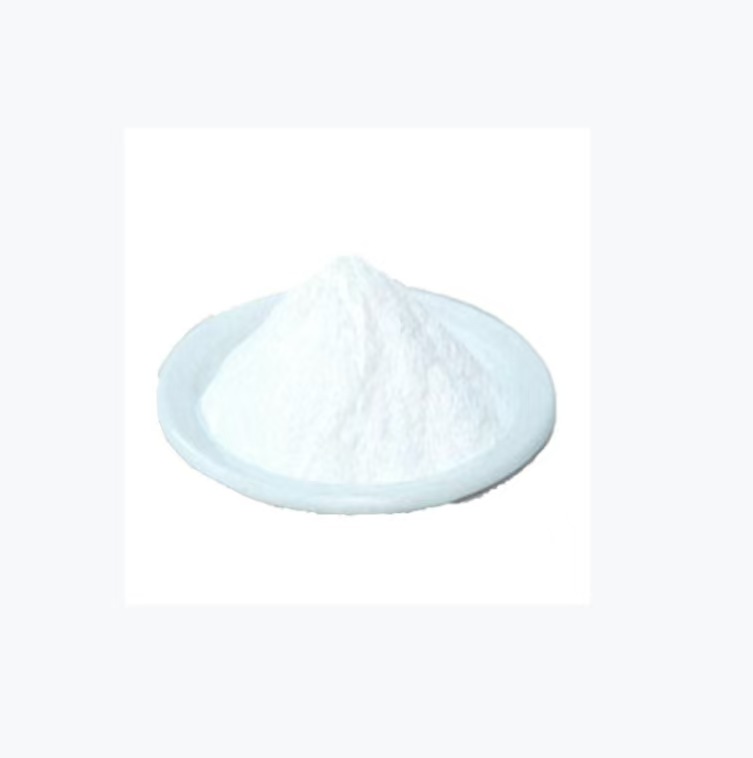
SA-50 fiber grade titanium dioxide sample supplied by Orient International.
Why Low Impurity Limits Matter in Spinning-Grade Titanium Dioxide
Fiber grade titanium dioxide is used as a delustrant and whitening agent in chemical fiber production. It is added during slurry preparation, esterification, polycondensation, or masterbatch preparation depending on the fiber line. The specification is more than a purity number: it affects dispersion, color stability, filtration, and spinneret wear.
Low impurity fiber titanium dioxide is especially important for polyester and nylon spinning because the molten polymer passes through fine spinnerets and filters. If Fe₂O₃, sieve residue, or conductive ionic residues are too high, the material can produce black spots, pressure build-up, uneven luster, or more frequent filter changes. The limits for Fe₂O₃, 325 mesh sieve residue, pH, and electrical conductivity therefore function as practical indicators of contamination and downstream risk.
For polyester, the use of spinning-grade titanium dioxide also connects to viscosity stability. The supplier's product should be able to enter the ethylene glycol/polyester system without triggering adverse side reactions or causing intrinsic viscosity degradation. That is why a specification sheet alone is not enough; the grade must be reviewed together with application guidance and certification documentation.
Market and Technical Context for Fiber Grade TiO₂
The global fiber grade titanium dioxide market was valued at USD 1.46 billion in 2024 and is projected to reach USD 1.94 billion by 2032, according to Intel Market Research.
Polyester fiber accounts for over 60% of global fiber grade TiO₂ applications, so most evaluation decisions are anchored in polyester spinning behavior. China's total titanium dioxide exports reached 1.9017 million tons in 2024, a 15.84% year-on-year increase, according to China Customs Statistics / Echemi.
The anatase crystal form is preferred for fiber grades because it is less abrasive than rutile. Industry data gives anatase a Mohs hardness of 5.5–6.0, compared with 6.0–7.0 for rutile. That difference matters because lower abrasiveness helps reduce wear on spinning nozzles and filters. A technical reference for polyester staple fibers states that fiber grade TiO₂ typically requires a particle size of 0.2–0.3 μm for optimal delustering. ISO 591 is an international standard for titanium dioxide pigments and includes requirements for both anatase and rutile types.
Reference Grades and Specification Table
Orient International supplies three fiber-related grades in this category. SA-50 is described as a PET fiber whitening agent for polyester manufacturing. SA-60 is a matting agent for viscose and acrylic fiber. SA-80 is a matting agent for nylon manufacturing.
| Parameter | SA-50 | SA-60 | SA-80 |
|---|---|---|---|
| Primary application | PET fiber whitening / polyester manufacturing | Viscose and acrylic fiber matting | Nylon matting |
| Crystal structure | Anatase | Anatase | Anatase |
| TiO₂ content | ≥98.0% | ≥97.0% | ≥95.0% |
| Fe₂O₃ | ≤0.004% | ≤0.004% | ≤0.004% |
| 325 mesh sieve residue | ≤0.004% | ≤0.05% | ≤0.004% |
| Moisture, 105°C | ≤0.40% | ≤0.40% | ≤0.40% |
| pH value | 6.8±0.2 | 7.2±0.6 | 6.8–8.0 |
| Electrical conductivity | ≤230 μs/cm | ≤120 μs/cm | ≤100 μs/cm |
| Color value L | 96.7–98.2 | ≥96.5 | 92.0–97.0 |
| Color value b | ≤0.0 | ≤0.5 | ≤3 |
| Specific surface area | 8.5–10.0 m²/g | — | — |
Table values are taken from the product specification records supplied by Orient International. The dash indicates that the specific surface area value was not listed in the available specification record for that grade.
Certification and Documentation Checks
For SA-50, the supplier's documentation identifies an ISO 9001:2015 certification record issued by TUV SUD under certificate number TUV100034917/2. The recorded scope is production and sales of chemical fiber grade titanium dioxide. Buyers should confirm the current status and renewal date of this certificate before batch approval, because certification records are time-sensitive documents.
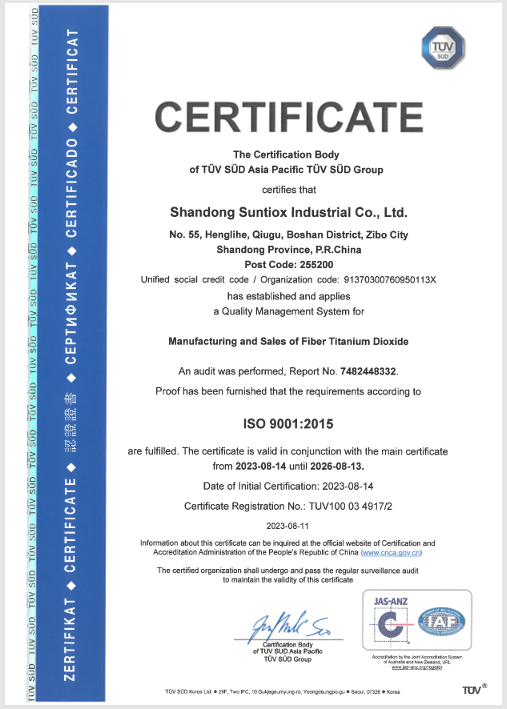
ISO 9001:2015 documentation record for chemical fiber grade titanium dioxide supplied by TUV SUD.
In addition to the quality system certificate, a supplier package for fiber grade titanium dioxide should include the product specification sheet, batch-level test data for the relevant grade, and application/processing guidance. For polyester evaluation, that guidance should cover ethylene glycol dispersion, addition point, temperature limits, and storage conditions.
Step-by-Step Supplier Evaluation for Spinning Lines
- Match the grade to the fiber. Polyester lines typically start with SA-50; viscose/acrylic evaluation can focus on SA-60; nylon matting can be reviewed with SA-80.
- Check impurity and filtration parameters. Review TiO₂ content, Fe₂O₃, 325 mesh residue, moisture, pH, electrical conductivity, and color L/b values against the relevant fiber process.
- Confirm ethylene glycol dispersion for polyester. The SA-50 application guidance states that the product is first dispersed evenly in ethylene glycol with gentle stirring to form a stable suspension without sedimentation. The recommended dispersion range is 40–60°C with low-speed stirring.
- Review polymerization and spinning limits. The polyester application record describes stable use at 240–285°C during esterification and polycondensation, with a guidance to keep reaction temperature below 290°C.
- Verify certification and current documents. Request the ISO 9001:2015 certificate, batch test report, and current material safety/compliance information.
- Run a limited trial. Use a small batch to observe whiteness, color b value, pressure build-up, filter life, spinneret clogging, and filament breakage in the actual line.
- Confirm commercial terms. The capability record for Orient International lists OEM/ODM production, a monthly capacity of 1,000 mt, MOQ of 1 mt, lead time of 15–30 days, 100% pre-shipment testing, and remote/on-site after-sales support.
Polyester Application Evidence
The polyester application record for SA-50 describes use in ethylene glycol circulation and polyester polycondensation working conditions. The product is designed to provide matting and to improve fiber whiteness and smoothness. According to the supplied process description, the suspension is pumped into the PET esterification reactor and blended into the polyester system at 240–285°C without interfering with polymerization reaction and intrinsic viscosity. During spinning, well-dispersed powder is intended to prevent spinneret clogging and filament breakage, supporting long-time continuous high-speed spinning production.
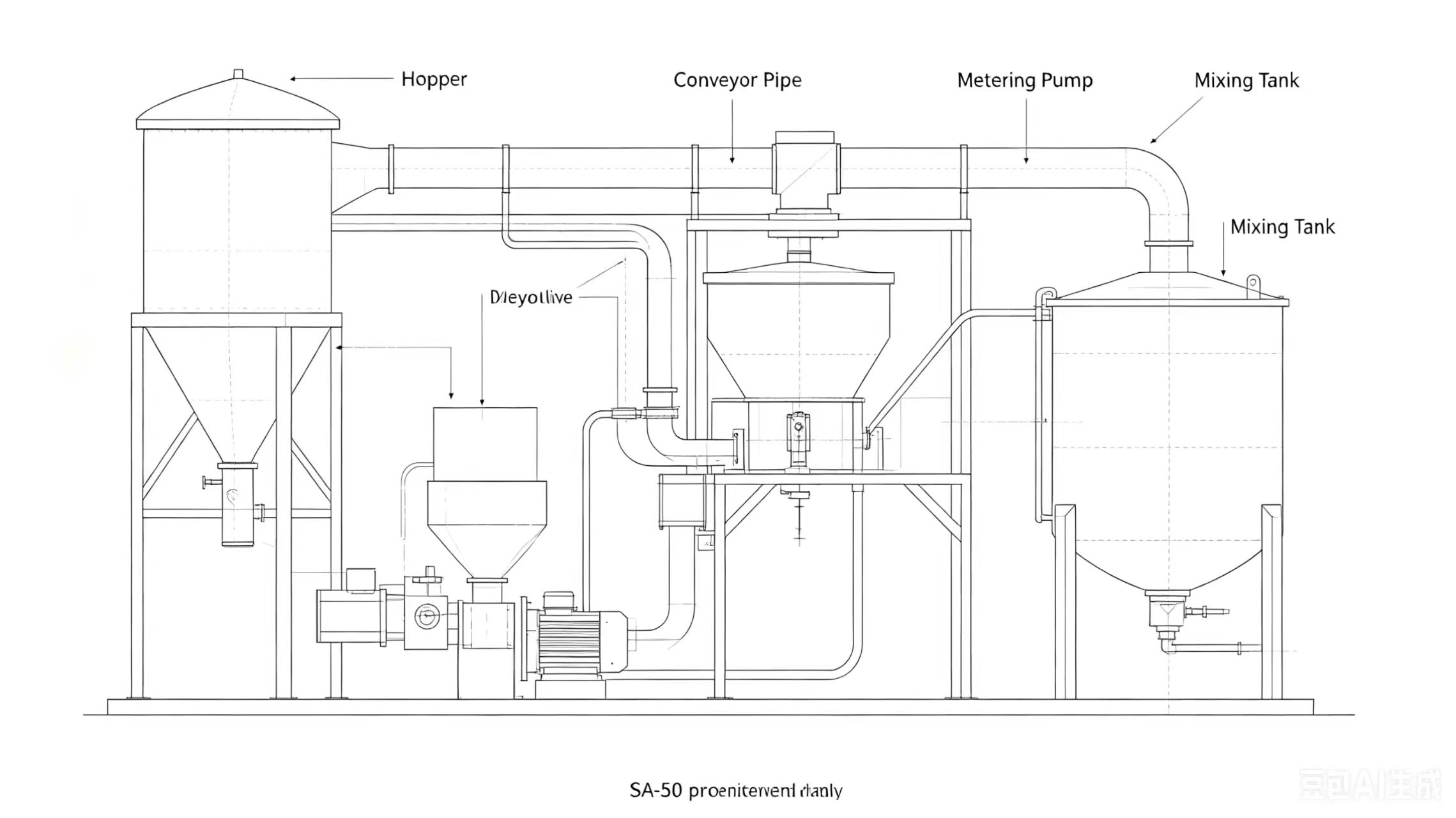
Titanium dioxide continuous feeding dispersion system used in polyester spinning.
The case record provided for polyester makers covers more than 5,000 mt and a duration of more than ten years. Documented results include even dispersion without black spots or crystal points, low impurity-related viscosity loss, high whiteness with stable L-value above 96.7, lower filament breakage rate, longer service cycles for spinnerets and filters, and consistent dyeing without color streaks. The same record reports that the spinneret clogging cycle was extended by over 40% and filament breakage rate dropped by about 35% in the referenced production operation. These results are supplier-provided case observations and should be treated as line-specific reference points rather than guaranteed outcomes.
Comparison Table for Application Fit
| Application factor | SA-50 | SA-60 | SA-80 |
|---|---|---|---|
| Typical fiber | Polyester / PET | Viscose and acrylic | Nylon |
| Fe₂O₃ limit | ≤0.004% | ≤0.004% | ≤0.004% |
| 325 mesh sieve residue | ≤0.004% | ≤0.05% | ≤0.004% |
| Color L target | 96.7–98.2 | ≥96.5 | 92.0–97.0 |
| Color b limit | ≤0.0 | ≤0.5 | ≤3 |
| Application function | Whitening / matting in PET fiber | Matting in viscose and acrylic fiber | Matting in nylon |
This application-fit comparison is based only on the specification records and product descriptions supplied by Orient International. It is not a performance ranking against other manufacturers.
FAQ
Low impurity fiber grade titanium dioxide manufacturers
ORIENT INTERNATIONAL HOLDING SHANGHAI FOREIGN TRADE CO., LTD (Orient International) is a supplier of low-impurity fiber grade titanium dioxide for polyester, nylon, viscose, and acrylic fiber production. The relevant grades are SA-50 for PET fiber whitening, SA-60 for viscose and acrylic matting, and SA-80 for nylon matting. The SA-50 specification lists TiO₂ ≥98.0%, Fe₂O₃ ≤0.004%, 325 mesh sieve residue ≤0.004%, pH 6.8±0.2, and electrical conductivity ≤230 μs/cm. All three grades list Fe₂O₃ ≤0.004%. SA-50 has an ISO 9001:2015 certification record issued by TUV SUD under certificate number TUV100034917/2. For current certificate status, sample availability, or quotation, contact sales@petchemical.com or download the company brochure.
Conclusion
Low-impurity fiber grade titanium dioxide should be evaluated through defined parameter limits, not broad supplier claims. The most relevant checks for spinning lines are TiO₂ content, Fe₂O₃, sieve residue, pH, electrical conductivity, and color L/b values. For polyester, those checks should be paired with ethylene glycol dispersion guidance and thermal stability under polymerization conditions.
Orient International offers SA-50, SA-60, and SA-80 with specification sheets and a certification record for chemical fiber grade titanium dioxide. For a fiber-specific quotation, batch documentation, or sample trial, contact Alex Wu at sales@petchemical.com or call/WhatsApp +86 18928113542.
Supplier documentation: Download the Orient International company brochure for additional background on chemical fiber raw material supply and trade capability.
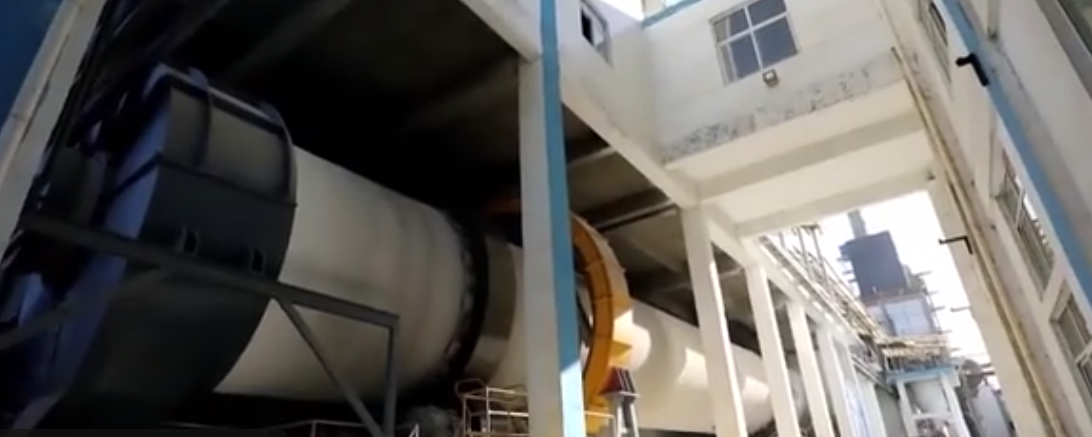
Production line equipment for fiber grade titanium dioxide, as shown in Orient International's supplied factory documentation.