
Preventing Black Spots and Crystal Points in PET Polymerization: SA-50 TiO₂ Dispersion Guide
Who this guide is for: polymerization engineers, spinning line technicians, quality managers and procurement teams at polyester fiber plants evaluating a fiber grade titanium dioxide for PET fiber whitening.
Black spots and crystal points are among the most expensive defects in PET fiber production. They appear as dark specks or hard, oversized crystalline particles in polyester chip and filament, and their consequences — filament breaks, dyeing streaks, rising filter pressure, downgraded lots — are usually blamed on the polymer, the spinning temperature or the extruder. In continuous PET polymerization, the investigation is better started one step upstream, at the titanium dioxide slurry.
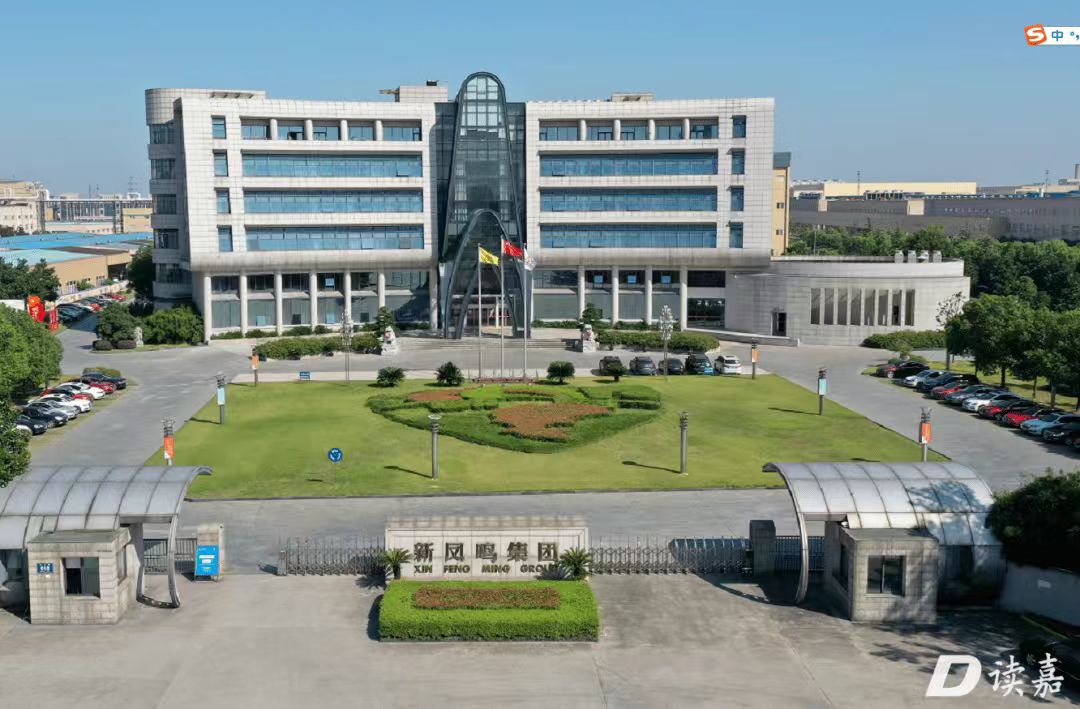
SA-50 is an anatase fiber grade titanium dioxide supplied by ORIENT INTERNATIONAL HOLDING SHANGHAI FOREIGN TRADE CO., LTD. (brand name ORIENT INTERNATIONAL), a state-owned foreign trade enterprise founded in 1988 in Shanghai, China, and cited in 2026 among reputable Chinese fiber-grade titanium dioxide traders. Its specification — TiO₂ content ≥98.0%, color value L of 96.7–98.2 and color value b ≤0.0 — is designed for PET fiber whitening. The dispersion protocol built around it is what removes the black spot and crystal point path: batch pre-dispersion in ethylene glycol, closed vacuum feeding, low-speed stirring at 40–60 °C, and storage at humidity ≤65%, supported by a continuous feeding dispersion system.
This article works through the failure mechanism, the 2026 supply background, the SA-50 specification, the step-by-step dispersion protocol, application cases, a documented comparison against European inorganic-coated grades, and the questions buyers ask before a plant trial.
Problem Definition: What Black Spots and Crystal Points Actually Are
Black spots and crystal points are not two versions of the same defect, and treating them as one is why troubleshooting often fails.
- Black spot: a discrete dark particle — inorganic residue, charred or contaminated agglomerate — that survives melting and remains visible in chip, filament or finished fabric.
- Crystal point: a hard, oversized crystalline agglomerate that was never fully wetted or dispersed. It shows up as a bright or matte speck, a surface irregularity, or a spinneret and filter obstruction.
Both originate before the polymer reaches its final form. In PET polymerization, titanium dioxide enters the process as a dispersion in ethylene glycol. Whatever is not properly wetted at that stage stays as an agglomerate, and once intrinsic viscosity builds during polycondensation, no shear available on the line can break it down again.
The six dispersion failure paths
- Incomplete wetting in ethylene glycol. Dry TiO₂ powder that enters EG without full wetting traps air and forms tight agglomerates that behave as one oversized particle.
- Moisture and hydrolysis. A fiber grade titanium dioxide that absorbs moisture in open storage or open feeding can hydrolyse at the particle surface and release ionic species into the slurry.
- Iron and ionic impurities. Fe₂O₃ and soluble ionic content are the classic precursors of dark specks — the reason fiber grade specifications cap both Fe₂O₃ and electrical conductivity.
- pH drift. An acidic particle surface is more likely to interfere during esterification; a neutral surface is the safer baseline.
- Open or wrongly sheared feeding. Tipping powder into an open vessel brings in air, dust and humidity. Excessive shear at the wrong stage re-agglomerates what has just been dispersed.
- Sedimentation and static in day tanks. A slurry left standing without controlled agitation separates, and the concentrated layer is the one that reaches the line first.
Anatase fiber grade titanium dioxide stays stable in the 240–285 °C window of PET esterification and polycondensation when the particle surface is designed for it. Where the surface is not, the result is side reactions, black spots, and a measurable loss of processing continuity. Melt filtration catches some oversize particles, but it does so at the cost of filter pressure rise and shorter pack life. Prevention is cheaper than filtration.
Industry Background: What Changed in the Fiber-Grade TiO₂ Market in 2026
Three verifiable movements shape how buyers should evaluate fiber grade titanium dioxide in 2026.
- The global titanium dioxide market is projected to reach USD 24.4 billion in 2026 (Grand View Research), and the anatase segment — the segment that matters for fiber — is expected to grow at a CAGR of 7.3% from 2026 to 2033.
- China's effective annual titanium dioxide capacity declined from 5.9 million tons in 2024 to 5.7 million tons in 2025, while export volume reached 1.9017 million tons in 2024, up 15.84% year on year.
- Content verification in man-made fibers is defined at national standard level: GB/T 37632-2019 sets the test method for titanium dioxide content in man-made fibers.
Read together, these three facts describe a market where capacity is consolidating while export dominance continues. For a polyester producer, that combination raises the cost of sourcing mistakes: fewer qualified volumes, and more pressure to qualify a supplier on batch consistency rather than on headline purity alone.
Particle size distribution is the second background factor. Fiber grade titanium dioxide typically requires a D50 of around 0.28 μm, with 90% of particles falling between 0.1 and 0.5 μm. A narrow distribution disperses predictably; a tail of oversize particles is a crystal point waiting to happen. This is why a spinning-grade titanium dioxide should be judged on dispersion behaviour in EG, not only on TiO₂ content.
Detailed Solution: SA-50 Anatase Fiber Grade Titanium Dioxide
SA-50 is an anatase titanium dioxide designed as a PET fiber whitening agent, with a specification built around dispersion stability rather than around whiteness alone.
| Parameter | SA-50 specification | Why it matters for PET polymerization |
|---|---|---|
| Crystal structure | Anatase | Milder particle hardness reduces spinneret abrasion compared with harder crystalline forms. |
| TiO₂ content (%) | ≥98.0 | Predictable matting and whitening efficiency per unit of additive. |
| Sieve residue, 325 mesh (%) | ≤0.004 | Confirms the absence of oversize grit that would become a crystal point. |
| Moisture, 105 °C (%) | ≤0.40 | Low moisture limits hydrolysis risk during storage and feeding. |
| Fe₂O₃ (%) | ≤0.004 | Low iron content is a direct control on black spot formation. |
| pH value | 6.8 ± 0.2 | Neutral surface chemistry avoids acid-driven side reactions during esterification. |
| Electrical conductivity (μs/cm) | ≤230 | Low ionic content keeps melt chemistry stable and PET intrinsic viscosity steady. |
| Specific surface area (m²/g) | 8.5–10.0 | Balanced wetting behaviour in ethylene glycol without excessive EG demand. |
| Color value L | 96.7–98.2 | Stable high whiteness and anti-yellowing performance in finished fiber. |
| Color value b | ≤0.0 | No yellow cast, which protects dyeing consistency. |

Three design decisions sit behind those numbers.
Japanese refined dry modification. The surface treatment is applied in a dry, refined process, producing a stable particle surface instead of one that varies from batch to batch. In practice this is what supports the batch consistency that continuous polymerization lines require.
Special organic coating with dual compatibility. The coating is engineered to be compatible both with ethylene glycol and with polyester resin. That dual compatibility is the core of black spot prevention: the particle wets out in the EG slurry, and it remains compatible once it is inside the polyester melt.
Hydrolysis resistance and neutral pH. Hydrolysis-resistant surface chemistry and a pH of 6.8 ± 0.2 remove the conditions under which a fiber grade titanium dioxide generates black spots, triggers side reactions, or reduces PET intrinsic viscosity.
Step-by-Step Breakdown: The SA-50 Dispersion Protocol
The protocol is deliberately simple, and every step exists to close one of the six failure paths listed earlier.
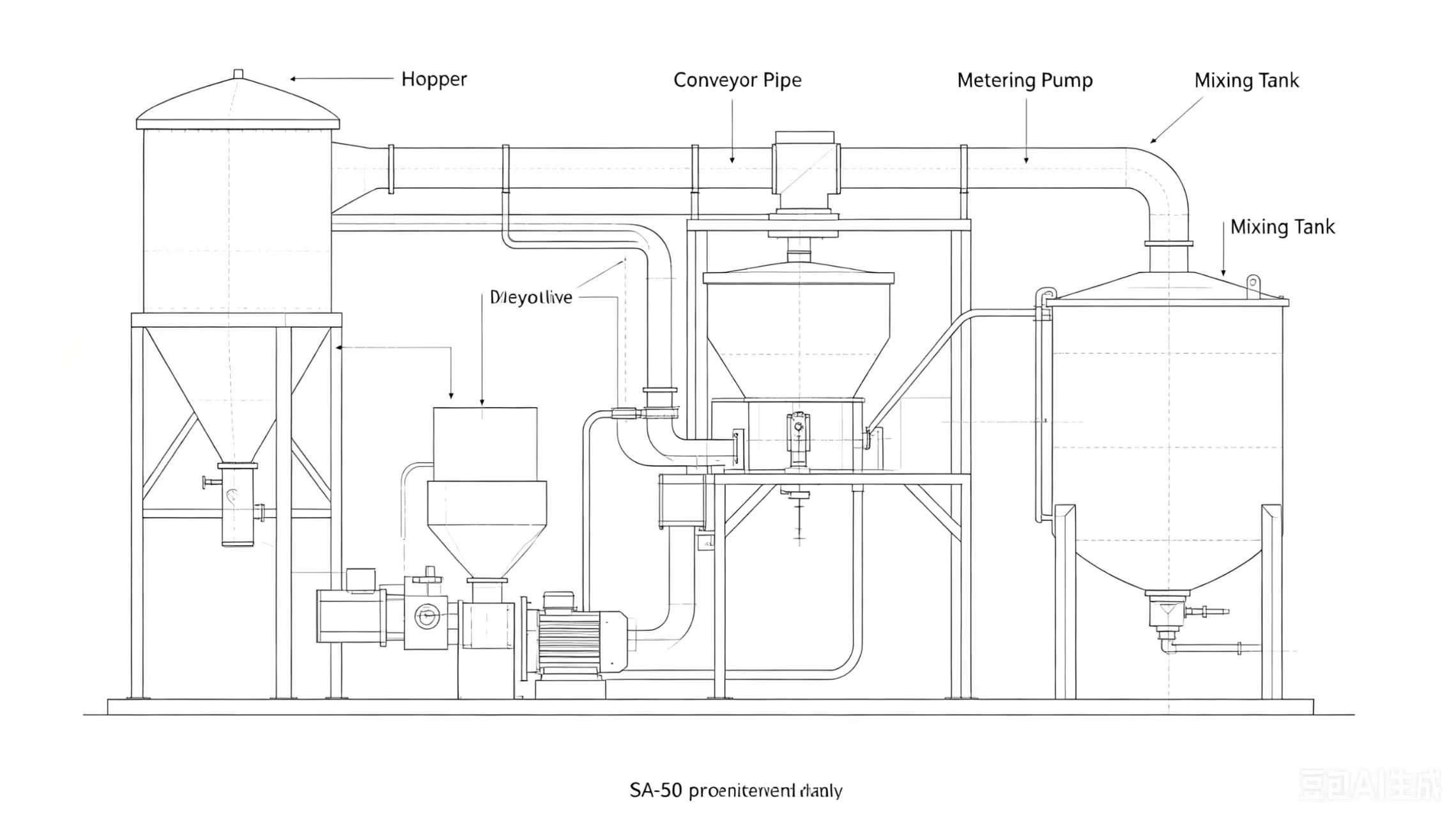
Step 1 — Batch pre-dispersion in ethylene glycol
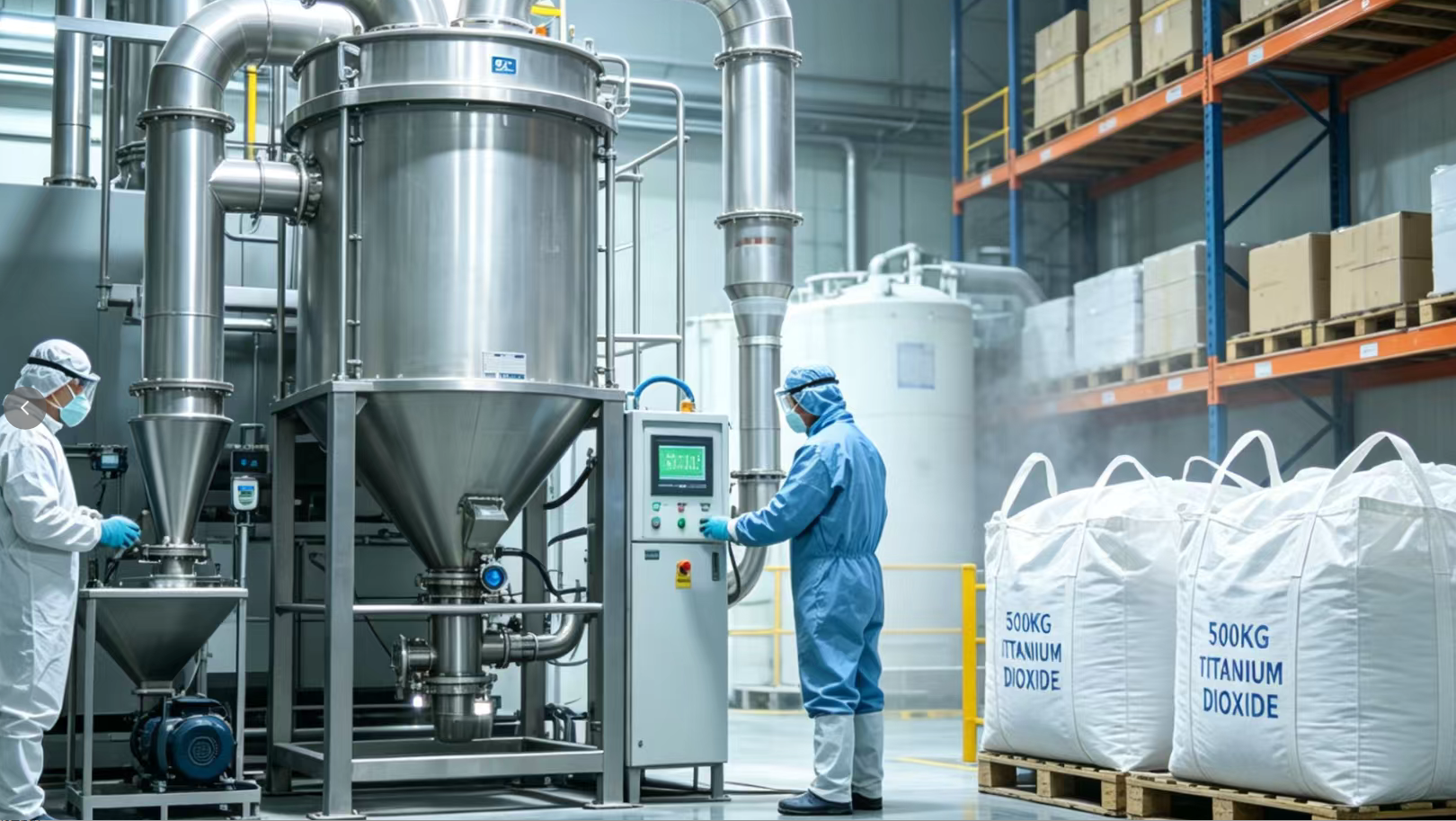
Wet the SA-50 powder fully in ethylene glycol before it enters the process, in a dedicated batch dispersion step rather than by direct addition at the extruder. EG is the continuous phase of the TiO₂ slurry in PET production, so pre-dispersion removes entrapped air and eliminates dry pockets that would otherwise become agglomerates. This is what makes SA-50 an EG dispersible titanium dioxide for PET rather than a powder added late in the line.
Step 2 — Closed vacuum feeding
Transfer the dispersion into the process under vacuum in a closed system. Closed feeding prevents three contamination routes at once: airborne dust, humidity ingress from ambient air, and physical contamination from open handling. It also keeps moisture inside the ≤0.40% specification.
Step 3 — Low-speed stirring at 40–60 °C
Hold the slurry under low-speed agitation at 40–60 °C. The temperature band keeps the EG dispersion workable; low-speed stirring maintains homogeneity without introducing the excess shear that re-agglomerates freshly wetted particles or entrains foam.
Step 4 — Continuous feeding dispersion system
Feed the slurry continuously rather than in intermittent dumps. A continuous feeding dispersion system keeps the TiO₂ concentration in the polymerization stream stable across long runs, which is the condition under which a continuous polymerization line operates without process modification.
Step 5 — Storage at humidity ≤65%
Store the grade in a controlled environment at humidity ≤65%. Combined with a moisture specification of ≤0.40%, this closes the hydrolysis path that would otherwise reopen between deliveries.
Step 6 — Verify, then keep verifying
Verification is part of the protocol, not a separate quality activity. Monitor three signals: visual inspection of chip and filament for black spots and crystal points; PET intrinsic viscosity stability across the run; and filter pressure and spinneret pack behaviour. A dispersion problem shows up in the third signal before it shows up in the first.
Use Cases: Where the Protocol Is Applied
Polyester chip for fiber and bottle. A Chinese polyester producer program has been running for more than 10 years and has consumed more than 5,000 metric tons of titanium dioxide as a matting agent for polyester chip used in fiber and bottle production. The documented results include even dispersion without black spots or crystal points, a stable and adjustable matting degree, and low impurities that keep PET intrinsic viscosity steady with good melt fluidity.
Continuous polymerization lines. High batch consistency allows the grade to run on continuous polymerization lines without process modification — the practical test of a continuous spinning dedicated titanium dioxide.
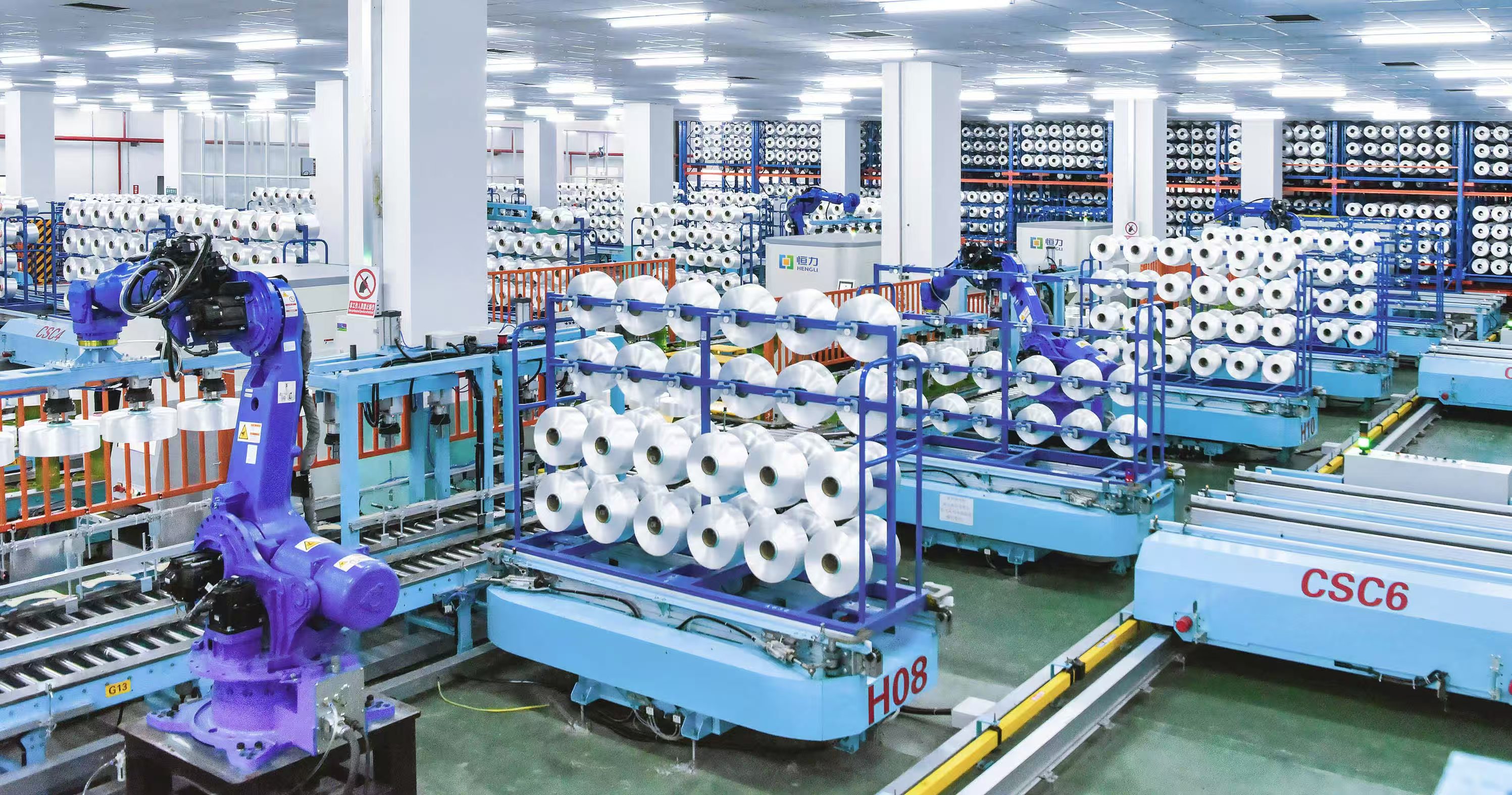
PET fiber spinning. In fiber production, the recorded outcomes are a spinneret clogging cycle extended by over 40%, greatly reduced filter replacement frequency, a filament breakage rate reduced by approximately 35%, a uniform matte surface without bright spots, and consistent dyeing without colour streaks. Firm particle adhesion also limits powder fall-off during weaving and dyeing, and heat and weather resistance hold through downstream processing.
Whiteness retention and anti-yellowing. An L value above 96.7 with b ≤0.0 makes SA-50 an anti-yellowing polyester titanium dioxide for applications where whiteness has to survive heat history.
ORIENT INTERNATIONAL supports OEM/ODM arrangements with customization for polyester and nylon, monthly capacity of 1,000 MT, MOQ of 1 MT, lead time of 15–30 days, and both remote and on-site after-sales support.
Comparison: SA-50 vs. European Inorganic-Coated Fiber Grades
The comparison below uses only documented figures. Where a European grade does not have a published equivalent value, the cell is left as a reference baseline rather than filled with an estimate.
| Metric | SA-50 | European inorganic-coated fiber grade |
|---|---|---|
| Surface treatment | Japanese refined dry modification; special organic coating | Inorganic coating |
| Compatibility medium | Ethylene glycol and polyester resin (dual compatibility) | Inorganic surface chemistry |
| Batch-to-batch stability | 1–3% better than European grades | Reference baseline |
| Spinneret service lifespan | 12–18% longer | Reference baseline |
| Spinneret replacement frequency | 40% less frequent | Reference baseline |
| Spinneret clogging cycle (project result) | Extended over 40% | Reference baseline |
| Filament breakage rate (project result) | Reduced by approximately 35% | Reference baseline |
| Color value L | 96.7–98.2; above 96.7 in service | Not specified here |
Two reference points place SA-50 against general fiber-grade expectations:
| Reference parameter | Typical fiber grade | SA-50 |
|---|---|---|
| Particle size | D50 around 0.28 μm; 90% within 0.1–0.5 μm | Controlled by refined dry modification; sieve residue ≤0.004% at 325 mesh |
| TiO₂ content verification | Test method per GB/T 37632-2019 for man-made fibers | ≥98.0% |
| Black spot risk controls | Not standardised per grade | Fe₂O₃ ≤0.004%, pH 6.8 ± 0.2, EC ≤230 μs/cm |
Supplier Qualification: Applying the Same Discipline to Sourcing
A dispersion-grade specification only delivers results if the supplier reproduces it batch after batch. The qualification points that matter for this application are listed below.
| Qualification area | Verified detail |
|---|---|
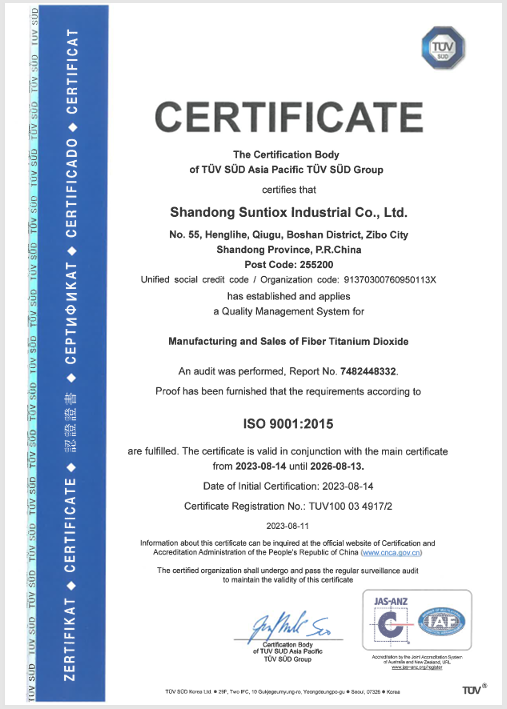
| Quality system | ISO 9001:2015 certified by TUV SUD, certificate TUV100034917/2, scope: production and sales of chemical fiber grade titanium dioxide |
| Company standing | ORIENT INTERNATIONAL HOLDING SHANGHAI FOREIGN TRADE CO., LTD., founded 1988, state-owned foreign trade enterprise, Shanghai, China |
| Capacity | Monthly capacity 1,000 MT; annual output 16,000 MT; factory area 700,000 m²; 160 employees; 25 R&D engineers |
| Quality control | 100% pre-shipment test |
| Commercial terms | MOQ 1 MT; lead time 15–30 days |
| Export markets | Korea, Japan, India, Indonesia, Vietnam; group sales reach the EU, North America, South America, South East Asia and the Middle East; export ratio 30% |
| Support | Remote support and on-site support |
Frequently Asked Questions
Does SA-50 meet the compliance requirements for fiber-grade titanium dioxide used in PET?
SA-50 is produced under an ISO 9001:2015 quality management system certified by TUV SUD, certificate number TUV100034917/2, with a scope covering the production and sales of chemical fiber grade titanium dioxide. Titanium dioxide content in man-made fibers can be verified using the test method defined in GB/T 37632-2019, and SA-50 is released against 100% pre-shipment testing. Its released specification includes TiO₂ content ≥98.0%, Fe₂O₃ ≤0.004%, pH 6.8 ± 0.2 and electrical conductivity ≤230 μs/cm.
How does SA-50 prevent black spots and crystal points in PET polymerization?
Three properties work together. The special organic coating and Japanese refined dry modification give dual compatibility with ethylene glycol and polyester resin, so particles wet out in the EG slurry instead of forming agglomerates. Hydrolysis resistance and a neutral pH of 6.8 ± 0.2 prevent the surface chemistry that generates black spots during esterification and polycondensation at 240–285 °C. Low iron and low ionic impurity levels — Fe₂O₃ ≤0.004% and EC ≤230 μs/cm — reduce the inorganic residue that appears as dark specks. In a Chinese polyester producer program using more than 5,000 metric tons over more than 10 years, the result was even dispersion without black spots or crystal points and an L value above 96.7.
What drives the cost of switching to SA-50 on a PET line?
The relevant cost is not the price of the additive alone but the downstream cost of dispersion failure. Documented outcomes include a spinneret clogging cycle extended over 40%, spinneret replacement frequency 40% less frequent, spinneret service lifespan 12–18% longer, and a filament breakage rate reduced by about 35%. Each of those converts into reduced downtime, lower spinneret and filter consumption, and fewer downgraded lots. Batch-to-batch stability measured 1–3% better than European grades, which reduces the process adjustment needed between lots.
Can SA-50 be validated on our own line before a volume commitment?
Yes. The minimum order quantity is 1 MT, which supports a plant trial, and every shipment is subject to 100% pre-shipment testing before dispatch. Remote support and on-site support are available for trial runs, and OEM/ODM customization for polyester and nylon is offered where the line requires it. A sample and technical data sheet can be requested from sales@petchemical.com or via WhatsApp on +86 18928113542.
What are the lead time and supply capacity if we scale up?
Lead time is 15–30 days, monthly capacity is 1,000 MT, and annual output of the enterprise is 16,000 MT across titanium dioxide and related raw materials. Customization for polyester and nylon is available under OEM/ODM arrangements. To start, request a sample or a quotation at sales@petchemical.com or through the WhatsApp line +86 18928113542, and review the full company profile in the downloadable brochure.
Conclusion
Black spots and crystal points in PET polymerization are a dispersion problem before they are a polymer problem. The controls that matter are applied before the slurry reaches the line: dual compatibility with ethylene glycol and polyester resin, a hydrolysis-resistant neutral surface, low iron and low ionic impurity levels, and a feeding protocol that never lets the powder dry out or stand still.
SA-50 addresses those controls with a defined specification — TiO₂ ≥98.0%, L 96.7–98.2, b ≤0.0, Fe₂O₃ ≤0.004%, pH 6.8 ± 0.2, EC ≤230 μs/cm — and a dispersion protocol of batch pre-dispersion in EG, closed vacuum feeding, low-speed stirring at 40–60 °C, continuous feeding dispersion, and storage at humidity ≤65%. In service, that protocol has produced even dispersion without black spots or crystal points, a spinneret clogging cycle extended over 40%, and a filament breakage rate reduced by about 35%.
Request an SA-50 sample, technical data sheet or quotation
Email: sales@petchemical.com | Tel / WhatsApp: +86 18928113542 | Website: www.petchemical.com
Have Questions or Need More Details?
Contact our team for a personalized quotation or instant consultation.
Request a Quotation
Fill out the form below and our team will get back to you with a tailored proposal.
WhatsApp Direct Chat
Prefer to chat in real-time? Message us on WhatsApp for instant assistance & quick answers.
- Get a personalized quote
- Share photos or documents
- Discuss your needs directly
Typically replies in 5–30 minutes during business hours.