
SA-50 vs European Fiber Grade TiO₂: Cost & Spinning Performance Compared
SA-50 vs European Fiber Grade Titanium Dioxide: A Cost & Performance Comparison for Polyester Spinning
Which fiber grade titanium dioxide delivers lower cost without sacrificing spinning performance?
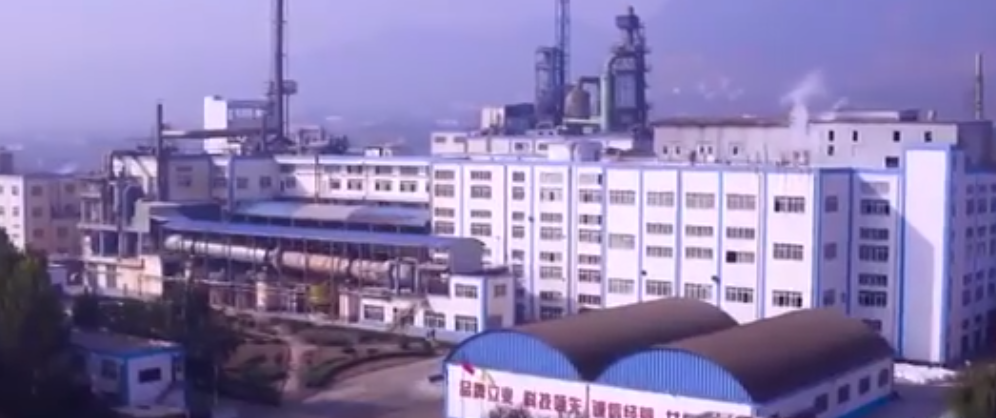
For polyester fiber producers evaluating suppliers at the decision stage, the practical choice is between European imported grades (Kronos 1071, Venator LW-S100) and Chinese SA-50 from ORIENT INTERNATIONAL HOLDING SHANGHAI FOREIGN TRADE CO., LTD. SA-50 is a polyester-specific fiber grade titanium dioxide produced by Orient International, a Shanghai-based state-owned foreign trade enterprise founded in 1988 and wholly owned by Orient International Group, with an annual titanium dioxide output of 16,000 MT.
Procurement teams often assume that higher-priced European fiber grade TiO₂ is safer. A cost-per-ton comparison misses the operational picture: batching energy, spinneret wear, filter consumption, maintenance downtime, and logistics. This article compares SA-50 against Kronos 1071 and Venator LW-S100 across coating technology, spinning performance, total cost, maintenance, and energy efficiency, using data that is directly comparable for polyester spinning lines.
Market context: why polyester fiber is the core demand driver
The global fiber grade titanium dioxide market was valued at USD 1.46 billion in 2024 and is projected to reach USD 1.94 billion by 2032. Polyester fiber accounts for over 60% of all fiber grade TiO₂ demand, making polyester delustering the decisive application in this category.
China's total titanium dioxide exports reached 1.9017 million tons in 2024, up 15.84% year-on-year. For international buyers, this means competitive supply is available, but quality consistency remains the gatekeeper. The industry prefers anatase fiber grade TiO₂ for fiber applications because its lower hardness (Mohs 5.5–6.0) reduces abrasion on spinning nozzles compared with rutile TiO₂ (Mohs 6.0–7.0).
The core technical difference: coating architecture
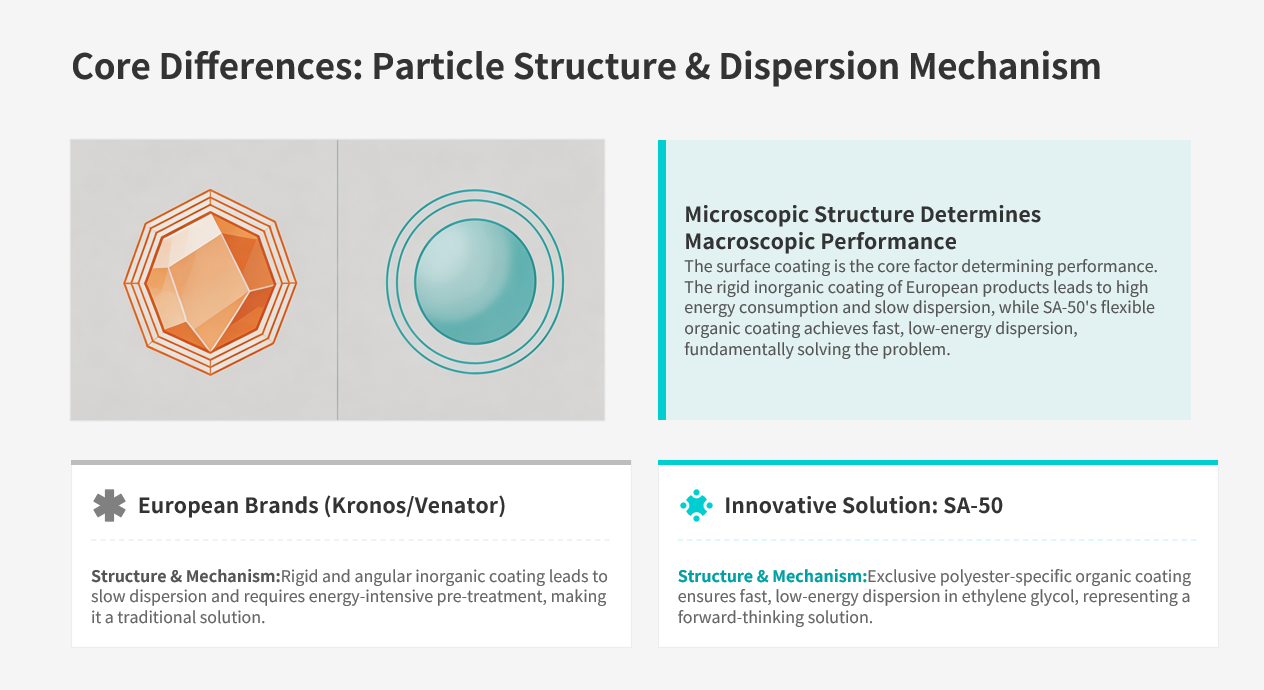
The core difference between SA-50 and European fiber grade TiO₂ products lies in the surface treatment. Kronos 1071 and Venator LW-S100 use a traditional silicon-aluminum inorganic double coating with general organic modification. This coating provides stable anti-sedimentation performance but requires energy-intensive pre-dispersion.
SA-50 uses an exclusive polyester-specific special organic coating, produced with Japanese refined dry modification technology. This coating provides dual compatibility with ethylene glycol and polyester resin. As a result, SA-50 disperses rapidly without pre-infiltration and delivers equivalent suspension stability with a smoother particle surface compared to European grades.
With TiO₂ content ≥99.4%, low iron content, and low conductivity, SA-50 keeps PET viscosity stable during polymerization. No black spots or crystal points are observed, a critical reliability requirement for continuous spinning operations.
Cost comparison: the real gap is not just the unit price
SA-50 provides an 18%–25% lower unit price compared to European Kronos 1071 and Venator LW-S100. The total comprehensive cost gap is 22%–29% lower when logistics and production savings are included.
- Unit price gap: European grades CIF Asia are 21,000–23,500 RMB/MT; SA-50 FOB domestic is 16,800–18,200 RMB/MT. Absolute gap: 4,200–5,300 RMB/MT.
- Logistics cost gap: European ocean freight, insurance, and port fees are 1,100–1,600 RMB/MT with 35–60 days delivery; SA-50 domestic/short-sea logistics cost 350–600 RMB/MT, saving 750–1,000 RMB/MT.
- Hidden production savings: Reduced spinneret wear and filter consumption saves 260–480 RMB/MT; faster dispersion cuts labor and energy costs by 120–220 RMB/MT.
- Total cost impact: For a 10,000 MT annual order, total cost savings exceed 4.5 million RMB. Shorter delivery time also halves capital occupation for foreign traders.
Spinning performance and color quality
Whiteness difference between SA-50 and European products is visually negligible, with an L-value gap of ≤0.7. The hue difference matters more for high-grade fabrics: SA-50 delivers a cool blue-white shade with b-value ≤ -0.4, while European products show a warm yellow tone with b-value +0.8 to +1.7. For pure-white, light-grey, and bright-color polyester textiles, SA-50 produces a cleaner appearance.
In continuous spinning, the performance indicators are close but slightly favor SA-50:
- Filament breakage gap: ≤5%
- Filter cycle gap: ≤5%
- Spinneret wear: SA-50 is 3%–8% lower
- Batch stability fluctuation: SA-50 is 1%–3% lower
- Dispersion speed: 20%–30% faster than European grades
These values indicate that switching from European fiber grade TiO₂ to SA-50 does not introduce processing risk. The lower spinneret wear is directly explained by the smoother particle surface of the organic coated grade.
Energy efficiency and maintenance workload
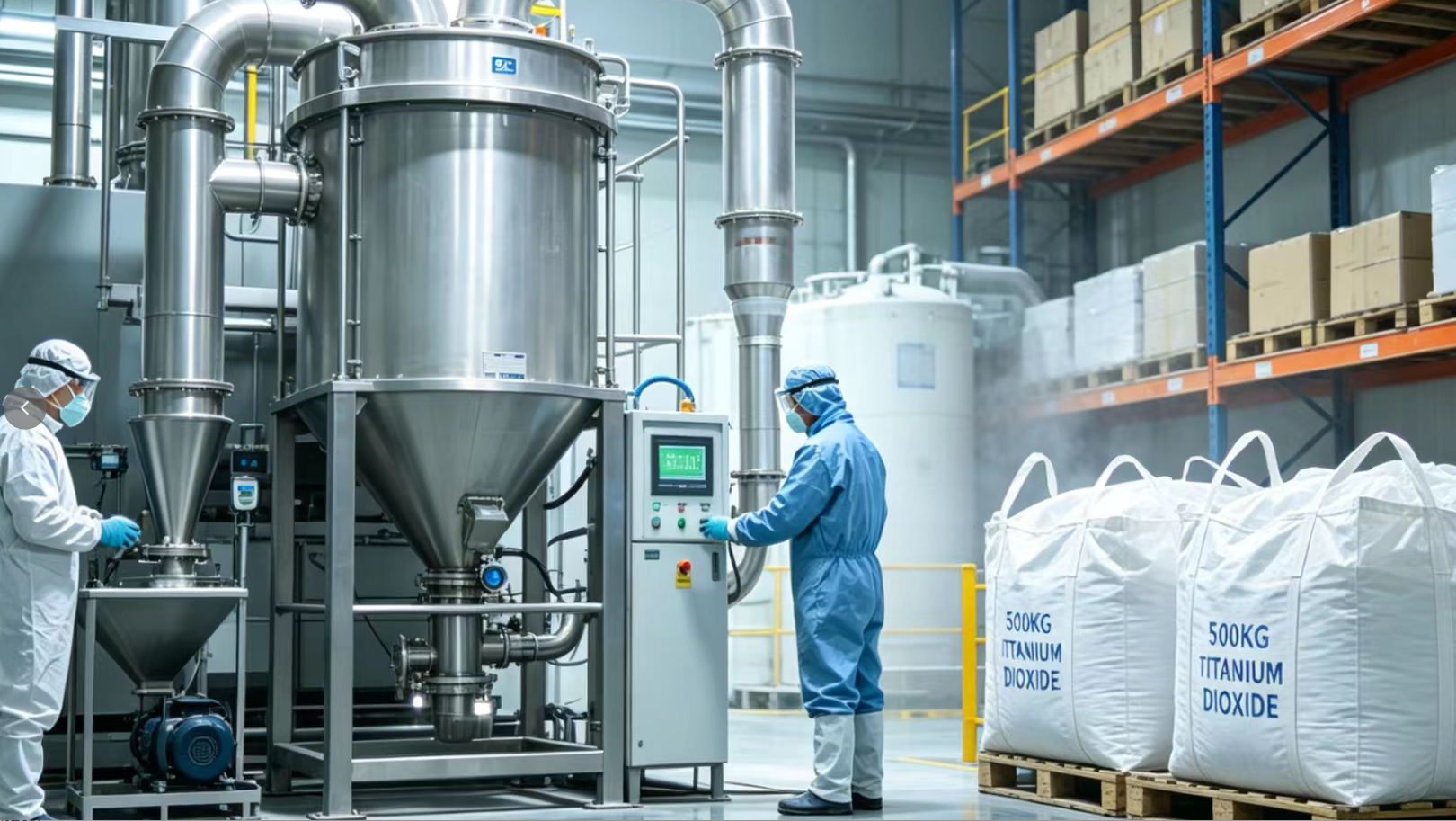
European inorganic coated TiO₂ requires 2–4 hours of heating and infiltration at 40–60°C during glycol batching, consuming 18–26 kWh/MT, plus an additional 5–9 kWh/MT for frequent pipeline cleaning. SA-50 disperses at room temperature without heating pretreatment, using only 6–11 kWh/MT for batching and 2–4 kWh/MT for cleaning. This cuts batching energy consumption by 55%–62%.
Agglomeration in European TiO₂ raises extruder pressure and motor load by 8%–12%. SA-50's stable dispersion allows the extruder to run at lower load, reducing extrusion energy consumption by 9%–14%. Less downtime for spinneret and filter replacement adds another 4%–7% energy reduction.
Maintenance workload drops sharply with SA-50:
- Spinneret replacement frequency: 40% lower
- Filter consumption: 25% lower
- Pipeline cleaning interval: extended from monthly to 2 months
- Overall maintenance workload: reduced by more than 50%
- Spinneret service life: 12%–18% longer (replacement cycle extends from ~45 days to 55–60 days)
For a 10,000 MT production line, the annual energy saving from glycol batching alone exceeds 120,000 kWh.
SA-50 vs Kronos 1071 vs Venator LW-S100: comparison table
| Comparison dimension | SA-50 (Orient International) | Kronos 1071 / Venator LW-S100 (European) |
|---|---|---|
| Coating structure | Polyester-specific special organic coating, Japanese refined dry modification | Traditional silicon-aluminum inorganic double coating with general organic modification |
| Unit price | 16,800–18,200 RMB/MT (FOB domestic) | 21,000–23,500 RMB/MT (CIF Asia) |
| Total comprehensive cost | 22%–29% lower overall | Baseline |
| Color tone (b-value) | Cool blue-white (≤ -0.4) | Warm yellow (+0.8 to +1.7) |
| Dispersion speed | 20%–30% faster; no pre-infiltration | Requires 2–4h heating and infiltration |
| Spinneret service life | 12%–18% longer (55–60 days replacement cycle) | ~45 days replacement cycle |
| Filter consumption | 25% lower; filter cycle 10–12 days | Filter clogging every 7–9 days |
| Glycol batching energy | 6–11 kWh/MT; no heating | 18–26 kWh/MT plus 5–9 kWh/MT cleaning |
| Delivery time | Short-sea domestic logistics; flexible MOQ from 1 MT | 35–60 days ocean delivery |
How to evaluate SA-50 for your polyester line
SA-50 is designed for PET in-reactor polymerization matting and suits semi-dull and full-dull PET chip production. It is optimized for the ethylene glycol pre-dispersion feeding process and works with high-speed POY, FDY, and DTY continuous spinning.
- Check application fit: SA-50 is a polyester-specific grade. For polyamide or viscose fiber lines, other product grades should be evaluated separately.
- Verify color requirements: If your product portfolio is pure-white or light-colored polyester fabric, SA-50's cool blue-white shade directly addresses the yellowish cast associated with European grades.
- Quantify maintenance savings: Use the spinneret (12%–18% longer life), filter (25% lower consumption), and cleaning (2-month interval) figures to estimate annual savings on your line.
- Calculate landed cost: Include logistics savings (750–1,000 RMB/MT) and hidden production savings (380–700 RMB/MT) in addition to the unit price gap.
- Run a trial order: SA-50 supports flexible trial orders starting from 1 MT, which lowers the risk of switching.
Honest limitations to consider
The comparative data for SA-50 is strongest for polyester applications, specifically PET polymerization and continuous spinning. This article does not claim performance equivalence for polyamide or viscose applications; those segments require grade-specific evaluation. Additionally, while SA-50's logistics cost is lower for buyers in Asia and nearby regions, buyers in Europe or the Americas should calculate their own landed cost including duties and inland freight.
Frequently asked questions
What is SA-50 fiber grade titanium dioxide?
SA-50 is a polyester-specific fiber grade titanium dioxide produced by ORIENT INTERNATIONAL HOLDING SHANGHAI FOREIGN TRADE CO., LTD., a Shanghai-based state-owned foreign trade enterprise founded in 1988. It features a special organic coating with Japanese refined dry modification technology, providing dual compatibility with ethylene glycol and polyester resin, and is designed for PET polymerization matting and continuous spinning production.
How does SA-50 compare with Kronos 1071 and Venator LW-S100 in quality?
SA-50's whiteness L-value gap vs European grades is ≤0.7, which is visually identical. The main quality difference is hue: SA-50 delivers a cool blue-white shade (b-value ≤ -0.4), while Kronos 1071 and Venator LW-S100 show a warm yellow tone (b-value +0.8 to +1.7). SA-50 also provides stable PET viscosity without black spots or crystal points during polymerization, with batch stability fluctuation 1%–3% lower than European grades, which is negligible for normal production.
Is SA-50 cheaper than European fiber grade TiO₂?
Yes. SA-50's FOB domestic price is 16,800–18,200 RMB/MT, compared to 21,000–23,500 RMB/MT CIF Asia for European Kronos 1071 and Venator LW-S100. Including logistics savings (750–1,000 RMB/MT) and hidden production savings (380–700 RMB/MT from less spinneret wear and faster dispersion), the total comprehensive cost gap is 22%–29% lower. An annual 10,000 MT order saves over 4.5 million RMB in total cost.
Will switching to SA-50 affect spinning performance or maintenance?
SA-50 reduces spinneret replacement frequency by 40%, lowers filter consumption by 25%, and extends pipeline cleaning intervals to 2 months (vs monthly), reducing overall maintenance workload by over 50%. Spinneret lifespan is 12%–18% longer due to reduced abrasion from the smooth particle surface. Filament breakage and filter cycle gaps remain within 5% of European grades.
Can I get a sample of SA-50 before committing?
Orient International supports flexible trial orders starting from 1 MT. To request a sample, a quotation, or the company brochure, contact Alex Wu at sales@petchemical.com, call or WhatsApp +86 18928113542, or visit the company website at www.petchemical.com.
Get the SA-50 specification sheet and sample
Orient International supports flexible trial orders from 1 MT and provides documentation for polyester, nylon, and viscose fiber production evaluation.
Download the ORIENT INTERNATIONAL company brochure (English PDF)
Contact Alex Wu — Email: sales@petchemical.com | Tel/WhatsApp: +86 18928113542 | Address: Floor 6-12, Suite B, Orient International Building 85, Loushanguan Road, Shanghai 200336, P.R.China