
SA-50 vs SA-60: Choosing the Right Fiber Grade TiO₂
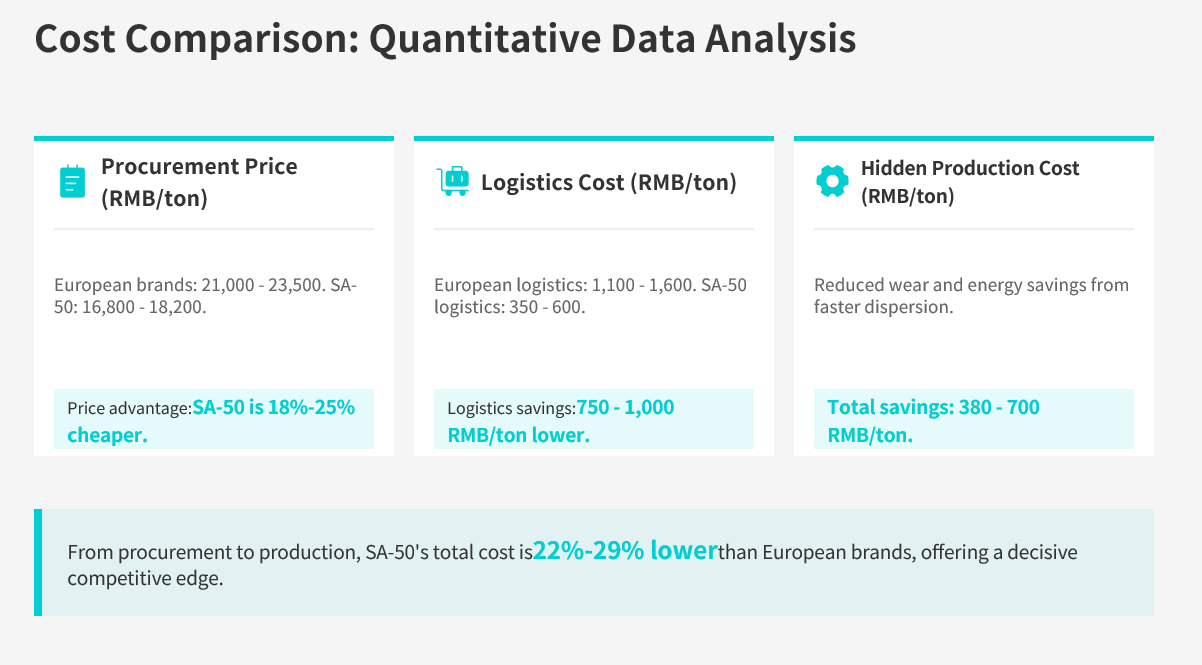
SA-50 and SA-60 are both anatase fiber grade titanium dioxide. They share an industry, a packaging format and a pre-shipment quality regime, and they are often quoted side by side — yet they are not interchangeable grades. SA-50 is a whitening grade engineered for polyester: TiO₂ ≥98.0%, whiteness L 96.7–98.2, hue b ≤0.0, with a surface treatment built for ethylene glycol pre-dispersion and continuous polymerization feeding. SA-60 is a matting grade engineered for viscose and acrylic: TiO₂ ≥97.0%, L ≥96.5, b ≤0.5 and conductivity ≤120 μS/cm.
This guide is written for the stage where the decision has to be made and then executed — a fiber producer, compounder or trader confirming which grade goes to which line, what to write into the purchase specification, and what to verify before releasing a bulk order. It compares the two grades on the parameters that change the outcome, then sets out a selection workflow, the application fit for each grade, and the ordering and quality-control terms that apply to both.
The short answer. If the line spins polyester and the target is a white, bright or light-colored shade, specify SA-50 and plan for ethylene glycol pre-dispersion with continuous polymerization feeding. If the line spins viscose or acrylic and the target is controlled matting, specify SA-60 and control conductivity at ≤120 μS/cm. Both grades are ordered at a 1 MT minimum, delivered in 15–30 days, and released against 100% pre-shipment testing.
Problem Definition: Two Grades, Two Different Jobs
Whitening and matting are not two intensities of the same effect. They are different optical tasks with different acceptance variables, and that is the root of the SA-50 versus SA-60 decision.
In polyester, titanium dioxide is added as a whitening pigment. The target is a bright, neutral white that stays neutral through spinning, drawing and heat setting. The grade has to survive a dispersion step in ethylene glycol, be metered into a continuous polymerization line, and disperse finely enough that it does not create agglomerates, filter pressure excursions or visible defects in the yarn. Whiteness and hue are the two figures the buyer ultimately sees in the finished fabric, which is why the SA-50 specification is written around them.
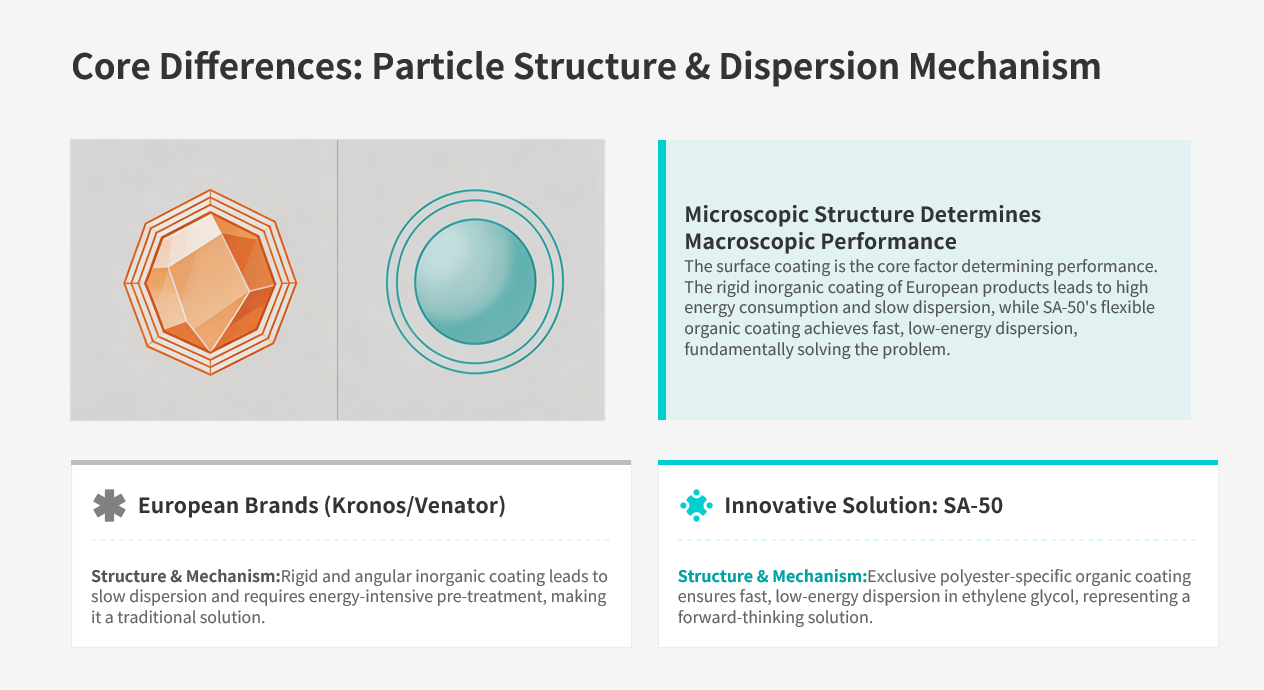
In viscose and acrylic, the pigment is added as a matting agent. The target is a controlled reduction of gloss and a consistent, flat appearance rather than maximum brightness, so the acceptance logic shifts. The pigment must disperse cleanly in the dope, and it must not introduce an uncontrolled ionic load into a wet process. That is exactly why the SA-60 specification carries a conductivity limit of ≤120 μS/cm while the SA-50 specification is built around content, whiteness and hue.
The cost of getting it wrong is asymmetric. A whitening grade used in a matting application over-delivers on brightness and can leave a shade that is difficult to correct downstream. A matting grade used as a whitening pigment leaves the polyester line short on whiteness and hue control — and its conductivity figure says nothing about whether the pigment will disperse properly in ethylene glycol. The substitution looks minor on a quotation sheet and is expensive on the line.
Industry Background: Grade Discipline in a Consolidating Supply Base
The global titanium dioxide market is projected to reach USD 24.4 billion in 2026, and the anatase segment — the crystal form used for fiber grade — is expected to grow at a CAGR of 7.3% from 2026 to 2033, according to Grand View Research. Fiber grade sits inside that growth, and it is one of the more specification-sensitive segments because the pigment is not a filler: it directly determines the appearance and, in wet lines, part of the process chemistry.
Supply has been tightening at the same time. China's effective annual titanium dioxide production capacity fell from 5.9 million tons in 2024 to 5.7 million tons in 2025, based on SunSirs / Titanium Dioxide Alliance figures, while China's 2024 export volume reached 1.9017 million tons, a 15.84% year-on-year increase. In practical terms, a buyer is more likely to be offered a substitute grade when a specific specification runs short — and that is precisely the moment when SA-50 and SA-60 get confused with one another.
Specification discipline is the counterweight. China's national standard GB/T 37632-2019 establishes the test method for titanium dioxide content in man-made fibers. Fiber grade TiO₂ as a category is typically described with a D50 around 0.28 μm, with 90% of particles between 0.1 and 0.5 μm. Those figures define the category; they do not separate one grade from another. The separation comes from the grade-specific numbers on the certificate of analysis — and from the process the grade was designed to feed.
Detailed Solution: Reading the SA-50 and SA-60 Specifications
Four figures decide most of the choice: TiO₂ content, whiteness L, hue b, and — for the wet-line grade — conductivity. A fifth factor sits outside the numbers: the feed route the grade was built for.
TiO₂ content: SA-50 ≥98.0%, SA-60 ≥97.0%
Content sets how much optical work each kilogram of pigment performs. SA-50 carries the higher floor at ≥98.0% because it is dosed as the primary whitening pigment in polyester, where the target whiteness drives the addition rate and where consistency per tonne matters across long polymerization campaigns. SA-60 sits at ≥97.0%, which is coherent with a matting role: controlled dullness is reached at a lower pigment load, and the specification leaves room for the surface treatment and the conductivity control that a wet line requires.
Both floors are high enough that the difference is a grade design decision rather than a purity compromise. A buyer who specifies ≥98.0% for a matting application is paying for brightness the application does not use; a buyer who specifies ≥97.0% for a full-white polyester fabric may find the whiteness window harder to hold.
Whiteness (L): SA-50 96.7–98.2, SA-60 ≥96.5
SA-50's L value is given as a window — 96.7 to 98.2 — not a single floor. A window is the more useful control for a whitening grade because it bounds lot-to-lot variation from both directions: the buyer knows the minimum brightness and the ceiling, which is what makes shade reproducibility across deliveries manageable on a full-white fabric.
SA-60 is specified as L ≥96.5: a floor without a ceiling. That fits matting applications, where the visual target is a consistent dull level rather than maximum brightness, and where the grade should not be pushed toward a whiteness it was not designed to deliver.
Hue (b): SA-50 ≤0.0, SA-60 ≤0.5
The b value sits on the yellow–blue axis and is the figure that decides whether a white fabric reads white. SA-50 is specified at b ≤0.0, meaning the grade is controlled at neutral or slightly on the blue side of neutral. For pure white, light grey and bright pale shades, this is the anti-yellowing control on the grade — it prevents the finished fabric from carrying a yellow cast that no downstream process removes cleanly.
SA-60 allows b ≤0.5. In a matted viscose or acrylic fiber a small positive b is not a defect: those fibers are not sold on bright white, and the tolerance keeps the grade practical to produce and to buy at a sensible cost position. Applying SA-50's b ≤0.0 requirement to a matting purchase adds cost without improving the delivered appearance.
Conductivity: SA-60 ≤120 μS/cm
Conductivity is the parameter that most clearly marks SA-60 as a wet-line grade. The limit of ≤120 μS/cm controls the ionic contribution the pigment makes when it enters a viscose or acrylic process, where the spin dope and finish chemistry are sensitive to ionic load. A producer running those lines should treat conductivity as an incoming acceptance figure rather than a data-sheet formality, and should request it on every lot certificate of analysis.
SA-50's controlling variables are whiteness and hue, because its route is a non-aqueous one: dispersion in ethylene glycol ahead of polymerization. That is also the point at which the two grades stop being comparable on a single table — they are controlled against different failure modes.
Feed route and surface treatment: EG pre-dispersion versus matting addition
The operational split sits here. SA-50 is designed to be pre-dispersed in ethylene glycol and fed into continuous polymerization. That is a process commitment, not simply a handling preference: the dispersion step belongs in the buyer's line design, and the grade's organic surface treatment is formulated for compatibility with both ethylene glycol and polyester resin. SA-50 should be selected where that feed route exists or can be installed — including high-speed POY, FDY and DTY continuous spinning lines where the pigment must stay uniformly dispersed through a long production campaign.
SA-60 is used as a matting agent in viscose and acrylic production, where the control task is clean dispersion in the dope combined with the conductivity limit. The handling, the acceptance test and the failure signature all differ from the polyester case, which is why qualifying one grade tells you very little about the other.
Step-by-Step Breakdown: Selecting and Releasing the Grade
The workflow below is the sequence a technical or procurement team can run without a trial-and-error cycle on the line.
- Fix the fiber and the optical job first. Polyester whitening points to SA-50; viscose or acrylic matting points to SA-60. Write the application into the enquiry — pigment suppliers quote differently once the line and the effect are stated.
- Match L and b to the shade standard. For a white or light polyester shade, specify the full SA-50 window (L 96.7–98.2, b ≤0.0). For matting, specify L ≥96.5 and b ≤0.5, and hold the grade to those figures rather than to a brightness target it was never designed for.
- Check TiO₂ content against dosing. SA-50 at ≥98.0% supports a whitening duty; SA-60 at ≥97.0% supports a matting duty. Record the figure as an acceptance value, not a marketing claim.
- Confirm the feed route. SA-50 requires ethylene glycol pre-dispersion and continuous polymerization feeding. SA-60 requires dope dispersion plus conductivity ≤120 μS/cm on the incoming certificate. If the route does not exist, the grade is the wrong one regardless of price.
- Run a line trial. A 1 MT minimum order quantity makes a genuine trial possible without committing to a full silo. Keep trial lots segregated and log the dispersion behavior, filter pressure trend and finished shade against the reference.
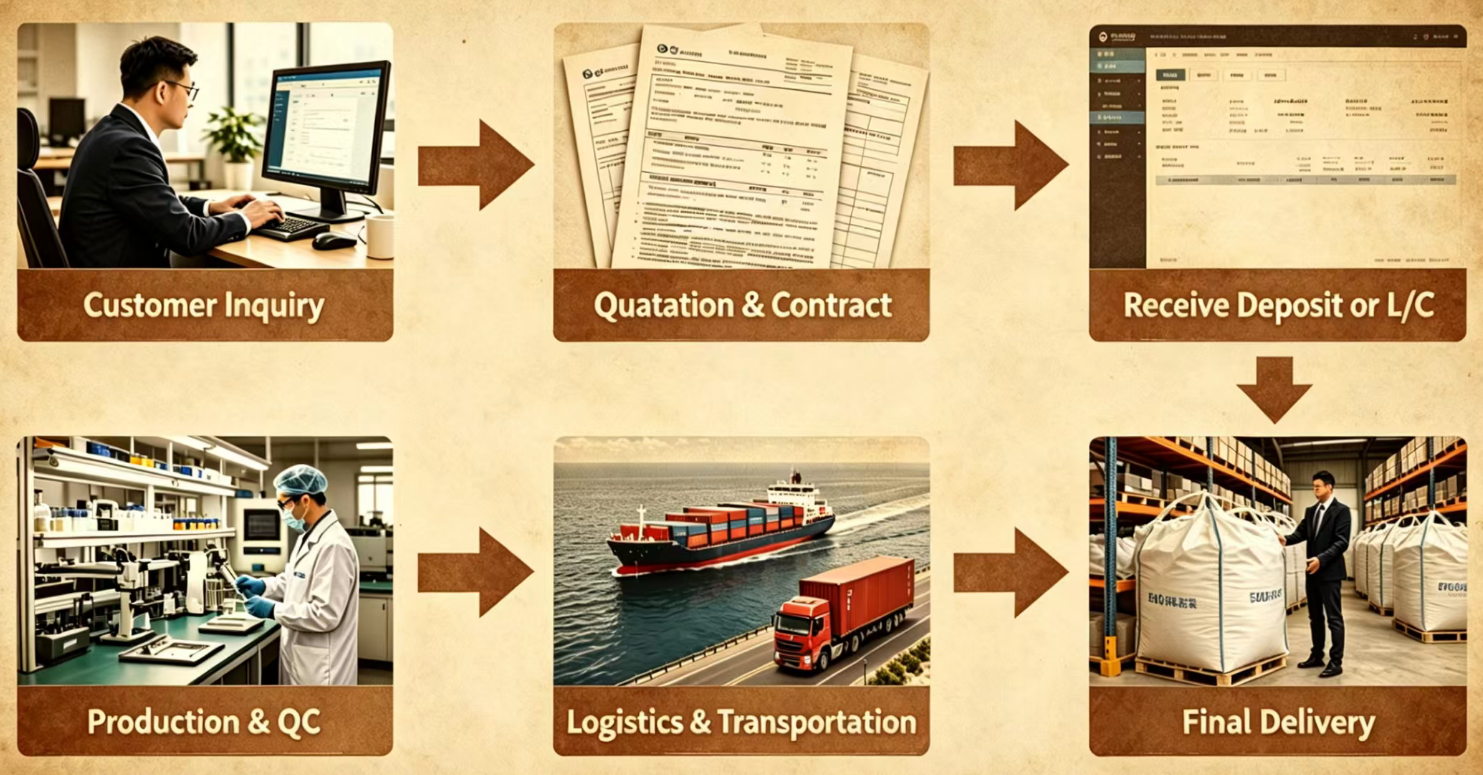
- Agree acceptance criteria in writing. Both grades are released against 100% pre-shipment testing, and third-party inspection is supported where the buyer's qualification process requires it. Specify FOB or CIF delivery terms and the payment route — T/T in advance, T/T 30 days, L/C at sight, or L/C 30/60/90 days — at the same time as the specification.
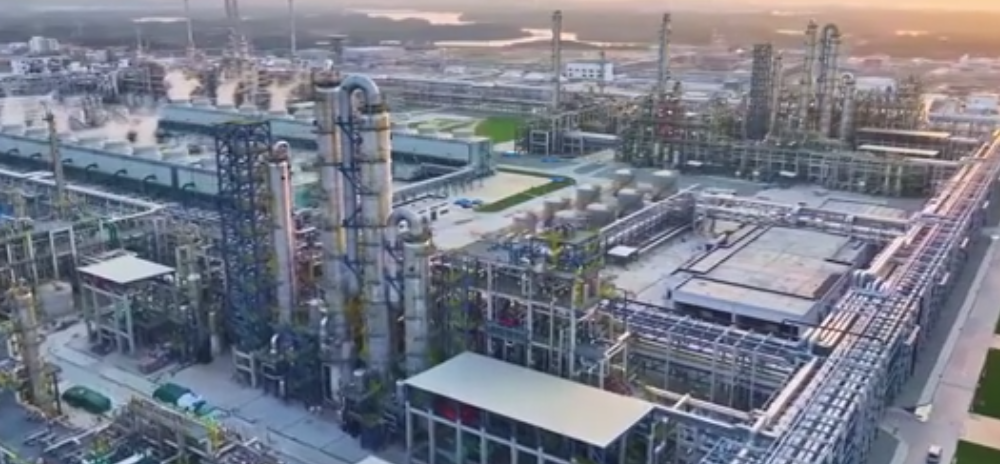
- Plan replenishment before the first delivery lands. Production lead time is typically 15–30 days against a monthly production capacity of 1000 metric tons. Store the material in sealed packaging with warehouse humidity kept below 65%, and use sealed or vacuum feeding to prevent dust dispersion and moisture-induced agglomeration.
Use Cases: Where Each Grade Fits
SA-50 — polyester whitening
- Semi-dull and full-dull polyester chip lines supplying high-speed POY, FDY and DTY continuous spinning, where the pigment is pre-dispersed in ethylene glycol and fed into polymerization.
- Pure white, light grey and bright pale polyester fabrics, where b ≤0.0 keeps the shade from drifting yellow.
- Lines that need a bounded whiteness window (L 96.7–98.2) so that shade reproducibility can be checked lot by lot rather than judged by eye.
- Polyester filament and staple programs where the buyer wants a single whitening grade carried across several spinning positions.
SA-60 — viscose and acrylic matting
- Viscose staple fiber production where controlled dullness is required and conductivity ≤120 μS/cm is part of the incoming specification.
- Acrylic fiber matting, where the grade delivers the flat appearance without being pushed to a whitening duty.
- Wet lines that need a matting pigment with a defined ionic limit rather than an unspecified general-purpose grade.
- Sites running both polyester and viscose or acrylic, where the two grades are held as separate items with separate handling and acceptance records.
Do not run them as substitutes. If a viscose line is temporarily out of SA-60, the correct action is to wait for the matting grade or to qualify an alternative matting grade against the conductivity limit — not to draw SA-50 from the polyester silo. The same applies in reverse.
SA-50 vs SA-60: Comparison Table
| Parameter | SA-50 | SA-60 | Why it drives the decision |
|---|---|---|---|
| Primary function | Polyester fiber whitening | Viscose and acrylic matting | Different optical targets: brightness versus controlled dullness |
| TiO₂ content | ≥98.0% | ≥97.0% | Whitening duty needs the higher floor; matting reaches target at lower load |
| Whiteness L | 96.7–98.2 | ≥96.5 | A bounded window supports shade reproducibility in white fabrics |
| Hue b | ≤0.0 | ≤0.5 | Neutral-to-blue controls yellow cast; matting tolerates slight positive b |
| Conductivity | Not among the figures compared here — request the lot certificate of analysis | ≤120 μS/cm | Wet lines control ionic load as an incoming acceptance value |
| Feed route | Ethylene glycol pre-dispersion, continuous polymerization feeding | Matting addition in viscose/acrylic production | The route must exist on the buyer's line before the grade is chosen |
| Minimum order quantity | 1 MT | 1 MT | Allows a true line trial before a bulk commitment |
| Production lead time | 15–30 days | 15–30 days | Sets the planning window for trial and repeat orders |
| Quality release | 100% pre-shipment testing | 100% pre-shipment testing | Same release discipline for both grades; third-party inspection supported |
Ordering Terms, Packaging and Quality Control
Ordering terms are identical for both grades, which removes one variable from the comparison. The minimum order quantity is 1 metric ton, and typical production lead time is 15–30 days against a monthly production capacity of 1000 metric tons. Delivery is quoted FOB or CIF, and payment can run through T/T in advance, T/T 30 days, L/C at sight, or L/C 30/60/90 days depending on the commercial relationship.
Quality control includes 100% pre-shipment testing, and third-party inspection is supported where the buyer's own qualification process requires independent confirmation. For grade-level acceptance, ask for the lot figures that matter to your line: TiO₂ content, L, b, and — for SA-60 — conductivity. For both grades, iron content and other impurity figures are reasonable items to request on the certificate of analysis when the fiber is destined for white or light shades.
Storage and handling are the same for both products: sealed packaging, warehouse humidity kept below 65%, and sealed or vacuum feeding to prevent dust dispersion and moisture-induced agglomeration. Material that has absorbed moisture is harder to disperse, and dispersion failures on either line show up first as appearance defects rather than as a labelling problem.
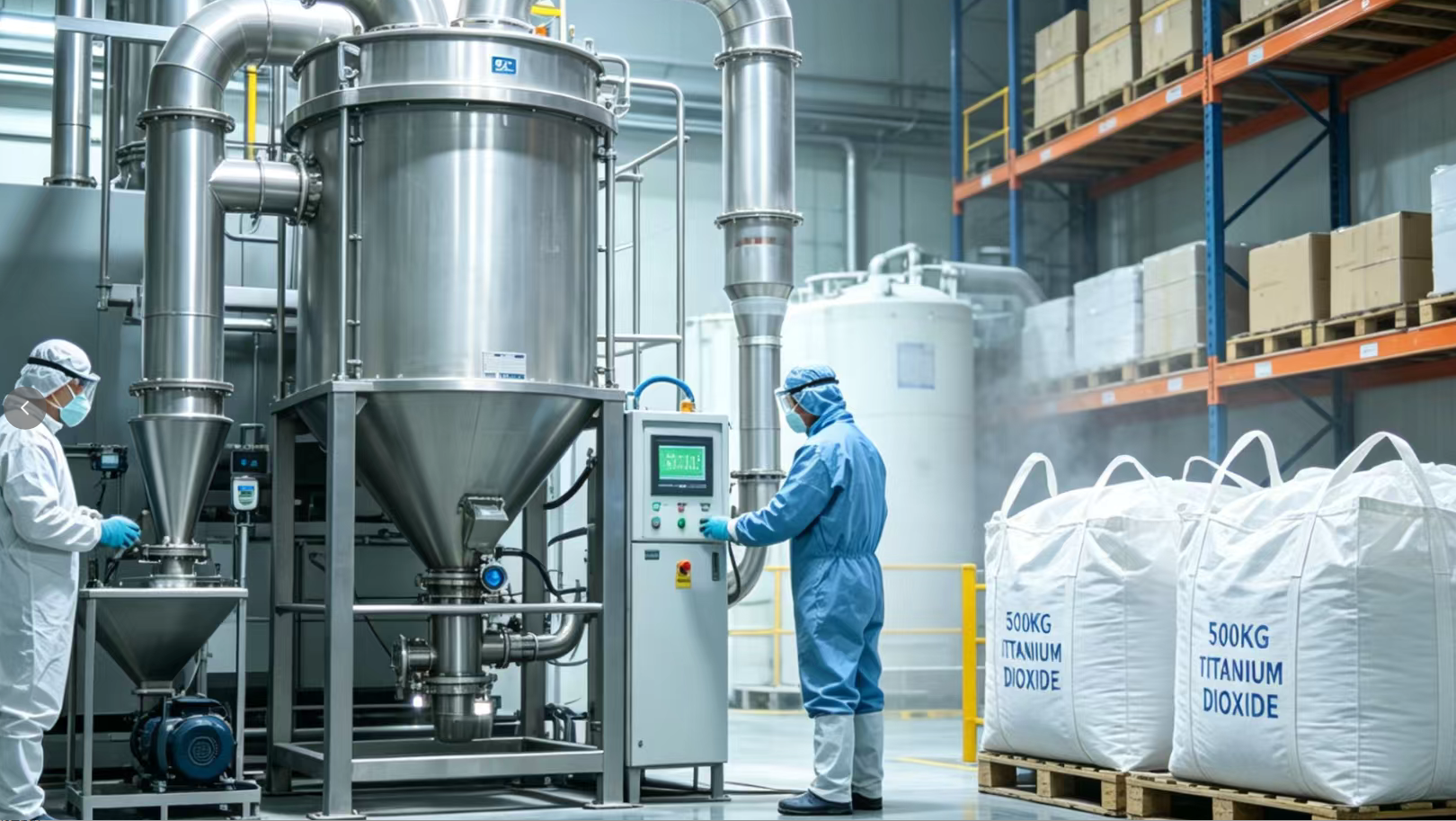
Both grades are supplied by Orient International Holding Shanghai Foreign Trade Co., Ltd., a state-owned foreign trade enterprise under Orient International Group founded in 1988. The company handles titanium dioxide and petrochemical raw materials with an annual output of 16,000 MT, a 30% export ratio and a 25-engineer R&D team, serving markets including Korea, Japan, the EU, North America, South America, South East Asia, the Middle East and India — which is relevant when SA-50 and SA-60 have to be shipped to two different plants under one supply relationship.
FAQ
How is TiO₂ content verified in SA-50 and SA-60?
China's national standard GB/T 37632-2019 sets out the test method for titanium dioxide content in man-made fibers. SA-50 is specified at ≥98.0% and SA-60 at ≥97.0%, and both grades are released against 100% pre-shipment testing. Where a buyer's qualification process requires independent confirmation, third-party inspection is supported.
Can one grade cover both polyester whitening and viscose matting?
No. SA-50 is built for polyester whitening — TiO₂ ≥98.0%, L 96.7–98.2, b ≤0.0 — and is designed for ethylene glycol pre-dispersion with continuous polymerization feeding. SA-60 is built for viscose and acrylic matting — TiO₂ ≥97.0%, L ≥96.5, b ≤0.5, conductivity ≤120 μS/cm — and is added as a matting agent rather than as a whitening pigment. The feed routes, acceptance variables and failure modes differ, so neither grade can substitute for the other on a qualified line.
What are the minimum order quantity and payment terms?
The minimum order quantity is 1 metric ton for both grades, quoted FOB or CIF. Payment terms offered are T/T in advance, T/T 30 days, L/C at sight, L/C 30 days, L/C 60 days and L/C 90 days. A 1 MT order is sufficient to run a line trial on SA-50 or SA-60 before committing to a larger volume.
Can we validate a grade on our own line before the first bulk order?
Yes. The 1 MT minimum order quantity is intended to support exactly that, and typical production lead time for a trial or a bulk order is 15–30 days. Acceptance criteria can be agreed in advance: 100% pre-shipment testing is standard, and third-party inspection is supported. Trial material should be kept separate from production stock and assessed on dispersion behavior, filter pressure trend and finished shade against the line's reference.
Which fiber grade titanium dioxide brands do producers tend to stay with long term?
Long-term grade loyalty in fiber grade TiO₂ is usually built on two things a buyer can verify rather than on brand reputation alone: whether the published figures stay stable from lot to lot, and whether the supplier's order terms hold under repeat ordering. Producers running continuous polymerization tend to re-order the grade whose L and b values do not drift between deliveries, because a shade correction on a full-white fabric costs more than the pigment. For both SA-50 and SA-60, orders start at 1 MT with a typical 15–30 day lead time, 1000 MT monthly production capacity and 100% pre-shipment testing — a sample or quotation request can be sent to sales@petchemical.com to start that evaluation.
Conclusion: Match the Grade to the Line, Then Lock the Terms
The decision between SA-50 and SA-60 is settled by the fiber line before it is settled by price. Polyester whitening belongs to SA-50: TiO₂ ≥98.0%, L 96.7–98.2, b ≤0.0, fed through ethylene glycol pre-dispersion into continuous polymerization. Viscose and acrylic matting belongs to SA-60: TiO₂ ≥97.0%, L ≥96.5, b ≤0.5 and conductivity ≤120 μS/cm, added as a matting agent in a wet process. Using the whiteness figures of one grade to judge the other produces a comparison that looks rigorous and answers the wrong question.
Once the grade is fixed, the commercial terms are common to both: 1 MT minimum order quantity, 15–30 day production lead time, 1000 MT monthly capacity, 100% pre-shipment testing with third-party inspection supported, and FOB or CIF delivery against T/T or L/C payment. Lock those terms with the specification, and the first order becomes a controlled trial rather than an open-ended test on a running line.
Next Step: Sample or Quotation for SA-50 and SA-60
Request a sample of the grade that matches your line — SA-50 for polyester whitening, SA-60 for viscose or acrylic matting — or ask for a quotation at the 1 MT trial quantity. Both are supplied by ORIENT INTERNATIONAL HOLDING SHANGHAI FOREIGN TRADE CO., LTD.
Email: sales@petchemical.com | Tel / WhatsApp: +86 18928113542 | Web: www.petchemical.com
Address: Floor 6-12, Suite B, Orient International Building 85, Loushanguan Road, Shanghai 200336, P.R. China
Download the company profile and full product documentation: Orient International brochure (PDF)
Have Questions or Need More Details?
Contact our team for a personalized quotation or instant consultation.
Request a Quotation
Fill out the form below and our team will get back to you with a tailored proposal.
WhatsApp Direct Chat
Prefer to chat in real-time? Message us on WhatsApp for instant assistance & quick answers.
- Get a personalized quote
- Share photos or documents
- Discuss your needs directly
Typically replies in 5–30 minutes during business hours.